A thin convex lens of focal length 25cm is cut into two pieces 0.5cm above the principal axis. The top part is placed at (0, 0) and an object placed at (-50cm, 0). Find the coordinates of the image.
Download our app for free and get started
Key concept: If a symmetric lens is cut parallel to principal axis in two parts. Focal length remains the same for each part. Intensity of image formed by each part will be less compared as that of complete lens. If there was no cut, then the object would have been at a height of 0.5cm from the principal axis OO'. 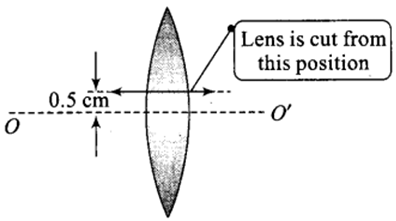 The top part is placed at (0, 0) and an object placed at (-50cm, 0). There is no effect on the lenght of the lens.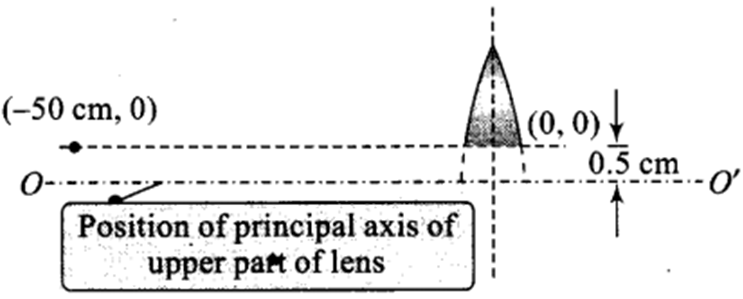
Applying lens formula, $\frac{1}{\text{v}}-\frac{1}{\text{u}}=\frac{1}{\text{f}}$ $\frac{1}{\text{v}}=\frac{1}{\text{u}}+\frac{1}{\text{f}}=\frac{1}{-50}+\frac{1}{25}=\frac{1}{50}\Rightarrow\ \text{v}=50\text{cm}$ Magnification is $\text{m}=\frac{\text{v}}{\text{u}}=-\frac{50}{50}=-1$ Hence the image would have been formed at 50cm from the pole and 0.5cm below the principal axis. Hence, with respect to the X-axis passing through the edge of the cut lens, the coordinates of the image are (50cm, -1cm).
The top part is placed at (0, 0) and an object placed at (-50cm, 0). There is no effect on the lenght of the lens.Applying lens formula, $\frac{1}{\text{v}}-\frac{1}{\text{u}}=\frac{1}{\text{f}}$ $\frac{1}{\text{v}}=\frac{1}{\text{u}}+\frac{1}{\text{f}}=\frac{1}{-50}+\frac{1}{25}=\frac{1}{50}\Rightarrow\ \text{v}=50\text{cm}$ Magnification is $\text{m}=\frac{\text{v}}{\text{u}}=-\frac{50}{50}=-1$ Hence the image would have been formed at 50cm from the pole and 0.5cm below the principal axis. Hence, with respect to the X-axis passing through the edge of the cut lens, the coordinates of the image are (50cm, -1cm).

Download our appand get started for free
Experience the future of education. Simply download our apps or reach out to us for more information. Let's shape the future of learning together!No signup needed.*
Similar Questions
- 1View SolutionA lady uses +1.5D glasses to have normal vision from 25cm onwards. She uses a 20D lens as a simple microscope to see an object. Find the maximum magnifying power if she uses then microscope
- Together with her glass
- Without the glass. Do the answers suggest that an object can be more clearly seen through a microscope without using the correcting glasses?
- 2View SolutionA pin of length 2.0cm lies along the principal axis of a converging lens, the centre being at a distance of 11cm from the lens. The focal length of the lens is 6cm. Find the size of the image.
- 3With the help of a ray diagram, show the formation of image of a point object due to refraction of light at a spherical surface separating two media of refractive indices $n_1$ and $n_2 (n_2 > n_1)$ respectively. Using this diagram, derive the relation.View Solution
$\frac{\text{n}_2}{\text{v}}-\frac{\text{n}_1}{\text{u}}=\frac{\text{n}_1-\text{n}_2}{\text{R}}$
Write the sign conventions used. What happens to the focal length of convex lens when it is immersed in water? - 4View Solution
- Draw a ray diagram to show image formation when the concave mirror produces a real, inverted and magnified image of the object.
- Obtain the mirror formula and write the expression for the linear magnification.
- Explain two advantages of a reflecting telescope over a refracting telescope.
- 5View Solution
- Draw a labelled ray diagram to obtain the real image formed by an astronomical telescope in normal adjustment position. Defineits magnifying power.
- You are given three lenses of power 0.5 D, 4 D and 10 D to design a telescope.
- Which lenses should he used as objective and eyepiece? Justify your answer.
- Why is the aperture of the objective preferred to be large?
- 6A biconvex thick lens is constructed with glass $(\mu=1.50)$ Each of the surfaces has a radius of 10cm and the thickness at the middle is 5cm. Locate the image of an object placed far away from the lens.View Solution
- 7View Solution
- Draw a labelled ray diagram to show the formation of image in an astronomical telescope for a distant object.
- Write three distinct advantages of a reflecting type telescope over a refracting type telescope.
- A convex lens of focal length 10 cm is placed coaxially 5 cm away from a concave lens of focal length 10 cm. If an object is placed 30 cm in front of the convex lens, find the position of the final image formed by the combined system.
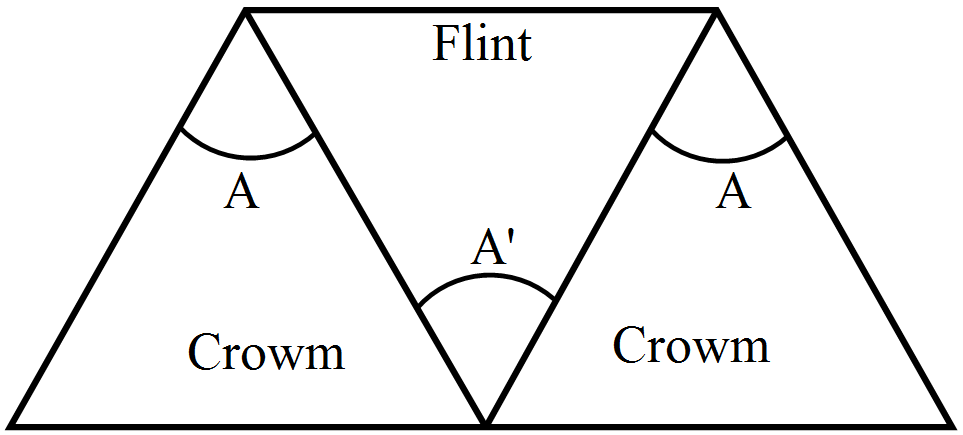
- 8Three thin prisms are combined as shown in figure. The refractive indices of the crown glass for red, yellow and violet rays are $\mu_\text{r},\mu_\text{y}$ and $\mu_\text{v}$ respectively and those for the flint glass are $\mu'_\text{r},\mu'_\text{y}$ and $\mu'_\text{v}$ respectively. Find the ratio $\frac{\text{A}'}{\text{A}}$ for which.View Solution
- There is no net angular dispersion.
- There is no net deviation in the yellow ray.
- 9View Solution
- Derive the mathematical relation between refractive indices $n_1$ and $n_2 $ of two radii and radius of curvature R for refraction at a convex spherical surface. Consider the object to be a point since lying on the principle axis in rarer medium of refractive index $n_1$ and a real image formed in the denser medium of refractive index $n_{2}$.Hence, derive lens maker's formula.
- Light from a point source in air falls on a convex spherical glass surface of refractive index 1.5 and radius of curvature 20 cm. The distance of light source from the glass surface is 100 cm. At what position is the image formed?
- 10Trace the rays of light showing the formation of an image due to a point object placed on the axis of a spherical surface separating the two media of refractive indices $n_1$ and $n_2$. Establish the relation between the distances of the object, the image and the radius of curvature from the central point of the spherical surface. Hence derive the expression of the lens maker’s formula.View Solution