Three thin prisms are combined as shown in figure. The refractive indices of the crown glass for red, yellow and violet rays are $\mu_\text{r},\mu_\text{y}$ and $\mu_\text{v}$ respectively and those for the flint glass are $\mu'_\text{r},\mu'_\text{y}$ and $\mu'_\text{v}$ respectively. Find the ratio $\frac{\text{A}'}{\text{A}}$ for which.
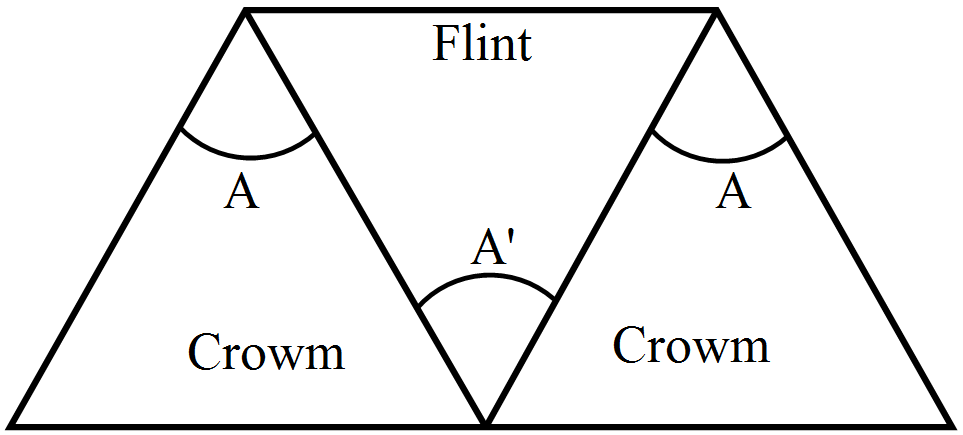
- There is no net angular dispersion.
- There is no net deviation in the yellow ray.
Download our app for free and get started
Total deviation for yellow ray produced by the prism combination is,
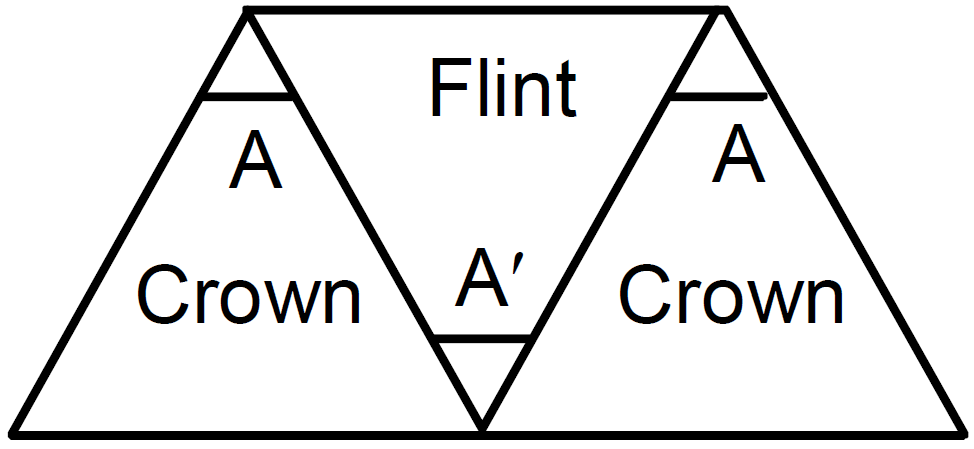
$\delta_\text{y}=\delta_\text{cy}-\delta_\text{fy}+\delta_\text{cy}=2\delta_\text{cy}-\delta_\text{fy}$ $=2(\mu_\text{cy}-1)\text{A}-(\mu_\text{cy}-1)\text{A}'$
Similarly the angular dispersion produced by the combination is
$\delta_\text{v}-\delta_\text{r}=\big[(\mu_\text{vc}-1)\text{A}-(\mu_\text{vf}-1)\text{A}'+(\mu_\text{vc}-1)\text{A}\big]\\\big[(\mu_\text{rc}-1)\text{A}-(\mu_\text{rf}-1)\text{A}'+(\mu_\text{r}-1)\text{A})\big]$
$=2(\mu_\text{vc}-1)\text{A}-(\mu_\text{vf}-1)\text{A}'$
$\Rightarrow2(\mu_\text{vc}-1)\text{A}=(\mu_\text{vf}-1)\text{A}'$
$\Rightarrow\frac{\text{A}'}{\text{A}}=\frac{2(\mu_\text{cv}-\mu_\text{rc})}{(\mu_\text{vf}-\mu_\text{rf}}$
$=\frac{2(\mu_\text{v}-\mu_\text{r})}{(\mu'_\text{v}-\mu'_\text{r})}$
$\Rightarrow2(\mu_\text{cy}-1)\text{A}=(\mu_\text{fy}-1)\text{A}'$
$\Rightarrow\frac{\text{A}'}{\text{A}}=\frac{2(\mu_\text{cy}-1)}{(\mu_\text{fy}-1)}$
$=\frac{2(\mu_\text{y}-1)}{(\mu'_\text{y}-1)}$
$\delta_\text{y}=\delta_\text{cy}-\delta_\text{fy}+\delta_\text{cy}=2\delta_\text{cy}-\delta_\text{fy}$ $=2(\mu_\text{cy}-1)\text{A}-(\mu_\text{cy}-1)\text{A}'$
Similarly the angular dispersion produced by the combination is
$\delta_\text{v}-\delta_\text{r}=\big[(\mu_\text{vc}-1)\text{A}-(\mu_\text{vf}-1)\text{A}'+(\mu_\text{vc}-1)\text{A}\big]\\\big[(\mu_\text{rc}-1)\text{A}-(\mu_\text{rf}-1)\text{A}'+(\mu_\text{r}-1)\text{A})\big]$
$=2(\mu_\text{vc}-1)\text{A}-(\mu_\text{vf}-1)\text{A}'$
- For net angular dispersion to be zero,
$\Rightarrow2(\mu_\text{vc}-1)\text{A}=(\mu_\text{vf}-1)\text{A}'$
$\Rightarrow\frac{\text{A}'}{\text{A}}=\frac{2(\mu_\text{cv}-\mu_\text{rc})}{(\mu_\text{vf}-\mu_\text{rf}}$
$=\frac{2(\mu_\text{v}-\mu_\text{r})}{(\mu'_\text{v}-\mu'_\text{r})}$
- For net deviation in the yellow ray to be zero,
$\Rightarrow2(\mu_\text{cy}-1)\text{A}=(\mu_\text{fy}-1)\text{A}'$
$\Rightarrow\frac{\text{A}'}{\text{A}}=\frac{2(\mu_\text{cy}-1)}{(\mu_\text{fy}-1)}$
$=\frac{2(\mu_\text{y}-1)}{(\mu'_\text{y}-1)}$

Download our appand get started for free
Experience the future of education. Simply download our apps or reach out to us for more information. Let's shape the future of learning together!No signup needed.*
Similar Questions
- 1View SolutionAt what angle should a ray of light be incident on the face of a prism of refracting angle 60° so that it just suffers total internal reflection at the other face? The refractive index of the material of the prism is 1.524.
- 2A point object 'O' is kept in a medium of refractive index $n_1$ in front of a convex spherical surface of radius of curvature R which separates the second medium of refractive index $n_2$ from the first one, as shown in the figure. Draw the ray diagram showing the image formation and deduce the relationship between the object distance and the image distance in terms of $n_1, n_2$ and R.View Solution
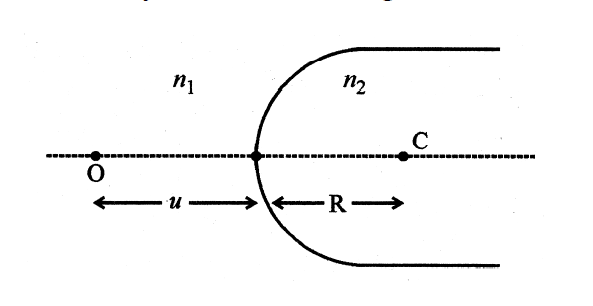
- hen the image formed above acts as a virtual object for concave spherical, surface separating the medium $n_2$ from $n_1 (n_2> n_1),$ draw this ray diagram and write the similar (similar to (a) relation. Hence obtain the expression for the lens maker's formula.
- 3View SolutionHow is the working of a telescope different from that of a microscope?
The focal lengths of the objective and eyepiece of a microscope are 1.25 cm and 5 cm respectively. Find the position of the object relative to the objective in order to obtain an angular magnification of 30 in normal adjustment. - 4View Solution
- Draw a ray diagram to show refraction of a ray of monochromatic light passing through a glass prism.
- Explain briefly how the phenomenon of total internal reflection is used in fibre optics.
- 5View SolutionLenses are constructed by a material of refractive index 1.50. The magnitude of the radii of curvature are 20cm and 30cm. Find the focal lengths of the possible lenses with the above specifications.
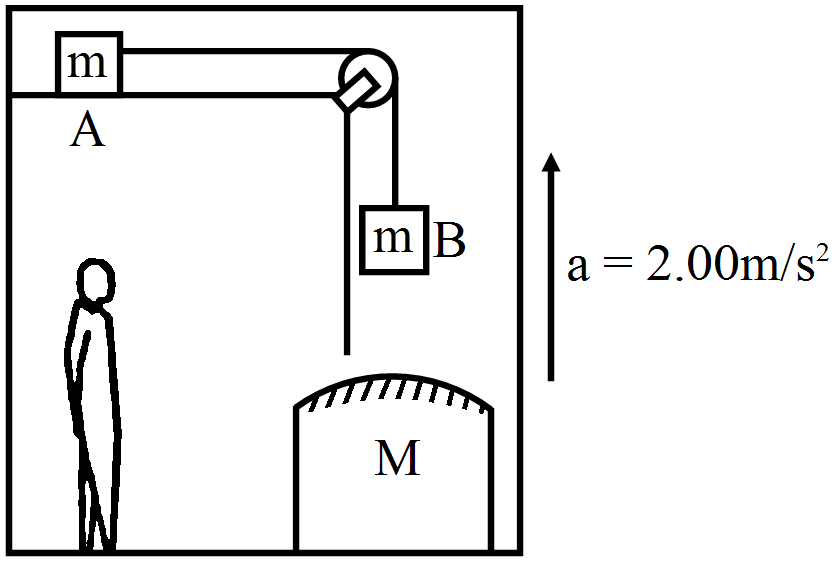
- 6Consider the situation shown in figure. The elevator is going up with an acceleration of $2.00m/s^2$ and the focal length of the mirror is 12.0cm. All the surfaces are smooth and the pulley is light. The mass-pulley system is released from rest (with respect to the elevator) at t = 0 when the distance of B from the mirror is 42.0cm. Find the distance between the image of the block B and the mirror at $t = 0.200s$. Take $g = 10m/s^2$.View Solution
- 7Trace the rays of light showing the formation of an image due to a point object placed on the axis of a spherical surface separating the two media of refractive indices $n_1$ and $n_2$. Establish the relation between the distances of the object, the image and the radius of curvature from the central point of the spherical surface. Hence derive the expression of the lens maker’s formula.View Solution
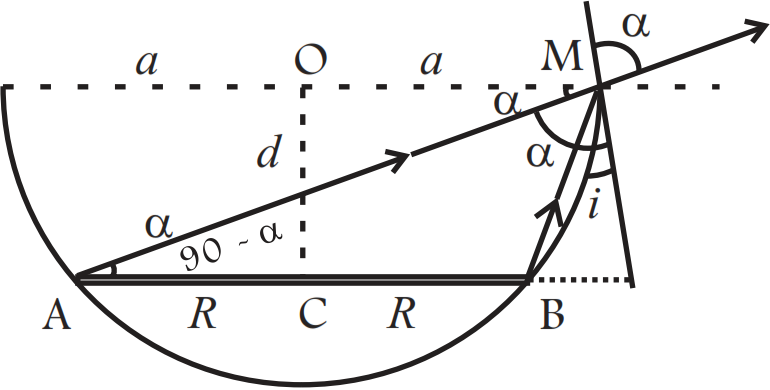
- 8View SolutionA circular disc of radius 'R' is placed co-axially and horizontally inside an opaque hemispherical bowl of radius 'a' (Fig). The far edge of the disc is just visible when viewed from the edge of the bowl. The bowl is filled with transparent liquid of refractive index μ and the near edge of the disc becomes just visible. How far below the top of the bowl is the disc placed?
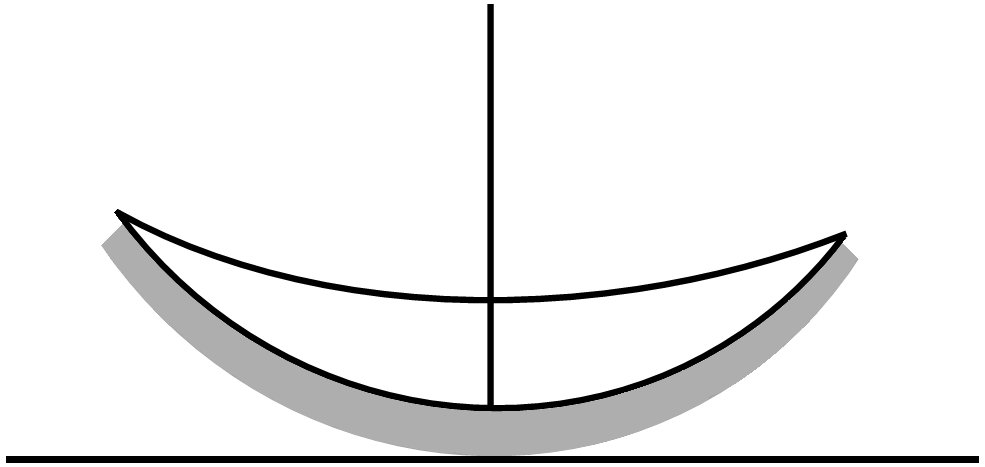
- 9The convex surface of a thin concavo-convex lens of glass of refractive index 1.5 has a radius of curvature 20cm. The concave surface has a radius of curvature 60cm. The convex side is silvered and placed on a horizontal surface as shown in figure.View Solution
- Where should a pin be placed on the axis so that its image is formed at the same place?
- If the concave part is filled with water $\Big(\mu=\frac{4}{3}\Big),$ find the distance through which the pin should be moved so that the image of the pin again coincides with the pin.
- 10View Solution
- Draw the ray diagram of an astronomical telescope when the final image is formed at infinity. Write the expression for the resolving power of the telescope.
- An astronomical telescope has an objective lens of focal length 20m and eyepiece of focal length 1cm.
- Find the angular magnification of the telescope.
- If this telescope is used to view the Moon, find the diameter of the image formed by the objective lens. Given the diameter of the Moon is $3.5 \times 10^6m$ and radius of lunar orbit is $3.8 \times 10^8m.$