Select the correct statement
[RPMT 2003]


Download our appand get started for free
Experience the future of education. Simply download our apps or reach out to us for more information. Let's shape the future of learning together!No signup needed.*
Similar Questions
- 1A common emitter amplifier is designed with NPN transistor $(\alpha= 0.99 ).$ The input impedance is $1 K \Omega$ and load is $10 k \Omega$. The voltage gain will beView Solution
- 2View SolutionA semiconductor device is connected in a series circuit with a battery and a resistance. A current is found to pass through the circuit. If the polarity of the battery is reversed, the current drops almost to zero. The device may be
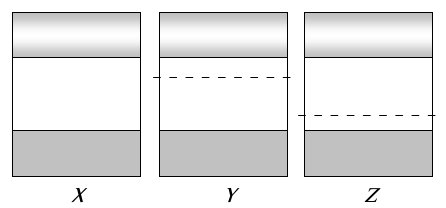
- 3Two $P N$-junctions can be connected in series by three different methods as shown in the figure. If the potential difference in the junctions is the same, then the correct connections will beView Solution
- 4Which impurity is doped in $S i$ to form $N$-type semi-conductor?View Solution
- 5A diode having potential difference $0.5 V$ across its junction which does not depend on current, is connected in series with resistance of $20 \Omega$ across source. If $0.1 A$ passes through resistance then what is the voltage of the sourceView Solution
- 6In a transistor configuration $\beta$-parameter isView Solution
- 7A $P N$-junction has a thickness of the order ofView Solution
- 8For a transistor, the current amplification factor is $0.8.$ The transistor is connected in common emitter configuration. The change in the collector current when the base current changes by 6 $m A$ isView Solution
- 9In an amplifier the load resistance $R_L$ is equal to the plate resistance $\left(r_p\right)$. The voltage amplification is equal toView Solution
- 10View SolutionWhich of the energy band diagrams shown in the figure corresponds to that of a semiconductor