Question
A1. Simple Factual Activity:
Complete the following sentences using information in the passage:
(1) The young seagull commended _______________.
(2) He completely forgot that _______________.

    Then he completely forgot that he had not always been able to fly, and commended himself to dive and soar and curve, shrieking shrilly.
    He was near the sea now, flying straight over it, facing straight out over the ocean. He saw a vast green sea beneath him, with little ridges moving over it and he turned his beak sideways and cawed amusedly.
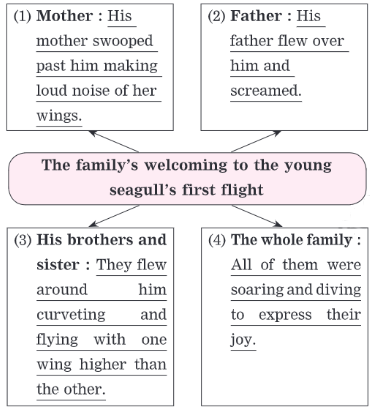
    His parents and his brothers and sister had landed on this green flooring ahead of him. They were beckoning to him, calling shrilly. He dropped his legs to stand on the green sea. His legs sank into it. He screamed with fright and attempted to rise again flapping his wings. But he was tired and weak with hunger and he could not rise, exhausted by the strange exercise. His feet sank into the green sea, and then his belly touched it and he sank no farther. He was floating on it, and around him his family was screaming, praising him and their beaks were offering him scraps of dog-fish. He had made his first flight.

A2. Complex Factual Activity:
Complete the web :
Image
A3. Activities based on Vocabulary:

(commended, attempted, exhausted, soared)
(1) The rocket _______________ up into space.
(2) Our achievements in Science Exhibition was highly _______________ by our Principal.
(3) He was totally _______________ after the day's tedious work.
(4) The thief _______________ to give the slip, but was caught by the police.
A4. Activities based on Contextual Grammar:
Do as directed:
(1) He was near the sea now. (Frame a Wh-question to get the underlined as an answer.)
(2) He could not rise. (Add a question tag.)
A5. Personal Response:
(1) How does your family help you to achieve your goal?
Answer

A1. Simple Factual Activity:
(1) The young seagull commended himself to dive and soar and curve.
(2) He completely forgot that he had not always been able to fly.
A2. Complex Factual Activity:
Image
A3. Activities based on Vocabulary:
(1) The rocket soared up into space.
(2) Our achievements in Science Exhibition was highly commended by our Principal.
(3) He was totally exhausted after the day's tedious work.
(4) The thief attempted to give the slip, but was caught by the police.
A4. Activities based on Contextual Grammar:
(1) Where was he now?
(2) He could not rise, could he?
A5. Personal Response:
(1) My family is always there to help me in my work. Each one of them, especially my parents, help me in deciding my goal. If I neglect any day, they remind me of my goal all the while. They all are ready to guide me, in their own way, to achieve whatever I desire. They always encourage, admire and praise me even for my smallest achievement.

Need a full question paper?

Generate a complete, print-ready paper with questions like this in minutes — across 16+ boards, with answer keys.

Start Generating Free

Similar questions

A1. Simple Factual Activity:
Say whether the following statements are True or False:
(1) When the young seagull. pretended to be falling asleep, his parents took notice of him.
(2) Flying across the young seagull, the mother dropped into his beak a piece of fish.
(3) The young seagull was fed a piece of fish by his mother.
(4) The young seagull's father was preening the feathers on his white back.

     The sun was now ascending the sky, blazing on his ledge that faced the south. He felt the heat because he had not eaten since the previous nightfall.
     He stepped slowly out to the brink of the ledge, and standing on one leg with the other leg hidden under his wing, he closed one eye, then the other, and pretended to be falling asleep. Still they took no notice of him. He saw his two brothers and his sister
lying on the plateau dozing with their heads sunk into their necks. His father was preening the feathers on his white back. Only his mother was looking at him. She was standing on a little high hump on the plateau, her white breast thrust forward. Now and
again, she tore at a piece of fish that lay at her feet and then scrapped each side of her beak on the rock. The sight of the food maddened him. How he loved to tear food that way, scrapping his beak now and again to whet it.
     “Ga, ga, ga”, he cried begging her to bring him some food. “Gaw-col-ah”, she screamed back derisively. But he kept calling plaintively, and after a minute or so he uttered a joyful scream. His mother had picked up a piece of the fish and was flying across to him with it. He leaned out eagerly, tapping the rock with his feet, trying to get nearer to her as she flew across. But when she was just opposite to him, she halted, her wings motionless, the piece of fish in her beak almost within reach of his beak. He waited a moment in surprise, wondering why she did not come nearer, and then, maddened by hunger, he dived at the fish. With a loud scream he fell outwards
and downwards into space. Then a monstrous terror seized him and his heart stood still. He could hear nothing. But it only lasted a minute. The next moment he felt his wings spread outwards. The wind rushed against his breast feathers, then under his stomach, and against his wings. He could feel the tips of his wings cutting through the air. He was not falling headlong now. He was soaring gradually downwards and outwards. He was no longer afraid. He just felt a bit dizzy.

A2. Complex Factual Activity:

(1) What were the young seagull's parents doing? 
A3. Activities based on Vocabulary:
Match the words in Column 'A' with their meanings in Column 'B':

'A''B'
(1) ascending  (a) grabbed
(2) maddened (b) flying upward into the air
(3) soaring (c) made one very angry
(4) seized (d) rising up

A4. Activities based on Contextual Grammar:
Read the following sentences carefully, underline the verbs and find out the tenses in the sentences: 
(1) The sun was ascending now.
(2) Still they took no notice of him.
A5. Personal Response:
Complete the following statements:
(1) The seagull is afraid to fly because _______________ .
(2) Young birds are afraid to make their first flight because_______________.

A1. Simple Factual Activities:
Make a list of the problems that we are facing and creating violence against children -

     I call upon all the governments, intergovernmental agencies, businesses, faith leaders, workers, teachers and NGOs, and each one of us, to put an end to all forms of violence against children. Slavery, trafficking, child marriages, child labour, sexual abuse, and illiteracy these things have no place in any civilised society.
     Friends, we can do this. Governments must make child - friendly policies, and invest in education and young people. Businesses must be more responsible, accountable and open to innovative partnerships.Intergovernmental agencies must work together to accelerate action. Global civil society must rise above the business-as-usual and fragmented agendas. Faith leaders and institutions, and all of us must stand with our children.
     We must be bold, we must be ambitious, and we must have the will. We must keep our promises. Over fifty years ago, on the first day of my school, I met a cobbler boy, my age sitting outside the gate of my school. I asked my teachers: “Why is he working outside? Why is he not with us in the school?” My teachers had no answer. One day, I
gathered the courage to ask the boys’ father. He said: “Sir, I have never thought about it. We are born to work.”
     His answer made me angry. It still makes me angry.

A2. Complex Factual Activities:
Image
A3. Activities based on Vocabulary:

Find out the describing words used for the following noun and make your own sentences by using any combination:
(1) _______________ agencies
(2) _______________ partnership
A4. Activities based on Contextual Grammar:
Make the sentences affirmative:
(1) My teacher had no answer.
(2) I have never thought about it.
A5. Personal Response:
(1) Why should we stop 'Child labour'?
A1. Simple Factual Activities:
State who/what:
(1) Colours the entire sky.
(2) Takes new shapes with every passing moment,
(3) Makes trees dance.
(4) Changes its forın according to the dictates of the sun and the wind.

     We saw small bits of grass peeping through the small cracks in a concrete pavement. It left us thinking : however impossible things may look, there is always an opening...
     We saw a tree bare of all leaves in the cold winter months. We thought its chapter was over. But three months passed, spring set in and the tree was back to its green majesty once again, full of leaves, flowers, birds and life. What if we too had the conviction that, however difficult things are right now, it will not remain so for ever. Remember, this too shall pass.
     We saw an army of ants lugging a fly which was at least ten times the ant’s size. The ants organized themselves around the fly, lifted it on frail feelers and carried it to quite a distance. Their teamwork and perseverance were impressive. What if we too are consistent, organized, focused...Spider webs are delicate, yet very strong. A rainbow colours the entire sky. Oysters take in a grain of sand they open up with a pearl. Innumerable stars shine across the infinite sky. Clouds take new shapes with every passing moment. The wind makes trees dance with unhindered passion. Water, without hint of ego, changes its form according to the dictates of the sun and the wind. When we see a caterpillar turn into a butterfly, a flower turn into a fruit, we experience the alchemy of nature... we touch it and become gold ourselves.

A2. Complex Factual Activities:
(1) What are the alchemies of nature mentioned in the extract?
A3. Activities based on Vocabulary:
Match the pairs of antonyms:

 WordsAntonyms
 (1) impossible (a) easy
 (2) difficult (b) strong
 (3) delicate (c) forget
 (4) remember (d) possible

A4. Activities based on Contextual Grammar:
Identify the tenses:
(1) We saw an army of ants
(2) We experience the alchemy of nature
A5. Personal Response:
(1) 'Nature is our best teacher'-Explain.

A1. Simple Factual Activity:
Complete the following sentences with the information given in the passage:
(1) The man with crooked leg was _______________.
(2) Someone said that the Seth had hanged himself _______________.

    Old Ganpat the beggar, had a crooked leg. He had been squatting on the pavement for years, calling for alms. In the evening someone would come with a barrow and take him away. He had never been known to walk. But now, on learning that the bank was about to collapse, Ganpat astonished everyone, leaping to his feet and actually running at top speed in the direction of the bank. It soon became known that he had a thousand rupees in savings!
     Men stood in groups at street corners discussing the situation. Pipalnagar seldom had a crisis, seldom or never had floods, earthquakes or drought; and the imminent crash of the Pipalnagar Bank set everyone talking and speculating and rushing about in a frenzy. Some boasted of their farsightedness, congratulating themselves on having already taken out their money, or on never having put any in; others speculated on the reasons for the crash, putting it all down to excesses indulged in by Seth Govind Ram. The Seth had fled the State, said one. He had fled the country, said another. He was hiding in Pipalnagar, said a third. He had hanged himself from the tamarind tree, said a fourth, and had been found that morning by the sweeper-boy.
     By noon the small bank had gone through all; its ready cash, and the harassed manager was in a dilemma. Emergency funds could only be obtained from another bank some thirty miles distant, and he wasn’t sure he could persuade the crowd to wait
until then. And there was no way of contacting Seth Govind Ram on his houseboat in Kashmir. 

A2. Complex Factual Activity:
Complete the following sentences that tell you about Ganpat, the beggar:
(1) Ganpat was an old beggar who had a _______________.
(2) He had been _______________ for years.
A3. Activities based on Vocabulary:
Find the describing words for the following from the passage:
(1) fund (2) leg (3) manager (4) speed
A4. Activities based on Contextual Grammar:
(1) I must know the reason. You are late.
(Join the sentence with the word 'why'.)
(2) He was hiding in Pipalnagar.
(Rewrite the sentence using Simple Present Tense.)
A5. Personal Response:
(1) Have you ever heard a rumour that harmed people? Elaborate it.
A1. Simple Factual Activity:
Name the following:
(1) The place where the conference based on Human Environment was held _______________.
(2) State parties are elected by the _______________.

     Shortly thereafter in 1965, a White House Conference in the United States called for a “World Heritage Trust” to protect historic and cultural sites but to also protect the world’s significant natural and scenic sites. Finally, in 1968, the International Union for Conservation of Nature developed similar goals and presented them at the United Nations conference on Human Environment in Stockholm, Sweden in 1972. Following the presentation of these goals, the Convention concerning the Protection of World Cultural and Natural Heritage was adopted by UNESCO’s General Conference on November 16,1972.
     THE WORLD HERITAGE COMMITTEE Today, the World Heritage Committee is the main group responsible for establishing which sites will be listed as a UNESCO World Heritage Site. The Committee meets once a year and consists of representatives from 21 State Parties that are elected for six year terms by the World Heritage Center’s General Assembly. The State Parties are then responsible for identifying and nominating new sites within their territory to be considered for inclusion on the World Heritage list.
 
A2. Complex Factual Activity:
Complete the web :
Image
A3. Activities based on Vocabulary:
Write from the passage nouns for the following:
(1) present (2) protect (3) conserve (4) include
A4. Activities based on Contextual Grammar:
Rewrite the sentences using 'not only....but also' and 'as well as' in two separate sentences:
(1) The State Parties are responsible for identifying and nominating new sites.
A5. Personal Response:
(1) Why do you like to visit tourist spots ?
A1. Simple Factual Activities:
State whether you agree or disagree with the following statements:
(1) The Holy Quran says the kingdom of God belongs to the children.
(2) Jesus says not to kill your children because of poverty.
(3) Denying the dreams of our children is greater violence.
(4) The writer has never given up against any threat or attack.

    I have come here only to share the voices and dreams of our children - because they are all our children - [gesture to everyone in the audience]. I have looked into their frightened and exhausted eyes. I have held their injured bodies and felt their broken spirits.
    Twenty years ago, in the foothills of the Himalayas, I met a small, skinny child labourer. He asked me: “Is the world so poor that it cannot give me a toy and a book, instead of forcing me to take a gun or a tool?”
    I met with a Sudanese child-soldier. He was kidnapped by an extremist militia. As his first training lesson, he was forced to kill his friends and family. He asked me: “What is my fault?”
    Friends, all the great religions teach us to care for our children. Jesus said: “Let the children come to me; do not hinder them, for the kingdom of God belongs to them.” The Holy Quran says: “Kill not your children because of poverty.”
    Friends! There is no greater violence than to deny the dreams of our children. Therefore ... I refuse to accept that all the temples and mosques and churches and prayer houses have no place for the dreams of our children.
    I refuse to accept that the world is so poor, when just one week of global military expenditure can bring all the children to classrooms. I refuse to accept that all the laws and constitutions, police and judges are unable to protect our children.
    I refuse to accept that the shackles of slavery can ever be stronger than the quest for freedom. I REFUSE TO ACCEPT here.
    My only aim in life is that every child is free to be a child,
- free to grow and develop,
- free to eat, sleep, and see daylight,
- free to laugh and cry,
- free to play and learn,
- free to go to school, and above all,
- free to dream.
    I have the privilege of working with many courageous people who have the same aim. We have never given up against any threat or attack and we never will.

A2. Complex Factual Activities:

Complete the following sentences:
(1) Satyarthi refuses to accept:
A3. Activities based on Vocabulary:
Find out the describing words used for the following nouns and make sentence on any one combination:
(1) _______________ militia
(2) _______________ eyes
A4. Activities based on Contextual Grammar:
Change the voice:
(1)He was kidnapped by an extremist militia.
(Begin the sentence with "An extremist militia....)
(2) He was forced to kill his friends and family.
(Begin the sentence with "They....".)
A5. Personal Response:
What will you do in the following situations?
(1) If you see a child working in a restaurant.
(2) If you find a child working on a construction site.
A1. Simple Factual Activity:
State whether you Agree or Disagree with the following statements:
(1) No event or parts of the story are mentioned in this book review.
(2) Mischievousness was the most striking quality of 10-year-old Swami.

     A little bit about the book...
     Anything I mention about the book can be mistakenly understood as 'spoilers', so I would rather give a glance into the book without mentioning any events or plots of the story.
     Swami is a mischievous little kid of about 10 years old and living in the era where India was under the British rule... Like most kids of that age, Swami is a kid who cannot stay at one place and absolutely hates school, even worse Mathematics. School is his absolute nightmare. Anyway the story unfolds around the happenings of this kid and how he constantly gets into trouble and gets a good beating from his father.
      Swami is a talkative little kid and thinks that’s his way of facing life, talking himself out of everything. But he does learn the truth the harsh way. As many teens back then, all he wants to do is play under the sun, kick something, climb a tree, break something and harass somebody (unlike kids today!!!). This, in fact, was (and in most parts of India, still is) the life of a typical boy growing up. Technology isn’t big in a kid's life. All they want is to play havoc!!!
       In what ways is Swami a typical boy in his growing years ?
       In this regard, Narayan gets deeply into the workings of Swami’s ten year old mind, explaining exquisitely how he thinks and what his perspective of the world is. The reader does feel like Swami and gets very attached with the character as the story progresses. That's the magic of Narayan.

A2. Complex Factual Activity:
Complete the following sentences that tell you about author Narayan's magic:
(1) Narayan gets deeply into the working of  _______________.
(2) Explains in pleasing manner how _______________. 
A3. Activities based on Vocabulary:
Find the following from the passage:
(i) Noun forms of : happen, true
(ii) Verb forms of : hatred, thought
A4. Activities based on Contextual Grammar:
Find the error and rewrite the corrected sentences:
(1) Swami thinks that's his way of living life.
(2) Swami is an mischievous little kid.
A5. Personal Response:
(1) Yes, I definitely think so. It is the natural instinct of most of the kids to play, to make fun, to play mischiefs and enjoy the life like Swami. They try to avoid going to school under some pretext and dislike to learn some particular subjects. They often get beaten for their naughtiness, mistakes and their mischievous deeds. They do anything that comes to their mind, unintentionally.
A1. Simple Factual Activities:
Name the following: 
(1) The warrior mentioned in the passage -
(2) Native place of Mary Kom -
(3) Mary Kom's parents -
(4) The sportsperson who won gold medal in Asian games-

   There had to be one successful story if Indians were to survive in sports and we have that story now. Enough has been said about this great warrior who conquered the world. This warrior is none other than Mary Mangte Kom-the Komqueror and the Komrade. She is famed as a five times World Boxing Champion and the only boxer to win a medal in every one of the six world championships. In the 2012 Olympics, she became the first Indian woman boxer to qualify and win a bronze medal in the 51
kg flyweight category of Boxing.
     Kom was born in Kangthei village, Moirang Lamkhai in Churachandpur district of rural Manipur in eastern India. She came from a poor family. Her parents, Mangte Tonpa Kom and Mangte Akham Kom were tenant farmers who worked in jhum fields.
Kom grew up in humble surroundings, helping her parents with farm related chores, going to school and learning athletics initially and later boxing simultaneously. Her father was a keen wrestler in his younger age.
     She had an eager interest in athletics since childhood and the success of Dingko Singh a fellow Manipuri returned from the 1998 Bangkok Asian games with a gold medal, Kom recollects, had inspired many youngsters in Manipur to try boxing
and she too thought of giving it a try.
     Mary Kom’s career started in 2000 after her victory in the Manipur State women’s boxing championship and the regional championship in West Bengal. In 2001, she started competing at international level. She was only 18 years old when she made her international debut at the first AIBA Women’s World Boxing Championship in United States, winning a silver medal in the 48 kg weight category. Her greatness is reinforced by the way she apoligized to the whole nation for not being able to win the Gold. She is a legend for sure and an idol for all the sportswomen to look up to.

A2. Complex Factual Activities:
(1) Mary Kom's exceptional achievement is that _______________.
(2) Mary Kom's parents made their living by _______________.
A3. Activities based on Vocabulary:
Fill in the blanks by selecting words or phrases from the passage :
(1) My younger sister has so much _______________ in dancing and singing.
(2) Tanaji Malusare was a great _______________ in history.
A4. Activities based on Contextual Grammar:
Do as directed: 
(1) Mary Kom was a warrior. She was a boxer. (Use 'as well as')
(2) Her father was a keen wrestler in his younger age. (Pick out and rewrite two adjectives from the given sentence.)
A5. Personal Response:
(1) Describe your favourite sportswoman.
A1. Simple Factual Activities:
Fill in the blanks:
(1) Ramlal had ________ sons and ________ daughters.
(2) All the children except Bholi were ________ and ________.

    Her name was Sulekha but since her childhood everyone had been calling her Bholi the simpleton.
    She was the fourth daughter of Numberdar Ramlal. When she was ten months old, she had fallen off the cot on her head and perhaps it had damaged some part of her brain. That was why she remained a backward child and came to be known
as Bholi, the simpleton.
     At birth the child was very fair and pretty. But when she was two years old, she had an attack of small pox. Only the eyes were saved. But the entire body was permanently disfigured by deep black pockmarks. Little Sulekha could not speak till she was five and when at last she learnt to speak, she stammered. The other children often made fun of
her and mimicked her. As a result, she talked very little.
     Ramlal had seven children, three sons and four daughters and the youngest of them was Bholi. It was a prosperous farmer’s household and there was plenty to eat and drink. All the children except Bholi were healthy and strong. The sons had been sent to
the city to study in schools and later in colleges. Of the daughters Radha, the eldest had already been married. The second daughter Mangla’s marriage had also been settled Ramlal would think of third Champa. They were good looking, healthy girls. And
it was not difficult to find bridegrooms for them.
     But Ramlal was worried about Bholi. She had neither good looks nor intelligence.
     Bholi was seven years old when Mangla was married. The same year a primary school for girls was opened in their village. The Tehsildar sahib came to perform its opening ceremony. He said to Ramlal, ‘‘As a revenue official you are the representative of the government in the village and so you must set an example to the villagers. You
must send your daughter to school.’’
      That night when Ramlal consulted his wife. She cried, ‘‘Are you crazy? If girls go to school, who will marry them?’’
      But Ramlal had not the courage to disobey the Tehsildar. At last his wife said, ‘‘I will tell you what to do. Send Bholi to school. As it is there is little chance of her getting married, with her ugly face and lack of sense. Let the teachers at school worry about her.’’

A2. Complex Factual Activities:
Give reasons:
(1) Little Sulekha used to talk very little because - _______________
A3. Activities based on Vocabulary:
Use the following phrases in the following sentences by making certain changes:
(to shout in terror, to pass on, to hand over)
(1) My sister _______________ a letter of apology to her class teacher.
(2) My father had the day off because he didn't want _______________ his flu to everyone in the office."
A4. Activities based on Contextual Grammar:
Do as directed:
(1) The child was very fair and pretty.
(Choose correct alternative to make it exclamatory.)
(a) What a fair and pretty the child was!
(b) How a fair and pretty the child was!
(c) How fair and pretty the child was!
(2) There was plenty to eat and drink.
(Pick out the infinitive.) 
A5. Personal Response:
(1) How do you feel on the first day of your school? 
A1. Simple Factual Activities:
Make a list of the problems that we are facing and creating violence against children -

     I call upon all the governments, intergovernmental agencies, businesses, faith leaders, workers, teachers and NGOs, and each one of us, to put an end to all forms of violence against children. Slavery, trafficking, child marriages, child labour, sexual abuse, and illiteracy these things have no place in any civilised society.
     Friends, we can do this. Governments must make child - friendly policies, and invest in education and young people. Businesses must be more responsible, accountable and open to innovative partnerships.Intergovernmental agencies must work together to accelerate action. Global civil society must rise above the business-as-usual and fragmented agendas. Faith leaders and institutions, and all of us must stand with our children.
     We must be bold, we must be ambitious, and we must have the will. We must keep our promises. Over fifty years ago, on the first day of my school, I met a cobbler boy, my age sitting outside the gate of my school. I asked my teachers: “Why is he working outside? Why is he not with us in the school?” My teachers had no answer. One day, I
gathered the courage to ask the boys’ father. He said: “Sir, I have never thought about it. We are born to work.”
     His answer made me angry. It still makes me angry.

A2. Complex Factual Activities:
Complete the following sentences :
(1) Government should make _______________.
(2) _______________ and _______________ must stand with our children.
A3. Activities based on Vocabulary:
Find out the describing words used for the following noun and make your own sentences by using any combination:
(1) _______________ agencies
(2) _______________ partnership
A4. Activities based on Contextual Grammar:
Rewrite as indirect speech:
(1) I asked my teachers, "Why is he working outside? Why is he not with us in the school?"
(2) The boy's father said to the writer, "I have never thought about it. We are born to work."
A5. Personal Response:
(1) Why should the government invest in education and young people?