An electric bulb is designed to operate at 12 volts DC. If this bulb is connected to an AC source and gives normal brightness, what would be the peak voltage of the source?
Download our app for free and get started
$\text{E}=12\text{volt}$
$\text{i}^2\text{Rt}=\text{i}^2_\text{rms}\text{RT}$
$\Rightarrow\ \frac{\text{E}^2}{\text{R}^2}=\frac{\text{E}^2_\text{rms}}{\text{R}^2}$
$\Rightarrow\ \text{E}^2=\frac{\text{E}_0^2}{2}$
$\Rightarrow\ \text{E}_0{^2}=2\text{E}^2$
$\Rightarrow\ \text{E}_0{^2}=2\times12^2=2\times144$
$\Rightarrow \text{E}_0=\sqrt{2\times144}=16.97\approx17\text{V}$
$\text{i}^2\text{Rt}=\text{i}^2_\text{rms}\text{RT}$
$\Rightarrow\ \frac{\text{E}^2}{\text{R}^2}=\frac{\text{E}^2_\text{rms}}{\text{R}^2}$
$\Rightarrow\ \text{E}^2=\frac{\text{E}_0^2}{2}$
$\Rightarrow\ \text{E}_0{^2}=2\text{E}^2$
$\Rightarrow\ \text{E}_0{^2}=2\times12^2=2\times144$
$\Rightarrow \text{E}_0=\sqrt{2\times144}=16.97\approx17\text{V}$

Download our appand get started for free
Experience the future of education. Simply download our apps or reach out to us for more information. Let's shape the future of learning together!No signup needed.*
Similar Questions
- 1Two capacitors of capacitance $10\mu\text{F}$ and $20 \mu\text{F}$ are connected in series with a 6 V battery. After the capacitors are fully charged, a slab of dielectric constant (K) is inserted between the plates of the two capacitors. How will the following be affected after the slab is introduced:View Solution
- The electric field energy stored in the capacitors.
- The charges on the two capacitors.
- The potential difference between the plates of the capacitors.
- 2A resistance R and a capacitor C are connected in series to a source $\text{V}=\text{V}_0\sin\omega\text{t}.$View Solution
Find:- The peak value of the voltage across the (i) resistance and (ii) capacitor.
- The phase difference between the applied voltage and current. Which of them is ahead?
- 3View SolutionDraw a circuit diagram of a C.E. transistor amplifier. Briefly, explain its working and write the expression for (i) current gain, (ii) voltage gain of the amplifier.
- 4View Solution
- What are the three basic units in communication systems? Write briefly the function of each of these.
- Write any three applications of the internet used in communication systems.
- 5View SolutionFigure shows a light bulb (B) and iron cored inductor connected to a dc battery through a switch (S).
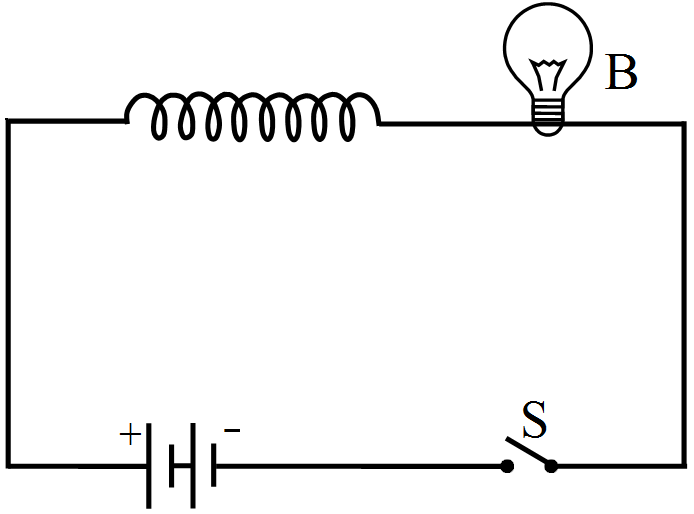
- What will one observe when switch (S) is closed?
- How will the glow of the bulb change when the battery is replaced by an ac source of rms voltage equal to the voltage of dc battery? Justify your answer in each case.
- 6Derive an expression for the electric field intensity at a point on the equatorial line of an electric dipole of dipole moment $\overrightarrow{\text{P}}$and length 2a. What is the direction of this field?View Solution
- 7View SolutionCompare and explain three distinguishing features observed in Young’s double slit interference pattern with those seen for a coherently illuminated single slit producing diffraction pattern.
- 8View SolutionState Ampere's circuital law. Use this law to find magnetic field due to straight infinite current carrying wire. How are the magnetic field lines different from the electrostatic field lines?
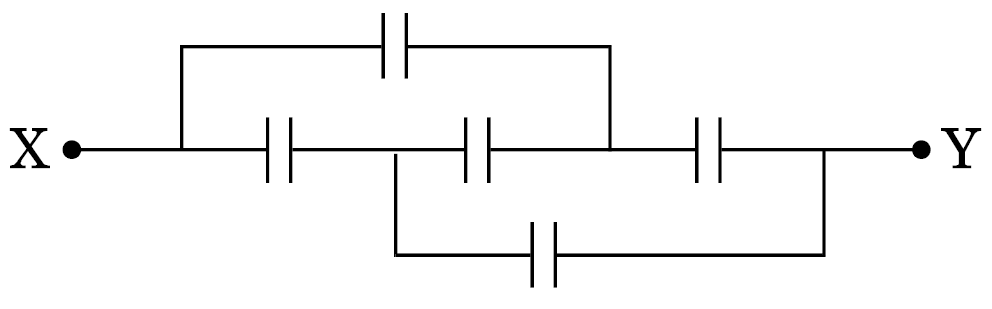
- 9Find the equivalent capacitance of the network shown in the figure, when each capacitor is of $1\mu\text{F}$. When the ends X and Y are connected to a 6 V battery, find out (i) The charge and (ii) The energy stored in the network.View Solution
- 10A series LCR circuit is connected across an a.c. source of variable angular frequency $' \omega'$. Plot a graph showing variation of current ‘i’ as a function of $' \omega'$ for two resistances $R_1$ and $R2 (R_1 > R_2).$View Solution
Answer the following questions using this graph:- In which case is the resonance sharper and why?
- In which case is the power dissipation more and why?