An electron of mass $m$ and charge $e$ is accelerated from rest through a potential difference $V$ in vacuum. The final speed of the electron will be
Easy


Download our appand get started for free
Experience the future of education. Simply download our apps or reach out to us for more information. Let's shape the future of learning together!No signup needed.*
Similar Questions
- 1The work done to take an electron from rest where potential is $-60\, V$ to another point where potential is $-20\, V$ is given by.....$eV$View Solution
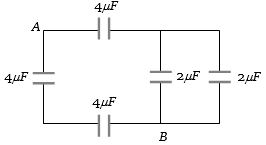
- 2In the circuit as shown in the figure the effective capacitance between $A$ and $B$ is........$\mu \,F$View Solution
- 3A series combination of $n_1$ capacitors, each of value $C_1$ is charged by a source of potential difference $4\, V.$ When another parallel combination of $n_2$ capacitors, each of value $C_2,$ is charged by a source of potential difference $V$, it has the same (total) energy stored in it, as the first combination has. The value of $C_2,$ in terms of $C_1$ is thenView Solution
- 4Assertion : If three capacitors of capacitances $C_1 < C_2 < C_3$ are connected in parallel then their equivalent capacitance $C_P > C_S$.View Solution
Reason : $\frac{1}{{{C_p}}} = \frac{1}{{{C_1}}} + \frac{1}{{{C_2}}} + \frac{1}{{{C_3}}}$
- 5The capacitance of a parallel plate capacitor is $12\,\mu \,F$. If the distance between the plates is doubled and area is halved, then new capacitance will be.........$\mu \,F$View Solution
- 6Two points $P$ and $Q$ are maintained at the potentials of $10\ V$ and $- 4\ V$, respectively. The work done in moving $100$ electrons from $P$ to $Q$ isView Solution
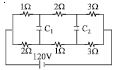
- 7In the circuit shown in figure $C_1 = C_2 = 2$ $\mu F$. Then charge stored inView Solution
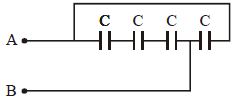
- 8The equivalent capacitance between $A$ and $B$ isView Solution
- 9While working on a physics project at school physics lab, you require a $4 \,\mu F$ capacitor in a circuit across a potential difference of $1 \,kV$. Unfortunately, $4 \,\mu F$ capacitors are out of stock in your lab but $2 \,\mu F$ capacitors which can withstand a potential difference of $400 \,V$ are available in plenty. If you decide to use the $2 \,\mu F$ capacitors in place of $4 \,\mu F$ capacitor, minimum number of capacitors required areView Solution
- 10A parallel plate capacitor is made of two plates of length $l$, width $w$ and separated by distance $d$. A dielectric slab ( dielectric constant $K$) that fits exactly between the plates is held near the edge of the plates. It is pulled into the capacitor by a force $F = -\frac{{\partial U}}{{\partial x}}$ where $U$ is the energy of the capacitor when dielectric is inside the capacitor up to distance $x$ (See figure). If the charge on the capacitor is $Q$ then the force on the dielectric when it is near the edge isView Solution