Density of rubber is $d$. $ A$ thick rubber cord of length $L$ and cross-section area $A$ undergoes elongation under its own weight on suspending it. This elongation is proportional to
Medium


Download our appand get started for free
Experience the future of education. Simply download our apps or reach out to us for more information. Let's shape the future of learning together!No signup needed.*
Similar Questions
- 1A cube of aluminium of sides $0.1\, m$ is subjected to a shearing force of $100\, N$. The top face of the cube is displaced through $0.02 \,cm$ with respect to the bottom face. The shearing strain would beView Solution
- 2When the temperature of a gas is $20^{\circ} C$ and pressure is changed from $P_1=1.01 \times 10^5 \,Pa$ to $P_2=1.165 \times$View Solution
$10^5 \,Pa$, then the volume changes by $10 \%$. The Bulk modulus is $.........\times 10^5 \,Pa$ - 3View SolutionThe following four wires are made of same material. Which one will have the largest elongation when subjected to the same tension ?
- 4View SolutionThe breaking stress of a wire depends upon
- 5A brass rod of cross-sectional area $1\,c{m^2}$ and length $0.2\, m$ is compressed lengthwise by a weight of $5\, kg$. If Young's modulus of elasticity of brass is $1 \times {10^{11}}\,N/{m^2}$ and $g = 10\,m/{\sec ^2}$, then increase in the energy of the rod will beView Solution
- 6Consider two wires of same material having their ratio of radii to be $2: 1$. If these two wires are stretched by equal force, then the ratio of stress produced in them isView Solution
- 7View SolutionShearing stress causes change in
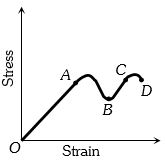
- 8In the below graph, point $D$ indicatesView Solution
- 9The Young's modulus of a wire of length $L$ and radius $r$ is $Y$. If the length is reduced to $\frac{L}{2}$ and radius is $\frac{r}{2}$ , then the Young's modulus will beView Solution
- 10View SolutionIn solids, inter-atomic forces are