Discuss the rolling motion of a cylinder on an inclined plane.
Download our app for free and get started
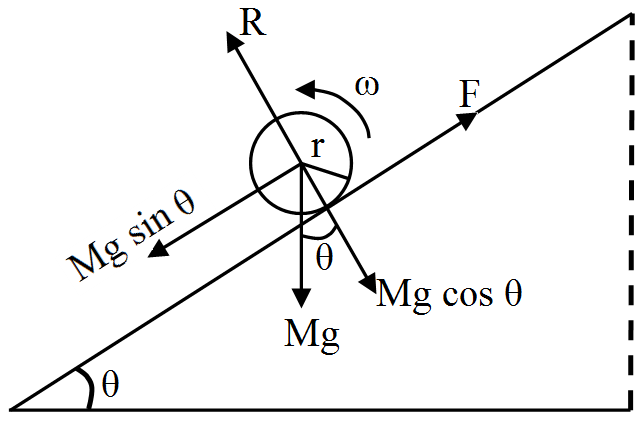 Consider a spherical body of mass M and radius r, rolling down on an inclined plane without slipping. Let the angle of inclination of the plane is $\theta$ with the horizontal (See fig.)
It $\omega$ be the angular velocity of the body, then the linear velocity of the body is,
$\text{v} = \text{r} \omega\dots(1)$
The various forces acting on the body are:
- The weight (Mg) of the body in the vertically downward direction.
- Normal reaction (R) of the surface of the plane on the body which acts vertically upward.
- The force of friction (F) which acts opposite to the direction of motion of the body.
- $\text{Mg}\cos\theta$ is the horizontal component, which is equal and opposite to the normal reaction $\text{i.e.,}\text{ R}=\text{Mg}\cos\theta\dots(2)$
- $\text{Mg}\sin\theta$ is the vertical component, which acts in the direction of the motion of the body
The external torque acting on the body is produced by the force of friction (F) and its lever arm is r (the radius of the spherical body) [The lines of action of Mg and R pass through the centre of mass of body and hence do not contribute anything to the torque about the centre of mass]
$\therefore\tau=\text{Fr}\dots(4)$
If $\alpha$ be the angular acceleration produced in the body whose moment of inertia is I, then $\tau=\text{I}\alpha\dots(5)$
From eqns (4) and (5), we get
$\text{Fr}=\text{I}\alpha\text{ or }\text{F}=\text{I}\frac{\alpha}{\text{r}}\dots(6)$
Using eqn. (6) in eqn. (3), we get
$\therefore\text{Ma}=\text{Mg}\sin\theta-\text{I}\frac{\alpha}{\text{r}}$
But $\text{a}=\text{ra}\text{ or }\alpha=\frac{\text{a}}{\text{r}}$
$\therefore\text{Ma}=\text{Mg}\sin\theta-\text{I}\frac{\text{a}}{\text{r}^2}$
$\Rightarrow\text{a}=\text{g}\sin\theta-\frac{\text{I}_{\text{a}}}{\text{Mr}^2}$
$\text{or }\text{a}\Big(1+\frac{\text{I}}{\text{Mr}^2}\Big)=\text{g}\sin\theta$
$\text{ or }=\frac{\text{g}\sin\theta}{1+\Big(\frac{\text{I}}{\text{Mr}^2}\Big)}$
Now $\alpha=\frac{\text{a}}{\text{r}}=\frac{\text{g}\sin\theta}{\text{r}\Big[1+\frac{\text{I}}{\text{Mr}^2}\Big]}$
Substituting this value in eqn. (6), we get
$\text{F}=\frac{\text{I}}{\text{r}}\frac{\text{g}\sin\theta}{\Big[1+\frac{\text{I}}{\text{Mr}^2}\Big]}=\frac{\text{Ig}\sin\theta}{\text{r}^2\Big[1+\frac{\text{I}}{\text{Mr}^2}\Big]}$
This is the force of friction, required by the body to roll down an inclined plane without slipping.

Download our appand get started for free
Experience the future of education. Simply download our apps or reach out to us for more information. Let's shape the future of learning together!No signup needed.*
Similar Questions
- 1View SolutionA particle of mass m is projected from origin O with speed u at an angle with positive x-axis. Find the angular momentum of particle at any time t about O before the particle strikes the ground again.
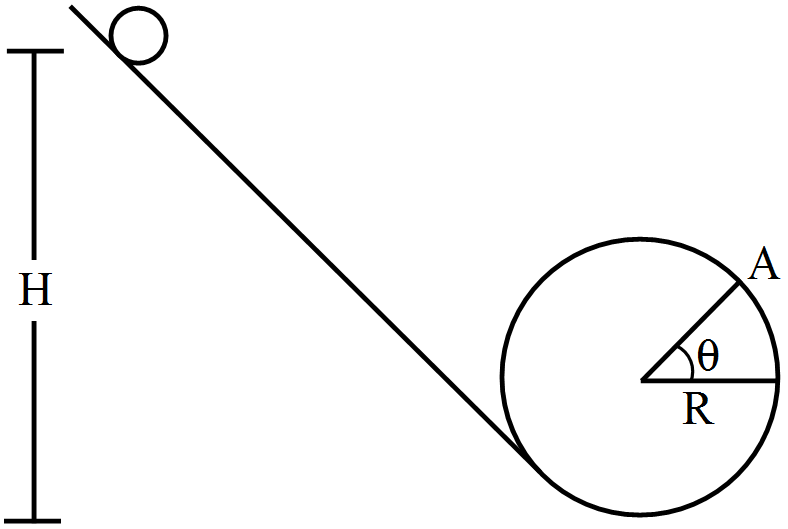
- 2Figure shows a small spherical ball of mass m rolling down the loop track. The ball is released on the linear portion at a vertical height H from the lowest point. The circular part shown has a radius R.View Solution
- Find the kinetic energy of the ball when it is at a point A where the radius makes an angle $\theta$ with the horizontal.
- Find the radial and the tangential accelerations of the centre when the ball is at A.
- Find the normal force and the frictional force acting on the ball if H = 60cm, R = 10cm, $\theta=0 $ and m = 70g.
- 3Two discs of moments of inertia $I_1$ and $I_2$ about their respective axes (normal to the disc and passing through the centre), and rotating with angular speed $\omega_1$ and $\omega_2$ are brought into contact face to face with their axes of rotation coincident.View Solution
- Does the law of conservation of angular momentum apply to the situation? why?
- Find the angular speed of the two-disc system.
- Calculate the loss in kinetic energy of the system in the process.
- Account for this loss.
- 4View SolutionTwo discs of same mass and thickness are made of materials having different densities. Which one of them will have larger M.I.?
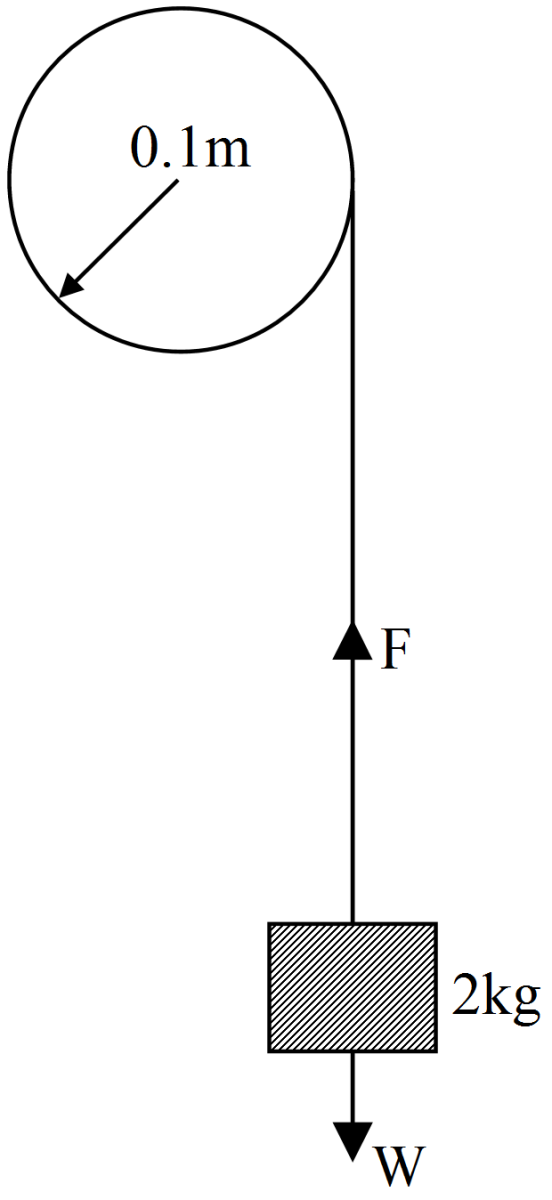
- 5The moment of inertia of a solid flywheel about its axis is $0.1kg-m^2$. A tangential force of $2kg/ wt$ is applied round the circumference of the flywheel with the help of a string and mass arrangement as shown in Fig. If the radius of the wheel is $0.1m$, find the acceleration of the mass.View Solution
- 6View SolutionTwo particles, each of mass m and speed v, travel in opposite directions along parallel lines separated by a distance d. Show that the angular momentum vector of the two particle system is the same whatever be the point about which the angular momentum is taken.
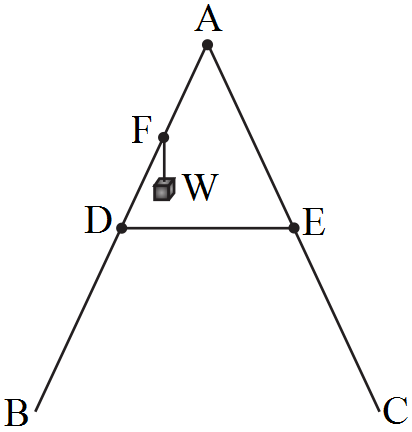
- 7As shown in the two sides of a step ladder BA and CA are 1.6m long and hinged at A. A rope DE, 0.5m is tied half way up. A weight 40kg is suspended from a point F, 1.2m from B along the ladder BA. Assuming the floor to be frictionless and neglecting the weight of the ladder, find the tension in the rope and forces exerted by the floor on the ladder. (Take $g = 9.8m/s^2$) (Hint: Consider the equilibrium of each side of the ladder separately).View Solution
- 8The oxygen molecule has a mass of $5.30 \times 10^{-26}kg$ and a moment of inertia of $1.94 \times 10^{-46}kgm^2$ about an axis through its centre perpendicular to the lines joining the two atoms. Suppose the mean speed of such a molecule in a gas is $500m/s$ and that its kinetic energy of rotation is two thirds of its kinetic energy of translation. Find the average angular velocity of the molecule.View Solution
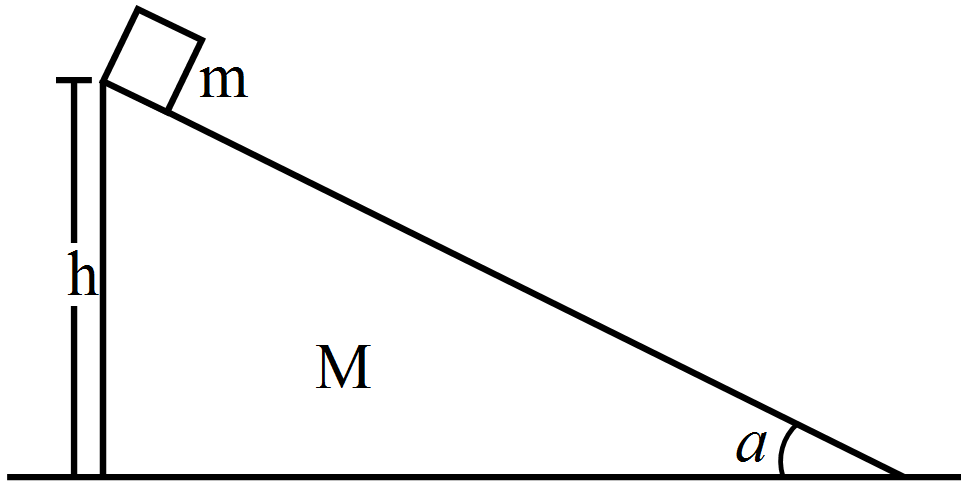
- 9View SolutionA block of mass m is placed on a triangular block of mass M, which in turn is placed on a horizontal surface as shown in figure. Assuming frictionless surfaces find the velocity of the triangular block when the smaller block reaches the bottom end.
- 10A disc of radius R is rotating with an angular speed $\omega_\text{o}$ about a horizontal axis. It is placed on a horizontal table. The coefficient of kinetic friction is $\mu_\text{k}{:}$View Solution
- What was the velocity of its centre of mass before being brought in contact with the table?
- What happens to the linear velocity of a point on its rim when placed in contact with the table?
- What happens to the linear speed of the centre of mass when disc is placed in contact with the table?
- Which force is responsible for the effects in (b) and (c).
- What condition should be satisfied for rolling to begin?
- Calculate the time taken for the rolling to begin.