The oxygen molecule has a mass of $5.30 \times 10^{-26}kg$ and a moment of inertia of $1.94 \times 10^{-46}kgm^2$ about an axis through its centre perpendicular to the lines joining the two atoms. Suppose the mean speed of such a molecule in a gas is $500m/s$ and that its kinetic energy of rotation is two thirds of its kinetic energy of translation. Find the average angular velocity of the molecule.
Exercise
Download our app for free and get started
Mass of an oxygen molecule, $m = 5.30 \times 10^{-26}kg$ Moment of inertia, $I = 1.94 \times 10^{-46}kgm^2$^ Velocity of the oxygen molecule, v = 500m/s The separation between the two atoms of the oxygen molecule = 2r Mass of each oxygen atom $=\frac{\text{m}}{2}$ Hence, moment of inertia I, is calculated as, $\Big(\frac{\text{m}}{2}\Big)\text{r}^2+\Big(\frac{\text{m}}{2}\Big)\text{r}^2=\text{mr}^2$
$\text{r}=\Big(\frac{\text{l}}{\text{m}}\Big)^{\frac{1}{2}}$
$\Big(\frac{1.94\times10^{-46}}{5.36\times10^{-26}}\Big)=0.60\times10^{-10}\text{m}$ It is given that, $\text{kE}_{\text{rot}}=\Big(\frac{2}{3}\Big)\times\Big(\frac{1}{2}\Big)\times\text{mv}^2$
$\text{m}\text{r}^2\omega^2=\Big(\frac{2}{3}\Big)\text{mv}^2$
$\omega=\Big(\frac{2}{3}\Big)^{\frac{1}{2}}\Big(\frac{\text{v}}{\text{r}}\Big)$
$\omega=\Big(\frac{2}{3}\Big)^{\frac{1}{2}}\Big(\frac{500}{0.6\times10^{-10}}\Big)$
$\omega=6.80\times10^{12}\text{rad/s}$
$\text{r}=\Big(\frac{\text{l}}{\text{m}}\Big)^{\frac{1}{2}}$
$\Big(\frac{1.94\times10^{-46}}{5.36\times10^{-26}}\Big)=0.60\times10^{-10}\text{m}$ It is given that, $\text{kE}_{\text{rot}}=\Big(\frac{2}{3}\Big)\times\Big(\frac{1}{2}\Big)\times\text{mv}^2$
$\text{m}\text{r}^2\omega^2=\Big(\frac{2}{3}\Big)\text{mv}^2$
$\omega=\Big(\frac{2}{3}\Big)^{\frac{1}{2}}\Big(\frac{\text{v}}{\text{r}}\Big)$
$\omega=\Big(\frac{2}{3}\Big)^{\frac{1}{2}}\Big(\frac{500}{0.6\times10^{-10}}\Big)$
$\omega=6.80\times10^{12}\text{rad/s}$

Download our appand get started for free
Experience the future of education. Simply download our apps or reach out to us for more information. Let's shape the future of learning together!No signup needed.*
Similar Questions
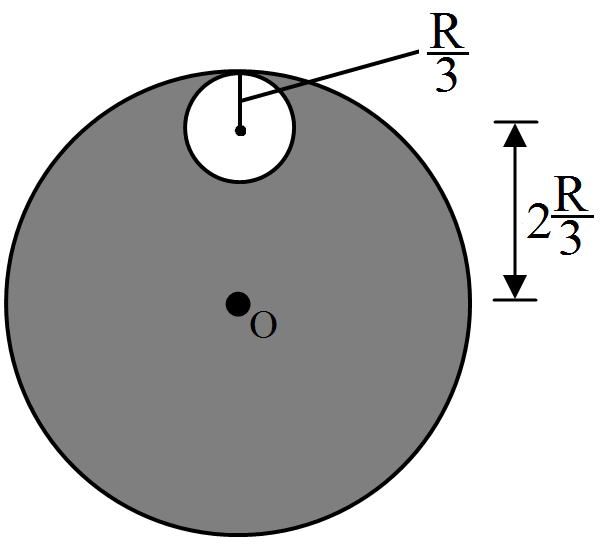
- 1From a circular disc of radius R and mass 9M, a small disc of radius $\frac{\text{R}}{3}$ is removed as shown in Fig. Find the moment of inertia of the remaining disc about an axis perpendicular to the plane of the disc and passing through the point O.View Solution
- 2Three point masses m,, m, and m, are located at the vertices of an equilateral triangle of side length a. What is the moment of inertia about an axis along the altitude of the triangle passing through $m_1$?View Solution
- 3View SolutionA wheel in uniform motion about an axis passing through its centre and perpendicular to its plane is considered to be in mechanical (translational plus rotational) equilibrium because no net external force or torque is required to sustain its motion. However, the particles that constitute the wheel do experience a centripetal acceleration directed towards the centre.How do you reconcile this fact with the wheel being in equilibrium? How would you set a half-wheel into uniform motion about an axis passing through the centre of mass of the wheel and perpendicular to its plane? Will you require external forces to sustain the motion?
- 4A solid disc and a ring, both of radius $10cm$ are placed on a horizontal table simultaneously, with initial angular speed equal to 10 π rad $s^{-1}$. Which of the two will start to roll earlier? The co-efficient of kinetic friction is $\mu_\text{k}=0.2$View Solution
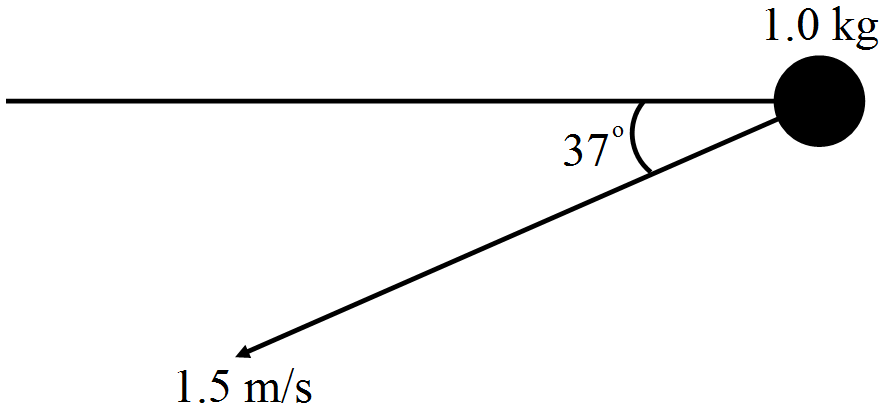
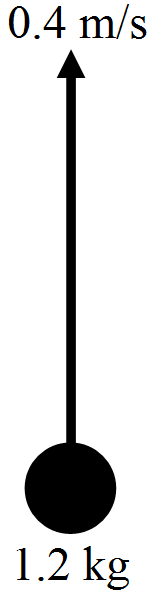
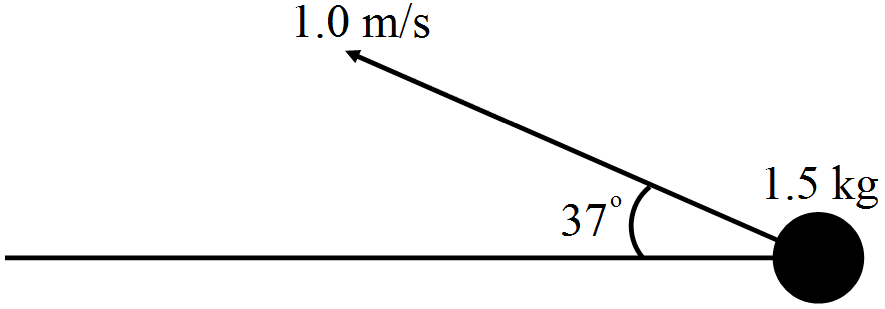
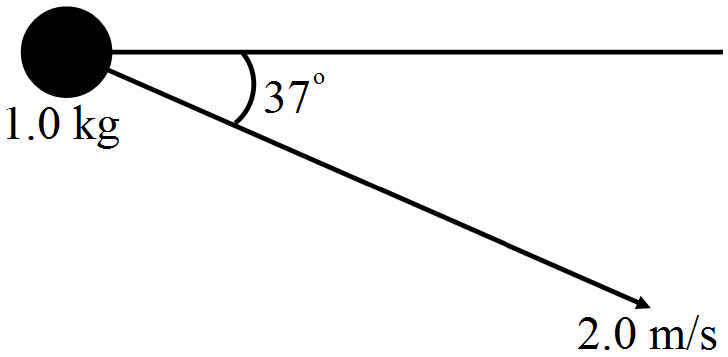
- 5View SolutionCalculate the velocity of the centre of mass of the system of particles shown in figure.

- 6Two discs of moments of inertia $I_1$ and $I_2$ about their respective axes (normal to the disc and passing through the centre), and rotating with angular speeds $\omega_1$ and $\omega_2$ are brought into contact face to face with their axes of rotation coincident.View Solution
- What is the angular speed of the two-disc system?
- Show that the kinetic energy of the combined system is less than the sum of the initial kinetic energies of the two discs. How do you account for this loss in energy? Take $\omega_1\neq\omega_2$
- 7View SolutionDefine radius of gyration and give the physical significance of moment of inertia.
- 8View SolutionExplain why friction is necessary to make the disc in roll in the direction indicated.
- Give the direction of frictional force at B, and the sense of frictional torque, before perfect rolling begins.
- What is the force of friction after perfect rolling begins?
- 9Particles of masses $1g, 2g, 3g, ........, 100g$ are kept at the marks $1cm, 2cm, 3cm, ........, 100cm$ respectively on a metre scale. Find the moment of inertia of the system of particles about a perpendicular bisector of the metre scale.View Solution
- 10What is Mechanical Advantage (M.A.) in the principle of moments for a lever? Find the reactions forces at knife edge as shown in the figure:View Solution
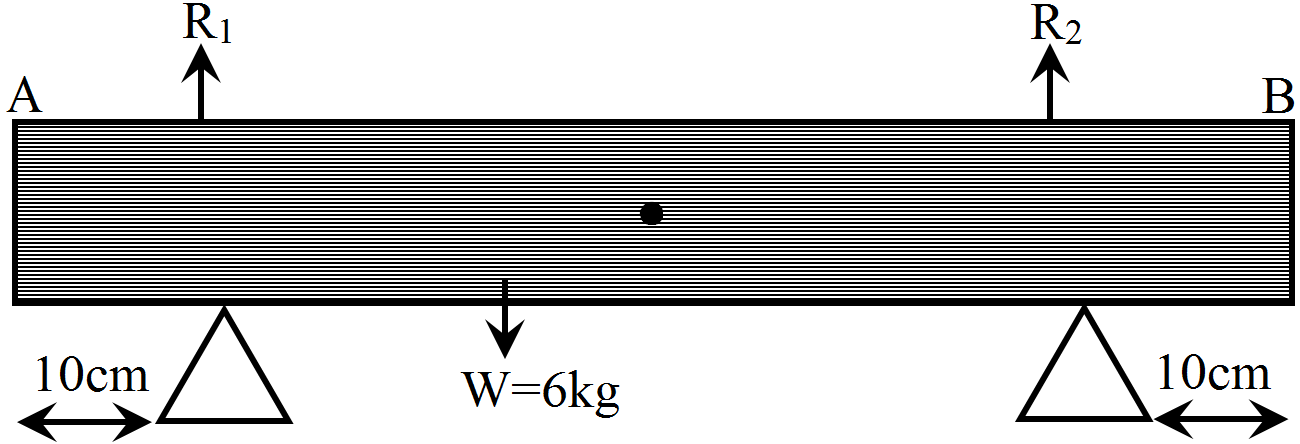
Where AB is a metal bar of $70cm$ length having mass $4kg$ and a $6kg$ load is suspended from $30cm$ from the end A.