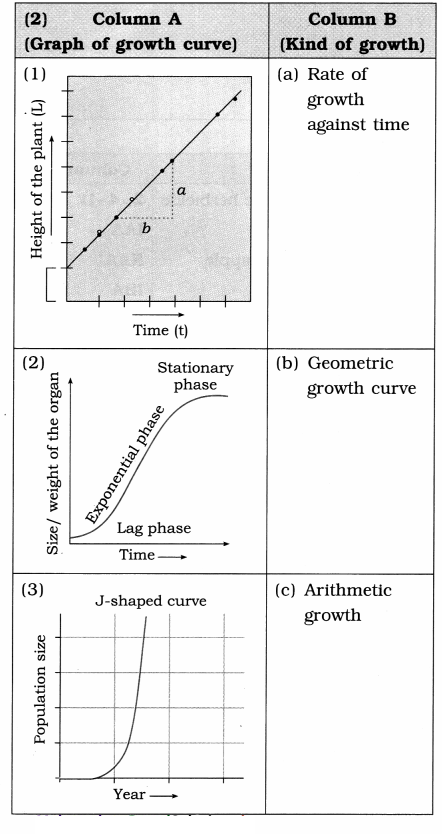
Question
Distinguish between : Erythrocytes and Leucocytes.
| Erythrocytes | Leucocytes |
| 1. Erythrocytes have a definite shape which is elliptical or oval. | 1. Leucocytes do not have definite shape as they are amoeboid. |
| 2. They are enucleated. | 2. They are nucleated. |
| 3. Erythrocytes contain haemoglobin and hence appear red. | 3. Leucocytes are devoid of any respiratory pigment and hence appear colourless. |
| 4. The normal erythrocyte count is 4.3 to 5.8 million per cubic mm of blood. | 4. The normal leucocyte count is 4000 to 11000 per cubic mm of blood. |
| 5. The life span of erythrocytes is 100 to 120 days. | 5. The life span of leucocytes is 3 to 4 days. |
| 6. The diameter of erythrocytes is 7.2 m and thickness is about 2 to 2.2 m. | 6. The size of leucocytes varies with its subtypes and is of average size of 8 to 15 m. |
| 7. Erythrocytes are formed by the process of erythropoiesis in red bone marrow. | 7. Leucocytes are formed by the process of leucopoiesis in bone marrow, tonsils, lymph nodes, spleen, thymus, etc. |
| 8. Erythrocytes transport the respiratory gases. | 8. Leucocytes help in the formation of antibodies besides fighting against foreign antigens by phagocytic activity. |
Generate a complete, print-ready paper with questions like this in minutes — across 16+ boards, with answer keys.
| Respiratory surface | Organism |
| (1) Plasma membrane | (a) Insect |
| (2) Lungs | (b) Salamander |
| (3) External gills | (c) Bird |
| (4) Internal gills | (d) Amoeba |
| (e) Fish |