A short object of length L is placed along the principal axis of a concave mirror away from focus. The object distance is u. If the mirror has a focal length f, what will be the length of the image? You may take $L < < |v - f|.$
Download our app for free and get started
Thin mirror formula: $\frac{1}{\text{v}}+\frac{1}{\text{u}}=\frac{1}{\text{f}}$
u = object distance and v = image distance.
Since, the object distance is u. Let us consider the two ends of the object be at distance $u_1$ and $u_2$ respectively,
so that du $= |u_1 - u_2| = L$. Hence size of image can be written as dv.
By differentiating Both sides $\Big(-\frac{\text{dv}}{\text{v}^2}\Big)+\Big(-\frac{\text{du}}{\text{u}^2}\Big)=0\Rightarrow\ \frac{\text{dv}}{\text{v}^2}=-\frac{\text{du}}{\text{u}^2}$
or $\text{dv}=-\Big(\frac{\text{v}^2}{\text{u}^2}\Big)\text{du}\ .....(\text{i})$
As $\frac{1}{\text{v}}=\frac{1}{\text{f}}-\frac{1}{\text{u}}\Rightarrow\ \text{v}=\frac{\text{fu}}{\text{u}-\text{f}}\Rightarrow\ \text{v}=\frac{\text{fu}}{\text{u}-\text{f}}$
Or $\frac{\text{v}}{\text{u}}=\frac{\text{f}}{\text{u}-\text{f}}\ .....(\text{ii})$
From (i) and (ii) $\text{dv}=-\Big(\frac{\text{f}}{\text{u}-\text{f}}\Big)^2\text{du}$
But du = L, hence the length of the image is $\frac{\text{f}^2}{(\text{u}-\text{f})^2}\text{L}$
This is the required expression for lenght of image.
u = object distance and v = image distance.
Since, the object distance is u. Let us consider the two ends of the object be at distance $u_1$ and $u_2$ respectively,
so that du $= |u_1 - u_2| = L$. Hence size of image can be written as dv.
By differentiating Both sides $\Big(-\frac{\text{dv}}{\text{v}^2}\Big)+\Big(-\frac{\text{du}}{\text{u}^2}\Big)=0\Rightarrow\ \frac{\text{dv}}{\text{v}^2}=-\frac{\text{du}}{\text{u}^2}$
or $\text{dv}=-\Big(\frac{\text{v}^2}{\text{u}^2}\Big)\text{du}\ .....(\text{i})$
As $\frac{1}{\text{v}}=\frac{1}{\text{f}}-\frac{1}{\text{u}}\Rightarrow\ \text{v}=\frac{\text{fu}}{\text{u}-\text{f}}\Rightarrow\ \text{v}=\frac{\text{fu}}{\text{u}-\text{f}}$
Or $\frac{\text{v}}{\text{u}}=\frac{\text{f}}{\text{u}-\text{f}}\ .....(\text{ii})$
From (i) and (ii) $\text{dv}=-\Big(\frac{\text{f}}{\text{u}-\text{f}}\Big)^2\text{du}$
But du = L, hence the length of the image is $\frac{\text{f}^2}{(\text{u}-\text{f})^2}\text{L}$
This is the required expression for lenght of image.

Download our appand get started for free
Experience the future of education. Simply download our apps or reach out to us for more information. Let's shape the future of learning together!No signup needed.*
Similar Questions
- 1View SolutionFigure shows a plane mirror M placed at a distance of 10cm from a concave lens L. A point object is placed at a distance of 60cm from the lens. The image formed due to refraction by the lens and reflection by the mirror is 30cm behind the mirror. What is the focal length of this lens?
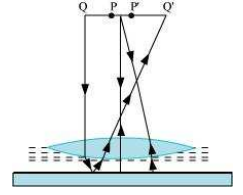
- 2View Solutionequiconvex lens (of refractive index 1.50) in contact with a liquid layer on top of a plane mirror. A small needle with its tip on the principal axis is moved along the axis until its inverted image is found at the position of the needle. The distance of the needle from the lens is measured to be 45.0 cm. The liquid is removed and the experiment is repeated. The new distance is measured to be 30.0 cm. What is the refractive index of the liquid?
- 3View SolutionAt what angle should a ray of light be incident on the face of a prism of refracting angle 60° so that it just suffers total internal reflection at the other face? The refractive index of the material of the prism is 1.524.
- 4View SolutionA paperweight in the form of a hemisphere of radius 3.0cm is used to hold down a printed page. An observer looks at the page vertically through the paperweight. At what height above the page will the printed letters near the centre appear to the observer?
- 5View Solution
- Draw the ray diagram showing refraction of light through a glass prism and hence obtain the relation between the refractive index $\mu$ of the prism, angle of prism and angle of minimum deviation.
- Determine the value of the angle of incidence for a ray of light travelling from a medium of refractive index $\mu_1=\sqrt{2}$ into the medium of refractive index $\mu_2=1$, so that it just grazes along the surface of separation.
- 6A small block of mass m and a concave mirror of radius R fitted with a stand lie on a smooth horizontal table with a separation d between them. The mirror together with its stand has a mass m. The block is pushed at t = 0 towards the mirror so that it starts moving towards the mirror at a constant speed V and collides with it. The collision is perfectly elastic. Find the velocity of the image:View Solution
- At a time $\text{t}<\frac{\text{d}}{\text{V}}$
- At a time $\text{t}>\frac{\text{d}}{\text{V}}.$
- 7View SolutionA converging lens of focal length 15cm and a converging mirror of focal length 10cm are placed 50cm apart. If a pin of length 2.0cm is placed 30cm from the lens farther away from the mirror, where will the final image form and what will be the size of the final image?
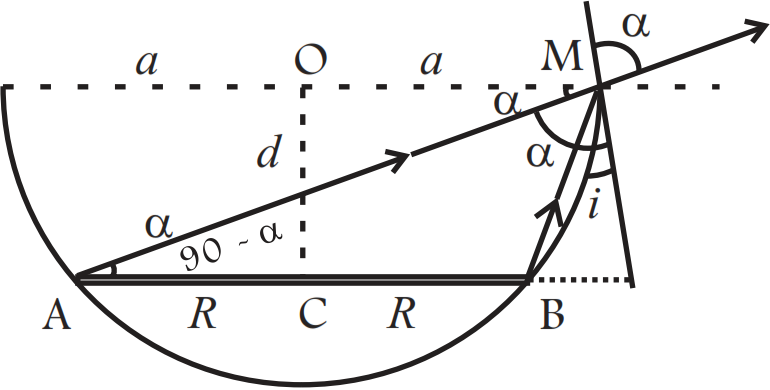
- 8View SolutionA circular disc of radius 'R' is placed co-axially and horizontally inside an opaque hemispherical bowl of radius 'a' (Fig). The far edge of the disc is just visible when viewed from the edge of the bowl. The bowl is filled with transparent liquid of refractive index μ and the near edge of the disc becomes just visible. How far below the top of the bowl is the disc placed?
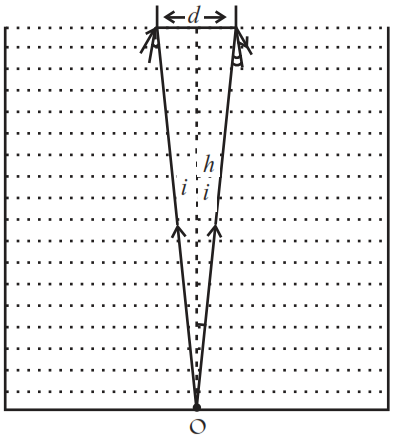
- 9View SolutionA jar of height h is filled with a transparent liquid of refractive index μ (Fig). At the centre of the jar on the bottom surface is a dot. Find the minimum diameter of a disc, such that when placed on the top surface symmetrically about the centre, the dot is invisible.
- 10Light is incident from glass $(\mu=1.50)$ to water $(\mu=1.33).$ Find the range of the angle of deviation for which there are two angles of incidence.View Solution