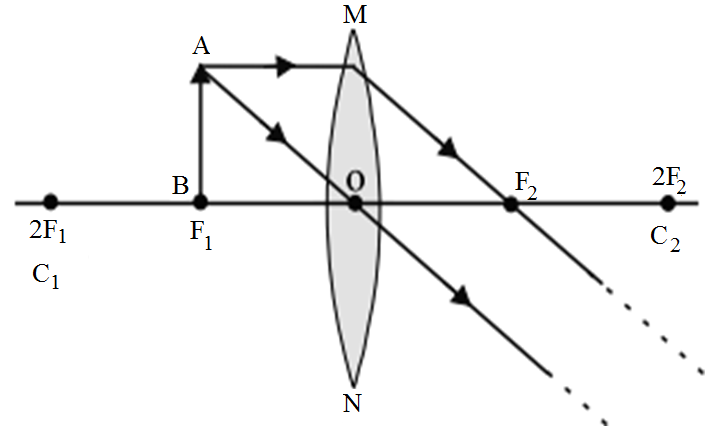
Draw ray diagrams showing the image formation by a convex lens when an object is placed:
At the focus of the lens.
At the focus of the lens.
Download our app for free and get started
The real, inverted and highly magnified image forms at infinity on the other side of the object when the object is placed at the focus of the lens.

Download our appand get started for free
Experience the future of education. Simply download our apps or reach out to us for more information. Let's shape the future of learning together!No signup needed.*
Similar Questions
- 1View SolutionList two properties of the images formed by convex mirrors. Draw ray diagram in support of your answer.
- 2View SolutionIdentify the device used as a spherical mirror or lens in following cases, when the image formed is virtual and erect in each case.Object is placed between infinity and device, image formed is diminished and between pole and focus, behind it.
- 3View SolutionDraw ray diagrams showing the image formation by a concave lens when an object is placed:
Beyond twice the focal length of the lens. - 4View SolutionYour eye contains a convex lens. Why is it unwise to look at the sun?
- 5View SolutionShow the lateral displacement of the ray on the diagram.
- 6View SolutionList four precautions which a student should observe while determining the focal length of a given convex lens by obtaining image of a distant object on a screen.
- 7View SolutionAt what distance from a converging lens of focal length 12cm must an object be placed in order that an image of magnification 1 will be produced?
- 8View SolutionDraw diagram to represent the action of a concave mirror on a beam of parallel light rays. Mark on this diagram principal axis, focus F, centre of curvature C, pole P and focal length ƒ, of the concave mirror.
- 9View SolutionAn object is placed just outside the principal focus of concave mirror. Draw a ray diagram to show how the image is formed, and describe its size, position and nature.
- 10View SolutionAn object is placed well outside the principal focus of a convex lens. Draw a ray diagram to show how.