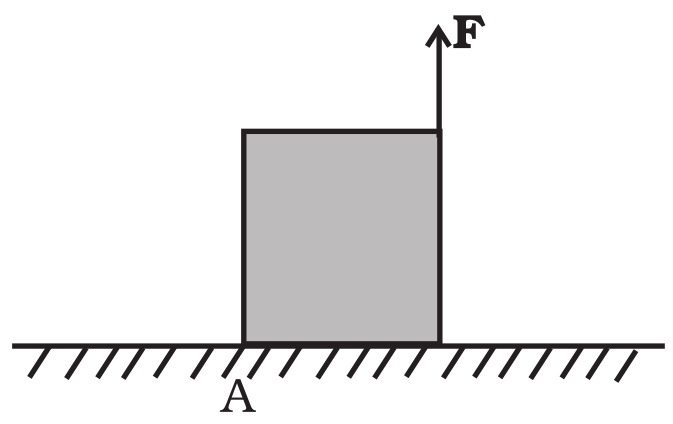
A uniform cube of mass m and side a is placed on a frictionless horizontal surface. A vertical force F is applied to the edge as shown in match the following (most appropriate choice):
| a. | $\frac{\text{mg}}{4}<\text{F}<\frac{\text{mg}}{2}$ | i. | Cube will move up. |
| b. | $\text{F}>\frac{\text{mg}}{2}$ | ii. | Cube will not exhibit motion. |
| c. | $\text{F}>\text{mg}$ | iii. | Cube will begin to rotate and slip at A. |
| d. | $\text{F}=\frac{\text{mg}}{4}$ | iv. | Normal reaction effectively at $\frac{\text{a}}{3}$ |
Download our app for free and get started
| a. | $\frac{\text{mg}}{4}<\text{F}<\frac{\text{mg}}{2}$ | i. | Cube will not exhibit motion. |
| b. | $\text{F}>\frac{\text{mg}}{2}$ | ii. | Cube will begin to rotate and slip at A. |
| c. | $\text{F}>\text{mg}$ | iii. | Cube will move up. |
| d. | $\text{F}=\frac{\text{mg}}{4}$ | iv. | Normal reaction effectively at $\frac{\text{a}}{3}$ |
Let us first consider the below diagram torque or moment of the force F about point A is given by I = aF
This is anticlockwise.
Torque of weight mg about A,
$=\frac{\text{q}}{2}$
This is clockwise.
N is acting at point A. So, torque due to normal reaction.
If $\tau_1=\tau_2,$ cube will not exhibit motion
$(\because$ In this case, both the torque will cancle the effect of each other$)$
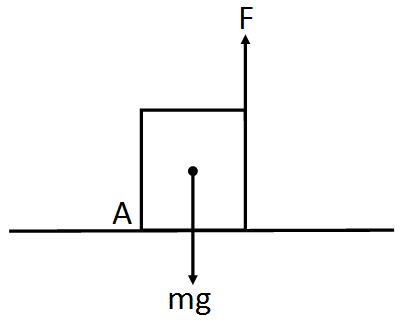
$\therefore\ \text{F}\times\text{a}=\text{mg}\times\frac{\text{a}}{2}$
$\Rightarrow\text{F}=\frac{\text{mg}}{2}$
The cube will rotate only when $\tau_1>\tau_2$
$\Rightarrow\text{F}\times\text{a}>\text{mg}\times\frac{\text{a}}{2}$
$\Rightarrow\text{F}>\frac{\text{mg}}{2}$
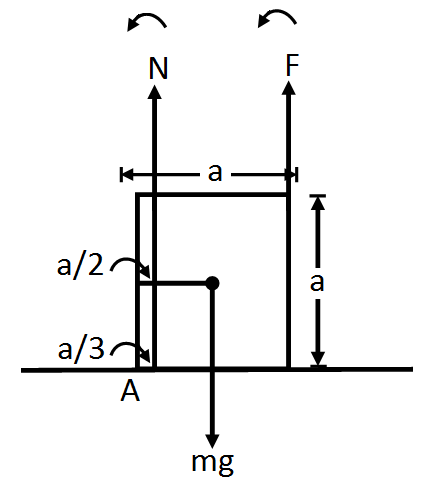
Let normal rection is acting at $\frac{\text{a}}{3}$ from point A as, shown in diagram below.
$\text{N}\times\frac{\text{a}}{3}+\text{Fa}=\text{mg}\times\frac{\text{a}}{2}$ (Fot no rotation)
$\Rightarrow(\text{mg}-\text{F})\frac{\text{a}}{3}+\text{Fa}=\text{mg}\times\frac{\text{a}}{2}$ $\big[\because\ \text{N}+\text{F}=\text{mg}\big]$
$\Rightarrow\frac{2}{3}\text{F}=\frac{1}{6}\text{mg}$
$\Rightarrow\text{F}=\frac{\text{mg}}{4}$
about A will be zero.

Download our appand get started for free
Experience the future of education. Simply download our apps or reach out to us for more information. Let's shape the future of learning together!No signup needed.*
Similar Questions
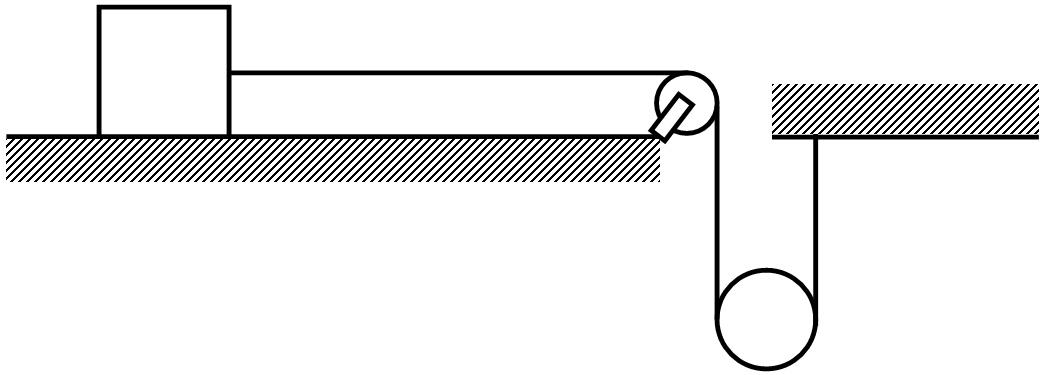
- 1The descending pulley shown in figure has a radius $20cm$ and moment of inertia $0.20kg-m^2$. The fixed pulley is light and the horizontal plane frictionless. Find the acceleration of the block if its mass is $1.0kg$.View Solution
- 2Prove the result that the velocity v of translation of a rolling body (like a ring, disc, cylinder or sphere) at the bottom of an inclined plane of a height h is given by $\text{v}^2=\frac{2\text{gh}}{\Big(\frac{1+\text{k}^2}{\text{R}^2}\Big)}$ using dynamical consideration (i.e. by consideration of forces and torques).View Solution
Note: k is the radius of gyration of the body about its symmetry axis, and R is the radius of the body. The body starts from rest at the top of the plane. - 3View SolutionSuppose the particle of the previous problem has a mass m and a speed v before the collision and it sticks to the rod after the collision. The rod has a mass M:
- Find the velocity of the centre of mass C of the system constituting ''The rod plus the particle''.
- Find the velocity of the particle with respect to C before the collision.
- Find the velocity of the rod with respect to C before the collision.
- Find the angular momentum of the particle and of the rod about the centre of mass C before the collision.
- Find the moment of inertia of the system about the vertical axis through the centre of mass C after the collision.
- Find the velocity of the centre of mass C and the angular velocity of the system about the centre of mass after the collision.
- 4The oxygen molecule has a mass of $5.30 \times 10^{-26}kg$ and a moment of inertia of $1.94 \times 10^{-46}kgm^2$ about an axis through its centre perpendicular to the lines joining the two atoms. Suppose the mean speed of such a molecule in a gas is 500m/s and that its kinetic energy of rotation is two thirds of its kinetic energy of translation. Find the average angular velocity of the molecule.View Solution
- 5Separation of Motion of a system of particles into motion of the centre of mass and motion about the centre of mass: Show $\text{K}=\text{K}'+\frac{1}{2}\text{M}\text{V}^2$ where K' is the total kinetic energy of the system of particles, K′ is the total kinetic energy of the system when the particle velocities are taken with respect to the centre of mass and $\frac{\text{MV}^2}{2}$ is the kinetic energy of the translation of the system as a whole (i.e. of the centre of mass motion of the system). The result has been used in $\sec7.14$View Solution
- 6View SolutionObtain an expression for linear acceleration of a cylinder rolling down an inclined plane and hence find the condition for the cylinder to roll down the inclined plane without slipping.
- 7View SolutionFind the components along the x, y, z axes of the angular momentum l of a particle, whose position vector is r with components x, y, z and momentum is p with components px, py and pz. Show that if the particle moves only in the x-y plane the angular momentum has only a z-component.
- 8View SolutionDefine radius of gyration and give the physical significance of moment of inertia.
- 9View SolutionWhat do you mean by the term "equilibrium"? What are equilibrium of rest and equilibrium of motion? State the conditions for complete equilibrium of a body.
- 10View SolutionTwo particles, each of mass m and speed v, travel in opposite directions along parallel lines separated by a distance d. Show that the angular momentum vector of the two particle system is the same whatever be the point about which the angular momentum is taken.