Question
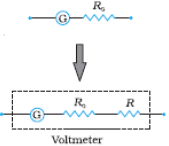
  1. Explain, giving reasons, the basic difference in converting a galvanometer into $(i)$ a voltmeter and $(ii)$ an ammeter.
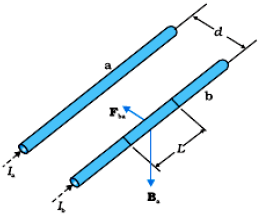
  2. Two long straight parallel conductors carrying steady currents $I_1$ and $I_2$ are separated by a distance $'d\ '$. Explain briefly, with the help of a suitable diagram, how the magnetic field due to one conductor acts on the other. Hence deduce the expression for the force acting between the two conductors. Mention the nature of this force.
Answer

  1. A galvanometer can be converted into a voltmeter by connecting a high resistance in series with its coil.
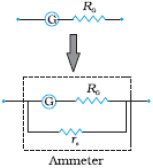
  2. A galvanometer can be converted into an ammeter by connecting a low resistance in parallel to its coil.
Alternate Answer


The magnetic field, due to wire $– 1,$ at any point on the wire $– 2,$ is directed normal to the direction of current flowin wire $– 2.$
Expression for force
$B_{21} =$ Magnetic field atwire $– 2,$ due to a current $I_1$ in
wire $ - 1 = \frac{\mu_{o}\text{I}_{1}}{2\pi\text{r}}$
Force upon conductor carrying current due to magnetic field
$\overrightarrow{\text{F}} = \text{I}(\overrightarrow{\ell}\times\overrightarrow{\text{B}})$
$\therefore\text{ Force, F}_{21}\text{ on a length l of wire}\ – 2 = \text{I}_{2} . l.\frac{\mu_{o}\text{I}_{1}}{2\pi\text{r}}$
$ =\frac{\mu_{o}\text{I}_{1}\text{I}_{2}}{2\pi\text{r}}l$
$\text{Similarly,} = \text{F}_{12} = \frac{\mu_{0}\text{I}_{1}\text{I}_{2}}{2\pi\text{r}}l$
Nature
The force is repulsive for currents in opposite direction and attractive when currents flow in the same direction.

Need a full question paper?

Generate a complete, print-ready paper with questions like this in minutes — across 16+ boards, with answer keys.

Start Generating Free

Similar questions

The work function of caesium metal is 2.14 eV. When light of frequency $6 \times 10^{14}$ Hz is incident on the metal surface photo-emission of electrons occurs. What is the
(a) Maximum kinetic energy of emitted electrons
(b) Stopping potential, and
(c) Maximum speed of the emitted photo-electrons?
A circular coil of radius 2.00cm has 50 turns. A uniform magnetic field B - 0.200T exists in the space in a direction parallel to the axis of the loop. The coil is now rotated about a diameter through an angle of 60.0°. The operation takes 0.100s.
  1. Find the average emf induced in the coil.
  2. If the coil is a closed one (with the two ends joined together) and has a resistance of $4.00\Omega.$ calculate the net charge crossing a cross-section of the wire of the coil.
Describe the main difference between Fraunhofer and Fresnel's diffraction. 
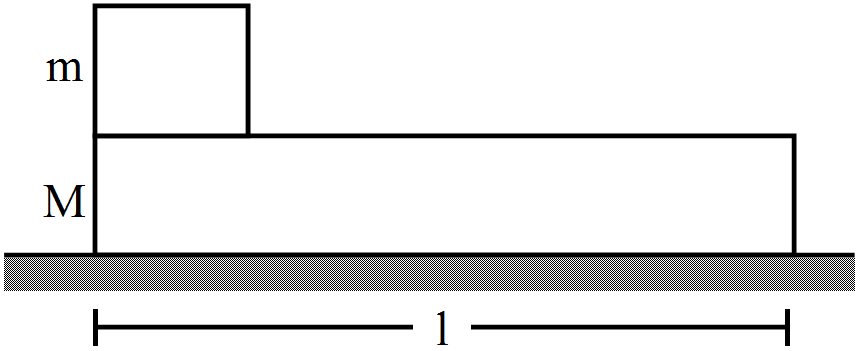
Figure shows a small block of mass m kept at the left end of a larger block of mass $M$ and length $l.$ The system can slide on a horizontal road. The system is started towards right with an initial velocity $v.$ The friction coefficient between the road and the bigger block is $g$ and that between the block is $\frac{\mu}{2}.$ Find the time elapsed before the smaller blocks separates from the bigger block.
Define magnifying power of a telescope. Write its expression.
A small telescope has an objective lens of focal length 150 cm and an eye piece of focal length 5 cm. If this telescope is used to view a 100m high tower 3 km away, find the height of the final image when it is formed 25 cm away from the eye piece.
Establish a relation between electric current and drift velocity.$OR$
Prove that the current density of a metallic conductor is directly proportional to the drift speed of electrons.
By explaining magnetic field lines, write their characteristics.
A solid wire of radius $10\ cm$ carries a current $5.0A$ distributed uniformly over its cross$-$section. Find the magnetic field $B$ at a point at a distance $(a)\ 2\ cm\  (b)\ 10\ cm$ and $(c)\ 20\ cm$ away from the axis. Sketch a graph of $B$ versus $x$ for $0 < x < 20\ cm.$
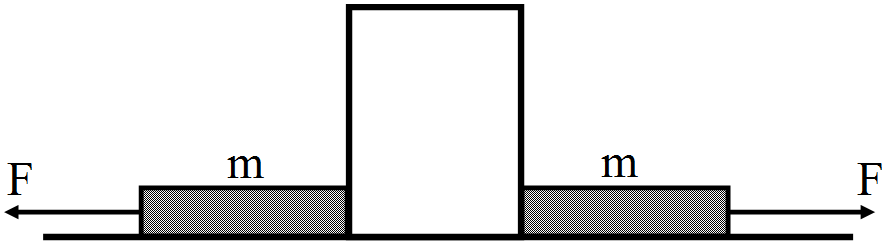
Figure shows a heavy block kept on a frictionless surface and being pulled by two ropes of equal mass $m.$
 At $t = 0,$ the force on the left rope is withdrawn but the
force on the right end continues to act.
Let $F_1$ and $F_2$ be the magnitudes of the forces by the right rope and the left rope on the block respectively:
Consider the situation of the previous problem. Consider the fastest electron emitted parallel to the large metal plate. Find the displacement of this electron parallel to its initial velocity before it strikes the large metal plate.