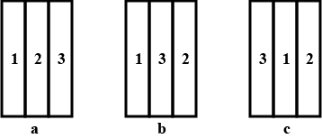
Figure shows three different arrangements of materials $1, 2$ and $3$ to form a wall. Thermal conductivities are $k_1 > k_2 > k_3$ . The left side of the wall is $20\,^oC$ higher than the right side. Temperature difference $\Delta T$ across the material $1$ has following relation in three cases
Easy
Download our app for free and get started
In all the three cases, temperature difference along the combination is same. Thus, heat current in all the three cases are same $\Rightarrow $ temperature difference across any layer in all the three case is same

Download our appand get started for free
Experience the future of education. Simply download our apps or reach out to us for more information. Let's shape the future of learning together!No signup needed.*
Similar Questions
- 1The ends of a metal bas of constant cross-sectional area are maintained at temperatures $T_1$ and $T_2$ which are both higher than the temperature of the surroundings. If the bar is unlagged, which one of the following sketches best represents the variation of temperature with distance along the bar?View Solution
- 2A black coloured solid sphere of radius $R$ and mass $M$ is inside a cavity with vacuum inside. The walls of the cavity are maintained at temperature $T_0$. The initial temperature of the sphere is $3T_0$. If the specific heat of the material of the sphere varies as $\alpha T^3$ per unit mass with the temperature $T$ of the sphere, where $\alpha $ is a constant, then the time taken for the sphere to cool down to temperature $2T_0$ will be ( $\sigma $ is Stefan Boltzmann constant)View Solution
- 3The radiant energy from the sun incident normally at the surface of earth is $20\, \frac{{k\;cal}}{{{m^2}\;min}}$. What would have been the radiant energy incident normally on the earth, if the sun had a temperature twice of the present one ....... $kcal/m ^2 \,min$View Solution
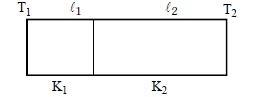
- 4One end of a thermally insulated rod is kept at a temperature $T_1$ and the other at $T_2$. The rod is composed of two sections of lengths $l_1$ and $l_2$ and thermal conductivities $K_1$ and $K_2$ respectively. The temperature at the interface of the two sections isView Solution
- 5The coefficient of linear expansion of brass and steel are ${\alpha _1}$ and ${\alpha _2}$. If we take a brass rod of length ${l_1}$ and steel rod of length ${l_2}$ at $0°C$, their difference in length $({l_2} - {l_1})$ will remain the same at a temperature ifView Solution
- 6An object kept in a large room having air temperature of $25^{\circ} \mathrm{C}$ takes $12$ minutes to cool from $80^{\circ} \mathrm{C}$ to $70^{\circ} \mathrm{C}$. The time taken to cool for the same object from $70^{\circ} \mathrm{C}$ to $60^{\circ} \mathrm{C}$ would be nearly.....$min$View Solution
- 7View SolutionIf black wire of platinum is heated, then its colour first appear red, then yellow and finally white. It can be understood on the basis of
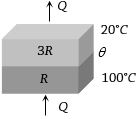
- 8In the following figure, two insulating sheets with thermal resistances $R$ and $3R$ as shown in figure. The temperature $\theta$ is ...... $^oC$View Solution
- 9A body takes $5$ minute to cool from $80°C$ to $50°C$ . ...... $\min.$ it will take to cool from $60°C$ to $30°C$ , if room temperature is $20°C$ .View Solution
- 10The two ends of a rod of length $L$ and a uniform cross-sectional area $A$ are kept at two temperatures $T_1$ and $T_2 (T_1 > T_2)$. The rate of heat transfer,$\frac{ dQ }{dt}$, through the rod in a steady state is given byView Solution