A uniform rod of length L lies on a smooth horizontal table. A particle moving on the table strikes the rod perpendicularly at an end and stops. Find the distance travelled by the centre of the rod by the time it turns through a right angle. Show that if the mass of the rod is four times that of the particle, the collision is elastic.
Download our app for free and get started
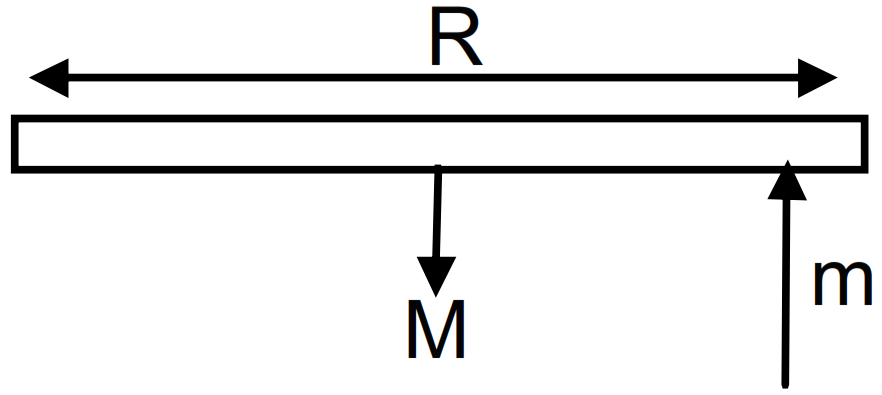 Let the mass of the particle = m & the mass of the rod = M.
Let the particle strikes the rod with a velocity V.
If we take the two body to be a system.
Therefore the net external torque & net external force = 0
Therefore Applying laws of conservation of linear momentum MV' = mV (V' = velocity of the rod after striking)
$\Rightarrow\frac{\text{V}'}{\text{V}}=\frac{\text{m}}{\text{M}}$
Again applying laws of conservation of angular momentum
$\Rightarrow\frac{\text{mVR}}{2}=\ell\omega$
$\Rightarrow\frac{\text{mVR}}{2}=\frac{\text{MR}^2}{12}\times\frac{\pi}{2\text{t}}$
$\Rightarrow\text{t}=\frac{\text{MR}\pi}{\text{m}\times12\times\text{V}}$
Therefore distance travelled:
$\text{V}'\text{t}=\text{V}'\Big(\frac{\text{MR}\pi}{\text{m}\times12\times\pi}\Big)$
$=\frac{\text{m}}{\text{M}}\times\frac{\text{M}}{\text{m}}\times\frac{\text{R}\pi}{12}=\frac{\text{R}\pi}{12}$

Download our appand get started for free
Experience the future of education. Simply download our apps or reach out to us for more information. Let's shape the future of learning together!No signup needed.*
Similar Questions
- 1In the HCl molecule, the separation between the nuclei of the two atoms is about $1.27\mathring{\text{A}}\big(1\mathring{\text{A}}= 10^{-10} \text{m}\big).$ Find the approximate location of the CM of the molecule, given that a chlorine atom is about 35.5 times as massive as a hydrogen atom and nearly all the mass of an atom is concentrated in its nucleus.View Solution
- 2View SolutionFind the components along the x, y, z axes of the angular momentum l of a particle, whose position vector is r with components x, y, z and momentum is p with components px, py and pz. Show that if the particle moves only in the x-y plane the angular momentum has only a z-component.
- 3An isolated particle of mass m is moving in a horizontal plane (x - y), along the x-axis at a certain height about the ground. It explodes suddenly into two fragments of masses $\frac{\text{m}}{4}$ and $3\frac{\text{m}}{4}.$ An instant later, the smaller fragment is at y = + 15 cm. What is the position of larger fragment at this instant?View Solution
- 4Two discs of moments of inertia $I_1$ and $I_2$ about their respective axes (normal to the disc and passing through the centre), and rotating with angular speeds $\omega_1$ and $\omega_2$ are brought into contact face to face with their axes of rotation coincident.View Solution
- What is the angular speed of the two-disc system?
- Show that the kinetic energy of the combined system is less than the sum of the initial kinetic energies of the two discs. How do you account for this loss in energy? Take $\omega_1\neq\omega_2$
- 5Separation of Motion of a system of particles into motion of the centre of mass and motion about the centre of mass: Show $\text{K}=\text{K}'+\frac{1}{2}\text{M}\text{V}^2$ where K' is the total kinetic energy of the system of particles, K′ is the total kinetic energy of the system when the particle velocities are taken with respect to the centre of mass and $\frac{\text{MV}^2}{2}$ is the kinetic energy of the translation of the system as a whole (i.e. of the centre of mass motion of the system). The result has been used in $\sec7.14$View Solution
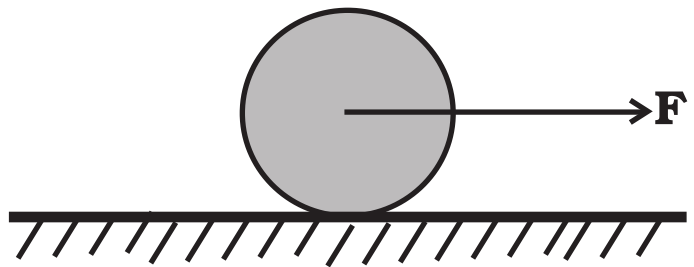
- 6A uniform disc of radius R, is resting on a table on its rim.The coefficient of friction between disc and table is $\mu.$Now the disc is pulled with a force F as shown in the figure. What is the maximum value of F for which the disc rolls without slipping?View Solution
- 7View SolutionA uniform disc of radius R and mass M is mounted on an axis supported in fixed frictionless bearing. A light chord is wrapped around the rim of the wheel and suppose that we hang a body of mass m from the chord. Find the angular acceleration of the disc and tangential acceleration of point on the rim.
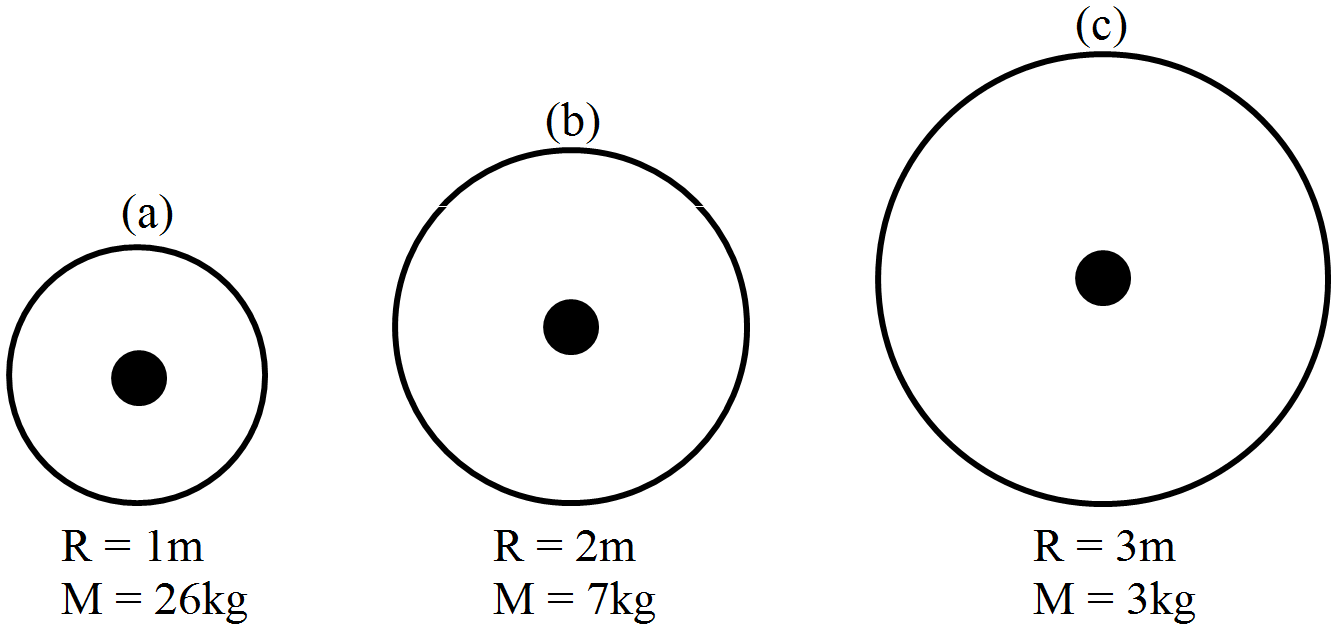
- 8View SolutionFigure shows three uniform discs, along with their radii R and masses M. Rank the discs according to their rotational inertia about their central axes, greatest first.
- 9View SolutionFind the centre of mass of a uniform:
- Half-disc.
- Quarter-disc.
- 10The descending pulley shown in figure has a radius $20cm$ and moment of inertia $0.20kg-m^2$. The fixed pulley is light and the horizontal plane frictionless. Find the acceleration of the block if its mass is $1.0kg$.View Solution