Three resistors $1\ \Omega,\ 2\ \Omega$ and $3\ \Omega$ are combined in series. What is the total resistance of the combination?
If the combination is connected to a battery of emf $12 V$ and negligible internal resistance, obtain the potential drop across each resistor.
If the combination is connected to a battery of emf $12 V$ and negligible internal resistance, obtain the potential drop across each resistor.
Exercise
Download our app for free and get started
Given, three resistors of resistances $1\ \Omega,\ 2\ \Omega\ \text{and}\ 3\ \Omega$ combined in series.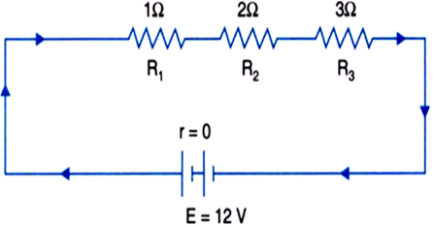
Therefore,
$=1+2+3$
$=6\ \Omega$
$\text{I}=\frac{\text{E}}{\text{R}+\text{r}}=\frac{12}{6+0}=2\ \text{A}$
Potential drop across $R_1 = 2 \times 1V = 2V$
Potential drop across $R_2 = 2 \times 2V = 4V$
Potential drop across $R_3 = 2 \times 3V = 6V$
Therefore,
- Total resistance of series combination is given by,
$=1+2+3$
$=6\ \Omega$
- If the combination is connected to a battery of $12 V$ and negligible internal resistance.
$\text{I}=\frac{\text{E}}{\text{R}+\text{r}}=\frac{12}{6+0}=2\ \text{A}$
Potential drop across $R_1 = 2 \times 1V = 2V$
Potential drop across $R_2 = 2 \times 2V = 4V$
Potential drop across $R_3 = 2 \times 3V = 6V$

Download our appand get started for free
Experience the future of education. Simply download our apps or reach out to us for more information. Let's shape the future of learning together!No signup needed.*
Similar Questions
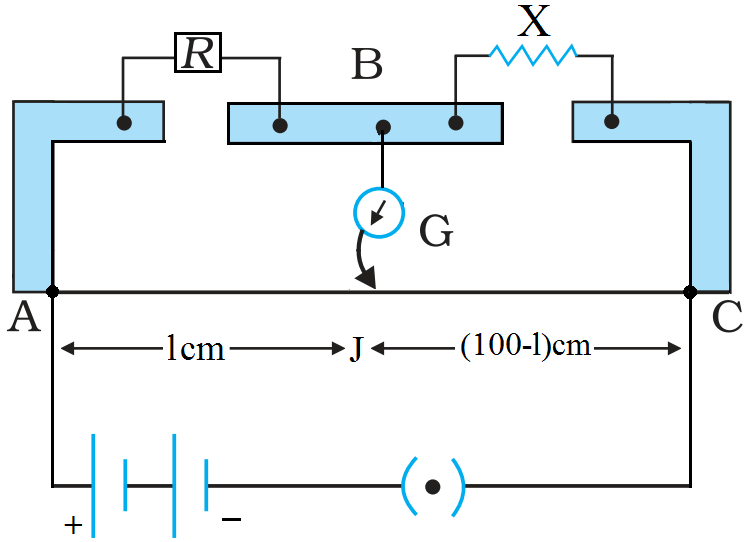
- 1A resistance $\text{R}=4\Omega$ is connected to one of the gaps in a meter bridge, which uses a wire of length 1m. An unknown resistance $\text{x}>4\Omega$ is connected in the other gap as shown in the figure. The balance point is noticed at ‘l’ cm from the positive end of the battery. On interchanging R and X, it is found that the balance point further shifts by 20cm (away from the end A). Neglecting the end correction calculate the value of unknown resistance ‘X’ used.View Solution
- 2n-identical cells, each of emf $\varepsilon,$ internal resistance r connected in series are charged by a dc source of emf $\varepsilon'$ using a resistance R.View Solution
- Draw the circuit arrangement.
- Deduce expressions for (a) the charging current and (b) the potential difference across the combination of cells.
- 3View SolutionAnswer the following:
- Why are the connections between the resistors in a meter bridge made of thick copper strips?
- Why is it generally preferred to obtain the balance point in the middle of the meter bridge wire?
- Which material is used for the meter bridge wire and why?
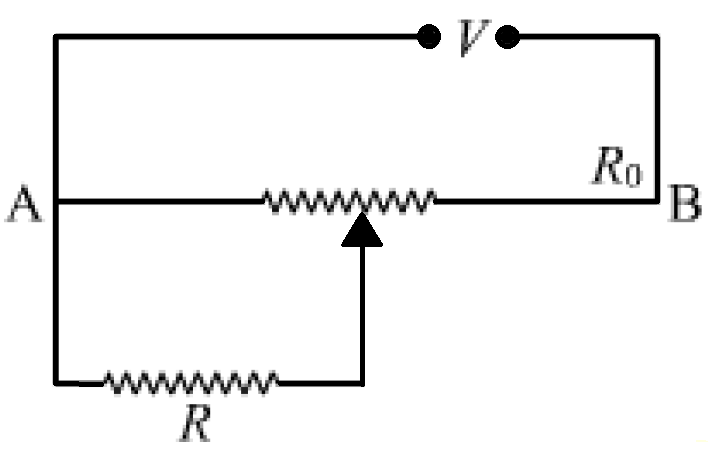
- 4A resistance of $R$ draws current from a potentiometer. The potentiometer wire, $AB,$ has a total resistance of $R_o$. A voltage $V$ is supplied to the potentiometer. Derive an expression for the voltage across $R$ when the sliding contact is in the middle of potentiometer wire.View Solution
- 5View Solution
- Three resistors $2\ \Omega,\ 4\ \Omega\ \text{and}\ 5\ \Omega$ are combined in parallel. What is the total resistance of the combination?
- If the combination is connected to a battery of emf 20 V and negligible internal resistance, determine the current through each resistor, and the total current drawn from the battery.
- 6Calculate the temperature at which the resistance of a conductor becomes 20% more than its resistance at 27°C. The value of the temperature coefficient of resistance of the conductor is $2.0 \times 10\frac{-4}{\text{K}}.$View Solution
- 7A battery of emf 10 V and internal resistance $3\ \Omega$ is connected to a resistor. If the current in the circuit is 0.5 A, what is the resistance of the resistor? What is the terminal voltage of the battery when the circuit is closed?View Solution
- 8What is end error in a metre bridge? How is it overcome? The resistances in the two arms of the metre bridge are $\text{R}=5\Omega$ and $S$ respectively. When the resistance $S$ is shunted with an equal resistance, the new balance length found to be $1.5 l_1 ,$ where $l_1$ is the initial balancing length. Calculate the value of $S.$View Solution
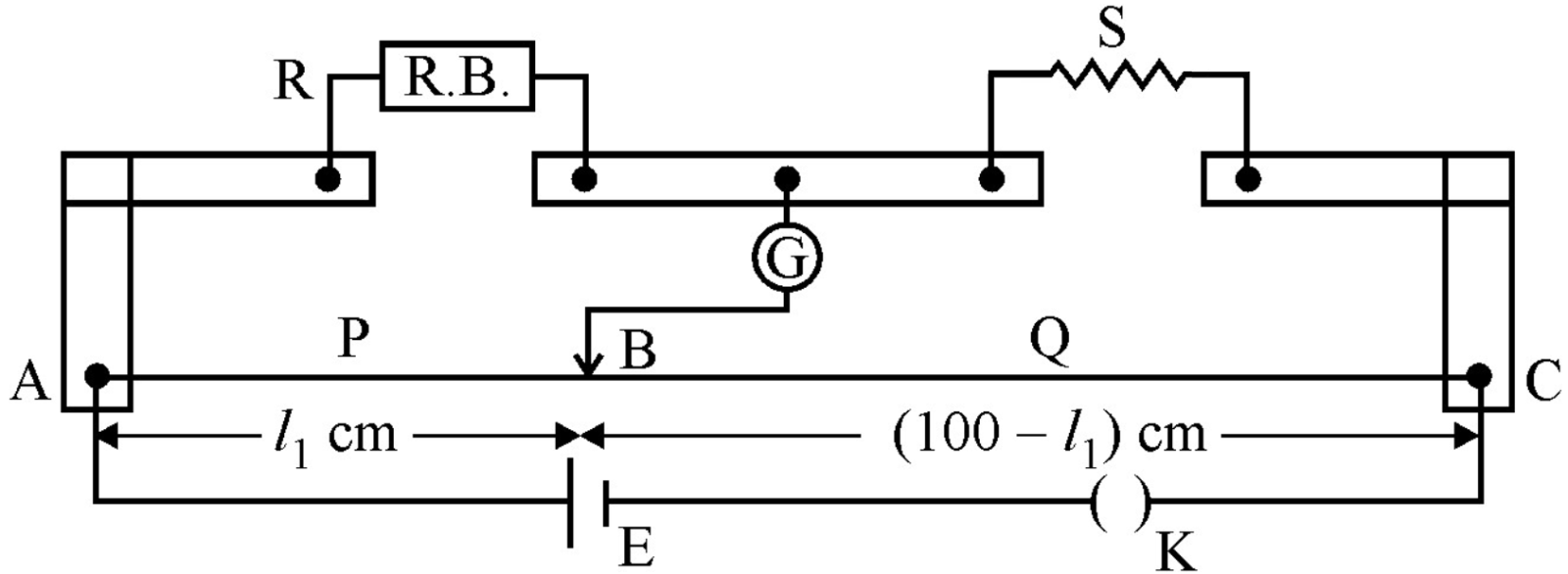
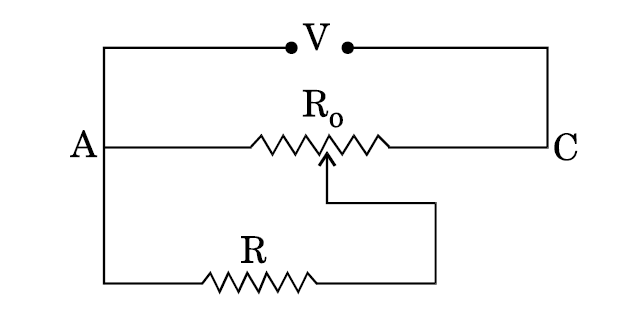
- 9A resistance of $R \Omega$ draws current from a potentiometer as shown in the figure. The potentiometer has a total resistance $R_o\Omega$ . A voltage $V$ is supplied to the potentiometer. Derive an expression for the voltage across $R$ when the sliding contact is in the middle of the potentiometer.View Solution
- 10Two heating elements of resistances $R_{1}$ and $R_{2}$ when operated at a constant supply of voltage, $V$, Consume power $P_1$ and $P_2$ respectively. Deduce the expressions for the power of their combination when they are, in turn, connected in $(i)$ series and $(ii)$ parallel across the same voltage supply.View Solution