If pressure of $C{O_2}$ (real gas) in a container is given by $P = \frac{{RT}}{{2V - b}} - \frac{a}{{4{b^2}}}$ then mass of the gas in container is ...... $gm$
Medium


Download our appand get started for free
Experience the future of education. Simply download our apps or reach out to us for more information. Let's shape the future of learning together!No signup needed.*
Similar Questions
- 1$310\,J$ of heat is required to raise the temperature of $2\,moles$ of an ideal gas at constant pressure from $25\,^oC$ to $35\,^oC$ . The amount of heat required to raise the temperature of the gas through the same range at constant volume is .... $J$View Solution
- 2When $2 \,\,gms$ of a gas are introduced into an evacuated flask kept at $25\,^0C$ the pressure is found to be one atmosphere. If $3 \,\,gms$ of another gas added to the same flask the pressure becomes $1.5$ atmospheres. The ratio of the molecular weights of these gases will beView Solution
- 3View SolutionIncrease in temperature of a gas filled in a container would lead to
- 4The temperature of a gas having $2.0 \times 10^{25}$ molecules per cubic meter at $1.38 \mathrm{~atm}$ (Given, $\mathrm{k}=$ $\left.1.38 \times 10^{-23} \mathrm{JK}^{-1}\right)$ is :View Solution
- 5Five moles of helium are mixed with two moles of hydrogen to form a mixture. Take molar mass of helium $M_1=4\ g$ and that of hydrogen $M_2=2\ g$ The equivalent molar mass of the mixture isView Solution
- 6One mole of an ideal gas $\left( {\frac{{{C_P}}}{{{C_V}}}\, = \gamma } \right)$ heated by law $P=\alpha V$ where $P$ is pressure of gas, $V$ is volume, $\alpha$ is a constant what is the heat capacity of gas in the process-View Solution
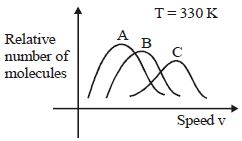
- 7View SolutionMaxwell distribution function is shown in figure for different gases, which of the following is correct matching?
- 8In the isothermal expansion of $10\,g$ of gas from volume $V$ to $2V$ the work done by the gas is $575\,J$. What is the root mean square speed of the molecules of the gas at that temperature ..... $m/s$?View Solution
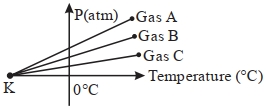
- 9For three low density gases $A, B, C$ pressure versus temperature graphs are plotted while keeping them at constant volume, as shown in the figure.View Solution
The temperature corresponding to the point ' $K$ ' is $...........\,{}^{\circ}\,C$
- 10In kinetic theory of gases, a molecule of mass m of an ideal gas collides with a wall of vessel with velocity $V.$ The change in the linear momentum of the molecule isView Solution