Use the mirror equation to deduce that:
- an object placed between f and 2f of a concave mirror produces a real image beyond 2f.
- a convex mirror always produces a virtual image independent of the location of the object.
- the virtual image produced by a convex mirror is always diminished in size and is located between the focus and the pole.
Exercise
Download our app for free and get started
- For a concave mirror, the focal length (f) is negative.
When the object is placed on the left side of the mirror, the object distance (u)is negative.
$\therefore \ \text{u}<0$
For image distance v, we can write the lens formula as:
$\frac{1}{\text{v}}-\frac{1}{\text{u}}=\frac{1}{\text{f}}$
$\frac{1}{\text{v}}=\frac{1}{\text{f}}-\frac{1}{\text{u}}\dots(1)$
The object lies between f and 2f.
$\therefore \ 2\text{f}<\text{u}<\text{f}$ $(\therefore \ \text{u and f are negetive})$
$\frac{1}{2\text{f}}>\frac{1}{\text{u}}>\frac{1}{\text{f}}$
$-\frac{1}{2\text{f}}>-\frac{1}{\text{u}}>-\frac{1}{\text{f}}$
$\frac{1}{\text{f}}-\frac{1}{2\text{f}}<\frac{1}{\text{f}}-\frac{1}{\text{u}}<0\dots(2)$
Using equation (1), we get:
$\frac{1}{2\text{f}}<\frac{1}{\text{v}}<0$
$\therefore \ \frac{1}{\text{v}}$ is negative, i.e., v is negative.
$\frac{1}{2\text{f}}<\frac{1}{\text{v}}$
2f > v
-v > -2f
Therefore, the image lies beyond 2f.
- For a convex mirror, the focal length (f) is positive.
When the object is placed on the left side of the mirror, the object distance (u) is negative.
$\therefore \ \text{u}>0$
For image distance v, we have the mirror formula:
$\frac{1}{\text{v}}+\frac{1}{\text{u}}=\frac{1}{\text{f}}$
$\frac{1}{\text{v}}=\frac{1}{\text{f}}-\frac{1}{\text{u}}$
Using equation (2), we can conclude that:
$\frac{1}{\text{v}}<0$
v > 0
Thus, the image is formed on the back side of the mirror.
Hence, a convex mirror always produces a virtual image, regardless of the object distance.
- For a convex mirror, the focal length (f) is positive.
When the object is placed on the left side of the mirror, the object distance (u) is negative,
$\therefore \ \text{u}>0$
For image distance v, we have the mirror formula:
$\frac{1}{\text{v}}+\frac{1}{\text{u}}=\frac{1}{\text{f}}$
$\frac{1}{\text{v}}=\frac{1}{\text{f}}-\frac{1}{\text{u}}$
But we have u < 0
$\therefore \ \frac{1}{\text{v}}>\frac{1}{\text{f}}$
v < f
Hence, the image formed is diminished and is located between the focus (f) and the pole.
- For a concave mirror, the focal length (f) is negative
When the object is placed on the left side of the mirror, the object distance (u) is negative.
$\therefore \ \text{u}>0$
It is placed between the focus (f) and the pole.
$\therefore \ \text{f}>\text{u}>0$
$\frac{1}{\text{f}}<\frac{1}{\text{u}}<0$
$\frac{1}{\text{f}}-\frac{1}{\text{u}}<0$
For image distance v, we have the mirror formula:
$\frac{1}{\text{v}}+\frac{1}{\text{u}}=\frac{1}{\text{f}}$
$\frac{1}{\text{v}}=\frac{1}{\text{f}}-\frac{1}{\text{u}}$
$\therefore \ \frac{1}{\text{v}}<0$
v > 0
The image is formed on the right side of the mirror. Hence, it is a virtual image. For u < 0 and v > 0, we can write:
$\frac{1}{\text{u}}>\frac{1}{\text{v}}$
v > u

Download our appand get started for free
Experience the future of education. Simply download our apps or reach out to us for more information. Let's shape the future of learning together!No signup needed.*
Similar Questions
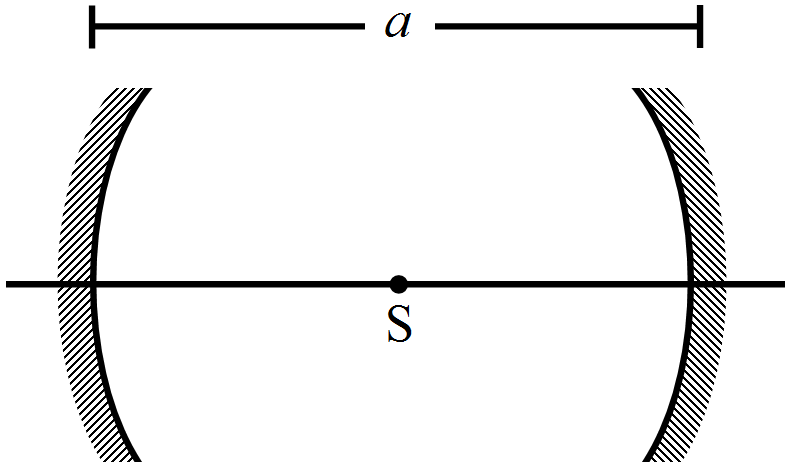
- 1View SolutionA point source S is placed midway between two converging mirrors having equal focal length f. Find the values of d for which only one image is formed.
- 2View SolutionThe mixture a pure liquid and a solution in a long vertical column (i.e, horizontal dimensions < < vertical dimensions) produces diffusion of solute particles and hence a refractive index gradient along the vertical dimension. A ray of light entering the column at right angles to the vertical is deviated from its original path. Find the deviation in travelling a horizontal distance d < < h, the height of the column.
- 3With the help of a ray diagram, show the formation of image of a point object due to refraction of light at a spherical surface separating two media of refractive indices $n_1$ and $n_2 (n_2 > n_1)$ respectively. Using this diagram, derive the relation.View Solution
$\frac{\text{n}_2}{\text{v}}-\frac{\text{n}_1}{\text{u}}=\frac{\text{n}_1-\text{n}_2}{\text{R}}$
Write the sign conventions used. What happens to the focal length of convex lens when it is immersed in water? - 4View SolutionFigure shows a plane mirror M placed at a distance of 10cm from a concave lens L. A point object is placed at a distance of 60cm from the lens. The image formed due to refraction by the lens and reflection by the mirror is 30cm behind the mirror. What is the focal length of this lens?
- 5The radii of curvature of a lens are +20cm and +30cm. The material of the lens has a refracting index 1.6. Find the focal length of the lens.View Solution
- If it is placed in air.
- If it is placed in water $(\mu=1.33).$
- 6View SolutionAn astronomical telescope is to be designed to have a magnifying power of 50 in normal adjustment. If the length of the tube is 102cm, find the powers of the objective and the eyepiece.
- 7View SolutionAn unsymmetrical double convex thin lens forms the image of a point object on its axis. Will the position of the image change if the lens is reversed?
- 8View SolutionA converging lens of focal length 15cm and a converging mirror of focal length 10cm are placed 50cm apart with common principal axis. A point source is placed in between the lens and the mirror at a distance of 40cm from the lens. Find the locations of the two images formed.
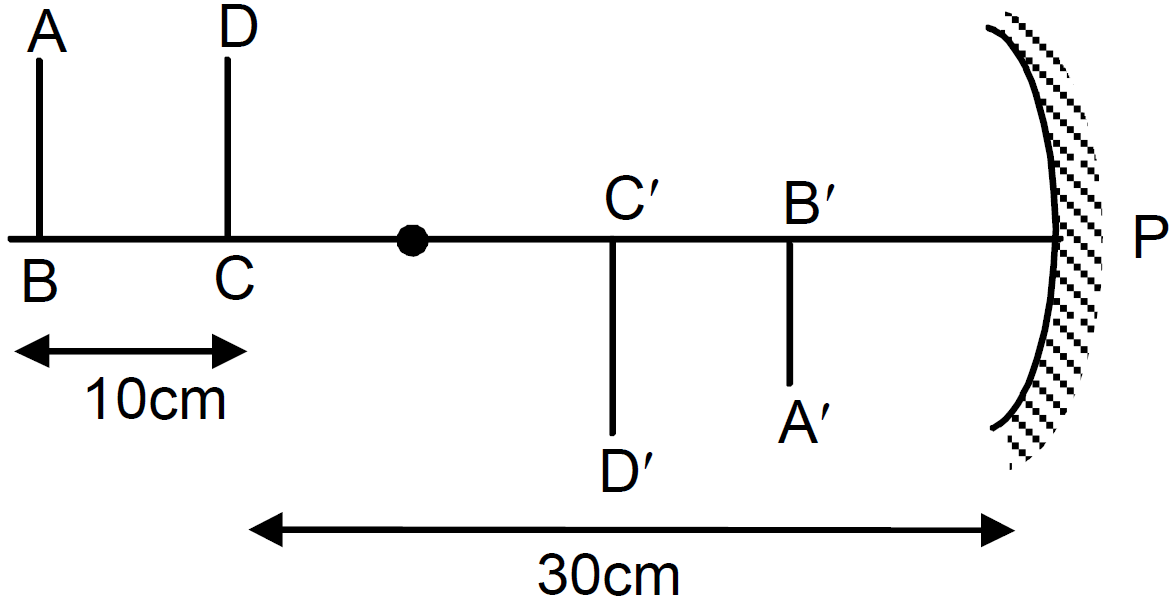
- 9View SolutionA U-shaped wire is placed before a concave mirror having radius of curvature 20cm. Find the total length of the image.
- 10Three immiscible liquids of densities $d_1 > d_2 > d_3$ and refractive indices $\mu _1 > \mu _2 > \mu _3$ are put in a beaker. The height of each liquid column is $\frac{\text{h}}{3}$. A dot is made at the bottom of the beaker. For near normal vision, find the apparent depth of the dot.View Solution