The air density at Mount Everest is less than that at the sea level. It is found by mountaineers that for one trip lasting a few hours, the extra oxygen needed by them corresponds to $30,000\, cc$ at sea level (pressure $1$ atmosphere, temperature $27°C$). Assuming that the temperature around Mount Everest is $-73°C$ and that the oxygen cylinder has capacity of $5.2 \,litre,$ the pressure at which ${O_2}$ be filled (at site) in cylinder is .... $atm$
Medium


Download our appand get started for free
Experience the future of education. Simply download our apps or reach out to us for more information. Let's shape the future of learning together!No signup needed.*
Similar Questions
- 1By what factor the $r.m.s.$ velocity will change, if the temperature is raised from $27^\circ C$ to $327^\circ C$View Solution
- 2The root mean square speed of the molecules of a diatomic gas is $v$. When the temperature is doubled, the molecules dissociate into two atoms. The new root mean square speed of the atom isView Solution
- 3A jar contains a gas and few drops of water at $T K.$ The pressure in the jar is $830 \,mm$ of mercury. The temperature of jar is reduced by $1\%.$ The saturated vapour pressure of water at the two temperatures are $30 \,mm$ and $ 25\, mm$ of mercury. Then the new pressure in the jar will be ..... $mm$ of $Hg$View Solution
- 4View SolutionWhich one the following graphs represents the behaviour of an ideal gas
- 5If the volume of the gas containing $n$ number of molecules is $V,$ then the pressure will decrease due to force of intermolecular attraction in the proportionView Solution
- 6$3\,moles$ of an ideal gas at a temperature of $27^{\circ}\,C$ are mixed with $2\,moles$ of an ideal gas at a temperature $227^{\circ}\,C$, determine the equilibrium temperature (${}^o C$) of the mixture, assuming no loss of energy.View Solution
- 7A gas at ${27}^\circ C$ temperature and $30$ atmospheric pressure is allowed to expand to the atmospheric pressure. If the volume becomes $10$ times its initial volume, then the final temperature becomes ...... $^oC$View Solution
- 8Two gases-argon (atomic radius $0.07 \;\mathrm{nm}$,atomic weight $40$ ) and xenon (atomic radius $0.1\; \mathrm{nm},$ atomic weight $140$ ) have the same number density and are at the same temperature. The raito of their respective mean free times is closest toView Solution
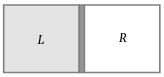
- 9A vessel is partitioned in two equal halves by a fixed diathermic separator. Two different ideal gases are filled in left $(L)$ and right $(R)$ halves. The rms speed of the molecules in $L$ part is equal to the mean speed of molecules in the $R$ part. Then the ratio of the mass of a molecule in $L$ part to that of a molecule in $R$ part isView Solution
- 10The average degree of freedom per molecule of a gas is $6.$ The gas performs $25 \,J$ work, while expanding at constant pressure. The heat absorbed by the gas is ...... $J$View Solution