MCQ
The phase difference between two $SHM\,\,$  ${y_1}\, = \,10\,\sin \,\left( {10\pi t\, + \,\frac{\pi }{3}} \right)$ and ${y_2}\, = \,12\,\sin \,\left( {8\pi t\, + \,\frac{\pi }{4}} \right)$  at $t = 0.5\,s$ it
  • A
    $\frac {11 \pi}{12}$
  • $\frac {13 \pi}{12}$
  • C
    $\pi $
  • D
    $\frac {17 \pi}{12}$

Answer

Correct option: B.
$\frac {13 \pi}{12}$
b
Phase for $1\, st$ $\mathrm{SHM}: \phi_{1}=10 \pi \mathrm{t}+\frac{\pi}{3}$

Phase for $2 \,nd$ $\mathrm{SHM}: \phi_{2}=8 \pi \mathrm{t}+\frac{\pi}{4}$

Phase difference : $\Delta \phi=\phi_{1}-\phi_{2}=2 \pi t+\frac{\pi}{12}$

Put $t=0.5 \mathrm{s}$

$\Delta \phi=2 \pi(0.5)+\frac{\pi}{12}=\frac{13 \pi}{12}$

Need a full question paper?

Generate a complete, print-ready paper with questions like this in minutes — across 16+ boards, with answer keys.

Start Generating Free

Similar questions

Which of the following quantities has a unit but dimensionless?
If a spring has time period $T$, and is cut into $n$ equal parts, then the time period of each part will be
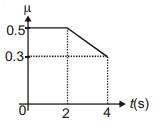
A block is projected with speed $20 \,m / s$ on a rough horizontal surface. The coefficient of friction $(\mu)$ between the surfaces varies with time $(t)$ as shown in figure. The speed of body at the end of $4$ second will be ............ $m / s$ ( $g=$ $10 \,m / s ^2$ )
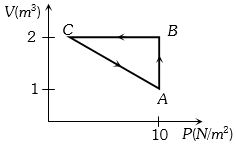
An ideal gas is taken through the cycle $A → B → C → A$, as shown in the figure. If the net heat supplied to the gas in the cycle is $5 \ J$, the work done by the gas in the process $C → A$ is ....... $J$

      Column $-I$

    Angle of projection

    Column $-II$
  $A.$ $\theta \, = \,{45^o}$   $1.$ $\frac{{{K_h}}}{{{K_i}}} = \frac{1}{4}$
  $B.$ $\theta \, = \,{60^o}$   $2.$ $\frac{{g{T^2}}}{R} = 8$
  $C.$ $\theta \, = \,{30^o}$   $3.$ $\frac{R}{H} = 4\sqrt 3 $
  $D.$ $\theta \, = \,{\tan ^{ - 1}}\,4$   $4.$ $\frac{R}{H} = 4$

$K_i :$ initial kinetic energy

$K_h :$ kinetic energy at the highest point

A body of mass $m$ moving with velocity  $v$ elastic collides head on with another body of mass $2\,\,m$ which is initially at rest. The ratio of  $K.E.$  of the colliding body before and after collision will be
A spring is compressed between two toy carts of mass $m_1$ and $m_2$. When the toy carts are released, the springs exert equal and opposite average forces for the same time on each toy cart. If $v_1$ and $v_2$ are the velocities of the toy carts and there is no friction between the toy carts and the ground, then :
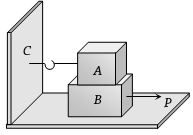
Block $A$ weighing $100$ kg rests on a block $B$ and is tied with a horizontal string to the wall at $C$. Block $B$ weighs $200 \,kg$. The coefficient of friction between $A$ and $B$ is $0.25$ and between $B$ and the surface is $1/3$. The horizontal force $P$ necessary to move the block $B$ should be  ........ $N$ $(g = 10\,m/{s^2})$
Pressure inside two soap bubbles are $1.01$ and $1.02$ atmosphere, respectively. The ratio of their volumes is
The potential energy of a particle of mass $m$ at a distance $r$ from a fixed point $O$ is given by $\mathrm{V}(\mathrm{r})=\mathrm{kr}^2 / 2$, where $\mathrm{k}$ is a positive constant of appropriate dimensions. This particle is moving in a circular orbit of radius $\mathrm{R}$ about the point $\mathrm{O}$. If $\mathrm{v}$ is the speed of the particle and $\mathrm{L}$ is the magnitude of its angular momentum about $\mathrm{O}$, which of the following statements is (are) true?

$(A)$ $v=\sqrt{\frac{k}{2 m}} R$

$(B)$ $v=\sqrt{\frac{k}{m}} R$

$(C)$ $\mathrm{L}=\sqrt{\mathrm{mk}} \mathrm{R}^2$

$(D)$ $\mathrm{L}=\sqrt{\frac{\mathrm{mk}}{2}} \mathrm{R}^2$