The ratio of specific heat of a mixture of one mole of helium and one mole of hydrogen gas will be
Medium


Download our appand get started for free
Experience the future of education. Simply download our apps or reach out to us for more information. Let's shape the future of learning together!No signup needed.*
Similar Questions
- 1Let $\gamma_1$ be the ratio of molar specific heat at constant pressure and molar specific heat at constant volume of a monoatomic gas and $\gamma_2$ be the similar ratio of diatomic gas. Considering the diatomic gas molecule as a rigid rotator, the ratio, $\frac{\gamma_1}{\gamma_2}$ isView Solution
- 2A certain amount of an ideal monatomic gas needs $20 \,J$ of heat energy to raise its temperature by $10^{\circ} C$ at constant pressure. The heat needed for the same temperature rise at constant volume will be ........ $J$View Solution
- 3$C_v$ and $C_p$ denote the molar specific heat capacities of a gas at constant volume and constant pressure, respectively. ThenView Solution
- 4View SolutionThat gas cannot be liquified
- 5Hydrogen gas and oxygen gas have volume $1 \,\,cm^3$ each at $N.T.P$.View Solution
- 6View SolutionAt constant volume, temperature is increased. Then
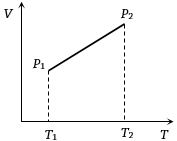
- 7From the following $V-T$ diagram we can concludeView Solution
- 8A container is divided into two equal parts $I$ and $II$ by a partition with a small hole of diameter $d$. The two partitions are filled with same ideal gas, but held at temperatures $T_{ I }=150 \,K$ and $T_{ II }=300 \,K$ by connecting to heat reservoirs. Let $\lambda_{1}$ and $\lambda_{1 I}$ be the mean free paths of the gas particles in the two parts, such that $d >> \lambda_{ I }$ and $d >> \lambda_{ II }$. Then, the $\lambda_{ I } / \lambda_{ II }$ is close toView Solution
- 9At constant pressure, the ratio of increase in volume of an ideal gas per degree raise in kelvin temperature to it's original volume is $(T =$ absolute temperature of the gas$)$View Solution
- 10For a gas, the $r.m.s.$ speed at $800\, K$ isView Solution