A cylinder is suspended by two strings wrapped around the cylinder near each end, the free ends of the string being attached to hooks on the ceiling, such that the length of the cylinder is horizontal. From the position of rest, the cylinder is allowed to roll down as suspension strings unwind. Calculate: (i) the downward linear acceleration of the cylinder and (ii) tension in the strings. Mass of cylinder is 12kg.
Download our app for free and get started
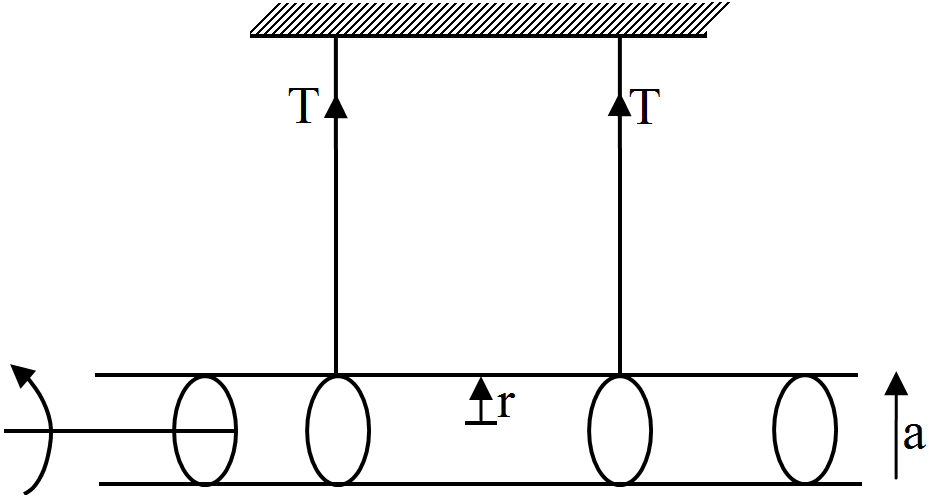 Let the downward linear acceleration of the cylinder be a. If M be the mass of the cylinder, then
$\text{Mg}-2\text{T}=\text{Ma}$
$\text{or }\text{T}=\frac{1}{2}\text{m}(\text{g}-\text{a})\dots(1)$
Now, Torque = Moment of inertia × angular acceleration
$\text{i.e.,}2\text{Tr}=\text{I}\alpha$
(when $\alpha$ = liner acceleration/ r)
$\text{or }2\text{Tr}=\frac{1}{2}\text{mr}^2\times\Big(\frac{\text{a}}{\text{r}}\Big)$
$\text{or }\text{T}=\frac{\text{ma}}{4}\dots(2)$
From eqns (1) and (2), we get
$\text{m}\frac{\text{a}}{4}=\frac{1}{2}\text{m}(\text{g}-\text{a})$
Solving eqns (3), we get $\text{a}=\Big(\frac{2}{3}\Big)\text{g}$
Substituting the value of a in eq. (2), we get
$\text{T}=\frac{\text{m}\Big(\frac{2}{3}\Big)\text{g}}{4}$
$=\frac{\text{m}\times2\text{g}}{12}=\frac{12\times2\text{g}}{12}=2\text{kgf}.$

Download our appand get started for free
Experience the future of education. Simply download our apps or reach out to us for more information. Let's shape the future of learning together!No signup needed.*
Similar Questions
- 1Separation of Motion of a system of particles into motion of the centre of mass and motion about the centre of mass: Show $\text{L}=\text{L}'+\text{R}\times\text{MV}$ where $\text{L}'=\sum\text{r}'_\text{i}\times\text{p}'_\text{i}$ is the angular momentum of the system about the centre of mass with velocities taken relative to the centre of mass. Remember $\text{r}'_\text{i}=\text{r}_\text{i}-\text{R},$ rest of the notation is the standard notation used in the chapter. Note: $\text{L}'$ and $\text{MR}\times\text{V}$ can be said to be angular momenta, respectively, about and of the centre of mass of the system of particles.View Solution
- 2An isolated particle of mass m is moving in a horizontal plane (x - y), along the x-axis at a certain height about the ground. It explodes suddenly into two fragments of masses $\frac{\text{m}}{4}$ and $3\frac{\text{m}}{4}.$ An instant later, the smaller fragment is at y = + 15 cm. What is the position of larger fragment at this instant?View Solution
- 3View SolutionTwo particles, each of mass m and speed v, travel in opposite directions along parallel lines separated by a distance d. Show that the angular momentum vector of the two particle system is the same whatever be the point about which the angular momentum is taken.
- 4A hollow sphere is released from the top of an inclined plane of inclination $\theta.$View Solution
- What should be the minimum coefficient of friction between the sphere and the plane to prevent sliding?
- Find the kinetic energy of the ball as it moves down a length 1 on the incline if the friction coefficient is half the value calculated in part (a).
- 5Point masses $m_1$ and $m_2$ are placed at the opposite ends of a rigid rod of length L, and negligible mass. The rod is to be set in rotation about an axis perpendicular to it. Find the position on this rod through which the axis should pass in order that the work required to set the rod in rotation with angular velocity $\omega_0$ should be minimum.View Solution
- 6View SolutionA uniform disc of radius R is put over another uniform disc of radius 2R of the same thickness and density. The peripheries of the two discs touch each other. Locate the centre of mass of the system.
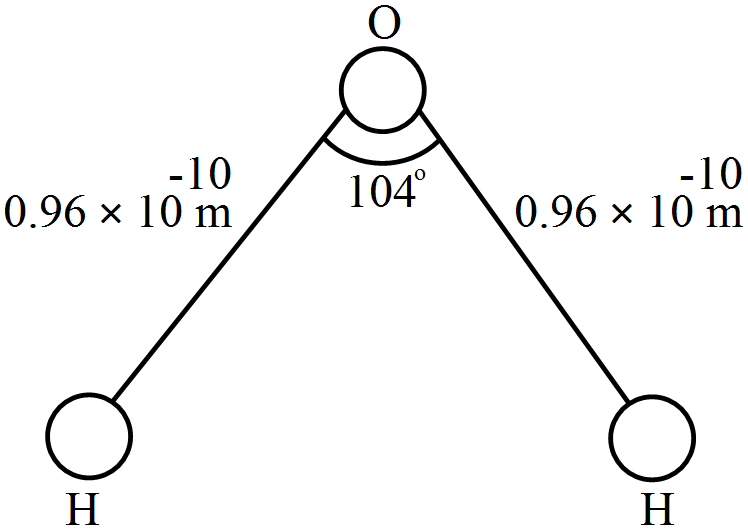
- 7View SolutionThe structure of a water molecule is shown in figure. Find the distance of the centre of mass of the molecule from the centre of the oxygen atom.
- 8View SolutionA uniform rod of mass m and length l is struck at an end by a force F perpendicular to the rod for a short time interval t. Calculate:
- The speed of the centre of mass.
- The angular speed of the rod about the centre of mass.
- The kinetic energy of the rod.
- The angular momentum of the rod about the centre of mass after the force has stopped to act. Assume that t is so small that the rod does not appreciably change its direction while the force acts.
- 9View SolutionA threaded rod with 12turns/ cm and diameter 1.18cm is mounted horizontally. A bar with a threaded hole to match the rod is screwed onto the rod. The bar spins at 216rev/ min. How long will it take for the bar to move 1.50cm along the rod?
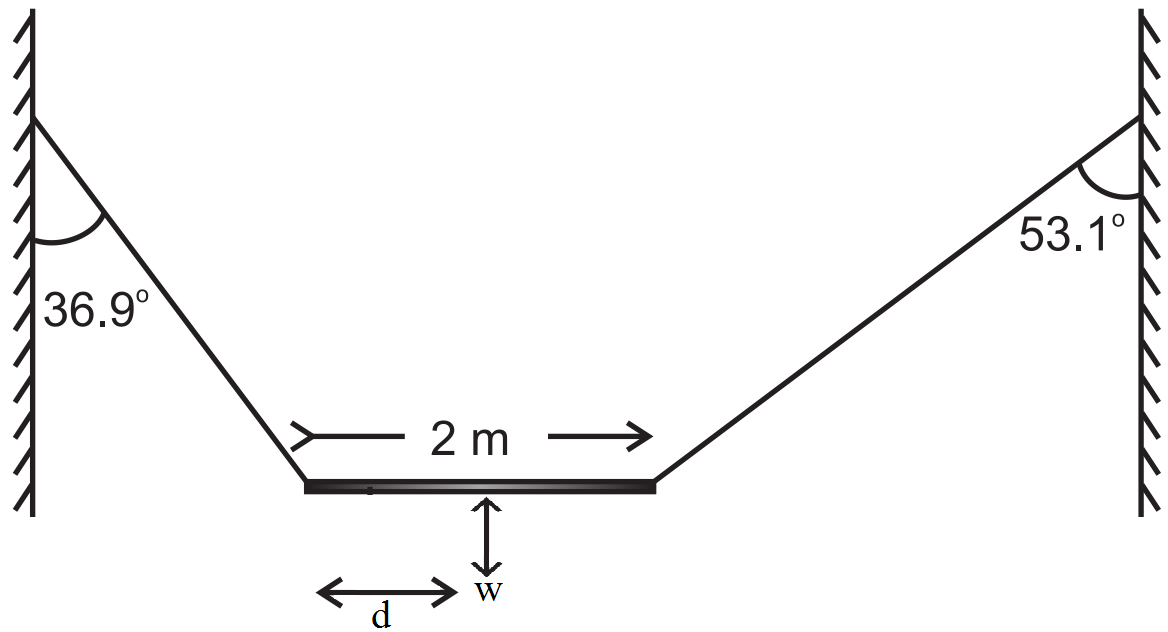
- 10A non-uniform bar of weight W is suspended at rest by two strings of negligible weight as shown in. The angles made by the strings with the vertical are $36.9°$ and $53.1°$ respectively. The bar is $2m$ long. Calculate the distance d of the centre of gravity of the bar from its left end.View Solution