The oxygen molecule has a mass of $5.30 \times 10^{-26}kg$ and a moment of inertia of $1.94 \times 10^{-46}kgm^2$ about an axis through its centre perpendicular to the lines joining the two atoms. Suppose the mean speed of such a molecule in a gas is 500m/s and that its kinetic energy of rotation is two thirds of its kinetic energy of translation. Find the average angular velocity of the molecule.
Download our app for free and get started
Mass of an oxygen molecule, $m = 5.30 \times 10^{-26}kg$ Moment of inertia, $I = 1.94 \times 10^{-46}kgm^2$^ Velocity of the oxygen molecule, v = 500m/s The separation between the two atoms of the oxygen molecule = 2r Mass of each oxygen atom $=\frac{\text{m}}{2}$ Hence, moment of inertia I, is calculated as, $\Big(\frac{\text{m}}{2}\Big)\text{r}^2+\Big(\frac{\text{m}}{2}\Big)\text{r}^2=\text{mr}^2$
$\text{r}=\Big(\frac{\text{l}}{\text{m}}\Big)^{\frac{1}{2}}$
$\Big(\frac{1.94\times10^{-46}}{5.36\times10^{-26}}\Big)=0.60\times10^{-10}\text{m}$ It is given that, $\text{kE}_{\text{rot}}=\Big(\frac{2}{3}\Big)\times\Big(\frac{1}{2}\Big)\times\text{mv}^2$
$\text{m}\text{r}^2\omega^2=\Big(\frac{2}{3}\Big)\text{mv}^2$
$\omega=\Big(\frac{2}{3}\Big)^{\frac{1}{2}}\Big(\frac{\text{v}}{\text{r}}\Big)$
$\omega=\Big(\frac{2}{3}\Big)^{\frac{1}{2}}\Big(\frac{500}{0.6\times10^{-10}}\Big)$
$\omega=6.80\times10^{12}\text{rad/s}$
$\text{r}=\Big(\frac{\text{l}}{\text{m}}\Big)^{\frac{1}{2}}$
$\Big(\frac{1.94\times10^{-46}}{5.36\times10^{-26}}\Big)=0.60\times10^{-10}\text{m}$ It is given that, $\text{kE}_{\text{rot}}=\Big(\frac{2}{3}\Big)\times\Big(\frac{1}{2}\Big)\times\text{mv}^2$
$\text{m}\text{r}^2\omega^2=\Big(\frac{2}{3}\Big)\text{mv}^2$
$\omega=\Big(\frac{2}{3}\Big)^{\frac{1}{2}}\Big(\frac{\text{v}}{\text{r}}\Big)$
$\omega=\Big(\frac{2}{3}\Big)^{\frac{1}{2}}\Big(\frac{500}{0.6\times10^{-10}}\Big)$
$\omega=6.80\times10^{12}\text{rad/s}$

Download our appand get started for free
Experience the future of education. Simply download our apps or reach out to us for more information. Let's shape the future of learning together!No signup needed.*
Similar Questions
- 1Find the centre of mass of a uniform $L-$shaped lamina $($a thin flat plate$)$ with dimensions as shown. The mass of the lamina is $3 \ kg.$View Solution
- 2Suppose the smaller pulley of the previous problem has its radius $5.0cm$ and moment of inertia $0.10kg-m^2$. Find the tension in the part of the string joining the pulleys.View Solution
- 3View SolutionA solid cylinder of mass M and radius R has a light flexible rope wound around it. The rope carries a mass m at its free end. The mass is rest at a height h above the floor. Find the angular velocity of the cylinder at the instant the mass m, after release, strikes the floor. Assume friction to be absent and the cylinder to rotate about its own axis.
- 4A solid disc and a ring, both of radius $10cm$ are placed on a horizontal table simultaneously, with initial angular speed equal to $10 π$ rad $s^{-1}$. Which of the two will start to roll earlier? The co-efficient of kinetic friction is $\mu_\text{k}=0.2$View Solution
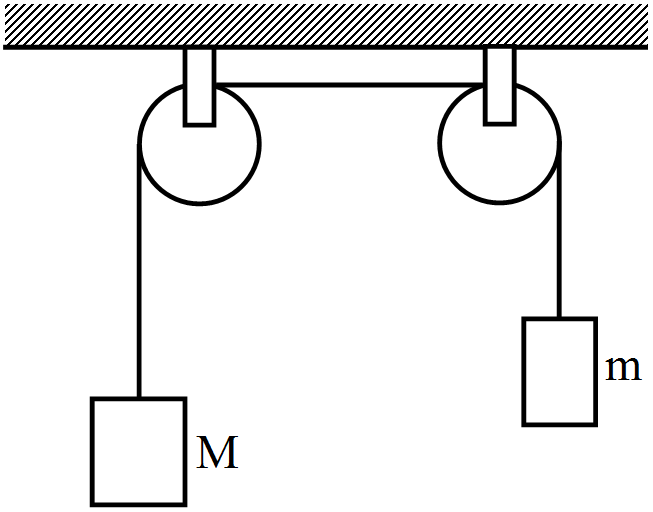
- 5View SolutionThe pulleys in figure are identical, each having a radius R and moment of inertia I. Find the acceleration of the block M.
- 6A $2kg$ body and a $3kg$ body are moving along the x-axis. At a particular instant, the $2kg$ body is $1m$ from the origin and has a velocity of $3ms^{-1}$ and the $3kg$ body is $2m$ from the origin and has velocity of $-1 ms^{-1}$. Find the position and velocity of the centre of mass and also find the total momentum.View Solution
- 7An electron of mass $9 \times 10^{-31}kg$ revolves in a circle of radius $0.53\mathring{\text{A}}$ around the nucleus of hydrogen with a velocity of $2.2 \times 10^6ms$. Show that angular momentum of elect ron is $\frac{\text{h}}{2\pi}$ where h is Planck's constant.View Solution
- 8From a uniform disk of radius R, a circular hole of radius $\frac{\text{R}}{2}$ is cut out. The centre of the hole is at $\frac{\text{R}}{2}$ from the centre of the original disc. Locate the centre of gravity of the resulting flat body.View Solution
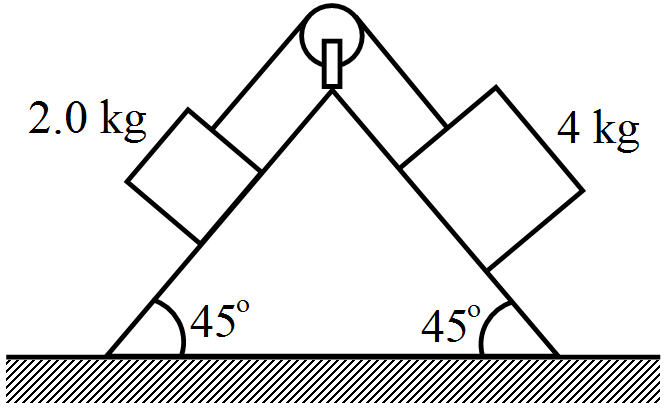
- 9The pulley shown in figure has a radius $10cm$ and moment of inertia $0.5kg-m^2$ about its axis. Assuming the inclined planes to be frictionless, calculate the acceleration of the $4.0kg$ block.View Solution
- 10$3$ A man stands on a rotating platform, with his arms stretched horizontally holding a $5kg$ weight in each hand. The angular speed of the platform is $30$ revolutions per minute. The man then brings his arms close to his body with the distance of each weight from the axis changing from $90cm$ to $20cm$. The moment of inertia of the man together with the platform may be taken to be constant and equal to $7.6kgm^2$.View Solution
- What is his new angular speed? (Neglect friction).
- Is kinetic energy conserved in the process? If not, from where does the change come about?