MCQ 2511 Mark
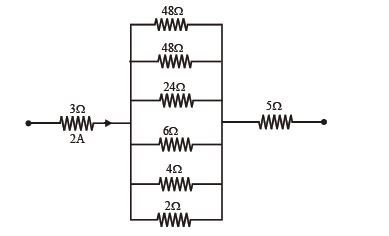
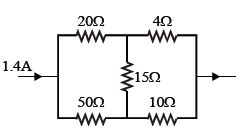
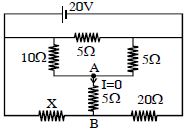
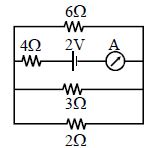
Find potential difference across $24\,\Omega $ ............. $\mathrm{volt}$
- A$48$
- ✓$2$
- C$4$
- D$1$
Answer
View full question & answer→Correct option: B.
$2$
b
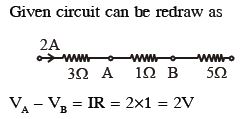
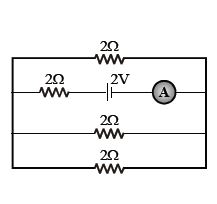
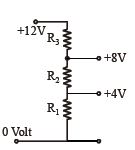
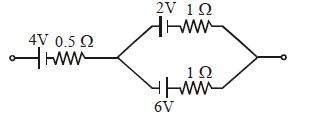
$\mathrm{E}^{\prime}=\frac{6 \times 1-2 \times 1}{1+1}=2 \mathrm{\,V} \quad $ and $ \quad \mathrm{R}^{\prime}=\frac{1}{2} \,\Omega$
Net $\mathrm{emf}$ $=2 \mathrm{\,V}$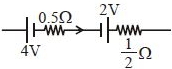
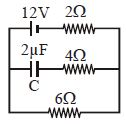
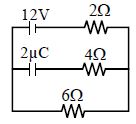
$\therefore $ Current in the circuit $\mathrm{I}=\frac{12}{6+2}=\frac{3}{2} \mathrm{\,amp}$
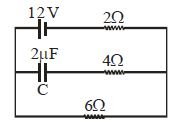
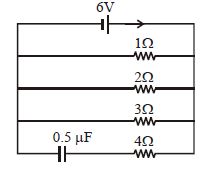
Potential difference across $2\, \mu \mathrm{F}$ is same as across $6\, \Omega$ resistance.
So, potential difference across capacitor of
$2\, \mu \mathrm{F}=6 \times \frac{3}{2}=9$ $\mathrm{volt}.$
$\therefore $ Charge on capacitor $=2 \times 9 \mu C=18\, \mu C$
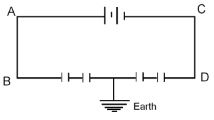
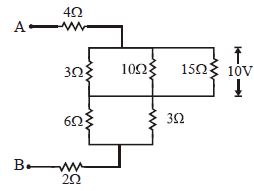
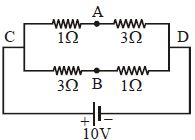
$\mathrm{V}_{\mathrm{A}}-\mathrm{V}_{\mathrm{P}}=\mathrm{V}_{\mathrm{P}}-\mathrm{V}_{\mathrm{B}}$ and $\mathrm{V}_{\mathrm{P}}=0$
${\therefore \quad \mathrm{V}_{\mathrm{A}}=-\mathrm{V}_{\mathrm{B}}} $
Also $ \quad \mathrm{V}_{\mathrm{A}}-\mathrm{V}_{\mathrm{B}}=10 \mathrm{\,V}$
$\,\,{{\rm{V}}_{\rm{A}}} = + 5\,{\rm{V}}$ and ${{\rm{V}}_{\rm{B}}} = - 5{\mkern 1mu} \,{\rm{V}}$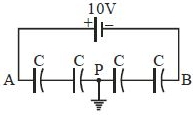
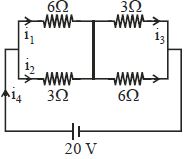
$\mathrm{i}_{4}=\frac{20}{4}=5 \mathrm{\,A}$
$\mathrm{i}_{1}=\frac{3}{3+6} \times 5=\frac{5}{3} \mathrm{\,A}$
$\mathrm{i}_{2}=\frac{6}{3+6} \times 5=\frac{10}{3} \mathrm{\,A}$
$\mathrm{i}_{3}=\frac{6}{3+6} \times 5=\frac{10}{3} \mathrm{\,A}$
Now, one resistance is removed then $\mathrm{R}_{2}=0$
$\therefore \mathrm{R}_{1}=2\, \Omega$
$\therefore \frac{2 \mathrm{R}_{2}}{2+\mathrm{R}_{2}}=\frac{6}{5}$
$10 \mathrm{R}_{2}=12+6 \mathrm{R}_{2}$
$4 \mathrm{R}_{2}=12$
$\mathrm{R}_{2}=3\, \Omega$
$\mathrm{v} \rightarrow$ potential drop across $6\, \Omega$ resistance.
at steady state, potential across $6\, \Omega$ is $=\frac{12}{8} \times 6$
$=9$ $\mathrm{volt}$
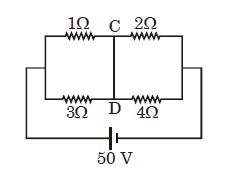
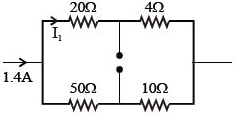
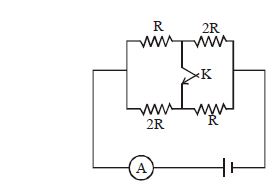
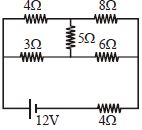
$\mathrm{I}_{1}=\frac{3}{4} \times 24=18 \mathrm{\,A}, \quad \mathrm{I}_{2}=\frac{1}{4} \times 24=6 \mathrm{\,A}$
$\mathrm{I}_{3}=\frac{4}{6} \times 24=16 \mathrm{\,A}, \quad \mathrm{I}_{4}=\frac{2}{6} \times 24=8 \mathrm{\,A}$
Current through conducting wire
$=\mathrm{I}_{1}-\mathrm{I}_{3}=2 \mathrm{\,A}$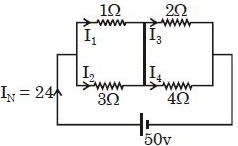
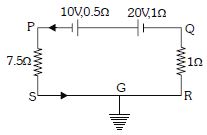
$\mathrm{V}_{\mathrm{p}}=7 \mathrm{\,V}$
$\mathrm{V}_{\mathrm{q}}=-1 \mathrm{\,V}$
$\mathrm{V}_{\mathrm{S}}=\mathrm{V}_{\mathrm{R}}=0 \mathrm{\,V}$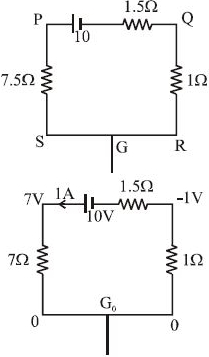
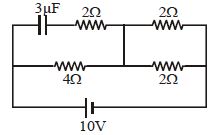
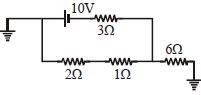
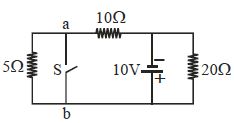
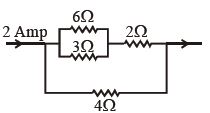
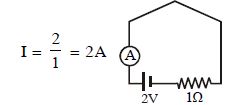
$I=\frac{10}{5}=2 \,A$
$I_{1}=\frac{3}{9} \times 2=\frac{2}{3} \,A$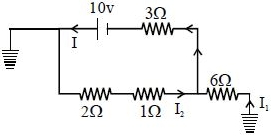
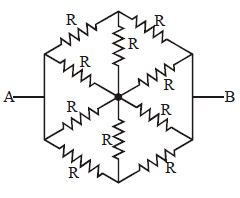
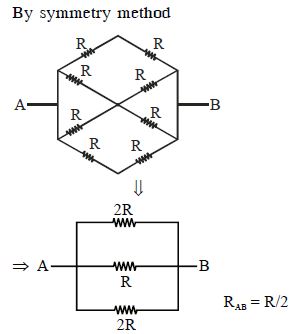
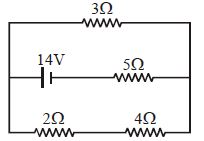
$=7\, \Omega$
$I=\frac{14}{7}=2 \,A$
$I_{1}=\frac{6}{9} \times 2=\frac{4}{3} \,A$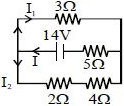
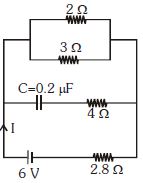
$\therefore $ Current in the circuit $\mathrm{I}=\frac{12}{6+2}=\frac{3}{2} \mathrm{\,amp}$
Potential difference across $2 \,\mu \mathrm{F}$ is same as across $6\, \Omega$ resistance.
So, potential difference across capacitor of $2\, \mu \mathrm{F}$
$=6 \times \frac{3}{2}=9$ $\mathrm{volt}$
$\therefore $ Charge on capacitor $=2 \times 10^{-6} \times 9\, \mu C=18\, \mu C$
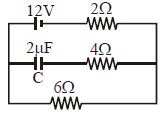
Voltage across capacitor = Voltage across $6 \Omega$ $\frac{q}{C}=i R$
$\frac{q}{2 \times 10^{-6}}=\frac{3}{2} \times 6$
$q=18 \times 10^{-6}$
$q=18 \mu C$
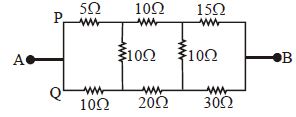
${R_e} = \frac{{30 \times 60}}{{30 + 60}} = 20\,\Omega $
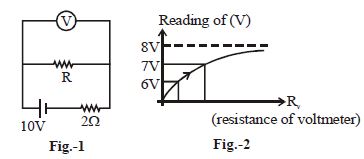
$8=\left(\frac{10}{R+2}\right) R \Rightarrow R=8\, \Omega$
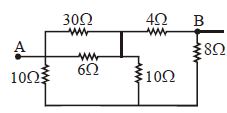
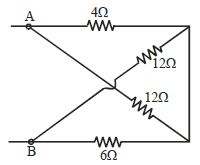
$\boxed{{{\text{R}}_{{\text{eq}}}} = \frac{{9 \times 18}}{{27}} = 6\,\Omega }$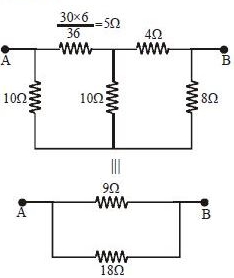
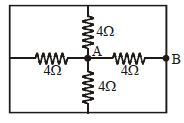
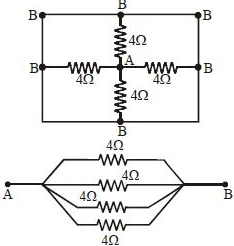
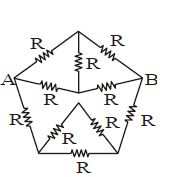
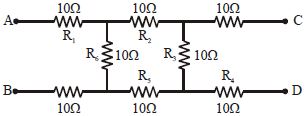
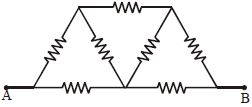
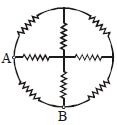
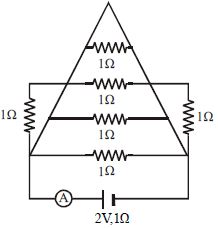
$\boxed{{{\left. {{{\text{R}}_{{\text{eq}}}}} \right|}_{{\text{AB}}}} = \frac{{\text{R}}}{4} = \frac{4}{4} = 1\Omega }$