Questions

MCQ

Take a timed test

154 questions · auto-graded multiple-choice test.

MCQ 11 Mark
What is the total number of sample spaces when a die is thrown 2 times?
  • A
    6
  • B
    12
  • C
    18
  • 36
Answer
Correct option: D.
36
The possible outcomes when a die is thrown are 1, 2, 3, 4, 5, and 6.
Given, a die is thrown two times.
Then, the total number of sample space = (6 × 6)
= 36
View full question & answer
MCQ 21 Mark
Choose the correct answer. In a non-leap year, the probability of having 53 tuesdays or 53 wednesdays is:
  • $\frac{1}{7}$
  • B
    $\frac{2}{7}$
  • C
    $\frac{3}{7}$
  • D
    none os these.
Answer
Correct option: A.
$\frac{1}{7}$
There are 365 days in non-leap year and there are 7 days in a week
$\therefore\ 365\div7=52$ weeks + 1 days
So, this day may be Tuesday or Wednesday.
So, the required probability $=\frac{1}{7}$
View full question & answer
MCQ 31 Mark
If 4-digit numbers greater than 5000 are randomly formed from the digits 0, 1, 3, 5 and 7, then the probability of forming a number divisible by 5 when the digits are repeated is:
  • A
    $\frac{1}{5}$
  • $\frac{2}{5}$
  • C
    $\frac{3}{5}$
  • D
    $\frac{4}{5}$
Answer
Correct option: B.
$\frac{2}{5}$
Given digits are 0, 1, 3, 5, 7
Now we have to form 4 digit numbers greater than 5000.
So leftmost digit is either 5 or 7.
When digits are repeated
Number of ways for filling left most digit = 2
Now remaining 3 digits can be filled = 5 × 5 × 5
So total number of ways of 4 digits greater than 5000 = 2 × 5 × 5 × 5 = 250
Again a number is divisible by 5 if the unit digit is either 0 or 5. So there are 2 ways to fill the unit place.
So total number of ways of 4 digits greater than 5000 and divisible by 5 = 2 × 5 × 5 × 2 = 100
Now probability of 4 digit numbers greater than 5000 and divisible by 5
$=\frac{100}{250}$
$=\frac{2}{5}$
View full question & answer
MCQ 41 Mark
Seven white balls and three black balls are randomly placed in a row. The probability that no two black balls are placed adjacently equals:
  • A
    $\frac{1}{2}$
  • $\frac{7}{15}$
  • C
    $\frac{2}{15}$
  • D
    $\frac{1}{3}$
Answer
Correct option: B.
$\frac{7}{15}$
While placing 7 while balls in a row, total gaps = 8
3 black balls can be placed in 8 gaps
$=\text{C}=\frac{(8\times7\times6)}{(3\times2\times1)}=8\times7=56$
So, the total number of ways of arranging white and black balls such that no two black balls are adjacent = 56 × 3! × 7!
Actual number of arrangement possible with 7 white and 3 black balls = (7 + 3)! = 10!
So, the required Probability
$=\frac{(56\times3!\times7!)}{10!}$
$=\frac{(56\times3!\times7!)}{(10\times9\times8\times7!)}$
$=\frac{(56\times3!)}{(10\times9\times8)}$
$=\frac{(56\times3\times2\times1)}{(10\times9\times8)}$
$=\frac{(7\times3\times2\times1)}{(10\times9)}$
$=\frac{(7\times2)}{(10\times3)}$
$=\frac{7}{(5\times3)}$
$=\frac{7}{15}$
View full question & answer
MCQ 51 Mark
The equation $y^2+4 x+4 y+k=0$ represents a parabola whose latus rectum is:
  • A
    1
  • B
    2
  • C
    3
  • 4
Answer
Correct option: D.
4
  1. 4
Solution:
$y^2+4 x+4 y+k=0$
$y^2+2 \times 2 y+4-4+4 x+k=0$
$(\text{y}+2)^2=-4\text{x}-\text{k}+4$
$(\text{y}+2^2)=-4\Big(\text{x}-\frac{4\ +\ \text{k}}{4}\Big)$
$∴$ Latus rectum = 4 units
View full question & answer
MCQ 61 Mark
All possible outcomes of a random experiment forms the:
  • A
    Events
  • Sample space
  • C
    Both
  • D
    None of these
Answer
Correct option: B.
Sample space
Sample Space is the set of all possible outcomes of an experiment. It is denoted by S.Examples:
When a coin is tossed, S = {H, T} where H = Head and T = Tail
When a dice is thrown, S = {1, 2 , 3, 4, 5, 6}
When two coins are tossed, S = {HH, HT, TH, TT} where H = Head and T = Tail
View full question & answer
MCQ 71 Mark
The equation of directrix and latus rectum of a parabola are 3x - 4y + 27 = 0 and 3x - 4y + 2 = 0. Then the length of latus rectum is:
  • A
    5
  • 10
  • C
    15
  • D
    20
Answer
Correct option: B.
10
  1. 10
Solution:
$\text{d}=\frac{\text{c}_1-\text{c}_2}{\sqrt{\text{a}^2+\text{b}^2}}$
where dd is the distance between lines whose equations are $a x+b y+C_1=0 \& a x+b y+C_2=0$
$\text{d}=\frac{27-2}{\sqrt{4^2+3^2}}$
= 5 d = 5
If the distance between vertex and latus rectum = distance of vertex from directri x = a
= then d = 2a = 5
⇒ Length of latus rectum = 4a = 10
View full question & answer
MCQ 81 Mark
What is number of outcomes when tossing two coins together?
  • A
    1
  • B
    2
  • C
    3
  • 4
Answer
Correct option: D.
4
H T, H H, T H, T T (Here H T means Head on first coin and Tail on the second coin and so on).
View full question & answer
MCQ 91 Mark
What is the approximate radius of the circle whose equation is $\text{(x}-\sqrt{3)}^2+(\text{y}+2)^2=11?$
  • A
    1.71
  • B
    2.33
  • 3.32
  • D
    3.85
Answer
Correct option: C.
3.32
The radius of given circle is $\sqrt{11}=3.32$
View full question & answer
MCQ 101 Mark
Two dice are thrown:
P is the event that the sum of the scores on the uppermost faces is a multiple of 6.
Q is the event that the sum of the scores on the uppermost faces is at least 10.
R is the event that same scores on both dice. Which of the following pairs is mutually exclusive?
  • A
    P, Q
  • B
    P, R
  • C
    Q, R
  • None of these
Answer
Correct option: D.
None of these
Possibilities ofP, (3, 3),(6, 6),(1, 5),(5, 1),(4, 2),(2, 4)
Possibilities of Q:(5, 5),(5, 6),(6, 5),(6, 6)
Possibilities of R:(1, 1),(2, 2),(3, 3),(4, 4),(5, 5),(6, 6)
Thus, the possibilities are neither exhaustive, nor mutually exclusive nor these are complementary probabilities.
View full question & answer
MCQ 111 Mark
If the probability for A to fail in an examination is 0.2 and that for B is 0.3, then the probability that either A or B fails is:
  • A
    $>0.5$
  • B
    $0.5$
  • $\leq0.5$
  • D
    $0$
Answer
Correct option: C.
$\leq0.5$
Let X and Y be two events given by, X : A fails in an examination Y : B fails in an examination P(A fails) = P(X) = 0.2 P(B fails) = P(Y) = 0.3 Now, P(either A or B fails) $=\text{P}(\text{X}\cup\text{Y})$ We know that, $=\text{P}(\text{X}\cup\text{Y})\leq\text{P(X)}+\text{P()Y}=0.2+0.3=0.5$ $\Rightarrow\text{P}(\text{X}\cup\text{Y})\leq0.5$ $\therefore\text{P}\text{(either A or B fails)}\leq0.5$ Hence, the correct answer is option (c).
View full question & answer
MCQ 121 Mark
The probabilities of three mutually exclusive events A, B and C are given by $\frac{2}{3}$, $\frac{1}{4}$ and $\frac{1}{6}$respectively. The statement
  • A
    Is true.
  • Is false.
  • C
    Nothing can be said.
  • D
    Could be either.
Answer
Correct option: B.
Is false.
Since the events A, B and C are mutually exclusive, we have:
$\text{P}(\text{A}\cup\text{B}\cup\text{C})=\frac{2}{3}+\frac{1}{4}+\frac{1}{6}=\frac{13}{12}>1$
which is not possible.
Hence, the given statement is false.
View full question & answer
MCQ 131 Mark
In a simultaneous throw of two dice what is the probability of getting a doublet ?
  • $\frac{1}{6}$
  • B
    $\frac{1}{4}$
  • C
    $\frac{3}{4}$
  • D
    $\frac{2}{3}$
Answer
Correct option: A.
$\frac{1}{6}$
Total number of possibilities = 36
Number of doublet = 6
Thus, probability
$=\frac{6}{36}=\frac{1}{6}$
View full question & answer
MCQ 141 Mark
One card is drawn from a well-shuffled deck of 52 cards. Find the probability of getting a face card.
  • A
    $\frac{1}{13}$
  • B
    $\frac{1}{26}$
  • $\frac{3}{13}$
  • D
    $\text{None}\text{ of}\text{ these}$
Answer
Correct option: C.
$\frac{3}{13}$
Total number of outcomes = 52
Favourable outcomes (A face card) = 12
Probability $=\frac{12}{52}=\frac{3}{13}$
View full question & answer
MCQ 151 Mark
A die is rolled. What is the probability that an even number is obtained?
  • $\frac{1}{2}$
  • B
    $\frac{2}{3}$
  • C
    $\frac{1}{4}$
  • D
    $\frac{3}{4}$
Answer
Correct option: A.
$\frac{1}{2}$
When a die is rolled, total number of outcomes = 6 (1, 2, 3, 4, 5, 6)
Total even number = 3 (2, 4, 6)
So, the probability that an even number is obtained
$=\frac{3}{6}=\frac{1}{2}$
View full question & answer
MCQ 161 Mark
Two dice are thrown the events A, B, C are as follows A: Getting an odd number on the first die. B: Getting a total of 7 on the two dice. C: Getting a total of greater than or equal to 8 on the two dice. Then AUB is equal to
  • A
    15
  • B
    17
  • C
    19
  • 21
Answer
Correct option: D.
21
When two dice are thrown, then total outcome = 6 × 6 = 36
A: Getting an odd number on the first die.
A = {(1, 1), (1, 2), (1, 3), (1, 4),(1, 5), (1, 6), (3, 1), (3, 2), (3, 3), (3, 4),(3, 5), (3, 6), (5, 1), (5, 2), (5, 3), (5, 4),(5, 5), (5, 6)}
Total outcome = 18 B: Getting a total of 7 on the two dice.
B = {(1, 6), (2, 5), (3, 4), (4, 3), (5, 2), (6, 1)} Total outcome = 6
C: Getting a total of greater than or equal to 8 on the two dice.
C = {(2, 6), (3, 5), (3, 6), (4, 4),(4, 5), (4, 6), (5, 3), (5, 4), (5, 5), (5, 6),(6, 2), (6, 3), (6, 4), (6, 5), (6, 6)} Total outcome = 15
Now $\text{n(A}\cup\text{B)}=\text{n(A)}+\text{n(B)}-\text{n(A}\cup\text{B)}$
$\Rightarrow\text{n(A}\cup\text{B)}=18+6-3$
$\Rightarrow\text{n(A}\cup\text{B)}=21$
View full question & answer
MCQ 171 Mark
If S is the sample space and $ \text{P(A)} = \frac{1}{3} \text{P(B)}$ and $\text{S} = \text{A}\cup\text{B}$ where A and B are two mutually exclusive events, then P (A) =
  • $\frac{1}{4}$
  • B
    $\frac{1}{2}$
  • C
    $\frac{3}{4}$
  • D
    $\frac{3}{8}$
Answer
Correct option: A.
$\frac{1}{4}$
Let $\text{P(B)}=\text{P}$
Than $\text{P(A)}=\frac{1}{3}\text{P}$
Since A and B are two mutually exclusive events, we have:
$\text{A}\cup\text{B}=\text{S}$
$\Rightarrow\text{P}\text{(A}\cup\text{B)}=\text{P}\text{(S)}$
$\Rightarrow\text{P}\text{(A}\cup\text{B)}=1$
$\Rightarrow\text{P}\text{(A)}+\text{(B)}=1$
$\Rightarrow\frac{1}{2}\text{P}+\text{P}=1$
$\Rightarrow\frac{4\text{p}}{3}=1$
$\therefore\text{P(A)}=\frac{1}{3}\text{P}=\frac{1}{3}\times\frac{3}{4}=\frac{1}{4}$
View full question & answer
MCQ 181 Mark
If the integers m and n are chosen at random between 1 and 100, then the probability that the number of the from $7^m$ + $7^n$ is divisible by 5 equals:
  • $\frac{1}{4}$
  • B
    $\frac{1}{7}$
  • C
    $\frac{1}{8}$
  • D
    $\frac{1}{49}$
Answer
Correct option: A.
$\frac{1}{4}$
  1. $\frac{1}{4}$
Solution:
Since m and n are selected between 1 and 100,
Hence total sample space = 100 × 100
Again, 71 = 7, 72 = 49, 73 = 343, 74 = 2401, 75 = 16807, etc
Hence 1, 3, 7 and 9 will be the last digit in the power of 7.
Now, favourable number of case are
→ 1,1 1,2 1,3 …………. 1,100
2,1 2,2 2,3 …………. 2,100
3,1 3,2 3,3 …………. 3,100
100,1 100,2 100,3 …………. 100,100
Now, for m = 1, n = 3, 7, 11, ………, 97
So, favourable cases = 25
Again for m = 2, n = 4, 8, 12, ………, 100
So, favourable cases = 25
Hence for every m, favourable cases = 25
So, total favourable cases = 100 × 25 Required Probability
$=\frac{(100\times25)}{(100\times100)}$
$=\frac{25}{100}$
$=\frac{1}{4}$
View full question & answer
MCQ 191 Mark
A card from a pack of $52$ cards is lost. From the remaining cards of the pack, two cards are drawn. Then the probability that they both are diamonds is:
  • A
    $\frac{84}{452}$
  • B
    $\frac{48}{452}$
  • C
    $\frac{84}{452}$
  • $\frac{48}{425}$
Answer
Correct option: D.
$\frac{48}{425}$
Total number of cards $= 52$ and one card is lost.
Case $1:$ if lost card is a diamond card
Total number of cards $= 51$ Number of diamond cards $= 12$ Now two cards are drawn.
P(both cards are diamonds) $\frac{=^{12}\text{C}_2}{^{51}\text{c}_2}$
Total number of cards $= 52$ and one card is lost.
Case $2:$ If lost card is not a diamond card Total number of cards $= 51$
Number of diamond cards $= 13$ Now two cards are drawn.
$P($both cards are diamonds$) \frac{=^{13}\text{C}_2}{^{51}\text{c}_2}$
Now probability that both cards are diamond $\frac{=^{12}\text{C}_2}{^{51}\text{c}_2}+\frac{=^{13}\text{C}_2}{^{51}\text{c}_2}$
$=\frac{^{12}\text{C}_2+^{13}\text{C}_2}{^{51}\text{C}_2}$
$\Big\{\frac{(12\times11)}{(2\times1)}+\frac{(13\times12)}{(2\times1)}\Big\}\Big\{\frac{(51\times50)}{(2\times1}\Big\}$
$=\frac{(12\times11\times+13\times12)}{(51\times50)}$
$=\frac{288}{2550}$
$=\frac{96}{850} (288$ and $2550$ divided by $3)$
$=\frac{48}{425} (96$ and $850$ divided by $2)$
So probability that both cards are diamond is $\frac{48}{425}$
View full question & answer
MCQ 201 Mark
A circle with center (3, 8) contains the point (2, -1). Another point on the circle is:​​​​​​​
  • A
    (1, -10)
  • (4, 17)
  • C
    (5, -9)
  • D
    (7, 15)
Answer
Correct option: B.
(4, 17)
  1. (4, 17)
Solution:
$=r^2=(x-3)^2+(y-8)^2$
Given $(2,-1)$ lies on the circle
$=r^2=(2-3)^2+(-1-8)^2$
$=r^2=1+81$
$=r^2=82$
Circle equation is: $(x-3)^2+(y-8)^2=82$
By trial and error, substitute the point in the above equation
$(4-3)^2+(17-8)^2=82$
hence, $(4,17)$ satisfy the circle euation.
View full question & answer
MCQ 211 Mark
In tossing a coin, the chance of throwing head and tail alternatively in 3 successive trials is:
  • $\frac{1}{4}$
  • B
    $\frac{1}{6}$
  • C
    $\frac{1}{5}$
  • D
    $\frac{1}{48}$
Answer
Correct option: A.
$\frac{1}{4}$
Favourable outcomes ={H T H, T H T} = 2 outcomes
Total number of outcomes = 8
Probability $=\frac{2}{8}=\frac{1}{4}$
View full question & answer
MCQ 221 Mark
Choose the correct answer. Three numbers are chosen from 1 to 20. Find the probability that they are not consecutive:
  • A
    $\frac{186}{190}$
  • $\frac{187}{190}$
  • C
    $\frac{188}{190}$
  • D
    $\frac{18}{^{20}\text{C}_3}$
Answer
Correct option: B.
$\frac{187}{190}$
Since, the set of three consecutive numbers from 1 to 20 are (1, 2, 3), (2, 3, 4), (3, 4, 5), ....... , (18, 19, 20), i.e., 18
P(numbers are consecutive)
$=\frac{18}{^{20}\text{C}_3}=\frac{18}{\frac{20\times19\times18}{3!}}=\frac{3}{190}$
P(three number are not consecutive)
$=1-\frac{3}{190}=\frac{187}{190}$
View full question & answer
MCQ 231 Mark
The probability that the leap year will have $53$ sundays and $53$ monday is:
  • A
    $\frac{2}{3}$
  • B
    $\frac{1}{2}$
  • C
    $\frac{2}{7}$
  • $\frac{1}{17}$
Answer
Correct option: D.
$\frac{1}{17}$
In a leap year, total number of days $= 366$ days.
In 366 days, there are $52$ weeks and $2$ days.
Now two days may be
$(i)$ Sunday and Monday
$(ii)$ Monday and Tuesday
$(iii)$ Tuesday and Wednesday
$(iv)$ Wednesday and Thursday
$(v)$ Thursday and Friday
$(vi)$ Friday and Saturday
$(vii)$ Saturday and Sunday
Now in total $7$ possibilities, Sunday and Monday both come together is $1$ time.
So probabilities of $53$ Sunday and Monday in a leap year
$=\frac{1}{17}$
View full question & answer
MCQ 241 Mark
One coin is tossed once. Find the probability of getting A head.
  • $\frac{1}{2}$
  • B
    $1$
  • C
    $\frac{2}{3}$
  • D
    $\text{None} \text{ of}\text{ these}$
Answer
Correct option: A.
$\frac{1}{2}$
The outcome of a throw of coin can be 2.
$\text{P}=\frac{1}{2}$
View full question & answer
MCQ 251 Mark
A box contains 10 good articles and 6 with defects. One item is drawn at random. The probability that it is either good or has a defect is:
  • $\frac{64}{64}$
  • B
    $\frac{49}{64}$
  • C
    $\frac{40}{64}$
  • D
    $\frac{24}{64}$
Answer
Correct option: A.
$\frac{64}{64}$
Let A be the event of drawing one good article whereas B be the event of drawing one defected article.
Here,
$\text{P(A)}=\frac{10}{10+6}=\frac{10}{16}$
$\text{P(B)}=\frac{6}{10+6}=\frac{6}{16}$
The events A and B are mutually exclusive. Thus, the required probability,
$\text{P}(\text{A}\cup\text{B})=\text{P(A)}+\text{P(B)}$
$\Rightarrow\text{P}(\text{A}\cup\text{B})=\frac{10}{16}+\frac{6}{16}=\frac{16}{16}=1$
Hence, the correct option is (a).
View full question & answer
MCQ 261 Mark
A die is rolled, then the probability that an even number is obtained is:
  • $\frac{1}{2}$
  • B
    $\frac{2}{3}$
  • C
    $\frac{1}{4}$
  • D
    $\frac{3}{4}$
Answer
Correct option: A.
$\frac{1}{2}$
When a die is rolled, total number of outcomes = 6 (1, 2, 3, 4, 5, 6)
Total even number = 3 (2, 4, 6)
So, the probability that an even number is obtained
$=\frac{3}{6}=\frac{1}{2}$
View full question & answer
MCQ 271 Mark
A die is thrown then find the probability of getting an odd number.
  • A
    $\frac{1}{3}$
  • B
    $\frac{2}{3}$
  • $\frac{1}{2}$
  • D
    $\text{None}\text{ of}\text{ these}$
Answer
Correct option: C.
$\frac{1}{2}$
Sample space = {1,2,3,4,5,6}=1,2,3,4,5,6
odd nos. = 1,3,5=1,3,5
probability of getting odd nos
$=\frac{3}{6}=\frac{1}{2}$
View full question & answer
MCQ 281 Mark
What is called one or more outcomes of an experiment?
  • A
    Space
  • B
    Experiment
  • C
    Sample
  • Event
Answer
Correct option: D.
Event
Event is called one or more outcomes of an experiment.
Example: rolling a dice, we get a possible outcomes as {1, 2, 3, 4, 5, 6}.
View full question & answer
MCQ 291 Mark
Two unbiased coins are tossed simultaneously. The probability of getting at least one head is:
  • A
    $\frac{1}{2}$
  • B
    $\frac{1}{4}$
  • $\frac{3}{4}$
  • D
    $\text{none}$
Answer
Correct option: C.
$\frac{3}{4}$
Favourable number of outcomes, getting at least one head = 3[H H, H T, T H]
Total number of outcomes = 4[H H, H T, T H, T T]
Probability $=\frac{3}{4}$
View full question & answer
MCQ 301 Mark
Without repetition of the numbers, four digit numbers are formed with the numbers 0, 2, 3, 5. The probability of such a number divisible by 5 is:
  • A
    $\frac{1}{5}$
  • B
    $\frac{4}{5}$
  • C
    $\frac{1}{30}$
  • $\frac{5}{9}$
Answer
Correct option: D.
$\frac{5}{9}$
The given digits are 0, 2, 3 and 5.
_____ _____ _____ _____
Thousands Hundreds Tens Ones
Now, there are 3 ways to fill the thousands place (0 cannot occupy the thousands place), 3 ways to fill the hundreds place, 2 ways to fill the tens place and 1 way to fill the ones place. Total number of four digit numbers formed = 3 × 3 × 2 × 1 = 18 We know that a number is divisible by 5 if it ends in 0 or 5. When 0 is at the ones place, Number of four digits numbers divisible by 5 formed = 3 × 2 × 1 = 6 When 5 is at the ones place, Number of four digits numbers divisible by 5 formed = 2 × 2 × 1 = 4 (0 cannot occupy the thousands place) Total number of four digit numbers divisible by 5 = 6 + 4 = 10 $\therefore$ P(four digit number formed is divisible by 5) $=\frac{\text{Total Number of four digit numbers divisible by 5}}{\text{Total Number of w4 digit numbers formed}}$ $=\frac{10}{18}=\frac{5}{9}$ Hence, the correct answer is option (d).
View full question & answer
MCQ 311 Mark
Choose the correct answer. If the probabilities for A to fail in an examination is 0.2 and that for B is 0.3, then the probability that either A or B fails is:
  • A
    $>0.5$
  • B
    $0.5$
  • $\leq0.5$
  • D
    $0$
Answer
Correct option: C.
$\leq0.5$
Given, P(A fail) = 0.2
and P(B fail) = 0.3
$\therefore\ \text{P(either A or B fail)}\leq\text{P(A fail)}+\text{P(B fail)}$
$\leq0.2+0.3$
$\leq0.5$
View full question & answer
MCQ 321 Mark
Six boys and six girls sit in a row at random. The probability that the boys and girls sit alternatively is:
  • $\frac{1}{462}$
  • B
    $\frac{11}{462}$
  • C
    $\frac{5}{51}$
  • D
    $\frac{7}{123}$
Answer
Correct option: A.
$\frac{1}{462}$
Given, 6 boys and 6 girls sit in a row at random.
Then, the total number of arrangement of 6 boys and 6 girls = arrangement of 12 persons = 12! Now, boys and girls sit alternatively.
So, the total number of arrangement = 2 × 6! × 6!
Now, P(boys and girls sit alternatively) $=\frac{(2\times6!\times6!)}{12!}$
$=\frac{(2\times6!\times6!)}{(12!\times11!)}$
$=​​\frac{(5!\times6!)}{11!}$
$=\frac{(5\times4\times3\times2\times1\times6!)}{(11\times10\times9\times8\times7\times6!)}$
$=\frac{(5\times4\times3\times2)}{(11\times10\times9\times8\times7)}$
$=\frac{(4\times3)}{(11\times9\times8\times7)}$
$=\frac{3}{(11\times9\times2\times7)}$
$=\frac{1}{(11\times9\times2\times7)}$
$=\frac{1}{462}$
View full question & answer
MCQ 331 Mark
Probability is 0.45 that a dealer will sell at least 20 television sets during a day, and the probability is 0.74 that he will sell less that 24 televisions. The probability that he will sell 20, 21, 22 or 23 televisions during the day, is:
  • 0.19
  • B
    0.32
  • C
    0.21
  • D
    None of these
Answer
Correct option: A.
0.19
Let A be the event that the sale is at least 20 televisions, i.e. 20, 21, 22,... and B be the event that sale is less than 24 i.e. 0.1.2.3...23.
Then A∩B will denote the sale of 20, 21, 22 and 23 televisions, We are given P(A) = 0.45 and P(B) = 0.74.
It is required to find P(A ∩ B).
Also P(A ∪ B) = P( sale of 0, 1, 2, 3,...,20, 21, 22, 23 televisions) = P(S) = 1.
From addition rule, required probability is P(A ∩ B) = P(A) + P(B) - P(A ∪ B) = 0.45 + 0.74 - 1 = 0.19.
View full question & answer
MCQ 341 Mark
Two unbiased coins are tossed simultaneously. Find the probability of getting at most one head.
  • A
    $\frac{1}{4}$
  • B
    $\frac{1}{2}$
  • $\frac{3}{4}$
  • D
    $\frac{1}{3}$
Answer
Correct option: C.
$\frac{3}{4}$
Since, Total possibilities are = {H H, H T, T H, T T}
no. of cases with atmost one head are = {H T, T H, T T}
$=\frac{3}{4}$
View full question & answer
MCQ 351 Mark
The equation circle whose center is $(0,0)$ and radius is 4 is:
 
  • A
    $x^2+y^2=4$
  • $x^2+y^2=16$
  • C
    $x^2+y^2=2$
  • D
    None
Answer
Correct option: B.
$x^2+y^2=16$
  1. $x^2+y^2=16$
Solution:
The equation of circle is $x^2+y^2=r^2$ Here the radius is 4 So the equation is
$x^2+y^2=42$
$x^2+y^2=16$
View full question & answer
MCQ 361 Mark
One card is drawn from a pack of 52 cards. The probability of getting a jack card is:
  • $\frac{1}{13}$
  • B
    $\frac{2}{13}$
  • C
    $\frac{3}{13}$
  • D
    $\frac{4}{13}$
Answer
Correct option: A.
$\frac{1}{13}$
Favourable number of outcomes i.e., numbers of jack cards = 4
Total number of outcomes = 52
Thus, probability $=\frac{4}{52}=\frac{1}{13}$
View full question & answer
MCQ 371 Mark
If the parabola $y^2=4 a x$ passes through (3, 2) then the length of latus rectum is:
  • A
    $\frac{1}{3}$
  • B
    $\frac{2}{3}$
  • C
    $1$
  • $\frac{4}{3}$
Answer
Correct option: D.
$\frac{4}{3}$
  1. $\frac{4}{3}$
Solution:
If the parabola $y^2=4 a x$ passes through (3, 2)
therefore, 4 = 4a (3)
$\Rightarrow\text{a}=\frac{1}{3}$
Therefore, length of latus rectum:
$1=4\text{a}=\frac{4}{3}$
View full question & answer
MCQ 381 Mark
If a coin is tossed till the first head appears, then what will be the sample space?
  • A
    {H}
  • B
    {TH}
  • C
    {T, TH, HHT, HHHT, ..........}
  • {H, TH, TTH, TTTH, .......}
Answer
Correct option: D.
{H, TH, TTH, TTTH, .......}
S: {H, TH, TTH, TTTH, ..........} infinte elements.
If for the first toss only, we would have got the head, we have stop there itself.
View full question & answer
MCQ 391 Mark
Choose the correct answer. The probability that at least one of the events A and B occurs is 0.6. If A and B occur simultaneously with probability 0.2, then $\text{P}(\bar{\text{A}})+\text{P}(\bar{\text{B}})$ is:
  • A
    0.4
  • B
    0.8
  • 1.2
  • D
    1.6
Answer
Correct option: C.
1.2
We have, $\text{P}(\text{A}\cup\text{B})=0.6$ and $\text{P}(\text{A}\cap\text{B})=0.2$
$\therefore\ \text{P}(\text{A}\cup\text{B})=0.6$ and $\text{P}(\text{A}\cap\text{B})=0.2$
$\Rightarrow0.6=\text{P(A)}+\text{P(B)}-0.2$
$\Rightarrow\text{P(A)}+\text{P(B)}=0.8$
$\therefore\ \text{P}(\bar{\text{A}})+\text{P}(\bar{\text{B}})=1-\text{P(A)}+1-\text{P(B)}$
$=2-\big[\text{P(A)}+\text{P(B)}\big]=2-0.8=1.2$
View full question & answer
MCQ 401 Mark
One coin is tossed once. Find the probability of getting A tail.
  • $\frac{1}{2}$
  • B
    $1$
  • C
    $\text{Data} \text{ insufficient}$
  • D
    $\text{None}\text{ of}\text{ these}$
Answer
Correct option: A.
$\frac{1}{2}$
There are 2 possible outcomes of a throw of coin.$\text{P(tail)}=\frac{1}{2}$
View full question & answer
MCQ 411 Mark
Two dice are thrown together. The probability that at least one will show its digit greater than 3 is:
  • A
    $\frac{1}{4}$
  • $\frac{3}{4}$
  • C
    $\frac{1}{2}$
  • D
    $\frac{1}{8}$
Answer
Correct option: B.
$\frac{3}{4}$
When two dice are thrown, there are (6 × 6) = 36 outcomes. The set of all these outcomes is the sample space, given by
S = (1, 1) , (1, 2), (1, 3), (1, 4), (1, 5), (1, 6)
(2, 1) , (2, 2), (2, 3), (2, 4), (2, 5), (2, 6)
(3, 1) , (3, 2), (3, 3), (3, 4), (3, 5), (3, 6)
(4, 1) , (4, 2), (4, 3), (4, 4), (4, 5), (4, 6)
(5, 1) , (5, 2), (5, 3), (5, 4), (5, 5), (5, 6)
(6, 1) , (6, 2), (6, 3), (6, 4), (6, 5), (6, 6)
i.e. n(S) = 36
Let E be the event of getting at least one digit greater than 3.
Then E = {(1, 4), (1, 5), (1, 6), (2, 4), (2, 5), (2, 6), (3, 4), (3, 5), (3, 6), (4, 1) , (4, 2), (4, 3), (4, 4), (4, 5), (4, 6),
(5, 1) , (5, 2), (5, 3), (5, 4), (5, 5), (5, 6), (6, 1) , (6, 2), (6, 3), (6, 4), (6, 5), (6, 6) }
$\therefore\ \text{n(E)}=27$
Hence, required probability $=\frac{27}{36}=\frac{3}{4}$
View full question & answer
MCQ 421 Mark
If $A$ and $B$ are mutually exclusive events then:
  • $\text{P(A)}\leq\text{P}(\overline{\text{B}})$
  • B
    $\text{P(A)}\geq\text{P}(\overline{\text{B}})$
  • C
    $\text{P(A)}<\text{P}(\overline{\text{B}})$
  • D
    None of these
Answer
Correct option: A.
$\text{P(A)}\leq\text{P}(\overline{\text{B}})$
It is given that A and B are mutually exclusive events.We know that,
$\text{P}(\text{A}\cup\text{B})=\text{P}(\text{A)}+\text{(B})-\text{P}(\text{A}\cap\text{B})$$\big[\text{From(1)}\big]$
$\Rightarrow\text{P}(\text{A}\cup\text{B})=\text{P}(\text{A)}+\text{P}\text{(B})$ $\big[\text{P}(\text{A}\cup\text{B})\leq1\big]$ $\Rightarrow\text{P}(\text{A)}+\text{P}\text{(B})\leq1$
$\Rightarrow\text{P}(\text{A)}\leq1-\text{P}\text{(B})=\text{P}(\overline{\text{B}})$
$\therefore\text{P}(\text{A)}\leq\text{P}\text{(B})$
Hence, the correct answer is option $(a).$
$\therefore\text{P}(\text{A }\cap\text{B})=0\ ...(1)$
View full question & answer
MCQ 431 Mark
The equation of the circle passing through $(3,6)$ and whose centre is $(2,-1)$ is:
  • A
    $x^2+y^2-4 x+3 y=45$
  • $x^2+y^2-4 x+2 y-45=0$
  • C
    $x^2+y^2+4 x-2 y=45$
  • D
    $x^2+y^2-4 x+2 y+45=0$
Answer
Correct option: B.
$x^2+y^2-4 x+2 y-45=0$
  1. $x^2+y^2-4 x+2 y-45=0$
Solution:
$(x-2)^2+(y+1)^2+r 2(3,6)$. lies on it $\Rightarrow 1+49=r^2$
$\Rightarrow r^2=50$
$\Rightarrow \mathrm{x}^2+4-4 \mathrm{x}+\mathrm{y}^2+1+2 \mathrm{y}=50$
$\Rightarrow x^2+y^2-4 x+2 y-45=0$
View full question & answer
MCQ 441 Mark
The length of the latus rectum of the parabola $x=a y^2+b y+c$ is:
  • A
    $\frac{\text{a}}{4}$
  • B
    $\frac{\text{a}}{3}$
  • $\frac{1}{\text{a}}$
  • D
    $\frac{1}{4\text{a}}$
Answer
Correct option: C.
$\frac{1}{\text{a}}$
  1. $\frac{1}{\text{a}}$
Solution:
$x=a y^2+b y+c$
$a y^2+b y=x-c$
$=\text{a}\Big(\text{y}+\frac{\text{b}}{\text{a}}\Big)^2$
$=\text{x}+\frac{\text{a}\text{b}^2}{4}-\text{c}$
$=\Big(\text{y}+\frac{\text{b}}{\text{a}}\Big)^2$
$=\frac{1}{\text{a}}\Big(\text{x}+\frac{\text{a}\text{b}^2}{4}-\text{c}\Big)$
Length of latus rectum
$=\frac{1}{\text{a}}$
View full question & answer
MCQ 451 Mark
If A, B, C are three mutually exclusive and exhaustive events of an experiment such that 3 $\text{P(A)}=2\text{P(B)}=\text{C},$ then P(A) is equal to:
  • A
    $\frac{1}{11}$
  • $\frac{2}{11}$
  • C
    $\frac{5}{11}$
  • D
    $\frac{6}{11}$
Answer
Correct option: B.
$\frac{2}{11}$
Let 3 P(A) = 2 P(B) = P(C) = p. Then, ​​$\text{P(A)}=\frac{\text{P}}{3},\text{P(B)}=\frac{\text{P}}{2}$ and $\text{P(C)}=\text{P}$ It is given that A, B, C are three mutually exclusive and exhaustive events. $\therefore\text{P(A)}+\text{P(B)}+\text{P(C)}=1$ $=0 $ and $\big[\text{P}(\text{A}\cup\text{B)=}\text{P}(\text{B}\cap\text{C)}=\text{P}(\text{C}\cap\text{A)=}\text{P}(\text{A}\cup\text{B }\cup\text{C}=1\big]$ $\Rightarrow\frac{\text{P}}{3}+\frac{\text{p}}{2}+\text{P}=1$ $\Rightarrow\frac{\text{11P}}{6}=1$ $\Rightarrow\text{P}=\frac{6}{11}$ $\therefore\text{P(A)}=\frac{\text{P}}{3}=\frac{\frac{6}{11}}{3}=\frac{2}{11}$ Hence, the correct answer is option (b).
View full question & answer
MCQ 461 Mark
Two coins are tossed, what is the sample space?
  • A
    (H, T), (H, T), (T, H), (H, H)
  • (H, T), (T, T), (T, H), (H, H)
  • C
    (T, T), (H, H), (T, T), (H, H)
  • D
    (H, T), (T, T), (H, T), (T, T)
Answer
Correct option: B.
(H, T), (T, T), (T, H), (H, H)
Sample space is the collection of all possible events.
So, sample space of tossing two coins, S=(H, T), (T, T), (T, H), (H, H)
View full question & answer
MCQ 471 Mark
Three numbers are chosen from 1 to 20. The probability that they are not consecutive is:
  • A
    $\frac{186}{190}$
  • $\frac{187}{190}$
  • C
    $\frac{188}{190}$
  • D
    $\frac{18}{\ ^{20}\text{C}_3}$
Answer
Correct option: B.
$\frac{187}{190}$
Number of ways to choose three numbers from 1 to 20 $=\ ^{20}\text{C}_3=1140$ Now, the set of three consecutive numbers from 1 to 20 are (1, 2, 3), (2, 3, 4), (3, 4, 5), ...., (18, 19, 20). So, the number of ways to choose three numbers from 1 to 20 such that they are consecutive is 18. P(three numbers choosen are consecutive) $=\frac{\text{Number of ways to choose three consecutive numbers from 1 to 20 }}{\text{Number of ways to choose three numbers from 1 to 20}}$ $=\frac{18}{\ ^{20}\text{c}_3}=\frac{18}{1140}=\frac{3}{190}$ $\therefore$P(three numbers choosen are not consecutive) = 1 - P(three numbers choosen are consecutive) $=1-\frac{3}{190}=\frac{187}{190}$ Hence, the correct answer is option (b).
View full question & answer
MCQ 481 Mark
Sample space is a set of ..... of an experiment.
  • All possible outcomes
  • B
    Selected outcomes
  • C
    Both
  • D
    None of these
Answer
Correct option: A.
All possible outcomes
A sample space is usually denoted using set notation, and the possible outcomes are listed as elements in the set. For example, if the
experiment is tossing a coin, the sample space is typically the set {head, tail}, i.e all possible outcomes.
View full question & answer
MCQ 491 Mark
Three digit numbers are formed using the digits 0, 2, 4, 6, 8. A number is chosen at random out of these numbers. What is the probability that this number has the same digits?
  • A
    $\frac{1}{16}$
  • B
    $\frac{16}{25}$
  • C
    $\frac{1}{645}$
  • $\frac{1}{25}$
Answer
Correct option: D.
$\frac{1}{25}$
The given digits are 0, 2, 4, 6, 8.
____ ____ ____
Hundreds Tens Ones
Now, there are 4 ways to fill the hundreds place (0 cannot occupy the hundreds place), 5 ways to fill the tens place and 5 ways to fill the ones place. Total number of 3 digit numbers formed using the given digits = 4 × 5 × 5 = 100 The three digit numbers formed using given digits that have the same digits are 222, 444, 666 and 888 Number of 3 digit numbers that have the same digits = 4 $\therefore$ P(three digit number formed has the same digits) $\frac{\text{Number of 3 digits numbers that have the same digits}}{\text{Total number of 3 digit numbers formed using the given digits}}$ $=\frac{4}{100}=\frac{1}{25}$ Hence, the correct answer is option (d).
View full question & answer
MCQ 501 Mark
What is the sample space for choosing an odd number from 2 to 10 at random?
  • A
    2, 4, 6, 8, 10
  • B
    1, 2, 3, 5
  • 3, 5, 7, 9
  • D
    1, 2, 3, 5, 7
Answer
Correct option: C.
3, 5, 7, 9
Sample space is the collection of all possible events.
So, the sample space for choosing an odd number from 2 to 10 at random = 3, 5, 7, 9.
View full question & answer
MCQ 511 Mark
One card is drawn from a pack of 52 cards. The probability that it is the card of a king or spade is:
  • A
    $\frac{1}{26}$
  • B
    $\frac{3}{26}$
  • $\frac{4}{13}$
  • D
    $\frac{3}{13}$
Answer
Correct option: C.
$\frac{4}{13}$
If A and B denote the events of drawing a king and a spade card, respectively, then event A consists of four sample points, whereas event B consists of 13 sample points.
Thus, $\text{P(A)}=\frac{4}{52}$ and $\text{P(B)}=\frac{13}{52}$
The compound event (A n B) consists of only one sample point, king of spade.
So, $\text{P}(\text{A}\cap\text{B})=\frac{1}{52}$
By addition theorem , we have:
$\text{P}(\text{A}\cup\text{B})=\text{P(A)}+\text{P(B)}-\text{P}(\text{A}\cap\text{B})$
$=\frac{4}{52}+\frac{13}{52}-\frac{1}{52}=\frac{16}{52}=\frac{4}{13}$
Hence, the probability that the card drawn is either a king or a spade is given by $\frac{4}{13}.$
View full question & answer
MCQ 521 Mark
Two dice are thrown simultaneously. The probability of obtaining total score of seven is:
  • A
    $\frac{5}{36}$
  • $\frac{6}{36}$
  • C
    $\frac{7}{36}$
  • D
    $\frac{8}{36}$
Answer
Correct option: B.
$\frac{6}{36}$
When two dices are thrown, there are (6 × 6) = 36 outcomes.
The set of all these outcomes is the sample space given by
S = (1, 1), (1, 2), (1, 3), (1, 4), (1, 5), (1, 6)
(2, 1), (2, 2), (2, 3), (2, 4), (2, 5), (2, 6)
(3, 1), (3, 2), (3, 3), (3, 4), (3, 5), (3, 6)
(4, 1), (4, 2), (4, 3), (4, 4), (4, 5), (4, 6)
(5, 1), (5, 2), (5, 3), (5, 4), (5, 5), (5, 6)
(6, 1), (6, 2), (6, 3), (6, 4), (6, 5), (6, 6)
$\therefore$ n(S) = 36
Let E be the event of getting a total score of 7.
Then E = {(1, 6), (2, 5), (3, 4), (4, 3), (5, 2), (6, 1)}
$\therefore$ n(E) = 6
Hence, required probability $=\frac{\text{n}(\text{E})}{\text{n}(\text{S})}=\frac{6}{36}$
View full question & answer
MCQ 531 Mark
If the vertex $=(2,0)$ and the extremities of the latus rectum are $(3,2)$ and $(3,-2)$, then the equation of the parabola is:
  • A
    $\mathrm{y}^2=2 \mathrm{x}-4$
  • B
    $x^2=4 y-8$
  • $y^2=4 x-8$
  • D
    None
Answer
Correct option: C.
$y^2=4 x-8$
  1. $y^2=4 x-8$
Solution:
$y^2=4 a x$
$(y-0)^2=4 a(x-2)$
$y^2=4 a(x-2)$
$y^2=4(x-2)$
$y^2=4 x-8$
View full question & answer
MCQ 541 Mark
The radius of circle $x^2+y^2-6 x-8 y=0$ :
 
  • 5
  • B
    4
  • C
    3
  • D
    2
Answer
Correct option: A.
5
  1. 5
Solution:
The radius of circel $x^2+y^2-6 x-8 y=0$ is
$=\sqrt{\mathrm{g}^2+\mathrm{f}-\mathrm{c}}$
Here $g=-3, f=-4, c=0$
$\Rightarrow \mathrm{r}=\sqrt{(-3)^2+(-4)^2} \sqrt{9+16}$
$=\sqrt{25}=25$
View full question & answer
MCQ 551 Mark
Two dice are thrown simultaneously. The probability of getting a pair of aces is
  • $\frac{1}{36}$
  • B
    $\frac{1}{3}$
  • C
    $\frac{1}{6}$
  • D
    none of these
Answer
Correct option: A.
$\frac{1}{36}$
When two dice are thrown simultaneously, the sample space associated with the random experiment is given by:
S = {(1, 1), (1, 2), (1, 3), (6, 4), (6, 5), (6, 6)}
Clearly, total number of elementary events = 36
Let A be the event of getting a pair of aces.
Then A = {(1, 1)}
$\therefore\text{n(A)}=1$
Hence, required probability $=\frac{\text{n(A)}}{\text{n(S)}}=\frac{1}{36}$
View full question & answer
MCQ 561 Mark
The line segment joining the foci of the hyperbola $x^2-y^2+1=0$ is one of the diameters of a circle. The equation of the circle is:
  • A
    $\text{x}^2+\text{y}^2=4$
  • B
    $\text{x}^2+\text{y}^2=\sqrt{2}$
  • $\text{x}^2+\text{y}^2=2$
  • D
    $\text{x}^2+\text{y}^2=2\sqrt{2}$
Answer
Correct option: C.
$\text{x}^2+\text{y}^2=2$
  1. $\text{x}^2+\text{y}^2=2$
Solution:
$x^2-y^2+1=0$
$=(\mathrm{x}-0)^2+(\mathrm{y}-0)^2=0$ Foci of the given hyperbola
$=(0,+\sqrt{2})$ Centre of the hyperbola is $(0,0)$ Diameter of the circle is
the distance between foci of the hyperbola and which is given by
$\mathrm{D}=\sqrt{(0-0)^2+(\sqrt{2}+\sqrt{2})^2}=2 \sqrt{2}$ Centre of the circle will be same as that of the hyperbola
Centre $=(0,0)$ and Radius $=\sqrt{2}$
Equation of the circle is $x^2+y^2=2$
View full question & answer
MCQ 571 Mark
A pack of cards contains 4 aces, 4 kings, 4 queens and 4 jacks. Two cards are drawn at random. The probability that at least one of them is an ace is
  • A
    $\frac{1}{5}$
  • B
    $\frac{3}{16}$
  • $\frac{9}{20}$
  • D
    $\frac{1}{9}$
Answer
Correct option: C.
$\frac{9}{20}$
We have:
$\text{P(both are aces)}=\frac{\ ^{4}\text{C}_2}{\ ^{16}\text{C}_2}$
$=\frac{4}{16}\times\frac{3}{15}=\frac{1}{20}$
$\text{P(one are ace)}=\frac{\ ^{4}\text{C}_1\times\ ^{12}\text{C}_1}{\ ^{16}\text{C}_2}=\frac{2}{5}$
$\therefore\text{P(at least one are ace)}=\frac{1}{20}+\frac{2}{5}=\frac{9}{20}$
View full question & answer
MCQ 581 Mark
The events A, B, C are mutually exclusive events such that $\text{P(A)}=\frac{(3\text{x}+1)}{3,\text{P(B)}}=\frac{(\text{x}-1)}{4\text{ and}\text{ P}}\text{(C)}=\frac{(1-2\text{x})}{4}.$The set of possible values of x are in the interval:
  • $\Big[\frac{1}{3},\frac{1}{2}\Big]$
  • B
    $\Big[\frac{1}{3},\frac{2}{3}\Big]$
  • C
    $\Big[\frac{1}{3},\frac{13}{3}\Big]$
  • D
    $\Big[0,1\Big]$
Answer
Correct option: A.
$\Big[\frac{1}{3},\frac{1}{2}\Big]$
$\text{P(A)}=\frac{(3\text{x}+1)}{3}$
$\text{P(B)}=\frac{(\text{x}-1)}{4}$
$\text{P(C)}=\frac{(1-2\text{x})}{4}$
These are mutually exclusive events.
$\Rightarrow-1\leq3\text{x}\leq2,-3\leq\text{x}\leq,-\leq2\text{x}\leq1$
$\Rightarrow-\frac{1}{3}\leq\text{x}\leq\frac{2}{3},-2\leq\text{x}\leq1,-\frac{1}{2}\leq\text{x}\leq\frac{1}{2}$
Also, 0 $\leq\frac{(3\text{x}+1)}{3}+\frac{\text{x}-1}{4}+\frac{(1-2\text{x)}}{4\leq1}$
$\Rightarrow\frac{1}{3}\leq\text{x}\leq\frac{13}{3}$
$\Rightarrow\text{max}\Big\{\frac{-1}{3},-3,-\frac{1}{2},\frac{1}{3}\Big\}$
$\Rightarrow\frac{1}{3}\leq\text{x}\leq\frac{1}{2}$
$\Rightarrow\text{x}\in\Big[\frac{1}{3},\frac{1}{2}\Big]$
View full question & answer
MCQ 591 Mark
If $\frac{(1-3\text{P})}{2},\frac{(1+4\text{P})}{3},\frac{(1+\text{P})}{6}$ are the probabilities of three mutually exclusive and exhaustive events, then the set of all values of p is:
  • A
    $(0,1)$
  • $\Big(\frac{-1}{4},\frac{1}{3}\Big)$
  • C
    $\big(0,\frac{1}{3}\big)$
  • D
    $(0,\infty)$
Answer
Correct option: B.
$\Big(\frac{-1}{4},\frac{1}{3}\Big)$
$\text{P(A)}=\frac{(1-3\text{P})}{2}$
$\text{P(B)}=\frac{(1+4\text{P})}{3}$
$\text{P()}=\frac{(1+\text{P})}{6}$
The events are mutually exclusive and exhaustive.
$\therefore\text{P}(\text{A}\cup\text{B }\cup\text{C})=\text{P(A)}+\text{P(B)}+\text{P(C)}=1$
$\Rightarrow0\leq\text{P(A)}\leq1,0\leq\text{P(B)}\leq1,0\leq\text{P(C)}\leq1$
$\Rightarrow0\leq\frac{1-3\text{P}}{2}\leq1$, $0\leq\frac{1-4\text{P}}{3}\leq1$, $0\leq\frac{1-\text{P}}{6}\leq1$
$\Rightarrow\frac{-1}{3}\leq\text{P}\leq\frac{1}{3}\ ...(1)$
$\frac{-1}{4}\leq\text{P}\leq\frac{1}{2}\ ...(2)$
$\text{and }{-1}\leq\text{P}\leq{5}\ ...(3)$
The common solution of (1), (2), and (3) is $\frac{-1}{4}\leq\text{P}\leq\frac{1}{3}$
$\therefore\text{The set values of P are}\Big(\frac{-1}{4},\frac{1}{3}\Big)$
View full question & answer
MCQ 601 Mark
Two unbiased coins are tossed simultaneously. Find the probability of getting at least one head.
  • A
    $\frac{1}{2}$
  • B
    $\frac{1}{4}$
  • $\frac{3}{4}$
  • D
    $\text{None}\text{ of}\text{ these}$
Answer
Correct option: C.
$\frac{3}{4}$
If two unbiased coins are tossed simultaneously, then the sample space will be S.
S: {H H, H T, T H, T T} n(S) = 4n
E: At least one head is obtained {H H, H T, T H} n(E) = 3n(E) = 3
Hence, P(At least one head) $=\frac{3}{4}$
View full question & answer
MCQ 611 Mark
A bag contains 2 red, 3 green and 2 blue balls. Two balls are drawn at random. The probability that none of the balls drawn is blue is:
  • $\frac{10}{21}$
  • B
    $\frac{11}{21}$
  • C
    $\frac{2}{7}$
  • D
    $\frac{5}{7}$
Answer
Correct option: A.
$\frac{10}{21}$
Total number of balls = 2 + 3 + 2 = 7
Two balls are drawn.
Now, P(none of them is blue) $=\frac{^5\text{C}_2}{^7\text{C}_2}$
$=\frac{\Big\{\frac{(5\times4)}{(2\times1)}\Big\}}{\Big\{\frac{(7\times6)}{(2\times1)}\Big\}}$
$=\frac{(5\times4)}{(7\times6)}$
$=\frac{(5\times2)}{(7\times3)}$
$=\frac{10}{21}$
View full question & answer
MCQ 621 Mark
Two dice are thrown together. The probability that neither they show equal digits nor the sum of their digits is 9 will be:
  • A
    $\frac{13}{15}$
  • $\frac{13}{18}$
  • C
    $\frac{1}{9}$
  • D
    $\frac{8}{9}$
Answer
Correct option: B.
$\frac{13}{18}$
When two dices are thrown, there are (6 × 6) = 36 outcomes.
The set of all these outcomes is the sample space is given by
S = (1, 1), (1, 2), (1, 3), (1, 4), (1, 5), (1, 6)
(2, 1), (2, 2), (2, 3), (2, 4), (2, 5), (2, 6)
(3, 1), (3, 2), (3, 3), (3, 4), (3, 5), (3, 6)
(4, 1), (4, 2), (4, 3), (4, 4), (4, 5), (4, 6)
(5, 1), (5, 2), (5, 3), (5, 4), (5, 5), (5, 6)
(6, 1), (6, 2), (6, 3), (6, 4), (6, 5), (6, 6)
$\therefore\text{n}\text{(S)} = 36$
Let E be the event of getting the digits which are neither equal nor give a total of 9.
Then E' = event of getting either a doublet or a total of 9
Thus, E' = {{1, 1), (2, 2), (3, 3), (4, 4), (5, 5), (6, 6), (3, 6), (4, 5), (5, 4), (6, 3)}
i.e. n(E') = 10
$\text{P(E}')=\frac{\text{n(E}')}{\text{n(E)}}=\frac{10}{36}=\frac{5}{18}$
Hence, required probability P(E) = 1 - P(E')
$=1-\frac{5}{18}=\frac{13}{18}$
View full question & answer
MCQ 631 Mark
The lines 2x−3y=5 and 3x−4y=7 are the diameters of a circle of area 154 sq.units. The equation of the circle is:
 
  • A
    $x^2+y^2+2 x-2 y=62$
  • $x^2+y^2-2 x+2 y=47$
  • C
    $x^2+y^2+2 x-2 y=47$
  • D
    $x^2+y^2-2 x+2 y=62$
Answer
Correct option: B.
$x^2+y^2-2 x+2 y=47$
  1. $x^2+y^2-2 x+2 y=47$
Solution:
Given equation of lines is 2x - 3y = 5 .....
(i) and 3x - 4y = 7 .....
(ii)Solving above equations, we get the point of intersection as (1, -1). Eqns (i) and (ii) are diameters of the circle.
We know that the centre of
circle = point of intersection of diameters
=(1, -1). Now, it is given that the area of the.
circle=154.
$=\pi\text{r}^2=154 $
$\Rightarrow\text{r}=7$
Hence, the equation of required circle is
$(x - 1)^2+ (y + 1)2 = 72$
$x^2 + y^2 - 2x + 2y = 47$
View full question & answer
MCQ 641 Mark
The length of latus rectum of the parabola $(x-2 a)^2+y^2=x^2$ is:
  • A
    2a
  • B
    3a
  • C
    6a
  • 4a
Answer
Correct option: D.
4a
  1. 4a
Solution:
$\text { We have }(x-2 a)^2+y^2=x^2$
$\Rightarrow x^2-4 a x+4 a^2+y^2=x^2$
$\Rightarrow y^2=4 a x-4 a 2=4 a(x-a)$
Comparing it with standard parabola $Y^2=4 b X$
$Y=y, X=x-a, b=a$
We know length of latus rectum of parabola $Y^2=4 b X$ is $4 b$
Hence length of latus rectum of given parabola is $=4 \times a=4 a$
View full question & answer
MCQ 651 Mark
What is the probability of getting the number 6 at least once in a regular die if it can roll it 6 times?
  • $1-(5 / 6)^6$
  • B
    $1-(1 / 6)^6$
  • C
    $(5 / 6)^6$
  • D
    $(1 / 6)^6$
Answer
Correct option: A.
$1-(5 / 6)^6$
  1. $1-(5 / 6)^6$
Solution:
Let A be the event that 6 does not occur at all.
Now, the probability of at least one 6 occurs = 1 – PA.
= $1-(5 / 6)^6$
View full question & answer
MCQ 661 Mark
If the lines $2 x-3 y=5$ and $3 x-4 y=7$ are two diameters of a circle of radius 7 then the equation of the circle is:
  • A
    $x^2+y^2+2 x-4 y-47=0$
  • B
    $x^2+y^2=49$
  • $x^2+y^2-2 x+2 y-47=0$
  • D
    $x^2+y^2=17$
Answer
Correct option: C.
$x^2+y^2-2 x+2 y-47=0$
  1. $x^2+y^2-2 x+2 y-47=0$
Solution:
$2 x-3 y=5---(1)$
$3 x-4 y=7---(2)$
Intersection of this lines given centre of circle
$\therefore \text { from (1) \$(2) }$
$n=1, y=-1$
So, equation of circle is
$(\mathrm{x}-1)^2+(\mathrm{y}+1)^2=(7)^2$
$\Rightarrow \mathrm{x}^2+\mathrm{y}^2-2 \mathrm{x}+2 \mathrm{y}-47=0$
View full question & answer
MCQ 671 Mark
One of the two events must occur. If the chance of one is $\frac{2}{3}$ of the other, then odds in favour of the other are
  • A
    $\text{1 : 3}$
  • $\text{3 : 1}$
  • C
    $\text{2 : 3}$
  • D
    $\text{3 : 2}$
Answer
Correct option: B.
$\text{3 : 1}$
Let $\text{P(B)}=\text{X}$
Than, $\text{P(A)}=\frac{2\text{x}}{3}$
$\text{P(A)}+\text{P(B)}=\text{x}+\frac{2x}{3}=\frac{5x}{3}$
$\Rightarrow\frac{5\text{x}}{3}=1$ $\big(\therefore$ They are exhaustive events $\big)$
$\Rightarrow\text{x}=\frac{3}{5}$
Now, $\text{P(A)}=\frac{2}{5}\text{ and }\text{P(B)}=\frac{3}{5}$
$\therefore\text{odd in favour of B}=\frac{\frac{3}{5}}{\frac{1-3}{5}}=\frac{3}{2}=\text{3 : 1}$
View full question & answer
MCQ 681 Mark
Choose the correct answer. 6 boys and 6 girls sit in a row at random. The probability that all the girls sit together is:
  • A
    $\frac{1}{432}$
  • B
    $\frac{12}{431}$
  • $\frac{1}{132}$
  • D
    none of these.
Answer
Correct option: C.
$\frac{1}{132}$
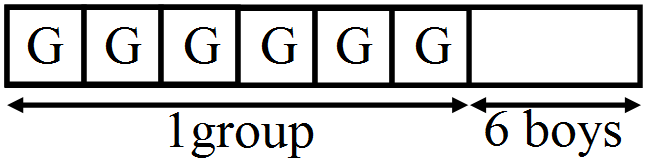
If all the girls sit together, then we consider it as 1 group

$\therefore$ Total number of arrangement of 6 + 1 = 7 persons in a row = 7! And the girls also interchanged their places with 6! Ways.
$\therefore\ \text{Required probability}=\frac{6!7!}{12!}$
$=\frac{6\times5\times4\times3\times2\times7!}{12\times11\times10\times9\times8\times7!}=\frac{1}{132}$
View full question & answer
MCQ 691 Mark
The equation of a locus is $y^2+2 a x+2 b y+c=0$. Then:
  • A
    it is an ellipse
  • it is a parabola
  • C
    latus rectum = a
  • D
    latus rectum = 2a
Answer
Correct option: B.
it is a parabola
  1. it is a parabola
Solution:
Given equation of locus is $\mathrm{y}^2+2 \mathrm{ax}+2 \mathrm{by}+\mathrm{c}=0$, which can be written
$=a s(y+b)^2$
$=-4\left(\frac{a}{2}\right)\left(a+\frac{c b^2}{2 a}\right)$
which is locus of parabola. For parabola with equation $\mathrm{y}^2$ $=4 a x, 4 a$ is length of latus rectum.
Then for given locus, length of latus rectum is
$=4\left(\frac{a}{b}\right)=2 a$
View full question & answer
MCQ 701 Mark
An urn contains 6 balls of which two are red and four are black. Two balls are drawn at random. What is the probability that they are of different colours?
  • A
    $\frac{2}{5}$
  • B
    $\frac{1}{15}$
  • $\frac{8}{15}$
  • D
    $\frac{4}{15}$
Answer
Correct option: C.
$\frac{8}{15}$
Given that, the total number of balls = 6 balls
Let A and B be the red and black balls, respectively,
The probability that two balls are drawn are different = P(the first ball drawn is red)(the second ball drawn is black)+ P(the first ball drawn is black)P(the second ball drawn is red)
$=\Big(\frac{2}{6}\Big)\Big(\frac{4}{5}\Big)+\Big(\frac{4}{6}\Big)\Big(\frac{2}{5}\Big)$
$=\Big(\frac{8}{30}\Big)+\Big(\frac{8}{30}\Big)$
$=\frac{16}{30}=\frac{8}{15}$
View full question & answer
MCQ 711 Mark
One mapping is selected at random from all mappings of the set A = {1, 2, 3, ..., n} into itself. The probability that the mapping selected is one to one is:
  • A
    $\frac{1}{\text{n}^n}$
  • B
    $\frac{1}{\text{n}}$
  • $\frac{\text{n}-1}{\text{n}^n-1}$
  • D
    None of these
Answer
Correct option: C.
$\frac{\text{n}-1}{\text{n}^n-1}$
Number of ways to map 1st element in set A = n Number of ways to map 2nd element in set A = n and so on $\therefore$Total number of mapping from set A to itself $=\text{n}\times\text{n}\times\ ...\ \times\text{n}(\text{n times})=\text{n}^\text{n}$
For one to one mapping,
Number of ways to map 1st element in set A = n
Number of ways to map 2nd element in set A = n −1 Number of ways to map nth element in set A = 1
Total number of one to one mappings from set A to itself $=\text{n}\times\text{(n -1)}\times\text{(n - 2)}\ \times\ ...\times1=\text{n}$ $\therefore$ Required probability $=\frac{\text{Total number of one mappings from set A to inselp} }{\text{Total number of mappings form set A to itself}}$ $=\frac{\text{n}}{\text{n}^\text{n}}=\frac{(\text{n}-1)}{\text{n}^\text{n-1}}$ Hence, the correct answer is option (c).
View full question & answer
MCQ 721 Mark
A bag contains 5 brown and 4 white socks. Ram pulls out two socks. What is the probability that both the socks are of the same colour?
  • A
    9/20
  • B
    2/9
  • C
    3/20
  • 4/9
Answer
Correct option: D.
4/9
Total number of socks = 5 + 4 = 9
Two socks are pulled.
Now, P(Both are same colour) = (5C2 + 4C2)/9C2
= {(5×4)/(2×1) + (4×3)/(2×1)}/{(9×8)/(2×1)}
= {(5×4) + (4×3)/}/{(9×8)
= (5 + 3)/(9×2)
= 8/18
= 4/9
View full question & answer
MCQ 731 Mark
The centre of a circle is (x - 2, x + 1) and it passes through the points (4, 4) Find the value ( or values ) of x, if the diameter of the circle is of length $2\sqrt{5} \text{ units.}$
  • A
    1 or 3
  • B
    -1 or 4
  • 5 or 4
  • D
    3 or -2
Answer
Correct option: C.
5 or 4
  1. 5 or 4
Solution:
Radius of the circle = dist. between the center and given pt. on the circle.
Distance between two points < br / > < br / >$(x_1​, y_1​)$ and $(x_2​, y_2​)$ can be calculated using the formula.
$=\sqrt{(\text{x}_2}-<\text{br}/><\text{br}/>\text{x}_1)^2+(\text{y}_2-\text{y}_1)^2$
Distance between the points (x - 2, x + 1) and D (4, 4)
$=\sqrt{(4-\text{x}+2)^2+(4-\text{x}-1)^2}$
$=\sqrt{(6-\text{x}^2+(3-\text{x)}^2}$
$=\sqrt{36+\text{x}^2-12\text{x}+9+\text{x}^2-6\text{x}}$
$=\sqrt{2}\text{x}^2-18\text{x}+45$
Given, diameter $2\sqrt{5}$ ⇒ Radius $=\sqrt{5}$
$\Rightarrow\sqrt{2\text{x}^2-18\text{x}+45<\text{br}/><\text{br}/>=\sqrt{5}}$
Squaring both sides,
$2x^2- 18x + 45 = 5$
$2x^2-18x + 40 = 0$
$x^2- 9x + 20 = 0$
$(x - 5)(x - 4) = 0$
$x = 5$ or $4$
View full question & answer
MCQ 741 Mark
What is the sample space for choosing a letter from a set of vowel ?
  • A
    {a, b, c........z}
  • {a, e, i, o, u}
  • C
    {a, e, i, o}
  • D
    None of the these
Answer
Correct option: B.
{a, e, i, o, u}
A letter is choose from set of vowels i.e. {a, e, i, o, u}.
View full question & answer
MCQ 751 Mark
If two coins are tossed then find the probability of the events that at the most one tail turns up:
  • A
    $\frac{1}{4}$
  • B
    $\frac{1}{3}$
  • C
    $\frac{1}{2}$
  • $\frac{3}{4}$
Answer
Correct option: D.
$\frac{3}{4}$
The sample space of 2 coins tossed = (h, h), (h, t), (t, h), (t, t)
for having atmost one tail we need = (h, t), (t, h), (h, h)
Thus the probability is $\frac{3}{4}$
View full question & answer
MCQ 761 Mark
The equation of the circle which touches $x$ - axis at $(0,0)$ and touches the line $3 x+4 y-5=0$ is:
  • A
    $x^2+y^2-4 y=0$
  • B
    $x^2+y^2-10 y=0$
  • C
    $x 2+y^2+10 x=0$
  • $x^2+y^2+10 y=0$
Answer
Correct option: D.
$x^2+y^2+10 y=0$
  1. $x^2+y^2+10 y=0$
Solution:
Equation of circle touching $x$ - axis at $(0,0)$, means centre of circle lie on $Y$ - axis i.e. ( $0, k$ ).
$(x-0)^2+(y-k)^2=k^2$
$S: x^2+y^2-2 k y=0$.......(1) Circle S touches
$=3 x+4 y-5=0$
$\therefore k=\frac{4 k-5}{5}$
$=5 k=4 k-5$
$=k=-5$
$\therefore$ Equation of circle is
$=x^2+y^2-(-5) \times 2 y=0$
$\Rightarrow x^2+y^2+10 y=0$
View full question & answer
MCQ 771 Mark
Let A and B are two mutually exclusive events and if P(A) = 0.5 and P(B ̅) =0.6 then P(AUB) is:
  • A
    0
  • B
    1
  • C
    0.6
  • 0.9
Answer
Correct option: D.
0.9
Given, A and B are two mutually exclusive events.
So, P(A ∩ B) = 0
Again given P(A) = 0.5 and P(B ̅) = 0.6
P(B) = 1 – P(B ̅) = 1 – 0.6 = 0.4
Now, P(A ∪ B) = P(A) + P(B) – P(A ∩ B)
⇒ P(A ∪ B) = P(A) + P(B)
⇒ P(A ∪ B) = 0.5 + 0.4 = 0.9
View full question & answer
MCQ 781 Mark
A die is thrown then find the probability of getting a number greater than 3.
  • A
    $\frac{1}{3}$
  • $\frac{1}{2}$
  • C
    $\frac{2}{3}$
  • D
    $0$
Answer
Correct option: B.
$\frac{1}{2}$
Sample space = 1, 2, 3, 4, 5, 6
a no >3 in sample space = 4, 5, 6 = 3
probability of getting no greater than $3=\frac{1}{2}$
View full question & answer
MCQ 791 Mark
The length of the latus rectum of the parabola whose focus is (3, 3) and directrix is 3x - 4y - 2 = 0 is
  • A
    1
  • 2
  • C
    4
  • D
    8
Answer
Correct option: B.
2
Length of the latus rectum (1) = 2 (perpendicular distance from focus to directix)
$1=2 \ \frac{3\ (3)\ -4\ (3)\ -2}{\sqrt{3^2\ +\ 4^2}}=2$
View full question & answer
MCQ 801 Mark
Two numbers are chosen from {1, 2, 3, 4, 5, 6} one after another without replacement. Find the probability that the smaller of the two is less than 4.
  • $\frac{4}{5}$
  • B
    $\frac{1}{15}$
  • C
    $\frac{1}{5}$
  • D
    $\frac{14}{15}$
Answer
Correct option: A.
$\frac{4}{5}$
Total number of ways of choosing two numbers out of six $=\ ^6\text{C}_6=\frac{(6\times2)}{2}=3\times5=15$
If smaller number is chosen as 3 then greater has choice are 4, 5, 6 So, total choices = 3
If smaller number is chosen as 2 then greater has choice are 3, 4, 5, 6 So, total choices = 4
If smaller number is chosen as 1 then greater has choice are 2, 3, 4, 5, 6 So, total choices = 5
Total favourable case = 3 + 4 + 5 = 12
Now, required probability
$=\frac{12}{15}=\frac{4}{5}$
View full question & answer
MCQ 811 Mark
Find the sample space for choosing a prime number less than 2020 at random.
  • 2, 3, 5, 7, 11, 13, 17, 19
  • B
    2, 3, 4, 5, 7, 11, 13, 17, 19
  • C
    2, 3, 5, 7, 11, 13, 17, 19, 20
  • D
    2, 3, 5, 7, 11, 13, 17, 19, 15
Answer
Correct option: A.
2, 3, 5, 7, 11, 13, 17, 19
  1. 2, 3, 5, 7, 11, 13, 17, 19
Solution:
Sample space is the collection of all possible events.
So, sample space for choosing a prime number less than 20 = 2, 3, 5, 7, 11, 13, 17, 19.
View full question & answer
MCQ 821 Mark
On the parabola $y=x^2$, the point least distant from the straight line y = 2x - 4 is:​​​​​​​
  • (1, 1)
  • B
    (1, 0)
  • C
    (1, -1)
  • D
    (0, 0)
Answer
Correct option: A.
(1, 1)
  1. (1, 1)
Solution:
Given, parabola is is $y=x^2 \ldots$ (i)
d straight line is $\mathrm{y}=2 \mathrm{x}-4$...(ii)
From equations (i) and (ii), we get
$x^2-2 x-4=0$
Let $f(x)=x^2-2 x-4$
Thus $f(x)=2 x-2$
or least distance, put $\mathrm{f}^{\prime}(\mathrm{x})=0$
$\Rightarrow 2 x-2=0$
$\Rightarrow x=1$
From equation (i), we have $y=1$
Hence, the point least distant from the line is $(1,1)$
View full question & answer
MCQ 831 Mark
There are 30 tickets numbered from 1 to 30 in a box . A ticket is drawn at random. What is the probability that the ticket drawn bears an odd number?
  • $\frac{1}{2}$
  • B
    $\frac{1}{3}$
  • C
    $\frac{2}{3}$
  • D
    $\frac{1}{4}$
Answer
Correct option: A.
$\frac{1}{2}$
Total number of outcomes = 30
Favourable outcomes (odd number on the ticket) = 15
Probability $=\frac{15}{30}=\frac{1}{2}$
View full question & answer
MCQ 841 Mark
The probability that a leap year will have 53 Fridays or 53 Saturdays is:
  • A
    $\frac{2}{7}$
  • $\frac{3}{7}$
  • C
    $\frac{4}{7}$
  • D
    $\frac{1}{7}$
Answer
Correct option: B.
$\frac{3}{7}$
We know that a leap year has 366 days (i.e. 7 × 52 + 2) = 52 weeks and 2 extra days .
The sample space for these 2 extra days is given below:
S = {(Sunday, Monday), (Monday, Tuesday), (Tuesday, Wednesday), (Wednesday, Thursday), (Thursday, Friday), (Friday, Saturday), (Saturday, Sunday)} There are 7 cases.
$\therefore\text{n(S)}=7$
Let E be the event that the leap year has 53 Fridays or 53 Saturdays.
E = { (Thursday, Friday), (Friday, Saturday), (Saturday, Sunday)}
i.e. n(E) = 3
$\therefore\text{P(E)}=\frac{\text{n(E)}}{\text{n(S)}}=\frac{3}{7}$
Hence, the probability that a leap year has 53 Fridays or 53 Saturdays is $\frac{3}{7}$.
View full question & answer
MCQ 851 Mark
If (a, b) lies on circle with centre as origin, then its radius will be:​​​​​​​
  • A
    $\text{a} - \text{ b}$
  • B
    $\text{a + b}$
  • $\sqrt{\text{a}^2+\text{b}^2}$
  • D
    $\text{a}^2+\text{b}^2$
Answer
Correct option: C.
$\sqrt{\text{a}^2+\text{b}^2}$
  1. $\sqrt{\text{a}^2+\text{b}^2}$
Solution:
We know the formula,
The equation of a circle of radius r and centre the origin is
$x^2+y^2=r^2$
Here the center is (a, b)
so Radius, $\text{r} = \sqrt{\text{a}^{2} + \text{b}^{2}}$
View full question & answer
MCQ 861 Mark
Choose the correct answer.If $\text{P}(\text{A}\cup\text{B})=\text{P}(\text{A}\cap\text{B})$ for any two events A and B, then:
  • $\text{P(A)}=\text{P(B)}$
  • B
    $\text{P(A)}>\text{P(B)}$
  • C
    $\text{P}(\text{A})<\text{P(B)}$
  • D
    none of these.
Answer
Correct option: A.
$\text{P(A)}=\text{P(B)}$
Given that, $\text{P}(\text{A}\cup\text{B})=\text{P}(\text{A}\cap\text{B})$
$\Rightarrow\text{P}(\text{A})+\text{P}(\text{B})-\text{P}(\text{A}\cap\text{B})=\text{P}(\text{A}\cap\text{B})$
$\Rightarrow\big[\text{P(A)}-\text{P}(\text{A}\cap\text{B})\big]+\big[\text{P(B)}-\text{P}(\text{A}\cap\text{B})\big]=0$
But $\text{P(A)}-\text{P}(\text{A}\cap\text{B})\geq0\ ....(\text{i})$
$\big[\because\ \text{P}(\text{A}\cap\text{B})\leq\text{P(A)}\text{ or }\text{P(B)}\big]$
And $\text{P}(\text{B})-\text{P}(\text{A}\cap\text{B})\geq0\ ...(\text{ii})$
From eq. (i) and (ii) we get
$\text{P(A)}=\text{P(B)}$
View full question & answer
MCQ 871 Mark
If three dice are throw simultaneously, then the probability of getting a score of 5 is:
  • A
    $\frac{5}{216}$
  • B
    $\frac{1}{6}$
  • $\frac{1}{36}$
  • D
    $\text{None of these}$
Answer
Correct option: C.
$\frac{1}{36}$
When three dice are thrown together, the sample space S associated with the random experiment is given by,
S = {(1, 1, 1), (1, 1, 2), (1, 1, 3) ...(6, 6, 5), (6, 6, 6)}
Clearly, total number of elementary events n(S) = 216
Let A be the event of getting a total score of 5.
Then A = { (1, 1, 3), (1, 3, 1), (3, 1, 1), (1, 2, 2), (2, 1, 2), (2, 2, 1)}
$\therefore$ Favourable number of elementary events = 6
i.e. n(A) = 6
Hence, required probability $=\frac{6}{216}=\frac{1}{36}$
View full question & answer
MCQ 881 Mark
Choose the correct answer. If $A$ and $B$ are mutually exclusive events, then:
  • $\text{P(A)}\leq\text{P}(\bar{\text{B}})$
  • B
    $\text{P(A)}\geq\text{P}(\bar{\text{B}})$
  • C
    $\text{P}(\text{A})<\text{P}(\bar{\text{B}})$
  • D
    none of these.
Answer
Correct option: A.
$\text{P(A)}\leq\text{P}(\bar{\text{B}})$
For mutually exclusive events,
$\text{P}(\text{A}\cap\text{B})=0$
$\therefore\ \text{P}(\text{A}\cup\text{B})=\text{P(A)}+\text{P(B)}$ $\big[\because\text{ P}(\text{A}\cap\text{B})=0\big]$
$\Rightarrow\text{P}(\text{A})+\text{P(B)}\leq1$
$\Rightarrow\text{P(A)}+1-\text{P}(\bar{\text{B}})\leq1$ $\big[\text{P(B)}=1-\text{P}(\bar{\text{B}})\big]$
$\Rightarrow\text{P(A)}-\text{P}(\bar{\text{B}})\leq0$
$\Rightarrow\text{P(A)}-\text{P}(\bar{\text{B}})$
View full question & answer
MCQ 891 Mark
Find the latus rectum of the parabola $x^2+2 y-3 x+5=0$:
  • A
    1
  • 2
  • C
    4
  • D
    8
Answer
Correct option: B.
2
  1. 2
Solution:
$x^2+2 y-3 x+5=0$
$\Rightarrow\text{x}^2-3\text{x}=-2\text{y}-5$
$\Rightarrow\text{x}^2-2.$
$=\frac{3}{2}\text{x}+\frac{9}{4}$
$=-2\text{y}-5+\frac{9}{4}$
$=-2\text{y}-\frac{11}{4}$
$\Rightarrow\Big(\text{x}-\frac{3}{2}\Big)^2$
$=-2\Big(\text{y}-\frac{11}{4}\Big)$
Hence latus rectum
$=4\times\frac{1}{2}=2$
View full question & answer
MCQ 901 Mark
If the probability of A to fail in an examination is $\frac{1}{5}$ and that of B is$\frac{3}{10}$Then, the probability that either A or B fails is
  • A
    $\frac{1}{2}$
  • B
    $\frac{11}{25}$
  • $\frac{19}{50}$
  • D
    None of these
Answer
Correct option: C.
$\frac{19}{50}$
Given:
$\text{P(A)}=\frac{1}{5}$
$\therefore\text{P(A}')=1-\frac{1}{5}=\frac{4}{5}$
$\text{P(B)}=\frac{3}{10}$
$\therefore\text{P(B}')=1-\frac{3}{10}=\frac{7}{30}$
Hence, required probability $=\text{P}(\text{A}\cap\text{B}')+\text{P}(\text{A}'\cap\text{B})$
$=\frac{1}{5}\times\frac{7}{10}+\frac{4}{5}\times\frac{3}{10}$
$=\frac{7}{50}+\frac{12}{50}$
$=\frac{19}{50}$
View full question & answer
MCQ 911 Mark
Coordinates of centre and radius of the circle $(x-3)^2+(y+4)^2=25$ are respectively:
 
  • A
    $(3,4), 25$
  • B
    $(-3,4), 5$
  • $(3,-4), 5$
  • D
    $(3,-4), 25$
Answer
Correct option: C.
$(3,-4), 5$
  1. $(3, -4), 5$
Solution:
$=(x-3)^2+(y+4)^2=25$
$=(x-3)^2+(y-(-4))^2-(5)^2$
$=(x-4)^2+(y-k)^2-(r)^2$
$=r=5(h, k)=(3,-4)$
View full question & answer
MCQ 921 Mark
Two dice are thrown simultaneously. The probability of obtaining a total score of 5 is:
  • A
    $\frac{1}{18}$
  • B
    $\frac{1}{12}$
  • $\frac{1}{9}$
  • D
    None of these
Answer
Correct option: C.
$\frac{1}{9}$
When two dice are thrown, there are (6 × 6) = 36 outcomes.
The set of all these outcomes is the sample space given by
S = (1, 1), (1, 2), (1, 3), (1, 4), (1, 5), (1, 6)
(2, 1), (2, 2), (2, 3), (2, 4), (2, 5), (2, 6)
(3, 1), (3, 2), (3, 3), (3, 4), (3, 5), (3, 6)
(4, 1), (4, 2), (4, 3), (4, 4), (4, 5), (4, 6)
(5, 1), (5, 2), (5, 3), (5, 4), (5, 5), (5, 6)
(6, 1), (6, 2), (6, 3), (6, 4), (6, 5), (6, 6)
i.e. n(S) = 36
Let E be the event of getting a total score of 5.
Then E = {(1, 4), (2, 3), (3, 2), (4, 1)
$\therefore$ n(E) = 4
Hence, required probability $=\frac{\text{n}(\text{E})}{\text{n}(\text{S})}=\frac{4}{36}=\frac{1}{9}$
View full question & answer
MCQ 931 Mark
The length of latus rectum of the parabola $y^2+8 x-2 y+17=0$ is:
  • A
    2
  • B
    4
  • 8
  • D
    16
Answer
Correct option: C.
8
  1. 8
Solution:
The given parabola is, $y^2+8 x-2 y+17=0$
$\Rightarrow\left(y^2-2 y+1\right)=-8 x-17+1=-8 x-16$
$\Rightarrow(y-1)^2=-8(x+2)$
Comparing with standard parabola $Y^2=-4 a X$
$Y=y-1, X=x+2, a=2$
Hence length of latus rectum is $=4 a=4 \times 2=8$
View full question & answer
MCQ 941 Mark
Equation of the circle with centre on the $y$ - axis and passing through the origin and the point $(2,3)$ is:
 
  • A
    $x^2+y^2+13 y=0$
  • B
    $x^2+3 y^2+13 x+3=0$
  • $x^2+6 y^2-13 y=0$
  • D
    $x^2+y^2+13+3=0$
Answer
Correct option: C.
$x^2+6 y^2-13 y=0$
  1. $x^2+6 y^2-13 y=0$
Solution:
We have to find equation of a circle with center on the $y$-axis.
General equation of such circle is $(x-0)^2+(y-k)^2=k^2$
It passes through $(2,3)$ i.e, $2^2+(3-k)^2=k^2$
$\Rightarrow 4+9+\mathrm{k}^2-6 \mathrm{k}=\mathrm{k}^2$
$\Rightarrow \mathrm{k}=\frac{13}{6}$
$\therefore$ Equation of circle
$=x^2+\left(y-\frac{13}{6}\right)^2$
$=\left(\frac{13}{6}\right)^2$
$=6 x^2+6 y^2-13 y=0$
View full question & answer
MCQ 951 Mark
Five persons entered the lift cabin on the ground floor of an 8 floor house. Suppose that each of them independently and with equal probability can leave the cabin at any floor beginning with the first, then the probability of all 5 persons leaving at different floor is:
  • $\frac{\ ^{7}\text{P}_5}{7^5}$
  • B
    $\frac{\ ^{7^5}}{\ ^{7}\text{P}_5}$
  • C
    $\frac{\ ^{6}}{\ ^{6}\text{P}_5}$
  • D
    $\frac{\ ^{5}\text{P}_5}{5^5}$
Answer
Correct option: A.
$\frac{\ ^{7}\text{P}_5}{7^5}$
  1. $\frac{\ ^{7}\text{P}_5}{7^5}$​
Solution:
Since, it is an eight - storey building.
So, there are 7 possible options for them in 7 floors in total if ground floor is not considered.
Hence, total possible outcomes = $7 \times 7 \times 7 \times 7 \times 7=7^5$
Thus, number of ways in which 5 persons can leave from seven floors differently $=\ ^{7}\text{P}_5$
Required probability $=\frac{\ ^{7}\text{P}_5}{7^5}$
View full question & answer
MCQ 961 Mark
Two dice are thrown:
P is the event that the sum of the scores on the uppermost faces is a multiple of 6.
Q is the event that the sum of the scores on the uppermost faces is at least 10.
R is the event that same scores on both dice. Which of the following pairs is mutually exclusive?
  • A
    P, Q
  • B
    P, R
  • C
    Q, R
  • None of these
Answer
Correct option: D.
None of these
Possibilities ofP, (3, 3),(6, 6),(1, 5),(5, 1),(4, 2),(2, 4)
Possibilities of Q:(5, 5),(5, 6),(6, 5),(6, 6)
Possibilities of R:(1, 1),(2, 2),(3, 3),(4, 4),(5, 5),(6, 6)
Thus, the possibilities are neither exhaustive, nor mutually exclusive nor these are complementary probabilities.
View full question & answer
MCQ 971 Mark
A person write 4 letters and addresses 4 envelopes. If the letters are placed in the envelopes at random, then the probability that all letters are not placed in the right envelopes, is
  • A
    $\frac{1}{4}$
  • B
    $\frac{11}{24}$
  • C
    $\frac{15}{24}$
  • $\frac{23}{24}$
Answer
Correct option: D.
$\frac{23}{24}$
Total number of ways of placing four letters in 4 envelops = 4 = 24
All the letters can be dispatched in the right envelops in only one way. Therefore, the probability that all the letters are placed in the right envelops is $\frac{1}{24}$.
Hence, probability that all the letters are not placed in the right envelops $=1-\frac{1}{24}=\frac{23}{24}$
View full question & answer
MCQ 981 Mark
The probability of getting a total of 10 in a single throw of two dices is:
  • A
    $\frac{1}{9}$
  • $\frac{1}{12}$
  • C
    $\frac{1}{6}$
  • D
    $\frac{5}{36}$
Answer
Correct option: B.
$\frac{1}{12}$
When two dices are thrown, there are (6 × 6) = 36 outcomes.
The set of all these outcomes is the sample space, given by
S = (1, 1), (1, 2), (1, 3), (1, 4), (1, 5), (1, 6)
(2, 1), (2, 2), (2, 3), (2, 4), (2, 5), (2, 6)
(3, 1), (3, 2), (3, 3), (3, 4), (3, 5), (3, 6)
(4, 1), (4, 2), (4, 3), (4, 4), (4, 5), (4, 6)
(5, 1), (5, 2), (5, 3), (5, 4), (5, 5), (5, 6)
(6, 1), (6, 2), (6, 3), (6, 4), (6, 5), (6, 6)
i.e. n(S) = 36
Let E be the event of getting a total score of 10.
Then E = {(4, 6), (5, 5), (6, 4)}
$\therefore$ n(E) = 3
Hence, required probability $=\frac{\text{n}(\text{E})}{\text{n}(\text{S})}=\frac{3}{36}=\frac{1}{12}$
View full question & answer
MCQ 991 Mark
6 boys and 6 girls sit in a row at random. The probability that all the girls sit together is
  • A
    $\frac{1}{432}$
  • B
    $\frac{12}{431}$
  • $\frac{1}{132}$
  • D
    $\text{none of these}$
Answer
Correct option: C.
$\frac{1}{132}$
Total number of ways in which 6 boys and 6 girls can sit in a row = 12
Consider 6 girls as one group, then 6 boys and one group can arrange in 7 ways.
Now, 6 girls in the group can arrange among themselves in 6.
So, the number of ways in which all the girls sit together is 7 × 6
$\therefore$P(all girls sit together) $=\frac{\text{Number of ways in which all girls sit together }}{\text{Total Number of ways in which 6 boys and 6 girls sit in a row}}$
$=\frac{7\times6}{12}=\frac{6\times5\times4\times3\times2\times1}{12\times11\times10\times9\times8}=\frac{1}{132}$
Hence, the correct answer is option (c).
View full question & answer
MCQ 1001 Mark
An urn contains 9 balls two of which are red, three blue and four black. Three balls are drawn at random. The probability that they are of the same colour is:
  • $\frac{5}{84}$
  • B
    $\frac{3}{9}$
  • C
    $\frac{3}{7}$
  • D
    $\frac{7}{17}$
Answer
Correct option: A.
$\frac{5}{84}$
Three balls can be drawn randomly from nine balls in$ \ ^{9}\text{C}_3 = 84$ ways.
Three balls cannot be red as there are only two red balls.
Three balls of the same colour can be drawn in the following ways :
3 blue out of a total of 3 blue balls.
The probability for which is $\frac{\ ^{3}\text{C}_3}{84}=\frac{1}{84}$
3 black out of a total of 4 black balls.
The probability for which is $\frac{\ ^{4}\text{C}_3}{84}=\frac{4}{84}$
Hence, required probability $=\frac{1}{84}+\frac{4}{84}=\frac{5}{84}$
View full question & answer
MCQ 1011 Mark
The vertex of the parabola $=y^2-4 y-x+3=0$ is:
  • A
    (-1, 3)
  • (-1, 2)
  • C
    (2, -1)
  • D
    (3, -1)
Answer
Correct option: B.
(-1, 2)
  1. (-1, 2)
Solution:
We have,
$=y^2-4 y-x+3=0$
$\Rightarrow(y-2)^2-4-x+3=0$
$\Rightarrow(y-2)^2=(x+1)$
$\therefore$ Vertex of the parabola $=(-1,2)$
View full question & answer
MCQ 1021 Mark
Two dice are thrown simultaneously. Find the probability of getting a multiple of 2 on first dice and a multiple of 3 on the second dice.
  • A
    $\frac{4}{6}$
  • B
    $\frac{2}{6}$
  • $\frac{1}{6}$
  • D
    $\frac{1}{36}$
Answer
Correct option: C.
$\frac{1}{6}$
Total cases = 6 × 6
Let A be the event of getting a multiple of 2 on first dice and a multiple of 3 on the second dice.
Hence, A = {(2, 3), (2, 6), (4, 3), (4, 6), (6, 3), (6, 6)} n(A) = 66
$∴\text{P(A)}=\frac{6}{36}=\frac{1}{6}$
View full question & answer
MCQ 1031 Mark
If two coins are tossed then find the probability of the event that no head turns up.
  • $\frac{1}{4}$
  • B
    $\frac{1}{3}$
  • C
    $\frac{1}{2}$
  • D
    $\frac{3}{4}$
Answer
Correct option: A.
$\frac{1}{4}$
2 coins tossed sample space = (h, h), (h, t), (t, h), (t, t)
have no head = 1 (when both tail)
probability is $\frac{1}{4}$
View full question & answer
MCQ 1041 Mark
The lines 2x - 3y = 5 and 3x - 4y = 7 are two diameters of a circel of area 154sq. units. Then the equation of circle is:
  • A
    $(x+1)^2+(y+1)^2=49$
  • B
    $(x-1)^2+(y-1)^2=-49$
  • $(x-1)^2+(y+1)^2=49$
  • D
    $(x+1)^2+(y-1)^2=49$
Answer
Correct option: C.
$(x-1)^2+(y+1)^2=49$
  1. $(x-1)^2+(y+1)^2=49$
Solution:
Circle area $=\pi^2=154 \Rightarrow \mathrm{r}=7$ sq.units
intersection of diameter $(2 x-3 y=5) \times 3$ $(3 x-4 y=7) \times 2$
$-y=1 \Rightarrow y=-1$
$12 \mathrm{x}=5-3=2 \Rightarrow \mathrm{x}=1$
eqn of circle $(x-1)^2+(y+1)^2=49$
View full question & answer
MCQ 1051 Mark
A die is rolled, then the probability that a number 1 or 6 may appear is
  • A
    $\frac{2}{3}$
  • B
    $\frac{5}{6}$
  • $\frac{1}{3}$
  • D
    $\frac{1}{2}$
Answer
Correct option: C.
$\frac{1}{3}$
Total number of sample space, S = {1, 2, 3, 4, 5, 6}
$\therefore\text{n}\text{(S)} = 6$
Let A be the event of getting the number 1 or 6.
A = {1, 6}
i.e. n(A) = 2
Hence, required probability $=\frac{\text{n(A)}}{\text{n(S)}}=\frac{2}{6}=\frac{1}{3}$
View full question & answer
MCQ 1061 Mark
Six boys and six girls sit in a row randomly. The probability that all girls sit together is
  • A
    $\frac{1}{122}$
  • B
    $\frac{1}{112}$
  • C
    $\frac{1}{102}$
  • $\frac{1}{132}$
Answer
Correct option: D.
$\frac{1}{132}$
Total number of ways in which six boys and six girls can be seated in a row = (12)
Taking all the six girls as one person, seven persons can be seated in a row in 7 ways.
The six girls can be arranged among themselves in 6 ways.
Then number of ways in which six boys and six girls can be seated in a row so that all
the girls sit together = 7 × 6
$\therefore\text{Required Probability}=\frac{7\times6}{12}$$\frac{720}{12\times11\times10\times9\times8}=\frac{1}{132}$
View full question & answer
MCQ 1071 Mark
If events A and B are independent and P(A) = 0.15, P(A ∪ B) = 0.45, then P(B)=:
  • A
    136​
  • 176​
  • C
    196​
  • D
    236​
Answer
Correct option: B.
176​
Given, P(A) = 0.15, P(A ∪ B) = 0.45
We have P(A ∪ B) = P(A) + P(B) - P(A ∩ B)
and P(A ∩ B) = P(A). P(B)
Therefore, 0.45 = 0.15 + P(B) - 0.15 P(B)
⇒ 0.30 = 0.85 P(B)
⇒ P(B) = 8530​ = 176​
View full question & answer
MCQ 1081 Mark
The ends of the latus rectum of the conic $x^2+10 x-16 y+25=0$ are:
  • A
    (3, -4), (13, 4)
  • B
    (-3, -4), (13, -4)
  • (3, 4), (-13, 4)
  • D
    (5, -8), (-5, 8)
Answer
Correct option: C.
(3, 4), (-13, 4)
  1. (3, 4), (-13, 4)
Solution:
$x^2+10 x-16 y+25=0$
$\Rightarrow(x+5)^2=16 y$
$\Rightarrow X^2=4 A Y, \text { where } X=x+5, A=4, Y=y$
The ends of the latus rectum are $(2 A, A)$ and $(-2 A, A)$
$\Rightarrow x+5=2(4)$
$\Rightarrow x=-8-5=3, y=4 \text { and } x+5=-2(4) x+5=-2(4)$
$\Rightarrow x=-8-5=-13, y=4$
$\Rightarrow(3,4) \text { and }(-13,4)$
View full question & answer
MCQ 1091 Mark
A card is drawn at random from a pack of 100 cards numbered 1 to 100. The probability of drawing a number which is a square is:
  • A
    $\frac{1}{5}$
  • B
    $\frac{2}{5}$
  • $\frac{1}{10}$
  • D
    None of these
Answer
Correct option: C.
$\frac{1}{10}$
Clearly, the sample space is given by
S = {1, 2, 3, 4, 5 ....97, 98, 99, 100}
$\therefore$ n(S) = 100
Let E = event of getting a square.
Then E = {1, 4, 9, 16, 25, 36, 49, 64, 81, 100}
$\therefore$ n(E) = 10
Hence, required probability $=\frac{\text{n}(\text{E})}{\text{n}(\text{S})}=\frac{10}{100}=\frac{1}{10}$
View full question & answer
MCQ 1101 Mark
The point (3, 4) is the focus and 2x - 3y + 5 = 0 is the directrix of a parabola. Lenghth of latus rectum is:
  • $\frac{2}{\sqrt{13}}$
  • B
    $\frac{4}{\sqrt{13}}$
  • C
    $\frac{1}{\sqrt{13}}$
  • D
    $\frac{3}{\sqrt{13}}$
Answer
Correct option: A.
$\frac{2}{\sqrt{13}}$
We know that, Latus rectum = 2× (distance from focus to directrix)
$=2.\frac{6\ -\ 12\ +\ 5}{\sqrt{4\ +\ 9}}$
$=\frac{2}{\sqrt{13}}$
View full question & answer
MCQ 1111 Mark
What is the probability of selecting a vowel in the word “PROBABILITY”?
  • A
    $\frac{2}{11}$
  • $\frac{3}{11}$
  • C
    $\frac{4}{11}$
  • D
    $\frac{5}{11}$
Answer
Correct option: B.
$\frac{3}{11}$
  1. $\frac{3}{11}$
View full question & answer
MCQ 1121 Mark
The equation of the circle passing through $(2, 0)$ and $(0, 4)$ and having the minimum radius is:
  • A
    $x^2+y^2=20$
  • $x^2+y^2-2 x-4 y=0$
  • C
    $x^2+y^2=4$
  • D
    $x^2+y^2=16$
Answer
Correct option: B.
$x^2+y^2-2 x-4 y=0$
  1. $x^2+y^2-2 x-4 y=0$
Solution:
Given points are $(2,0)$ and $(0,4)$
Therefore, equation of circle is $(x-2)(x-0)+(y-0)(y-4)=0$
By expanding, we get
$x^2-2 x+y^2-4 y=0$
Option B is correct.
View full question & answer
MCQ 1131 Mark
The length of the latus rectum of the parabola whose vertex is (2, -3) and the directrix x = 4 is:
  • A
    2
  • B
    4
  • C
    6
  • 8
Answer
Correct option: D.
8
Distance of vertex (2, -3) from directrix x = 4 is
$=\frac{2\ -\ 4}{\sqrt{1^2\ +\ 0^2}}=2$
So length of latue rectum of above parabola is =4× distance of vertex to directrix = 4 × 2 = 8.
View full question & answer
MCQ 1141 Mark
If the circle $x^2+y^2=9$ passesthrough $(2, c)$ then cc is equal to:
  • $\sqrt5$
  • B
    $\sqrt 6$
  • C
    $\sqrt 3$
  • D
    $\sqrt 7$
Answer
Correct option: A.
$\sqrt5$
  1. $\sqrt5$
Solution:
The equation of circle $x^2+y^2=9$ The point is $(2, c) \Longrightarrow 2^2+c^2=94+c^2=9$
$c^2=9-4$
$c^2=5$
$c=\sqrt{5}$
View full question & answer
MCQ 1151 Mark
The equation of circle center at $(0,0)$ and Radius 8 cm :
  • $x^2+y^2=64 \mathrm{~cm}$
  • B
    $x^2+y^2=8$
  • C
    $x^2+y^2=16$
  • D
    $x^2+y^2=4$
Answer
Correct option: A.
$x^2+y^2=64 \mathrm{~cm}$
  1. $x^2+y^2=64 \mathrm{~cm}$
Solution:
The equation of circle is $x^2+y^2=r^2$
$x^2+y^2=8^2$
$x^2+y^2=64$
View full question & answer
MCQ 1161 Mark
A and B are two events such that P (A) = 0.25 and P (B) = 0.50. The probability of both happening together is 0.14. The probability of both A and B not happening is
  • 0.39
  • B
    0.2
  • C
    0.11
  • D
    none of these.
Answer
Correct option: A.
0.39
$\text{p(A)}=0.25\text{ and }\text{P(B)=0.50}$
$\text{P}(\text{A}\cap\text{B})=0.14$
$\therefore\text{Required probability}=1-\text{P}(\text{A}\cup\text{B})$
$=1-\big[\text{P(A)}+\text{P(B)}-\text{P}(\text{A}\cap\text{B})\big]$
$=1-\big[0.25+0.50-0.14\big]$
$=1-0.61=0.39$
View full question & answer
MCQ 1171 Mark
If the centroid of an equilateral triangle is $(1,1)$ and its one vertex is $(-1,2)$ then the equation of its circumcircle is:
  • $x^2+y^2-2 x-2 y-3=0$
  • B
    $x^2+y^2+2 x-2 y-3=0$
  • C
    $x^2+y^2+2 x+2 y-3=0$
  • D
    none of these
Answer
Correct option: A.
$x^2+y^2-2 x-2 y-3=0$
  1. $x^2+y^2-2 x-2 y-3=0$
Solution:
Given centroid of an equilateral triangle is $\mathrm{G}(1,1)$.
We know that in an equilateral triangle, centroid, circumcenter and incenter are at the same point.
So, the circumcenter is at $\mathrm{G}(1,1)$.
Given one vertex of equilateral triangle at $A(-1,2)$
So, circumradius
$=\mathrm{AG}=\sqrt{5}$
$=$ So, equation of circumcircle is
$=(x-1)^2+(y-1)^2=5$
$\Rightarrow x^2+y^2-2 x-2 y-3=0$
View full question & answer
MCQ 1181 Mark
Choose the correct answer. While shuffling a pack of 52 playing cards, 2 are accidentally dropped. Find the probability that the missing cards to be of different colours:
  • A
    $\frac{29}{52}$
  • B
    $\frac{1}{2}$
  • $\frac{26}{51}$
  • D
    $\frac{27}{51}$
Answer
Correct option: C.
$\frac{26}{51}$
We know that out of 52 playing cards 26 are of red and 26 are of black colour.$\therefore$ P(both cards of differents colour)
$=\frac{26}{52}\times\frac{26}{51}+\frac{26}{52}\times\frac{26}{51}$
$=2\times\frac{26}{52}\times\frac{26}{51}=\frac{6}{51}$
View full question & answer
MCQ 1191 Mark
Which ordered number pair represents the center of the circle $x^2+y^2-6 x+4 y-12=0$ ?
  • A
    (9, 4)
  • B
    (3, 2)
  • (3, -2)
  • D
    (6, 4)
Answer
Correct option: C.
(3, -2)
  1. (3, -2)
Solution:
The equation of circle is $x^2+y^2-6 x+4 y-12=0 \Rightarrow x^2-6 x+9+y^2+4 y+4=12+13$ $\Rightarrow(x-3)^2+(y+2)^2=25$ Comparing above equation with $(x-h)^2+(y-k)^2=r^2$
Therefore, we get the center of circle as $(3,-2)(3,-2)$.
View full question & answer
MCQ 1201 Mark
Find the center-radius form of the equation of the circle with center $(4,0)$ and radius 7 :
  • $(x-4)^2+y^2=49$
  • B
    $x^2+(y+4)^2=7$
  • C
    $x^2+(y-4)^2=7$
  • D
    $(x+4)^2+y^2=49$
Answer
Correct option: A.
$(x-4)^2+y^2=49$
  1. $(x-4)^2+y^2=49$
Solution:
If $(-g,-f)$ is the center and rr is radius
The $(x+g)^2+(y+f)^2=r^2$ is the equation of the circle There
$=C=(4,0), r=7$
$\Rightarrow(x-4) 2+(y-0) 2=72$
$=(x-4)^2+(y)^2=49$
View full question & answer
MCQ 1211 Mark
The probabilities of happening of two events A and B are 0.25 and 0.50 respectively. If the probability of happening of A and B together is 0.14, then probability that neither A nor B happens is:
  • $\text{0.39}$
  • B
    $0.29$
  • C
    $0.11$
  • D
    None of these.
Answer
Correct option: A.
$\text{0.39}$
$\text{P(A)}=0.25, \text{P(B)=0.50}\text{ and }\text{P(A}\cap\text{B)}=0 .14$
$\therefore\text{Required Probability}=1-\text{P}(\text{A}\cup\text{B})$
$=1-\big[\text{P(A)}+\text{P(B)}-\text{P}(\text{A}\cap\text{B}\big]$
$=1-\big[0.25+0.50-0.14\big]$
$=1-0.61=0.39$
View full question & answer
MCQ 1221 Mark
If a card is drawn from a pack of cards. The probability of getting black ace is:
  • A
    $\frac{1}{52}$
  • $\frac{1}{26}$
  • C
    $\frac{1}{13}$
  • D
    $\frac{1}{4}$
Answer
Correct option: B.
$\frac{1}{26}$
Total number of cases = 52
Number of favourable cases (getting a black ace) = 2
Thus, Probability (getting a black ace)
$=\frac{5}{52}=\frac{1}{26}$
View full question & answer
MCQ 1231 Mark
A box contains 10 good articles and 6 defective articles. One item is drawn at random. The probability that it is either good or has a defect, is:
  • $\frac{64}{64}$
  • B
    $\frac{49}{64}$
  • C
    $\frac{40}{69}$
  • D
    $\frac{24}{64}$
Answer
Correct option: A.
$\frac{64}{64}$
The answer is one, because the article would be either good or defective as per the question.
Hence, the only option is $\frac{64}{64}=1$
View full question & answer
MCQ 1241 Mark
All the three face cards of spades are removed from a well-shuffled pack of 52 cards. A card is then drawn at random from the remaining pack. Find the probability of getting black face card:
  • A
    $\frac{6}{49}$
  • $\frac{3}{49}$
  • C
    $\frac{5}{49}$
  • D
    $\frac{4}{49}$
Answer
Correct option: B.
$\frac{3}{49}$
Total number of possibilities Total number of possibilities = 49 (Since, 3 cards of spade are removed)
Number of black face cards = 3 (3 cards of clubs)
Thus, required probability
$=\frac{3}{49}$
View full question & answer
MCQ 1251 Mark
Four persons are selected at random out of 3 men, 2 women and 4 children. The probability that there are exactly 2 children in the selection is:
  • A
    $\frac{11}{21}$
  • B
    $\frac{9}{21}$
  • $\frac {10}{21}$
  • D
    None of these
Answer
Correct option: C.
$\frac {10}{21}$
There are nine persons (three men, two women and four children) out of which four persons can be selected in $\ ^{9}\text{C}_4 = 126\ \text{ways}.$
Total number of elementary events = 126
Exactly two children means selecting two children and two other people from three men and two women.
This can be done in $\ ^{4}\text{C}_2\times\ ^{ 5}\text{C}_2 \text{ways}.$
Favourable number of elementary events$=\ ^{4}\text{C}_2\times\ ^{ 5}\text{C}_2 = 60$
So, required probability $=\frac{60}{120} =\frac{10}{21}$
View full question & answer
MCQ 1261 Mark
Out of 30 consecutive integers, 2 are chosen at random. The probability that their sum is odd, is
  • A
    $\frac{14}{29}$
  • B
    $\frac{16}{29}$
  • $\frac {15}{29}$
  • D
    $\frac{10}{29}$
Answer
Correct option: C.
$\frac {15}{29}$
The total number of ways in which two integers can be chosen from the given 30 integers is $\ ^{30}\text{C}_2$.
The sum of the selected numbers is odd if exactly one of them is even or odd.
$\therefore$ Favourable number of outcomes $=\ ^{15}\text{C}_1\times\ ^{15}\text{C}_1$
Hence, required probability $=\frac{\ ^{15}\text{C}_1\times\ ^{15}\text{C}_1}{\ ^{30}\text{C}_2}=\frac{15}{29}$
View full question & answer
MCQ 1271 Mark
20 cards are numbered from 1 to 20. If one card is drawn at random, what is the probability that the number on the card is a prime number?
  • A
    $\frac{1}{5}$
  • $\frac{2}{5}$
  • C
    $\frac{3}{5}$
  • D
    $5$
Answer
Correct option: B.
$\frac{2}{5}$
Let E be the event of getting a prime number.
E = {2, 3, 5, 7, 11, 13, 17, 19} Hence, P(E)
$\frac{8}{20}=\frac{2}{5}.$
View full question & answer
MCQ 1281 Mark
Events A and B are said to be mutually exclusive if:
  • P (A U B) = P A. + P B.
  • B
    P (A ∩ B) = P A. × P B.
  • C
    P(A U B) = 0
  • D
    None of these
Answer
Correct option: A.
P (A U B) = P A. + P B.
If A and B are mutually exclusive events,
Then P(A ∩ B) = 0
Now, by the addition theorem,
P(A U B) = PA. + PB. – P(A ∩ B)
⇒ P(A U B) = PA. + PB
View full question & answer
MCQ 1291 Mark
A glass jar contains 10 red, 12 green, 14 blue and 16 yellow marbles. If a single marble is chosen at random from the jar, find the sample space.
  • {red, green, blue, yellow}
  • B
    {red, blue, yellow}
  • C
    {red, yellow}
  • D
    {red, green, blue}
Answer
Correct option: A.
{red, green, blue, yellow}
Sample space is the collection of all possible outcomes.
So, sample space == {red, green, blue, yellow}
View full question & answer
MCQ 1301 Mark
The area of the circle represented by the equation $(x + 3)^2+ (y + 1)^2 = 25$ is:
  • A
    $\pi4$
  • B
    $\pi5$
  • C
    $16\pi$
  • $25\pi$
Answer
Correct option: D.
$25\pi$
  1. $25\pi$
Solution:
The general equation of circle with centre (h, k) and radius rr is given by
$(x - h)^2+ (y - k)^2= (r)^2$.It is given that the equation of the circle is
$(x + 3)^2+ (y + 1)^2= 25$ Therefore,
$= -3, k = -1$ and $r = 5$.
The area of the circle with radius r is
$=\pi\text{r}^2$ thus, the area of the circle with radius r = 5 is:
$=\pi\text{r}^2=\pi(5)^2=25\pi$
Hence, the area of the circle is
$=25\pi.$
View full question & answer
MCQ 1311 Mark
A bag contains 5 black balls, 4 white balls and 3 red balls. If a ball is selected randomwise, the probability that it is black or red ball is:
  • A
    $\frac{1}{3}$
  • B
    $\frac{1}{4}$
  • C
    $\frac{5}{12}$
  • $\frac{2}{3}$
Answer
Correct option: D.
$\frac{2}{3}$
Out of 12 balls, one ball can be drawn in $\ ^{12}\text{C}_1$ ways.
Total number of elementary events $= \ ^{12}\text{C}_1 = 12$
Out of fivne black balls, one black ball can be chosen in $\ ^{5}\text{C}_1 = 5$ ways.
Out of three red balls, one red ball can be chosen in $\ ^{3}\text{C}_1 = 3$ ways
Favourable number of events $= 5 + 3 = 8$
Hence, required probability $=\frac{8}{12}=\frac{2}{3}$
View full question & answer
MCQ 1321 Mark
A card is drawn at random from a pack of 52 cards. What is the probability that the card drawn is a spade or a king ?
  • $\frac{4}{13}$
  • B
    $\frac{3}{13}$
  • C
    $\frac{2}{13}$
  • D
    $\frac{1}{13}$
Answer
Correct option: A.
$\frac{4}{13}$
Since, Total cards = 52
No. of kings = 4
No. of cards that are spade = 13
There is one card of king which is of spad
$∴$ no. of cards which are spade or a king = 16
$∴$ Required probability $=\frac{16}{52}=\frac{4}{13}$
View full question & answer
MCQ 1331 Mark
Choose the correct answer. Without repetition of the numbers, four digit numbers are formed with the numbers 0, 2, 3, 5. The probability of such a number divisible by 5 is:
  • A
    $\frac{1}{5}$
  • B
    $\frac{4}{5}$
  • C
    $\frac{1}{30}$
  • $\frac{5}{9}$
Answer
Correct option: D.
$\frac{5}{9}$
We have digite 0, 2, 3, 5.
Number of divisible by 5 if unit place digit is '0' or '5'
If unit place is '0' then first three places can be filled in 3! ways.
If unit place is '5' then first place can be filled in two ways and second and thried place can be filled in 2! ways.
So, number of numbers ending with digit '5' is 2 × 2! = 4
$\therefore$ Total number of numbers divisible by 5 = 3! + 4 = 110 = n(E)
Also total number of numbers = 3 × 3! = 18
$\therefore\ \text{Required probability}=\frac{10}{18}=\frac{5}{9}$
View full question & answer
MCQ 1341 Mark
Toss a fair coin 3 times in a row, how many elements are in the sample space?
  • A
    2
  • B
    4
  • C
    6
  • 8
Answer
Correct option: D.
8
Sample space is the collection of all possible events.
So, sample space, S = (H, H, H), (H, H, T), (H, T, T), (H, T, T), (T, H, H), (T, H, T ), (T, T, H), (T, T, T)
Therefore, there are 8 elements in sample space.
View full question & answer
MCQ 1351 Mark
Three identical dice are rolled. What is the probability that the same number will appear on each of them?
  • A
    $\frac{1}{6}$
  • $\frac{1}{36}$
  • C
    $\frac{1}{18}$
  • D
    $\frac{3}{28}$
Answer
Correct option: B.
$\frac{1}{36}$
Total number of cases = 6³ = 216
The same number can appear on each of the dice in the following ways:
(1, 1, 1), (2, 2, 2), ………….(3, 3, 3)
So, favourable number of cases = 6
Hence, required probability = 6/216 = 1/3
View full question & answer
MCQ 1361 Mark
A bag contains 3 red, 4 white and 5 blue balls. All balls are different. Two balls are drawn at random. The probability that they are of different colour is:
  • $\frac{47}{66}$
  • B
    $\frac{10}{33}$
  • C
    $\frac{1}{3}$
  • D
    $1$
Answer
Correct option: A.
$\frac{47}{66}$
Out of 12 balls, two balls can be drawn in $^{12}\text{C}_2$ ways.
$\therefore$ Total number of elementary events, $\text{n}(\text{S})=^{12}\text{C}_2=66$
We observe that at least one ball of each colour can be drawn in one of the following mutually exclusive ways:
Red and 1 white
1 red and 1 blue
1 white and 1 blue
Thus, if we define three events A, B and C as follows:
A = drawing 1 red and 1 white
B = drawing 1 red and 1 blue
C = drawing 1 white and 1 blue
then, A, B and C are mutually exclusive events.
$\therefore$ Required probability $=\text{P}(\text{A}\cup\text{B}\cup\text{C})$
$=\text{P}(\text{A})+\text{P}(\text{B})+\text{P}(\text{C})$
$=\frac{^3\text{C}_1\times^4\text{C}_1}{^{12}\text{C}_2}+\frac{^3\text{C}_1\times^5\text{C}_1}{^{12}\text{C}_2}+\frac{^4\text{C}_1\times^5\text{C}_1}{^{12}\text{C}_2}$
$=\frac{3\times4}{66}+\frac{3\times5}{66}+\frac{4\times5}{66}$
$=\frac{12}{66}+\frac{15}{66}+\frac{20}{56}=\frac{47}{66}$
View full question & answer
MCQ 1371 Mark
Choosing a queen from a deck of cards is an example of:
  • compound event
  • B
    complementary event
  • C
    simple event
  • D
    impossible event
Answer
Correct option: A.
compound event
Choosing a queen from a deck of cards is an example of compound event.
Because the total number of card = 52
Choosing a queen card = 4= (spade, diamond, heart, club)
So, more than one element of the sample space in the set representing an event, then this event is called a compound event.
View full question & answer
MCQ 1381 Mark
What is the radius of the circle passing through the point (2, 4) and having centre at the intersection of the lines 4x - y = 4 and 2x + 3y + 7?
  • A
    $3\text{ units}$
  • B
    $5\text{ units}$
  • C
    $3\sqrt{3}\text{ units}$
  • $5\sqrt{2}\text{ units}$
Answer
Correct option: D.
$5\sqrt{2}\text{ units}$
The line x - y = 4 and 2x + 3y + 7 = 0 intersect at the point (1, -3) So, the centre of circle lies at (1, -3)
Point (2, 4) lies on the circle. So, radius = distance of (2, 4) from (1, -3)
$=\sqrt{(2-1)^2+(4-(-3)^2}$
$=\sqrt{1^2+7^2}$
$=\sqrt{50}=5\sqrt{2}$
View full question & answer
MCQ 1391 Mark
The name of the conic represent by the equation $x^2+y^2-2 y+20 x+10=0$ is:
  • A
    a hyperbola
  • B
    an ellipse
  • C
    a parabola
  • circle
Answer
Correct option: D.
circle
  1. circle
Solution:
For a standard second degree equation $a x^2+2 h x y+b y^2+2 g x+$
$2 f y+c=0$ to be a circle $a=b$
$\mathrm{h}=0$ Here $\mathrm{a}=\mathrm{b}=1$
$\mathrm{h}=0$ So The given equation is Circle.
View full question & answer
MCQ 1401 Mark
Three integers are chosen at random from the first 20 integers. The probability that their product is even is:
  • A
    $\frac{2}{19}$
  • B
    $\frac{3}{29}$
  • $\frac{17}{19}$
  • D
    $\frac{4}{19}$
Answer
Correct option: C.
$\frac{17}{19}$
Number of ways in which we can choose three distinct integers from 20 integers $\ ^{20}\text{C}_3=1140$
We know that, if we take three odd numbers, there product will always be an odd number.
Out of 20 consecutive integers, 10 are even and 10 are odd integers.
Number of ways in which we can choose three distinct odd integers from 10 odd integers $=\ ^{10}\text{C} _3=120$
P(product is even) = 1 - P(product is odd),
$=1-\frac{120}{1140}=\frac{1140-120}{1140}=\frac{1020}{1140}=\frac{17}{19}$
View full question & answer
MCQ 1411 Mark
A box contains 3 red, 3 white and 3 green balls. A ball is selected at random. Find the probability that the ball picked up is neither a white nor a red ball:
  • A
    $\frac{1}{4}$
  • $\frac{1}{3}$
  • C
    $\frac{1}{2}$
  • D
    $\frac{3}{4}$
Answer
Correct option: B.
$\frac{1}{3}$
Total number of outcomes = 9
Favourable outcomes (the ball is neither white nor red) = 3
Probability $=\frac{3}{9}=\frac{1}{3}$
View full question & answer
MCQ 1421 Mark
The equation of the tangent to the curve y = 2sinx + sin2x at $\text{x}=\frac{\pi}{3}$ on it is:
  • $(2,3)$
  • B
    $\text{y}+\sqrt{3}=0$
  • C
    $2\text{t}-3=0$
  • D
    $2\text{y}-3\sqrt{3}=0$
Answer
Correct option: A.
$(2,3)$
  1. $(2,3)$
Solution:
$(x - 2)^2+ (y - 3)^2= 0$
$\Rightarrow x^2+ 4 - 4x + y^2+ 9 - 6y = 0$
$x^2 + y^2- 4x + 6y + 13 = 0$ radius = $\sqrt{\text{g}^2+\text{f}^2-\text{cg}}=-2$
$\text{f}=-3 \text{ c}=13\text{r}$
$=\sqrt{(-2)^2+(-3)^2-13}=\sqrt{13-13}=$ 0radius of
the circle is zero .Hence diameter =0i.e., it is a point circle with centre at (2 ,3).
View full question & answer
MCQ 1431 Mark
Poonam buys a fish from a shop for her aquarium. The shopkeeper takes out one fish at random from a tank containing 5 male fish and 8 female fish. What is the probability that the fish taken out is a male fish?
  • $\frac{5}{13}$
  • B
    $\frac{1}{4}$
  • C
    $\frac{1}{5}$
  • D
    $\frac{5}{14}$
Answer
Correct option: A.
$\frac{5}{13}$
Favourable outcome (Getting a male fish) = 5
Total number of outcomes (Male and female fish) =13
Probabilit $=\frac{5}{13}$
View full question & answer
MCQ 1441 Mark
In how many different ways can the letter of the word TOTAL be arranged?
  • A
    120
  • 60
  • C
    72
  • D
    48
Answer
Correct option: B.
60
The word ′TOTAL′It can be arranged in $\frac {5!}{2!}$​ waysi.e, Total no. of words = 5
$\therefore$ It can be arranged in 5! ways. No. of repeating words can be arranged in 2! ways.
$\therefore$ Probability $=\frac {5!}{2!}=60.$
View full question & answer
MCQ 1451 Mark
A box contains 6 nails and 10 nuts. Half of the nails and half of the nuts are rusted. If one item is chosen at random, the probability that it is rusted or is a nail is:
  • A
    $\frac{3}{16}$
  • B
    $\frac{5}{16}$
  • $\frac{11}{16}$
  • D
    $\frac{14}{16}$
Answer
Correct option: C.
$\frac{11}{16}$
If the numbers of nails and nuts are 6 and 10, respectively, then the numbers of rusted nails and rusted nuts are 3 and 5, respectively.
Total number of items = 6 + 10 = 16
Total number of rusted items = 3 + 5 = 8
Total number of ways of drawing one item $=\ ^{16}\text{C}_1$
Let R and N be the events where both the items drawn are rusted items and nails, respectively.
R and N are not mutually exclusive events, because there are 3 rusted nails.
P(either a rusted item or a nail) $= \text{P} \text{(R}\cup\text{N})$
$= \text{P} \text{(R})+\text{P}\text{(N})-\text{P}(\text{R}\cap\text{N})$
$=\frac{\ ^{6}\text{C}_1}{{\ ^{16}\text{C}_1}}+\frac{\ ^{8}\text{C}_1}{{\ ^{16}\text{C}_1}}-\frac{\ ^{3}\text{C}_1}{{\ ^{16}\text{C}_1}}$
$=\frac{6}{16}+\frac{8}{16}-\frac{3}{16}=\frac{11}{16}$
View full question & answer
MCQ 1461 Mark
When a die is thrown, list the outcomes of an event of getting: I. A prime number, II. Not a prime number.
  • Prime number are 2, 3 and 5 Not a prime number are 1, 4 and 6
  • B
    Prime number are 2, 7 and 9 Not a prime number are 1, 4 and 6
  • C
    Prime number are 2, 3 and 5 Not a prime number are 1, 5 and 7
  • D
    None of these
Answer
Correct option: A.
Prime number are 2, 3 and 5 Not a prime number are 1, 4 and 6
In a throw of die, the total outcomes are {1, 2, 3, 4, 5, 6}
  1. A prime number are 2, 3 and 5.
  2. Not a prime number are 1, 4 and 6.
View full question & answer
MCQ 1471 Mark
Choose the correct answer. A single letter is selected at random from the word ‘PROBABILITY’. The probability that it is a vowel is:
  • A
    $\frac{1}{3}$
  • $\frac{4}{11}$
  • C
    $\frac{2}{11}$
  • D
    $\frac{3}{11}$
Answer
Correct option: B.
$\frac{4}{11}$
Total number of alphabets in probability = 11
Number of vowels = 4
$\therefore\ \text{Required probability}=\frac{4}{11}$
View full question & answer
MCQ 1481 Mark
A die is thrown then find the probability of getting a perfect square.
  • $\frac{1}{3}$
  • B
    $\frac{1}{2}$
  • C
    $\frac{2}{3}$
  • D
    $0$
Answer
Correct option: A.
$\frac{1}{3}$
Sample space = 1, 2, 3, 4, 5, 6
A perfect square in samples =1, 4 = 2
Probability of getting perfect square $=\frac{1}{3}$
View full question & answer
MCQ 1491 Mark
The set of all possible outcomes of any experiment is called:
  • A
    Event
  • B
    Random experiment
  • Sample space
  • D
    Sample point
Answer
Correct option: C.
Sample space
The set of all possible outcomes of any experiment is called sample space.
Example: toss a coin,
Sample space, S = {H, T}
H = head
T = tail
View full question & answer
MCQ 1501 Mark
The sample space for choosing 2 letters at random from a set of 55 vowels is ____.
  • A
    {e, i, p}
  • B
    {n, o, u}
  • {a, e, i, o, u}
  • D
    {a, h}
Answer
Correct option: C.
{a, e, i, o, u}
Sample space is the collection of all possible outcomes.
So, sample space, S = {a, e, i, o, u}
View full question & answer
MCQ 1511 Mark
The radius of the circle passing through the point (6, 2) and two of whose diameters are x + y = 6 and x+2y = 4 is:
  • A
    $4$
  • B
    $6$
  • C
    $20$
  • $\sqrt{20}$
Answer
Correct option: D.
$\sqrt{20}$
int of intersection of the given diameters is (8, -2) which is the centre of
the circleAlso the circle pass through the point (6, 2), so the radius is
$=\sqrt{(8-6)^2+(-2-2)^2}=\sqrt{20}$
View full question & answer
MCQ 1521 Mark
Choose the correct answer. If M and N are any two events, the probability that at least one of them occurs is:
  • A
    $\text{P(M)}+\text{P(N)}-2\text{P(M}\cap\text{N)}$
  • $\text{P(M)}+\text{P(N)}-\text{P(M}\cap\text{N)}$
  • C
    $\text{P(M)}+\text{P(N)}+\text{P(M}\cap\text{N)}$
  • D
    $\text{P(M)}+\text{P(N)}+2\text{P(M}\cap\text{N)}$
Answer
Correct option: B.
$\text{P(M)}+\text{P(N)}-\text{P(M}\cap\text{N)}$
If M and N are any two events.
$\text{P(M}\cup\text{N)}=\text{P(M)}+\text{P(N)}-\text{P(M}\cap\text{N)}$
View full question & answer
MCQ 1531 Mark
Two dice are thrown simultaneously. Find the probability of getting an even number as the sum.
  • A
    $\frac{1}{6}$
  • $\frac{1}{2}$
  • C
    $\frac{5}{6}$
  • D
    $\frac{1}{3}$
Answer
Correct option: B.
$\frac{1}{2}$
Total number of possible cases = 36
Favourable cases of getting even number as the sum
= {(1, 1), (1, 3), (1, 5), (2, 2), (2, 4), (2, 6), (3, 1), (3, 3), (3, 5), (4, 2), (4, 4), (4, 6), (5,1), (5, 3), (5, 5), (6, 2), (6, 4), (6, 6)}
Total number of favourable cases = 18
P(getting even number as the sum) $=\frac{18}{36}=\frac{1}{2}$
View full question & answer
MCQ 1541 Mark
One card is drawn from a pack of $52$ cards.The probability of getting a $10$ of black suit is:
  • A
    $\frac{1}{26}$
  • B
    $\frac{1}{13}$
  • C
    $\frac{3}{26}$
  • None of these
Answer
Correct option: D.
None of these
Favourable number of outcomes, with $10$ of black suit $= 2$
Total number of outcomes $= 52$
Thus, probabilit
$=\frac{2}{52}=\frac{1}{6}$
View full question & answer