- Prove the theorem of perpendicular axes.
- Prove the theorem of parallel axes.
Exercise
Download our app for free and get started
- According to the theorem of perpendicular axes the moment of inertia of a planar body (lamina) about an axis perpendicular to its plane is equal to the sum of the moments of inertia of the lamina about any two mutually perpendicular axes in its plane and intersecting each other at the point where the perpendicular axis passes through it. let us consider a physical body with center O and a point mass m,in the x-yplane at (x, y) is shown in the following figure:
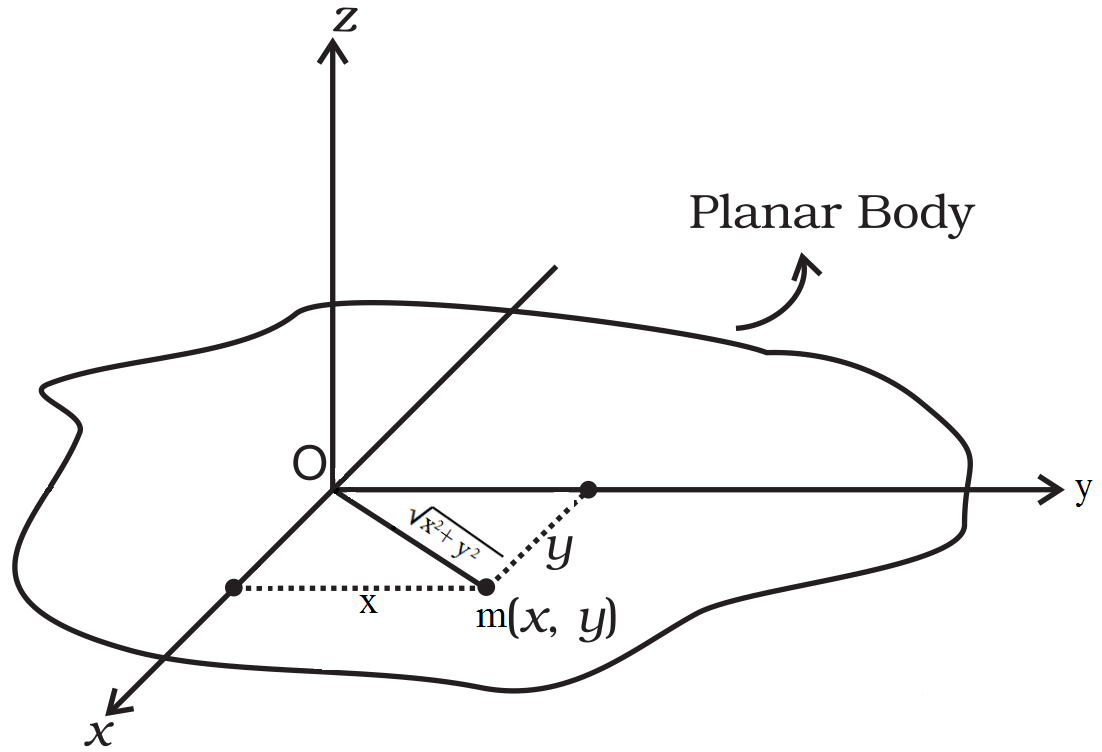
Moment of inertia about x-axis, $I_x = mx^2$
Moment of inertia about y-axis, $I_y = my^2$
Moment of inertia about z-axis, $I_z = m(x^2 + y^2)^{1/2}$
$I_x + I_y = mx^2 + my^2$
$= m(x^2 + y^2)$
$= m [(x^2 + y^2)^{1/2}]^{1/2}$
$I_x + I_y = I_z$
Thus, the theorem is verified.
- According to the theorem of parallel axes the moment of inertia of a body about any axis is equal to the sum of the moment of inertia of the body about a parallel axis passing through its center of mass and the product of its mass and the square of the distance between the two parallel axes.
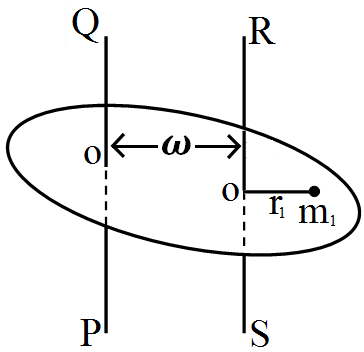
Suppose a rigid body is made up of n number of particles, having masses $m_1, m_2, m_3, … ,m_n$, at perpendicular distances $r_1, r_2, r_3, … , r_n$ respectively from the center of mass O of the rigid body.
The moment of inertia about axis RS passing through the point O,
$\text{I}_{\text{RS}}=\sum\limits^\text{n}_{\text{i}=1}=\text{m}_{\text{i}}\text{r}_{\text{i}}^2$
The perpendicular distance of mass $m_i$ from the axis $QP = a+ r_i$
$\text{I}_{\text{QR}}=\sum\limits^\text{n}_{\text{i}=1}\text{m}_{\text{i}}(\text{a}+\text{r}_\text{i})^2$
$\text{I}_{\text{QR}}=\sum\limits^\text{n}_{\text{i}=1}\text{m}_{\text{i}}(\text{a}^2+\text{r}_\text{i}^2+2\text{ar}_{\text{i}})$
$\text{I}_{\text{QR}}=\sum\limits^\text{n}_{\text{i}=1}\text{m}_{\text{i}}\text{a}^2+\sum\limits^\text{n}_{\text{i}=1}\text{m}_{\text{i}}\text{r}_\text{i}^2+\sum\limits^\text{n}_{\text{i}=1}\text{m}_{\text{i}}2\text{ar}_{\text{i}}$
$\text{I}_{\text{QR}}=\text{I}_{\text{RS}}=\sum\limits^\text{n}_{\text{i}=1}\text{m}_{\text{i}}\text{a}^2+2\sum\limits^\text{n}_{\text{i}=1}\text{m}_{\text{i}}\text{ar}^2_{\text{i}}$
We know, the moment of inertia of all particles about the axis passing through the center of mass is zero.
$2\sum\limits^\text{n}_{\text{i}=1}\text{m}_{\text{i}}\text{ar}_{\text{i}}=0$
as $\text{a}\neq0$
Therefore, $\sum\text{m}_{\text{i}}\text{r}_{\text{i}}=0$
Also,
Therefore, $\sum\text{m}_{\text{i}}$
= M; M = Total mass of the rigid body.
Therefore, $IQP = IRS + Ma^2$
Therefore the theorem is verified.

Download our appand get started for free
Experience the future of education. Simply download our apps or reach out to us for more information. Let's shape the future of learning together!No signup needed.*
Similar Questions
- 1View SolutionTwo discs of same mass and thickness are made of materials having different densities. Which one of them will have larger M.I.?
- 2A uniform wheel of radius R is set into rotation about its axis at an angular speed $\omega.$ This rotating wheel is now placed on a rough horizontal surface with its axis horizontal. Because of friction at the contact, the wheel accelerates forward and its rotation decelerates till the wheel starts pure rolling on the surface. Find the linear speed of the wheel after it starts pure rolling.View Solution
- 3View SolutionA body is in translational equilibrium under the action of coplanar forces. If the torque of these forces is zero about a point, is it necessary that it will also be zero about any other point?
- 4View Solution
- Obtain an expression for moment of inertia of uniform circular disc about an axis perpendicular to the plane of disc and passing through its centre.
- Three point masses of 1kg, 2kg and 3kg lie at (1, 2), (0, -1) and (2, -3) respectively. Calculate the co-ordinates of centre of mass of the system.
- 5A cylinder of mass $5kg$ and radius $30cm$ and free to rotate about its axis, receives an angular impulse of $3kgm^2 s^{-1}$ followed by a similar impulse after every $4$ seconds. What is the angular speed of the cylinder $30s$ after the initial impulse? The cylinder is at rest initially.View Solution
- 6View SolutionA hoop of radius 2m weighs 100kg. It rolls along a horizontal floor so that its centre of mass has a speed of 20cm/s. How much work has to be done to stop it?
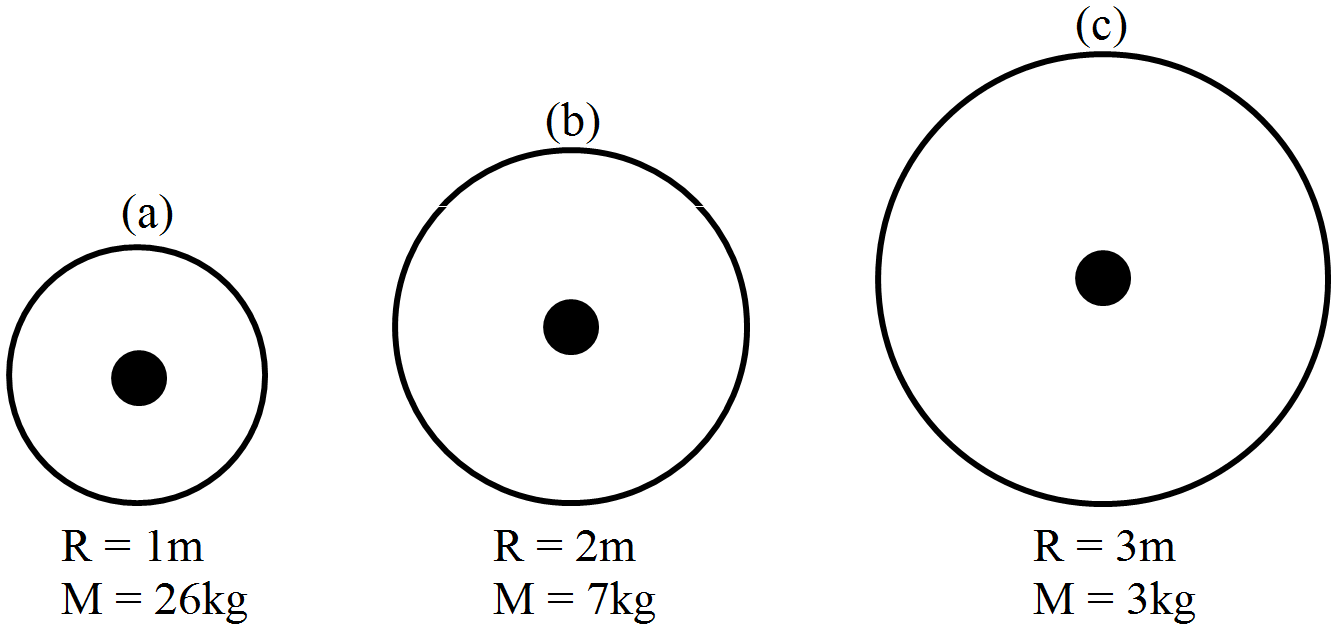
- 7View SolutionFigure shows three uniform discs, along with their radii R and masses M. Rank the discs according to their rotational inertia about their central axes, greatest first.
- 8In the HCl molecule, the separation between the nuclei of the two atoms is about $1.27\mathring{\text{A}}\big(1\mathring{\text{A}}= 10^{-10} \text{m}\big).$ Find the approximate location of the CM of the molecule, given that a chlorine atom is about 35.5 times as massive as a hydrogen atom and nearly all the mass of an atom is concentrated in its nucleus.View Solution
- 9Prove that the velocity v of translation of a rolling body (like a ring, disc, cylinder or sphere) at the bottom of an inclined plane of height h is given by:$\text{v}^2=\frac{2\text{gh}}{\big(1+\frac{\text{K}^2}{\text{R}^2}\big)}$View Solution
Note K is the radius of gyration of the body about its symmetry axis, and R is the radius of the body. The body starts from rest at the top of the plane. - 10View SolutionExplain why friction is necessary to make the disc in roll in the direction indicated.
- Give the direction of frictional force at B, and the sense of frictional torque, before perfect rolling begins.
- What is the force of friction after perfect rolling begins?