- A$4\mu\text{F}$
- B$6\mu\text{F}$
- C$8\mu\text{F}$
- D$10\mu\text{F}$
- $8\mu\text{F}$
Explanation:
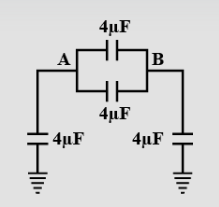
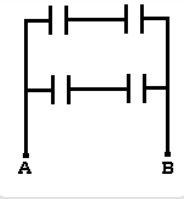
In the given figure,
Equivalent capcitance between A and B.
Ceg = C1 + C2
$=4μ\text{F}+4μ\text{F}$
Explanation:
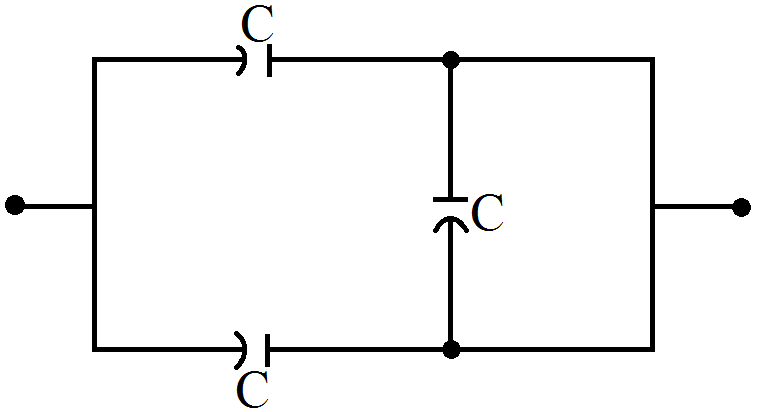
In the given figure,
Equivalent capcitance between A and B.
Ceg = C1 + C2
$=4μ\text{F}+4μ\text{F}$
Explanation:

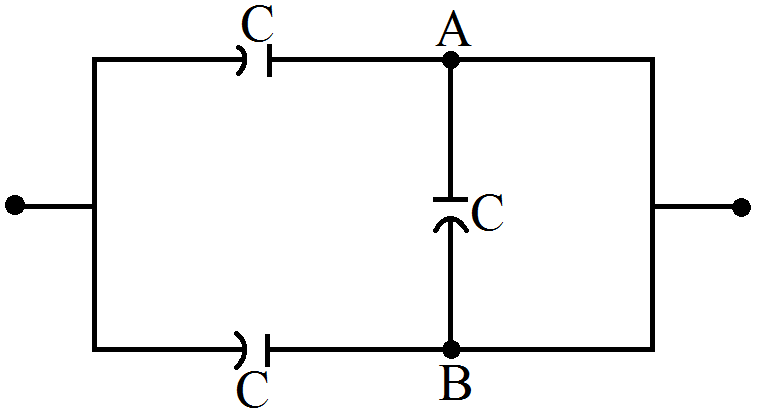
Since the potential at point A is equal to the potential at point B, no current will flow along arm AB. Hence, the capacitor on arm AB will not contribute to the circuit. Also, because the remaining two capacitors are connected in parallel, the net capacitance of the circuit is given by
Ceq = C + C = 2C
Explanation:
Since the voltage gets added up when the capacitors are connected in series, the voltage of the combination is 2V.
Also, the capacitance of a series combination is given by
$\frac{1}{\text{C}_{\text{net}}}=\frac{1}{\text{C}_1}+\frac{1}{\text{C}_2}$
Here,
Cnet = Net capacitance of the combination
$\text{C}_1=\text{C}_2=\text{C}$
$\therefore\text{C}_{\text{net}}=\frac{\text{C}}{2}$
Explanation:
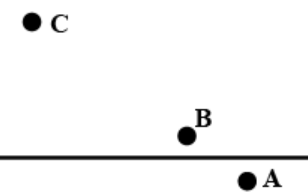
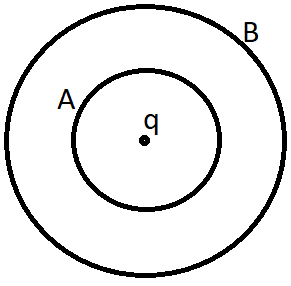
A charge always tries to move from a point of higher potential to a point of lower potential. The potential at A is greater than the potential at B because of electric potential decreases with distance from the charge. It can also be explained by the fact that a positive charge is always repelled by another positive charge.
Explanation:
Since the total charge on a capacitor is given by sum of the charges on the two parallel plates, here charge on each plate is equal and opposite, hence –Q + Q = 0. Therefore, the total charge on the capacitor is 0.
Explantion:
Electric field is negative gradient of electric potential.
$\text{E}=-\text{grad}(\text{V})$
$\text{E}=-\frac{\text{dV}}{\text{dr}}$
If $\text{E}=0$
$-\frac{\text{dV}}{\text{dr}}=0$
This implies
V = constant.
A constant can be zero or a quantifiable number.
Explanation:
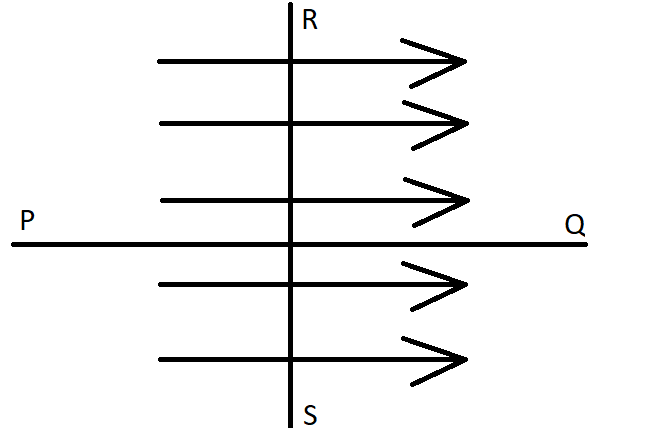
The equipotential surface is always perpendicular to the electric field lines. In the diagram, the electric field lines are horizontal and parallel to each other. Therefore, the equipotential lines must be vertical and the points that have equal potential should be on the vertical line. Therefore, R and S have equal potential.
Is always zero.
Explanation:

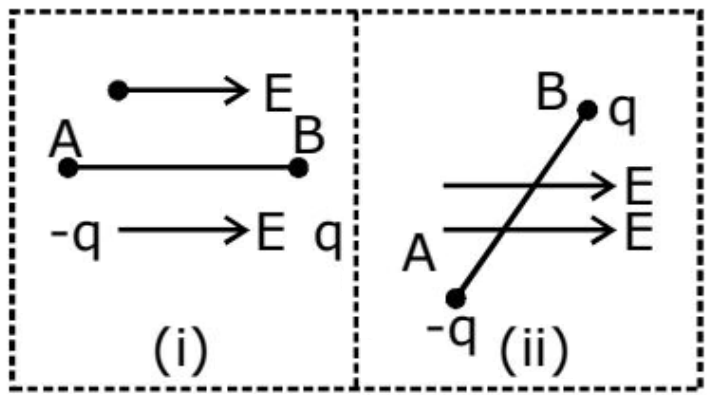
Net Electric force = FA + FB
= -qE + qE
= 0
Explanation:
If a point charge is situated at infinity, the electric field lines coming out of it will be in the form of parallel straight lines. As we know that field lines cut the equipotential surfaces orthogonally, therefore the equipotential surfaces must be plane surfaces. They can be considered the surface of a sphere of infinite radius.
Explanation:
A capacitor becomes a perfect insulator for direct current as the regular supply of current charges capacitor and the it behaves as open circuit, where as in A.C. the current being variable in sign and magnitude does not charge capacitor ever it goes through a repetitive process of charging and discharging and hence it never behaves as open circuit.
Explanation:
Electrical potential is a type of potential energy, and refers to the energy that could be released if electric current is allowed to flow.
Explanation:
Net electrostatic field is zero in the interior of a conductor. When a conductor is placed in an electric field, its free electrons begin to move in the opposite direction. Negative charges are induced on the left end and positive charges on the right end of the conductor. The process continues until the electric field set up by induced charges becomes equal and opposite the external field.
Explanation:
The simplest and the most widely used capacitor is the parallel plate capacitor. It consists of two large plane parallel conducting plates, separated by a small distance.
Explanation:
We consider earth as the storage of infinite positive as well as a negative charge. Therefore, the potential of the earth is always considered to be zero and the potential of every body is measured with respect to earth. That’s why if we connect any charged body to the earth, its potential instantaneously becomes zero.
Explanation:
The capacitance of a parallel plate capacitor is directly proportional to the area of the plates and permittivity of the medium between the plates. It is indirectly proportional to the distance between the plates.
Explanation:
A Van de Graff generator, by means of a moving belt and suitable brushes, transfers charge continuously to a large spherical conducting shell. As a result, a potential difference of the order of several million volts is built up and this can be used for accelerating charged particles.

Explanation:
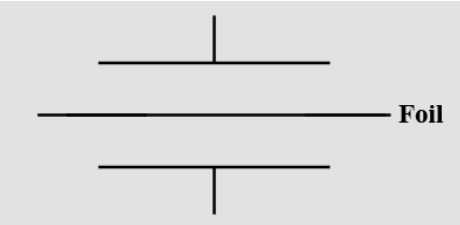
The capacity of condenser before inserting foil is $\text{C}=\frac{\text{A}\in0}{\text{d}}$ where A be the area of plate and d be the separation between plates.
After inserting foil the there will be two capacitors in series with capacitance 2C as distance is halved and the series combination of the two will give equivalent capacitance of C, hence, capacity will remain same.
Explanation:
Here copper, tin, iron all are conductor so they will decrease the capacitance. The mica sheet is a dielectric or insulator so it will increase the capacitance k times. Where k is the dielectric constant.
Explanation:
As the capacitor is charged by using cell so potential as well as filed between the plates become constant.
For removing dielectric the capacitance becomes C/ k. Thus capacitance decreases by a factor of k.
Explanation:
Equipotential surface
→ P.D difference between two points on the surface is zero always since potential is same everywhere in equipotential surface.
→ The EF is always perpendicular to the surface because there is no potential gradient along any direction parallel to the surface P so no EF parallel to the surface
→ Equipotential surface can have any shape not just sphere.
→ No work is done in moving a charge along the surface, because potential difference is zero.

Explanation:
Equivalent capacitance of each pair of capacitance in series$=\frac{1\times1}{1+1}\text{F}=0.5\text{F}$
The two series combination are connected in parallel. Hence the net capacitance becomes 0.5F + 0.5F = 1F
Explanation:
Electric field at any point is equal to the negative of the potential gradient. But inside a conductor, the electric field is zero. Hence, the electric potential is constant throughout the volume of a conductor and has the same value on its surface.
Explanation:
We know that for a conducting sphere, the charge is always distributed on its outer surface. We also know that charge flows from higher potential to lower potential. But if we put the smaller sphere inside the larger sphere and connect them with a conductor, they will act as a single conductor and charge will be distributed to its outer surface, i.e. charge will flow to the larger sphere.
Explanation:
Dipole moment = charge × length of the dipole. The electric charge has dimensions [I T] and length has dimensions [L]. Therefore, the dipole moment has the dimension [I T L] and has unit C × m of C × m.
Explanation:
The resultant capacitor when capacitors are joined in series is the reciprocal of the sum of the reciprocals of the indivisual capacitors.
Explanation:
A molecule in which the centre of mass of positive and negative charges does not collide with each other is called a polar molecule. They have a permanent dipole moment. They have unsymmetrical shapes.
Explanation:
Equipotential surface is a surface formed by the locus of all the points which are at the same potential. Equipotential surfaces do not intersect with each other and are closely spaced in the region of strong electric fields and vice-versa.
The facing surfaces of the capacitor have equal and opposite charges.
The two plates of the capacitor have equal and opposite charges.
Explanation:
In H.C Verma the answer is (a), (c), (d). But according to us the answer should be (a), (b), (d) all these options are the properties of a capacitor and the option (c) is incorrect because the battery is a source of energy not charge. Moreover if a capacitor plates have equal charge on outside and equal charge on inside then one can think that the charge on the plates must be also equal so option (b) cant be incorrect.
Explanation:
If the empty Condensor has capacity C, then its capacity with dielectric is given by C′ = kC, where k is the dielectric constant of the dielectric material. k can never be less than 1.
Explanation:
The number of current pulses is equal to the frequency of the AC source because one current pulse passes through the diode for one oscillation of the AC source.
Explanation:
Electric potential is equal to work done by an external agent in carrying a unit positive charge from the arbitrary chosen reference point to that point without any acceleration.
Explanation:
A dipole contains two equal and opposite charge. So total charge inside the sphere will be zero.
By Gauss's law, the flux across a surface is depends on the charge inside the surface. As total charge is zero inside the sphere so the flux through the sphere will be zero.
As the electric field is resultant effect due to all charges so there will be field exists on the surface.
As the sphere contains two equal and opposite charges so there may be exists equipotential surface in the sphere.