Questions

3 Marks Question

Take a timed test

41 questions · self-marked practice — reveal the answer and mark yourself.

Question 13 Marks
Give reasons:
  1. $SO_2$ is reducing while $TeO_2$ is an oxidizing agent.
  2. Nitrogen does not form pentahalide.
  3. $ICl$ is more reactive than $I_2.$
Answer
  1. Because stability of higher oxidation state decreases as we move down the group/S is more stable in higher $(+6)$ oxidation state whereas Te is more stable in $+4$ oxidation state.
  2. Due to absence of d orbital.
  3. Because $I–Cl$ bond is weaker than I-I bond.
View full question & answer
Question 23 Marks
Give reasons for the following:
  1. Red phosphorus is less reactive than white phosphorus.
  2. Electron gain enthalpies of halogens are largely negative.
  3. $N_2O_5$ is more acidic than $N_2O_3.$
Answer
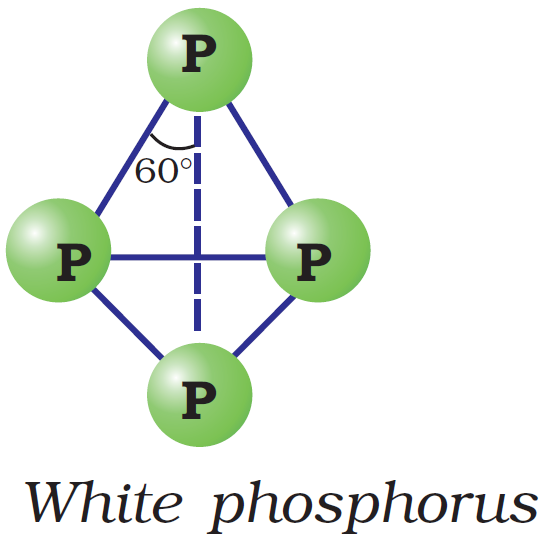
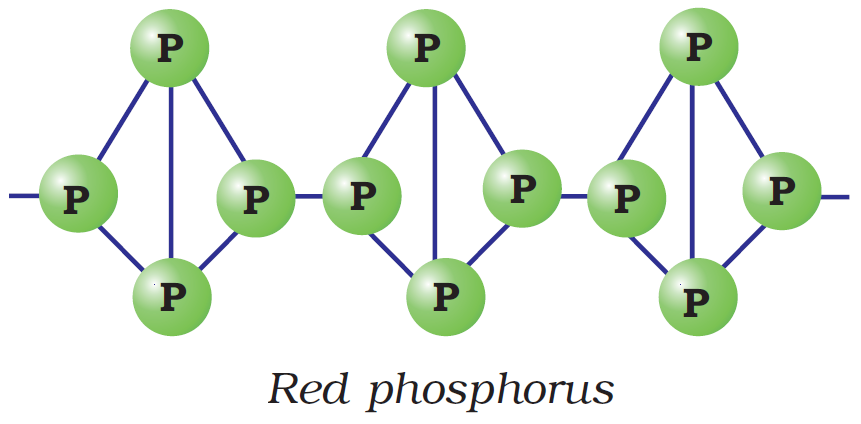
  1. Red phosphorous being polymeric is less reactive than white phosphorous which has discrete tetrahedral structure.
  2. They readily accept an electron to attain noble gas configuration.
  3. Because of higher oxidation state$(+5)$ of nitrogen in $N_2O_5$
View full question & answer
Question 33 Marks
Give reasons for the following:
  1. $(CH_3)_3P=O$ exists but $(CH_3)_3\ N=O$ does not.
  2. Oxygen has less electron gain enthalpy with negative sign than sulphur.
  3. $H_3PO_2$ is a stronger reducing agent than $H_3PO_3.$
Answer
  1. As N can’t form $5$ covalent bonds/its maximum covalency is four.
  2. This is due to very small size of Oxygen atom/repulsion between electrons is large in relatively small $2$p sub-shell.
  3. In $H_3PO_2$ there are 2P–H bonds, whereas in $H_3PO_3$ there is $1$P–H bond.
View full question & answer
Question 43 Marks
Give reasons for the following:
  1. Where $R$ is an alkyl group, $R_3P=O$ exists but $R_3N=O$ does not.
  2. $PbCI_4$ is more covalent than $PbCI_2.$
  3. At room temperature, $N_2$ is much less reactive.
Answer
  1. Because $‘N’$ can’t extend its covalency beyond $4$ whereas $‘P’$ can, due to the presence of d-orbital.
  2. Because $‘Pb’$ is in $+4$ oxidation state in $PbCl_4$ and has high charge/size ratio than $Pb^{2+}.$
  3. Due to very high bond dissociation enthalpy of $N≡N.$
View full question & answer
Question 53 Marks
How would you account for the following:
  1. $H_2S$ is more acidic than $H_2O.$
  2. The $N–O$ bond in ${NO_2}^-$ is shorter than the $N–O$ bond in ${NO_3}^-.$
  3. Both $O_2$ and $F_2$ stabilise high oxidation states but the ability of oxygen to stabilize the higher oxidation state exceeds that of fluorine.
Answer
  1. Because bond dissociation enthalpy of $H-S$ bond is lower that of $H-O$ bond. /oxygen is more electronegative than $S.$
  2. In the resonance structure of these two species, in ${NO_2}^–, 2$ bonds are sharing a double bond while in ${NO_3}^–, 3$ bonds are sharing a double bond which means that bond in ${NO_2}^–$ will be shorter than in ${NO_3}^–.$
Alternate Answer
In ${NO_2}^–,$ bond order is $1.5$ while in ${NO_3}^–,$ bond order is $1.33$ Because of the tendency of oxygen to form multiple bonds with metal.
  1. The ability of $O_2$ to stabilise higher oxidation states exceeds that of fluorine because oxygen can form multiple bonds with metals.
View full question & answer
Question 63 Marks
How would you account for the following:
  1. $NCl_3$ is an endothermic compound while $NF_3$ is an exothermic one.
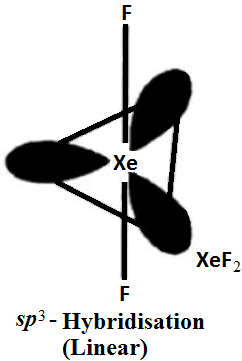
  2. $XeF_2$ is a linear molecule without a bend.
  3. The electron gain enthalpy with negative sign for fluorine is less than that for chlorine, still fluorine is a stronger oxidising agent than chlorine.
Answer
  1. Because
  1. Bond dissociation enthalpy of $F_2$ is lower than that of $Cl_2$ and
  2. Small size F atom forms stronger bond with $N.$
  1. Because it has $sp^3d$ hybridization with $3$ lone pairs.
  2. Because of
  1. Lower bond dissociation enthalpy of $F_2$ and
  2. High hydration enthalpy of $F.$
View full question & answer
Question 73 Marks
Give reasons:
  1. $PCl_5$ is more covalent than $PCl_3.$
  2. $O-O$ bond has lower bond dissociation enthalpy than S-S bond.
  3. $F_2$ is a stronger oxidising agent than $Cl_{2}.$
Answer
  1. Because of higher oxidation state $(+5)/$high charge to size ratio/high polarising power.
  2. Because of high interelectronic repulsion.
  3. Because of its low bond dissociation enthalpy and high hydration enthalpy of $F^-.$
View full question & answer
Question 83 Marks
Account for the following:
  1. Sulphur in vapour form exhibits paramagnetic behaviour.
  2. $SnCl_4$ is more covalent than $SnCl_{2}.$
  3. $H_3PO_2$ is a stronger reducing agent than $H_3PO_{3}.$
Answer
  1. Because in vapour form sulphur $(S2)$ contains unpaired electrons.
  2. Because of higher oxidation state $(+4)/$ high charge to size ratio$/$ high polarizingpower.
  3. Because of the two $P–H$ bonds in $H_3PO_2$ whereas in $H_3\ PO_3$ there isone $P-H$ bond.
View full question & answer
Question 93 Marks
  1. Draw the structures of the following molecules:
  1. $XeOF_4$
  2. $H_2SO_4$
  1. Write the structural difference between white phosphorus and red phosphorus.
View full question & answer
Question 103 Marks
Account for the following:
  1. Bi(V) is a stronger oxidizing agent than Sb(V).
  2. N-N single bond is weaker than P-P single bond.
  3. Noble gases have very low boiling points.
Answer
  1. Because Bi is more stable in +3 oxidation state than that of Sb.
  2. Because of interelectronic repulsion owing to small bond length of N-N/ smaller size of nitrogen atom.
  3. Because of weak dispersion forces.
View full question & answer
Question 113 Marks
  1. Name the sweetening agent used in the preparation of sweets for a diabetic patient.
  2. What are antibiotics? Give an example.
  3. Give two examples of macromolecules that are chosen as drug targets.
Answer
  1. Sucrolose.
  2. Antibiotics are the chemical substances that inhibit the growth or even destroy micoorgnisms.
Example: Ofloxacin, Chloramphenicol.
  1. Carbohydrates, lipids, proteins, nucleic acids, enzymes.
View full question & answer
Question 123 Marks
Give reasons:
  1. Thermal stability decreases from $H_2O$ to $H_2$Te.
  2. Fluoride ion has higher hydration enthalpy than chloride ion.
  3. Nitrogen does not form pentahalide.
Answer
  1. Due to the decrease in bond dissociation enthalpy/due to increase in atomic size from O to Te.
  2. Due to small size of fluoride ion/high charge density of fluoride ion/high charge size ratio of fluoride ion.
  3. Absence of d-orbitals.
View full question & answer
Question 133 Marks
  1. Indicate the principle behind the method used for the refining of zinc.
  2. What is the role of silica in the extraction of copper?
  3. Which form of the iron is the purest form of commercial iron?
Answer
  1. Zinc being low boiling will distil first leaving behind impurities/or on electrolysis the pure metal gets deposited on cathode from anode.
  2. Silica acts as flux to remove iron oxide which is an impurity as slag or $FeO + SiO_2 \rightarrow FeSiO_3.$
  3. Wrought iron.
View full question & answer
Question 143 Marks
Account for the following:
  1. $PCl_5$ is more covalent than $PCl_3.$
  2. Iron on reaction with HCl forms $FeCl_2$ and not $FeCl_3$
  3. The two $O-O$ bond lengths in the ozone molecule are equal.
Answer
  1. Because $+5$ oxidation state is more covalent than $+3/$high charge to size ratio/high polarizing power.
  2. Because $HCl$ is a mild oxidising agent/formation of hydrogen gas prevents the formation of $FeCl_3.$
  3. Because of resonance in $O_3$ molecule.
View full question & answer
Question 153 Marks
How would you account for the following?
  1. The lower oxidation state becomes more stable with increasing atomic number in Group $13.$
  2. Hydrogen fluoride is much less volatile than hydrogen chloride,
  3. Interhalogen compounds are strong oxidising agents.
Answer
  1. Due to inert pair effect/the energy required to unpair the $ns^2$ electrons is not compensated by the energy released in forming the two additional bonds.
  2. Due to strong hydrogen bonding in hydrogen fluoride.
  3. Due to lower bond energy of interhalogen compound.
View full question & answer
Question 163 Marks
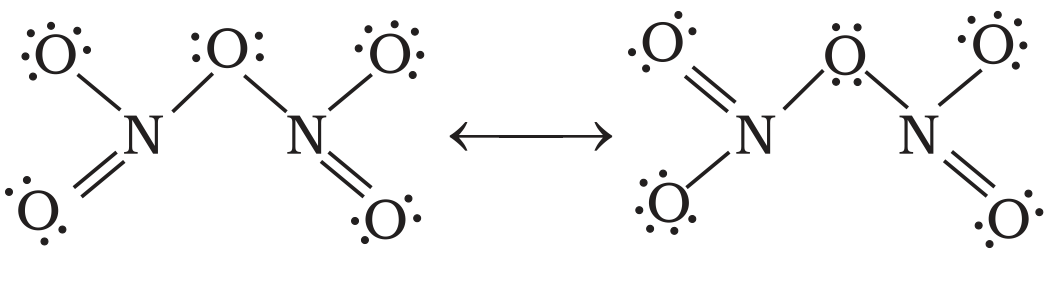
Nitric acid forms an oxide of nitrogen on reaction with $P_4O_{10}.$ Write the reaction involved. Also write the resonating structures of the oxide of nitrogen formed.
Answer
$\text{P}_4\text{O}_{10}+4\text{HNO}_3\xrightarrow{\ \ \ \ \ \ \ \ \ }4\text{HPO}_3+2\text{N}_2\text{O}_5$
Reactivity: White phosphorus is very reactive in comparison to red phosphorus. This is due to angular strain in white phosphorus on account of bond angles $(60^\circ).$
View full question & answer
Question 173 Marks
Considering the parameters such as bond dissociation enthalpy, electron gain enthalpy and hydration enthalpy, compare the oxidising power of $F_2$ and $Cl_2.$
Answer
Fluorine is a much stronger oxidizing agent than chlorine. The oxidizing power depends on three factors.
  1. Bond dissociation energy.
  2. Electron gain enthalpy.
  3. Hydration enthalpy.
The electron gain enthalpy of chlorine is more negative than that of fluorine. However, the bond dissociation energy of fluorine is much lesser than that of chlorine. Also, because of its small size, the hydration energy of fluorine is much higher than that of chlorine. Therefore, the latter two factors more than compensate for the less negative electron gain enthalpy of fluorine. Thus, fluorine is a much stronger oxidizing agent than chlorine.
View full question & answer
Question 183 Marks
Name three oxoacids of nitrogen. Write the disproportionation reaction of that oxoacid of nitrogen in which nitrogen is in $+3$ oxidation state.
Answer
Three oxoacids of nitrogen are,
  1. $HNO_2,$ Nitrous acid
  2. $HNO_3,$ Nitric acid
  3. Hyponitrous acid, $H_2N_2O_2$
$3\text{HNO}_2\xrightarrow{\text{Disproportionation}{\ }}\text{HNO}_3+\text{H}_2\text{O}+2\text{NO}$
View full question & answer
Question 193 Marks
How are xenon fluorides $XeF_2,\ XeF_4$ and $XeF_6$ obtained?
Answer
All three binary fluorides of Xe are formed by direct union of elements under appropriate experimental conditions. $XeF_2$ can also be prepared by irradiating a mixture of Xenon and fluorine with sunlight or light from a pressure mercury are lamp.
$\text{Xe}(\text{g})+\text{F}_2(\text{g})\xrightarrow[]{\Delta \ \text{ at 675 K}}\text{XeF}(\text{g})$
$\text{Xe}(\text{g})+2\text{F}_2(\text{g})\xrightarrow[\text{sealed Ni vessel}]{\Delta \ \text{ at 75 K atm}}\text{XeF}_4(\text{g})$
$\text{Xe}(\text{g})+3\text{F}_2(\text{g})\xrightarrow[\text{sealed Ni vessel}]{\Delta \ \text{ at 475-975 K}}\text{XeF}_6(\text{g})$
View full question & answer
Question 203 Marks
White phosphorus reacts with chlorine and the product hydrolyses in the presence of water. Calculate the mass of HCl obtained by the hydrolysis of the product formed by the reaction of 62g of white phosphorus with chlorine in the presence of water.
Answer
$\text{P}_4+6\text{Cl}_2\xrightarrow{\ \ \ \ \ \ \ \ \ \ }4\text{PCl}_3$
$\text{PCl}_3+3\text{H}_2\text{O}\xrightarrow{\ \ \ \ \ \ \ \ \ \ }\text{H}_3\text{PO}_3+3\text{HCl}]\times4$
$\text{P}_4+6\text{Cl}_2+12\text{H}_2\text{O}\xrightarrow{\ \ \ \ \ \ \ \ \ }4\text{H}_3\text{PO}_3+12\text{HCl}$
1 mol of white phosphorus produces 12 mol of HCl
62g of white phosphorus has been taken which is equivalent to $\frac{62}{124}=\frac{1}2\text{ mol.}$
Therefore 6 mol HCl will be formed
Mass of 6 mol HCl = 6 × 36.5 = 219.0g HCl
View full question & answer
Question 213 Marks
In $PCl_5,$ phosphorus is in $sp^3d$ hybridised state but all its five bonds are not equivalent. Justify your answer with reason.
Answer
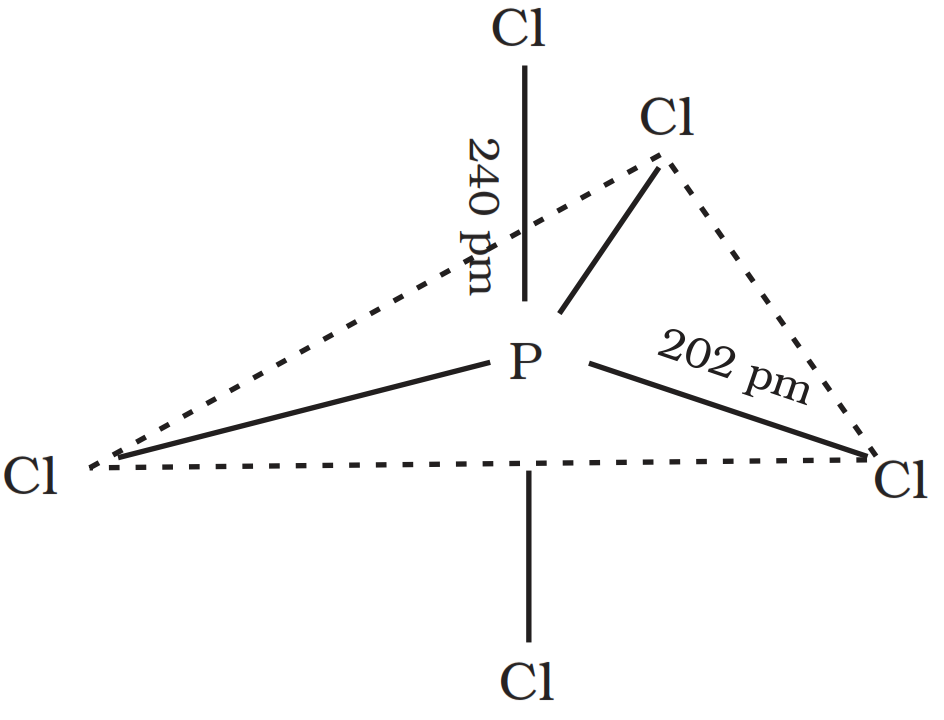
In gaseous and liquid phases, it has a trigonal bipyramidal structure as shown. The three equatorial $P-Cl$ bonds are equivalent, while the two axial bonds are longer than equatorial bonds. This is due to the fact that the axial bond pairs suffer more repulsion as compared to equatorial bond pairs.
View full question & answer
Question 223 Marks
A colourless inorganic salt A decomposes at about $250^\circ C$ to give only two products $B$ and $C$ leaving no residue. The oxide $C$ is a liquid at room temperature and is neutral to litmus paper while $B$ is neutral oxide. White phosphorus burns in excess of $B$ to produce strong dehydrating agent. Give balanced equations for above processes.
Answer
$A = NH_4NO_3 ($Ammonium nitrate$), B = N_2O ($Nitrous oxide$), C = H_2O$
Reactions involved:
$\ \ \ \text{NH}_4\text{NO}_3\ \ \ \ \ \ \ \xrightarrow{ \ \ \ 250^\circ\text{C}\ \ }\ \ \ \ \text{N}_2\text{O}\ \ \ \ +\ \ \ 2\text{H}_2\text{O}\\^\text{Ammonium nitrate}\ \ \ \ \ \ \ \ \ \ \ \ \ \ \ \ \ ^\text{Nitrous oxide}\ \ \ \ \ \ \ \ \ ^\text{(C)}\\ \ \ \ \ \ \ \ \ ^\text{(A)}\ \ \ \ \ \ \ \ \ \ \ \ \ \ \ \ \ \ \ \ \ \ \ \ \ \ \ \ \ \ \ \ \ \ \ \ ^\text{(B)}$
$10\text{N}_2\text{O}+\text{P}_4\xrightarrow{\ \ \ }\ \ \ 10\text{N}_2\ \ \ \ \ \ \ \ \ +\ \ \ \ \ \ \text{P}_4\text{O}_{10}\\ \ \ \ \ \ ^\text{(B)}\ \ \ \ \ \ \ \ \ \ \ \ \ \ \ \ \ \ \ \ \ \ \ \ \ \ \ \ \ \ \ \ \ \ \ \ \ \ \ \ \ \ \ ^\text{Phosphorus pentoxide}\\ \ \ \ \ \ \ \ \ \ \ \ \ \ \ \ \ \ \ \ \ \ \ \ \ \ \ \ \ \ \ \ \ \ \ \ \ \ \ \ \ \ \ \ \ \ \ \ \ \ \ \ \ \ \ ^\text{(dehydrating agent)}$
View full question & answer
Question 233 Marks
$SF_6$ is known but $SCl_6$ is not. Why?
Answer
Due to small size, six fluorine atoms can be accommodated around sulphur atom while chlorine atoms being larger in size are difficult to accommodate.
The other reason is that the fluorine being highly electronegative and oxidising in nature is capable of unpairing the paired orbitals of the values shell of sulphur atom and thereby showing the highest, oxidation state of $+6$ while chlorine is not able to do this.
View full question & answer
Question 243 Marks
Explain why the stability of oxoacids of chlorine increases in the order given below:
$HClO < HClO_2 < HClO_3 < HClO_4$
Answer
Oxygen is more electronegative than chlorine, therefore dispersal of negative charge present on chlorine increases from $ClO$ to $ClO_4$ ion because number of oxygen atoms attached to chlorine increases. Therefore, stability of ions will increase in the order given below:
$ClO < ClO_2 < ClO_3 < ClO_4$
Thus due to increase in stability of conjugate base, acidic strength of corresponding acid increases in the following order $HClO$ $< HClO_2 < HClO_3 < HClO_4$
View full question & answer
Question 253 Marks
Give reason to explain why $ClF_3$ exists but $FCl_3$ does not exist.
Answer
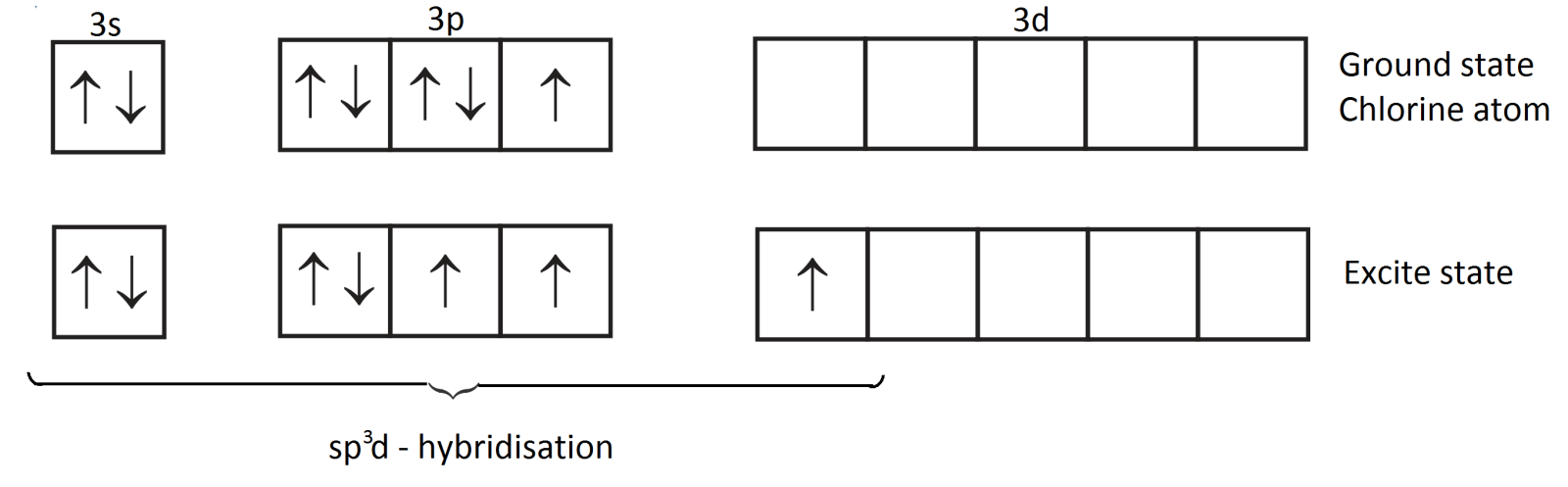
$ClF_3$ is known because chlorine can exhibit $+3$ oxidation state due to promotion of

Each of the three singly occupied orbitals overlap with p-orbital of each of three fluorine atoms to form $ClF_3($trigonal bipyramidal geometry, T-shaped molecule$).$
No $($i-orbitals are present in the valency shell of fluorine and thus excitation is not possible. Fluorine, therefore, does not exhibit positive oxidation state and so the formation of $FCl_3$ is not possible.
View full question & answer
Question 263 Marks
Answer the following question:
Complete the following chemical equations:
  1. $\text{P}_4+\text{SO}_2\text{Cl}_2\rightarrow$
  2. $\text{XeF}_2+\text{H}_2\text{O}\rightarrow$
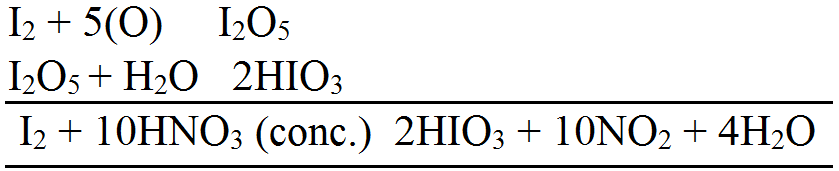
  3. $\text{I}_2+\text{HNO}_3\rightarrow\\ \ \ \ \ \ \ \ \ \ ^\text{(cone)}$
Answer
  1. $\text{P}_4+10\text{SO}_2\text{Cl}_2\rightarrow4\text{PCl}_5+10\text{SO}_2$
  2. $2\text{XeF}_2+2\text{H}_2\text{O}\rightarrow2\text{Xe}+4\text{HF}+\text{O}_2$
  3. $2\text{HNO}_3(\text{conc.})\rightarrow\text{H}_2\text{O}+2\text{NO}_2+\text{(O)}]\times5$
​​​​​​​
View full question & answer
Question 273 Marks
How is $SO_2$ an air pollutant?
Answer
  1. $SO_2$ dissolves in moisture present in air to form $H_2SO_4$ which damages building materials especially marble $($acid - rain$)$.
    $-\text{CaCO}_3+\text{H}_2\text{SO}_3\rightarrow\text{CaSO}_3+\text{H}_2\text{O}+\text{CO}_2$
  2. 1t corrodes metals like Fe and steel. It also brings about fading and deterioration of fabrics, leather, paper, etc., and affecting the colour of paints.
  3. Even in low concentration $(= 0.03$ ppm$),$ it has damaging effect on the plants. If exposed for a long time, i.e., a few days or weeks, it slows down the formation of chlorophyll i. e., loss of green colour. This is called chlorosis.
  4. 1t is strongly irritating to the respiratory track. It cause throat and eye irritation, resulting into cough, tears and redness in eyes. It also cause breathlessness and effects larynx i. e., voice box.
View full question & answer
Question 283 Marks
Give reason for the following:
Noble gases are mostly inert.
Answer
Noble gases are mostly inert because of the following reasons:
  • They have completely filled $ns^2np^6$ electronic configurations in their valence shells.
  • Electron gain enthalpies of noble gases are positive.
  • They have high ionisation enthalpies.
View full question & answer
Question 293 Marks
Justify the placement of $O,\ S,\ Se,\ Te$ and $Po$ in the same group of the periodic table in terms of electronic configuration, oxidation state and hydride formation.
Answer
The elements of group $16$ are collectively called chalcogens.
  1. Elements of group $16$ have six valence electrons each. The general electronic configuration of these elements is $ns^2\ np^4 ,$ where $n$ varies from $2$ to $6$.
  2. Oxidation state:
Asthese elements have six valence electrons $(ns^2\ np^4),$ they should display an oxidation state of $-2.$ However, only oxygen predominantly shows the oxidation state of $-2$ owing to its high electronegativity. It also exhibits the oxidation state of $-1 ( H_2O_2),$ zero $(O_2 ),$ and $+2(OF_2).$
However, the stability of the $-2$ oxidation state decreases on moving down a group due to a decrease in the electronegativity of the elements. The heavier elements of the group show an oxidation state of $+2,\ +4,$ and $+6$ due to the availability of d-orbitals.
  1. Formation of hydrides:
These elements form hydrides of formula $H_2E,$ where $E = O,\ S,\ Se,\ Te,\ PO.$ Oxygen and sulphur also form hydrides of type $H_2E_2.$ These hydrides are quite volatile in nature.
View full question & answer
Question 303 Marks
On reaction with $Cl_2,$ phosphorus forms two types of halides $‘A’$ and $‘B’.$ Halide $A$ is yellowish-white powder but halide $‘B’$ is colourless oily liquid. Identify $A$ and $B$ and write the formulas of their hydrolysis products.
Answer
When dry chlorine is passed over white phosphorus heated gently in a retort, first phosphorus trichloride is formed. $PCl_3$ further reacts with $Cl_2$ and forms phosphorus pentachloride $PCl_5.$
$(A)$ $(B)$
$PCl_5$ $PCl_3$
Yellowish Coloutless oily
white powder liquid
$PCl_3$ reacts voilently with water forming phousphorus acid $(H_3PO_3).$
$\text{PCl}_3+3\text{H}_2\text{O}\xrightarrow{\ \ \ \ \ \ \ \ }\text{H}_3\text{PO}_3+3\text{HCl}$
$PCl_5$ undergoes a violent hydrolysis
$\text{PCl}_5+\text{H}_2\text{O}\xrightarrow{\ \ \ \ \ \ \ \ }\text{POCl}_3+2\text{HCl}$
$\text{PCl}_5+4\text{H}_2\text{O}\xrightarrow{\ \ \ \ \ \ \ \ }\text{H}_3\text{PO}_4+5\text{HCl}$
View full question & answer
Question 313 Marks
Assign appropriate reasons for the following statement:
Addition of $Cl_2$ to $KI$ solution gives it a brown colour but excess of $Cl_2$ turns it colourless.
Answer
$Cl_2$ being a stronger oxidising agent than $I_2$ first oxidises $KI$ to give $I_2$ which imparts brown colour to the solution.
$\text{KI(aq)}+\text{Cl}_2\text{(g)}\ \ \ \xrightarrow{\ \ \ \ \ }\ \ \ 2\text{KCl(aq)}+\text{I}_2(\text{s})\\\ \ \ \ \ \ \ \ \ \ \ \ \ \ \ \ \ \ \ \ \ \ \ \ \ \ \ \ \ \ \ \ \ \ \ \ \ \ \ \ \ \ \ \ \ \ \ \ \ \ \ \ \ \ \ \ \ \ \ \ \ \ \ ^{\text{Brown}}$
If $Cl_2$ is passed in excess, the $I_2$ thus formed gets further oxidised to iodic acid $(HIO_3)$ which is colourless.
$5\text{Cl}_2+\text{I}_2+6\text{H}_2\text{O}\ \ \xrightarrow{\ \ \ \ }\ \ 10\text{HCl}+2\text{HIO}_3\\ \ \ \ \ \ \ \ \ \ \ \ \ \ \ \ \ \ \ \ \ \ \ \ \ \ \ \ \ \ \ \ \ \ \ \ \ \ \ \ \ \ \ \ \ \ \ \ \ \ \ \ \ \ \ ^\text{(Colourless)}$
View full question & answer
Question 323 Marks
Give the formula and describe the structure of a noble gas species which is isostructural with:
  1. ${ICl_4}^-$
  2. ${IBr_2}^-$
  3. ${BrO_3}^-$
Answer
  1. ${ICl_4}^-- XeF_4 ($Square planar$)$
  2. ${IBr_2}^- - XeF_2 ($pyramidal$)$
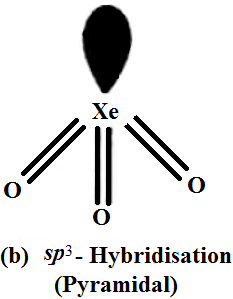
  3. ${BrO_3}^-- XeO_3 ($Linear$)$

View full question & answer
Question 333 Marks
$PH_3$ forms bubbles when passed slowly in water but $NH_3$ dissolves. Explain why?
Answer
$PH_3$ forms bubbles means that it's not soluble in water and $NH_3$ completely dissolves because it's soluble in water. Now $NH_3$ can form hydrogen bonds with water i.e. $H_20$ and hence it's completely soluble in water while $PH_3$ can't form hydrogen bonds with water because of large size of phosphorus as compared to Nitrogen.
View full question & answer
Question 343 Marks
Give an example to show the effect of concentration of nitric acid on the formation of oxidation product.
Answer
Dilute and concentrated nitric acid give different oxidation products on reaction with metals.
For example, zinc with very dilute $HNO_3 (6\%)$ forms $NH_4NO_3,$ with dilute $HNO_3(20\%)$ forms $N_2O$ and with cone. $HNO_3 (70\%)$ forms $NO_2$.
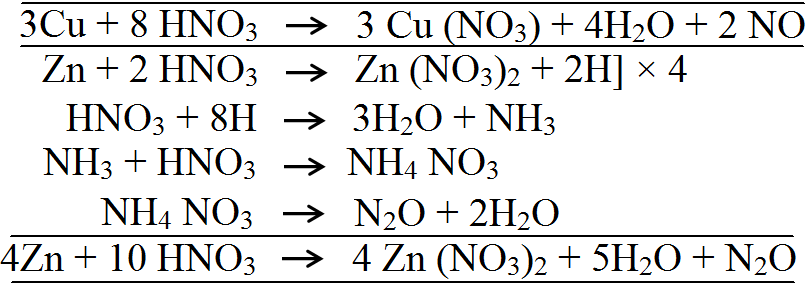
$4\text{Zn}+10\text{HNO}_3\xrightarrow{\ \ \ \ \ \ \ \ \ }4\text{Zn}(\text{NO}_3)_2+\text{NH}_4\text{NO}_3+3\text{H}_2\text{O}\\\ \ \ \ \ \ \ \ \ \ \ \ ^{\text{very dilute}}$
$4\text{Zn}+10\text{HNO}_3\xrightarrow{\ \ \ \ \ \ \ \ \ }4\text{Zn}(\text{NO}_3)_2+\text{N}_2\text{O}+5\text{H}_2\text{O}\\\ \ \ \ \ \ \ \ \ \ \ \ \ \ ^{\text{Dilute}}$
$\text{Zn}+4\text{HNO}_3\xrightarrow{\ \ \ \ \ \ \ \ \ }\text{Zn}(\text{NO}_3)_2+2\text{N}\text{O}_2+2\text{H}_2\text{O}\\\ \ \ \ \ \ \ \ \ \ \ \ ^{\text{Conc.}}$
View full question & answer
Question 353 Marks
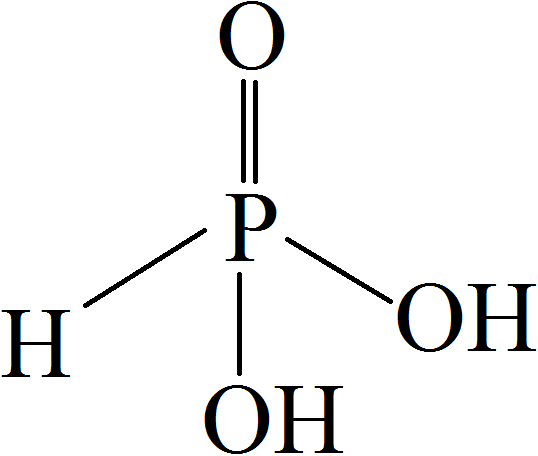
Explain the following: $H_3PO_3$ is diprotic.
Answer


Since it contains only two ionisable H-atoms which are present are present as OH-groups, it is diprotic.
View full question & answer
Question 363 Marks
Write the conditions to maximise the yield of $H_2SO_4$ by Contact process.
Answer
Conditions are:
  1. High concentration of reactants.
  2. Low temperature. But an optimum temperature of $623-723$ k must be maintained.
  3. High pressure: Normally a pressure of about two osphere is maintained.
  4. presence of catalyst: In order to accelerate the reaction, the presence of catalyst is quite helpful. $V_2O_5,$ is used as a catalyst.
  5. Purity of gases: Gases must be completely free from dust and poisonous gases like arsenic oxide before they are passed through the catalyst.
View full question & answer
Question 373 Marks
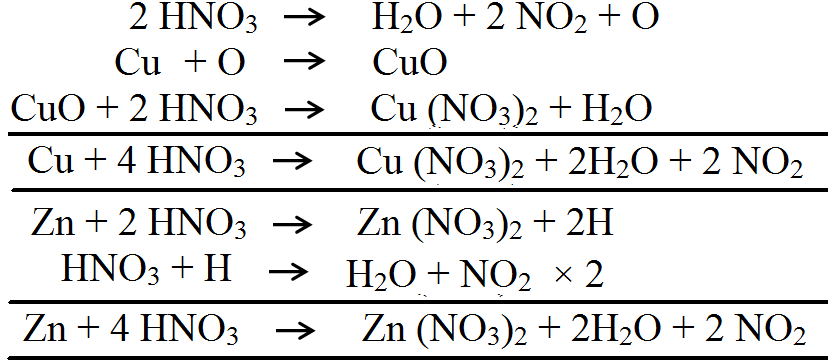
Illustrate how copper and zinc give different products on reaction with $HNO_3.$
Answer

With conc. $HNO_3:$

With dil $HNO_3:$
$2\text{HNO}_3\rightarrow\text{H}_2\text{O}+2\text{NO}+3\text{O}$
$\text{Cu}+\text{O}\rightarrow \text{CuO}]\times3$
$\text{CuO}+2\text{HNO}_3\rightarrow\text{Cu}(\text{NO}_3)_2+\text{H}_2\text{O}]\times3$
View full question & answer
Question 383 Marks
Account for the following:
Bleaching of flowers by chlorine is permanent while that by sulphur dioxide is temporary.
Answer
$Cl_2$ bleaches coloured material by oxidation.
$Cl_2 + H_2O → 2HCl + O$
Coloured material $+ [O] →$ Colourless
Hence, bleaching is permanent.
In contrast, $SO_2$ bleaches coloured material by reduction and hence bleaching is temporary since when the bleached colourless material is exposed to air, it gets oxidised and the colour is restored.
$SO_2 + 2H_2O → H_2SO_4 + 2H$
Coloured material + H → Colourless material $\xrightarrow[\ \ \text{oxidation}]{\ \ \ \ \text{aerial} \ \ \ \ \ \ }$ Colourless material
View full question & answer
Question 393 Marks
Phosphorus has three allotropic forms —
  1. white phosphorus
  2. red phosphorus and
  3. black phosphorus.
Write the difference between white and red phosphorus on the basis of their structure and reactivity.
Answer
White phosphorus is more reactive than red phosphorus because white P exists as discrete $P_4$ molecules. In red P several $P_4$ tetrahedral molecules are linked to formed polymeric chain.
Black phosphorus is the most stable form of phosphorus it is least reactive among all the allotrophic form of phosphorus.

View full question & answer
Question 403 Marks
Describe the manufacture of $H_2SO_4$ by contact process?
Answer
Preparation of sulphuric acid: By Contact Process: Burning of sulphur or sulphide ores in presence of oxygen to produce $SO_2.$ Catalytic oxidation of $SO_2$ with $O_2$ to give $SO_3$ in the presence of $V_2O_5.$
$2\text{SO}_2(\text{g})+\text{O}_2(\text{g})\xrightarrow[]{\text{v}_2\text{O}_5}2\text{SO}_3(\text{g})$
Then $SO_3$ made to react with sulphuric acid of suitable normality to obtain a thick oily liquid called oleum.
$\text{SO}_3(\text{g})+\text{H}_2\text{SO}_4(\text{l})\rightarrow\text{H}_2\text{S}_2\text{O}_7(\text{l})$
Then oleum is diluted to obtain sulphuric acid of desired concentration.
$\text{H}_2\text{S}_2\text{O}_7(\text{l})+\text{H}_2\text{O}(\text{l})\rightarrow2\text{H}_2\text{S}\text{O}_4(\text{l})$
The sulphuric acid obtained by contact process is $96 - 98\%$ pure.
View full question & answer
Question 413 Marks
Discuss the trends in chemical reactivity of group $15$ elements.
Answer
General trends in chemical properties of group $–15.$
  1. Reactivity towards hydrogen:
The elements of group $15$ react with hydrogen to form hydrides of type $EH_3,$ where $E = N,\ P,\ As,\ Sb,$ or $Bi.$ The stability of hydrides decreases on moving down from $NH3$ to $BiH_3.$​​​​​​​
  1. Reactivity towards oxygen:
The elements of group $15$ form two types of oxides: $E_2O_3$ and $E_2O_5,$ where $E = N,\ P,\ As,\ Sb$, or $Bi$. The oxide with the element in the higher oxidation state is more acidic than the other. However, the acidic character decreases on moving down a group.
  1. Reactivity towards halogens:
The group $15$ elements react with halogens to form two series of salts: $EX_3$ and $EX_5$.
However, nitrogen does not form $NX5$ as it lacks the d-orbital. All trihalides (except NX3) are stable.
  1. Reactivity towards metals:
​​​​​​​The group $15$ elements react with metals to form binary compounds in which metals exhibit $−3$ oxidation states.
View full question & answer