Questions · Page 1 of 2

3 Marks Question

Take a timed test

50 questions · self-marked practice — reveal the answer and mark yourself.

Question 13 Marks
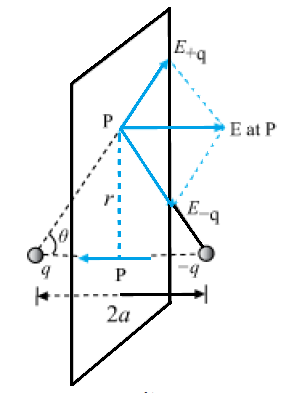
  1. Drive the expression for electric field at a point on the equatorial line of an electric dipole.
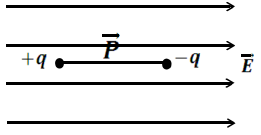
  2. Depict the orientation of the dipole in (i) stable, (ii) unstable equilibrium in a uniform electric field.
Answer
  1.  

Let the point ‘P’ be at a distance ‘r’ from the mid point of the dipole.
$E_{+q}=\frac{q}{4\pi\varepsilon_0(r^2+a^2)}$
$E_{-q}=\frac{q}{4\pi\varepsilon_0(r^2+a^2)}$
Both are equal and their directions are as shown in the figure. Hence net electric field
$\overrightarrow{E}=[-(E_{+q}+E_{-q})\cos\theta]\hat{p}$
$=-\frac{2qa}{4\pi\varepsilon_0(r^2+a^2)^{\frac{3}{2}}}\hat{p}$
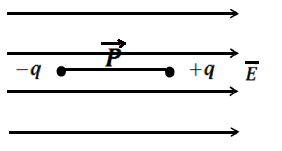
  1. Stable equilibrium, $\theta=0^\circ$

Unstable equilibrium, $\theta=180^\circ$
View full question & answer
Question 23 Marks
A point charge of 2.0 μC is at the centre of a cubic Gaussian surface 9.0 cm on edge. What is the net electric flux through the surface?
Answer
Net electric flux $(\phi_{\text{Net}})$ through the cubic surface is given by,
$\phi_{\text{Net}}=\frac{\text{q}}{\in_0}$
Where,
$\in_0$ = permittivity of free space
$= 8.854 \times 10^{-12} N^{-1}C^2m^{-2}$
q = Net charge contained inside the cube $= 2.0 µC = 2 \times 10^{-6}C$
$\therefore\phi_{\text{Net}}=\frac{2\times10^{-6}}{8.854\times10^{-12}}$
$= 2.26 \times 10^5 Nm^2C^{-1}​​​​​​​$​​​​​​​
The net electric flux through the surface is $2.26 \times 10^5 Nm^2C^{-1}.$
View full question & answer
Question 33 Marks
An electric dipole with dipole moment $4 \times 10^{-9}$ Cm is aligned at 30^\circ with the direction of a uniform electric field of magnitude $5 \times 10^4 NC^{-1}.$ Calculate the magnitude of the torque acting on the dipole.
Answer
Electric dipole moment, $p = 4 \times 10^{-9}\ Cm$
Angle made by p with a uniform electric field, θ = 30°
Electric field, $E = 5 \times 10^4\ NC^{-1}.$
Torque acting on the dipole is given by the relation,
Τ = pEsinθ
$= 4 \times 10^{-9} \times 5 \times 10^4\times Sin\ 30$
$= 20 \times 10^{-5} \times \frac{1}{2}$
$= 10^{-4}\ Nm$
Therefore, the magnitude of the torque acting on the dipole is $10^{-4}\ Nm.$
View full question & answer
Question 43 Marks
Suppose that the particle in Exercise in 1.33 is an electron projected with velocity $v_x= 2.0 \times 10^6 m s^{–1}$. If E between the plates separated by 0.5 cm is $9.1 \times 10^2N/C,$ where will the electron strike the upper plate? $(|e|=1.6 \times 10^{–19}C, m_e = 9.1 \times 10^{–31} kg.)$
Answer
Velocity of the particle, $V_x = 2 .0 x 10^6 m/s$
Separation of the two plates, $d = 0.5 cm = 0.005 m$
Electric field between the two plates, $E = 9.1 x 10^2 N/C$
Charge on an electron, $q = 1.6 x 10^{-19} C$
Mass of an electron, $m_e= 9 .1 x 10^{-31} kg$
Let the electron strike the upper plate at the end of plate L, when deflection is s. Therefore,
$\text{s}=\frac{\text{qEL}^2}{2\text{mv}^2\text{x}}$
$\text{L}=\sqrt{\frac{2\text{dmv}^2\text{x}}{\text{qE}}}$
$=\sqrt{\frac{2\times0.005\times9.1\times10^{-31}\times(2.0\times10^6)^2}{1.6\times10^{-10}\times9.1\times10^2}}$
$=\sqrt{0.025\times10^{-2}}=\sqrt{2.5\times10^{-4}}$
$= 1.6 x 10^{-2}\ m$
$= 1.6\ cm$
Therefore, the electron will strike the upper plate after travelling 1.6 cm.
View full question & answer
Question 53 Marks
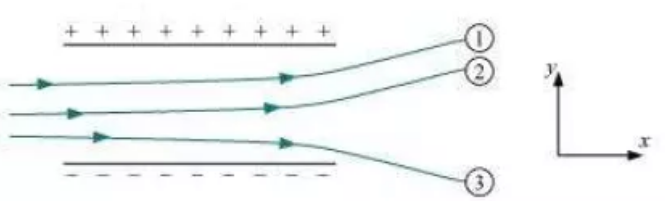
Figure 1.33 shows tracks of three charged particles in a uniform electrostatic field. Give the signs of the three charges. Which particle has the highest charge to mass ratio?
Answer
Opposite charges attract each other and same charges repel each other. It can be observed that particles 1 and 2 both move towards the positively charged plate and repel away from the negatively charged plate. Hence, these two particles are negatively charged. It can also be observed that particle 3 moves towards the negatively charged plate and repels away from the positively charged plate. Hence, particle 3 is positively charged.
The charge to mass ratio (emf) is directly proportional to the displacement or amount of deflection for a given velocity. Since the deflection of particle 3 is the maximum, it has the highest charge to mass ratio.
View full question & answer
Question 63 Marks
Consider a uniform electric field $E = 3 \times 10^3$ î N/C.
  1. What is the flux of this field through a square of 10 cm on a side whose plane is parallel to the yz plane?
  2. What is the flux through the same square if the normal to its plane makes a 60° angle with the x-axis?
Answer
  1. Electric field intensity, $\vec{\text{E}} = 3 \times 10^3 î N/C$
Magnitude of electric field intensity, $|\vec{\text{E}}| = 3 × 10^3N/C$

Side of the square,$ s = 10 cm= 0.1 m$

Area of the square, $A = s^2 = 0.01 m^2$

The plane of the square is parallel to the y-z plane. Hence, angle between the unit vector normal to the plane and electric field, $\theta = 0°$

Flux ($\phi$) through the plane is given by the relation,

$\phi = |\vec{\text{E}}|\text{A}\cos\theta$

$= 3 \times 10^3\times 0.01 \times \cos0^{\circ}$

$= 30 Nm^2/C$​​​​​​​​​​​​​​
  1. Plane makes an angle of $60°$ with the x-axis. Hence, $e = 60°$
Flux, $\phi = |\vec{\text{E}}|\text{A}\cos\theta$

$= 3 \times 10^3\times 0.01 \times \cos60^{\circ}$

$= 30 \times \frac{1}{2} = 15 Nm^2/C$
View full question & answer
Question 73 Marks
The electrostatic force on a small sphere of charge 0.4 μC due to another small sphere of charge –0.8 μC in air is 0.2 N.
  1. What is the distance between the two spheres?
  2. What is the force on the second sphere due to the first?
Answer
  1. Electrostatic force on the first sphere, F = 0.2 N
Charge on this sphere, $q_1 = 0.4 µC = 0.4 \times 10^{-6}\ C$

Charge on the second sphere, $q_2 = -0.8 µC = 0.8 \times 10^{-6}\ C$

Electrostatic force between the spheres is given by the relation,

$\text{F}=\frac{\text{q}_1\text{q}_2}{4\pi\in_0\text{r}^2}$ And $\frac{1}{4\pi\in_0}=9\times10^{9}\text{Nm}^2\text{C}^{-2}$

Where, $\in_0\ =$ Permittivity of free space

And, $\frac{1}{4\pi\in_0} = 9\times10^9\text{Nm}^{-2}\text{C}^{-2}$

$\text{r}^2=\frac{\text{q}_1\text{q}_2}{4\pi\in_0\text{F}}$

$= 144 \times 10^{-4}$​​​​​​​

$r = \sqrt{144\times10^{-4}}=0.12\text{m}$

The distance between the two spheres is 0.12m.
  1. Both the spheres attract each other with the same force. Therefore, the force on the second sphere due to the first is 0.2N.
View full question & answer
Question 83 Marks
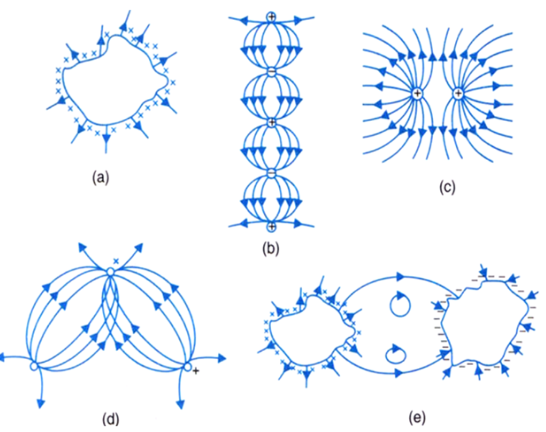
Which among the curves shown in Fig. 1.35 cannot possibly represent electrostatic field lines?
Answer
  1. Figure (a) cannot represent electrostatic field lines since electrostatic field lines start or end only at 90° to the surface of the conductor.
  2. Figure (b) too cannot represent electrostatic field lines as electrostatic field lines do not start from a negative charge. Electric field lines always traverse from a region of positive charge to a region of negative charge.
  3. Electrostatic field lines are represented by figure (c).
  4. Figure (d) cannot represent electrostatic field lines since no two such lines of force can intersect each other.
  5. As electrostatic field lines cannot form closed loop, therefore figure (d) also does not represent electrostatic field lines.
View full question & answer
Question 93 Marks
A conducting sphere of radius 10 cm has an unknown charge. If the electric field 20 cm from the centre of the sphere is $1.5 \times 10^3 N/C$ and points radially inward, what is the net charge on the sphere?
Answer
Given,
Radius of conducting sphere, $r = 10 cm = 0. 1 m$
Electric field , $E = 1.5 x 10^3N/C$ at distance, $d = 20 cm = 0. 2 m$
As, $\text{E}=\frac{1}{4\pi\in_0}\frac{\text{q}}{\text{r}^2}$
$\Rightarrow \text{q = E.}\ 4\pi\in_0.\text{r}^2$
$q = 1.5 \times 10^3 \times   4\pi \times 8.854 \times 10^{-12} \times (0.2)^2$
$q = 6.67 \times 10^{-9} C$
Here, since electric field is directed radially inward charge q is negative.
Thus,
$q = - 6. 67 x 10^{-9} C$
$= -6.67 nC.$
View full question & answer
Question 103 Marks
What is the force between two small charged spheres having charges of $2 \times 10^{-7}C$ and $3 \times 10^{-7}C$ placed 30cm apart in air?
Answer
Repulsive force of magnitude $6 \times 10^{-3} N$
Charge on the first sphere, $q_1 = 2 \times 10^{-7} C$
Charge on the second sphere, $q_2 = 3 \times 10^{-7} C$
Distance between the spheres,$ r = 30 cm = 0.3 m$
Electrostatic force between the spheres is given by the relation,
$\text{F}=\frac{\text{q}_1\text{q}_2}{4\pi\in_0\text{r}^2}$
Where, $\in_0$ = Permittivity of free space
$\frac{1}{4\pi\in_0}=9\times10^9\text{Nm}^2\text{C}^{2}$
$\text{F}=\frac{9\times10^9\times2\times10^{-7}\times3\times10^{-7}}{(0.3)^2}=6\times10^{-3}\text{N}$
Hence, force between the two small charged spheres is $6 \times 10^{-3} N.$ The charges are of same nature. Hence, force between them will be repulsive.
View full question & answer
Question 113 Marks
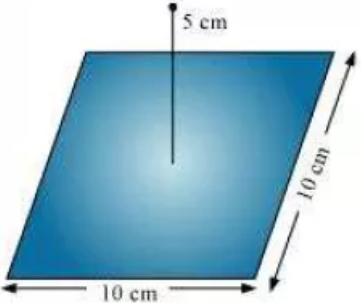
A point charge +10 μC is a distance 5cm directly above the centre of a square of side 10cm, as shown in Fig. 1.34. What is the magnitude of the electric flux through the square?
(Hint: Think of the square as one face of a cube with edge 10cm.)
Answer
The square can be considered as one face of a cube of edge 10cm, with a centre where charge q is placed. According to Gauss's theorem for a cube, total electric flux is through all its six faces.
$\phi_{\text{Total}}=\frac{\text{q}}{\in_0}$
Hence, electric flux through one face of the cube i.e., through the square, $\phi=\frac{\phi_{\text{Total}}}{6}$
$=\frac{1}{6}\frac{\text{q}}{\in_0}$
Where,
$\in_0$ = Permittivity of free space
$= 8.854 \times 10^{-12} N^{-1}C^{-1}m^{-2}$
$q = 10 µC = 10 \times 10^{-6}C$
$\therefore\phi=\frac{1}{6}\times\frac{10\times10^{-6}}{8.854\times10^{-12}}$
$= 1.88 \times 10^5 Nm^2C^{-1}$​​​​​​​
Therefore, electric flux through the square is $1.88 \times 10^5 Nm^2C^{-1}.$
View full question & answer
Question 123 Marks
  1. Consider an arbitrary electrostatic field configuration. A small test charge is placed at a null point (i.e., where E = 0) of the configuration. Show that the equilibrium of the test charge is necessarily unstable.
  2. Verify this result for the simple configuration of two charges of the same magnitude and sign placed a certain distance apart.
Answer
  1. Let the equilibrium of the test charge be stable. If a test charge is in equilibrium and displaced from its position in any direction, then it experiences a restorinq force towards a null point, where the electric field is zero. All the field lines near the null point are directed inwards towards the null point. There is a net inward flux of electric field through a closed surface around the null point. According to Gauss's law, the flux of electric field through a surface, which is not enclosing any charge, is zero. Hence, the equilibrium of the test charge can be stable.
  2. Two charges of same magnitude and same sign are placed at a certain distance. The mid-point of the joining line of the charges is the null point. When a test charged is displaced along the line, it experiences a restoring force. If it is displaced normal to the joining line, then the net force takes it away from the null point. Hence, the charge is unstable because stability of equilibrium requires restoring force in all directions.
View full question & answer
Question 133 Marks
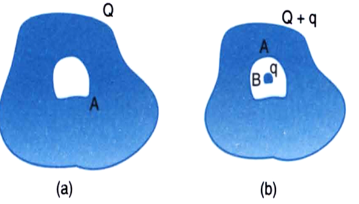
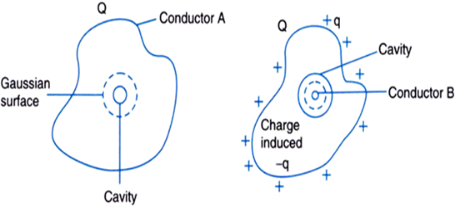
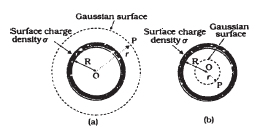
  1. A conductor A with a cavity as shown in Fig. 1.36(a) is given a charge Q. Show that the entire charge must appear on the outer surface of the conductor.
  2. Another conductor B with charge q is inserted into the cavity keeping B insulated from A. Show that the total charge on the outside surface of A is Q + q [Fig. 1.36(b)].
  3. A sensitive instrument is to be shielded from the strong electrostatic fields in its environment. Suggest a possible way.
Answer
  1. Let us take a Gaussian surface which is lying completely within the conductor and enclosing the cavity. According to the Gaussian theorem, the charge enclosed by Gaussian surface must be zero as electric field vanishes everywhere inside a conductor. Thus, electric field vanishes inside the cavity. Therefore, charges which are supplied to the conductor reside on its outer surface.
  1. Let us take a Gaussian surface inside the conductor which is quite close to the cavity. According to the Gaussian theorem,
$\phi_\text{E}=\int\text{E.ds}=\frac{\text{total charge}}{\in_0}$

As the electric field inside the conductor is zero, the total charge which is enclosed by the gaussian surface must be zero. This requires, a charge of -q units to be induced on the inner surface of the hollow conductor A. But an equal and opposite charge +q units must appear on the outer surface of conductor A, so that the total charge on the outer surface of A is Q + q.
  1. Use a metallic surface to enclose the sensitive instrument completely safe and intact. Because of electrostatic shielding, the electric field inside the metal surface vanishes to zero and all charge will reside on outer surface.
View full question & answer
Question 143 Marks
Two large, thin metal plates are parallel and close to each other. On their inner faces, the plates have surface charge densities of opposite signs and of magnitude 17.0 × 10⁻²² C/m2 . What is E:
  1. In the outer region of the first plate,
  2. In the outer region of the second plate, and
  3. Between the plates?
Answer
Given,
Surface charge density, $\sigma = 17. 0 x 10^{-22} C /m^2$
  1. To the left of the plates, electric fields are equal and opposite as plates are close to each other electric field is zero as surface charge density in outer side is zero.
  2. To the right of the plates, electric fields are equal and opposite as plates are close to each other electric field is zero.
  3. Electric fields between the plates are in same direction as total E.F. on both sides of plate due to $\sigma$ surface charge density = $\frac{\sigma}{\in_0}$ electric field of inner side of plate =$\frac{\sigma}{2\in_0}$
and for both plate E $=\frac{\sigma}{2\in_0}+\frac{\sigma}{2\in_0}$

$\text{E}=\frac{\sigma}{\in_0}=\sigma\times4\pi\times9\times10^9$

$E = 17.0 \times 10^{-22} \times 4 \times 3.14 \times 9 \times 10^9$​​​​​​​

$E = 1921.7 \times 10^{-13}​​​​​​​$​​​​​​​

$= 1.92 \times 10^{-10} N/C.$
View full question & answer
Question 153 Marks
A hollow charged conductor has a tiny hole cut into its surface. Show that the electric field in the hole is $(\sigma /2ε_0)$ $\hat{\text{n}}$ , where $\hat{\text{n}}$ is the unit vector in the outward normal direction, and σ is the surface charge density near the hole.
Answer
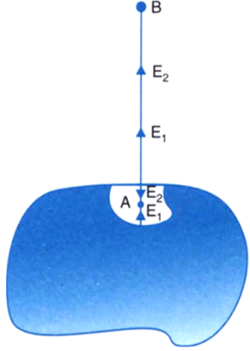
Let us take a charged conductor with the hole filled up, as shown by shaded portion in the figure.

We find with the application of Gaussian theorem that field inside is zero and just outside is $\frac{\sigma}{\in_0}\hat{\text{n}}.$
This field can be viewed as the superposition of the field $E_2$ due to the filled up hole plus the field $E_1$ due to the rest of the charged conductor.
The two fields $(E_1$ and $E_2)$ must be equal and opposite as the field vanishes inside the conductor. Thus, $E_1 - E_2 = 0$
Now, the field outside the conductor is given by
$\text{E}_1+\text{E}_2=\frac{\sigma}{\in_0}$
$\therefore \ 2\ \text{E}_1=\frac{\sigma}{\in_0}$
$\Rightarrow\ \text{E}_1=\frac{\sigma}{2\in_0}$
Therefore, field in the hole (due to the rest of the conductor) is given as:
$\text{E}_1=\frac{\sigma}{2\in_0}\hat{\text{n}}$ ($\hat{\text{n}}$ → unit vector in the outward normal direction)
View full question & answer
Question 163 Marks
Careful measurement of the electric field at the surface of a black box indicates that the net outward flux through the surface of the box is 8.0 × 10³ Nm2 /C.
  1. What is the net charge inside the box?
  2. If the net outward flux through the surface of the box were zero, could you conclude that there were no charges inside the box? Why or Why not?
Answer
  1. Net outward flux through the surface of the box, $(\phi) = 8.0 x 10^3 Nm^2/C$
For a body containing net charge a, flux is given by the relation,

$\phi = \frac{\text{q}}{\in_0}$

$\in_0$ = Permittivity of free space

$= 8.854 \times 10^{-12}\times 8.0 \times 10^3$

$q = \in_0\phi$

$= 8.854 \times 10^{-12} \times 8.0 \times 10^3​​​​​​​$​​​​​​​

$= 7.08 \times 10^{-8}​​​​​​​$​​​​​​​

$= 0.07 µC$

Therefore, the net charge inside the box is 0.07 µC.
  1. No
Net flux piercing out through a body depends on the net charge contained in the body. If net flux is zero, then it can be inferred that net charge inside the body is zero. The body may have equal amount of positive and negative charges.
View full question & answer
Question 173 Marks
A polythene piece rubbed with wool is found to have a negative charge of $3 \times 10^{-7}\ C.$​​​​​​​
  1. Estimate the number of electrons transferred (from which to which?)
  2. Is there a transfer of mass from wool to polythene?
Answer
  1. When polythene is rubbed against wool, a number of electrons get transferred from wool to polythene. Hence, wool becomes positively charged and polythene becomes negatively charged.
Amount of charge on the polythene piece, $q = -3 \times 10^{-7} C$

Amount of charge on an electron, $e = -1.6 \times 10^{-19} C$

Number of electrons transferred from wool to polythene = n

n can be calculated using the relation,

q = ne

$\text{n} = \frac{\text{q}}{\text{e}}$

$=\frac{-3\times10^{-7}}{-1.6\times10^{-19}}$

$= 1.87 \times 10^{12}$​​​​​​​

Therefore, the number of electrons transferred from wool to polythene is $1.87 \times 10^{12}.​​​​​​​$​​​​​​​
  1. Yes.
There is a transfer of mass taking place. This is because an electron has mass, $m_e = 9.1 \times 10^{-3} kg$

Total mass transferred to polythene from wool, $m = m_e \times n$

$= 9.1 \times 10^{-31} \times 1.85 \times 10^{12}​​​​​​​$​​​​​​​

$= 1.706 \times 10^{-18} kg$

Hence, a negligible amount of mass is transferred from wool to polythene.
View full question & answer
Question 183 Marks
Obtain the formula for the electric field due to a long thin wire of uniform linear charge density λ without using Gauss’s law.
[Hint: Use Coulomb’s law directly and evaluate the necessary integral.]
Answer
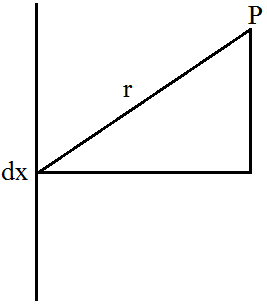
Consider a long thin wire of uniform linear charge density, $\lambda$.
To find: Formula for electric field due to this wire at any point P at a perpendicular distance PC= r from the wire.
Consider a small element of length dx of the wire with centre O, such that OC = x.
Charge on the element, q = $\lambda$. dx

So, electric intensity at P due to the element is given by,
$\text{dE}=\frac{1}{4\pi\in_0}\frac{\lambda\text{dx}}{\text{OP}^2}=\frac{\lambda.\text{dx}}{4\pi\in_0(\text{r}^2+\text{x}^2)}$
Now, $\text{d}\vec{\text{E}}$ can be resolved into two rectangular components, that is $\text{d}\vec{\text{E}}$ $\cos\theta$ in a perpendicular direction and $\text{d}\vec{\text{E}}$ $\sin\theta$ in a parallel direction.
The parallel component will be cancelled by the parallel component of the field due to charge on a similar element dx of wire on the other half.
The radial components get added.
Therefore,
Effective component of electric intensity due to the charge element, dE' = $\text{d}\vec{\text{E}}\cos\theta$
$\text{dE}' = \frac{\lambda.\text{dx}\cos\theta}{4\pi\in_0(\text{r}^2+\text{x}^2)} \dots\dots(1)$
From $\triangle$ OCP, x = r tan $\theta$
$\therefore\text{dx}=\text{r}\sec^2\theta\ \text{d}\theta$
$\text{Now}, \text{r}^2+\text{x}^2=\text{r}^2+\text{r}^2\tan^2\theta=\text{r}^2(1+\tan^2\theta)$
From equation (1), we have
$\text{dE}'=\frac{\lambda\text{r}\sec^2\theta\ \text{d}\theta}{4\pi\in\text{r}^2\sec^2\theta}\cos\theta$
$\Rightarrow\text{dE}' = \frac{\lambda}{4\pi\in_0\text{r}}\cos\theta\ \text{d}\theta$
Since the wire has infinite length, it's ends A and B are infinite distances apart.
Therefore, $\theta$ varies from $-\frac{\pi}{2}\text{to}+\frac{\pi}{2}$
So, Electric Intensity at P due to the whole wire is given by,
$\text{E}'=\int_{-\frac{\pi}{2}}^{+\frac{\pi}{2}}\frac{\lambda}{4\pi\in_0\text{r}}\cos\theta\ \text{d}\theta$
$=\frac{\lambda}{2\pi\in_0\text{r}},$ is the required electric field intensity.
View full question & answer
Question 193 Marks
Suppose the spheres A and B in Exercise 1.12 have identical sizes. A third sphere of the same size but uncharged is brought in contact with the first, then brought in contact with the second, and finally removed from both. What is the new force of repulsion between A and B?
Answer
Distance between the spheres, A and B, r = 0.5 m
Initially, the charge on each sphere, $q = 6.5 x 10^{-7} C$
When sphere A is touched with an uncharged sphere C, $\frac{\text{q}}{2}$ amount of charge from A will transfer to sphere C. Hence, charge on each of the spheres, A and C, is $\frac{\text{q}}{2}$.
When sphere C with charge $\frac{\text{q}}{2}$ is brought in contact with sphere B with charge q, total charges on the system will divide into two equal halves given as,
$\frac{\frac{\text{q}}{2}+\text{q}}{2}=\frac{3\text{q}}{4}$
Each sphere will share each half. Hence, charge on each of the spheres, C and B, is $\frac{3\text{q}}{4}.$
Force of repulsion between sphere A having charge $\frac{\text{q}}{2}$ and sphere B having charge
$\frac{3\text{q}}{4}=\frac{\frac{\text{q}}{2}\times\frac{3\text{q}}{4}}{4\pi\in_0\text{r}^2}=\frac{3\text{q}^2}{8\times4\pi\in_0\text{r}^2}$
$=9\times10^9\times\frac{3\times(6.5\times 10^{-7})^2}{8\times(0.5)^2}$
$= 5.703 \times 10^{-3} N$
Therefore, the force of attraction between the two spheres is $ 5.703 x 10^{-3} N.$
View full question & answer
Question 203 Marks
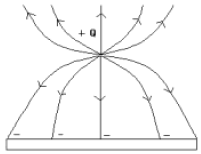
A positive point charge (+ q) is kept in the vicinity of an uncharged conducting plate. Sketch electric field lines originating from the point on to the surface of the plate.
Derive the expression for the electric field at the surface of a charged conductor.
Answer
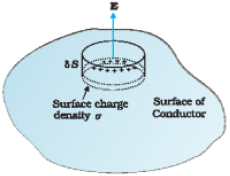
Field at the surface of a charged conductor We have, by Gauss’s law,$\text{E }\delta\text{ S} =\frac{|\sigma| \delta\text{ S}}{\varepsilon_{0}}$
$\therefore\text{E} = \frac{|\sigma|}{\varepsilon_{0}}.$
View full question & answer
Question 213 Marks
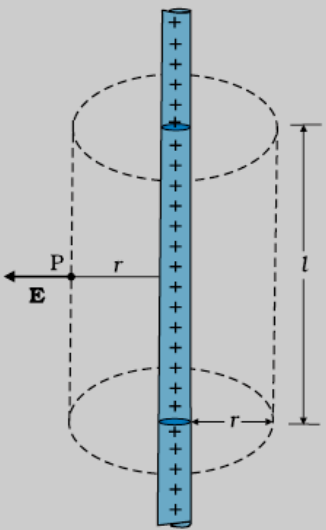
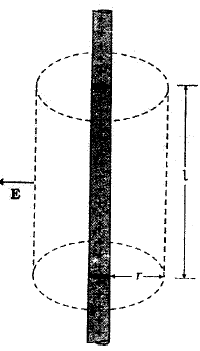
State Gauss's theorem in electrostatics. Apply this theorem to derive an expression for electric field intensity at a point near an infinitely long straight charged wire.
Answer
  1. Statement: Net electric flux through to a closed surface is equal to $\frac{1}{\varepsilon_\circ}$ times the total net charge enclosed within the surface.
(If the student just writes $\oint\text{E}.\text{ds} =\frac{\text{q}}{\in_\circ}$, award )
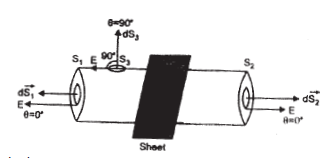
  1. Diagram:-
  1. Derivation:-
$\oint\text{E}.\text{ds} \int\limits_{s_1}\overline{E}.\text{d}\overline{s}_{1} + \int\limits_{s_2}\overline{E}.\text{ds}_{2} + \int\limits_{s_3}\overline{E}.\text{ds}_{3}$
$ = 0 + 0 + 2\pi\text{r}\ell$
Also, $\text{q} = \lambda$ $\ell$ (where $\lambda$ is charge per unit length)
$(\text{E}).(2\pi\text{r}\ell) = \frac{1}{\varepsilon_\circ}\lambda\ell $ OR $\text{E}2\pi\text{r}\ell\frac{\text{q}}{\varepsilon_\circ}$
$\text{E} = \frac{\lambda}{2\pi\varepsilon_\circ\text{r}}$ OR $\text{E} = \frac{\text{q}}{2\pi\varepsilon_\circ\text{r}\ell}$.
View full question & answer
Question 223 Marks
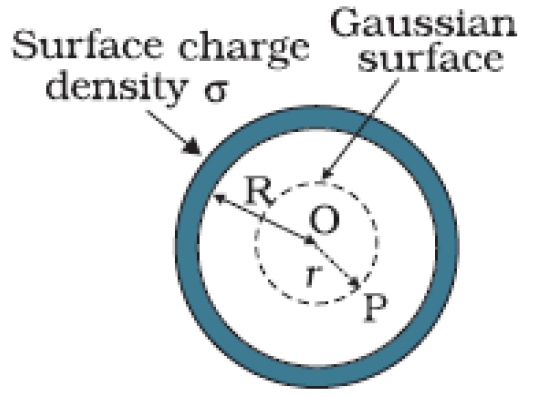
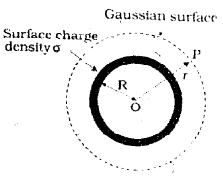
Using Gauss’s theorem, show mathematically that for any point outside the shell, the field due to a uniformly charged thin spherical shell is the same as if the entire charge of the shell is concentrated at the centre. Why do you expect the electric field inside the shell to be zero according to this theorem?
Answer
$\phi =\oint\limits_{s}\overrightarrow{\text{E}}.\overrightarrow{\text{d}}\text{s} = \frac{\text{q}}{\varepsilon_{\circ}}$
Derivation: $\text{E}\times4\pi\text{r}^{2} =\frac{\sigma}{\varepsilon_{\circ}}4\pi\text{R}^{2}$
$\therefore \text{E} = \frac{\sigma\text{R}^{2}}{\varepsilon_{\circ}\text{r}^{2}}$
where $\text{q} = 4\pi\text{R}^{2}\sigma$ is the total charge on the spherical shell. Electrostatic field is zero, since total charge inside the shell is zero or charge reside on the surface of the shell.
View full question & answer
Question 233 Marks
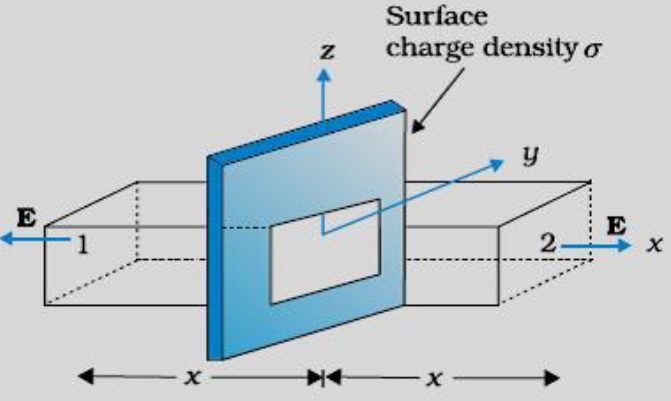
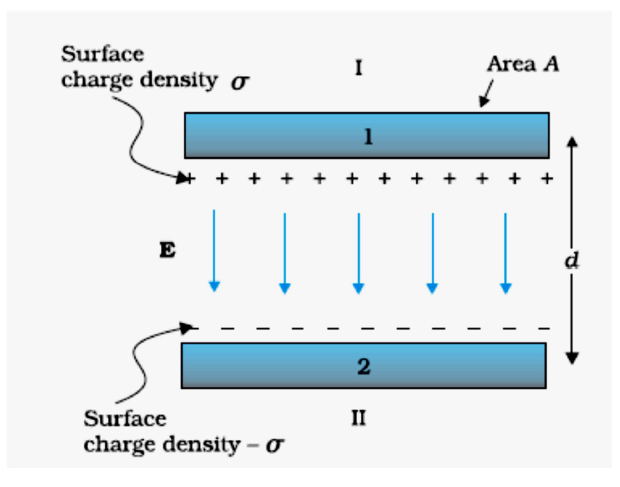
Using Gauss’s law in electrostatics, deduce an expression for electric field intensity due to a uniformly charged infinite plane sheet. If another identical sheet is placed parallel to it, show that there is no electric field in the region between the two sheets.
Answer

By Gauss’s law $ \oint \overrightarrow{E}.\overrightarrow{ds}=\frac{q}{\in_0}$
$\therefore{2{\text{EA}}}=\frac{\sigma{\text{A}}}{{\in_0}}$
$\therefore\text{E}=\frac{\sigma}{2\in_0}\text{ }\text{or}\frac{\sigma}{2\in_0}\text{A}$
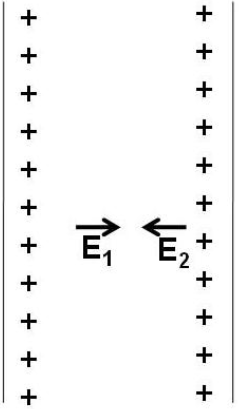
Electric field between two identical charged sheets

$\because$ Both the sheets have same charge density, their electric fields will be equal and opposite in the region between the two sheets.
Hence the net field is zero.Alternate Answer
$\text{E}_1=\frac{\sigma}{2\in_0}$
$\text{E}_2=-\frac{\sigma}{2\in_0}$
Resultant electric field between the plates $= E_1 + E_2\frac{\sigma}{2\in_0}-\frac{\sigma}{2\in_0}=0$]
View full question & answer
Question 243 Marks
Define electric flux. Write its SI unit.
Using Gauss’s law, deduce an expression for electric field intensity due to an infinitely long straight uniformly charged wire.
Answer
The electric flux is defined as$\phi_E=\overrightarrow{E}.\overrightarrow{A}={EA}\cos\theta$
Its S.I unit is $(Nm^{2}C^{-1})$ The Gaussian surface is cylindrical and field is radial. At the cylindrical part of the surface, cylindrical part of the surface, $ \overrightarrow{E}$ is normal to the surface at every point and its magnitude is constant (since it depends only on r). By Gauss’s theorem : $ \oint \overrightarrow{E}.{d}\overrightarrow{S}=\frac{q}{\in_0}$$\therefore(2\pi{rl})=\frac{\lambda{l}}{\in_0}$
$\text{or}\text{ }\text{ } E=\frac{\lambda}{2\pi\in_0r}$
View full question & answer
Question 253 Marks
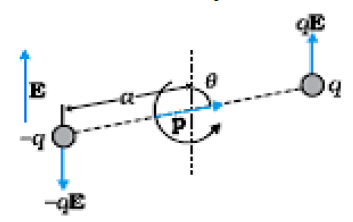
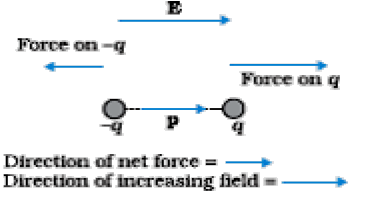
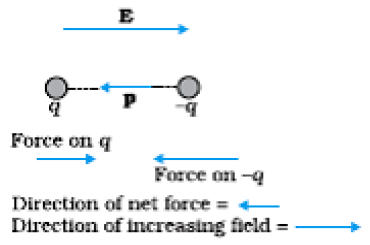
  1. Define torque acting on a dipole of dipole moment $\overrightarrow{p}$ placed in a uniform electric field $\overrightarrow{\text{E}}$. Express it in the vector form and point out the direction along which it acts.
  2. What happens if the field is non-uniform?
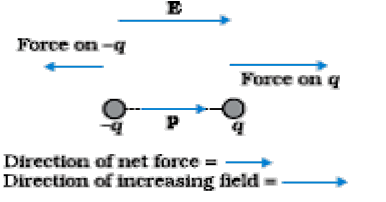
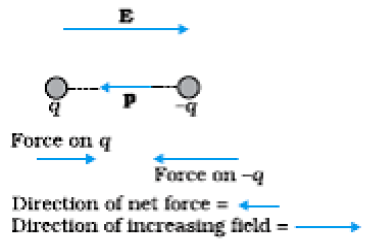
  3. What would happen if the external field $\overrightarrow{\text{E}}$ is increasing (i) parallel to $\overrightarrow{p}$ and (ii) anti-parallel to $\overrightarrow{p}$?
Answer
  1. $\tau=pE\sin\theta\text{ };\text{ }\theta=$ angle between dipole moment($\overrightarrow{p}$) and electric field($\overrightarrow{\text{E}}$)
$\tau=\overrightarrow{p}\times\overrightarrow{\text{E}}$
Direction of torque is perpendicular to the plane containing and given by right-hand screw rule.
Alternate Answer

Direction of torque is out of the plane of the paper.
  1. If the field is non uniform the net force on the dipole will not be zero. There will be translatory motion of the dipole.
  2.  
  1. Net force will be in the direction of increasing electric field.
  1. Net force will be in the direction opposite to the increasing field. [or in the direction of decreasing field]
View full question & answer
Question 263 Marks
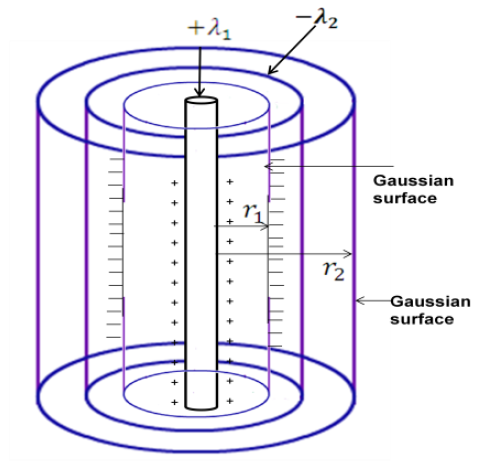
A long charged cylinder of linear charge density $+\lambda_1$ is surrounded by a hollow coaxial conducting cylinder of linear charge density $-\lambda_2$. Use Gauss’s law to obtain expressions for the electric field at a point (i) in the space between the cylinders, and (ii) outside the larger cylinder.
Answer
As Gauss’s Law states:$\oint\overrightarrow{E}.\vec{ds}=\frac{q}{\in_0}$
  1. $\oint\overrightarrow{E_1}.\vec{ds}=\frac{\lambda_1l}{\in_0}$
$\Longrightarrow\overrightarrow{E_1}=\frac{\lambda_1}{2\pi\in_0r_1}\hat{r_1}$
  1. $\oint\overrightarrow{E_2}.\vec{ds}=\frac{(\lambda_1-\lambda_2)l}{\in_0}$
$\Longrightarrow\overrightarrow{E_2}=\frac{(\lambda_1-\lambda_2)}{2\pi\in_0r_2}\hat{r_2}$
View full question & answer
Question 273 Marks
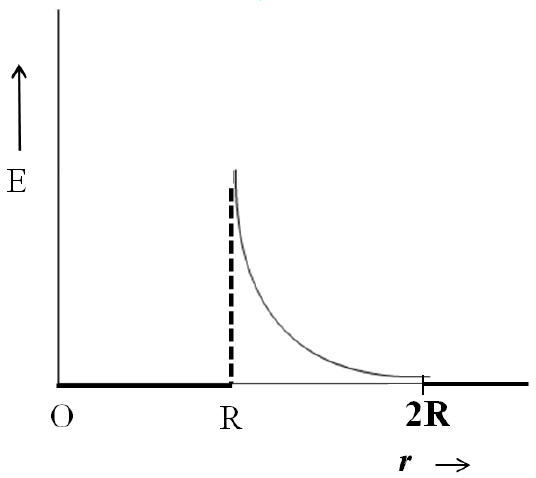
A charge Q is distributed uniformly over a metallic sphere of radius R. Obtain the expressions for the electric field (E) and electric potential (V) at a point 0 < x < R.
Show on a plot the variation of E and V with x for 0 < x < 2R.
Answer
By Gauss theorem $\oint \overrightarrow{E}.d\vec{s}=\frac{q}{E_0}$ q = 0 in interval 0 < x < R$\Rightarrow E=0$
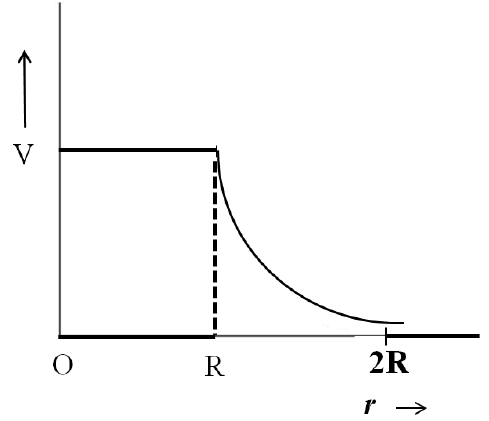
$E=-\frac{dv}{dr}$
$\Rightarrow V= constant=\frac{1}{4\pi E_0}\frac{Q}{R}$
View full question & answer
Question 283 Marks
  1. Define torque acting on a dipole of dipole moment $\overrightarrow{p}$ placed in a uniform electric field $\overrightarrow{\text{E}}$. Express it in the vector form and point out the direction along which it acts
  2. What happens if the field is non-uniform?
  3. What would happen if the external field $\overrightarrow{\text{E}}$ is increasing (i) parallel to $\overrightarrow{p}$ and (ii) anti-parallel to $\overrightarrow{p}$?
Answer
  1. $\tau=pE\sin\theta\text{ };\text{ }\theta=$ angle between dipole moment($\overrightarrow{p}$) and electric field($\overrightarrow{\text{E}}$)
$\tau=\overrightarrow{p}\times\overrightarrow{\text{E}}$
Direction of torque is perpendicular to the plane containing and given by right-hand screw rule.
Alternate Answer

Direction of torque is out of the plane of the paper.
  1. If the field is non uniform the net force on the dipole will not be zero. There will be translatory motion of the dipole.
  2.  
  1. Net force will be in the direction of increasing electric field.
  1. Net force will be in the direction opposite to the increasing field. [or in the direction of decreasing field]
View full question & answer
Question 293 Marks
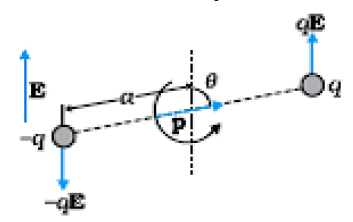
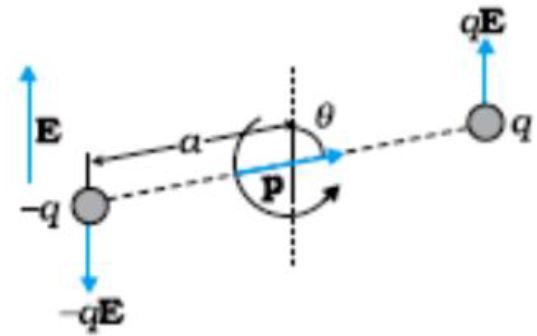
  1. Obtain the expression for the torque $\overrightarrow\tau$ experienced by an electric dipole of dipole moment $\overrightarrow{\text{P}}$ in a uniform electric field$\overrightarrow{\text{E}}$
  2. What will happen if the field were not uniform?
Answer
  1.  

Force on + q, $\overrightarrow{\text{F}}=q\overrightarrow{\text{E}}$
Force on - q, $\overrightarrow{\text{F}}=-q\overrightarrow{\text{E}}$
Magnitude of torque
$\tau=q\text{E}\times2a \text{ sin}\theta$
$\tau=2q\text{a}\times{\text{E}} \text{ sin}\theta$
$\overrightarrow\tau=\overrightarrow{\text{P}}\times\overrightarrow{\text{E}}$
  1. If the electric field is non uniform, the dipole experiences a translatory force as well as a torque.
View full question & answer
Question 303 Marks
A charge is distributed uniformly over a ring of radius ‘a’. Obtain an expression for the electric intensity E at a point on the axis of the ring. Hence show that for points at large distances from the ring, it behaves like a point charge.
Answer

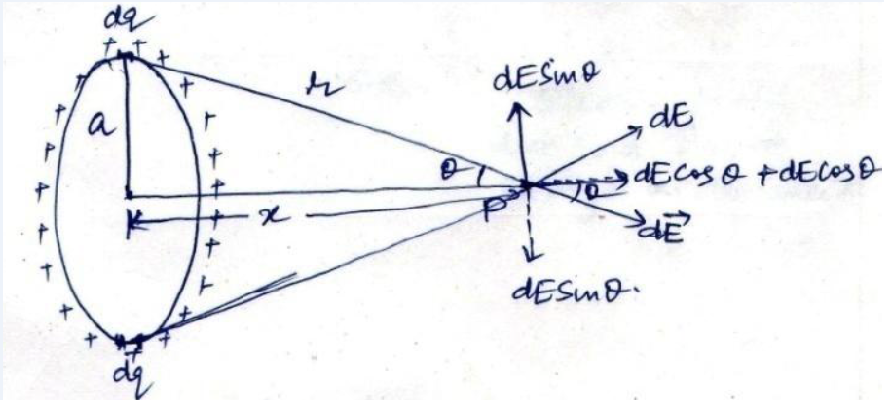
Net Electric Field at point $\text{P} =\int^{2\pi\text{a}}_{\circ}\text{dE}\cos\theta$
dE = Electric field due to a small element having charge dq
$ = \frac{1}{4\pi\varepsilon_\circ}\frac{\text{dq}}{\text{r}^{2}}$
Let $\lambda$ = Linear charge density
$ = \frac{\text{dq}}{\text{dl}}$
$\text{dq} = \lambda\text{dl}$
Hence $\text{E} = \int^{2\pi\text{a}}_{\circ}\frac{1}{4\pi\varepsilon_\circ}.\frac{\lambda\text{dl}}{\text{r}^{2}}\times\frac{x}{r} , $
where $\cos\theta =\frac{\text{x}}{\text{r}}$
$ = \frac{\lambda\text{x}}{4\pi\varepsilon_\circ\text{r}^{3}}(2\pi\text{a})$
$ =\frac{1}{4\pi\varepsilon_\circ}\frac{\text{Qx}}{(\text{x}^{2} + \text{a}^{2})^{\frac{3}{2}}}$
where total charge $\text{Q} = \lambda\times2\pi\text{a}$
At large distance i.e. x >> a
$\text{E}\simeq\frac{1}{4\pi\varepsilon_\circ}.\frac{\text{Q}}{\text{x}^{2}}$
This is the Electric field due to a point charge at distance x.
View full question & answer
Question 313 Marks
  1. Derive the expression for the capacitance of a parallel plate area A and plate separation d.
  2. Two charged spherical conductors of radii $R_1$ and $R_2$ when conducting wire acquire charges $q_1$ and $q_2$ respectively. surface charge densities in terms of their radii.
Answer
  1.  


Electric field between the plates of capacitor E = $\frac{\sigma}{\varepsilon_{0}} =\frac{\text{Q}}{\text{A}\varepsilon_{0}}$

$\therefore$ potential difference

$\text{V} = \text{Ed} = \frac{\text{Qd}}{\text{A}\varepsilon_{0}}$

Capacitance

$\text{C} = \frac{\text{Q}}{\text{V}} = \frac{\varepsilon_{0}\text{A}}{\text{d}}$
  1. When the two charged spherical conductors are connected by a conducting wire , they acquire the same potential
i.e $\frac{\text{Kq}_{1}}{\text{R}_{1}} = \frac{\text{Kq}_{2}}{\text{R}_{2}}\Rightarrow\frac{\text{q}_{1}}{\text{q}_{2}} = \frac{\text{R}_{1}}{\text{R}_{2}}$

Hence, ratio of surface charge densities

$\frac{\sigma_{1}}{\sigma_{2}} = \frac{\text{q}_{1}/4\pi\text{R}_{1}^{2}}{\text{q}_{2}/4\pi\text{R}_{2}^{2}}$

$ = \frac{\text{q}_{1}\text{R}_{2}^{2}}{\text{q}_{2}\text{R}_{1}^{2}}$

$ = \frac{\text{R}_{1}}{\text{R}_{2}}\times\frac{\text{R}_{2}^{2}}{\text{R}_{1}^{2}} = \frac{\text{R}_{2}}{\text{R}_{1}}.$
View full question & answer
Question 323 Marks
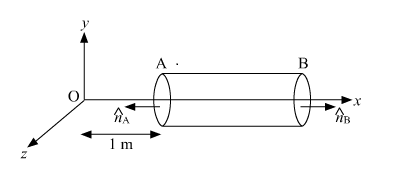
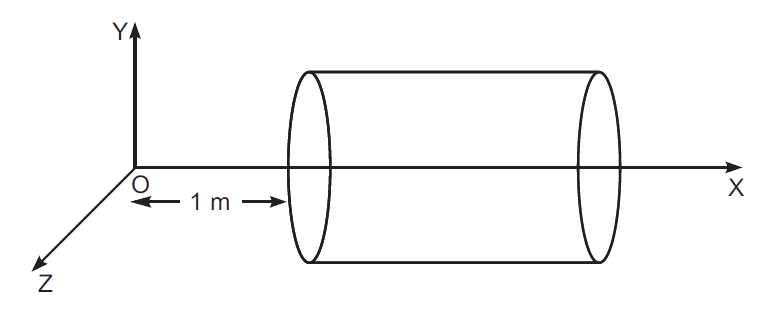
A hollow cylindrical box of length 1 m and area of cross-section $25\ cm^2$ is placed in a three dimensional coordinate system as shown in the figure. The electric field in the region is given by$\overrightarrow{\text{E}} = 50\text{x}\hat{\text{i}},$ where E is in $NC^{–1}$ and x is in metres. Find
  1. Net flux through the cylinder.
  2. Charge enclosed by the cylinder.
Answer
  1.  

Given, $\vec{E}={50}{x}\vec{i} \text{and}\bigtriangleup{s}={25}\text{C}\text{m}{^2}={25}\times{10}{^-}{^4}\text{m}{^2}$
As the electric field is only along the x-axis, so, flux will pass only through the cross-section of cylinder.
Magnitude of Electric Field at cross - section A, $\text{E}_\text{A}={50}\times{1}={50}\text{N}\text{C}{^-}{^1}$
Magnitude of Electric Field at cross - Section B, $\text{E}_\text{B}={50}\times{2}={100}\text{N}\text{C}{^-}{^1}$
The Corresponding Electric Fluxes are:
$\phi_\text{A}=\vec{\text{E}}.\bigtriangleup\vec{s}={50}\times{25}\times{10}{^-}{^4}\times\cos{180}{^0}=-{0.125}\text{N}\text{m}{^2}\text{C}{^-}{^1}$
$​​\phi_\text{B}=\vec{\text{E}}.\bigtriangleup\vec{s}={100}\times{25}\times{10}{^-}{^4}\times\cos{0}{^0}=-{0.25}\text{N}\text{m}{^2}\text{C}{^-}{^1}$
So, the net flux through the cylinder, $\phi=\phi_\text{A}+\phi_\text{B}= -{0.125} + {0.25}={0.125}\text{N}\text{m}{^2}\text{C}{^-}{^1}$
  1. Using Gauss’s law:
$\oint\vec{\text{E}}{d}\vec{\text{s}}=\frac{\text{q}}{\in_{0}}\Rightarrow{0.125}=\frac{\text{q}}{{8.85}\times{10}{^-}{^1}{^2}}$
$\Rightarrow\text{q}={8.85}\times{0.125}\times{10}{^-}{^1}{^2}={1.1}\times{10}{^-}{^1}{^2}\text{C}$
View full question & answer
Question 333 Marks
A capacitor of unknown capacitance is connected across a battery of V volts. The charge stored in it is 360 $\mu$C. When potential across the capacitor is reduced by 120 V, the charge stored in it becomes 120 $\mu$C.
Calculate:
  1. The potential V and the unknown capacitance C.
  2. What will be the charge stored in the capacitor, if the voltage applied had increased by 120 V?
Answer
  1. Initial voltage, $V_1 = V$ volts and charge stored, $Q_1 = 360\ µC.$
    $Q_1 = CV_1 …(1)$
    Changed potential, $V_2 = V − 120$
    $Q_2 = 120\ µC$
    $Q_2 = CV_2 ...(2)$
    By dividing (2) from (1), we get $\frac{\text{Q}_{1}}{\text{Q}_{2}}=\frac{\text{C}{V}_{1}}{\text{C}{V}_{2}} \Rightarrow \frac{360}{120}=\frac{\text{V}}{\text{V}-{120}}$
$\therefore {\text{C}}=\frac{\text{Q}_{1}}{\text{V}_{1}}=\frac{{360}\times{10}{^-}{^6}}{180}={2}\times{10}{^-}{^6} \text{F}={2}\mu{\text{F}}$
  1. If the voltage applied had increased by 120 V, then $\text{V}_{3}={180}+{120}={300}\text{V}.$
Hence, charge stored in the capacitor, $\text{Q}_{3}=\text{C}\text{V}_{3}={2}\times{10}{^-}{^6}\times{300}={600}\mu\text{C}.$
View full question & answer
Question 343 Marks
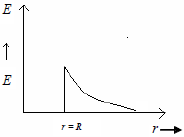
Using Gauss's law obtain the expression for the electric field due to a uniformly charged thin spherical shell of radius R at a point outside the shell. Draw a graph showing the variation of electric field with r, for r > R and r < R.
Answer

From Gauss's theorem, ${\phi = \oint\overrightarrow{\text{E}}}.\text{d}\overrightarrow{\text{S}} = \frac{\text{q}_{m}}{\varepsilon_{0}}$
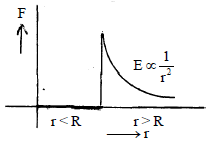
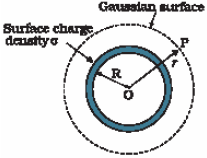
Flux $\phi$through S'.
$\phi = \oint\limits_{s'}\overrightarrow{\text{E}}.\text{d}\overrightarrow{\text{S}} = \oint\limits_{s'}\text{EdS} = \text{E}.4\pi\text{r}^{2}$
$\Rightarrow\text{E}.4\pi\text{r}^{2} = \frac{\text{q}_{m}}{\varepsilon_{0}}\Rightarrow\text{E} = \frac{1}{4\pi\varepsilon_{0}}\frac{\text{q}_{m}}{\text{r}^{2}}$
View full question & answer
Question 353 Marks
A thin conducting spherical shell of radius R has charge Q spread uniformly over its surface. Using Gauss’s law, derive an expression for an electric field at a point outside the shell.Draw a graph of electric field E(r) with distance r from the centre of the shell for $0\underline{<}\text{r}\underline{<}\infty.$
Answer
$\oint\overrightarrow{\text{E}}.\overrightarrow{\text{ds}} = \frac{\text{q}}{\varepsilon_\circ}$$\text{E}\times4\pi\text{r}^{2} =\frac{\text{Q}}{\varepsilon_\circ}$
$\text{E} = \frac{1}{4\pi\varepsilon_\circ}\frac{\text{Q}}{\text{r}^{3}}$

View full question & answer
Question 363 Marks
What is electric flux? Write its S.I. units.Using Gauss’s theorem, deduce an expression for the electric field at a point due to a uniformly charged infinite plane sheet.
Answer
Electric Flux: Total number of electric lines of force crossing a certain area normally.Alternate Answer
The surface integral of electric field over a closed surface.
Alternate Answer
$\phi = \oint\overrightarrow{\text{E}}.\text{d}\overrightarrow{\text{s}}$
  1. S.I. Units: $Nm^2 /C$ Or V-m
  1.  

Derivation: $\phi= \oint_{s}\overrightarrow{\text{E}}.\overrightarrow{\text{ds}}= \frac{\text{q}}{\varepsilon_\circ}$
$2\text{EA} =\frac{\sigma\text{A}}{\varepsilon_\circ}$
$\therefore \text{E} =\frac{\sigma}{2\varepsilon_{\circ}}$
View full question & answer
Question 373 Marks
What is the nature of electrostatic force between two point electric charges $q_1$ and $q_2$ if:
  1. $q_1 + q_2 > 0?$
  2. $q_1 + q_2 < 0?$
Answer
  1. If both $q_1$ and $q_2$ are positive, the electrostatic force between these will be repulsive.
However, if one of these charges is positive and is greater than the other negative charge, the electrostatic force between them will be attractive.

Thus, the nature of force between them can be repulsive or attractive.
  1. If both $q_1$ and $q_2$ are -ve, the force between these will be repulsive.
However, if one of them is -ve and it is greater in magnitude than the second +ve charge, the force between them will be attractive.

Thus, the nature of force between them can be repulsive or attractive.
View full question & answer
Question 383 Marks
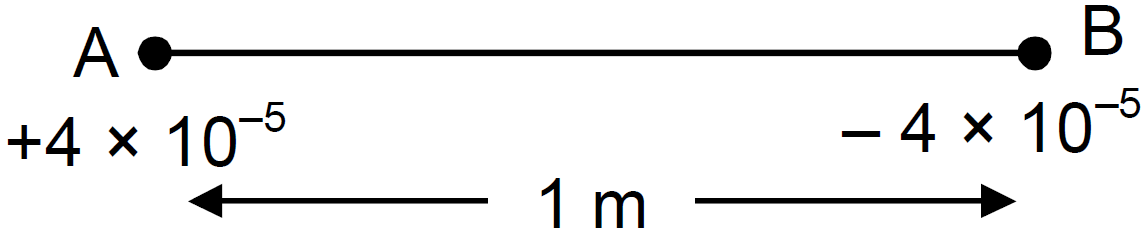
Two particles have equal masses of 5.0g each and opposite charges of $+4.0 \times 10^{-5}\ C$ and $-4.0 \times 10^{-5}C$. They are released from rest with a separation of 1.0m between them. Find the speeds of the particles when the separation is reduced to 50cm.
Answer

$\text{q}_1=\text{q}_2=4\times10^{-5}$
$\text{s}=1\text{m},\ \text{m}=5\text{g}$
$=0.005\text{kg}$
$\text{F}=\text{K}\frac{\text{q}^2}{\text{r}^2}$
$=\frac{9\times10^9\times\big(4\times10^{-5}\big)^2}{1^2}$
$=14.4\text{N}$
Acceleration ‘a’ $=\frac{\text{F}}{\text{m}}$
$=\frac{14.4}{0.005}$
$=2880\text{m/s}^2$
Now, $\text{u}=0,$
$\text{s}=50\text{cm}=0.5\text{m}$
$\text{a}=2880\text{m/s}^2,\ \text{V}=?$
$\Rightarrow\text{V}=\sqrt{2880}$
$=53.66\text{m/s}\approx54\text{m/s}$ for each particle.
View full question & answer
Question 393 Marks
Two isolated metal spheres A and B have radii R and 2R respectively, and same charge q. Find which of the two spheres have greater energy density just outside the surface of the spheres.
Answer
Energy density,$\text{U}=\frac{1}{2}\in_0\text{E}^2$
But, $\text{E}=\frac{\sigma}{\in_0}=\frac{\text{Q}}{\text{A}\in_0}$$\therefore\ \text{U}=\frac{1}{2}\frac{\in_0\text{Q}^2}{\text{A}^2\in_0}\ \Rightarrow\ \text{U}=\frac{\text{Q}^2}{2\text{A}^2}$
$\Rightarrow\ \text{U}\propto\frac{1}{\text{A}^2}\ \Rightarrow\ \text{U}_\text{A}>\text{U}_\text{B}$
View full question & answer
Question 403 Marks
It is said that any charge given to a conductor comes to its surface. Should all the protons come to the surface? Should all the electrons come to the surface? Should all the free electrons come to the surface?
Answer
Protons never take part in any electrical phenomena because they are inside the nuclei and are not able to interact easily. These are the free electrons that are responsible for all electrical phenomena. So, if a conductor is given a negative charge, the free electrons come to the surface of the conductor. If the conductor is given a positive charge, electrons move away from the surface and leave a positive charge on the surface of the conductor.
View full question & answer
Question 413 Marks
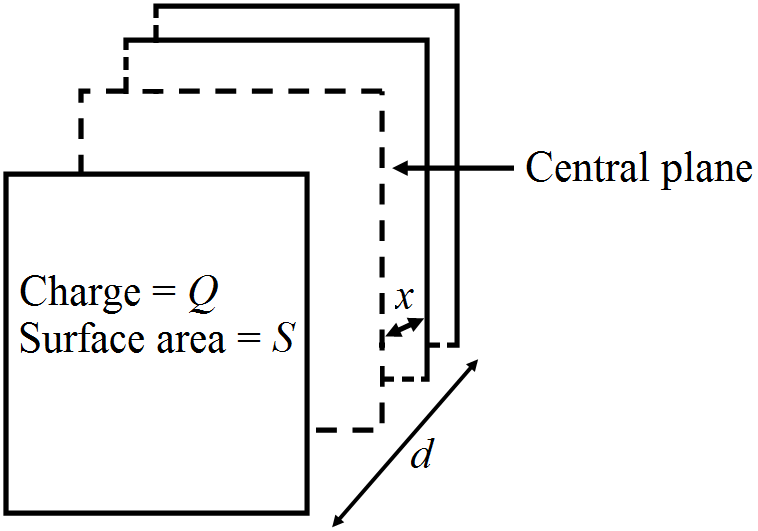
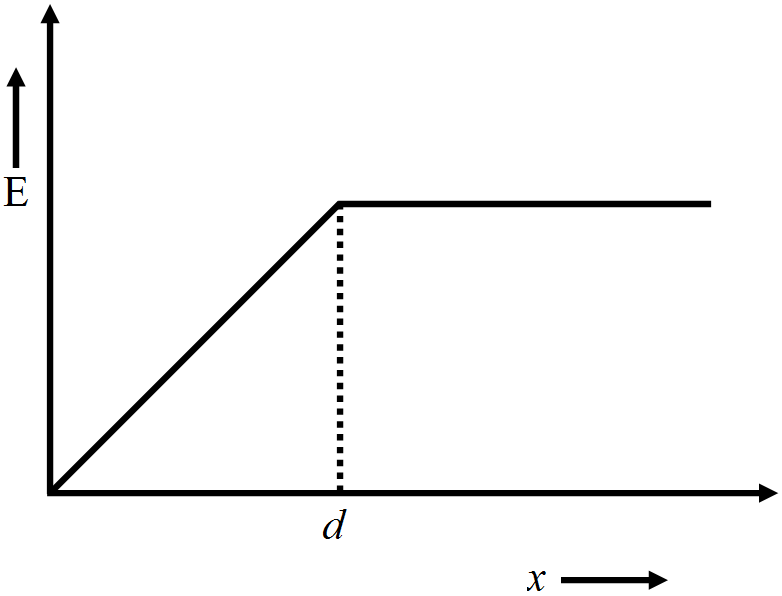
A nonconducting sheet of large surface area and thickness d contains uniform charge distribution of density $\rho.$ Find the electric field at a point P inside the plate, at a distance x from the central plane. Draw a qualitative graph of E against x for 0 < x < d.
Answer
Given: Thickness of the sheet = d Let the surface area of the sheet be s. Volume of the sheet = sd Volume charge density of the sheet, $\rho=\frac{\text{Q}}{\text{sd}}$ Charge on the sheet = Q
Consider an imaginary plane at a distance x from the central plane of surface area s. Charge enclosed by this sheet, $\text{q}=\rho\text{sx}$ For this Guassian surface, using Gauss's Law,we get:$\oint\text{E.ds}=\frac{\text{q}}{\in_0}$
$\text{E}.\text{s}=\frac{\rho\text{sx}}{\in_0}$
$\text{E}=\frac{\rho\text{x}}{\in_0}$
The electric field outside the sheet will be constant and will be:$\text{E}=\frac{\rho\text{d}}{\in_0}$
View full question & answer
Question 423 Marks
A charge Q is uniformly distributed over a rod of length l. Consider a hypothetical cube of edge l with the centre of the cube at one end of the rod. Find the minimum possible flux of the electric field through the entire surface of the cube.
Answer
Given: Total charge on the rod = Q The length of the rod = edge of the hypothetical cube = l Portion of the rod lying inside the cube, $\text{x}=\frac{\text{l}}2{}$ Linear charge density for the rod $=\frac{\text{Q}}{\text{l}}$ Using Gauss's theorem, flux through the hypothetical cube,$\phi=\Big(\frac{\text{Q}_{\text{in}}}{\in_0}\Big),$ where $Q_{in}=$ charge enclosed inside the cube
Here, charge per unit length of the rod $=\frac{\text{Q}}{\text{l}}$ Charge enclosed, $\text{Q}_{\text{in}}=\frac{\text{Q}}{\text{l}}\times\frac{\text{l}}{2}=\frac{\text{Q}}{2}$ Therefore,$\phi=\frac{\frac{\text{Q}}{2}}{\in_0}=\frac{\text{Q}}{2\in_0}$
View full question & answer
Question 433 Marks
Assume that each atom in a copper wire contributes one free electron. Estimate the number of free electrons in a copper wire having a mass of $6.4g$ (take the atomic weight of copper to be $64g$ mol$^{-1}.$
Answer
64 grams of copper have 1 mole
6.4 grams of copper have 0.1 mole
1 mole = No atoms
0.1 mole = (no × 0.1) atoms
$= 6 \times 10^{23}\times 0.1$ atoms $= 6 \times 10^{22}$ atoms
1 atom contributes 1 electron
$6 \times 10^{22}$ atoms contributes $6 \times 10^{22}$ electrons.
View full question & answer
Question 443 Marks
A charge of 1.0C is placed at the top of your college building and another equal charge at the top of your house. Take the separation between the two charges to be 2.0km. Find the force exerted by the charges on each other. How many times of your weight is this force?
Answer
Given:$\text{q}_1=\text{q}_2=\text{q}=1.0\text{C}$
Distance between the charges, $\text{r}=2\text{km}=2\times10^3\text{m}$ By Coulomb's Law, electrostatic force,$\text{F}=\frac{1}{4\pi\in_0}\frac{\text{q}_1\text{q}_2}{\text{r}^2}$
$\text{F}=9\times10^9\times\frac{1\times1}{(2\times10^3)^2}$
$=2.25\times10^3\text{N}$
Let my mass, m, be 50kg. Weight of my body, W = mg$\Rightarrow\text{W}=50\times10\text{N}=500\text{N}$
Now,$\frac{\text{Weight of my body}}{\text{Force between the charges}}=\frac{500}{2.25\times10^3}$
$=\frac{1}{4.5}$
So, the force between the charges is 4.5 times the weight of my body.
View full question & answer
Question 453 Marks
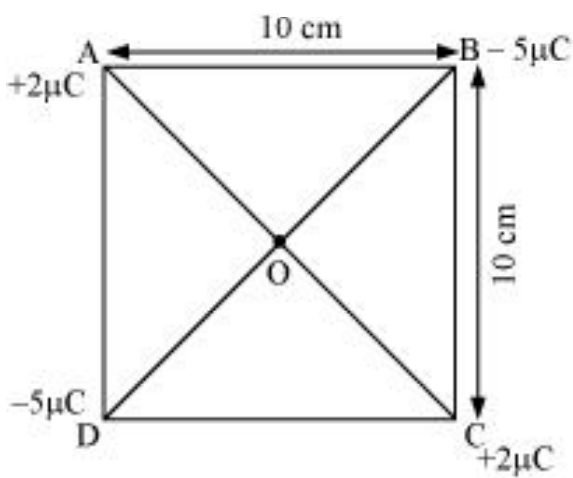
Four point charges $q_A = 2 \mu\ C, q_B = –5 \mu\ C, q_C = 2 \mu\ C,$ and $q_D = –5 \mu\ C$ are located at the corners of a square ABCD of side 10 cm. What is the force on a charge of 1 μC placed at the centre of the square?
Answer
The given figure shows a square of side 10 cm with four charges placed at its corners. O is the centre of the square.
Where,
(Sides) AB = BC = CD = AD cm
(Diagonals) AC = BD $=10\sqrt{2}$ cm
AO = OC = DO = OB cm $5\sqrt{2}$ cm
A charge of amount 1µ C is placed at point O.
Force of repulsion between charges placed at corner A and centre O is equal in magnitude but opposite in direction relative to the force of repulsion between the charges placed at corner C and centre O. Hence, they will cancel each other. Similarly, force of attraction between charges placed at corner B and centre O is equal in magnitude but opposite in direction relative to the force of attraction between the charges placed at corner D and centre O. Hence, they will also cancel each other. Therefore, net force caused by the four charges placed at the corner of the square on 1µ C charge at centre O is zero.
View full question & answer
Question 463 Marks
A water particle of mass 10.0mg and having a charge of $1.50 \times 10^{-6}C$ stays suspended in a room. What is the magnitude of electric field in the room? What is its direction?
Answer


$\text{m}=10,\ \text{mg}=10\times10^{-3}\text{g}\times10^{-3}\text{kg},$
$\text{q}=1.5\times10^{-6}\text{C}$
But $\text{qE}=\text{mg}$
$\Rightarrow(1.5\times10^{-6})\text{E}=10\times10^{-6}\times10$
$\Rightarrow\text{E}=\frac{10\times10^{-4}\times10}{1.5\times10^{-6}}$
$=\frac{100}{1.5}=66.6\text{N/C}$
$=\frac{100\times10^3}{1.5}=\frac{10^{5+1}}{15}$
$=6.6\times10^{3}$
View full question & answer
Question 473 Marks
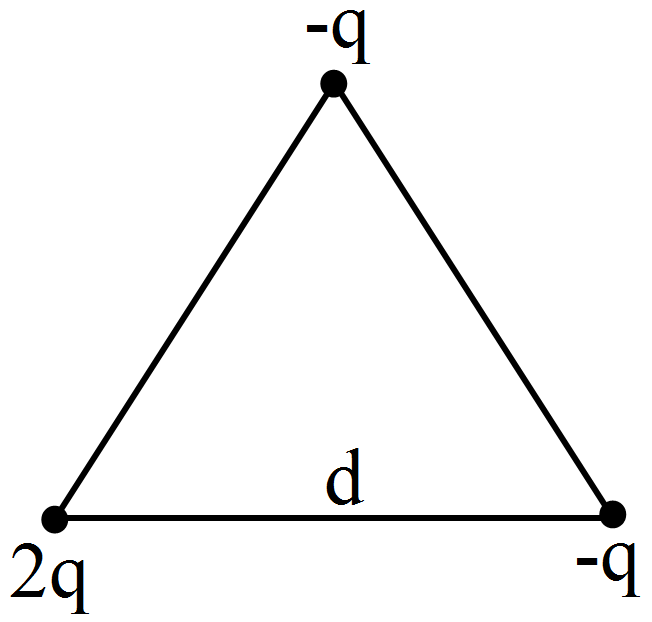
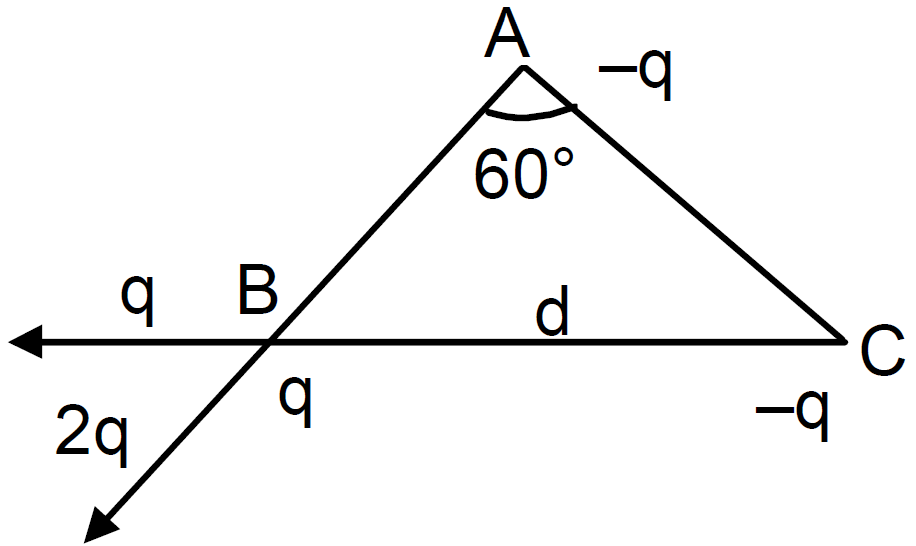
Three charges are arranged on the vertices of an equilateral triangle as shown in figure. Find the dipole moment of the combination.
Answer

Let -q & -q are placed at A & C
Where 2q on B
So length of A = d
So the dipole moment = (q × d) = P
So, Resultant dipole moment
$\text{P}=\Big[(\text{qd})^2+(\text{qd})^2+2\text{qd}\times\text{qd}\cos60^\circ\Big]^{\frac{1}{2}}$
$=\big[3\text{q}^2\text{d}^2\big]^{\frac{1}{2}}$
$=\sqrt{3}\text{qd}$
$=\sqrt{3}\text{p}$
View full question & answer
Question 483 Marks
Suppose an attractive nuclear force acts between two protons which may be written as $\text{F}=\text{Ce}^{-\text{kr}}/\text{r}^2.$
  1. Write down the dimensional formulae and appropriate SI units of C and k.
  2. Suppose that $k = 1$ fermi$^{-1}$ and that the repulsive electric force between the protons is just balanced by the attractive nuclear force when the separation is 5 fermi. Find the value of C.
Answer
Expression of electrical force $\text{F}=\text{C}\times\text{e}^{\frac{-\text{kr}}{\text{r}^2}}$ Since $e^{-kr}$ is a pure number.
So, dimensional formulae of $\text{F}=\frac{\text{dimensional formulae of C}}{\text{dimensional formulae of r}^2}$
Or, $\big[\text{MLT}^{-2}\big]\big[\text{L}^2\big]=$ dimensional formulae of $\text{C}=\big[\text{ML}^3\text{T}^{-2}\big]$
Unit of C = unit of force × unit of $r^2 =$
Newton $\times m^2 =$ Newton-$m^2$
Since -kr is a number hence dimensional formulae of$\text{k}=\frac{1}{\text{dim entional formulae of r}}=\big[\text{L}^{-1}\big]$ Unit of
$k = m^{-1}$​​​​​​​
View full question & answer
Question 493 Marks
Two equal charges are placed at a separation of 1.0m. What should be the magnitude of the charges so that the force between them equals the weight of a 50kg person?
Answer
Let the magnitude of each charge be Separation between them, r = 1m Force between them, F = 50 × 9.8 = 490N By Coulomb's Law force,$\text{F}=\frac{1}{4\pi\in_0}\frac{\text{q}_1\text{q}_2}{\text{r}^2}$
$\Rightarrow490=9\times10^9\times\frac{\text{q}^2}{1^2}$
$\Rightarrow\text{q}^2=54.4\times10^{-9}$
$\Rightarrow\text{q}=\sqrt{54.4\times10^{-9}}$
$=23.323\times10^{-5}\text{C}$
$\text{q}=2.3\times10^{-4}\text{C}$
View full question & answer
Question 503 Marks
Find the speed of the electron in the ground state of a hydrogen atom. The description of ground state is given in the previous problem.
Answer
Fe from previous problem No. $18=8.2\times10^{-8}\text{N},\ \text{Ve}=?$ Now, $\text{M}_\text{e}=9.12\times10^{31}\text{kg},\ \text{r}=0.53\times10^{-10}\text{m}$ Now, $\text{Fe}=\frac{\text{M}_\text{e}\text{v}^2}{\text{r}}$$\Rightarrow\text{v}^2=\frac{\text{Fe}\times\text{r}}{\text{m}_\text{e}}$
$=\frac{8.2\times10^{-8}\times0.53\times10^{-10}}{9.1\times10^{-31}}$
$=0.4775\times10^{13}$
$=4.775\times10^{12}\text{m}^2/\text{s}^2$
$\text{v}=2.18\times10^6\text{m/s}$
View full question & answer
3 Marks Question - Physics STD 12 Science Questions - Vidyadip