Questions · Page 2 of 2

3 Marks Question

Question 513 Marks
The kinetic energy of a charged particle decreases by 10J as it moves from a point at potential 100V to a point at potential 200V. Find the charge on the particle.
Answer
K.C. decreases by 10J. Potential = 100v to 200v. So, change in K.E = amount of work done$\Rightarrow10\text{J}=(200-100)\text{v}\times\text{q}_0$
$\Rightarrow100\text{q}_0=10\text{v}$
$\Rightarrow\text{q}_0=\frac{10}{100}$
$=0.1\text{C}$
View full question & answer
Question 523 Marks
Two insulating small spheres are rubbed against each other and placed 1cm apart. If they attract each other with a force of 0.1N, how many electrons were transferred from one sphere to the other dunng rubbing?
Answer
$\text{F}=0.1\text{N}$$\text{r}=1\text{cm}=10^{-2}$ (As they rubbed with each other. So the charge on each sphere are equal)
So, $\text{F}=\frac{\text{kq}_1\text{q}_2}{\text{r}^2}$
$\Rightarrow0.1=\frac{\text{kq}^2}{(10^{-2})^2}$
$\Rightarrow\text{q}^2=\frac{0.1\times10^{-4}}{9\times10^9}$
$\Rightarrow\text{q}^2=\frac{1}{9}\times10^{-14}$
$\Rightarrow\text{q}=\frac{1}{3}\times10^{-7}$
$1.6\times10^{-19}\text{c}$ Carries by 1 electron
1 c carried by $\frac{1}{1.6\times10^{-19}}$
$0.33\times10^{-7}$ c carries by
$\frac{1}{1.6\times10^{-19}} \times0.33\times10^{-7}$
$=0.208\times10^{12}$
$=2.08\times10^{11}$
View full question & answer
Question 533 Marks
The number of electrons in an insulator is of the same order as the number of electrons in a conductor. What is then the basic difference between a conductor and an insulator?
Answer
The outer electrons of an atom or molecule in a conductor are only weakly bound to it and are free to move throughout the body of the material.
On the other hand, in insulators, the electrons are tightly bound to their respective atoms and cannot leave their parent atoms and move through a long distance.
View full question & answer
Question 543 Marks
Estimate the number of electrons in 100g of water. How much is the total negative charge on these electrons?
Answer
Molecular mass of water = 18g Number of molecules in $18g$ of $H_2O$
= Avogadro's number $= 6.023 \times 10^{23}$​​​​​​​
Number of electrons in 1 molecule of $H_2O = (2 \times 1) + 8 = 10$
Number of electrons in $6.023 \times 10^{23}$ molecules of $H_2O = 6.023 \times 10^{24}​​​​​​​$​​​​​​​
That is, number of electrons in $18g$ of $H_2O = 6.023 \times 10^{24}​​​​​​​$​​​​​​​
So, number of electrons in $100g$ of $H_2O$
$=\frac{6.023\times10^{24}}{18}\times100$$=3.34\times10^{25}$
$\therefore$ Total charge $=3.34\times10^{25}\times1.6\times10^{-19}$
$=5.34\times10^6\text{C}$
View full question & answer
Question 553 Marks
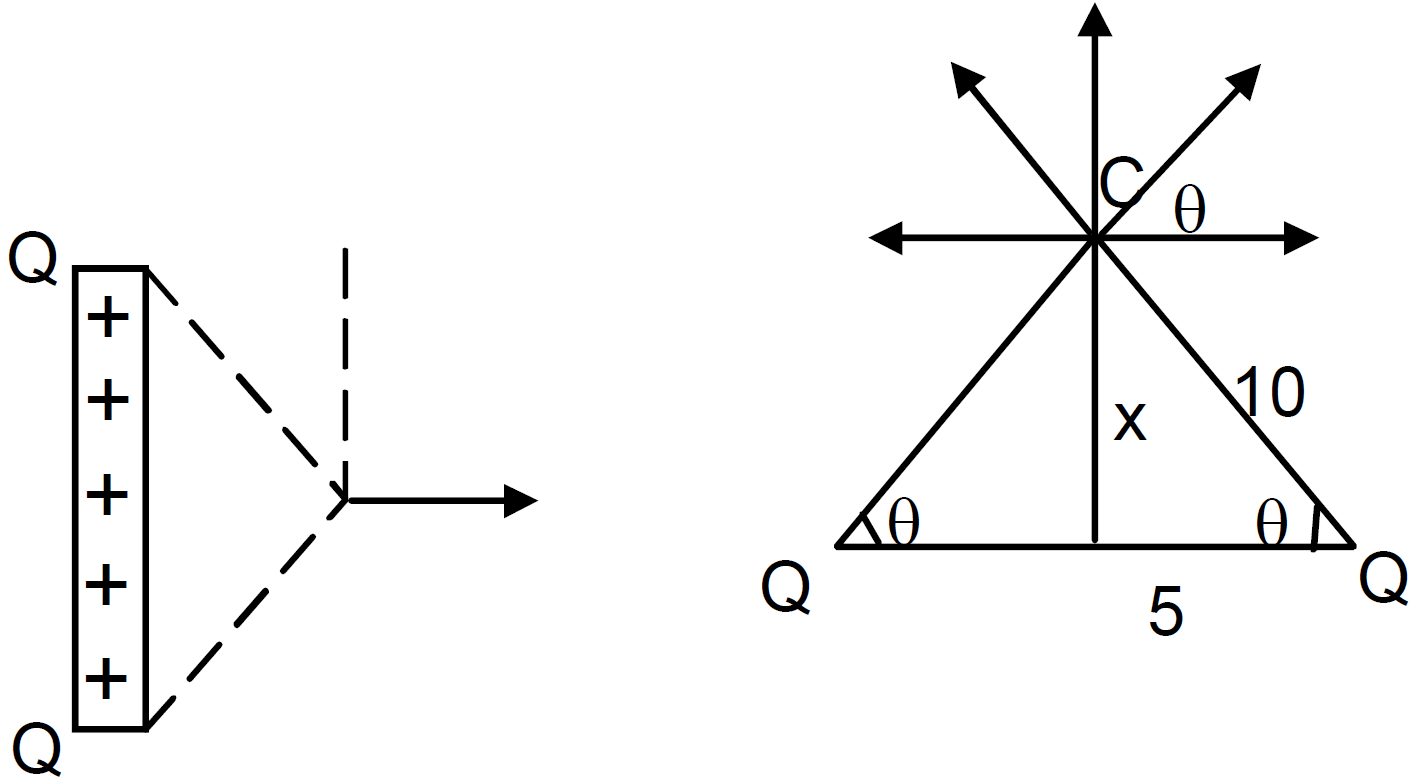
A 10cm long rod carries a charge of $+50\mu\text{C}$ distributed uniformly along its length. Find the magnitude of the electric field at a point 10cm from both the ends of the rod.
Answer

$\text{G}=50\mu\text{C}=50\times10^{-6}\text{C}$

We have, $\text{E}=\frac{2\text{KQ}}{\text{r}}$ for a charged cylinder
$\Rightarrow\text{E}=\frac{2\times9\times10^9\times50\times10^{-6}}{5\sqrt{3}}$
$=\frac{9\times10^{-5}}{5\sqrt{3}}$
$=1.03\times10^{-5}$
View full question & answer
Question 563 Marks
Does the force on a charge due to another charge depend on the charges present nearby?
Answer
Coulomb's Law states that the force between two charged particle is given by,$\text{F}=\frac{\text{q}_1\text{q}_2}{4\pi\in_0\text{r}^2}$
Where, $q_1$ and $q_2$ are the charges on the charged particles . r = separation between the charged particles.$\in_0$ = parmittivity of free space.
According to the Law of Superposition, the electrostatic force between two charged particles are unaffected due to the presence of other charges.
View full question & answer
Question 573 Marks
Two identical particles, each having a charge of $2.0 \times 10^{-4}C$ and mass of 10g, are kept at a separation of 10cm and then released. What would be the speeds of the particles when the separation becomes large?
Answer

$\text{m}=10\text{g}$
$\text{F}=\frac{\text{KQ}}{\text{r}}$
$=\frac{9\times10^9\times2\times10^{-4}}{10\times10^{-2}}$
$\text{F}=1.8\times10^{-7}$
$\text{F}=\text{m}\times\text{a}$
$\Rightarrow\text{a}=\frac{1.8\times10^{-7}}{10\times10^{-3}}$
$=1.8\times10^{-3}\text{m/s}^2$
$\text{V}^2-\text{u}^2=2\text{as}$
$\Rightarrow\text{V}^2=\text{u}^2+2\text{as}$
$\text{V}=\sqrt{0+2\times1.8\times10^{-3}\times10\times10^{-2}}$
$=\sqrt{3.6\times10^{-4}}$
$=0.6\times10^{-2}$
$=6\times10^{-3}\text{,m/s}.$
View full question & answer
Question 583 Marks
A charged particle having a charge of $-2.0 \times 10^{-6}C$ is placed close to a nonconducting plate having a surface charge density $4.0 \times 10^{-5}Cm^{-2}$. Find the force of attraction between the particle and the plate.
Answer
The electric field due to a conducting thin sheet,$\text{E}=\frac{\sigma}{2\in_0}$
The magnitude of attractive force between the particle and the plate,$\text{F}=\text{qE}$
$\text{F}=\frac{\text{q}\times\sigma}{2\in_0}$
$\text{F}=\frac{\big(2.0\times10^{-6}\big)\times\big(4.0\times10^{-6}\big)}{2\times\big(8.85\times10^{-12}\big)}$
$\text{F}=0.45\text{N}$
View full question & answer
Question 593 Marks
A hollow charged conductor has a tiny hole cut into its surface. Show that the electric field in the hole is $(\sigma /2ε_0)$ $\hat{\text{n}}$ , where $\hat{\text{n}}$ is the unit vector in the outward normal direction, and σ is the surface charge density near the hole.
Answer
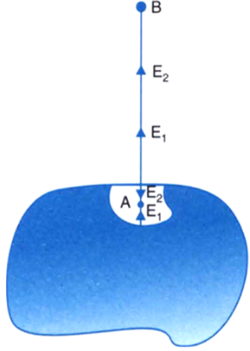
Let us take a charged conductor with the hole filled up, as shown by shaded portion in the figure.

We find with the application of Gaussian theorem that field inside is zero and just outside is $\frac{\sigma}{\in_0}\hat{\text{n}}.$ This field can be viewed as the superposition of the field $E_2$ due to the filled up hole plus the field $ E_1$ due to the rest of the charged conductor. The two fields $(E_1$ and $E_2)$ must be equal and opposite as the field vanishes inside the conductor. Thus, $E_1 - E_2 = 0$ Now, the field outside the conductor is given by$\text{E}_1+\text{E}_2=\frac{\sigma}{\in_0}$
$\therefore \ 2\ \text{E}_1=\frac{\sigma}{\in_0}$
$\Rightarrow\ \text{E}_1=\frac{\sigma}{2\in_0}$
Therefore, field in the hole (due to the rest of the conductor) is given as:$\text{E}_1=\frac{\sigma}{2\in_0}\hat{\text{n}}$ ($\hat{\text{n}}$ → unit vector in the outward normal direction)
View full question & answer
Question 603 Marks
Three equal charges, $2.0 \times 10^{-6}C$ each, are held fixed at the three corners of an equilateral triangle of side 5cm. Find the Coulomb force experienced by one of the charges due to the rest two.
Answer


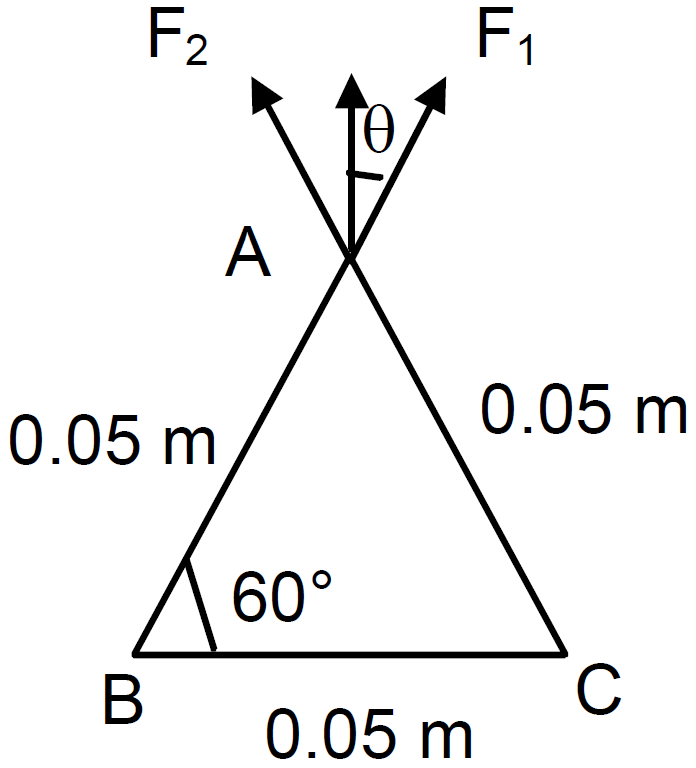
Three charges are held at three corners of a equilateral trangle.
Let the charges be A, B and C.
It is of length 5cm or 0.05m
Force exerted by B on A $= F_1$
Force exerted by C on A $= F_2$
So, force exerted on A = resultant $F_1 = F_2$
$\Rightarrow\text{F}=\frac{\text{kq}_2}{\text{r}^2}$
$=\frac{9\times10^9\times2\times2\times2\times10^{-12}}{5\times5\times10^{-4}}$
$=\frac{36}{25}\times10$
$=14.4$
Now, force on $A = 2 × F$ cos $30^\circ$ since it is equilateral $\triangle.$
$⇒ $Force on $\text{A}=2\times1.44\times\sqrt{\frac{3}{2}}$
$=24.94\text{N}.$
View full question & answer
Question 613 Marks
When a charged comb is brought near a small piece of paper, it attracts the piece. Does the paper become charged when the comb is brought near it?
Answer
When a charged comb is brought near a small piece of paper, it attracts the piece due to induction. There's a distribution of charges on the paper. When a charged comb is brought near the pieces of paper then an opposite charge is induced on the near end of the pieces of paper so the charged comb attracts the opposite charge on the near end of paper and similar on the farther end. The net charge on the paper remains zero.
View full question & answer
Question 623 Marks
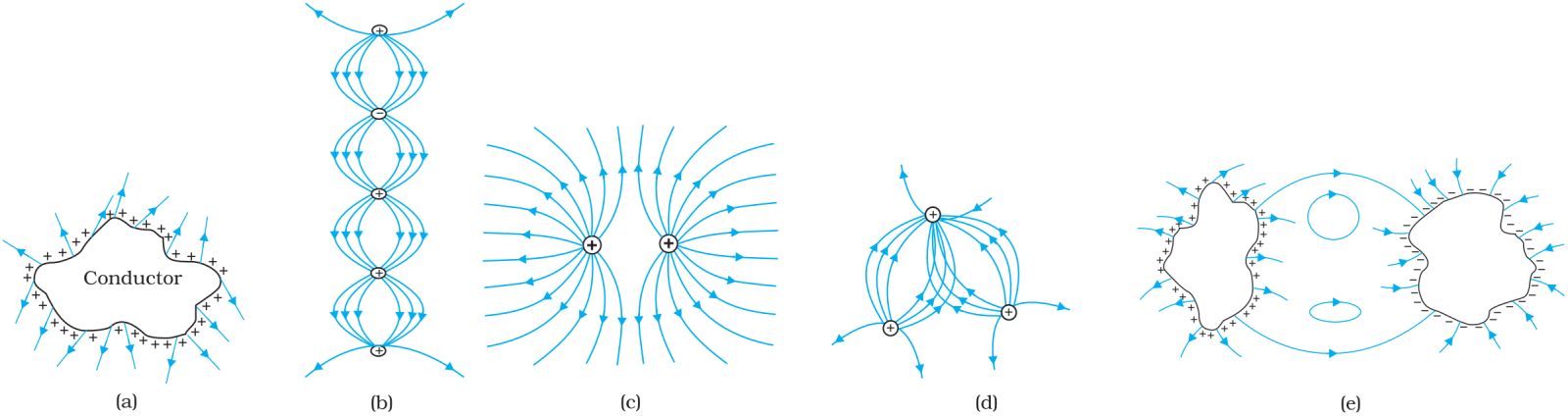
Which among the curves shown in figure cannot possibly represent electrostatic field lines?
Answer
  1. Field lines are wrongly drawn because electric field lines must be normal to the surface of the conductor at each point.
  2. Field lines are wrongly drawn because field lines cannot start from a negative charge.
  3. Field lines are correctly drawn, because they are originating from a positive charge.
  4. Field lines are wrongly drawn as the field lines cannot intersect.
  5. Field lines are wrongly drawn because they cannot form closed loops.
View full question & answer
Question 633 Marks
A spherical shell made of plastic, contains a charge Q distributed uniformly over its surface. What is the electric field inside the shell? If the shell is hammered to deshape it without altering the charge, will the field inside be changed? What happens if the shell is made of a metal?
Answer
As the shell is made of plastic, it is non-conducting. But as the charge is distributed uniformly over the surface of the shell, the sum of all the electric field vectors at the centre due to this kind of distribution is zero. But when the plastic shell is deformed, the distribution of charge on it becomes non-uniform. In other words, the sum of all the electric field vectors is non-zero now or the electric field exists at the centre now.
In case of a deformed conductor, the field inside is always zero.
View full question & answer
Question 643 Marks
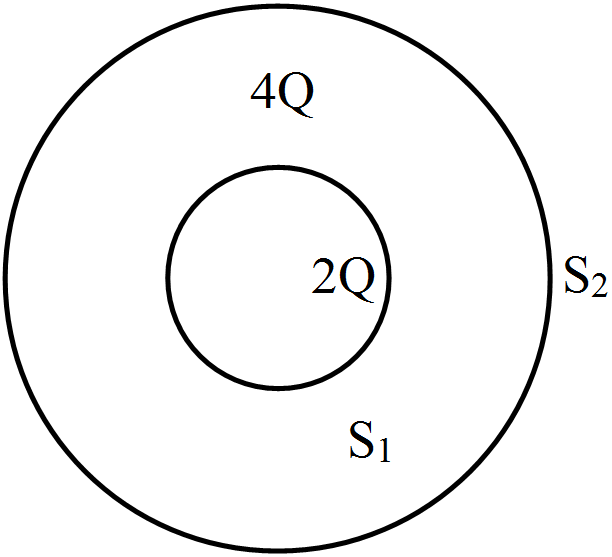
Consider two hollow concentric spheres, $S_1$ and $S_2$, enclosing charges 2Q and 4Q respectively as shown in the figure.
  1. Find out the ratio of the electric flux through them.
  2. How will the electric flux through the sphere $S_1$ change if a medium of dielectric constant $'\in_\text{r}'$ is introduced in the space inside $S_1$ in place of air? Deduce the necessary expression.
Answer
Using Gauss's Theorem $\oint\vec{\text{E}}.\vec{\text{ds}}=\frac{\text{q(T)}}{\in_0}$Electric flux through sphere $S_1,$ $\Phi_1=\frac{2(\text{Q})}{\in_0}$
Electric flux through sphere $S_2,  \Phi=\frac{(2\text{Q}+4\text{Q})}{\in_0}=\frac{6\text{Q}}{\in_0}$
$\text{Ratio}=\frac{\Phi_1}{\Phi}=\frac{\frac{2\text{Q}}{\in_0}}{\frac{6\text{Q}}{\in_0}}=\frac{1}{3}$
If a medium of dielectric constant $\text{K}(=\in_\text{r})$ is filled in the sphere $S_1$​​​​​​​, electric flux through sphere,
$\Phi'_1=\frac{2\text{Q}}{\in_\text{r}\in_0}=\frac{2\text{Q}}{\text{K}\in_0}.$
View full question & answer
Question 653 Marks
Two identically charged particles are fastened to the two ends of a spring of spring constant $100\ Nm^{-1}$ and natural length 10cm. The system rests on a smooth horizontal table. If the charge on each particle is $2.0 \times 10^{-8}C$, find the extension in the length of the spring. Assume that the extension is small as compared to the natural length. Justify this assumption after you solve the problem.
Answer
$\text{K}=100\text{N/m},\ \ell=10\text{cm}=10^{-1}\text{m}$$\text{q}=2.0\times10^{-8}\text{c},\ \text{Find}\ell=?$

Force between them $\text{F}=\frac{\text{kq}_1\text{q}_2}{\text{r}^2}$
$=\frac{9\times10^92\times10^{-8}\times2\times10^{-8}}{10^{-2}}$
$=36\times10^{-5}\text{N}$
So, $\text{F}=-\text{kx}$ or $\text{x}=\frac{\text{F}}{-\text{K}}$
$=\frac{36\times10^{-5}}{100}$
$=36\times10^{-7}\text{cm}$
$=3.6\times10^{-6}\text{m}$
View full question & answer
Question 663 Marks
A spherical volume contains a uniformly distributed charge of density $2.0 \times 10^{-4}Cm^{-3}.$ Find the electric field at a point inside the volume at a distance 4.0cm from the centre.
Answer
Given : Volume charge density, $\rho=2\times10^{-4}\text{C/m}^3$ Let us assume a concentric spherical surface inside the given sphere with radius $= 4cm = 4 \times 10^{-2}m$ The charge enclosed in the spherical surface assumed can be found by multiplying the volume charge density with the volume of the sphere. Thus,$\text{q}=\rho\times\frac{4}3{}\pi\text{r}^3$
$\Rightarrow\text{q}=\big(2\times10^{-4}\big)\times\frac{4}{3}\pi\text{r}^3$
The net flux through the spherical surface,$\phi=\frac{\text{q}}{\in_0}$
The surface area of the spherical surface of radius r cm:$\text{A}=4\pi\text{r}^2$
Electric field,$\text{E}=\frac{\text{q}}{\in_0\times\text{A}}$
$\text{E}=\frac{2\times10^{-4}\times4\pi\text{r}^3}{\in_0\times3\times4\pi\text{r}^2}$
$\text{E}=\frac{2\times10^{-4}\times\text{r}}{3\times\in_0\times}$
The electric field at the point inside the volume at a distance 4.0cm from the centre,$\text{E}=\frac{(2\times10^{-4})\times(4\times10^{-2})}{3\times(8.85\times10^{-12})}\text{N/C}$
$\text{E}=3.0\times10^{5}\text{N/C}$
View full question & answer
Question 673 Marks
If a charge is placed at rest in an electric field, will its path be along a line of force? Discuss the situation when the lines of force are straight and when they are curved.
Answer
If a charge is placed at rest in an electric field, its path will be tangential to the lines of force. When the electric field lines are straight lines then the tangent to them will coincide with the electric field lines so the charge will move along them only. When the lines of force are curved, the charge moves along the tangent to them.
View full question & answer
Question 683 Marks
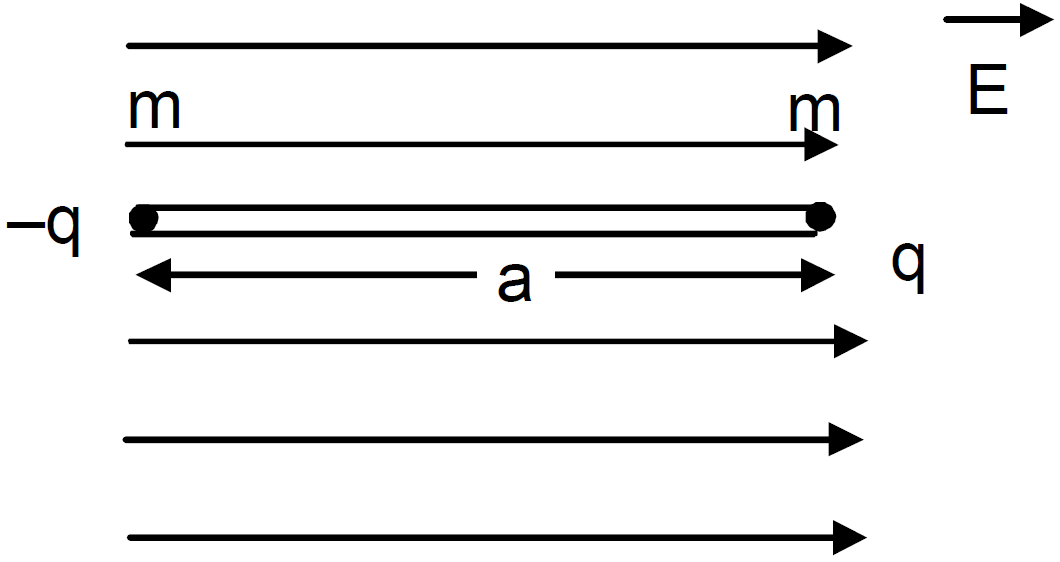
Two particles, carrying charges -q and +q and having equal masses m each, are fixed at the ends of a light rod of length a to form a dipole. The rod is clamped at an end and is placed in a uniform electric field E with the axis of the dipole along the electric field. The rod is slightly tilted and then released. Neglecting gravity find the time period of small oscillations.
Answer
Consider the rod to be a simple pendulum. For simple pendulum, $\text{T}=2\pi\sqrt{\frac{\ell}{\text{g}}}$ $\big(\ell=$ length, q = acceleration$\big)$

Now, force experienced by the charges F = Eq Now, acceleration $=\frac{\text{F}}{\text{m}}$$=\frac{\text{Eq}}{\text{m}}$
Hence length = a so, Time period $=2\pi\sqrt{\frac{\text{a}}{\Big(\frac{\text{Eq}}{\text{m}}\Big)}}$$=2\pi\sqrt{\frac{\text{ma}}{\text{Eq}}}$
View full question & answer
Question 693 Marks
Given a uniformly charged plane/sheet of surface charge density, $\sigma=2\times10^{17}\text{C/m}^2.$Image
  1. Find the electric field intensity at a point A, 5mm away from the sheet on the left side.
  2. Given a straight line with three points X, Y and Z placed 50cm away from the charged sheet on the right side. At which of these points, the field due to the sheet remain the same as that of point A and why?
Answer
  1. At A, $\text{E}=\frac{\sigma}{2\in_0}=\frac{2\times10^{17}\text{Cm}^{-2}}{2\times8.854\times10^{-12}\text{C}^2\text{N}^{-1}\text{m}^{-2}}$
$\text{E}=1.1\times1028 \text{N/C}$

Directed away from the sheet.
  1. Point Y, Because at 50cm, the charge sheet acts as a finite sheet and thus the magnitude remains same towards the middle region of the planar sheet.
View full question & answer
Question 703 Marks
Two particles A and B having charges of $+2.00 \times 10^{-6}C$ and of $-4.00 \times 10^{-6}C$ respectively are held fixed at a separation of 20.0cm. Locate the point(s) on the line AB where
  1. The electric field is zero.
  2. The electric potential is zero.
Answer
$\text{q}_2=2\times10^{-6}\text{C},\ \text{q}_1^2=-4\times10^{-6}\text{C},$$\text{r}=20\text{cm}=0.2\text{m}$
$(E_1 =$ electric field due to $q_1, E_2 =$ electric field due to $q_2)$
$\Rightarrow\frac{(\text{r}-\text{x})^2}{\text{x}^2}=\frac{-\text{q}_2}{\text{q}_1}\Rightarrow\frac{(\text{r}-1)^2}{\text{x}}=\frac{-\text{q}_2}{\text{q}_1}$
$=\frac{4\times10^{-6}}{2\times10^{-6}}=\frac{1}{2}$
$\Rightarrow\Big(\frac{\text{r}}{\text{x}}-1\Big)=\frac{1}{\sqrt{2}}$
$=\frac{1}{1.414}$
$\Rightarrow\frac{\text{r}}{\text{x}}=1.414+1$
$=2.414$
$\Rightarrow\text{x}=\frac{\text{r}}{2.414}$
$=\frac{20}{2.414}$
$=8.285\text{cm}$
View full question & answer
Question 713 Marks
Define electric field intensity. Write its SI unit. Write the magnitude and direction of electric field intensity due to an electric dipole of length 2a at the midpoint of the line joining the two charges.
Answer
Electric Field Intensity: The electric field intensity at any point in an electric field is defined as the electric force per unit positive test charge placed at that point i.e.,$\vec{\text{E}}=\lim\limits_{\text{q}_0\rightarrow0}\frac{\vec{\text{F}}}{\text{q}_0}$
The test charge q0 has to be vanishingly small so that it does not affect the electric field of the main charge. The SI unit of electric field intensity is newton/ coulomb.
Electric Field Strength at mid-point of dipole: The electric field strength at mid-point C due to charge +q is -q along the same direction.
$E = E_1 + E_2=\frac{1}{4\pi\in_0}\frac{\text{q}}{\text{a}^2}+\frac{1}{4\pi\in_0}\frac{\text{q}}{\text{a}^2}=\frac{1}{4\pi\in_0}\frac{2\text{q}}{\text{a}^2}$
Its direction is from +q to -q.
View full question & answer
Question 723 Marks
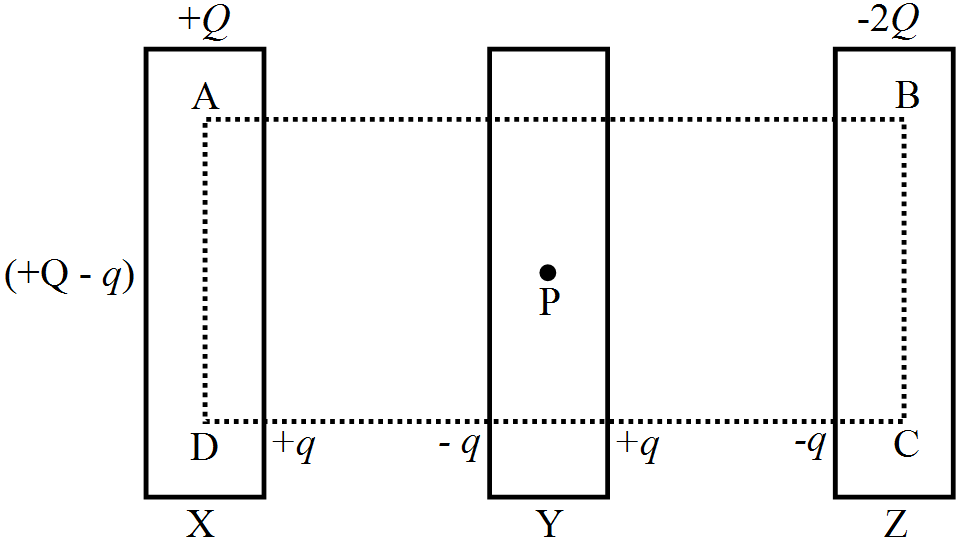
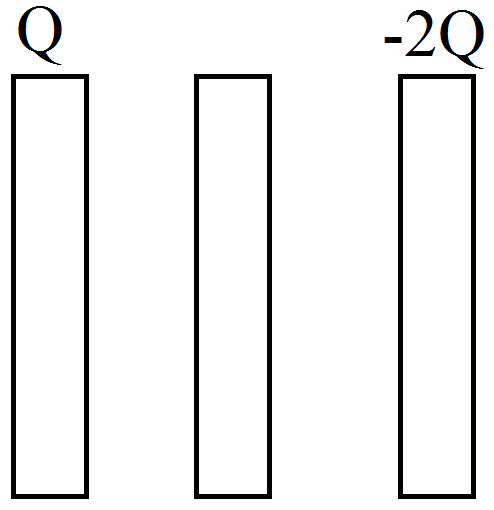
Three identical metal plates with large surface areas are kept parallel to each other as shown in figure. The leftmost plate is given a charge Q, the rightmost a charge -2Q and the middle one remains neutral. Find the charge appearing on the outer surface of the rightmost plate.
Answer

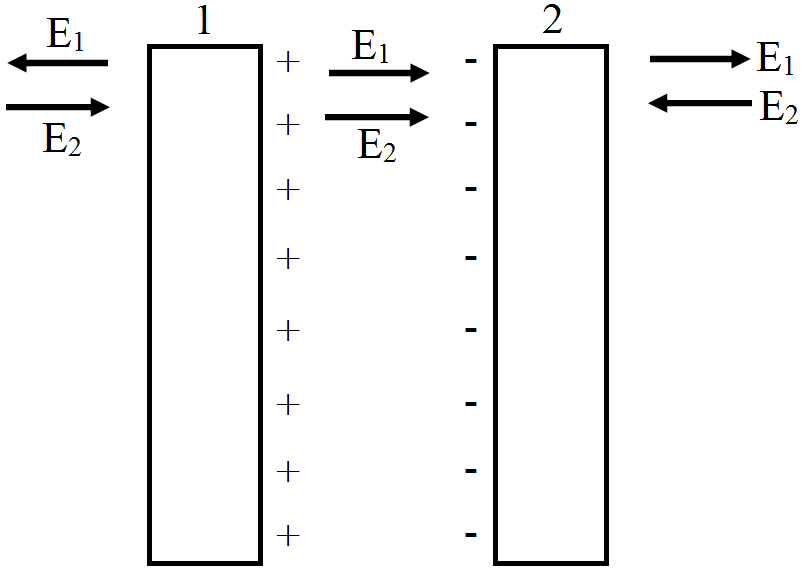
Consider the Gaussian surface as shown in the figure.
Let the charge on the outer surface of the left-most plate be q. Thus, the charges on the plates are distributed as shown in the diagram.
The net field at point P due to all the induced charges must be zero, as it is lying inside the metal surface.
Let the surface area of the plates be A.
Electric field at point P due to the charges on plate X:
Due to charge (+Q - q) is $\frac{\text{Q}-\text{q}}{2\text{A}\in_0}$ in the right direction
Due to charge (+q) is $\frac{\text{q}}{2\text{A}\in_0}$ in the right direction
Electric field at point P due to charges on plate Y:
Due to charge (-q) is $\frac{\text{q}}{2\text{A}\in_0}$ in the right direction
Due to charge (+q) is $\frac{\text{q}}{2\text{A}\in_0}$ in the left direction
Electric field at point P due to charges on plate Z:
Due to charge (-q) is $\frac{\text{q}}{2\text{A}\in_0}$ in the right direction
Due to charge (-2Q + q) is $\frac{\text{2Q}-\text{q}}{2\text{A}\in_0}$ in the right direction
The net electric field at point P:
$\frac{\text{Q}-\text{q}}{2\text{a}\in_0}+\frac{\text{q}}{2\text{A}\in_0}-\frac{\text{q}}{2\text{A}\in_0}-\frac{\text{q}}{2\text{A}\in_0}+\frac{\text{q}}{2\text{A}\in_0}+\frac{\text{2Q}-\text{q}}{2\text{A}\in_0}=0$
$\frac{\text{Q}-\text{q}}{2\text{A}\in_0}+\frac{\text{2Q}-\text{q}}{2\text{A}\in_0}=0$
$\text{Q}-\text{q}+\text{2Q}-\text{q}=0$
$\text{3Q}-2\text{q}=0$
$\text{q}=\frac{\text{3Q}}{2}$
Thus, the charge on the outer plate of the right-most plate
$-2\text{Q}+\text{q}=-2\text{Q}+\frac{3\text{Q}}{2}=-\frac{\text{Q}}{2}$
View full question & answer
Question 733 Marks
Consider a sphere of radius R with charge density distributed as$\rho\text{(r)}=\text{kr for r}\leq\text{R}$
$=0\text{ for f}>\text{R}.$
Find the electric field at all points r.
Answer
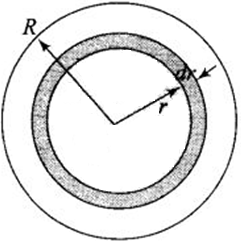
The expression of charge density distribution in the sphere suggests that the electric field is radial. Let us consider a sphere S of radius R and two hypothetic spheres of radius r < R and r > R. Let us first consider for point r < R, electric field intensity will be given by, $\oint\overrightarrow{\text{E}}.\text{d}\overrightarrow{\text{S}}=\frac{1}{\in_0}\int\rho\text{dV}$
Here $\text{dV}=4\pi\text{r}^2\text{dr}$$\Rightarrow\ \oint\overrightarrow{\text{E}}.\text{d}\overrightarrow{\text{S}}=\frac{1}{\in_0}4\pi\text{K}\int\text{r}^3\text{dr}\ \ (\because\ \rho(\text{r})=\text{Kr})$
$\Rightarrow\ (\text{E})4\pi\text{r}^2=\frac{4\pi\text{K}}{\in_0}\frac{\text{r}^4}{4}$
We get, $\text{E}=\frac{1}{4\in_0}\text{Kr}^2$ As charge density is positive, it means the direction of E is radially outwards. Now consider points r > R, electric field intensity will be given by$\oint\overrightarrow{\text{E}}.\text{d}\overrightarrow{\text{S}}=\frac{1}{\in_0}\int\rho\text{dV}$
$\Rightarrow\ \text{E}(4\pi\text{r}^2)=\frac{4\pi\text{K}}{\in_0}\oint\text{r}^3\text{dr}=\frac{4\pi\text{K}}{\in_0}\frac{\text{R}^4}{4}$
Which given, $\text{E}=\frac{\text{K}}{4\in_0}\frac{\text{r}^4}{\text{r}^2}$ Here also the charge density is again positive. So, the direction of E is radially outward.
View full question & answer
Question 743 Marks
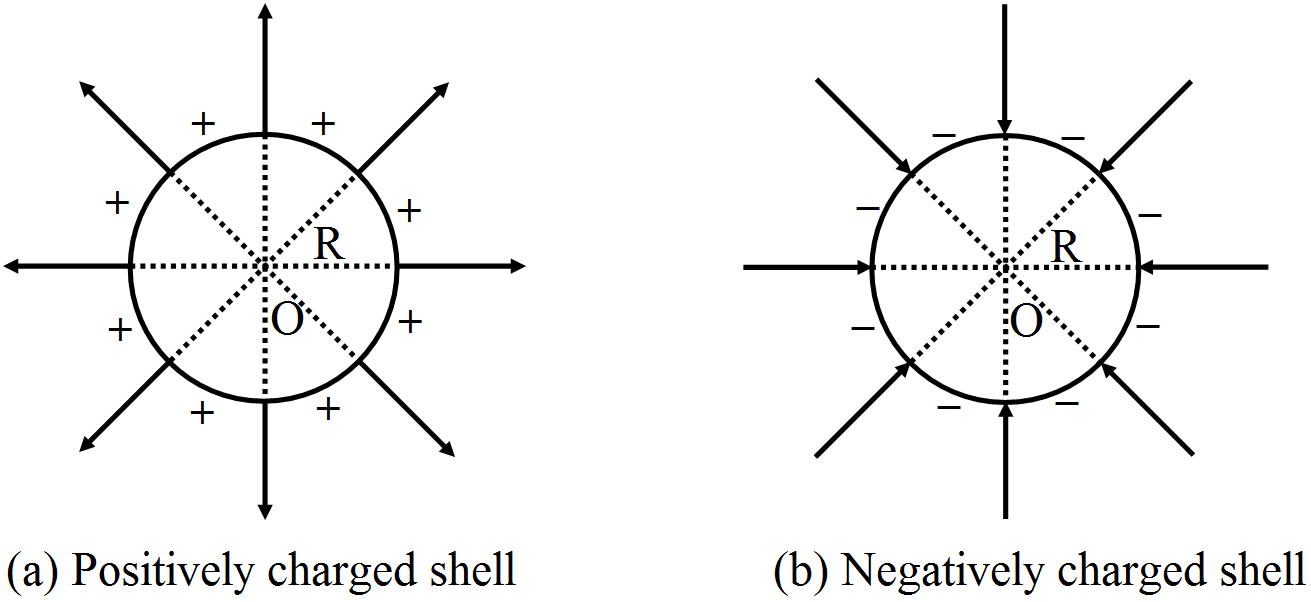
Draw the electric field lines due to a uniformly charged thin spherical shell when charge on the shell is (a) positive and (b) negative.
Answer
The electric field lines are shown in the figure. For a positively charged shell, the field lines are directed in radially outward direction and for negatively charged shell, these are directed in radially inward direction.
View full question & answer
Question 753 Marks
A circular ring of radius r made of a nonconducting material is placed with its axis parallel to a uniform electric field. The ring is rotated about a diameter through 180°. Does the flux of electric field change? If yes, does it decrease or increase?
Answer
It is given that the circular ring, made of a non-conducting material, of radius r is placed with its axis parallel to a uniform electric field.This means that both the electric field and the area vector are parallel to each other (area vector is always perpendicular to the surface area). Thus, the flux through the ring is given by $\vec{\text{E}}.\vec{\text{S}}={\text{ES}}\cos0=\text{E}(\pi\text{r}^2).$
Now, when the ring is rotated about its diameter through 180°, the angle between the area vector and the electric field becomes 180°. Thus, the flux becomes $-\text{E}(\pi\text{r}^2).$
View full question & answer
Question 763 Marks
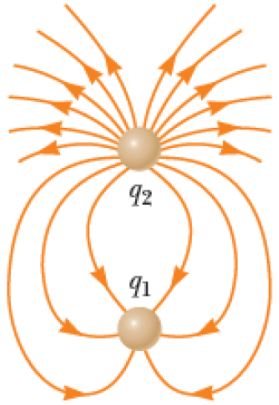
Consider the situation shown in figure. What are the signs of $q_1$ and $q_2?$ If the lines are drawn in proportion to the charge, what is the ratio $\frac{\text{q}_1}{\text{q}_2}?$
Answer
The electric lines of force are entering charge $q_1$​​​​​​​; So, it is is negative. On the other hand, the lines of force are originating from charge $q_2$; so, it positive. If the lines are drawn in proprotion to the charges, then$\frac{\text{q}_1}{\text{q}_2}=\frac{6}{18}$
$\Rightarrow\frac{\text{q}_1}{\text{q}_2}=\frac{1}{3}$
6 lines are entering $q_1$ and 18 are coming our of $q_2.$
View full question & answer
Question 773 Marks
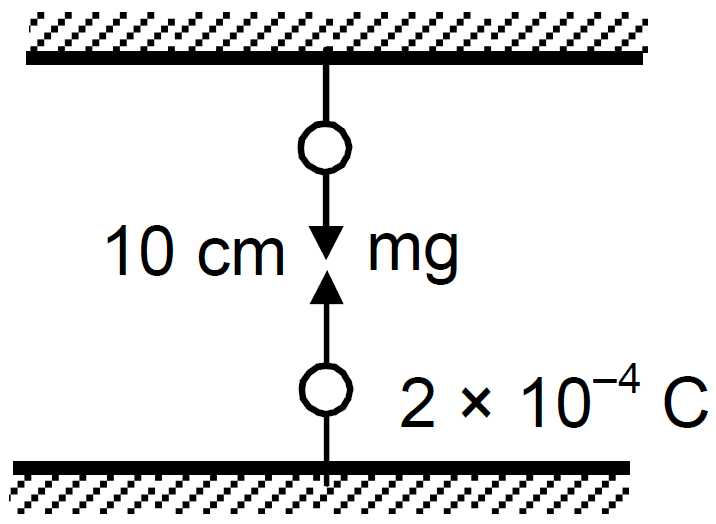
A particle having a charge of $2.0 \times 10^{-4}C$ is placed directly below and at a separation of 10cm from the bob of a simple pendulum at rest. The mass of the bob is 100g. What charge should the bob be given so that the string becomes loose?
Answer


Mass of the bob $= 100g = 0.1kg$
So Tension in the string $= 0.1 × 9.8 = 0.98N.$
For the Tension to be 0, the charge below should repel the first bob.
$\Rightarrow\text{F}=\frac{\text{kq}_1\text{q}_2}{\text{r}^2}$ $\big[\text{T}-\text{mg}+\text{F}=0\ \Rightarrow\text{T}=\text{mg}-\text{f},\ \text{T}=\text{mg}\big]$
$\Rightarrow0.98=\frac{9\times10^9\times2\times10^{-4}\times\text{q}^2}{(0.01)^2}$
$\Rightarrow\text{q}_2=\frac{0.98\times1\times10^{-2}}{9\times2\times10^5}$
$=0.054\times10^{-9}\text{N}$
View full question & answer
Question 783 Marks
The electric field in a region is given by $\overrightarrow{\text{E}}=\frac{3}{5}\text{E}_0\overrightarrow{\text{i}}+\frac{4}{5}\text{E}_0\overrightarrow{\text{j}}$ with $\text{E}_0=2.0\times10^3\text{NC}^{-1}.$ Find the flux of this field through a rectangular surface of area $0.2m^2$ parallel to the y-z plane.
Answer
Given: Electric field strength, $\overrightarrow{\text{E}}=\frac{3}{5}\text{E}_0\hat{\text{i}}+\frac{4}{5}\text{E}_0\hat{\text{j}}$ where $\text{E}_0=2.0\times10^3\text{N/C}$ The plane of the rectangular surface is parallel to the y-z plane. The normal to the plane of the rectangular surface is along the x axis. Only $\frac{3}{5}\text{E}_0\hat{\text{i}}$ passes perpendicular to the plane; so, only this component of the field will contribute to flux. On the other hand, $\frac{4}{5}\text{E}_0\hat{\text{i}}$ moves parallel to the surface.
Surface area of the rectangular surface, $a = 0.2m^2$​​​​​​​ Flux,$\phi=\overrightarrow{\text{E}}.\overrightarrow{\text{a}}=\text{E}\times\text{a}$
$\phi=\Big(\frac{3}5{}\times2\times10^3\Big)\times(2\times10^{-1})\text{Nm}^2/\text{C}$
$\phi=0.24\times10^3\text{Nm}^2/\text{C}$
$\phi=240\text{Nm}^2/\text{C}$
View full question & answer
Question 793 Marks
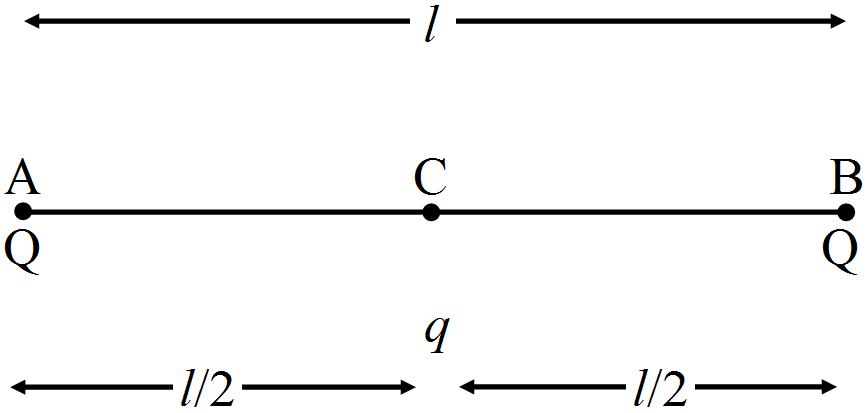
A charge q is placed at the centre of the line joining two equal charges Q.
Show that the system of three charges will be in equilibrium if $\text{q}=-\frac{\text{Q}}{4}.$
Answer


Charge q is in equilibrium since charges A and B exert equal and opposite forces on it.
For equilibrium of charge Q at B;
$F_{BC} + F_{AB} = 0$
$\Rightarrow\ \frac{1}{4\pi\in_0}\frac{\text{qQ}}{(\text{l}/2)^2}+\frac{1}{4\pi\in_0}\frac{\text{Q.Q}}{\text{l}^2}=0$
$\Rightarrow\ \frac{1}{4\pi\in_0}\frac{\text{Q}}{\text{l}^2}(4\text{q}+\text{Q})=0\Rightarrow\ \text{}q=-\frac{\text{Q}}{4}$
View full question & answer
Question 803 Marks
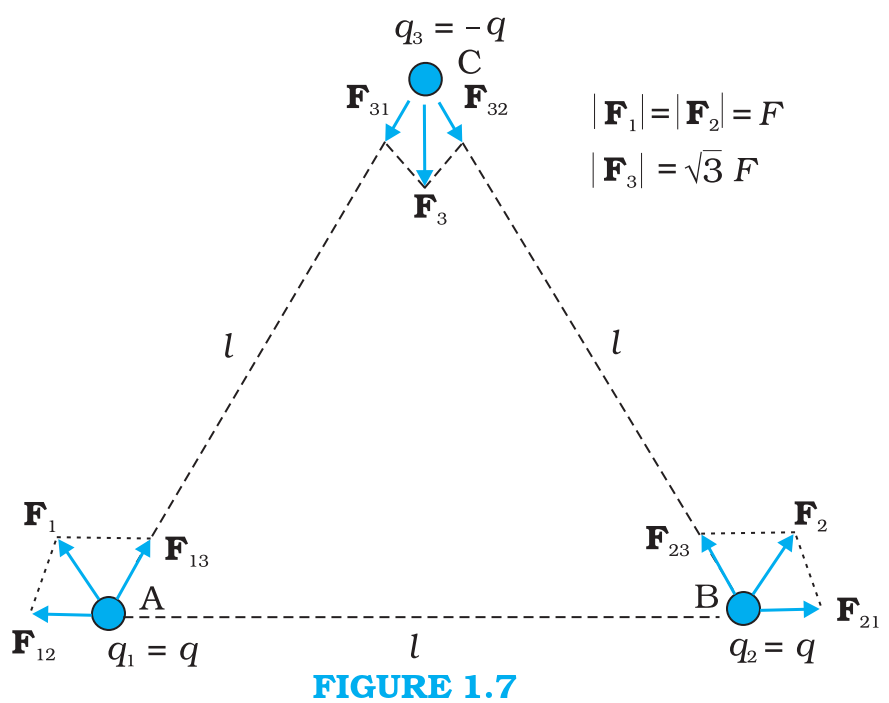
Consider the charges q, q, and –q placed at the vertices of an equilateral triangle, as shown in Fig. 1.7. What is the force on each charge?
Image
Answer
The forces acting on charge $q$ at A due to charges $q$ at and $-q$ at $C$ are $F _{12}$ along BA and $F _{13}$ along $AC$ respectively, as show1 in Fig. 1.7. By the parallelogram law, the total force $F _1$ on the charg $q$ at $A$ is given by
$F _1=F \hat{ r }_1$ where $\hat{ r }_1$ is a unit vector along BC.
The force of attraction or repulsion for each pair of charges has th same magnitude $F=\frac{q^2}{4 \pi \varepsilon_0 l^2}$
The total force $F _2$ on charge $q$ at B is thus $F _2=F \hat{ r }_2$, where $\hat{ r }_2$ is unit vector along $AC$.
Similarly the total force on charge $-q$ at $C$ is $F _3=\sqrt{3} F \hat{ n }$, where $\hat{ n }$ is the unit vector along the direction bisecting the $\angle BCA$.
It is interesting to see that the sum of the forces on the three charges is zero, i.e.,
$
F _1+ F _2+ F _3=0
$
The result is not at all surprising. It follows straight from the fact that Coulomb's law is consistent with Newton's third law. The proof is left to you as an exercise.
View full question & answer
Question 813 Marks
Consider three charges $q_1, q_2, q_3$ each equal to $q$ at the vertices of an equilateral triangle of side $l$. What is the force on a charge $Q$ (with the same sign as q) placed at the centroid of the triangle, as shown in Fig. 1.6?
Image
Answer
In the given equilateral triangle $ABC$ of sides of length $l$, if we draw a perpendicular $AD$ to the side $BC$,
$AD = AC \cos 30^{\circ}=(\sqrt{3} / 2) l$ and the distance $AO$ of the centroid $O$ from $A$ is $(2 / 3) AD =(1 / \sqrt{3})$. By symmatry $AO = BO = CO$.
Thus,
Force $F _1$ on $Q$ due to charge $q$ at $A =\frac{3}{4 \pi \varepsilon_0} \frac{Q q}{l^2}$ along $AO$
Force $F _2$ on $Q$ due to charge $q$ at $B =\frac{3}{4 \pi \varepsilon_0} \frac{Q q}{l^2}$ along BO
Force $F _3$ on $Q$ due to charge $q$ at $C =\frac{3}{4 \pi \varepsilon_0} \frac{Q q}{l^2}$ along $CO$
The resultant of forces $F _2$ and $F _3$ is $\frac{3}{4 \pi \varepsilon_0} \frac{Q q}{l^2}$ along $OA$, by the parallelogram law. Therefore, the total force on $Q=\frac{3}{4 \pi \varepsilon_0} \frac{Q q}{l^2}(\hat{ r }-\hat{ r })$ $=0$, where $\hat{ r }$ is the unit vector along $OA$.
It is clear also by symmetry that the three forces will sum to zero. Suppose that the resultant force was non-zero but in some direction. Consider what would happen if the system was rotated through $60^{\circ}$ about $O$.
View full question & answer
Question 823 Marks
A charged metallic sphere A is suspended by a nylon thread. Another charged metallic sphere B held by an insulating
Image
handle is brought close to A such that the distance between their centres is 10 cm, as shown in Fig. 1.4(a). The resulting repulsion of A is noted (for example, by shining a beam of light and measuring the deflection of its shadow on a screen). Spheres A and B are touched by uncharged spheres C and D respectively, as shown in Fig. 1.4(b). C and D are then removed and B is brought closer to A to a distance of 5.0 cm between their centres, as shown in Fig. 1.4(c). What is the expected repulsion of A on the basis of Coulomb’s law? Spheres A and C and spheres B and D have identical sizes. Ignore the sizes of A and B in comparison to the separation between their centres.
Answer
Let the original charge on sphere A be $q$ and that on B be $q^{\prime}$. At a distance $r$ between their centres, the magnitude of the electrostatic force on each is given by
$
F=\frac{1}{4 \pi \varepsilon_0} \frac{q q^{\prime}}{r^2}
$
neglecting the sizes of spheres A and B in comparison to $r$. When an identical but uncharged sphere $C$ touches $A$, the charges redistribute on A and $C$ and, by symmetry, each sphere carries a charge q/2. Similarly, after D touches B, the redistributed charge on each is $q^{\prime} / 2$. Now, if the separation between A and B is halved, the magnitude of the electrostatic force on each is
$
F^{\prime}=\frac{1}{4 \pi \varepsilon_0} \frac{(q / 2)\left(q^{\prime} / 2\right)}{(r / 2)^2}=\frac{1}{4 \pi \varepsilon_0} \frac{\left(q q^{\prime}\right)}{r^2}=F
$
Thus the electrostatic force on A, due to B, remains unaltered.
View full question & answer
Question 833 Marks
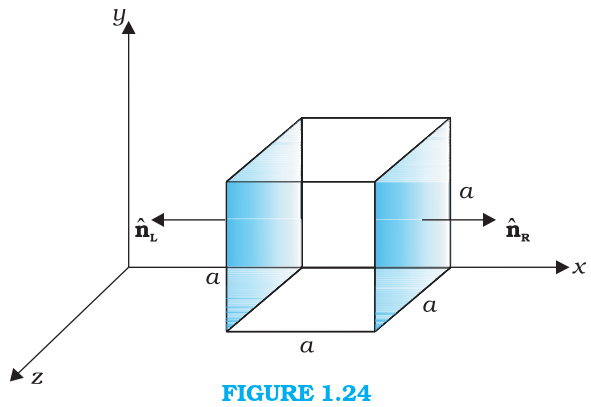
The electric field components in Fig. $1.24$ are $E_x=\alpha x^{1 / 2}, E_y=E_z=0$, in which $\alpha=800 N / C m ^{1 / 2}$. Calculate $(a)$ the flux through the cube, and$ (b)$ the charge within the cube. Assume that $a=0.1 m$.
Image
Answer
$(a)$ Since the electric field has only an $x$ component, for faces perpendicular to $x$ direction, the angle between $E$ and $\Delta S$ is $\pm \pi / 2$. Therefore, the flux $\phi= E . \Delta S$ is separately zero for each face of the cube except the two shaded ones. Now the magnitude of the electric field at the left face is
$E_L=\alpha x^{1 / 2}=\alpha a^{1 / 2}$
$( x=a$ at the left face$)$.
The magnitude of electric field at the right face is
$E_R=\alpha x^{1 / 2}=\alpha(2 a)^{1 / 2}$
$(x=2a$ at the right face$).$
The corresponding fluxes are
$\phi_L = E _L \cdot \Delta S =\Delta S E _L \cdot \hat{ n }_L=E_L \Delta S \cos \theta=-E_L \Delta S , \text { since } \theta=180^{\circ}$
$ =-E_L a^2$
$\phi_R = E _R \cdot \Delta S =E_R \Delta S \cos \theta=E_R \Delta S , \text { since } \theta=0^{\circ}$
$ =E_R a^2$
Net flux through the cube
$=\phi_R+\phi_L=E_R a^2-E_L a^2=a^2\left(E_R-E_L\right)=\alpha a^2\left[(2 a)^{1 / 2}-a^{1 / 2}\right]$
$=\alpha a^{5 / 2}(\sqrt{2}-1)$
$=800(0.1)^{5 / 2}(\sqrt{2}-1)$
$=1.05 N m ^2 C ^{-1}$
$(b)$ We can use Gauss's law to find the total charge $q$ inside the cube.
We have $\phi=q / \varepsilon_0$ or $q=\phi \varepsilon_0$. Therefore,
$q=1.05 \times 8.854 \times 10^{-12} C =9.27 \times 10^{-12} C \text {. }$
View full question & answer
Question 843 Marks
If $10^9$ electrons move out of a body to another body every second, how much time is required to get a total charge of $1 C$ on the other body?
Answer
In one second $10^9$ electrons move out of the body. Therefore the charge given out in one second is $1.6 \times 10^{-19} \times 10^9 C =1.6 \times 10^{-10} C$. The time required to accumulate a charge of $1 C$ can then be estimated to be $1 C \div\left(1.6 \times 10^{-10} C / s \right)=6.25 \times 10^9 s =6.25 \times 10^9 \div(365 \times 24 \times$ 3600) years $=198$ years. Thus to collect a charge of one coulomb, from a body from which $10^9$ electrons move out every second, we will need approximately 200 years. One coulomb is, therefore, a very large unit for many practical purposes.
It is, however, also important to know what is roughly the number of electrons contained in a piece of one cubic centimetre of a material. A cubic piece of copper of side $1 cm$ contains about $2.5 \times 10^{24}$ electrons.
View full question & answer