Questions

5 Marks Questions

Take a timed test

34 questions · self-marked practice — reveal the answer and mark yourself.

Question 15 Marks
A monoenergetic (18 keV) electron beam initially in the horizontal direction is subjected to a horizontal magnetic field of 0.04 G normal to the initial direction. Estimate the up or down deflection of the beam over a distance of 30 cm $(m_e = 9.11 \times 10^{–19} C).$
[Note: Data in this exercise are so chosen that the answer will give you an idea of the effect of earth’s magnetic field on the motion of the electron beam from the electron gun to the screen in a TV set.]
Answer
Energy of an electron beam, $E = 18 keV = 18 \times 10^3 eV$
Charge on an electron, $e = 1.6 \times 10^{−19}C$
$E = 18 \times 10^3 \times 1.6 \times 10^{−19} J$
Magnetic field, $B = 0.04 G$
Mass of an electron, $m_e = 9.1 \times 10^{−31} kg$
Distance up to which the electron beam travels, $d = 30 cm = 0.3 m$
We can write the kinetic energy of the electron beam as:
$\text{E}=\frac{1}{2}\text{mv}^2$
$\text{v}=\sqrt{\frac{2\text{E}}{\text{m}}}$
$\text{v}=\sqrt{\frac{2\times18\times10^3\times1.6\times10^{-19}}{9.1\times10^{-31}}}=0.795\times10^{8}\text{m}/\text{s}$
The electron beam deflects along a circular path of radius, r.
The force due to the magnetic field balances the centripetal force of the path.
$\text{B}_e\text{V}=\frac{\text{mv}^2}{\text{r}}$
$\therefore\ \text{r}=\frac{\text{mv}}{\text{Be}}$
$=\frac{9.1\times10^{-31}\times0.795\times10^8}{0.4\times10^{-4}\times1.6\times10^{-19}}=11.3\text{ m}$
Let the up and down deflection of the electron beam be $\text{x}=\text{r}(1-\cos\theta)$
Where, $\theta$ = Angle of declination.
$\sin\theta=\frac{\text{d}}{\text{r}}$
$=\frac{0.3}{11.3}$
$\theta=\sin^{-1}\frac{0.3}{11.3}=1.521^\circ$
And $\text{x}=11.3(1-\cos1.521^\circ)$
$=0.0039\text{ m}=3.9\text{ mm}$
Therefore, the up and down deflection of the beam is 3.9 mm.
View full question & answer
Question 25 Marks
Answer the following questions:
  1. Explain qualitatively on the basis of domain picture the irreversibility in the magnetisation curve of a ferromagnet.
  2. The hysteresis loop of a soft iron piece has a much smaller area than that of a carbon steel piece. If the material is to go through repeated cycles of magnetisation, which piece will dissipate greater heat energy?
  3. ‘A system displaying a hysteresis loop such as a ferromagnet, is a device for storing memory?’ Explain the meaning of this statement.
  4. What kind of ferromagnetic material is used for coating magnetic tapes in a cassette player, or for building ‘memory stores’ in a modern computer?
  5. A certain region of space is to be shielded from magnetic fields. Suggest a method.
Answer

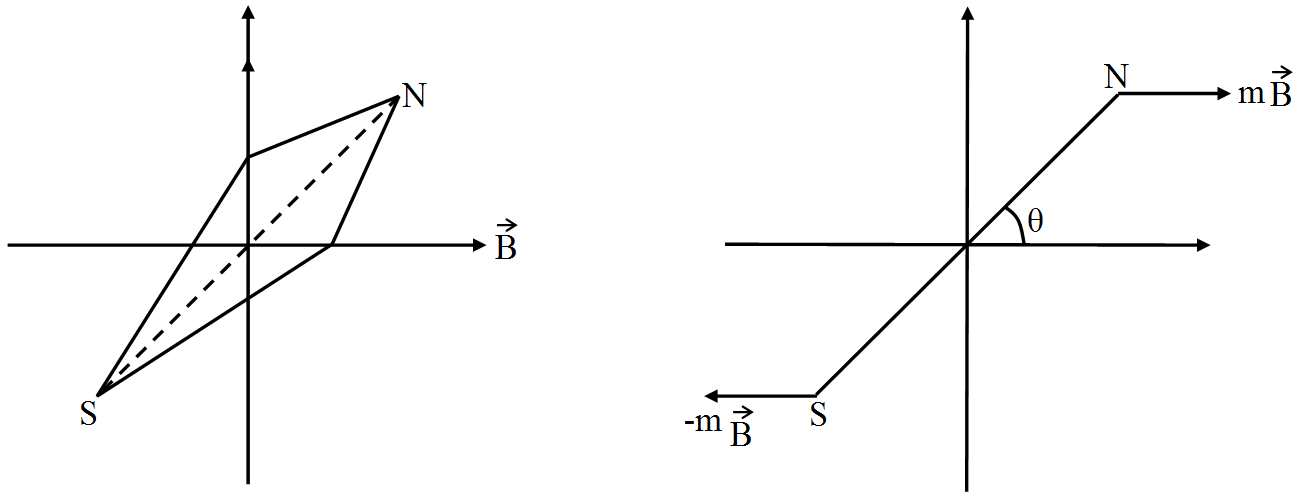
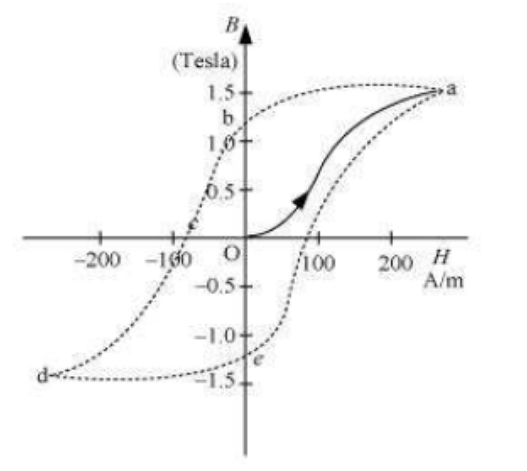
The hysteresis curve (B-H curve) of a ferromagnetic material is shown in the following figure.
  1. It can be observed from the given curve that magnetisation persists even when the external field is removed. This reflects the irreversibility of a ferromagnet.
  2. The dissipated heat energy is directly proportional to the area of a hysteresis loop. A carbon steel piece has a greater hysteresis curve area. Hence, it dissipates gr-eater heat energy.
  3. The value of rnaqnettsatton is memory or- record of hysteresis loop cycles of magnetisation. These bits of information correspond to the cycle of magnetisation. Hysteresis loops can be used for storing information.
  4. Ceramic is used for coating magnetic tapes in cassette players and for building memory stores in modern computers,
  5. A certain region of space can be shielded from magnetic fields if it is surrounded by soft iron rings. In such arrangements, the magnetic lines are drawn out of the region.
View full question & answer
Question 35 Marks
A telephone cable at a place has four long straight horizontal wires carrying a current of 1.0 A in the same direction east to west. The earth’s magnetic field at the place is 0.39 G, and the angle of dip is 35º. The magnetic declination is nearly zero. What are the resultant magnetic fields at points 4.0 cm below the cable?
Answer
Number of horizontal wires in the telephone cable, $n = 4$
Current in each wire, $I = 1.0 A$
Earth's magnetic field at a location$, H = 0.39 G = 0.39 x 10^{-4} T $
Angle of dip at the location, $\delta=35^\circ$
Angle of declination, $\theta\sim0^\circ$
For a point 4 cm below the cable:
Distance, $r = 4 cm = 0.04 m$
The horizontal component of earth's rnaqnetic field can be written as:
$\text{H}_\text{n}=\text{H}\cos\delta-\text{B}$
where,
B = Magnetic field at 4 cm due to current I in the four wires.
$=4\times\frac{\mu_0\text{I}}{2\pi\text{r}}$
$\mu_0$ = Permeability of free space = $4\pi\times10^{-7}\text{ Tm A}^{-1}$
$\therefore\ \text{B}=4\times\frac{4\pi\times10^{-7}\times1}{2\pi\times0.04}$
$=0.2\times10^{-4}\text{ T}=.2\text{ G}$
$\therefore\ \text{H}_{\text{n}}=0.39\cos35^\circ-0.2$
$=0.39\times0.819-0.2\approx0.12\text{ G}$
The vertical component of earth's magnetic field is given as:
$\text{H}_\text{v}=\text{H}\sin\delta$
$=0.39\sin35^\circ=0.22\text{ G}$
The angle made by the field with its horizontal cornponent is given as:
$\theta=\tan^{-1}\frac{\text{H}_\text{v}}{\text{H}_\text{h}}$
$=\tan^{-1}\frac{0.22}{0.12}=61.39^\circ$
The resultant field at the point is given as:
$\text{H}_1=\sqrt{(\text{H}_\text{v})^2+(\text{H}_\text{h})^2}$
$=\sqrt{(0.22)^2+(0.12)^2}=0.25\text{ G}$
For a point 4 cm above the cable:
Horizontal component of earth's magnetic field:
$\text{H}_\text{h}=\text{H}\cos\delta+\text{B}$
$=0.39\cos35^\circ+0.2=0.52\text{ G}$
Vertical component of earth's magnetic field:
$\text{H}_\text{v}=\text{H}\sin\delta$
$=0.39\sin35^\circ=0.22\text{ G}$
$=\tan^{-1}\frac{\text{H}_\text{v}}{\text{H}_\text{h}}=\tan^{-1}\frac{0.22}{0.52}=22.9^\circ$
$\text{Angle},\ \theta$
And resultant field:
$\text{H}_2=\sqrt{(\text{H}_\text{v})^2+(\text{H}_\text{h})^2}$
$=\sqrt{(0.22)^2+(0.52)^2}=0.56\text{ T}$
View full question & answer
Question 45 Marks
A long straight horizontal cable carries a current of 2.5 A in the direction 10° south of west to 10° north of east. The magnetic meridian of the place happens to be 10° west of the geographic meridian. The earth’s magnetic field at the location is 0.33 G, and the angle of dip is zero. Locate the line of neutral points (ignore the thickness of the cable). (At neutral points, magnetic field due to a current-carrying cable is equal and opposite to the horizontal component of earth’s magnetic field.)
Answer
Current in the wire, $I = 2.5 A$
Angle of dip at the given location on earth, $\delta=0^\circ$
Earth's magnetic field, $H = 0.33 G = 0.33 \times 10^{-4} T$
The horizontal component of earth's rnaqnetic field is given as:
$\text{H}_\text{H}=\text{H}\cos\delta$
$=0.33\times10^{-4}\times\cos0^\circ=0.33\times10^{-4}\text{ T}$
The rnaqnetic field at the neutral point at a distance R from the cable is given by the relation:
$\text{H}_\text{H}=\frac{\mu_0\text{I}}{2\pi\text{R}}$
Where,
$\mu_0$ = Permeability of free space = $4\pi\times10^{-7}\text{Tm A}^{-1}$
$\therefore\ \text{R}=\frac{\mu_0\text{I}}{2\pi\text{H}_\text{H}}$
$=\frac{4\pi\times10^{-7}\times2.5}{2\pi\times0.33\times10^{-4}}=15.15\times10^{-3}\text{ m}=1.51\text{ cm}$
Hence, a set of neutral points parallel to and above the cable are located at a normal distance of 1.51 cm.
View full question & answer
Question 55 Marks
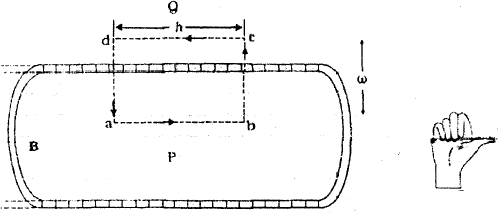
  1. Using Ampere's circuital law, obtain the expression for the magnetic field due to a long solenoid at a point inside the solenoid on its axis.
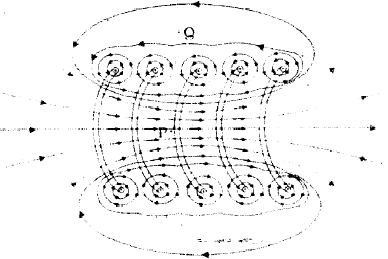
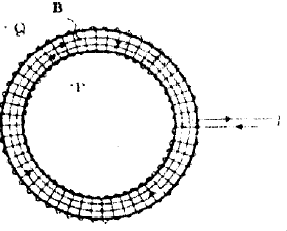
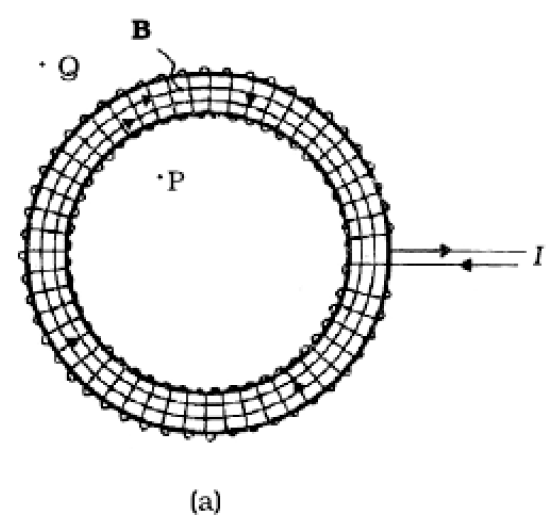
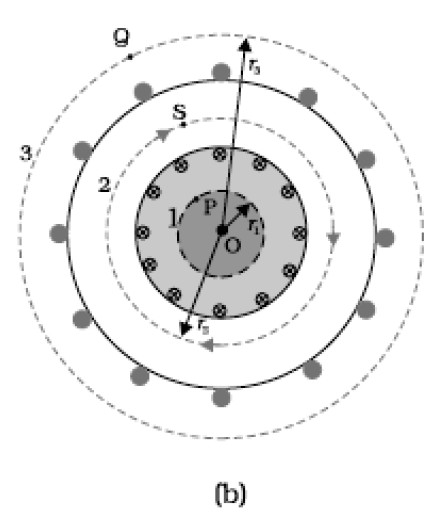
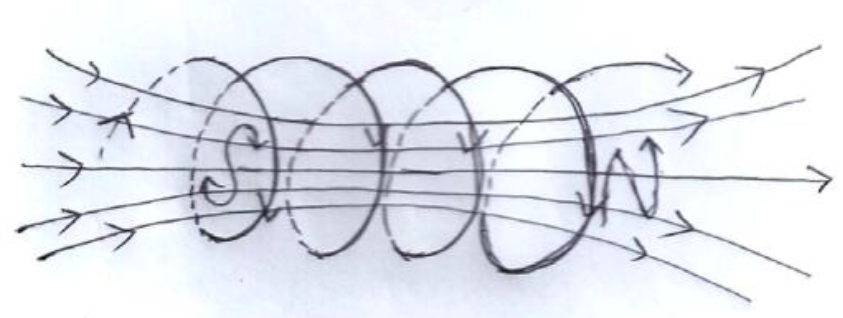
  2. In what respect is a toroid different from a solenoid? Draw and compare the pattern of the magnetic field lines in the two cases.
  3. How is the magnetic field inside a given solenoid made strong?
Answer
  1.  

$\oint\overrightarrow{\text{B}}.\overrightarrow{\text{dl}} = \mu_{0}\sum\text{i}$
$\oint\limits_{a}^{b}\overrightarrow{\text{B}}.\overrightarrow{\text{dl}} + \int\limits_{b}^{c}\overrightarrow{\text{B}}.\overrightarrow{\text{dl}} + \int\limits_{c}^{d}\overrightarrow{\text{B}}.\overrightarrow{\text{dl}} + \int\limits_{d}^{a}\overrightarrow{\text{B}}.\overrightarrow{\text{dl}} = \mu_{o}\text{I}(\text{nh})$
Bh + 0 + 0 + 0 = $\mu_{o}\text{I}$(nh)
$\text{B} = \mu_{o}\text{nl}$
  1. (Any one difference ~ In a toroid,magnetic lines do not exist outside the body.
$\rightarrow$Toroid is closed whereas the solenoid is open on both sides.
$\rightarrow$ Magnetic field is uniformin side a toroid whereas for 'solenoid, it is different at the two ends and centre.


Strengthing ofmagnetic field:
  • By inserting a ferromagnetic substance inside the solenoid.
  • By increasing the amount of current through the solenoid.
View full question & answer
Question 65 Marks
Distinguish the magnetic properties of dia, para- and ferro-magnetic substances in terms of (i) susceptibility, (ii) magnetic permeability and (iii) coercivity. Give one example of each of these materials. Draw the field lines due to an external magnetic field near a (i)diamagnetic, (ii) paramagnetic substance.
Answer
  Dia para Ferro
(i) Susceptibility Very small and negative small and negative High and positive
(ii) Pernmeability Less than one Greater than one very large compared to one
(iii) Coercivity - - Exists
Example one each $Bi,Cu,Pb,Si, N,H_2O$(or any other example) $Al,Na,Ca,O,CuCl_2$​​​​​​​ Fe,Ni,Co and their alloys
View full question & answer
Question 75 Marks
  1. Define mutual inductance and write its S.I. unit.
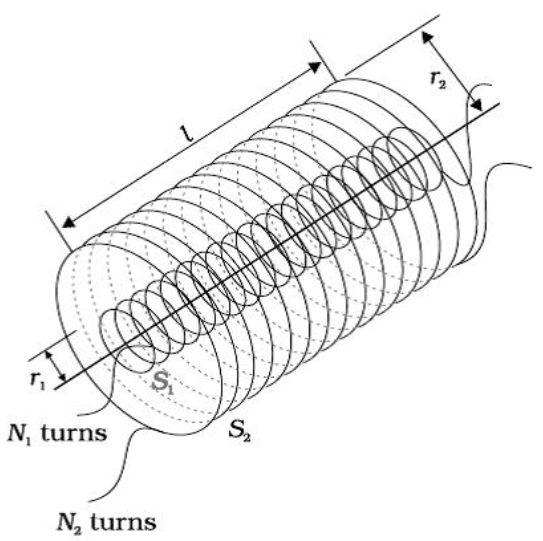
  2. Derive an expression for the mutual inductance of two long co-axial solenoids of same length wound one over the other.
  3. In an experiment, two coils $c_1 $ and $c_2$ are placed close to each other. Find out the expression for the emf induced in the coil $c_1$ due to a change in the current through the coil $c_2.$
Answer
  1. $\phi = \text{MI}$
Mutual inductance of two coils is equal to the magnetic flux linked with one coil when a unit current is passed in the other coil.
Alternate Answer
$\text{e} = - \text{M}\frac{\text{dl}}{\text{dt}}$
Mutual inductance is equal to the induced emf set up in one coil when the rate of change of current flowing through the other coil is unity.
SI unit: henry/(weber ampere$^{–1})/($volt second ampere$^{–1})$

Let a current $I_2$ flow through $S_2$.This sets up a magnetic flux $\phi_{1}$ through each turn of the coil $S_1.$
Total flux linked with $S_1$
$\text{N}_{1}\phi_{1} = \text{M}_{12}\text{I}_{2}$......(i)
where $M_{12}$ is the mutual inductance between the two solenoids Magnetic field due to the current $I_2$ in $S_2$ is $\text{S}_{2}\text{ is } \mu_{\circ}\text{n}_{2}\text{I}_{2}$
Therefore, resulting flux linked with $S_{1.}$
$\text{N}_{1}\phi_{1} = [ (\text{n}_{1}\ell)\pi\text{r}^{2}](\mu_0\text{n}_{2}\text{I}_{2})$........(ii)
Comparing (i) & (ii),we get
$M_{12}I_2 =(\text{n}_{1}\ell)\pi\text{r}_{1}^{2}(\mu_{0}\text{n}_{2}\text{I}_{2})$
$\therefore\text{M}_{12} = \mu_{0}\text{n}_{1}\text{n}_{2}\pi\text{r}_{1}^{2}\ell$
  1. Let a magnetic flux be $(\phi_{1})$linked with coil $C_1$ due to current (I_2) in coil $C_{2};​​​​​​​$​​​​​​​
We have:
$\Phi_{1}\propto\text{I}_{2}$
$ = > \Phi_{1} = \text{MI}_{2}$
$\therefore\frac{\text{d}\Phi_{1}}{\text{dt}}= \text{M}\frac{\text{dI}_{2}}{\text{dt}}$
$= > \text{e} = - \text{M}\frac{\text{dI}_{2}}{\text{dt}}$.
View full question & answer
Question 85 Marks
  1. State Ampere's circuital law. Use this law to obtain the expression for the magnetic field inside an air cored toroid of average radius 'r' having 'n' turns per unit length and carrying a steady current I.
  2. An observer to the left of a solenoid of N turns each of cross section area 'A' observes that a steady current I in it flows in the clockwise direction. Depict the magnetic field lines due to the solenoid specifying its polarity and show that it acts as a bar magnet of magnetic moment m = NIA.
Answer
  1. Line integral of magnetic field over a closed loop is equal to the $\mu_{0}$ times the total current passing through the surface enlosed by the loop.
Alternate Answer
$\oint\overrightarrow{\text{B}}.\overrightarrow{\text{dl}} = \mu_0\text{I}$


Let the current flowing through each turn of the toroid be I. The total number of turns equals n.($2\pi\text{r}$) where n is the number of turns per unit length.
Applying Ampere's circuital law, for the Amperian loop, for interior points.
$\oint\overrightarrow{\text{B}}.\overrightarrow{\text{dl}} = \mu_0(\text{n}2\pi\text{l})$
$\oint\text{Bdl}\cos\text{0} = \mu_0\text{n}2\pi\text{rl}$
$= > \text{B}\times2\pi\text{r} = \mu_0\text{n}2\pi\text{rl}$
$\text{B} = \mu_0\text{nl}$
  1.  

The solenoid contains N loops, each carrying a current I. Therefore,½ each loop acts as a magnetic dipole. The magnetic moment for a current I, flowing in loop of area (vector) A is given by m = IA. The magnetic moments of all loops are aligned along the same direction. Hence, net magnetic moment equals NIA.
View full question & answer
Question 95 Marks
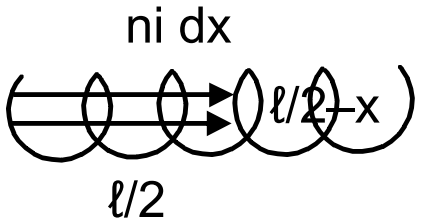
A tightly-wound solenoid of radius a and length l has n turns per unit length. It carries an electric current i. Consider a length dx of the solenoid at a distance x from one end. This contains n(dx) turns and may be approximated as a circular current in (dx).
  1. Write the magnetic field at the centre of the solenoid due to this circular current. Integrate this expression under proper limits to find the magnetic field at the centre of the solenoid.
  2. Verify that if a >> l, the field tends to $\text{B}=\frac{\mu_0\text{nil}}{2\text{a}}.$ Interpret these results.
Answer

Current at ‘0’ due to the circular loop $=\text{dB}=\frac{\mu_0}{4\pi}\times\frac{\text{a}^2\text{in}\ \text{dx}}{\Big[\text{a}^29+\Big(\frac{1}{2}-\text{x}\Big)^2\Big]^\frac{3}{2}}$
$\therefore$ for the whole solenoid $\text{B}=\int\limits_0^\text{B}\text{dB}$
$=\int\limits_0^\ell\frac{\mu_0\text{a}^2\text{in}\ \text{dx}}{4\pi\Big[\text{a}^2+\Big(\frac{\ell}{2}-\text{x}\Big)^2\Big]^\frac{3}{2}}$
$\frac{\mu_0\text{ni}}{4\pi}=\int\limits_0^\ell\frac{\mu_0\text{a}^2\text{in}\ \text{dx}}{\text{a}^3\Big[1+\Big(\ell-\frac{2\text{x}}{2\text{a}}\Big)^2\Big]^\frac{3}{2}}$
$=\frac{\mu_0\text{ni}}{4\pi\text{a}}\int\limits_0^\ell\frac{\text{dx}}{\Big[1+\Big(\ell-\frac{2\text{x}}{2\text{a}}\Big)^\frac{3}{2}\Big]}=1+\Big(\ell-\frac{2\text{x}}{2\text{a}}\Big)^2$
View full question & answer
Question 105 Marks
The magnetic field inside a long solenoid having 50 turns/cm is increased from $2.5 × 10.3T$ to $2.5T$ when an iron core of cross-sectional area $4cm^2$ is inserted into it. Find:
  1. The current in the solenoid.
  2. The magnetization I of the core.
  3. The pole strength developed in the core.
Answer
$B_1 = 2.5 \times 10^{-3},$
$B_2 = 2.5$
$A = 4 \times 10^{-4}m^2,$
$n = 50$ turns/cm $= 5000$ turns/m​​​​
  1. $\text{B}=\mu_0\text{ni}$
$\Rightarrow2.5\times10^{-3}=4\pi\times10^{-7}\times5000\times\text{i}$

$\Rightarrow\text{i}=\frac{2.5\times10^{-3}}{4\pi\times10^{-7}\times5000}=0.398\approx0.4\text{A}$
  1. $\text{I}=\frac{\text{B}_2}{\mu_0}-\text{H}$
$=\frac{2.5}{4\pi\times10^{-7}}-(\text{B}_2-\text{B}_1)$

$=\frac{2.5}{4\pi\times10^{-7}}-2.497$

$=1.99\times10^6\approx2\times10^6$
  1. $\text{I}=\frac{\text{M}}{\text{V}}\Rightarrow\text{I}=\frac{\text{m}\ell}{\text{A}\ell}=\frac{\text{m}}{\text{A}}$
$\Rightarrow\text{m}=\text{IA}=2\times10^6\times4\times10^{-4}=800\text{A-m}$
View full question & answer
Question 115 Marks
A permanent magnet in the shape of a thin cylinder of length 10 cm has M = 106A/m. Calculate the magnetisation current $I_M.$
Answer
According to the problem, M(intensity of magnetisation) $=  10^6A/m.$ 
l(length) $= 10cm = 10 \times 10^{-2} m = 0.1m$
and $I_m =$ magnetisation current
Here we know that $\text{M}=\frac{\text{I}_\text{M}}{\text{l}}$
$\Rightarrow I_M = M \times l$
$= 10^6 \times 0.1 = 10^5A.$
Important Point: Here, M = Intensity of magnetisation as its units are given as A/m.
View full question & answer
Question 125 Marks
The magnetic field B and the magnetic intensity H in material are found to be 1.6T and 1000A/m reepectively. Calculate the relative permeability $\mu_\text{r}$ and the susceptibility x of the material.
Answer
$\text{B}=1.6\text{T},$
$\text{H}=1000\text{A/m}$
$\mu=$ Permeability of material
$\mu=\frac{\text{B}}{\text{H}}=\frac{1.6}{1000}=1.6\times10^{-3}$
$\mu\text{r}=\frac{\mu}{\mu_0}=\frac{1.6\times10^{-3}}{4\pi\times10^{-7}}$
$=0.127\times10^{4}\approx1.3\times10^3$
$\mu=\mu_0(1+\text{x})$
$\Rightarrow\text{X}=\frac{\mu}{\mu_0}-1$
$=\mu-1=1.3\times10^3-1$
$=1300-1=1299\approx1.3\times10^3$
View full question & answer
Question 135 Marks
Consider a solid sphere of radius r and mass m that has a charge q distributed uniformly over its volume. The sphere is rotated about its diameter with an angular speed $\omega.$ Show that the magnetic moment $\mu$ and the angular momentum l of the sphere are related as $\mu=\frac{\text{q}}{2\text{m}}\text{l}.$
Answer


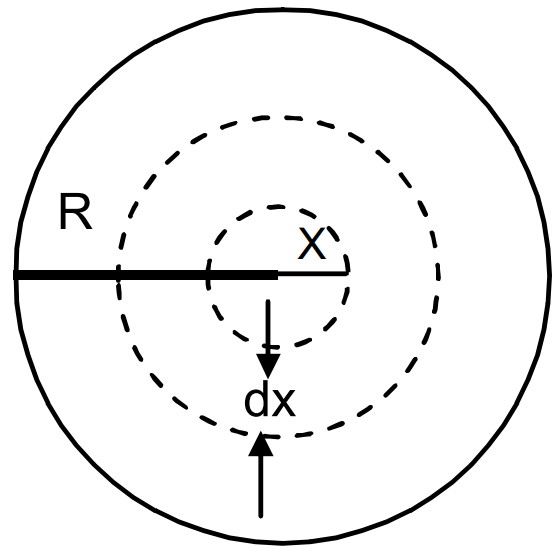
Considering a strip of width dx at a distance x from centre,
$\text{di}\frac{\text{dp}}{\text{dt}}=\frac{\text{q}4\pi\text{x}^2\text{dx}}{\Big(\frac{4}{3}\Big)\pi\text{R}^3\text{}}4\pi\text{x}^2\text{dx}$
$\text{di}=\frac{\text{dq}}{\text{dt}}=\frac{\text{q}4\pi\text{x}^2\text{dx}}{\Big(\frac{4}{3}\Big)\pi\text{R}^3\text{t}}=\frac{3\text{q}\text{x}^2\text{dx}\omega}{\text{R}^32\pi}$
$\text{d}\mu=\text{di}\times\text{A}=\frac{3\text{q}\text{x}^2\text{d}\text{x}\omega}{\text{R}^32\pi}\times4\pi\text{x}^{2\ =\ \frac{6\text{q}\omega}{\text{R}^3}\text{x}^4\text{dx}}$
$\mu=\int\limits_0^{\mu}\text{d}\mu\int\limits_0^{\text{R}}\frac{6\text{q}\omega}{\text{R}^3}\text{x}^4\text{dx}=\frac{6\text{q}\omega}{\text{R}^3}\Big[\frac{\text{x}^5}{5}\Big]_0$
$\text{R}=\frac{\text{6}\text{q}\omega\text{R}^5}{\text{R}^3}\frac{\text{R}^5}{5}=\frac{6}{5}\text{q}\omega\text{R}^2$
View full question & answer
Question 145 Marks
Consider a non-conducting plate of radius r and mass m that has a charge q distributed uniformly over it. The plate is rotated about its axis with an angular speed $\omega.$ Show that the magnetic moment $\mu$ and the angular momentum of the plate are related as $\mu=\frac{\text{q}}{2\text{m}}\text{l}.$
Answer


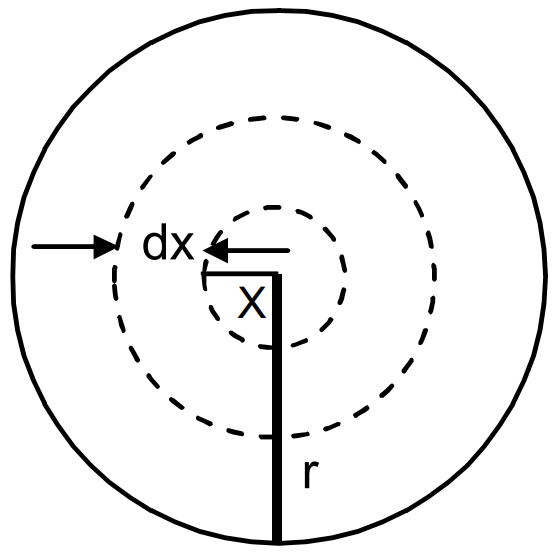
dp on the small length dx is $\frac{\text{q}}{\pi\text{r}^2}2\pi\text{x}\text{ dx}.$
$\text{di}=\frac{\text{q}2\pi\times\text{dx}}{\pi\text{r}^2\text{t}}=\frac{\text{q}2\pi\text{dx}\omega}{\pi\text{r}^2\text{q}2\pi}=\frac{\text{q}\omega}{\pi\text{r}^2}\text{xdx}$
$\text{d}\mu=\text{n}\text{ di}\text{A}=\frac{\text{q}\omega\text{xdx}}{\pi\text{r}^2}\pi\text{x}^2$
$\mu=\int\limits_0^\mu\text{d}\mu=\int\limits_0^{\text{r}}\frac{\text{q}\omega}{\text{r}^2}\text{x}^3\text{dx}=\frac{\text{q}\omega}{\text{r}^2}\Big[\frac{\text{x}^4}{4}\Big]^\text{r}=\frac{\text{q}\omega\text{r}^4}{\text{r}^2\times4}=\frac{\text{q}\omega\text{r}^2}{4}$
$\text{l}=\text{I}\omega=\Big(\frac{1}{2}\Big)\text{mr}^2\omega$
$\Big[\therefore$ M.I. for disc is $\Big(\frac{1}{2}\Big)\text{mr}^2\Big]$
$\frac{\mu}{\text{l}}=\frac{\text{q}\omega\text{r}^2}{4\times\Big(\frac{1}{2}\Big)\text{mr}^2\omega}$
$\Rightarrow\frac{\text{q}}{\text{l}}=\frac{\text{q}}{2\text{m}}$
$\Rightarrow\mu=\frac{\text{q}}{2\text{m}}\text{l}$
View full question & answer
Question 155 Marks
When a dielectric is placed in an electric field, it gets polarized. The electric field in a polarized material is less than the applied field. When a paramagnetic substance is kept in a magnetic field, the field in the substance is more than the applied field. Explain the reason of this opposite behaviour.
Answer
This opposite behaviour is due to the opposite behaviour of magnetic dipole as compared to electric dipole. When the paramagnetic substance is kept in magnetic field, the direction of magnetic field at the centre of magnetic dipole of substance is along the direction of magnetic moment which is opposite to the case of dipole in electric field. Also, when paramagnetic substance is kept in the magnetic field then its magnetic dipole aligns in the direction of field. Thus, magnetic field due to the magnetic dipole adds up to the applied magnetic field.
Hence, an extra magnetic field produced in the direction of applied field.
View full question & answer
Question 165 Marks
A rod, when suspended in a magnetic field, stays in the east-west direction. Can we be sure that the field is in the east-west direction? Can it be in the north-south direction?
Answer
No, it depends on the nature of rod. As we know that when the diamagnetic substance is suspended in a uniform field they set their longer axis right angles to the direction of magnetic field. So, if the material of the rod will be diamagnetic then it will stay in the east-west direction in perpendicular magnetic field (i.e. along north-south direction). But if the material of the rod is paramagnetic or ferromagnetic it will stay in east-west direction having magnetic field in east-west direction.
View full question & answer
Question 175 Marks
A copper wire having resistance 0.01 ohm in each metre is used to wind a 400-turn solenoid of radius 1.0cm and length 20cm. Find the emf of a battery which when connected the solenoid will eauee a magnetic field of $1.0 \times 10^{-2}T$ near the centre of the solenoid.
Answer
$\frac{\text{R}}{\text{l}}=0.01\Omega\ \text{in}\ 1\text{m},$
$\text{r} = 1.0\text{cm},\ \text{Total turns} = 400$
$\ell=20\text{cm},$
$\text{B}=1\times10^{-2}\text{T},$
$\text{n}=\frac{400}{20\times10^{-2}}\text{turns\m}$
$\text{i}=\frac{\text{E}}{\text{R}_0}=\frac{\text{E}}{\frac{\text{R}}{\text{l}}\times(2\pi)\text{r}\times400}$
$=\frac{\text{E}}{0.01\times2\times\pi\times0.01\times400}$
$\Rightarrow10^2=4\pi\times10^{-7}\times\frac{400}{20\times10^{-2}}\times\frac{\text{E}}{400\times2\pi\times0.01\times10^{-2}}$
$\Rightarrow\text{E}=\frac{10^{-2}\times20\times10^{-2}\times400\times2\pi\times10^{-2}\times0.01}{4\pi\times10^{-7}\times400}=1\text{V}$
View full question & answer
Question 185 Marks
A tightly-wound, long solenoid is kept with its axis parallel to a large metal sheet carrying a surface current. The surface current through a width dl of the sheet is Kdl and the number of turns per unit length of the solenoid is n. The magnetic field near the centre of the solenoid is found to be zero.
  1. Find the current in the solenoid.
  2. If the solenoid is rotated to make its axis perpendicular to the metal sheet, what would be the magnitude of the magnetic field near its centre ?
Answer
No. of turns per unit length $=\ell$
  1. As the net magnetic field = zero
$\therefore\overrightarrow{\text{B}}_\text{plate}=\overrightarrow{\text{B}}_\text{Solenoid}$

$\overrightarrow{\text{B}}_\text{plate}\times2\ell=\mu_0\text{kd}\ell=\mu_0\text{k}\ell$

$\overrightarrow{\text{B}}_\text{plate}=\frac{\mu_0\text{k}}{2}\ ...(1)$

$\overrightarrow{\text{B}}_\text{Solenoid}=\mu_0\text{ni}\ ...(2)$

Equating both $\text{i}=\frac{\mu_0\text{k}}{2}$

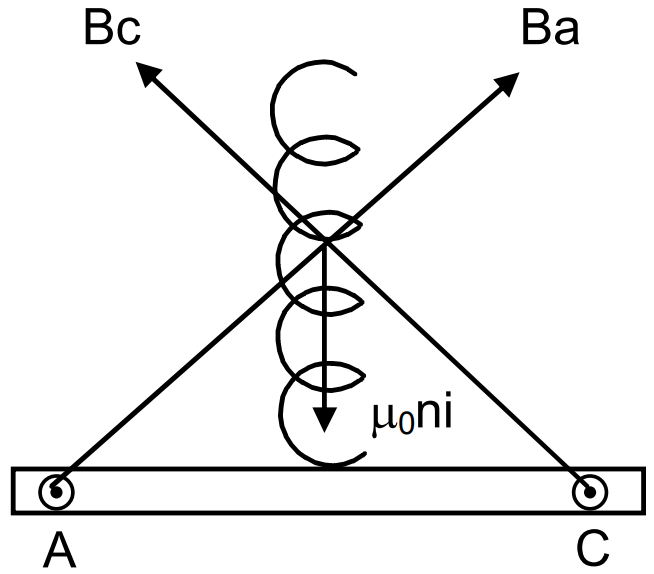
  1. $\text{B}_\text{a}\times\ell=\mu\text{k}\ell$
$\Rightarrow\text{B}_\text{a}=\mu_0\text{k}\ \text{BC}=\mu_0\text{K}$

$\text{B}=\sqrt{\text{B}_\text{a}^2+\text{B}_\text{a}^2}=\sqrt{2(\mu_0\text{k})^2}=\sqrt{2}\mu_0\text{k}$

$2\mu_0\text{k}=\mu_0\text{ni}\text{i}=\frac{\sqrt2\text{k}}{\text{n}}$
View full question & answer
Question 195 Marks
Do permeability and relative permeability have the same dimensions?
Answer
Magnetic permeability $(\mu)$ is the ratio of magnatic flux density (B) to the megnatising field strength (H).
$\mu=\frac{\text{B}}{\text{H}}$
In CGS (centimeter-gram-second) dimension of B and H is same. Hence, magnetic permeability is dimensionless. But in SI unit, dimension of B and H is not same. Thus, permeability is not dimensionless.
Relative ​permeability is defined as the ratio of magnetic permeability of any medium to the permeability of the vaccum. Hence, it is dimensionless. Thus, permeability and relative permeability have the same dimensions in CS system.
View full question & answer
Question 205 Marks
Suppose we want to verify the analogy between electrostatic and magnetostatic by an explicit experiment. Consider the motion of (i) electric dipole p in an electrostatic field E and (ii) magnetic dipole m in a magnetic field B. Write down a set of conditions on E, B, p, m so that the two motions are verified to be identical. (Assume identical initial conditions.)
Answer
Electric field $\vec{\text{E}}$ and magnetic field $\vec{\text{B}}$ are related as
Key concept: Suppose the angle between $\vec{\text{p}}$ and $\vec{\text{E}}$ is $\theta$. Torque on electric dipole of moment $\vec{\text{p}}$ in an electric firld $\vec{\text{E}},\tau=\text{pE}\sin\theta.$
Let us assume that the angle between $\vec{\mu}$ and $\vec{\text{B}}$ is $\theta$.
Torque on magnetic dipole moment $\vec{\mu}$ in magnetic field $\vec{\text{B}}$,
$\vec{\tau}=\mu\text{B}\sin\theta\ \hat{\text{n}}$
If these two motions are identical, then
$\text{pE}\sin\theta=\mu\text{B}\sin\theta$
$\Rightarrow\ \text{pE}=\mu\text{B}\ .....{\text{i}}$
But, $\text{E}=\text{cB}$
$\therefore$ Putting this value in Eq. (i),
$\text{pcB}=\mu\text{B}$
$\Rightarrow\ \text{p}=\frac{\mu}{\text{c}}$
View full question & answer
Question 215 Marks
The property of diamagnetism is said to be present in all materials. Then, why are some materials paramagnetic or ferromagnetic?
Answer
When a diamagnetic material is placed in magnetic field, dipole moment are induced in its atoms by the applied magnetic field. The direction of magnetic field due to induced dipole moment is opposite to the applied magnetic field therefore the resultant magnetic field is smaller than the applied magnetic field. This process is called diamagnetism. As this process takes place for all the material, therefore all the material exhibit diamagnetism. However, some material consists of atoms having some magnetic moment on their own (without applying magnetic field). As a result of it, when they are placed in magnetic field, they alignstheir atomic dipole in the direction of applied magnetic field and hence their resultant magnetic field is more then the applied magnetic field and exhibit paramagnetism or ferromagnetism.
View full question & answer
Question 225 Marks
Answer the following the questions.
  1. A small compass needle of magnetic moment ‘m’ is free to turn about an axis perpendicular to the direction of uniform magnetic field ‘B’. The moment of inertia of the needle about the axis is ‘I’. The needle is slightly disturbed from its stable position and then released. Prove that it executes simple harmonic motion. Hence deduce the expression for its time period.
  2. A compass needle, free to turn in a vertical plane orients itself with its axis vertical at a certain place on the earth. Find out the values of (i) horizontal component of earth’s magnetic field and (ii) angle of dip at the place.
Answer

If magnetic compass of dipole moment $\vec{\text{m}}$ is placed at angle θ in uniform magnetic field, and released it experiences a restoring torque.

$\vec{\text{T}}=-$ magnetic froce prependicular distance
$=-|\text{mB}|.(2\text{a}\sin\theta).\vec{\text{T}}=-\vec{\text{m}}\times\vec {\text{B}}$
$|\text{T}|=-\text{m}|\text{B}|.\sin\theta,$ where m = pole strength
In equilibrium, the equation of motion,
$\Rightarrow\text{I}\frac{\text{d}^2\theta}{\text{dt}^2}=-|\text{m}||\text{B}|\theta$ (For small angle sin)
$\Rightarrow\text{I}\frac{\text{d}^2\theta}{\text{dt}^2}=-\frac{|\text{m}|\text{B}||\theta}{\text{I}}$
$\Rightarrow\text{l}\frac{\text{d}^2\theta}{\text{dt}^2}=-\frac{|\text{m}||\text{B}|\theta}{\text{I}}$
$\Rightarrow\text{l}\frac{\text{d}^2\theta}{\text{dt}^2}=-\Big(\frac{\text{m}\text{B}}{\text{I}}\Big)\theta$

$\text{Since}\frac{\text{d}^2\theta}{\text{dt}^2}​​\propto\theta$
It represents the simple harmonic motion with angular frequency
$\omega^2=\frac{|\text{m}|\text{B}|}{\text{I}}$
$\Rightarrow\text{T}=\frac{2\pi}{\omega}=2\pi\sqrt{\frac{\text{I}}{\text{mB}}}$
View full question & answer
Question 235 Marks
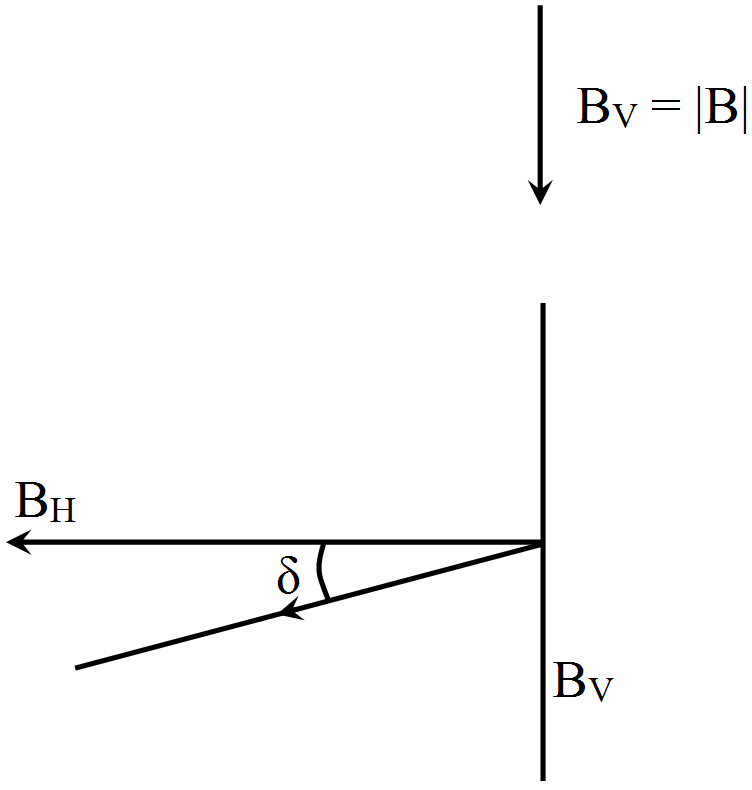
Assume the dipole model for earth's magnetic field B which is given by $B_V =$ vertical component of magnetic field $=\frac{\mu_0}{4\pi}\frac{2\text{m}\cos\theta}{\text{r}^3}$
$B_H =$ Horizontal component of magnetic field $=\frac{\mu_0}{4\pi}\frac{\sin\theta\text{m}}{\text{r}^3}$
θ = 90º - lattitude as measured from magnetic equator. Find loci of points for which,
  1. |B| is minimum,
  2. Dip angle is zero,
  3. Dip angle is ± 45º.
Answer
  1. $\text{B}_\text{V}=\frac{\mu_02\text{m}\cos\theta}{4\pi}$
$\text{B}_\text{H}=\frac{\mu_0}{4\pi}\frac{\text{m}\sin\theta}{\text{r}^3}$
These are the components of B to net magnetic field will be
$\text{B}=\sqrt{\text{B}_\text{v}^2+\text{B}_\text{H}^2}=\frac{\mu_0\text{m}}{4\pi\text{r}^3}\big[3\cos^{2}\theta+1\big]^\frac{1}{2}$
From above equation, the value of B is minimum, if cos $\theta=\frac{\pi}{2}$.
$\theta=\frac{\pi}{2}$. Thus, B is minimum at the magnetic equator.
  1. Angle of dip,
$\tan\delta=\frac{\text{B}_\text{V}}{\text{B}_\text{H}}=\frac{\frac{\mu_0}{4\pi}.\frac{2\text{m}\cos\theta}{\text{r}^3}}{\frac{\mu_0}{4\pi}.\frac{\sin\theta.\text{m}}{\text{r}^3}}=2\cot\theta\ .....(\text{i})$
$\tan\delta=2\cot\theta$
For dip angle is zero i.e., $\delta = 0$
$\cot\theta=0$
$\theta=\frac{\pi}{2}$
For this value of $\theta$ angle fo dip is vanished. It means that locus is again magnetic equator.
  1. $\tan\delta=\frac{\text{B}_\text{V}}{\text{B}_\text{H}}$
Angle of dip i.e., $\delta=\pm45^\circ$
$\frac{\text{B}_\text{V}}{\text{B}_\text{H}}=\tan(\pm45^\circ)$
$\frac{\text{B}_\text{V}}{\text{B}_\text{H}}=1$
$2\cot\theta=1\ \big[\text{From Eq. (i)}\big]$
$\cot\theta=\frac{1}{2}$
$\tan\theta=\frac{1}{2}$
$\Rightarrow\ \theta=\tan^{-1}(2)$
Thus, $\theta=\tan^{-1}(2)$ is the locus.
View full question & answer
Question 245 Marks
A bar magnet of magnetic moment m and moment of inertia I (about centre, perpendicular to length) is cut into two equal pieces, perpendicular to length. Let T be the period of oscillations of the original magnet about an axis through the mid point, perpendicular to length, in a magnetic field B. What would be the similar period T' for each piece?
Answer
Key concept: Time period in this type of S.H.M. is $\text{T}=2\pi\sqrt{\frac{\text{I}}{\text{MB}}}$
where, T = time period
I = moment of inertia
M = mass of magnet
B = magnetic field
According to the problem, a magnet is oscillating in a uniform magnetic field, so we get the time period of oscillation as
$\text{T}=2\pi\sqrt{\frac{\text{I}}{\text{MB}}}$
Here, $\text{I}=\frac{\text{mI}^2}{12}.$
When magnet is cut two equal pieces, perpendicular to length, then moment of inertia of each piece of magnet about an axis perpendicular to the lenght passing through its centre is
$\text{I}'=\frac{\text{m}}{12}\frac{\Big(\frac{\text{l}}{2}\Big)^2}{12}=\frac{\text{ml}^2}{12}\times\frac{1}{8}=\frac{\text{I}}{8}$
Magnetic dipole moment $\text{M}'=\frac{\text{M}}{2}$
$\text{T}'=2\pi\sqrt{\frac{\text{I}'}{\text{M}'\text{B}}}=2\pi\sqrt{\frac{\frac{\text{I}}{8}}{\Big(\frac{\text{M}}{2}\Big)\text{B}}}=\frac{2\pi}{2}\sqrt{\frac{\text{I}}{\text{MB}}}$
$\text{T}'=\frac{\text{T}}{2}$
View full question & answer
Question 255 Marks
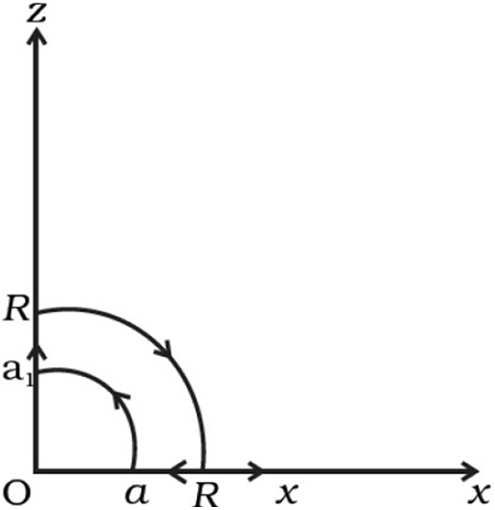
Verify the Ampere's law for magnetic field of a point dipole of dipole moment $\text{m}=\text{m}\hat{\text{k}}$. Take C as the closed curve running clockwise along:
  1. The z-axis from z = a > 0 to z = R.
  2. Along the quarter circle of radius R and centre at the origin, in the first quadrant of x-z plane.
  3. Along the x-axis from x = R to x = a.
  4. Along the quarter circle of radius a and centre at the origin in the first quadrant of x-z plane.
Answer
  1. Along z axis
$\text{B}=\frac{\mu_0}{4\pi}\frac{2\text{m}}{\text{r}^3}$

$\int\limits_\text{a}^\text{R}\text{B.dl}=\frac{\mu_0}{4\pi}2\text{m}\int\limits_\text{a}^\text{R}\frac{\text{dz}}{\text{z}^3}=\frac{\mu_{0}\text{m}}{2\pi}\bigg(-\frac{1}{2}\bigg)\bigg(\frac{1}{\text{R}^2}-\frac{1}{\text{a}^2}\bigg)$
  1. Along the quarter circle of radius R
$\text{B}=\frac{\mu_0}{4\pi}\frac{\text{M}\sin\theta}{\text{R}^3};\text{dl}=\text{Rd}\theta$

$\therefore\int\vec{\text{B}}.\vec{\text{dl}}=\int\text{B.dl}\cos\theta=\int_0^{\frac{\pi}{2}}\frac{\mu_0}{4\pi}\frac{\text{M}\sin\theta}{\text{R}^3}\text{Rd}\theta$

$=\frac{\mu_0}{4\pi}\frac{\text{M}}{\text{R}}(-\cos\theta)_0^{\frac{\pi}{2}}=\frac{\mu_0}{4\pi}\frac{\text{M}}{\text{R}^2}$
  1. Along x-axis
$\text{B}=\frac{\mu_0}{4\pi}\Big(\frac{-\text{m}}{\text{x}^3}\Big)$

$\int \text{B.dl}=0$
  1. Along the quarter circle of radius a
$=\int\text{B.dl}=\int_{\frac{\pi}{2}}^{0}\frac{\mu_0}{4\pi}\frac{\text{M}\sin\theta}{\text{a}^3}\text{ad}\theta$

$=\frac{\mu_0}{4\pi}\frac{\text{M}}{\text{a}^2}=\int_{\frac{\pi}{2}}^{0}\sin\theta\text{d}\theta=\frac{\mu_0}{4\pi}\frac{\text{M}}{\text{a}}^2[-\cos\theta]_{\frac{\pi}{2}}^0$

$=\frac{-\mu_0}{4\pi}\frac{\text{M}}{\text{a}^2}$

Adding final result from ....(i) ....(ii) ....(iii) ....(iv), we get zero.
View full question & answer
Question 265 Marks
What are the dimensions of $\chi$, the magnetic susceptibility? Consider an H-atom. Guess an expression for $\chi$, upto a constant by constructing a quantity of dimensions of $\chi$, out of parameters of the atom: e, m, v, R and $\mu _0$ . Here, m is the electronic mass, v is electronic velocity, R is Bohr radius. Estimate the number so obtained and compare with the value of $|\chi|\sim10^{-5}$ for many solid materials.
Answer
Key concept: Magnetic susceptibility: It is property of the substance which shows how easily a substance can be magnetised. It can also be defined as the ratio of intensity of magnetisation (I) in a substance to the magnetic intensity (H) applied to the substance, i.e. $\chi_\text{m}=\frac{\text{I}}{\text{H}}.$
$\chi_\text{m}=\frac{\text{I}}{\text{H}}=\frac{\text{(intensity of magnetisation)}}{(\text{Magnetising force})}$
As I and H both have same units and dimensions, hence $\chi$ has no dimensions. In this problem, $\chi$ is related with e, m, v, R and $\mu_0$. We know that dimensions of $\mu_0=[\text{MLT}^{-2}\text{A}^{-2}]$
From biot-Savart's law,
$\text{dB}=\frac{\mu_0}{4\pi}\frac{\text{Idl}\sin\theta}{\text{r}^2}$
$\Rightarrow\ \mu_0=\frac{4\pi\text{r}^2\text{dB}}{\text{Idl}\sin\theta}=\frac{4\pi\text{r}^2}{\text{Idl}\sin\theta}\times\frac{\text{f}}{\text{qv}\sin\theta}\ \ \Big[\therefore\ \text{dB}=\frac{\text{F}}{\text{qv}\sin\theta}\Big]$
$\therefore$ Dimensions of
$\mu_0=\frac{\text{L}^2\times(\text{MLT}^{-2})}{(\text{QT}^{-1})(\text{L})\times1\times(\text{Q})(\text{LT}^{-1})\times(1)}=[\text{MLQ}^{-2}]$
Where Q is the dimension of charge.
As $\chi$ is dimensionless, it should have no involvement of charge Q in its dimensional formula. It will be so if $\mu_0$ and e together should have the value $\mu_0\text{e}^2$, as e has the dimesions of charge.
Let $\chi=\mu_0\text{e}^2\text{m}^{\text{a}}\text{v}^{\text{b}}\text{R}^\text{c}\ .....(\text{i})$
Where a, b, c are the power of m, v and R respectively, such that relation (i) is satisfied.
Dimensional equation of (i) is
$\big[\text{M}^0\text{L}^0\text{T}^0\text{A}^{0}\text{T}^{0}\big]=\big[\text{MLA}^{-2}\text{T}^{-2}\big]\times\big[\text{A}^2\text{T}^2\big]\big[\text{M}\big]^\text{a}\times\big[\text{LT}^{-1}\big]^\text{b}\times\big[\text{L}\big]^\text{c}$
$=\big[\text{M}^{1+\text{a}}+\text{L}^{1+\text{b}+\text{c}}\text{T}^{-\text{b}}\text{A}^{0}\big]$
Equating the powers of M, L and T, we get
$0 = 1 + a ⇒ a = -1, 0 = 1 + b + c .....(ii)$
$0 = -b ⇒ b = 0, 0 = 1 + 0 + c or c = -1$
Putting values in Eq. (i), we get
$\chi=\mu_0 \text{e}^2\text{m}^{-1}\text{v}^{2}\text{R}^{-1}=\frac{\mu_0\text{e}^2}{\text{mR}}$
Here, $\mu_0=4\pi\times10^{-7}\text{TmA}^{-1}$
$\text{e}=1.6\times10^{-19}\text{C}$
$\text{m}=9.1\times10^{-31}\text{kg}, \text{R}=10^{-10}\text{m}$
$\chi=\frac{(4\pi\times10^{-7})\times(1.6\times10^{-19})^2}{(9.1\times10^{-31})\times10^{-10}}\approx10^{-4}$
View full question & answer
Question 275 Marks
Verify the Gauss’s law for magnetic field of a point dipole of dipole moment m at the origin for the surface which is a sphere of radius R.
Answer
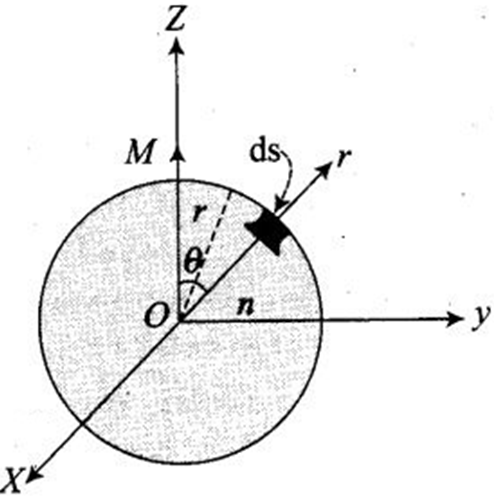
Let us draw the figure for given situation,

We have to prove that $\oint\text{B.dS}=0$. This is called gauss's law in magnetism.
Now, magnetic moment of dipole at origin O is along z-axis.
Let P be a point at distance r from O and OP makes an angle $\theta$ with z-axis Component of M along $\text{OP}=\text{M}\cos\theta$.
Now, the magnetic field induction at P due to dipole of moment $\text{M}\cos\theta$ is $\text{B}=\frac{\mu_0}{4\pi}\frac{2\text{M}\cos\theta}{\text{r}^3}\hat{\text{r}}$.
From the diagram, r is the radius of sphere with centre at O lying in yz-plane.
Take an elementary area dS of the surface at P. Then,
$\text{dS}=\text{r}(\text{r}\sin\theta\text{ d }\theta)\hat{\text{r}}=\text{r}^2\sin\theta\text{ d }\theta\hat{\text{r}}$
$\oint\text{B.dS}=\oint\frac{\mu_0}{4\pi}\frac{2\text{M}\cos\theta}{\text{r}^3}\hat{\text{r}}(\text{r}^2\sin\theta\text{ d }\theta\hat{\text{r}})$
$=\frac{\mu_0}{4\pi}\frac{\text{M}}{\text{r}}\int_{0}^{2\pi}2\sin\theta.\cos\theta\text{ d }\theta$
$=\frac{\mu_0}{4\pi}\frac{\text{M}}{\text{r}}\int_{0}^{2\pi}\sin2\theta\text{ d }\theta$
$=-\frac{\mu_0}{4\pi}\frac{\text{M}}{2\text{r}}\Big(\frac{-\cos2\theta}{2}\Big)_{0}^{2\pi}$
$=-\frac{\mu_0}{4\pi}\frac{\text{M}}{2\text{r}}\big[\cos4\pi-\cos0\big]$
$=-\frac{\mu_0}{4\pi}\frac{\text{M}}{2\text{r}}\big[1-1\big]=0.$
View full question & answer
Question 285 Marks
A bar magnet of length 1cm and cross-sectional area $1.0cm^2$ produces a magnetic field of $1.5 \times 10.$ T at a point in end-on position at a distance 15cm away from the centre.
  1. Find the magnetic moment M of the magnet.
  2. Find the magnetization I of the magnet.
  3. Find the magnetic field B at the centre of the magnet.
Answer
  1. Given,
$\text{d} = 15\text{cm} = 0.15\text{m}$
$\ell = 1\text{cm} = 0.01\text{m}$
$\text{A} = 1.0\text{cm}^2 = 1 \times10^{-4}\text{m}^2$
$\text{B} = 1.5\times10^{-4}\text{T}$
$\text{M} = ?$
We know $\overrightarrow{\text{B}}=\frac{\mu_0}{4\pi}\times\frac{2\text{Md}}{(\text{d}^2-\ell)^2}$
$\Rightarrow1.5\times10^{-4}=\frac{10^{-7}\times2\times\text{M}\times0.15}{(0.0225-0.0001)^2}=\frac{3\times10^{-8}\text{M}}{5.01\times10^{-4}}$
$\Rightarrow\text{M}=\frac{1.5\times10^{-4}\times5.01\times10^{-4}}{3\times10^{-8}}=2.5\text{A}$
  1. Magnetisation $\text{I}=\frac{\text{M}}{\text{V}}=\frac{2.5}{10^{-4}\times10^{-2}}=2.5\times10^6\text{A/m}$
  1. $\text{H}=\frac{\text{m}}{4\pi\text{d}^2}=\frac{\text{M}}{4\pi\text{Id}^2}$
$=\frac{2.5}{4\times3.14\times0.01\times(0.15)^2}$
net $\text{H}=\text{H}_\text{N}+\text{H}=2\times884.6=8.846\times10^2$
$\overrightarrow{\text{B}}=\mu_0(-\text{H}+\text{I})=4\pi\times10^{-7}(2.5\times10^6-2\times884.6)\approx3.14\text{T}$
View full question & answer
Question 295 Marks
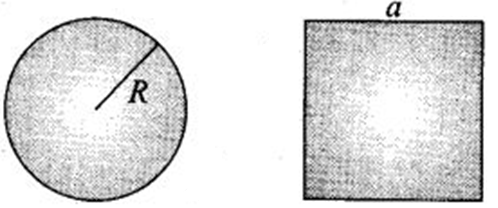
There are two current carrying planar coils made each from identical wires of length L. $C_1$ is circular (radius R ) and $C_2$ is square (side a). They are so constructed that they have same frequency of oscillation when they are placed in the same uniform B and carry the same current. Find a in terms of R.
Answer
According to the problem $C_1 = $circular coil of radius R, length L, number of turns per units lengh
$\text{n}_1=\frac{\text{L}}{2\pi\text{R}}$
$C_2 =$ square of side a and perimeter L, number of turns per units $\text{n}_2=\frac{\text{L}}{4\text{a}}$

Magnetic moment of $C_1$
$\Rightarrow m_1 = n_1iA_1$ (where i is the current in the coil)
Magnetic moment of $C_2$
$\Rightarrow m_2 = n_2iA_2$ (where i is the current in the coil)
$\text{m}_1=\frac{\text{L.i.}\pi\text{R}^2}{2\pi\text{R}}$
$\text{m}_2=\frac{\text{L}}{4\text{a}}.\text{i}.\text{a}^2$
$\text{m}_1=\frac{\text{Li}\text{R}}{2}$
$\text{m}_2=\frac{\text{Lia}}{4}$
Moment of inertia of $\text{C}_1\Rightarrow\ \text{I}_{\text{l}}=\frac{\text{MR}^2}{2}\ .....(\text{i})$
Moment of inertia of $\text{C}_2\Rightarrow\ \text{I}_{\text{l}}=\frac{\text{Ma}^2}{12}\ .....(\text{ii})$ (where M is the mass of coil)
Frequency of $\text{C}_1\Rightarrow\ \text{f}_{\text{l}}=2\pi\sqrt{\frac{\text{I}_{1}}{\text{m}_{1}\text{B}}}\ .....(\text{iii})$
Frequency of $\text{C}_2\Rightarrow\ \text{f}_{\text{l}}=2\pi\sqrt{\frac{\text{I}_{2}}{\text{m}_{2}\text{B}}}\ .....(\text{iv})$
Accoeding to problem, $f_1 = f_2$
$2\pi\sqrt{\frac{\text{I}_1}{\text{m}_1\text{B}}}=2\pi\sqrt{\frac{\text{I}_2}{\text{m}_2\text{B}}}$
$\frac{\text{I}_1}{\text{m}_1}=\frac{\text{I}_2}{\text{m}_2}\text{ or }\frac{\text{m}_2}{\text{m}_1}=\frac{\text{I}_2}{\text{I}_1}$
Substituting the values from Eqs. (i), (ii), (iii) and (iv) (and also substitute the values of $m_1$ and $m_2$ in equation (iii) and (iv)),
$\frac{\text{Lia.2}}{4\times\text{LiR}}=\frac{\text{Ma}^2.2}{12.\text{MR}^2}$
$\frac{\text{a}}{2\text{R}}=\frac{\text{a}^2}{6\text{R}^2}$
$3\text{R}=\text{a}$
THus, the value of a is 3R.
View full question & answer
Question 305 Marks
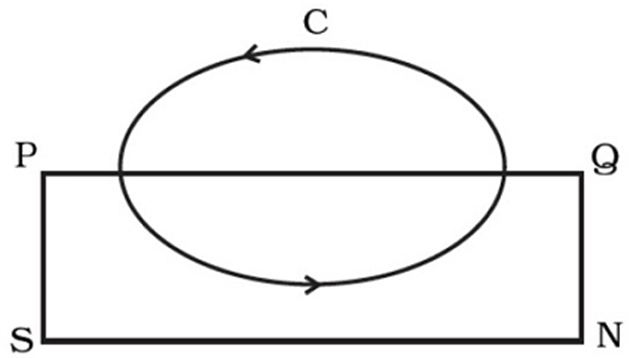
Use (i) the Ampere's law for H and (ii) continuity of lines of B, to conclude that inside a bar magnet, (a) lines of H run from the N pole to S pole, while (b) lines of B must run from the S pole to N pole.
Answer

Magnetic field line through the bar magnet is shown in the figure given above
Suppose C is the amperian loop.
Therefore,
$\int_\text{Q}^\text{P}\text{H.dl}=\int_\text{Q}^{P}\frac{\text{B}}{\text{m}_0}.\text{dl}$
Inside bat magnet, the angle between B and dl is less than 90°. So, B.dl is positive.
i.e., $\int_\text{Q}^\text{P}\text{H.dl}=\int_\text{Q}^{P}\frac{\text{B}}{\mu_0}.\text{dl}>0$
Therefore, lines of B must run from South pole (S) to North Pole (N) inside the bar magnet.
By using Ampere's law, we have
$\oint\limits_\text{PQP}\text{H.dl}=0$
$\oint\limits_\text{PQP}\text{H.dl}=\int_\text{Q}^{P}\text{H.dl}+\int_\text{Q}^{P}\text{H.dl}=0$
As, $\int_\text{Q}^{P}\text{H.dl}>0$ and, $\int_\text{Q}^{P}\text{H.dl}<0$
It will be so if angle between H and dl is more than 90º, so that $\cos\theta$ is negative. This shows that inside the bar magnet the line of H must run from N-pole to S-pole.
View full question & answer
Question 315 Marks
Explain quantitatively the order of magnitude difference between the diamagnetic susceptibility of $N_2 (~5 \times 10^{-9})$ (at STP) and Cu $(~10^{-5}).$
Answer
Key concept:
Magnetic susceptibility: It is the property of the substance which shows how easily a substance can be magnetised. It can also be defined as the ratio of intensity of magnetisation (I) in a substance to the magnetic intensity (H) applied to the substance, i.e., $\text{XM}=\frac{\text{I}}{\text{H}}$.
According to the problem, we have
Density of nitrogen $\rho_{\text{N}_2}=\frac{28\text{g}}{22.4\text{L}}=\frac{28\text{g}}{22400\text{cc}}$
Also, density of copper $\rho_{\text{Cu}}=\frac{8\text{g}}{22.4\text{L}}=\frac{8\text{g}}{22400\text{cc}}$
So, ration of both densities
$\frac{\rho_{\text{N}_2}}{\rho_\text{Cu}}=\frac{28}{22400}\times\frac{1}{8}=16\times10^{-4}$
Also given $\frac{\chi_{\text{N}_2}}{\chi_\text{Cu}}=\frac{5\times10^{-9}}{10^{-5}}=5\times10^{-4}$
we know that, $\chi=\frac{\text{Magentisation (M)}}{\text{Magnetic intensity (H)}}$
$=\frac{\text{Magnetic moment (M)/Volime (V)}}{\text{H}}$
$=\frac{\text{M}}{\text{HV}}=\frac{\text{M}}{\text{H}(\text{mass/density})}=\frac{\text{M}\rho}{\text{Hm}}$
$\chi\propto\rho\ \ \Big(\because\ \frac{\text{M}}{\text{Hm}}=\text{constant}\Big)$
Hence, $\frac{\chi_{\text{N}_2}}{\chi_\text{Cu}}=\frac{\rho_{\text{N}_2}}{\rho_\text{Cu}}=1.6\times10^{-4}$
Therefore, we can say that magnitude difference or major difference between the diamagnetic susceptibility of $N_2$ and Cu is $1.6 \times 10^{-4}.$
View full question & answer
Question 325 Marks
Derive an expression for magnetic field intensity due to a magnetic dipole at a point on its axial line.
Answer

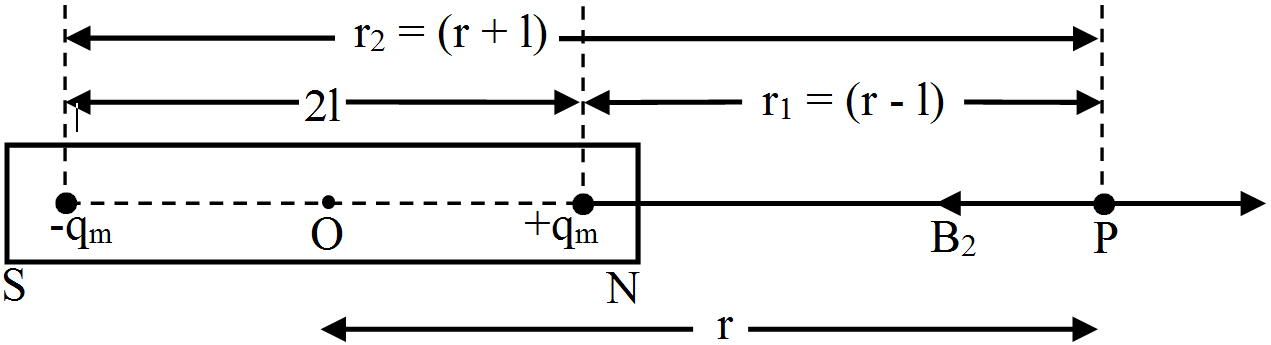
Consider a magnetic dipole (or a bar magnet) SN of length 2l having South Pole at S and North Pole at N. The strength of south and north poles are $-q_m$ and +qm respectively.
Magnetic moment of magnetic dipole $m = q_m$ 2l, its direction is from S to N.
Consider a point P on the axis of magnetic dipole at a distance r from mid-point O of dipole.
The distance of point P from N-pole,

$r_1 = (r - 1)$
The distance of point P from S-pole, $r_2 = (r + l)$ Let $B_1$ and $B_2$ be the magnetic field intensities at point P due to north and south poles respectively. The directions of magnetic field due to North Pole is away from N-pole and due to South Pole is towards the S-pole. Therefore,
$\text{B}_1=\frac{\mu_0}{4\pi}\frac{\text{q}_{\text{m}}}{(\text{r}-\text{l})^2}$ from N to P and $\text{B}_2=\frac{\mu_0}{4\pi}\frac{\text{q}_{\text{m}}}{(\text{r}+\text{l})^2}$ from p to S
Clearly, the directions of magnetic field strengths $\overrightarrow{\text{B}_1}\text{ and }\overrightarrow{\text{B}_2}$ are along the same line but opposite to each other and $B_1 > B_2​​​​​​​.$ Therefore, the resultant magnetic field intensity due to bar magnet has magnitude equal to the difference of B1 and B2 and direction from N to P.
$\text{i.e.,}\text{B}=\text{B}_1-\text{B}_2=\frac{\mu_0}{4\pi}\frac{\text{q}_{\text{m}}}{(\text{r}-\text{l})^2}-\frac{\mu_0}{4\pi}\frac{\text{q}_{\text{m}}}{(\text{r}+\text{l})^2}$
$=\frac{\mu_0}{4\pi}\text{q}_{\text{m}}\Big[\frac{1}{(\text{r}-1)^2}\Big]=\frac{\mu_0}{4\pi}\text{q}_{\text{m}}\Big[\frac{(\text{r}+\text{l}^2-(\text{r}-\text{l})^2}{(\text{r}^2-\text{l}^2)^2}\Big]$
$=\frac{\mu_0}{4\pi}\text{q}_{\text{m}}\Big[\frac{4\text{rl}}{(\text{r}^2-\text{l}^2)^2}\Big]=\frac{\mu_0}{4\pi}\frac{2(\text{q}_{\text{m}}2\text{l})\text{r}}{(\text{r}^2-\text{l}^2)^2}$
But $q_m21 = m$ (magnetic dipole moment)
$\therefore\text{B}=\frac{\mu_0}{4\pi}\frac{2\text{m.r}}{(\text{r}^2-\text{l}^2)^2}\dots(1)$
If the bar magnet is very short and point P is far away from the magnet, the r >> l, therefore, equation (1) takes the form $\text{B}=\frac{\mu_0}{4\pi}\frac{2\text{mr}}{\text{r}^4}$
$\text{or }\text{B}=\frac{\mu_0}{4\pi}\frac{2\text{mr}}{\text{r}^4}\dots(2)$
This is expression for magnetic field intensity at axial position due to a short bar magnet.
View full question & answer
Question 335 Marks
Derive an expression for magnetic field intensity due to a magnetic dipole at a point lies on its equatorial line.
Answer
Consider a point P on equatorial position (or broad side on position) of short bar magnet of length 2l, having north pole (N) and south pole (S) of strength $+q_m$ and $-q_m$ respectively. The distance of point P from the mid-point (O) of magnet is r. Let $B_1$ and $B_2$ be the magnetic field intensities due to north and south poles respectively. NP = SP $=\sqrt{\text{r}^2}+\text{l}^2.$
$\vec{\text{B}}_1=\frac{\mu_0}{4\pi}\frac{\text{q}_{\text{m}}}{\text{r}^2+\text{l}^2}$ along N to P
$\vec{\text{B}}_2=\frac{\mu_0}{4\pi}\frac{\text{q}_{\text{m}}}{\text{r}^2+\text{l}^2}$along P to S
Clearly, magnitudes of and are equal
$\text{i.e,.}|\vec{\text{B}_1}|=|\vec{\text{B}_2}|\text{ or }\text{B}_1=\text{B}_2$
To find the resultant of $\vec{\text{B}_1}\text{ and }\vec{\text{B}_2}$ we resolve them along and perpendicular to magnetic axis SN. Components $\vec{\text{B}_1}$ of along and perpendicular to magnetic axis are $\text{B}_1\cos\theta\text{ and }\text{B}_2\sin\theta$ respectively.
Components of $\vec{\text{B}_2}$ along and perpendicular to magnetic axis are $\text{B}_2\cos\theta\text{ and }\text{B}_2\sin\theta$ respectively. Clearly, components of and perpendicular to axis SN. $\text{B}_1 \sin \theta \text{ and B}_2 \sin \theta$ are equal in magnitude and opposite in direction and hence, cancel each other; while the components of $\vec{\text{B}_1}\text{ and }\vec{\text{B}_2}$ along the axis are in the same direction and hence, add up to give to resultant magnetic field parallel to the direction $\vec{\text{NS}}.$
$\therefore$ Resultant magnetic field intensity at P.
$\text{But}\text{B}_1=\text{B}2=\frac{\mu_0}{4\pi}\frac{\text{q}_{\text{m}}}{\text{r}^2+\text{l}^2}$
$\text{and}\cos\theta=\frac{\text{ON}}{\text{PN}}=\frac{1}{\sqrt{\text{r}^2+\text{l}^2}}$
$=\frac{1}{(\text{r}^2+\text{l}^2)^{\frac{1}{2}}}$
$\therefore\text{B}=2\text{B}_1\cos\theta$
$=2\times\frac{\mu_0}{4\pi}\frac{\text{q}_{\text{m}}}{(\text{r}^2+\text{l}^2)}\times\frac{1}{(\text{r}^2+\text{l}^2)^{1/2}}$
$=\frac{\mu_0}{4\pi}\frac{2q_{\text{m}}\text{l}}{(\text{r}^2+\text{l}^2)^{3/2}}$
But $q_m\ 21 = m$ (magnetic dipole moment)
$\therefore\text{B}=\frac{\mu_0}{4\pi}\frac{\text{m}}{(\text{r}^2+\text{l}^2)^{3/2}}\dots(3)$
If the magnet is very short and point P is far away, we have l<<; so l2 may be neglected as compared to $r^2$ and so equation (3) takes the form $\text{B}=\frac{\mu_0}{4\pi}\frac{\text{m}}{\text{r}^3}\dots(4)$
This is expression for magnetic field intensity at equatorial position of the magnet. It is clear from equations (2) and (4) that the magnetic field strength due to a short magnetic dipole is inversely proportional to the cube of its distance from the centre of the dipole and the magnetic field intensity at axial position is twice that at equatorial position for the same distance.
View full question & answer
Question 345 Marks
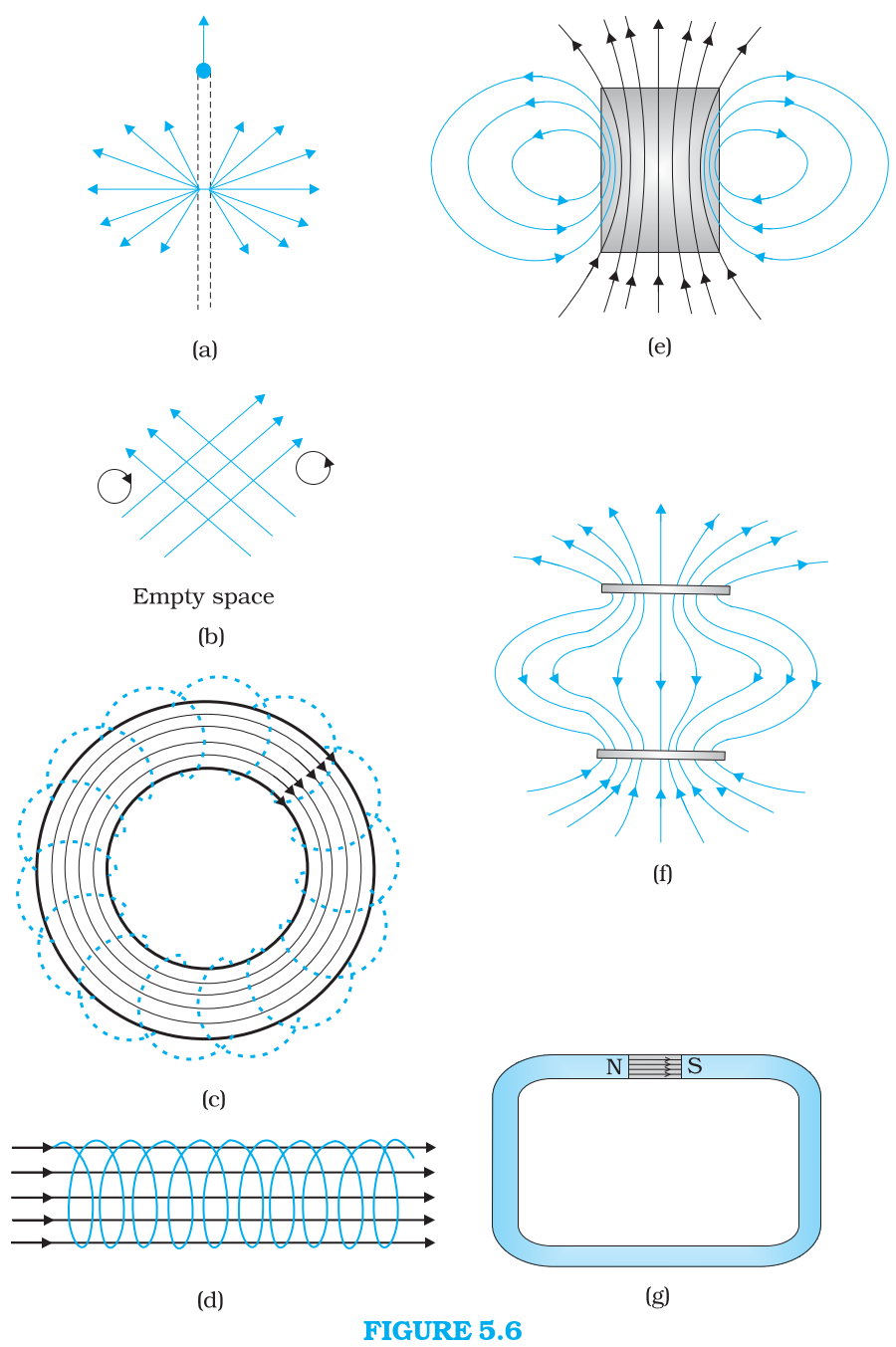
Many of the diagrams given in Fig. 5.7 show magnetic field lines (thick lines in the figure) wrongly. Point out what is wrong with them. Some of them may describe electrostatic field lines correctly. Point out which ones.
Image
Answer
(a) Wrong. Magnetic field lines can never emanate from a point, as shown in figure. Over any closed surface, the net flux of B must always be zero, i.e., pictorially as many field lines should seem to enter the surface as the number of lines leaving it. The field lines shown, in fact, represent electric field of a long positively charged wire. The correct magnetic field lines are circling the straight conductor, as described in Chapter 4.
(b) Wrong. Magnetic field lines (like electric field lines) can never cross each other, because otherwise the direction of field at the point of intersection is ambiguous. There is further error in the figure. Magnetostatic field lines can never form closed loops around empty space. A closed loop of static magnetic field line must enclose a region across which a current is passing. By contrast, electrostatic field lines can never form closed loops, neither in empty space, nor when the loop encloses charges.
(c) Right. Magnetic lines are completely confined within a toroid. Nothing wrong here in field lines forming closed loops, since each loop encloses a region across which a current passes. Note, for clarity of figure, only a few field lines within the toroid have been shown. Actually, the entire region enclosed by the windings contains magnetic field.
(d) Wrong. Field lines due to a solenoid at its ends and outside cannot be so completely straight and confined; such a thing violates Ampere's law. The lines should curve out at both ends, and meet eventually to form closed loops.
(e) Right. These are field lines outside and inside a bar magnet. Note carefully the direction of field lines inside. Not all field lines emanate out of a north pole (or converge into a south pole). Around both the $N$-pole, and the $S$-pole, the net flux of the field is zero.
(f) Wrong. These field lines cannot possibly represent a magnetic field. Look at the upper region. All the field lines seem to emanate out of the shaded plate. The net flux through a surface surrounding the shaded plate is not zero. This is impossible for a magnetic field. The given field lines, in fact, show the electrostatic field lines around a positively charged upper plate and a negatively charged lower plate. The difference between Fig. [5.7(e) and (f)] should be carefully grasped.
(g) Wrong. Magnetic field lines between two pole pieces cannot be precisely straight at the ends. Some fringing of lines is inevitable. Otherwise, Ampere's law is violated. This is also true for electric field lines.
View full question & answer