Question 14 Marks
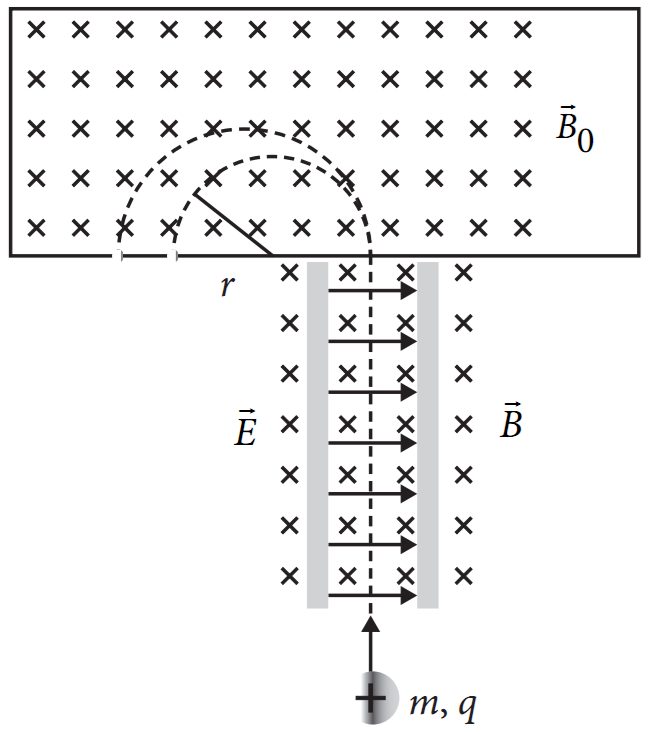
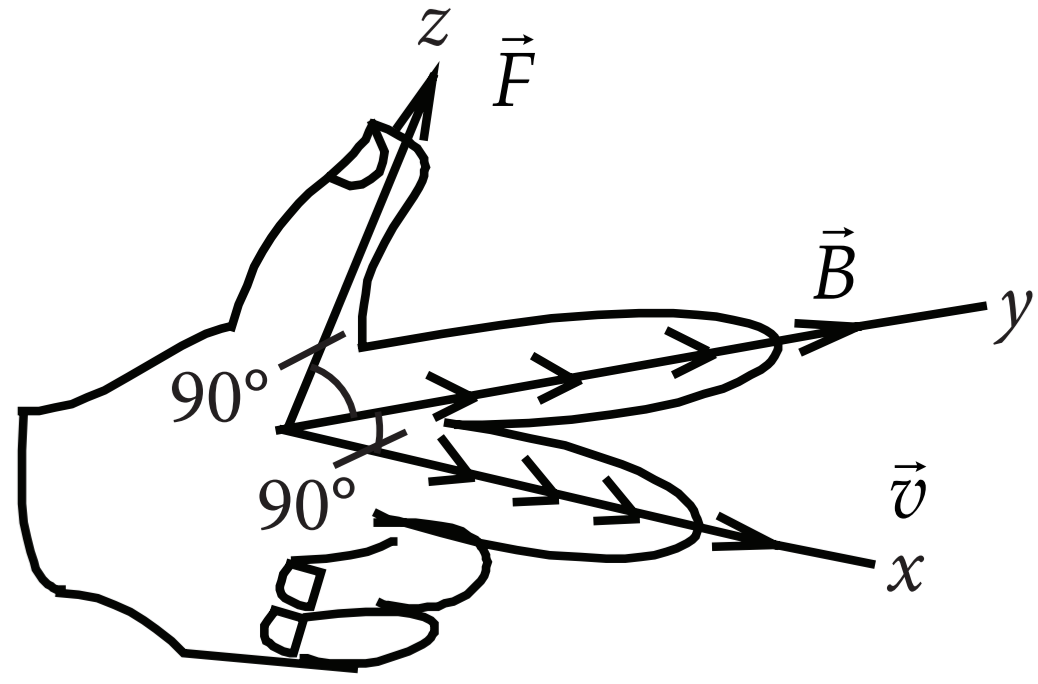
A magnetic field set up using Helmholtz coils (described in Exercise 4.16) is uniform in a small region and has a magnitude of 0.75 T. In the same region, a uniform electrostatic field is maintained in a direction normal to the common axis of the coils. A narrow beam of (single species) charged particles all accelerated through 15 kV enters this region in a direction perpendicular to both the axis of the coils and the electrostatic field. If the beam remains undeflected when the electrostatic field is $9.0 \times 10^{–5} V m^{–1},$ make a simple guess as to what the beam contains. Why is the answer not unique?
Answer
View full question & answer→Magnetic field, B = 0.75 T
Accelerating voltage, $V = 15\ kV = 15 \times 10^3\ V$
Electrostatic field, $E = 9.0 \times 10^{-5}\ V\ m^{-1}$
Mass of the electron = m
Charge of the electron = e
Velocity of the electron = v
Kinetic energy of the electron = eV
$\Rightarrow\frac{1}{2}\text{mv}^{2}=\text{eV}$
$\therefore\frac{\text{e}}{\text{m}}=\frac{\text{v}^{2}}{2\text{V}}....(1)$
Since the particle remains undeflected by electric and magnetic fields, we can infer that the electric field is balancing the magnetic field.
$\therefore\text{eE}=\text{evB}$
$\text{v}=\frac{\text{E}}{\text{B}}...........(2)$
Putting equation (2) in equation (1), we get;
$\frac{\text{e}}{\text{m}}=\frac{1}{2}\frac{\Big(\frac{\text{E}}{\text{B}}\Big)^{2}}{\text{V}}=\frac{\text{E}^{2}}{2\text{VB}^{2}}$
$=\frac{(9.0\times10^{5})^{2}}{2\times15000\times(0.75)^{2}}$
$=4.8\times10^{7}\text{C/ kg}$
This value of specific charge e/m is equal to the value of deuteron or deuterium ions. This is not a unique answer. Other possible answers are $He^{++}, Li^{++},$ etc.
Accelerating voltage, $V = 15\ kV = 15 \times 10^3\ V$
Electrostatic field, $E = 9.0 \times 10^{-5}\ V\ m^{-1}$
Mass of the electron = m
Charge of the electron = e
Velocity of the electron = v
Kinetic energy of the electron = eV
$\Rightarrow\frac{1}{2}\text{mv}^{2}=\text{eV}$
$\therefore\frac{\text{e}}{\text{m}}=\frac{\text{v}^{2}}{2\text{V}}....(1)$
Since the particle remains undeflected by electric and magnetic fields, we can infer that the electric field is balancing the magnetic field.
$\therefore\text{eE}=\text{evB}$
$\text{v}=\frac{\text{E}}{\text{B}}...........(2)$
Putting equation (2) in equation (1), we get;
$\frac{\text{e}}{\text{m}}=\frac{1}{2}\frac{\Big(\frac{\text{E}}{\text{B}}\Big)^{2}}{\text{V}}=\frac{\text{E}^{2}}{2\text{VB}^{2}}$
$=\frac{(9.0\times10^{5})^{2}}{2\times15000\times(0.75)^{2}}$
$=4.8\times10^{7}\text{C/ kg}$
This value of specific charge e/m is equal to the value of deuteron or deuterium ions. This is not a unique answer. Other possible answers are $He^{++}, Li^{++},$ etc.