Question 12 Marks
Find the value of $\frac{3}{13} \div\left(\frac{-4}{65}\right)$
Answer$\frac{3}{13} \div\left(\frac{-4}{65}\right)=\frac{3}{13} \times\left(\frac{65}{-4}\right)$
As $13$ times $5$ equals to $65[13 \times 5 = 65]$
$\frac{3 \times 5}{1 \times-4}=\frac{-15}{4}=-3 \frac{3}{4}$
View full question & answer→Question 22 Marks
Find the value of: $\frac{-7}{12} \div\left(\frac{-2}{13}\right)$
AnswerHere,
We have, $(\left.-\frac{7}{12}\right) \div \frac{-2}{13}$
Or we can write it as: $-\frac{7}{12} \times \frac{13}{(-2)}$
Now, we can solve the above given fractions as follows:
$-\frac{7}{12} \times \frac{13}{(-2)}=\frac{-7 \times 13}{12 \times(-2)}=\frac{-91}{-24}=\frac{91}{24}$
Hence,
The solution for the given fraction is $\frac{91}{24}$
View full question & answer→Question 32 Marks
Find the value of: $\frac{-2}{13} \div \frac{1}{7}$
AnswerHere,
We have, $\left(-\frac{2}{13}\right) \div \frac{1}{7}$
Or we can write it as: $\frac{-2}{13} \times 7$
Now, we can solve the above given fractions as follows:
$\frac{2}{-13} \times 7=\frac{-2 \times 7}{13}=\frac{-14}{13}$
Hence,
The solution for the given fraction is $\frac{-14}{13}$
View full question & answer→Question 42 Marks
Find the value of: $-\frac{1}{8} \div \frac{3}{4}$
AnswerWe have,
$-\frac{1}{8} \div \frac{3}{4}$
Or we can write it as: $-\frac{1}{8} \times \frac{4}{(3)}$
Now, we can solve the above-given fractions as follows:
$\frac{1}{-8} \times \frac{4}{(3)}=\frac{-1 \times 4}{8 \times 3}=\frac{-4}{24}=-\frac{1}{6}$
Hence, the solution for the given fraction is $\frac{-1}{6}$
View full question & answer→Question 52 Marks
Find the value of: $\frac{-4}{5} \div(-3)$
AnswerHere,
We have,
$\frac{-4}{5} \div(-3)$
Or we can write it as: $\frac{4}{-5} \times-\frac{1}{3}$
Now, we can solve the above given fractions as follows:
$\frac{4}{-5} \times\left(-\frac{1}{3}\right)=\frac{-4 \times-1}{15}=\frac{4}{15}$
Hence,
The solution for the given fraction is $\frac{4}{15}$
View full question & answer→Question 62 Marks
Find the value of: $\frac{-3}{5} \div 2$
AnswerHere,
We have: $\frac{-3}{5} \div 2$
Or we can write it as: $-\frac{3}{5} \times \frac{1}{2}$
Now, we can solve the above-given fractions as follows: $-\frac{3}{5} \times \frac{1}{2}$
$=\frac{-3 \times 1}{10}=\frac{-3}{10}$
Hence,
The solution for the given fraction is $\frac{-3}{10}$
View full question & answer→Question 72 Marks
Find the value of $\left( { - 4} \right) \div \frac{2}{3}$.
Answer$ - 4 \times \frac{3}{2}$
$ = - \frac{{12}}{2}$
$= -6$
View full question & answer→Question 82 Marks
Find the product of $\frac{3}{-5} \times\left(\frac{-5}{3}\right)$
AnswerHere,
We have,
$\frac{3}{-5} \times\left(\frac{-5}{3}\right)$
We can solve the above given fractions as follows:
$\frac{3}{-5} \times \frac{-5}{(3)}=\frac{3 \times-5}{-5 \times 3} = 1$
Hence,
The solution for the given fraction is $1$
View full question & answer→Question 92 Marks
Find the product of $\frac{3}{11} \times \frac{2}{5}$
AnswerHere,
We have:
$\frac{3}{11} \times \frac{2}{(5)}$
We can solve the above given fractions as follows:
$\frac{3}{11} \times\left(\frac{2}{5}\right)=\frac{3 \times 2}{11 \times 5}=\frac{6}{55}$
Hence,
The solution for the given fraction is $\frac{6}{55}$
View full question & answer→Question 102 Marks
Find the product of $\frac{3}{7} \times\left(\frac{-2}{5}\right)$
Answer$\frac{3}{7} \times\left(\frac{-2}{5}\right)=\frac{3 \times(-2)}{7 \times 5}=\frac{-6}{35}$
View full question & answer→Question 112 Marks
Find $\frac{-3}{8}-\frac{7}{11}$
Answer$\frac{-3}{8}-\frac{7}{11}=\frac{-3}{8}+\left(\frac{-7}{11}\right)$
As denominators are different we find the LCM of 8 & 11
LCM of 8 and 11 is 88
$-3\over 8$ = $-3\times 11\over 8\times11$ = $-33\over 88$
$-7\over 11$ = $-7\times 8\over 11\times 8$ = $-56\over 88$
Thus, $\frac{-3}{8}+\frac{(-7)}{11}=\frac{-33}{88}+\frac{(-56)}{88}$
$\frac{-33+(-56)}{88}=\frac{-89}{88}=-1 \frac{1}{88}$
View full question & answer→Question 122 Marks
Find: $\frac{-6}{13}-\left(\frac{-7}{15}\right)$
AnswerHere,
We have:
$\frac{-6}{13}-\frac{-7}{(15)}$
We can solve the above given fractions as follows:
$\frac{-6}{13}-\frac{-7}{(15)}=\frac{-90+91}{195}=\frac{1}{195}$
Hence,
The solution for the given fraction is $\frac{1}{195}$
View full question & answer→Question 132 Marks
Find $\frac{5}{63}-\left(-\frac{6}{21}\right)$
Answer$\frac{5}{63}-\left(-\frac{6}{21}\right)=\frac{5}{63}+\frac{6}{21}$
As denominators are different we find the $LCM$ of $21 \& 63$
$LCM$ of $63$ and $21$ is $63.$
$\frac{6}{21}=\frac{6 \times 3}{21 \times 3}=\frac{18}{63}$
Thus,
$\frac{5}{63}+\frac{6}{21}=\frac{5}{63}+\frac{18}{63}=\frac{5+18}{63}=\frac{23}{63}$
View full question & answer→Question 142 Marks
Find $\frac{7}{24}-\frac{17}{36}$
AnswerAs the denominators are different we find $LCM$ of $24 \& 36$
$\frac{7}{24}-\frac{17}{36}=\frac{7}{24}+\frac{(-17)}{36}$
$LCM$ of $24$ and $36$ is $72.$
$7\over 24$=$7\times3\over 24\times3$=$21\over 72$
$-17\over 36$=$-17\times 2\over 36\times2$=$-34\over 72$
Thus, $\frac{7}{24}+\frac{(-17)}{36}=\frac{21}{72}+\frac{(-34)}{72}$
= $\frac{21+(-34)}{72}=\frac{-13}{72}$
View full question & answer→Question 152 Marks
Find the sum $-2 \frac{1}{3}+4 \frac{3}{5}$
AnswerAs the denominators are different find the $LCM$ of $3 \& 5$
$-2 \frac{1}{3}+4 \frac{3}{5}=-\frac{7}{3}+\frac{23}{5}$
$LCM$ of $3$ and $5$ is $15$
$-7\over 3$ = $- 7\times5\over 3\times 5$ = $-35\over 15$
$23\over 5 $ = $23\times 3\over 5\times3$ = $69\over 15$
Thus, $\frac{-7}{3}+\frac{23}{5}=\frac{-35}{15}+\frac{69}{15}$
$= \frac{-35+69}{15}=\frac{34}{15}=2 \frac{4}{15}$
View full question & answer→Question 162 Marks
Find the sum $\frac{-8}{19}+\frac{(-2)}{57}$
AnswerAs denominators are different we find the $LCM$ of $19 \& 57$
$\frac{-8}{19}+\frac{(-2)}{57} LCM$ of $19$ and $57$ is $57.$
$-8\over 19$=$-8\times 3\over 19\times3$=$-24\over 57$
$\frac{-2}{57}=\frac{-2}{57}$
Thus, $\frac{-8}{19}+\frac{(-2)}{57}=\frac{-24}{57}+\frac{(-2)}{57}$
$=\frac{(-24)+(-2)}{57}=\frac{-26}{57}$
View full question & answer→Question 172 Marks
Find the sum $\frac{-3}{-11}+\frac{5}{9}$
AnswerAs the denominators are different find the $LCM$ of $11 \& 9$
$\frac{-3}{-11}+\frac{5}{9}$,
$LCM$ of $11$ and $9$ is $99.$
$3\over 11 $= $3\times9\over 11\times9$ = $27\over 99$
$5\over 9$ = $5\times11\over 9\times11$ = $55\over 99$
Thus,
$\frac{3}{11}+\frac{5}{9}=\frac{27}{99}+\frac{55}{99}=\frac{27+55}{99}=\frac{82}{99}$
View full question & answer→Question 182 Marks
Find the sum $\frac{-9}{10}+\frac{22}{15}$
AnswerAs denominators are different find the $LCM$ of $10 \& 15$
$\frac{-9}{10}+\frac{22}{15}$
$LCM$ of $10$ and $15$ is $30.$
$-9\over 10 $=$-9\times3\over 10\times3$=$-27\over 30$
$22\over 15$=$22\times 2\over 15\times2$=$44\over 30$
Thus, $\frac{-9}{10}+\frac{22}{15}=\frac{-27}{30}+\frac{44}{30}$
$\frac{-27+44}{30}=\frac{17}{30}$
View full question & answer→Question 192 Marks
Find the sum $\frac{5}{3}+\frac{3}{5}$
AnswerAs the denominators are different find the $LCM$ of $3 \& 5$
$\frac{5}{3}+\frac{3}{5}$$LCM$ of $3$ and $5$ is $15$
So,$5\over 3$=$5\times 5\over 3\times 5$and$3\over 5$=$3\times 3\over 5\times 3$
Thus, $\frac{5}{3}+\frac{3}{5}=\frac{25}{15}+\frac{9}{15}$
$\frac{25+9}{15}=\frac{34}{15}=2 \frac{4}{15}$
View full question & answer→Question 202 Marks
Which is greater in$\frac{-5}{6}, \frac{-4}{3}$
AnswerTo find the greater rational number we need to have a common denominator of $6$ and $3$, so $LCM$ of $6$ and $3$ is $6$
$\frac{-5}{6}=\frac{-5}{6}$
$\frac{-4}{3}=\frac{-4 \times 2}{3 \times 2}=\frac{-8}{6}. . . .[LCM (6,3) = 6]$
$\because$$\frac{-5}{6}>\frac{-8}{6}$
$\frac{-5}{6}>\frac{-4}{3}$
Or
$-5\over 6$ and $-4\over 3$
cross multiplying the numerators we have
$-5 \times 3$ and $-4 \times 6$
$-15 > -24$
$\therefore$ $-5\over 6$>$-4\over 3$
View full question & answer→Question 212 Marks
Does the pair represent the same rational number $\frac{1}{3} \text { and } \frac{-1}{9}$?
AnswerWe have, $\frac{1}{3} \text { and } \frac{-1}{9}$
We have to check if the two given are the same rational number.
Clearly,
We can see that,
$\frac{1}{3} \neq-\frac{1}{9}$ Hence, It does not represent the same rational number.
View full question & answer→Question 222 Marks
Does the pair represent the same rational number $\frac{8}{-5} \text { and } \frac{-24}{15}$?
AnswerWe have, $\frac{8}{-5} \text { and } \frac{-24}{15}$
Here,
$\frac{8}{-5} = \frac{-24}{15}$ [Multiplying numerator and denominator by $3]$
And,
$\frac{8}{-5}=\frac{-8}{5}$
Clearly, we can see that,
$\frac{-8}{5}=\frac{-8}{5}$
Hence, it represents the same rational number.
View full question & answer→Question 232 Marks
Is pair represent the same rational number $\frac{-3}{5} \text { and } \frac{-12}{20}$?
AnswerHere,
$ \frac{-12}{20} =\frac{-3}{5} $
Clearly, we can see that,
$\frac{-3}{5} \text { and } \frac{-12}{20}$
Hence, it represents the same rational number.
View full question & answer→Question 242 Marks
Is pair represent the same rational number $\frac{-2}{-3} \text { and } \frac{2}{3}$?
AnswerWe have, $\frac{-2}{-3} \text { and } \frac{2}{3}$
Here,
$\frac{-2}{-3} = \frac{2}{3}$
Clearly,
We can see that,
$\frac{-2}{-3} = \frac{2}{3}$
Hence, it represents the same rational number.
View full question & answer→Question 252 Marks
Is pair represent the same rational number $\frac{-16}{20} \text { and } \frac{20}{-25}$?
AnswerWe have, $-\frac{16}{20} \text { and } \frac{20}{-25}$
Here,
$-\frac{16}{20} =- \frac{4}{5}$
And,
$\frac{-20}{25}=\frac{-4}{5}$
Clearly,
We can see that,
$\frac{-20}{25}=-\frac{16}{20}$
Hence, it represents the same rational number.
View full question & answer→Question 262 Marks
Does the pair represent the same rational numbers $\frac{-7}{21} \text { and } \frac{3}{9}$?
AnswerWe have, $\frac{-7}{21} \text { and } \frac{3}{9}$
Here,
$-\frac{7}{21} = - \frac{3}{9}$
And,
$\frac{3}{9}=\frac{1}{3}$
Clearly,
We can see that,
$\frac{1}{3} \neq-\frac{1}{3}$
Hence, it does not represent the same rational number.
View full question & answer→Question 272 Marks
The points $P, Q, R, S, T, U, A$ and $B$ on this number line are such that, $TR = RS = SU$ and $AP = PQ = QB$. Name the rational numbers represented by $P, Q, R$ and $S.$

AnswerThe rational number represented by $P$ is $2 \frac{1}{3}=\frac{7}{3}$
The rational number represented by $Q$ is $2 \frac{2}{3}=\frac{8}{3}$
The rational number represented by $R$ is $-1 \frac{1}{3}=\frac{-4}{3}$
The rational number represented by $S$ is $-1 \frac{2}{3}=\frac{-5}{3}$
The rational numbers represented by $P, Q, R$ and $S$ are
$2 \frac{1}{3} \quad 2 \frac{2}{3}-1 \frac{1}{3}$ and $-1 \frac{2}{3}$ respectively.
View full question & answer→Question 282 Marks
Write four more rational numbers in: $\frac{-2}{3}, \frac{2}{-3}, \frac{4}{-6}, \frac{6}{-9}, \ldots \ldots$
AnswerHere, we have,
$\frac{-2}{3}, \frac{2}{-3}, \frac{4}{-6}, \frac{6}{-9}, \dots$
$-\frac{2}{3}, \frac{2}{-3}, \frac{2 \times 2}{-3 \times 2} \frac{2 \times 3}{-3 \times 3}, \dots$
We can observe that,
The numerator and denominator are a multiple of increasing natural numbers.
Hence,
The next four rational numbers in this pattern are as follows:
$\frac{2 \times 4}{-3 \times 4}, \frac{2 \times 5}{-3 \times 5}, \frac{2 \times 6}{-3 \times 6}, \frac{2 \times 7}{-3 \times 7}$...
$\frac{8}{-12}, \frac{10}{-15}, \frac{12}{-18}, \frac{14}{-21}$...
View full question & answer→Question 292 Marks
Write four more rational numbers in $\frac{-1}{6}, \frac{2}{-12}, \frac{3}{-18}, \frac{4}{-24}$....
Answer$\frac{-1}{6}, \frac{2}{-12}, \frac{3}{-18}, \frac{4}{-24}$....
We have $\frac{2}{-12}=\frac{-1 x-2}{6 x-2}$
$\frac{3}{-18}=\frac{-1 x-3}{6 x-3}$
$\frac{4}{-24}=\frac{-1 x-4}{6 x-4}$
Thus, we observe a pattern in these numbers.
Four more rational numbers would be
$\frac{-1 x-5}{6 x-5}=\frac{5}{-30}$, $\frac{-1 \times-6}{6 x-6}=\frac{6}{-36}$
$\frac{-1 x-7}{6 x-7}=\frac{7}{-42}$ and $\frac{-1 \times-8}{6 x-8}=\frac{8}{-48}$
View full question & answer→Question 302 Marks
Write four more rational numbers in $\frac{-1}{4}, \frac{-2}{8}, \frac{-3}{12}, \ldots . .$
Answer$-\frac{1}{4},-\frac{2}{8},-\frac{3}{12}$...
We have $-\frac{1}{4}=-\frac{1 \times 1}{4 \times 1}$
$-\frac{2}{8}=-\frac{1 \times 2}{4 \times 2}$
$-\frac{3}{12}=-\frac{1 \times 3}{4 \times 3}$
Thus, we observe a pattern in these numbers.
Four more rational numbers would be
$\frac{-1 \times 4}{4 \times 4}=-\frac{4}{16}, \frac{-1 \times 5}{4 \times 5}=-\frac{5}{20}$
$\frac{-1 \times 6}{4 \times 6}=-\frac{6}{24}$ and $\frac{-1 \times 7}{4 \times 7}=-\frac{7}{28}$
View full question & answer→Question 312 Marks
Write four more rational numbers in $\frac{-3}{5}, \frac{-6}{10}, \frac{-9}{15}, \frac{-12}{20}, \dots$
Answer$-\frac{3}{5},-\frac{6}{10},-\frac{9}{15},-\frac{12}{20}$....
we have $-\frac{3}{5}=-\frac{3 \times 1}{5 \times 1}$
$-\frac{6}{10}=-\frac{3 \times 2}{5 \times 2}$
$-\frac{9}{15}=-\frac{3 \times 3}{5 \times 3}$
$-\frac{12}{20}=-\frac{3 \times 4}{5 \times 4}$
Thus, we observe a pattern in these numbers.
Four more rational numbers would be
$-\frac{3 \times 5}{5 \times 5}=-\frac{15}{25},-\frac{3 \times 6}{5 \times 6}=-\frac{18}{30}$
$-\frac{3 \times 7}{5 \times 7}=-\frac{21}{35}$and $-\frac{3 \times 8}{5 \times 8}=-\frac{24}{40}$
View full question & answer→Question 322 Marks
List five rational numbers between $-\frac{1}{2}$ and $\frac{2}{3}$
AnswerFirstly we need to have common denominators in both the rational numbers
Thus we multiply $2$ with $6$ and $3$ with $4$ to get the common denominator $12$
We have $-\frac{1}{2}=-\frac{1 \times 6}{2 \times 6}=-\frac{6}{12}$
$\frac{2}{3}=\frac{2 \times 4}{3 \times 4}=\frac{8}{12}$
Now, we write the rational numbers between$-6\over 12$and$8\over 12$
So, $-\frac{6}{12}<-\frac{4}{12}<-\frac{3}{12}<0<\frac{4}{12}<\frac{6}{12}<\frac{8}{12}$
$\Rightarrow$ $-\frac{1}{2}<-\frac{1}{3}<-\frac{1}{4}<0<\frac{1}{3}<\frac{1}{2}<\frac{2}{3}$
$\therefore $ five rational numbers between $-\frac{1}{2}$and $\frac{2}{3}$are $-\frac{1}{3},-\frac{1}{4}, 0, \frac{1}{3}$and $\frac{1}{2}$.
View full question & answer→Question 332 Marks
List five rational numbers between $\frac{-4}{5} \text { and } \frac{-2}{3}$
AnswerHere, we have to find five rational numbers that lie between the numbers
$\frac{-4}{5},$ and $\frac{-2}{3}$
Now making the denominator same,
$-\frac{4}{5}=\frac{-4 \times 9}{5 \times 9}=-\frac{36}{45}$
And, $-\frac{2}{3}=\frac{-2 \times 15}{3 \times 15}=-\frac{30}{45}$
Therefore, we write five rational numbers between $\frac{-4}{5},$ and $\frac{-2}{3}$ as:
$-\frac{35}{45},-\frac{34}{45},-\frac{33}{45},-\frac{32}{45},-\frac{31}{45}$
View full question & answer→Question 342 Marks
List five rational numbers between $–2$ and $–1.$
AnswerWe need to make the whole numbers as a rational number by multiplying and dividing the numerator and the denominator with the same number
Thus, We have,
$-2 = -\frac{2}{1}=\frac{-2 \times 10}{1 \times 10}=-\frac{20}{10}$
$- 1 = -\frac{1}{1}=\frac{-1 \times 10}{1 \times 10}=\frac{-10}{10}$
So, $-\frac{20}{10}<-\frac{19}{10}<-\frac{18}{10}<-\frac{17}{10}<-\frac{16}{10}<-\frac{15}{10}<-\frac{10}{10}$
or $- 2 <-\frac{19}{10}<-\frac{18}{10}<-\frac{17}{10}<-\frac{16}{10}<-\frac{15}{10}<-1$
$\therefore$ five rational numbers between $–2$ and $–1$ are
$-\frac{19}{10},-\frac{18}{10},-\frac{17}{10},-\frac{16}{10}$ and $-\frac{15}{10}$
View full question & answer→Question 352 Marks
List five rational numbers between $–1$ and $0.$
AnswerWe should multiply $-1$ with any whole number and write the numbers between them as:
We have, $–1 = \frac{-1}{1}=\frac{-1 \times 10}{1 \times 10}=\frac{-10}{10}$
$0 = \frac{0}{1}=\frac{0 \times 10}{1 \times 10}=\frac{0}{10}$
So $-\frac{10}{10}<-\frac{9}{10}<-\frac{8}{10}<-\frac{7}{10}<-\frac{6}{10}<-\frac{5}{10}<\frac{0}{10}$
or $-1<-\frac{9}{10}<-\frac{8}{10}<-\frac{7}{10}<-\frac{6}{10}<-\frac{5}{10}<0$
So, five rational numbers between $–1$ and $0$ are
$-\frac{9}{10},-\frac{8}{10},-\frac{7}{10},-\frac{6}{10}$ and $-\frac{5}{10}$
View full question & answer→Question 362 Marks
Write the given rational numbers in ascending order.$\frac{-3}{7}, \frac{-3}{2}, \frac{-3}{4}$
AnswerWe need to make the denominators the same by taking the $LCM$ of $7,2 \& 4$
$LCM$ of $7,2 \& 4$ is $28$
$\frac{-3}{7}, \frac{-3}{2}, \frac{-3}{4}$
$\frac{-3}{7}=\frac{-3 \times 4}{7 \times 4}=\frac{-12}{28}$
$\frac{-3}{2}=\frac{-3 \times 14}{2 \times 14}=\frac{-42}{28}$
$\frac{-3}{4}=\frac{-3 \times 7}{4 \times 7}=\frac{-21}{28}$
$\because$$\frac{-42}{28}<-\frac{21}{28}<-\frac{12}{28}$
$-\frac{3}{2}<-\frac{3}{4}<-\frac{3}{7}$
View full question & answer→Question 372 Marks
Write the given rational numbers in ascending order.$\frac{-1}{3}, \frac{-2}{9}, \frac{-4}{3}$
AnswerFirstly we need to make the denominators the same.
$\therefore$ taking the $LCM$ of $3, 9 \& 3$ we have $9$ as the $LCM$
Thus,
$\frac{-1}{3}=\frac{-1 \times 3}{3 \times 3}=\frac{-3}{9}. . . .[LCM (3, 9, 3) = 9]$
$\frac{-2}{9}=\frac{-2}{9}$
$\frac{-4}{3}=\frac{-4 \times 3}{3 \times 3}=\frac{-12}{9}$
$\because \frac{-12}{9}<\frac{-3}{9}<\frac{-2}{9}$
$\therefore \frac{-4}{3}<\frac{-1}{3}<\frac{-2}{9}$
View full question & answer→Question 382 Marks
Write the given rational numbers in ascending order.$\frac{-3}{5}, \frac{-2}{5}, \frac{-1}{5}$
AnswerSince the denominators are the same, comparing the numerators we have
$\frac{-3}{5}<\frac{-2}{5}<\frac{-1}{5}$
Therefore the given rational numbers are in ascending order.
View full question & answer→Question 392 Marks
Satpal walks $\frac{2}{3}$ km from a place $P$, towards east and then from there $1 \frac{5}{7}$ km towards west. Where will he be now from $P?$
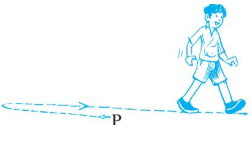
AnswerLet us denote the distance travelled towards east by positive sign.
So, the distances towards west would be denoted by negative sign.
Thus, distance of Satpal from the point $P$ would be$\frac{2}{3}+\left(-1 \frac{5}{7}\right)=\frac{2}{3}+\frac{(-12)}{7}=\frac{2 \times 7}{3 \times 7}+\frac{(-12) \times 3}{7 \times 3}$
$=\frac{14-36}{21}=\frac{-22}{21}=-1 \frac{1}{21}$
Since it is negative, it means Satpal is at a distance $1 \frac{1}{21}$ km towards west of $P.$
View full question & answer→Question 402 Marks
Write four more numbers in the pattern: $\frac{-1}{3}, \frac{-2}{6}, \frac{-3}{9}, \frac{-4}{12},...$
AnswerWe have, $\frac{-2}{6}=\frac{-1 \times 2}{3 \times 2}, \frac{-3}{9}=\frac{-1 \times 3}{3 \times 3}, \frac{-4}{12}=\frac{-1 \times 4}{3 \times 4}$
or $\frac{-1 \times 1}{3 \times 1}=\frac{-1}{3}, \frac{-1 \times 2}{3 \times 2}=\frac{-2}{6}$ $\frac{-1 \times 3}{3 \times 3}=\frac{-3}{9}, \frac{-1 \times 4}{3 \times 4}=\frac{-4}{12}$
Thus, we observe a pattern in these numbers.
The other numbers would be $\frac{-1 \times 5}{3 \times 5}=\frac{-5}{15}, \frac{-1 \times 6}{3 \times 6}=\frac{-6}{18}, \frac{-1 \times 7}{3 \times 7}=\frac{-7}{21}$
View full question & answer→Question 412 Marks
Reduce $\frac{-45}{30}$ to the standard form.
AnswerHere, $\frac{-45}{30}=\frac{-45 \div 3}{30 \div 3}=\frac{-15}{10}=\frac{-15 \div 5}{10 \div 5}=\frac{-3}{2}$
View full question & answer→