Question 13 Marks
Prove that $\frac{\cot A}{1-\cot A}+\frac{\tan A}{1-\tan A}=-1$
Answer$\text { L.H.S }=\frac{\cot A}{1-\cot A}+\frac{\tan A}{1-\tan A}$
$=\frac{\cot A}{1-\frac{1}{\tan A}}+\frac{\tan A}{1-\tan A}$
$=\frac{\cot A}{\frac{\tan A-1}{\tan A}}+\frac{\tan A}{1-\tan A}$
$=\frac{\cot A \tan A}{\tan A-1}+\frac{\tan A}{1-\tan A}$
$=\frac{1}{\tan A-1}+\frac{\tan A}{1-\tan A} \quad \ldots \ldots[\because \cot A \tan A=1]$
$=-\frac{1}{1-\tan A}+\frac{\tan A}{1-\tan A}$
$=-\left(\frac{1}{1-\tan A}-\frac{\tan A}{1-\tan A}\right)$
$=-\left(\frac{1-\tan A }{1-\tan A }\right)$
$=-1$
$=\text { R.H.S }$
$\therefore \frac{\cot A}{1-\cot A}+\frac{\tan A}{1-\tan A}=-1$
View full question & answer→Question 23 Marks
Draw a circle of radius 4.2 cm. Draw arc PQ measuring 120°. Draw a tangent to the circle from point P and point Q
Answer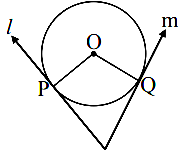 Analysis:
Let O be the centre of the circle.Here, ∠POQ = m(arc PQ) ......[Definition of measure of minor arc]∴ On drawing ∠POQ = 120°, we get an arcPQ measuring 120°.line l and line m are tangents to the circle.line l ⊥ seg OP and line m ⊥ seg OQ ......[Tangent theorem]∴ To get tangents l and m, we draw perpendiculars to seg OP and seg OQ at points P and Q respectively.
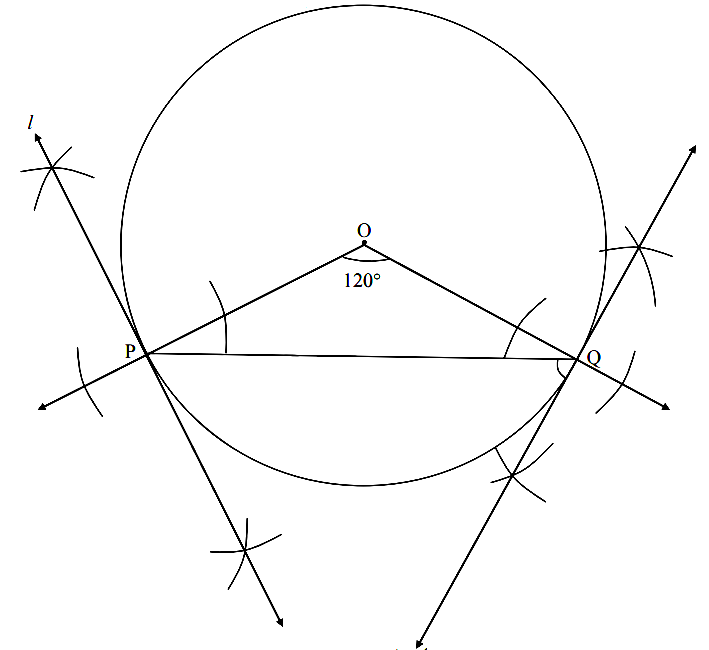 Steps of construction:
- Draw a circle of radius 4.2 cm with centre O.
- Draw rays OP and OQ such that ∠POQ = 120°. (Points P and Q must be on the circle.)
- Draw line l ⊥ ray OP at point P
- Draw line m ⊥ ray OQ at point Q.
Line l and m are the required tangents.
View full question & answer→Question 33 Marks
Prove that $\frac{\sin \theta+\operatorname{cosec} \theta}{\sin \theta}=2+\cot ^2 \theta$
Answer$\text { L.H.S }=\frac{\sin \theta+\operatorname{cosec} \theta}{\sin \theta}$
$=\frac{\sin \theta}{\sin \theta}+\frac{\operatorname{cosec} \theta}{\sin \theta}$
$=1+\operatorname{cosec} \theta \times \operatorname{cosec} \theta \quad \ldots \ldots\left[\because \operatorname{cosec} \theta=\frac{1}{\sin \theta}\right]$
$=1+\operatorname{cosec}^2 \theta$
$=1+1+\cot ^2 \theta \quad \ldots \ldots\left[\because 1+\cot ^2 \theta=\operatorname{cosec}^2 \theta\right]$
$=2+\cot ^2 \theta$
$=\text { R.H.S }$
$\therefore \frac{\sin \theta+\operatorname{cosec} \theta}{\sin \theta}=2+\cot ^2 \theta$
View full question & answer→Question 43 Marks
Draw a circle with a radius of 3.5 cm. Take the point K anywhere on the circle. Draw a tangent to the circle from K (without using the center of the circle)
Answer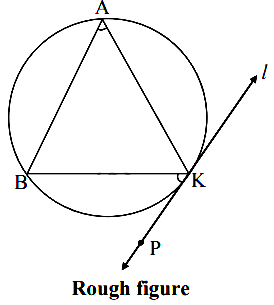
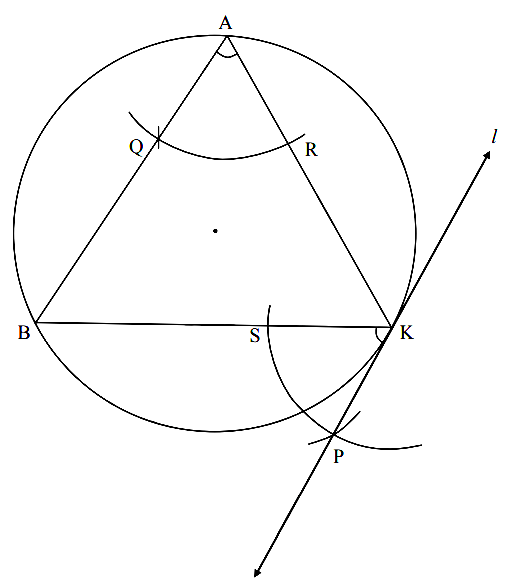 Steps of construction:
- Draw a circle of radius 3.5 cm and take any point K on it.
- Draw chord BK of any length and an inscribed ∠BAK of any measure.
- By taking A as centre and any convenient distance on compass draw an arc intersecting the arms of ∠BAK in points Q and R.
- With K as centre and the same distance in the compass, draw an arc intersecting the chord BK at point S.
- Taking radius equal to QR and S as centre, draw an arc intersecting the previously drawn arc. Name the point of intersection as P.
- Draw line KP.
Line KP is the required tangent to the circle.
View full question & answer→Question 53 Marks
Prove that $\frac{\sec A }{\tan A +\cot A }=\sin A$
Answer$\text { L.H.S }=\frac{\sec A }{\tan A +\cot A }$
$=\frac{\sec A }{\frac{\sin A }{\cos A }+\frac{\cos A }{\sin A }}$
$=\frac{\sec A }{\frac{\sin ^2 A +\cos ^2 A }{\cos A \sin A }}$
$=\frac{\sec A }{\frac{1}{\cos A \sin A }} \cdots \ldots \cdot\left[\cdot \sin ^2 A +\cos ^2 A =1\right]$
$=\sec A \cos A \sin A$
$=\frac{1}{\cos A } \times \cos A \sin A$
$=\sin A$
$=\text { R.H.S. }$
$\therefore \frac{\sec A }{\tan A +\cot A }=\sin A $
View full question & answer→Question 63 Marks
Draw a circle with center C and radius 3.2 cm. Draw a tangent to the circle from point P at a distance of 7.5 cm from the center of the circle
Answer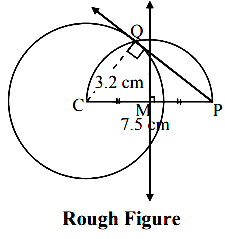
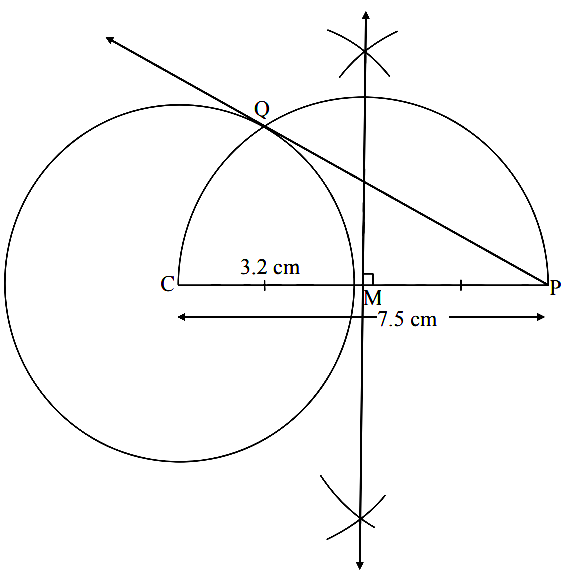 Steps of construction:
- With centre C, draw a circle of radius 3.2 cm
- Take point P such that CP = 7.5 cm
- Draw the perpendicular bisector of seg CP. It intersects CP in point M.
- With M as centre and radius equal to CM, draw an arc intersecting the circle in points Q.
- Draw ray PQ.
Ray PQ is the required tangent to the circle.
View full question & answer→Question 73 Marks
Prove that $\frac{\sin \theta}{\sec \theta+1}+\frac{\sin \theta}{\sec \theta-1}=2 \cot \theta$
Answer$ \text { L.H.S }=\frac{\sin \theta}{\sec \theta+1}+\frac{\sin \theta}{\sec \theta-1}$
$ =\frac{\sin \theta}{\frac{1}{\cos \theta}+1}+\frac{\sin \theta}{\frac{1}{\cos \theta}-1}$
$ =\frac{\sin \theta}{\frac{1+\cos \theta}{\cos \theta}}+\frac{\sin \theta}{\frac{1-\cos \theta}{\cos \theta}}$
$ =\frac{\sin \theta \cos \theta}{1+\cos \theta}+\frac{\sin \theta \cos \theta}{1-\cos \theta}$
$ =\sin \theta \cos \theta\left(\frac{1}{1+\cos \theta}+\frac{1}{1-\cos \theta}\right)$
$ =\sin \theta \cos \theta\left[\frac{1-\cos \theta+1+\cos \theta}{(1+\cos \theta)(1-\cos \theta)}\right]$
$ =\sin \theta \cos \theta\left(\frac{2}{1-\cos ^2 \theta}\right) \ldots \ldots\left[\because(a+b)(a-b)=a^2-b^2\right] $
$ =\sin \theta \cos \theta \times \frac{2}{\sin ^2 \theta} \cdots \cdots\left[\begin{array}{c}\because \sin ^2 \theta+\cos ^2 \theta=1 \\ \therefore 1-\cos ^2 \theta=\sin ^2 \theta\end{array}\right]$
$ =2 \times \frac{\cos \theta}{\sin \theta}$
$ =2 \cot \theta$
$ =\text{R.H.S}$
$ \therefore \frac{\sin \theta}{\sec \theta+1}+\frac{\sin \theta}{\sec \theta-1}=2 \cot \theta$
View full question & answer→Question 83 Marks
Draw a circle with center O and radius 3.6 cm. Draw a tangent to the circle from point B at a distance of 7.2 cm from the center of the circle.
Answer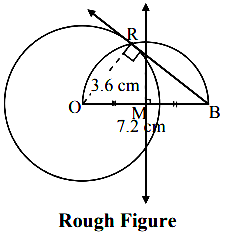 Analysis:
 As shown in the figure, let B be a point in the exterior of the circle at a distance of 7.2 cm from O. Let BR be the tangent to the circle at points R. ∴ seg OR ⊥ tangent BR ......[Tangent theorem] ∴ ∠ORB = 90° ∴ Point R is on the circle having OB as diameter. ......[Angle inscribed in a semicircle is a right angle] On drawing a circle with OB as diameter, the point where it intersects the circle with centre O, will be the position of point R.
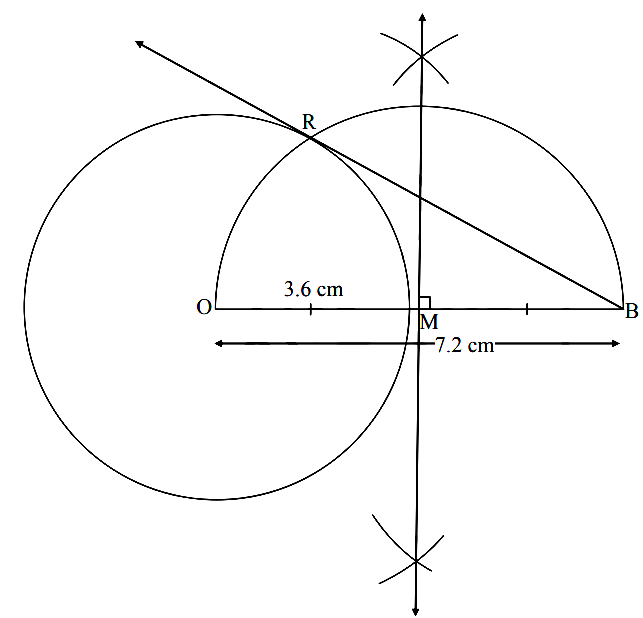 Steps of construction:
- With centre O, draw a circle of radius 3.6 cm
- Take point B such that OB = 7.2 cm
- Draw the perpendicular bisector of seg OB. It intersects OB in point M.
- With M as centre and radius equal to OM, draw an arc intersecting the circle in points R.
- Draw ray BR.
Ray BR is the required tangent to the circle.
View full question & answer→Question 93 Marks
Prove that $\frac{1+\sin \theta}{1-\sin \theta}=(\sec \theta+\tan \theta)^2$
Answer$ \text { L.H.S }=\frac{1+\sin \theta}{1-\sin \theta}$
$ =\frac{\frac{1+\sin \theta}{\cos \theta}}{\frac{1-\sin \theta}{\cos \theta}}$
$[$Dividing numerator and denominator by $\cos \theta ]$
$ =\frac{\frac{1}{\cos \theta}+\frac{\sin \theta}{\cos \theta}}{\frac{1}{\cos \theta}-\frac{\sin \theta}{\cos \theta}}$
$ =\frac{\sec \theta+\tan \theta}{\sec \theta-\tan \theta}$
$ =\frac{\sec \theta+\tan \theta}{\sec \theta-\tan \theta} \times \frac{\sec \theta+\tan \theta}{\sec \theta+\tan \theta} \ldots \ldots [$On rationalising the denominator$]$
$ =\frac{(\sec \theta+\tan \theta)^2}{\sec ^2 \theta-\tan ^2 \theta}$
$=\frac{(\sec \theta+\tan \theta)^2}{1} \cdots \cdot\left[\begin{array}{l}\because 1+\tan ^2 \theta=\sec ^2 \theta \\ \therefore \sec ^2 \theta-\tan ^2 \theta=1\end{array}\right]$
$ =(\sec \theta+\tan \theta)^2$
$ =\text { R.H.S }$
$ \therefore \frac{1+\sin \theta}{1-\sin \theta}=(\sec \theta+\tan \theta)^2$
View full question & answer→Question 103 Marks
Draw a circle with center $O$ and radius $3.4.$ Draw a chord $MN$ of length $5.7 \ cm$ in a circle. Draw tangents to the circle from point $M$ and $N$
Answer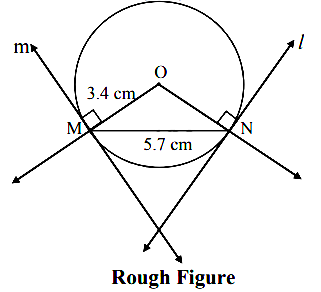
Analysis$:$
$\left.\begin{array}{l}\text { seg } ON \perp \text { line } 1 \\ \text { seg } OM \perp \text { line } m \end{array}\right\} .....[$Tangent theorem $]$
The perpendicular to $\text{seg} \ ON$ and $\operatorname{seg} OM$ at points $N$ and $M$ respectively will give the required tangents at $N$ and $M$.
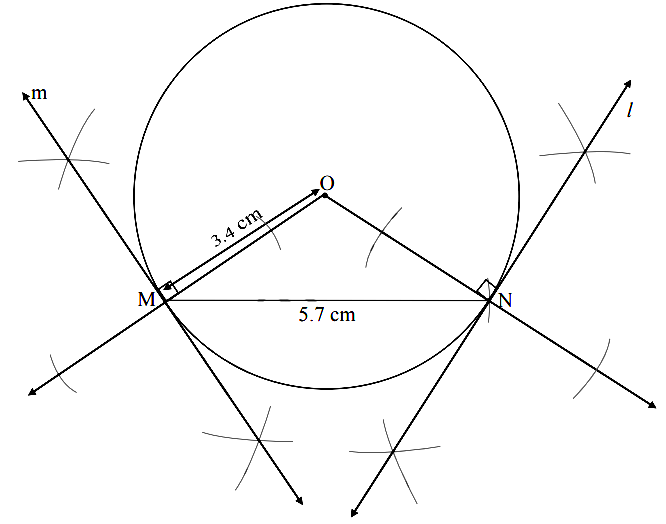
Steps of construction:
- With center $O,$ draw a circle of radius $3.4 \ cm$
- Draw chord $MN$ of length $5.7 \ cm$ in the circle.
- Draw rays $OM$ and $ON.$
- Draw line $l \perp$ ray $ON$ at point $N.$
- Draw line $m \perp$ ray $OM$ at point $M.$
- Lines $l$ and $m$ are the required tangents at points $M$ and $N$ to the circle.
View full question & answer→Question 113 Marks
In Quadrilateral $A B C D$, side $A D \| B C$, diagonal $A C$ and $B D$ intersect in point $P$, then prove that $\frac{ AP }{ PD }=\frac{ PC }{ BP }$
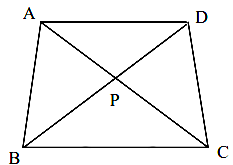
AnswerProof: seg $A D|| \operatorname{seg} B C$ and $B D$ is their transversal.
...[Given]
$\therefore \angle DBC \cong \angle BDA \quad \ldots$ [Alternate angles]
$\therefore \angle PBC \cong \angle PDA \quad$...(i) $[ D - P - B ]$
In $\triangle P B C$ and $\triangle P D A$,
$\angle P B C \cong \angle P D A \quad \ldots[$ From (i) $]$
$\angle B P C \cong \angle DPA \quad \ldots$ [Vertically opposite angles]
$\therefore \triangle PBC \sim \triangle PDA \quad \ldots[ AA$ test of similarity]
$\therefore \frac{ BP }{ PD }=\frac{ PC }{ AP } \quad \ldots[$ Corresponding sides of similar triangles $]$
$\therefore \frac{ AP }{ PD }=\frac{ PC }{ BP } \quad \ldots[$ By alternendo $]$
View full question & answer→Question 123 Marks
Prove that $\cot ^2 \theta-\tan ^2 \theta=\operatorname{cosec}^2 \theta-\sec ^2 \theta$
Answer$\text { L.H.S }=\cot ^2 \theta-\tan ^2 \theta$
$=\left(\operatorname{cosec}^2 \theta-1\right)-\left(\sec ^2 \theta-1\right) \quad \cdots \cdot\left[\because \tan ^2 \theta=\sec ^2 \theta-1\cot ^2 \theta=\operatorname{cosec}^2 \theta-1\right]$
$=\operatorname{cosec}^2 \theta-1-\sec ^2 \theta+1$
$=\operatorname{cosec}^2 \theta-\sec ^2 \theta$
$=\text { R.H.S }$
$\therefore \cot ^2 \theta-\tan ^2 \theta=\operatorname{cosec}^2 \theta-\sec ^2 \theta$
View full question & answer→Question 133 Marks
Construct an equilateral ∆ABC with side 5 cm. ∆ABC ~ ∆LMN, ratio the corresponding sides of triangle is 6 : 7, then construct ΔLMN and ΔABC
Answer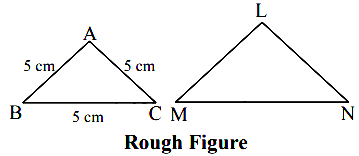
Analysis: $\triangle ABC \sim \triangle LMN$
$\therefore \frac{ AB }{ LM }=\frac{ BC }{ MN }=\frac{ AC }{ LN } \ldots . . .[$ Corresponding sides of similar triangles]
$\therefore \frac{5}{ LM }=\frac{5}{ MN }=\frac{5}{ LN }=\frac{6}{7} \quad \ldots .$. [Given]
$\therefore \frac{5}{ LM }=\frac{6}{7}$
$\therefore L M=\frac{5 \times 7}{6}$
$\therefore LM =5.8 cm$ (approx)
$\therefore L M=M N=L N=5.8 cm$ (approx) $\quad \ldots .$. [Equilateral triangle]
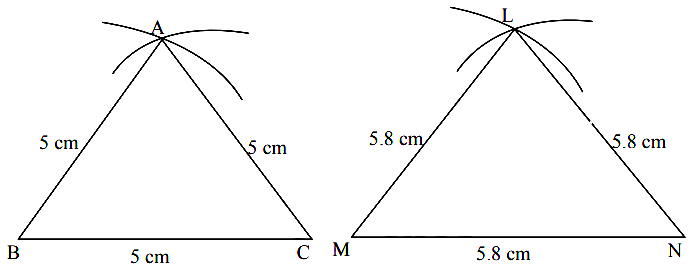
Steps of Construction:
| |
/_\ABC |
/_\PQR |
| i. |
Draw seg BC of 5cm |
Draw seg MN of 5.8 cm |
| ii. |
Draw two arcs at 5cm from point B and point Cspectively. |
Draw two arcs at 5.8 cm from point M and point respectively. |
| iii. |
Name the point of intersection of two arcs as A. |
Name the point of intersection of two arcs as L. |
| iv. |
Join seg AB and seg AC. |
Join seg LM and seg LN. |
View full question & answer→Question 143 Marks
Prove that $\frac{\tan (90-\theta)+\cot (90-\theta)}{\operatorname{cosec} \theta}=\sec \theta$
Answer$\text{L.H.S} =\frac{\tan (90-\theta)+\cot (90-\theta)}{\operatorname{cosec} \theta}$
$=\frac{1}{\operatorname{cosec} \theta}(\cot \theta+\tan \theta) \ldots \ldots\left[\begin{array}{c}\because \tan (90-\theta)=\cot \theta \\ \cot (90-\theta)=\tan \theta\end{array}\right]$
$ =\sin \theta(\cot \theta+\tan \theta)$
$ =\sin \theta\left(\frac{\cos \theta}{\sin \theta}+\frac{\sin \theta}{\cos \theta}\right)$
$ =\sin \theta\left(\frac{\cos ^2 \theta+\sin ^2 \theta}{\sin \theta \cos \theta}\right)$
$ =\sin \theta\left(\frac{1}{\sin \theta \cos \theta}\right) \ldots \ldots\left[\because \sin ^2 \theta+\cos ^2 \theta=1\right]$
$ =\frac{1}{\cos \theta}$
$ =\sec \theta$
$ =\text { R.H.S }$
$ \therefore \frac{\tan (90-\theta)+\cot (90-\theta)}{\operatorname{cosec} \theta}=\sec \theta$
View full question & answer→Question 153 Marks
Point $P(– 4, 6)$ divides point $A(– 6, 10)$ and $B(m, n)$ in the ratio $2:1,$ then find the coordinates of point $B$
AnswerBy section formula
$ -4=\frac{2 \times m+1 \times(-6)}{2+1}$
$\therefore-4=\frac{2 m-6}{3}$
$\therefore-12=2 m-6$
$\therefore 2 m=-6$
$\therefore=\frac{2 \times n+1 \times 10}{2+1}$
$\therefore 6=\frac{2 n+10}{3}$
$\therefore 18=2 n+10$
$\therefore n=4$
$\therefore n=8$
Co-ordinates of point $B$ are $(-3,4)$.
View full question & answer→Question 163 Marks
ΔPQR ~ ΔABC. In ΔPQR, PQ = 3.6cm, QR = 4 cm, PR = 4.2 cm. Ratio of the corresponding sides of triangle is 3 : 4, then construct ΔPQR and ΔABC
Answer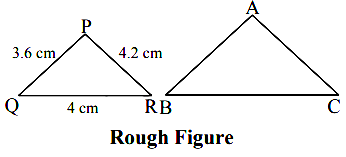
Analysis: $\triangle P Q R \sim \triangle A B C$
$\therefore \frac{ PQ }{ AB }=\frac{ QR }{ BC }=\frac{ PR }{ AC } \ldots . . .[$ Corresponding sides of similar triangles]
$\therefore \frac{3.6}{ AB }=\frac{4}{ BC }=\frac{4.2}{ AC }=\frac{3}{4} \quad \ldots . . .[$ Given]
:.(3.6)/(AB)=(3)/(4)
:.AB=(3.6 xx4)/(3)
:.AB=1.2 xx4
:.AB=4.8 cm |
(4)/(BC)=(3)/(4)
:.BC=(4xx4)/(3)
:.BC=(16)/(3)
:.BC=5.3 cm (approx) |
(4.2)/(AC)=(3)/(4)
:.AC=(4.2 xx4)/(3)
:.AC=1.4 xx4
:.AC=5.6 cm |
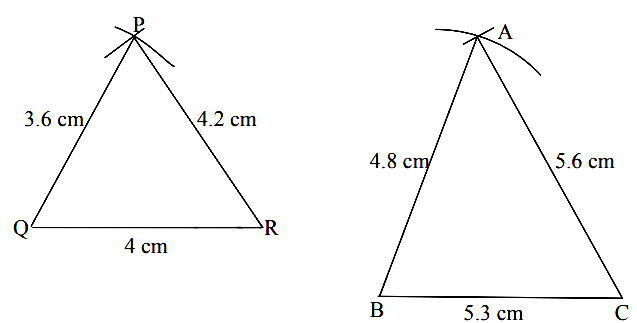
Steps of Construction:
| |
/_\PQR |
/_\ABC |
| i. |
Draw seg QR of 4cm |
Draw seg BC of 5.3 cm |
| ii. |
Taking 3.6 cm and 4.2 cm distances on compass draw two arcs from Q and R respectively |
Taking 4.8 cm and 5.6 cm distance on compass draw two arcs from point B and C respectively. |
| iii. |
Name the point of intersection as P. |
Name the point of intersection as A. |
View full question & answer→Question 173 Marks
In given fig., quadrilateral PQRS, side PQ || side SR, AR = 5 AP, then prove that, SR = 5PQ
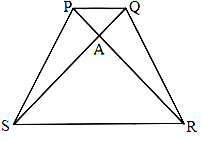
Answerside $P Q$ || side $S R$ and seg $S Q$ is their transversal.
...[Given]
$\therefore \angle Q S R \cong \angle S Q P$
...[Alternative angles]
$\therefore \angle ASR \cong \angle AQP$
(i) $[Q-A-S]$
In $\triangle ASR$ and $\triangle AQP$,
$\angle ASR \cong \angle AQP$ [From (i)]
$\angle S A R \cong \angle Q A P$ [Vertically opposite angles]
$\therefore \triangle ASR \sim \triangle AQP$
[AA test of similarity]
$\therefore \frac{ AR }{ AP }=\frac{ SR }{ PQ }$
(ii)[Corresponding sides of similar triangles]
But, $AR =5 AP$ [Given]
$\therefore \frac{ AR }{ AP }=\frac{5}{1}$
$\therefore \frac{ SR }{ PQ }=\frac{5}{1}$
[From (ii) and (iii)]
$\therefore S R=5 P Q$
View full question & answer→Question 183 Marks
If 5 sec θ – 12 cosec θ = 0, then find values of sin θ, sec θ
Answer$5 \sec \theta-12 \operatorname{cosec} \theta=0$ [Given]
$\therefore 5 \sec \theta=12 \operatorname{cosec} \theta$
$\therefore \frac{5}{\cos \theta}=\frac{12}{\sin \theta} \quad \ldots \ldots\left[\because \sec \theta=\frac{1}{\cos \theta}, \operatorname{cosec} \theta=\frac{1}{\sin \theta}\right]$
$\therefore \frac{\sin \theta}{\cos \theta}=\frac{12}{5}$
$\therefore \tan \theta=\frac{12}{5}$
We know that,
$1+\tan ^2 \theta=\sec ^2 \theta$
$\therefore 1+\left(\frac{12}{5}\right)^2=\sec ^2 \theta$
$\therefore 1+\frac{144}{25}=\sec ^2 \theta$
$\therefore \frac{25+144}{25}=\sec ^2 \theta$
$\therefore \sec ^2 \theta=\frac{169}{25}$
$\therefore \sec \theta=\frac{13}{5}$
[Taking square root of both sides]Now, $\cos \theta=\frac{1}{\sec \theta}$
$=\frac{1}{\left(\frac{13}{5}\right)}$
$\therefore \cos \theta=\frac{5}{13}$
We know that,
$ \sin ^2 \theta+\cos ^2 \theta=1$
$\therefore \sin ^2 \theta+\left(\frac{5}{13}\right)^2=1$
$\therefore \sin ^2 \theta+\frac{25}{169}=1$
$\therefore \sec ^2 \theta=1-\frac{25}{169}$
$\therefore \sec ^2 \theta=\frac{169-25}{169}$
$\therefore \sec ^2 \theta=\frac{144}{169}$
$\therefore \sin \theta=\frac{12}{13} \ldots . .[\text { Taking square root of both sides] }$
$\therefore \sin \theta=\frac{12}{13}, \text { sec } \theta=\frac{13}{5} . $
View full question & answer→Question 193 Marks
Show that the point $(0, 9)$ is equidistant from the points $(– 4, 1)$ and $(4, 1)$
AnswerLet $P\left(x_1, y_1\right)=P(0,9), Q\left(x_2, y_2\right)=Q(-4,1), R\left(x_3, y_3\right)=R(4,1)$
By distance formula,
$ d(P, Q)=\sqrt{\left(x_2-x_1\right)^2+\left(y_2-y_1\right)^2}$
$=\sqrt{[(-4)-0]^2+(1-9)^2}$
$=\sqrt{(-4)^2+(-8)^2}$
$=\sqrt{16+64}$
$=\sqrt{80}$
$=4 \sqrt{5} $
And
$ d(P, R)=\sqrt{\left(x_3-x_1\right)^2+\left(y_3-y_1\right)^2}$
$=\sqrt{(4-0)^2+(1-9)^2}$
$=\sqrt{4^2+(-8)^2}$
$=\sqrt{16+64}$
$=\sqrt{80}$
$=4 \sqrt{5} $
And
$d(P, R)=\sqrt{\left(x_3-x_1\right)^2+\left(y_3-y_1\right)^2}$
$=\sqrt{(4-0)^2+(1-9)^2}$
$=\sqrt{4^2+(-8)^2}$
$=\sqrt{16+64}$
$=\sqrt{80}$
$=4 \sqrt{5}$
Here, $d(P, Q)=d(P, R)$
$\therefore$ The point $(0,9)$ is equidistant from $(-4,1)$ and $(4,1)$.
View full question & answer→Question 203 Marks
$\triangle RHP \sim \triangle NED$, In $\triangle NED , NE =7 cm , \angle D =30^{\circ}, \angle N =20^{\circ}$ and $\frac{ HP }{ ED }=\frac{4}{5}$. Then construct $\triangle RHP$ and $\triangle N E D$
Answer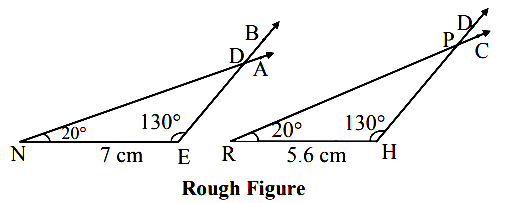
In $\triangle N E D, \angle D=30^{\circ}$
and $\angle N =20^{\circ}$ (i) [Given]
$\therefore \angle E=130^{\circ}$
....(ii) [Remaining angle of a triangle]
$\triangle RHP \sim \triangle NED$
$\therefore \frac{ RH }{ NE }=\frac{ HP }{ ED }=\frac{ PR }{ DN } \ldots$....[Corresponding sides of similar triangles]
$\therefore \frac{ RH }{7}=\frac{4}{5} \quad \ldots . . .[$ Given]
$\therefore RH =\frac{4 \times 7}{5}=5.6 cm$
Also, $\angle R =\angle N , \angle H =\angle E , \angle P =\angle D$ (iii) [Corresponding angles of similar triangles]
$\therefore \angle R =20^{\circ}, \angle H =130^{\circ}, \angle P =30^{\circ}$ [From (i),(ii) and (iii)]
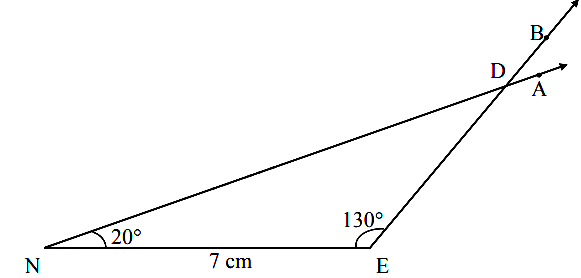
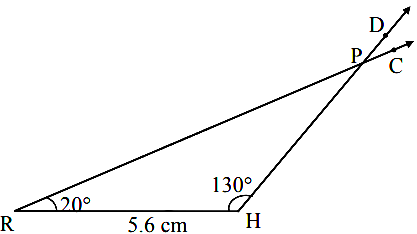
Steps of Construction:
| /_\NED |
Delta RHP |
| Draw seg NE of 7cm |
Draw seg RH of 5.6 cm |
| Draw a ray NA and EB such that /_ANE=20^(@) and /_BEN=130^(@). |
Draw a ray RC and HD such that /_CRH=20^(@) and /_DHR=130^(@). |
| Name the point of intersection of r |
Name the point of intersection of rays P. |
View full question & answer→Question 213 Marks
A congruent side of an isosceles right angled triangle is 7 cm, Find its perimeter
Answer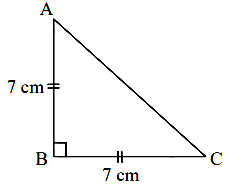
Given: In $\triangle ABC , \angle ABC =90^{\circ}, AB = BC =7 cm$
To find: Perimeter of $\triangle ABC$
In $\triangle ABC , \angle ABC =90^{\circ}$ [Given]
$\therefore A C^2=A B^2+B C^2$ [Pythagoras theorem]
$\therefore A C^2=(7)^2+(7)^2$
$\therefore A C^2=49+49$
$\therefore A C^2=98$
$\therefore AC =\sqrt{49 \times 2}$ [Taking square root of both sides]
Perimeter of $\triangle ABC = AB + BC + AC$
$=7+7+7 \sqrt{2}$
$=14+7 \sqrt{2} cm$
$=7(2+\sqrt{2})$
$\therefore$ The perimeter of the given triangle is $7(2+\sqrt{2}) cm$ View full question & answer→Question 223 Marks
In ΔABC, B − D − C and BD = 7, BC = 20, then find the following ratio.
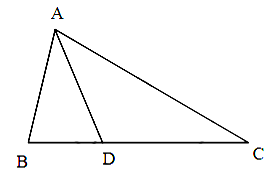
AnswerDraw AE ⊥ BC, B – E – C.
![]()
$
B C=B D+D C
$
$
\therefore 20=7+ DC
$
$
\therefore DC =20-7=13
$
(i) $\triangle ABD$ and $\triangle ADC$ have same height $AE$.
$\frac{ A (\Delta ABD )}{ A (\Delta ADC )}=\frac{ BD }{ DC } \ldots . . .[$ Triangles having equal height $]$
$
\therefore \frac{ A (\Delta ABD )}{ A (\Delta ADC )}=\frac{7}{13}
$
(ii) $\triangle ABD$ and $\triangle ABC$ have same height $AE$.
$\frac{ A (\triangle ABD )}{ A (\triangle ABC )}=\frac{ BD }{ BC } \quad \ldots . . .[$ Triangles having equal height $]$
$
\therefore \frac{ A (\Delta ABD )}{ A (\Delta ABC )}=\frac{7}{20}
$
(iii) $\triangle ADC$ and $\triangle ABC$ have same height $AE$.
$\frac{ A (\triangle ADC )}{ A (\triangle ABC )}=\frac{ DC }{ BC } \ldots \ldots . .[$ Triangles having equal height $]$
$
\therefore \frac{ A (\triangle ADC )}{ A (\Delta ABC )}=\frac{13}{20}
$
View full question & answer→Question 233 Marks
Prove that $\frac{1+\sin B}{\cos B}+\frac{\cos B}{1+\sin B}=2 \sec B$
Answer$\text { L.H.S }=\frac{1+\sin B }{\cos B }+\frac{\cos B }{1+\sin B }$
$=\frac{(1+\sin B )^2+\cos ^2 B }{\cos B (1+\sin B )}$
$=\frac{1+2 \sin B +\sin ^2 B +\cos ^2 B }{\cos B (1+\sin B )} \quad \ldots \ldots\left[\because \cdot( a + b )^2= a ^2+2 a b+b^2\right]$
$=\frac{1+2 \sin B +1}{\cos B (1+\sin B )} \quad \ldots . .\left[\because \sin ^2 B +\cos ^2 B =1\right]$
$=\frac{2+2 \sin B }{\cos B (1+\sin B )}$
$=\frac{2(1+\sin B )}{\cos B (1+\sin B )}$
$=\frac{2}{\cos B }$
$=2 \sec B$
$=\text { R.H.S }$
$\therefore \frac{1+\sin B }{\cos B }+\frac{\cos B }{1+\sin B }=2 \sec B $
View full question & answer→Question 243 Marks
If $\sin A=\frac{3}{5}$ then show that $4 \tan A+3 \sin A=6 \cos A$
Answer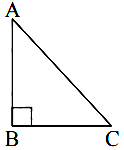
$\sin A =\frac{3}{5} \quad \ldots$ (i) [Given]
In $\triangle ABC$
Let $\angle A B C=90^{\circ}$
$\therefore \sin A =\frac{ BC }{ AC }$
(ii) [By definition]
$\therefore \frac{ BC }{ AC }=\frac{3}{5} \quad \ldots . . .[$ From (i) and (ii)]
Let $B C=3 k, A C=5 k$
In $\triangle ABC , \angle B =90^{\circ}$
$\therefore AB ^2+ BC ^2= AC ^2$ [Pythagoras theorem]
$\therefore A B^2+(3 k)^2=(5 k)^2$
$\therefore AB ^2+9 K ^2=25 k ^2$
$\therefore A B^2=25 k^2-9 k^2$
$\therefore A B^2=16 k^2$
$\therefore AB =4 k$ [Taking square root of both sides]
Now, $\tan A =\frac{ BC }{ AB }$ [By definition]
$\therefore \tan A =\frac{3 k }{4 k }=\frac{3}{4}$
$\cos A =\frac{ AB }{ AC }$ [By definition]
$\therefore \cos A =\frac{4 k }{5 k }=\frac{4}{5}$
$\therefore 4 \tan A +3 \sin A =4\left(\frac{3}{4}\right)+3\left(\frac{3}{5}\right)$
$=3+\frac{9}{5}$
$=\frac{15+9}{5}$
$=\frac{24}{5} \ldots \ldots . . \text { (iii) }$
$6 \cos A =6\left(\frac{4}{5}\right)=\frac{24}{5} \ldots . . . \text { (iv) }$
$\therefore 4 \tan A+3 \sin A=6 \cos A \quad \ldots . .[$ From (iii) and (iv)] View full question & answer→Question 253 Marks
Prove that $\frac{1+\sec A }{\sec A }=\frac{\sin ^2 A }{1-\cos A }$
Answer$ \text { L.H.S }=\frac{1+\sec A}{\sec A}$
$ =\frac{1}{\sec A}+\frac{\sec A}{\sec A}$
$ =\cos A+1$
$ =(1+\cos A) \times \frac{1-\cos A}{1-\cos A}$
$ =\frac{1-\cos ^2 A}{1-\cos A}$
$=\frac{\sin ^2 A}{1-\cos A} ........ \left[\begin{array}{l}\because \sin ^2 A+\cos ^2 A=1 \\ \therefore 1-\cos ^2 A=\sin ^2 A\end{array}\right]$
$ =\text { R.H.S }$
$ \therefore \frac{1+\sec A}{\sec A}=\frac{\sin ^2 A}{1-\cos A}$
View full question & answer→Question 263 Marks
In $\triangle A B C, \cos C=\frac{12}{13}$ and $B C=24$, then $A C=$ ?
Answer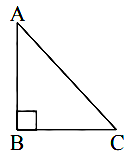
$\cos C=\frac{12}{13}$
.....(i) [Given]
In $\triangle ABC$,
Let $\angle A B C=90^{\circ}$
$\therefore \cos C =\frac{ BC }{ AC } \quad \ldots .$. (ii) [By definition]
$\therefore \frac{ BC }{ AC }=\frac{12}{13} \ldots \ldots[$ From (i) and (ii) $]$
$\therefore \frac{24}{ AC }=\frac{12}{13}$
$\therefore \frac{24 \times 13}{12}= AC$
$\therefore \frac{312}{12}= AC$
$\therefore AC =26$ units View full question & answer→Question 273 Marks
Prove that $\operatorname{cosec} \theta-\cot \theta=\frac{\sin \theta}{1+\cos \theta}$
Answer$\text { L.H.S }=\operatorname{cosec} \theta-\cot \theta$
$=\frac{1}{\sin \theta}-\frac{\cos \theta}{\sin \theta}$
$=\frac{1-\cos \theta}{\sin \theta}$
$=\frac{1-\cos \theta}{\sin \theta} \times \frac{1+\cos \theta}{1+\cos \theta} \quad \ldots . .[\text { On rationalising the numerator] }$
$=\frac{1-\cos ^2 \theta}{\sin \theta(1+\cos \theta)}$
$\left.=\frac{\sin 2 \theta}{\sin \theta(1+\cos \theta)} \quad \ldots . . . \sin ^2 \theta+\cos ^2 \theta=1\right]$
$\left.\therefore .1-\cos ^2 \theta=\sin ^2 \theta\right]$
$=\frac{\sin \theta}{1+\cos \theta} \quad \text { R.H.S }$
$\therefore \operatorname{cosec} \theta-\cot \theta=\frac{\sin \theta}{1+\cos \theta}$
View full question & answer→Question 283 Marks
Prove that $\sec ^2 \theta-\cos ^2 \theta=\tan ^2 \theta+\sin ^2 \theta$
Answer$\text { L.H.S }=\sec ^2 \theta-\cos ^2 \theta$
$ =\sec ^2 \theta-\left(1-\sin ^2 \theta\right) \quad \ldots \ldots \cdot\left[\because \sin ^2 \theta+\cos ^2 \theta=1\therefore 1-\sin ^2 \theta=\cos ^2 \theta\right]$
$=\sec ^2 \theta-1+\sin ^2 \theta \quad$
$=\tan ^2 \theta+\sin ^2 \theta \quad \ldots \ldots \cdot\left[\because 1+\tan ^2 \theta=\sec ^2 \theta\therefore \tan ^2 \theta=\sec ^2 \theta-1\right]$
$=\text { R.H.S }$
$\therefore \sec ^2 \theta-\cos ^2 \theta=\tan ^2 \theta+\sin ^2 \theta$
View full question & answer→Question 293 Marks
Prove that $\sin^4A – \cos^4A = 1 – 2 \cos^2A$
Answer$ \text { L.H.S }=\sin ^4 A-\cos ^4 A$
$ =\left(\sin ^2 A\right)^2-\left(\cos ^2 A\right)^2$
$ =\left(\sin ^2 A+\cos ^2 A\right)\left(\sin ^2 A-\cos ^2 A\right) \ldots \ldots\left[\because a^2-b^2=(a+b)(a-b)\right]$
$ =(1)\left(\sin ^2 A-\cos ^2 A\right) \ldots \ldots\left[\because \sin ^2 A+\cos ^2 A=1\right]$
$ =\sin ^2 A-\cos ^2 A$
$=\left(1-\cos ^2 A\right)-\cos ^2 A \ldots \ldots\left[\begin{array}{l}\left.\sin ^2 A+\cos ^2 A=1\right] \\ \left.\therefore 1-\cos ^2=\sin ^2 A\right]\end{array}\right.$
$ =1-2 \cos ^2 A$
$ =\text { R.H.S }$
$ \therefore \sin ^4 A-\cos ^4 A=1-2 \cos ^2 A$
View full question & answer→Question 303 Marks
Draw a circle of radius 3 cm and draw chord XY 5 cm long. Draw the tangent of the circle passing through point X and point Y (without using the center of the circle)
Answer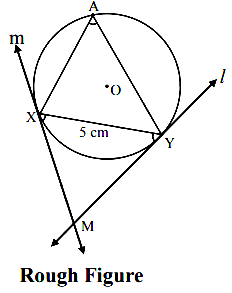 Analysis:
As shown in the figure, line l, m are the tangents to the circle at points Y, X respectively.seg XY is a chord of the circle and ∠XAY is an inscribed angle. By tangent secant angle theorem,∠XAY = ∠YXM and ∠XAY = ∠XYMBy converse of tangent secant angle theorem,If we draw ∠XYM such that ∠XAY = ∠XYM, then ray YMi.e. (line l) is a tangent at point Y.Also, if we draw ∠YXM such that ∠XAY = ∠YXM, then ray XM.i.e. (line m) is a tangent at point X.
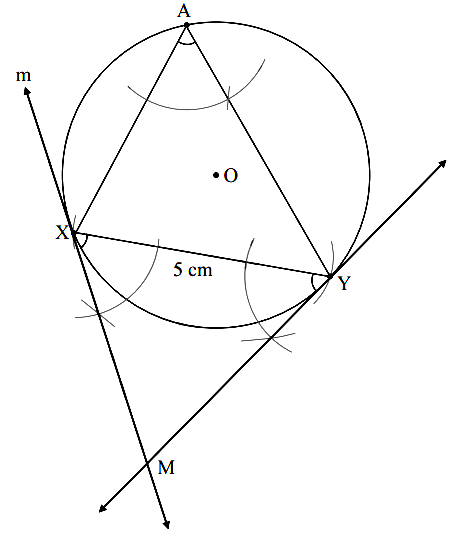 Steps of construction:
- Draw a circle of radius 3 cm.
- Draw a chord XY of length 5 cm.
- Take a point A on the major arc, other than X and Y.
- Join XA and YA.
- Using X and Y as vertices and chord XY as one side, draw ∠XYM and ∠YXM equal to ∠XAY.
- Lines containing the rays XM and YM are the tangents to the circle at X and Y respectively.
View full question & answer→Question 313 Marks
Prove that $\sqrt{\frac{1+\cos A}{1}}=\operatorname{cosec} A+\cot A$
Answer$ \text { L.H.S }=\sqrt{\frac{1+\cos A}{1-\cos A}}$
$ =\sqrt{\frac{1+\cos A}{1-\cos A} \times \frac{1+\cos A}{1+\cos A}} \ldots \ldots [ $On rationalising the denominator$]$
$ =\sqrt{\frac{(1+\cos A)^2}{1-\cos ^2 A}}$
$=\sqrt{\frac{(1+\cos A)^2}{\sin ^2 A}} \quad \ldots \ldots\left[\begin{array}{l}\because \sin ^2 A+\cos ^2 A=1 \\ \therefore 1-\cos ^2 A=\sin ^2 A\end{array}\right]$
$ =\frac{1+\cos A}{\sin A}$
$ =\frac{1}{\sin A}+\frac{\cos A}{\sin A}$
$ =\operatorname{cosec} A+\cot A$
$ =\text { R.H.S }$
$ \therefore \sqrt{\frac{1+\cos A}{1-\cos A}}=\operatorname{cosec} A+\cot A$
View full question & answer→Question 323 Marks
Draw a circle of radius 4.2 cm. Draw a tangent to the circle from a point 7 cm away from the center of the circle
Answer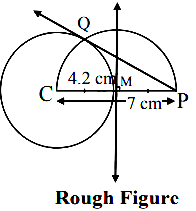
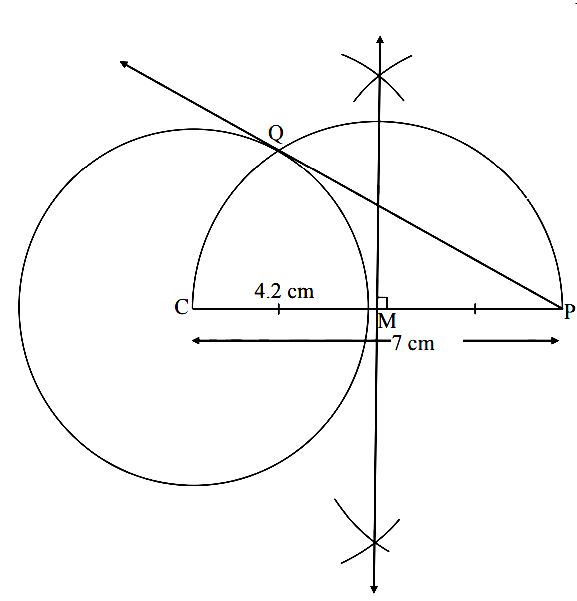 Steps of construction:
- With centre C, draw a circle of radius 4.2 cm
- Take point P such that CP = 7 cm.
- Draw the perpendicular bisector of seg CP. It intersects CP in point M.
- With M as centre and radius equal to CM, draw an arc intersecting the circle in points Q.
- Draw ray PQ.
Ray PQ is the required tangent to the circle.
View full question & answer→Question 333 Marks
If $\sec \theta=\frac{41}{40}$, then find values of $\sin \theta, \cot \theta, \operatorname{cosec} \theta$
Answer$\sec \theta=\frac{41}{40} \quad \ldots . . . \text { [Given] }$
$\therefore \cos \theta=\frac{1}{\sec \theta}=\frac{1}{\frac{41}{40}}$
$\therefore \cos \theta=\frac{40}{41} $
We know that,
$\sin ^2 \theta+\cos ^2 \theta=1$
$\therefore \sin ^2 \theta+\left(\frac{40}{41}\right)^2=1$
$\therefore \sin ^2 \theta+\frac{1600}{1681}=1$
$\therefore \sin ^2 \theta=1-\frac{1600}{1681}$
$\therefore \sin ^2 \theta=\frac{1681-1600}{1681}$
$\therefore \sin ^2 \theta=\frac{81}{1681}$
$\therefore \sin \theta=\frac{9}{41}$ [Taking square root of both sides]
Now, $\operatorname{cosec} \theta=\frac{1}{\sin \theta}$
$=\frac{1}{\left(\frac{9}{41}\right)}$
$=\frac{41}{9}$
$\cot \theta=\frac{\cos \theta}{\sin \theta}$
$=\frac{\left(\frac{40}{41}\right)}{\left(\frac{9}{41}\right)}$
$=\frac{40}{9}$
$\therefore \sin \theta=\frac{9}{41}, \cot \theta=\frac{40}{9}, \operatorname{cosec} \theta=\frac{41}{9}$
View full question & answer→Question 343 Marks
Show that $P(– 2, 2), Q(2, 2)$ and $R(2, 7)$ are vertices of a right angled triangle
AnswerDistance between two points $=\sqrt{\left(x_2-x_1\right)^2+\left(y_2-y_1\right)^2}$
By distance formula,
$ P Q=\sqrt{[2-(-2)]^2+(2-2)^2}$
$=\sqrt{(2+2)^2+(0)^2}$
$=\sqrt{(4)^2}$
$Q R=\sqrt{(2-2)^2+(7-2)^2}$
$=\sqrt{(0)^2+(5)^2}$
$=\sqrt{(5)^2}$
$=5 R=\sqrt{[(i i)}$
$=\sqrt{(4)^2+(5)^2}$
$=\sqrt{(2+2)^2+(5)^2}$
$=\sqrt{16+2)]^2+(7-2)^2}$
Now, $PR ^2=(\sqrt{41})^2=41$
Consider, $PQ ^2+ QR ^2$
$=4^2+5^2$
$=16+25$
$=41$
[From (i) and (ii)]
$\therefore P R^2=P Q^2+Q^2$ [From (iii)]
$\therefore \triangle P Q R$ is a right angled triangle. ...[Converse of Pythagoras theorem]
$\therefore$ Points $P, Q$, and $R$ are the vertices of a right angled triangle.
View full question & answer→Question 353 Marks
$\triangle ABC ~ \triangle PBQ$. In $\triangle ABC, AB = 3 cm, \angle B = 90^\circ, BC = 4 cm$. Ratio of the corresponding sides of two triangles is $7: 4$. Then construct $\triangle ABC$ and $\triangle PBQ$
Answer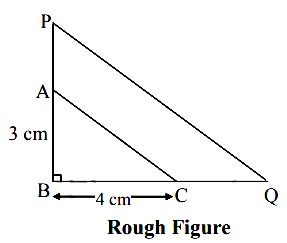
Analysis: As shown in the figure,
Let $B - A - P$ and $B - C - Q$.
$\triangle PBQ \sim \triangle ABC$
$\therefore \angle PQB \cong \angle ACB$ [Corresponding angles of similar triangles]
$\frac{ PB }{ AB }=\frac{ BQ }{ BC }=\frac{ PQ }{ AC }$
(i) [Corresponding sides of similar triangles]
$\therefore \frac{ PB }{ AB }=\frac{ BQ }{ BC }=\frac{ PQ }{ AC }=\frac{7}{4}$ [Given]
$\therefore$ Sides of $\triangle P B Q$ are longer than corresponding sides of $\triangle A B C$.
$\therefore$ If seg $BC$ is divided into 4 equal parts, then seg $BQ$ will be 7 times each part of seg $BC$.
So, if we construct $\triangle A B C$ point $Q$ will be on side $B C$, at a distance equal to 7 parts from $B$.
Now, point $P$ is the point of intersection of ray $A B$ and a line through $Q$, parallel to $A C$.
$\therefore \triangle PBQ$ is the required triangle similar to $\triangle ABC$
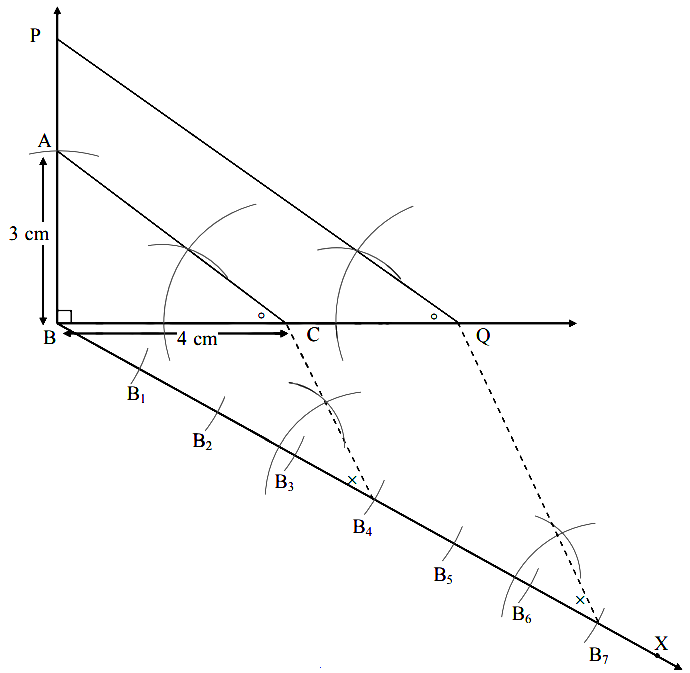
Steps of construction:
1. Draw seg $B C$ of length 4 cm .
2. Take $\angle B$ as $90^{\circ}$ and draw an arc of 3 cm on it. Name the point as A .
3. Join seg $A C$ to obtain $\triangle A B C$.
4. Draw ray $B X$ such that $\angle C B X$ is an acute angle.
5. Locate points $B _1, B_2, B_3, B_4, B_5, B_6, B_7$ on ray BX such that, $BB _1= B _1 B_2= B _2 B_3= B _3 B_4= B _4 B_5= B _5 B_6= B _6 B_7$.
6. Join point $C$ and $B_4$.
7. Through point, $B_7$ draw a line parallel to seg $C B_4$ which intersects seg $B C$ at point $Q$.
8. Draw a line parallel to $A C$ through $Q$ to intersect line $A B$ at point $P$.
$\triangle PBQ$ is the required triangle similar to $\triangle ABC$. View full question & answer→Question 363 Marks
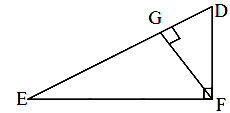
As shown figure, ∠DFE = 90°, FG ⊥ ED, if GD = 8, FG = 12, then EG = ?
Answer(i) In $\triangle DEF$,
$\angle DFE =90^{\circ}$ and seg FG $\perp$ hypotenuse ED ...[Given]
$\therefore F G^2=E G \times G D \quad \ldots . . .[B y$ theorem of geometric mean]
$\therefore(12)^2= EG \times 8 \quad \ldots . . .[$ Given $]$
$\therefore 144=E G \times 8$
$\therefore E G=\frac{144}{8}$
$\therefore EG =18$ units
(ii) In $\triangle D G F$,
$\angle DGF =90^{\circ} \quad \ldots \ldots[\because FG \perp ED ]$
$\therefore FD ^2= FG ^2+ GD ^2 \quad \ldots . . .[$ Pythagoras theorem $]$
$\therefore F D^2=(12)^2+(8)^2 \quad \ldots \ldots$ [Given]
$\therefore F D^2=144+64$
$\therefore FD ^2=208$
$\therefore FD =\sqrt{16 \times 13}$ [Taking square root of both sides]
$\therefore FD =4 \sqrt{13}$ units
(iii) In EGF,
$
\angle EGF =90^{\circ} \quad \ldots \ldots[\because FG \perp ED ]
$
$\therefore EF ^2= EG ^2+ FG ^2 \quad \ldots . . .[ Py$ thagoras theorem]
$\therefore EF ^2=(18)^2+(12)^2$ [From (i) and given]
$\therefore EF ^2=324+144$
$\therefore EF ^2=468$
$\therefore EF =\sqrt{36 \times 13}$ [Taking square root of both sides]
$\therefore EF =6 \sqrt{13}$ units
View full question & answer→Question 373 Marks
There are two poles having heights 8 m and 4 m on plane ground as shown in fig. Because of sunlight shadows of smaller pole is 6m long, then find the length of shadow of longer pole.
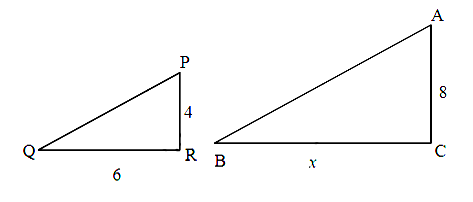
AnswerHere, $A C$ and $P R$ represent the bigger and smaller poles, and $B C$ and $Q R$ represent their shadows respectively.
Now,
$\triangle ACB \sim \triangle PRQ$ [Vertical poles and their shadows form similar figures]
$\therefore \frac{ CB }{ RQ }=\frac{ AC }{ PR }$ [Corresponding sides of similar triangles]
$\therefore \frac{x}{6}=\frac{8}{4}$
$\therefore x=\frac{8 \times 6}{4}$
$\therefore x =12 m$
$\therefore$ The shadow of the bigger pole will be 12 metres long at that time.
View full question & answer→