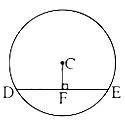
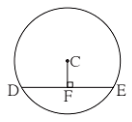
$\therefore DF \cong DE$
[[A perpendicular drawn from the centre of a circle on its chord bisects the chord]
$\therefore DF =\frac{1}{2} DE$
$=\frac{1}{2} \times 16$
[Given]
$\therefore DF =8 cm$
72 questions · self-marked practice — reveal the answer and mark yourself.


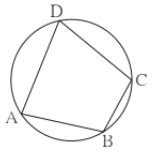
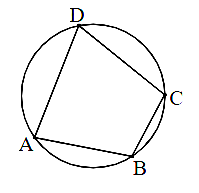
∠DAB = 75° .....[Given]
∠DAB + ∠DCB = 180° ......[Opposite angle of cyclic quadrilateral are supplementary]
∴ 75° + ∠ DCB = 180°
∴ ∠ DCB = 180° – 75°
∴ ∠ DCB = 105°

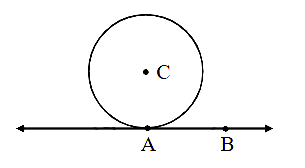
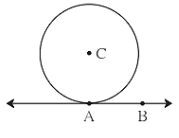
∴ ∠CAB = 90° ......(i) [Tangent theorem]

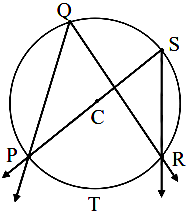
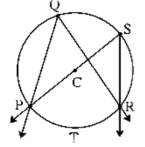
∠PQR ≅ ∠PSR ......[Angles inscribed in the same arc are congruent]
∴ ∠PSR = 50°

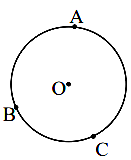
∴ 125° + 110° + m(arc AC) = 360°
∴ m(arc AC) = 360° – 125° – 110°
= 125°
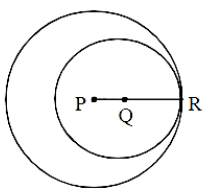
We know, the distance between the centres of the circles touching internally is equal to the difference of their radii.
∴ Distance between the centres of the two circles = 4.8 cm − 3.5 cm = 1.3 cm
Thus, the distance between their centres is 1.3 cm.

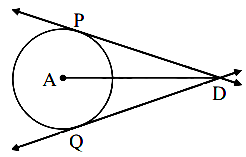
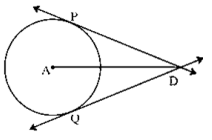
∴ DP = DQ ......[Tangent segment theorem]
∴ DQ = 7 cm ......[Given]


$\therefore \frac{\sin \theta}{\cos \theta} \times A=\sin \theta$
$\therefore \frac{1}{\cos \theta} \times A=1$
$\therefore A=\cos \theta$
$\therefore \mathrm{x}_1=0, \mathrm{y}_1=0, \mathrm{x}_2=-5, \mathrm{y}_2=12$
By distance formula,
$d(O, B)=\sqrt{\left(x_2-x_1\right)^2+\left(y_2-y_1\right)^2}$
$=\sqrt{(-5-0)^2+(12-0)^2}$
$=\sqrt{(-5)^2+12^2}$
$=\sqrt{25+144}$
$=\sqrt{169}$
$\therefore d(O, B)=13 \text { units }$
$\therefore$ The distance between the points $O$ and $B$ is 13 units.

$\therefore D F=\frac{1}{2} D E$
$=\frac{1}{2} \times 16$ $\quad$$\ldots$[ Given ]
$\therefore D F=8 \mathrm{~cm}$
The longest side of the triangle is $17 \mathrm{~cm}$.
$\therefore(17)^2=289$
Now, sum of the squares of the remaining sides is,
$(8)^2+(15)^2=64+225=289$
$\therefore(17)^2=(8)^2+(15)^2$
$\therefore$ Square of the longest side is equal to the sum of the squares of the remaining two sides.
$\therefore$ The given sides will form a right-angled triangle.$\quad$ $\ldots$[Converse of Pythagoras theorem]
Let $A_1$ and $A_2$ be their corresponding areas.
$s_1: s_2=4: 7 \quad \ldots \text{[Given]}$
$\therefore \frac{s_1}{s_2}=\frac{4}{7}\quad \ldots \text{(i)}$
by theorem of areas of similar triangles,
$\frac{A_1}{A_2}=\frac{s_1^2}{s_2^2}$
$\frac{A_1}{A_2}=\left(\frac{s_1}{s_2}\right)^2$
$\frac{A_1}{A_2}=\left(\frac{4}{7}\right)^2 \quad \ldots \ldots . .[\text { From (i)] } $
$\frac{A_1}{A_2}=\frac{16}{49}$
$\therefore$ Ratio of areas of similar triangles $=16: 49$
$=\frac{\sin A}{\sin A}$
$=1$
$\text { R.H.S }=\frac{\sin (90-A)}{\cos A}$
$=\frac{\cos A}{\cos A}$
$=1$
$\therefore \text { L.H.S }=\text { R.H.S }$
$\therefore$ By centroid formula,
$\mathrm{x}=\frac{x_1+x_2+x_3}{3}$
$=\frac{4+8+7}{3}$
$=\frac{19}{3}$
$\mathrm{y}=\frac{y_1+y_2+y_3}{3}$
$=\frac{7+4+11}{3}$
$=\frac{22}{3}$
$\therefore$ The co-ordinates of the centroid are $\left(\frac{19}{3}, \frac{22}{3}\right)$

$\angle D A B=75^{\circ} \ldots . . .[\text { Given }]$
$\angle D A B+\angle D C B=180^{\circ}\ldots [\text { Opposite angle of cyclic quadrilateral are supplementary] }$
$\therefore 75^{\circ}+\angle D C B=180^{\circ}$
$\therefore \angle D C B=180^{\circ}-75^{\circ}$
$\therefore \angle D C B=105^{\circ}$
The longest side of the triangle is $50 \mathrm{~cm}$.
$\therefore(50)^2=2500$
Now, sum of the squares of the remaining sides is,
$(14)^2+(48)^2=196+2304=2500$
$\therefore(50)^2=(14)^2+(48)^2$
$\therefore$ Square of the longest side is equal to the sum of the squares of the remaining two sides.
$\therefore$ The given sides will form a right angled triangle. ...[Converse of Pythagoras theorem]


$\therefore \mathrm{x}_1=-2, \mathrm{y}_1=6, \mathrm{x}_2=8, \mathrm{y}_2=2$
By midpoint formula,
$C(x, y)=\left(\frac{x_1+x_2}{2}, \frac{y_1+y_2}{2}\right)$
$=\left(\frac{-2+8}{2}, \frac{6+2}{2}\right)$
$=\left(\frac{6}{2}, \frac{8}{2}\right)$
$=(3,4)$
$\therefore$ Coordinates of midpoint of segment joining $(-2,6)$ and $(8,2)$ are $(3,4)$.

$\therefore \angle C A B=90^{\circ}$ $\quad$$\ldots$ (i) [Tangent theorem]

$\therefore$ The ratios of corresponding sides of the given triangles are $\frac{A B}{D E}, \frac{B C}{E F}$ and $\frac{A C}{D F}$
$\therefore \tan A=1$
$\therefore A=45^{\circ} \quad \ldots \ldots\left[\because \tan 45^{\circ}=1\right]$
$\therefore x_1=6, y_1=8, x_2=0, y_2=0$
By distance formula,
$d(A, O)=\sqrt{\left(x_2-x_1\right)^2+\left(y_2-y_1\right)^2}$
$=\sqrt{(0-6)^2+(0-8)^2}$
$=\sqrt{36+64}$
$=\sqrt{100}$
$=10 \mathrm{~cm}$
$\therefore$ The distance of point $A(6,8)$ from origin is $10 \mathrm{~cm}$.

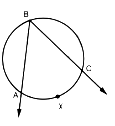
$\angle P Q R \cong \angle P S R$ $\quad$ $\ldots$ [Angles inscribed in the same arc are congruent]
$\therefore \angle P S R=50^{\circ}$

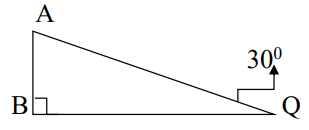
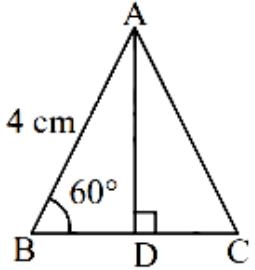
$\angle B=90^{\circ}, \angle Q=30^{\circ} \quad \ldots [ Given ]$
$\therefore \angle A=60^{\circ} \quad \ldots[\text { Remaining angle of a triangle ] }$
$\therefore \triangle A B Q \text { is a } 30^{\circ}-60^{\circ}-90^{\circ} \text { triangle. }$
$\therefore A B=\frac{1}{2} A Q$ $\quad$ $\ldots$[ Side opposite to $30^{\circ}$ ]
$\therefore A B=\frac{1}{2} \times 8$
$\therefore A B=4 \mathrm{~cm}$
$\therefore \angle \mathrm{P} \cong \angle \mathrm{S}, \angle \mathrm{Q} \cong \angle \mathrm{U}, \angle \mathrm{R} \cong \angle \mathrm{V} \quad \ldots \ldots$ [ Corresponding angles of similar triangles ]
$\therefore \frac{\sin \theta}{\cos \theta}=\frac{3}{2}$
$\therefore \tan \theta=\frac{3}{2}$


$\therefore 125^{\circ}+110^{\circ}+m(\operatorname{arc} A C)=360^{\circ}$
$\therefore m(\operatorname{arc} A C)=360^{\circ}-125^{\circ}-110^{\circ}$
$=125^{\circ}$ $\quad$ $\ldots$ [Measure of complete circle is $360^{\circ}$ ]

$\therefore \frac{\mathrm{A}_1}{\mathrm{~A}_2}=\frac{144}{49} \quad \ldots \text {(i)[Given]}$
$\therefore$ by the theorem of areas of similar triangles,
$\therefore \frac{\mathrm{A}_1}{\mathrm{~A}_2}=\frac{\mathrm{S}_1^2}{\mathrm{~S}_2^2}$
$\therefore \frac{144}{49}=\frac{\mathrm{S}_1^2}{\mathrm{~s}_2^2} \quad \ldots[\text {From (i)]}$
$\therefore$ by taking square root of both sides,
$\therefore \frac{\mathrm{S}_1}{\mathrm{~S}_2}=\frac{12}{7}$
$\therefore$ The ratio of the corresponding sides of the given triangles is $12 : 7$.
$\therefore \theta=45^{\circ} \quad \ldots . .\left[\because \tan 45^{\circ}=1\right]$
$\therefore \sin \theta \cdot \cos \theta=\sin 45^{\circ} \cos 45^{\circ}$
$=\frac{1}{\sqrt{2}} \cdot \frac{1}{\sqrt{2}}$
$=\frac{1}{2}$
$Y$-co-ordinate of point $P(-5,4)$ is 4

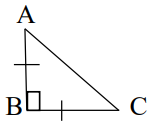
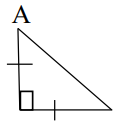
$\therefore \angle \mathrm{A}=\angle \mathrm{C}$ $\quad$ $\ldots$[Isosceles triangle theorem]
$\text { Let } \angle \mathrm{A}=\angle \mathrm{C}=\mathrm{x}$$\quad$ $\ldots$(i)
$\text { In } \triangle A B C, \angle A+\angle B+\angle C=180^{\circ}$$\ldots$ (Sum of the measures of the angles of a triangle is $180^\circ$)
$\therefore \mathrm{x}+90^{\circ}+\mathrm{x}=180^{\circ}$ $\quad$ $\ldots$ [From (i)]
$\therefore 2 \mathrm{x}=90^{\circ}$
$\therefore \mathrm{x}=\frac{90^{\circ}}{2}$ $\quad$ $\ldots$ [From (i)]
$\therefore \mathrm{x}=45^{\circ}$
$\therefore \angle \mathrm{A}=\angle \mathrm{C}=45^{\circ}$
$\therefore \triangle \mathrm{ABC} \text { is a } 45^{\circ}-45^{\circ}-90^{\circ} \text { triangle. }$
$\therefore A B=B C=\frac{1}{\sqrt{2}} \times A C$ $\quad$ $\ldots$ [Side opposite to $45^\circ$]
$=\frac{1}{\sqrt{2}} \times 5 \sqrt{2}$
$\therefore \mathrm{AB}=\mathrm{BC}=5 \text { units }$
$\therefore$ The height of $\triangle \mathrm{ABC}$ is 5 units.
$\therefore \angle \mathrm{B} \cong \angle \mathrm{M}$$\quad$........(i) [Corresponding angles of similar triangles]
But $\angle B=40^{\circ}$ $\quad$ .....[Given]
$\therefore \angle \mathrm{M}=40^{\circ}$ $\quad$ .......[From (i)]
$A\left(x_1, y_1\right)=A(2,7), B\left(x_2, y_2\right)=B(4,5)$
$\therefore x_1=2, y_1=7, x_2=4, y_2=5$
$C$ is the mid-point of seg $A B$.
$\therefore$ By midpoint formula,
$C\left(x_r, y\right)=\left(\frac{x_1+x_2}{2}, \frac{y_1+y_2}{2}\right)$
$=\left(\frac{2+4}{2}, \frac{7+5}{2}\right)$
$=\left(\frac{6}{2}, \frac{12}{2}\right)$
$\therefore C(x, y)=C(3,6)$
$\therefore$ The co-ordinates of the centre of the circle are $(3,6)$.


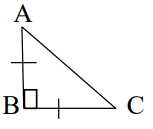
$\therefore \angle \mathrm{A}=\angle \mathrm{C}$ $\quad$ $\ldots$[Isosceles triangle theorem]
$\text { Let } \angle A=\angle C=x$
$\text { In } \triangle \mathrm{ABC}, \angle \mathrm{A}+\angle \mathrm{B}+\angle \mathrm{C}=180^{\circ}$ $\quad$ $\ldots$[Sum of the measures of the angles of a triangle is $180^\circ]$
$\therefore \mathrm{x}+90^{\circ}+\mathrm{x}=180^{\circ}$ $\quad$ $\ldots$[From (i)]
$\therefore 2 \mathrm{x}=90^{\circ}$
$\therefore \mathrm{x}=\frac{90^{\circ}}{2}$ $\quad$ $\ldots$[From (i)]
$\therefore \mathrm{x}=45^{\circ}$
$\therefore \angle \mathrm{BAC}=\angle \mathrm{BCA}=45^{\circ}$
$\therefore \triangle A B C \text { is a } 45^{\circ}-45^{\circ}-90^{\circ} \text { triangle. }$
$\therefore A B=B C=\frac{1}{\sqrt{2}} \times A C$$\quad$ $\ldots$[Side opposite to $45^\circ$]
$=\frac{1}{\sqrt{2}} \times 2 \sqrt{2}$
$\therefore l(\mathrm{AB})=2 \text { units }$

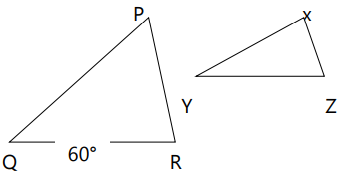
$\angle \mathrm{P}=35^{\circ}, \angle \mathrm{X}=35^{\circ}, \angle \mathrm{Q}=60^{\circ}$ and $\angle \mathrm{Y}=60^{\circ}$ $\quad$......[Given]
$\therefore \angle \mathrm{P} \cong \angle \mathrm{X}$ and $\angle \mathrm{Q} \cong \angle \mathrm{Y}$
$\therefore \triangle P Q R \sim \triangle X Y Z$ $\quad$...[AA test of similarity]
$\therefore$ The triangles in the figure are similar by AA test of similarity.
$=\frac{1}{\frac{13}{12}}$
$\therefore \cot \theta=\frac{12}{13}$
$\therefore$ By distance formula,
$d(A, B)=\sqrt{\left(x_2-x_1\right)^2+\left(y_2-y_1\right)^2}$
$=\sqrt{(2-7)^2+(5-5)^2}$
$=\sqrt{(-5)^2+0^2}$
$=\sqrt{25}$
$=5 \mathrm{~cm}$
$\therefore$ The distance between points $A$ and $B$ is $5 \mathrm{~cm}$.

$\therefore D P=D Q \quad \ldots . . .[\text { Tangent segment theorem ] }$
$\therefore D Q=7 \mathrm{~cm} \quad \ldots . .[\text { Given ] }$

$\therefore \angle A=\angle C \quad \ldots . . .[\text { Isosceles triangle theorem }]$
$\text { Let } \angle A=\angle C=x$
$\text { In } \triangle A B C$
$\angle A+\angle B+\angle C=180^{\circ}\ldots\left[\text { Sum of the measures of the angles of a triangle is } 180^{\circ}\right]$
$\therefore x+90^{\circ}+x=180^{\circ}$
$\therefore 2 x=90^{\circ}$
$\therefore x=\frac{90^{\circ}}{2}$
$\therefore x=45^{\circ}$
$\therefore m \angle A=45^{\circ}$

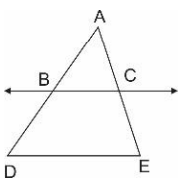
line BC \|| $\operatorname {seg DE} $
$\therefore$ by Basic proportionality theorem
$\therefore \frac{A B}{B D}=\frac{A C}{C E}$
$\therefore \frac{2}{3}=\frac{4}{x}$
$\therefore x=4 \times \frac{3}{2}$
$\therefore x=2 \times 3$
$\therefore x=6$
$=\frac{1-1}{1+1}$
$=\frac{0}{2}$
$=0$


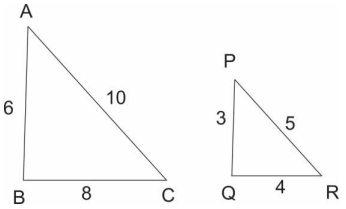
$\frac{\mathrm{AB}}{\mathrm{PQ}}=\frac{6}{3}=\frac{2}{1} \quad \quad \ldots . . . \text {(i)}$
$\frac{\mathrm{BC}}{\mathrm{QR}}=\frac{8}{4}=\frac{2}{1} \quad \quad \ldots \ldots \text{(ii)}$
$\frac{\mathrm{AC}}{\mathrm{PR}}=\frac{10}{5}=\frac{2}{1} \quad \quad \ldots \ldots \text {(iii)}$
$\therefore \frac{\mathrm{AB}}{\mathrm{PQ}}=\frac{\mathrm{BC}}{\mathrm{QR}}=\frac{\mathrm{AC}}{\mathrm{PR}} \ldots \ldots . .[\text { From (i), (ii) and (iii) ] }$
$\therefore \triangle \mathrm{ABC} \sim \triangle \mathrm{PQR} \quad \ldots . . .[\ \mathrm{ SSS } \text { test of similarity ] }$
$\therefore$ The triangles in the figure are similar by SSS test of similarity.
$=\frac{\cos 15^{\circ}}{\cos 15^{\circ}} \quad \ldots .\left[\because \sin \left(90^{\circ}-\theta\right)=\cos \theta\right]$
$=1$
Let the co-ordinates of the midpoint be $P(x, y)$.
$\therefore$ By midpoint formula,
$\mathrm{x}=\frac{x_1+x_2}{2}=\frac{0+12}{2}=6$
$\mathrm{y}=\frac{y_1+y_2}{2}=\frac{2+14}{2}=\frac{16}{2}=8$
$\therefore$ The co-ordinates of the midpoint of the segment joining $(0,2)$ and $(12$, 14) are $(6,8)$.


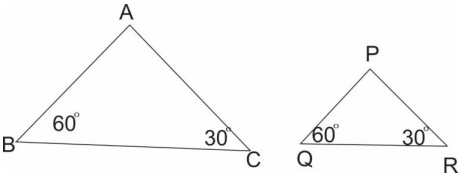
$\angle \mathrm{ABC} \cong \angle \mathrm{PQR}$ $\quad$ $\ldots$[Each of measure $60^{\circ}$]
$\angle \mathrm{ACB} \cong \angle \mathrm{PRQ}$ $\quad$ $\ldots$[Each of measure $30^{\circ}$]
$\therefore \triangle \mathrm{ABC} \sim \triangle \mathrm{PQR}$ $\quad$$\ldots$[ AA test of similarity ]