A $4 Ω$ coil and a $2 Ω$ coil are connected in parallel. What is their combined resistance? A total current of 3A passes through the coils. What current passes through the $2 Ω$ coil?
Download our app for free and get started
$4\Omega$ and $2\Omega$ coil are connected in parallel.
Combined resistance is R
$\frac{1}{\text{R}}=\frac{1}{4}+\frac{1}{2}=\frac{3}{4}$
$\text{R}=\frac{4}{3}\Omega$
Total current $\text{I}=\frac{\text{V}}{\text{R}}=3\Omega$
$\frac{\text{V}}{\frac{4}{3}}=3$
$\text{V}=3\times\frac{4}{3}=4\text{V}$
Current through $2\Omega$ coil $=\frac{\text{V}}{2}=\frac{4}{2}=2\text{A}$
Combined resistance is R
$\frac{1}{\text{R}}=\frac{1}{4}+\frac{1}{2}=\frac{3}{4}$
$\text{R}=\frac{4}{3}\Omega$
Total current $\text{I}=\frac{\text{V}}{\text{R}}=3\Omega$
$\frac{\text{V}}{\frac{4}{3}}=3$
$\text{V}=3\times\frac{4}{3}=4\text{V}$
Current through $2\Omega$ coil $=\frac{\text{V}}{2}=\frac{4}{2}=2\text{A}$

Download our appand get started for free
Experience the future of education. Simply download our apps or reach out to us for more information. Let's shape the future of learning together!No signup needed.*
Similar Questions
- 1View SolutionWhat is the resistance between A and B in the figure given below?
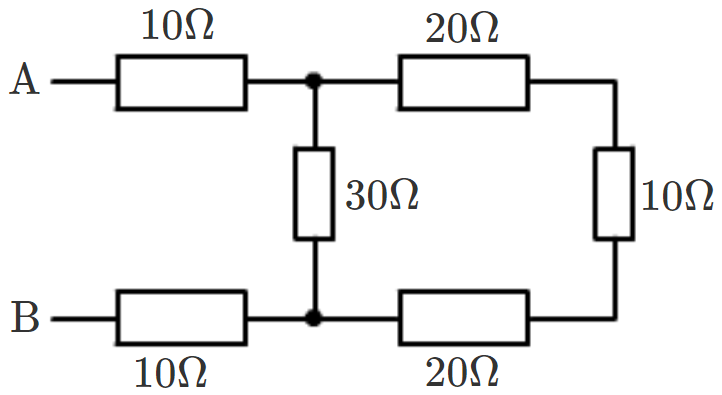
- 2View SolutionState and explain Joule’s law of heating.
- 3View SolutionWhat is Ohm’s law? Explain how it is used to define the unit of resistance.
- 4View SolutionHow does the resistance of a wire change when:
- Its length is tripled?
- Its diameter is tripled?
- Its material is changed to one whose resistivity is three times?
- 5A piece of wire of resistance $20 Ω$ is drawn out so that its length is increased to twice its original length. Calculate the resistance of the wire in the new situation.View Solution
- 6For the circuit shown in the diagram below:View Solution
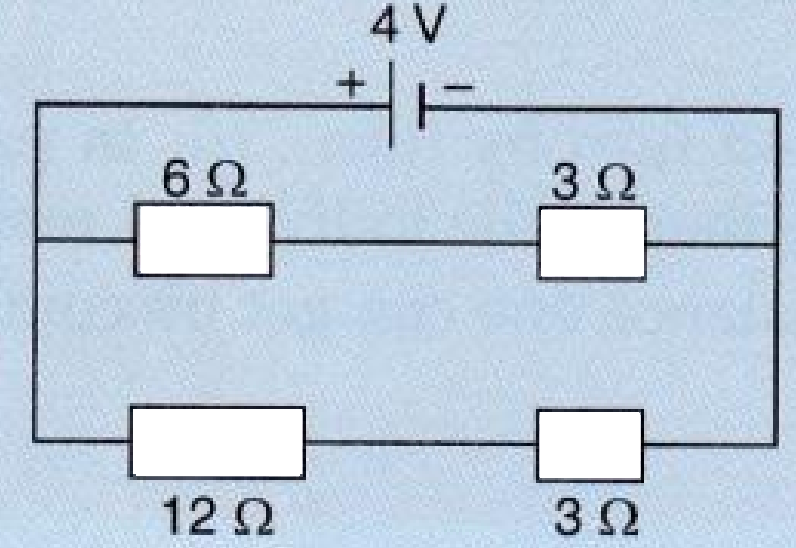
What is the value of :
Current through $6 Ω$ resistor?
Potential difference across $12 Ω$ resistor? - 7View SolutionConsider the circuit given below where A, B and C are three identical light bulbs of constant resistance.
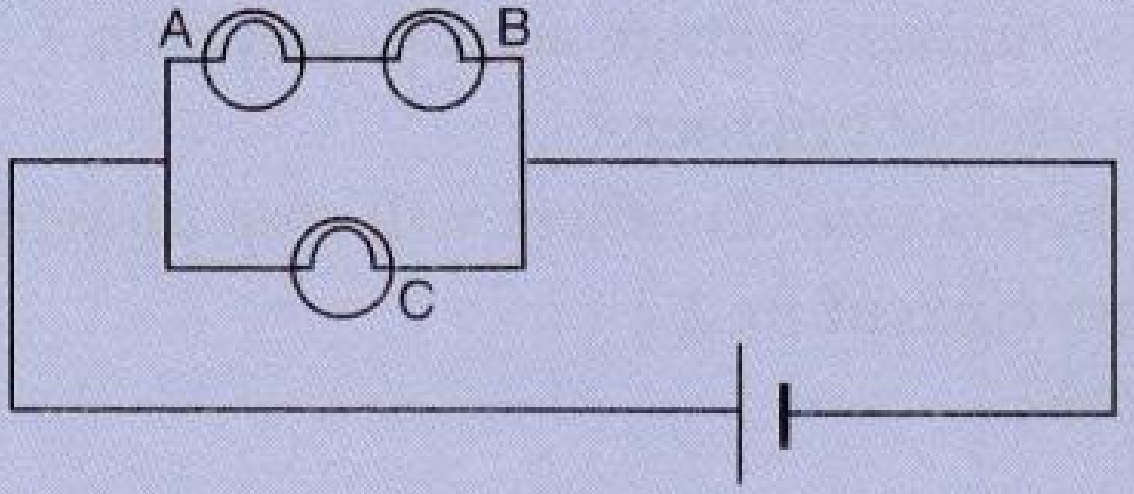
- List the bulbs in order of increasing brightness.
- If C burns out, what will be the brightness of A now compared with before?
- If B burns out instead, what will be the brightness of A and C compared with before?
- 8View SolutionA resistor of 8 ohms is connected in parallel with another resistor X. The resultant resistance of the combination is 4.8 ohms. What is the value of the resistor X?
- 9View SolutionThree 2V cells are connected in series and used as a battery in a circuit.
- What is the p.d. at the terminals of the battery?
- How many joules of electrical energy does 1C gain on passing through
- One cell.
- All three cells?
- 10A p.d. of 6V is applied to two resistors of $3 Ω$ and $6 Ω$ connected in parallel. Calculate:View Solution
The combined resistance.
The current flowing in the main circuit.
The current flowing in the $3 Ω$ resistor.