Question 15 Marks
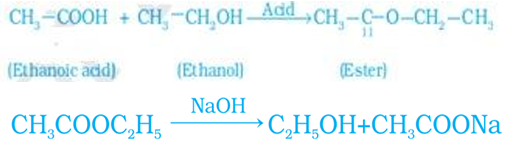
Raina while doing certain reactions observed that heating of substance ' $X$ ' with vinegar like smell with a substance ' $Y$ ' (which is used as an industrial solvent) in presence of conc. Sulphuric acid on a water bath gives a sweet-smelling liquid ' $Z$ ' having molecular formula $C _4 H _8 O _2$. When heated with caustic soda $( NaOH )$, ' $Z$ ' gives back the sodium salt of and the compound ' $Y$ '
Identify ' $X$ ', ' $Y$ ', and ' $Z$ '. Illustrate the changes with the help of suitable chemical equations.
Answer$X$ - Ethanoic acid/ acetic acid/ $CH _3 COOH$
$Y$ - Ethanol/ Ethyl alcohol/ $C _2 H _5 OH$
$Z$ - Ethyl ethanoate/ Ester $- CH _3 COOC _2 H _5$
View full question & answer→Question 25 Marks
a) Rehmat classified the reaction between Methane and Chlorine in presence of sunlight as a substitution reaction. Support Rehmat's view with suitable justification and illustrate the reaction with the help of a balanced chemical equation.
b) Chlorine gas was prepared using electrolysis of brine solution. Write the chemical equation to represent the change. Identify the other products formed in the process and give one application of each.
Answera) Rehmat's observation is correct as the hydrogen atoms are substituted by hetero atom i.e., $Cl$
$CH _4+ Cl _2 \rightarrow CH Cl + HCl$ (in the presence of sunlight)
OR
Any other relevant equation in the chain reaction
$
2 NaCl ( aq )+2 H _2 O ( l ) \rightarrow 2 NaOH ( aq )+ Cl _2( g )+ H _2( g )
$
OR
$
\begin{aligned}
& NaCl \rightarrow Na ^{+}+ Cl ^{-} \\
& 2 Cl ^{+} \rightarrow Cl _2+2 e ^{-} \text {(At anode) } \\
& H _2 O \rightarrow H ^{+}+ OH ^{-} \\
& 2 H ^{+}+2 e \rightarrow H _2 \text { (At cathode) } \\
& Na ^{+}+ OH \rightarrow NaOH
\end{aligned}
$
b) Sodium hydroxide/ $NaOH /$ Caustic soda
Hydrogen - $1 / 2$
Uses: (any one each)
Sodium hydroxide/ $NaOH /$ Caustic soda
- Degreasing of metals
- Preparation of soaps and detergents
- Paper making
- Artificial fibres
Hydrogen -
- Fuels
- Margarine
- Manufacture of ammonia for fertilizers
View full question & answer→Question 35 Marks
Why are certain compounds called hydrocarbons? Write the general formula for homologous series of alkanes, alkenes and alkynes and also draw the structure of the first member of each series. Write the name of the reaction that converts alkenes into alkanes and also write a chemical equation to show the necessary conditions for the reaction to occur.
Answer
Certain compounds contain only carbon and hydrogen. So, these organic compounds are called hydrocarbons.
General formula for the homologous series of alkanes = $C _n H _{2 n+2}$
$\ \ \ \ \ \ \text{H} \\ \ \ \ \ \ \ \ \text{|} \\ \text{H} {-} \text{C} {-} \text{H} \\ \ \ \ \ \ \ \ \text{|} \\ \ \ \ \ \ \ \text{H}$
General formula for the homologous series of alkenes = $C _n H _{2 n}$
First member of the alkene family is ethene.
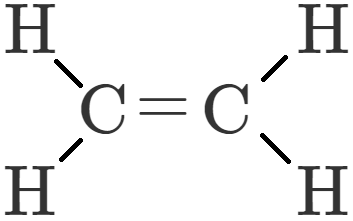
General formula for the homologous series of alkynes = $C _n H _{2 n+2}$
First member of the alkyne family is ethyne.
$\text{H} {-} \text{C} \equiv \text{C} {-} \text{H}$ View full question & answer→Question 45 Marks
Both soap and detergent are some type of salts. What is the difference between them? Describe in brief the cleansing action of soap. Why do soaps not form lather in hard water? List two problems that arise due to the use of detergents instead of soaps.
Answer
The molecules of soap are sodium or potassium salts of long-chain carboxylic acids. Detergents are generally ammonium or sulphonate salts of long chain carboxylic acids.
Cleansing action of soap can be described as follows:
The soap molecule is generally represented as RCOONa . In solution, it ionises to form $RCOO ^{-}$and $Na ^{+}$. Each soap molecule has a polar head group (carboxylate ion, $COO ^{-}$group) and a long non-polar hydrocarbon tail ( R group from long chain fatty acid). The polar head attracts the polar water molecule and is called hydrophilic end and the non-polar tail attracts the water-insoluble oily or greasy dirt particles.
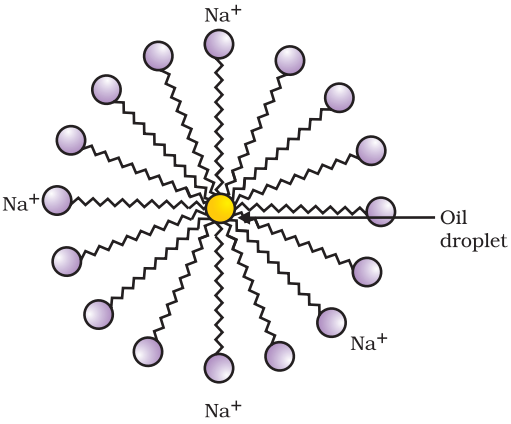
Soaps do not form a lather in hard water because hard water contains calcium and magnesium salts. Soap molecules react with calcium and magnesium salts to form an insoluble precipitate called scum.
Two problems arise because of the use of detergents instead of soap:
- Soaps are biodegradable, while detergents are non-biodegradable; hence, detergents accumulate in the environment and cause problems.
- Certain phosphate additives are added to detergents. These phosphate additives act as nutrients for algae which form a thick green scum over the river water and upset the animal life in the river.
View full question & answer→Question 55 Marks
List two reasons for carbon forming a large number of compounds. Name the type of bonding found in most of its compounds. Why does carbon form compounds mainly by this kind of bonding?
Give reason why the carbon compounds:
- Generally have low melting and boiling points.
- Do not conduct electricity in molten state.
AnswerCarbon forms a large number of compounds.
The two properties of carbon uihicli lead to the huge number of carbon compounds are:
- Catenation: Catenation is the unique property of carbon atoms to form bonds with other atoms of carbon giving rise to large molecules.
- Tetravalency: Since carbon has a valency of four, it is capable of bonding with four other atoms of carbon or atoms of some other monovalent elements.
Carbon compounds are formed mainly by covalent bonding, i.e., bond formed by sharing of electrons because:-
i. Carbon atoms have 4 electrons in their outermost shell. So needs to gain or lose electrons to attain noble gas configuration. It could gain four electrons forming $C ^{4-}$ anion. But it would be difficult for the nucleus with six protons to hold on to ten electrons. It could lose four electrons forming $C ^{4+}$ cation. But it would require a large amount of energy to remove four electrons from its outermost shell. Because of these reasons, carbon shares its valence electrons to complete its octet with other atoms to form covalent bonds.
ii. Carbon compounds generally have low melting and boiling points because carbon compounds are generally formed by covalent bonds in which the force of attraction between their molecules is not very strong. Carbon compounds do not conduct electricity. As carbon compounds have covalent bonds between them, these do not give rise to any ions in their solution form or molten state. So carbon compounds do not conduct electricity through them. View full question & answer→Question 65 Marks
A carbon compound ‘P' on heating with excess cont. $H2SO_4$ forms another carbon compound ‘Q' which on addition of hydrogen in the presence of nickel catalyst forms a saturated carbon compound ‘R'. One molecule of ‘R' on combustion forms two molecules of carbon dioxide and three molecules of water. Identify P, Q and R and write chemical equations for the reactions involved.
AnswerCompound Q is ethene $= CH _2= CH _2+ H 2 O$
Compound R is ethane $= CH _2- CH _3$ Reaction:${\text{C}_{2}\text{H}_{5}\text{OH}}\xrightarrow[\Delta]{\text{Conc. } \text{H}_{2}\text{SO}_{4}}{\text{CH}_{2}} = \text{CH}_{2}+\text{H}_{2}\text{O} \\ $
$\text{CH}_{2}=\text{CH}_{2}\xrightarrow[\text{H}_{2}]{\text{Nickel Catalyst}}{\text{CH}_{3}-\text{CH}_{3}} + \text{H}_2\text{O} \\$
$\text{CH}_{3}-\text{CH}_{3}+\frac{7}{2}\text{O}_{2}\rightarrow 2\text{CO}_{2}+ 3\text{H}_{2}\text{O}$
View full question & answer→Question 75 Marks
Elements forming ionic compounds attain noble gas configuration by either gaining or losing electrons from their outermost shells. Give reason to explain why carbon cannot attain noble gas configuration in this manner to form its compounds. Name the type of bonds formed in ionic compounds and in the compounds formed by carbon. Also give reason why carbon compounds are generally poor conductors of electricity.
AnswerCarbon mainly forms covalent bonds because carbon atoms have 4 elections in their outermost shell. So it needs to gain or lose electrons to attain noble gas configuration.
i. It could gain four electrons forming $C ^{4-} C ^{4-}$ anion. But it would be difficult for the nucleus with six protons to hold on to ten electrons.
ii. It could lose four electrons forming $C ^{4+} C ^{4+}$ cation. But it would require a large amount of energy to remove four electrons from its outermost shell.
Because of these reasons, carbon shares its valence electrons to complete its octed with other atoms to form covalent bonds.
Carbon has 4 electrons in its outermost shell. It cannot lose 4 electrons to form $C ^{4+}$ cation because very high energy is required to remove 4 electrons leaving behind a carbon cation with 6 protons in this nucleus holding onto just 2 electrons. It also cannot gain 4 electrons to form $C ^4$ anion because it is difficult for 6 protons to hold onto 10 electrons. The type of bonds formed in ionic compounds is ionic or electrovalent bonds and in compounds formed by carbon are covalent bonds.
Since the electrons are shared, there are no charged particles in carbon compounds and hence they are poor conductors of electricity.
View full question & answer→Question 85 Marks
What are hydrocarbons? Write the name and general formula of,
- Saturated hydrocarbons.
- Unsaturated hydrocarbons.
Draw the structure of one hydrocarbon of each type. How can an unsaturated hydrocarbon be made saturated?
AnswerA hydrocarbon is an organic compound made of nothing more than carbons and hydrogen. It is possible for double or triple bonds to form between carbon atoms and even for structures, such as rings, to form Saturated hydrocarbon: Saturated hydrocarbons are that contain only single bonds between carbon atoms. General formula $C _{ n } H _{2 n +2}$ Example: methane, ethane etc.$\ \ \ \ \ \ \ \text{H}\ \ \ \text{H}\\ \ \ \ \ \ \ \ \ \text{|}\ \ \ \ \ \text{|} \\ \text{H} {- } \text{C }{-} \text{C} {-}\text{H}\\ \ \ \ \ \ \ \ \ \text{|} \ \ \ \ \ \text{|}\\ \ \ \ \ \ \ \ \text{H}\ \ \ \text{H}\\ \ \ \ \ \ \ \text{Ethane}$
Unsaturated hydrocarbons: - that contain double or even triple bonds between the carbon atoms. General formula of double bond hydrocarbon $C _{ n } H _{2 n }$ For example: Ethene, propene etc.$\ \ \ \ \ \ \ \text{H}\ \ \ \text{H}\\ \ \ \ \ \ \ \ \ \text{|}\ \ \ \ \ \text{|} \\ \text{H} {- } \text{C }{= } \text{C} {-}\text{H}\\ \ \ \ \ \ \ \text{Ethene}$
General formula of triple bond hydrocarbon $C _{ n } H _{2 n +2}$ Ethyne, propyne etc.$\text{HC}\equiv\text{CH} \\ \ \ {\text{Ethyne}}$
View full question & answer→Question 95 Marks
What are detergents chemically? List two merits and two demerits of using detergents for cleansing. State the reason for the suitability of detergents for washing, event in the case of water having calcium and magnesium ions.
AnswerDetergents is the sodium salt of a long chain Benzene Suplhonic acid which has cleansing properties in water.
A detergent has a large non ionic hydrocarbon group and an ionic group like sulphonate group, SO³⁻ Na⁺.
Examples of detergents are :
Sodium n-dodecyl benzene sulphonate and sodium n-dodecyl sulphate
Cleansing action of detergent is same as soap.
Merits of detergents:
- Detergent works properly even if the water is hard.
- Detergent has better cleansing action than soap.
Demerits of detergents:
- Detergents are non-biodegradable.
- Detergents cause environmental and health problems.
Reason for the having calcium and magnesium ions :
Detergents react with with Ca²⁺ and Mg²⁺ ions in hard water forming soluble compounds. lather is formed easily and cleansing action is efficient.
View full question & answer→Question 105 Marks
Explain isomerism State any four characteristics of isomers draw the structures of possible isomers of butane, $C_4H_{10}$.
AnswerThe phenomenon due to which organic compounds having the same molecular formula have different structures is called isomerism.Characteristic:
- Isomers s have same molecular formula.
- Isomers have different structural formulae.
- Isomers have same molecular mass.
- Isomers have different physical properties.
- Isomers have different chemical properties.
Two structures:
- 1. $CH _3- CH _2- CH _2- CH _3$
- $\text{CH}_3{-}\text{CH}{-}\text{CH}_3 \\ \ \ \ \ \ \ \ \ \ \ \ \ \text{|} \\ \ \ \ \ \ \ \ \ \ \ \ \text{CH}_3$
View full question & answer→Question 115 Marks
- State two properties of carbon which lead to a very large number of carbon compounds.
- Why does micelle formation take place when soap is added to water? Why are micelles not formed when soap is added to ethanol?
Answer
-
- Catenation: It is the important property of carbon to form bonds of carbon atoms which forms bonds with the other atoms resulting in the formation of large molecules.
- Tetravalency of carbon atom: Due to the valency 4 of the carbon atom, it has capability of making bonds with four other carbon atoms or other elements.
- When soap is added to water, there is formation of micelle because soap molecule consists of two chains one is hydrophilic and other is hydrophobic chain. Hydrophilic chain has ionic end and hydrophobic chain repels water. They hydrophobic chain of soap dissolved in the dirt and oily particles and the ionic part is suspended in water.
Micelles are not formed when soap is added to ethane because the alkyl chain of the soap is soluble in ethanol and doesn't forms micelles.
View full question & answer→Question 125 Marks
- Distinguish between ionic and covalent compounds under the following properties:
- Strength of forces between constituent elements’.
- Solubility of compounds in water.
- Electrical conduction in substances.
Answer
-
-
|
Property
|
Ionic Compounds
|
Covalent Compounds
|
|
Strength of forces
|
Strong
|
Weak
|
|
Solubility
|
Generally soluble in water
|
Generally insoluble in water/ soluble in organic solvents.
|
|
Electrical Conductivity
|
Conduct electricity
|
Do not conduct electricity
|
View full question & answer→Question 135 Marks
What are micelles? Why does it form when soap is added to water? Will a micelle be formed in other solvents such as ethanol also? State briefly how the formation of micelles help to clean the clothes having oily spots.
Answer
- Micelles: A micelle is an aggregate of surfactant molecules dispersed in a liquid colloid. A typical micelle in aqueous solution forms an aggregate with the hydrophilic "head" regions in contact with surrounding solvent, sequestering the hydrophobic single tail regions in the micelle centre.
- When soap is dissolved in water, its hydrophobic ends attach themselves to dirt and remove it from the cloth,
- Organic compounds like ethanol would not be able to interact with micelle when present in small amounts. The energy requirement for bringing the hydrophobic tail into solution may decrease, leading to an increase in micelle concentration. Conversely, adding alcohol will result in a reduction in the dielectric constant of the solvent mixture thus affecting the decrease in the critical micelle concentration of ionic surfactants as a result of their lower solubility and reduced repulsion between adjacent head groups at the micelle surface.
- When the soap molecules come in contact with water, the non-ionic part of the soap molecule (hydrocarbon chain) attaches itself to the dirt or the grease because it is miscible in it. The ionic part remains in the water because water is also partially ionic in nature so you see that "like dissolves the like". These soap molecules gradually surround the dirt particle by dissolving their non-ionic end in it and gradually form Michelle (around structure around the dirt particle) and then they detach the dirt particle and encapsulate (embed) it in water molecules, making it miscible in water. Thus the cloth gets thoroughly cleaned after being rinsed nicely.
The cleaning action of soap occurs when oil and grease are absorbed into the hydrophobic centers of soap micelles and are washed away.
View full question & answer→Question 145 Marks
- You have three unlabelled test tubes containing ethanol, ethanoic acid and soap solution. Explain the method you would use to identify the compounds in different test tubes by chemical tests using litmus paper and sodium metal.
- Give the reason of formation of scum when soaps are used with hard water.
Answer
-
|
S.No.
|
Solution
|
Blue Litmus
Paper
|
Red Litmus
Paper
|
Sodium Metal
|
|
1.
|
Ethanol
|
No change
|
No change
|
Hydrogen gas
|
|
2.
|
Ethanoic acid
|
Turns red
|
No change
|
Hydrogen gas
|
|
3.
|
Soap
|
No change
|
Turns blue
|
Hydrogen gas
|
- The precipitate form of scum is formed when soap is used for washing clothes. With hard water, a large amount of soap is wasted in reacting with the calcium and magnesium ions of hard water to form an insoluble precipitate. The precipitate form formed by the action of hard water on soap, sticks to the clothes being washed and interferes with the cleaning ability of the additional soap. This makes the cleaning of clothes difficult.
View full question & answer→Question 155 Marks
Soaps and detergents are both types of salts. State the difference between the two. Write the mechanism of the cleansing action of soaps. Why do soaps not form lather (foam) with hard water? Mention any two problems that arise due to the use of detergents instead of soaps.
AnswerThe molecules of soap are sodium or potassium salts of long-chain carboxylic acids. Detergents are generally ammonium or sulphonate salts of long chain carboxylic acids.
Cleansing action of soap can be described as follows:
- A soap molecule has a tadpole-shaped structure.
- At one end (long non-polar end) of the soap molecule is a hydrocarbon chain which is insoluble in water but soluble in oil.
- At the other end (short polar end) of the soap molecule, there is a carboxylate ion which is hydrophilic, i.e. water soluble but insoluble in oil.
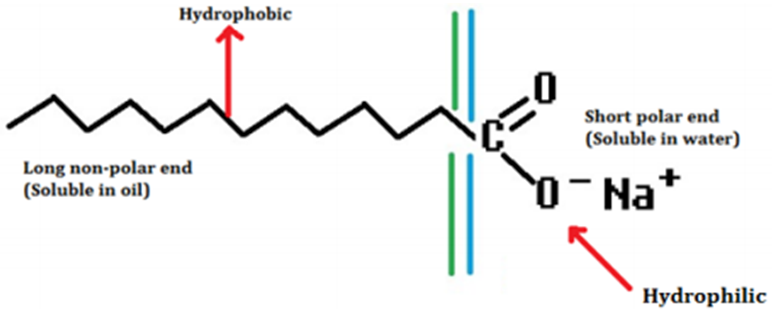
Soap on mixing with water forms a concentrated solution and causes foaming. The long non-polar end of soap gravitates towards and surrounds the dirt and absorbs the dust in it. The short polar end with the carboxylate ion repels the water away from the dirt. A spherical aggregate of soap molecules is formed in the soap solution in water and is called a micelle. Thus, the soap molecule dissolves the dirt and our clothes get clean.
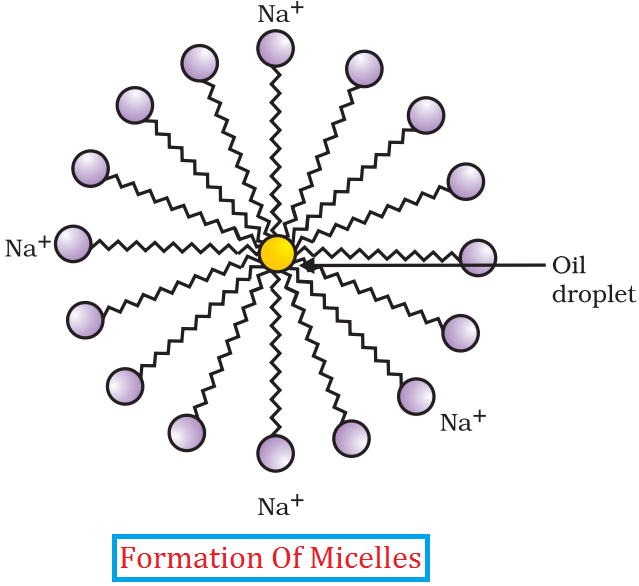
Soaps do not form lather in hard water because Hard water contains calcium and magnesium salts. Soap molecules react with calcium and magnesium salts to form an insoluble precipitate called scum.
Two problems arise because of the use of detergents instead of soap:
- Soaps are biodegradable, while detergents are non-biodegradable; hence, detergents accumulate in the environment and cause problems.
- Certain phosphate additives are added to detergents. These phosphate additives act as nutrients for algae which form a thick green scum over the river water and upset the animal life in the river.
View full question & answer→Question 165 Marks
- Give a chemical test to distinguish between saturated and unsaturated hydrocarbon.
- Name the products formed when ethane burns in air. Write the balanced chemical equation for the reaction showing the types of energies liberated.
- Why is reaction between methane and chlorine in the presence of sunlight considered a substitution reaction?
Answera. A chemical test to distinguish between saturated and unsaturated hydrocarbon.
Bromine water test: Unsaturated hydrocarbon gives addition reaction with $Br _2$. So the colour of $Br _2$-water gets decolorized.
$R-C=C=R+Br_2 \rightarrow R-BrC-R$
whereas, Saturated hydrocarbons do not react with $Br _2$-water so the colour of $Br _2$-water does not get decolorized.
b. When ethane $\left( CH _3- CH _3\right)$ is burned in air (oxygen), it forms carbon dioxide and water.
$CH_3-CH_3+\frac{7}{2 O_2} \rightarrow 2 CO_2+3 H_2 O+\text { Heat }$
This reaction is called an exothermic reaction due to the evolution of heat.
c. When methane reacts with chlorine in the presence of light, the following reaction takes place:
$CH_4+Cl_2 \xrightarrow{\text { Sun light }} CH_3 Cl+HCl$
It is considered a substitution reaction because in this reaction hydrogen is substituted with chlorine.
View full question & answer→Question 175 Marks
State the reason why carbon can neither form $\text{C}^{4+}$ cations nor $\text{C}^{4-}$ anions, but forms covalent compounds. Also state reasons to explain why covalent compounds:
- Are bad conductors of electricity?
- Have low melting and boiling points?
AnswerCarbon atoms have 4 electrons in their outermost shell. So needs to gain or lose electrons to attain noble gas configuration.
- It could gain four electrons forming $\text{C}^{4-}$ anion. But it would be difficult for the nucleus with six protons to hold on to ten electrons.
- It could lose four electrons forming $\text{C}^{4+}$ cation. But it would require a large amount energy to remove four electrons from its outermost shell.
Because of these reasons, carbon shares its valence electrons to complete its octet with other atoms to from cavalent bonds.
- Covalent compounds are bad conductors of electricity because they do not contain ions.
- Covalent compounds have usually low melting and boiling points because they are made up of electronically neutral molecules of a covalent compound is very weak. Only a small amount of heat energy is required to break these weak molecular forces, due to which covalent compounds have low melting and boiling points.
View full question & answer→Question 185 Marks
- Define the term ‘isomers’.
- Draw two possible isomers of the compound with molecular formula $\text{C}_3\text{H}_6\text{O}$ and write their names.
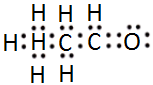
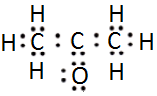
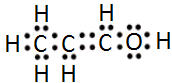
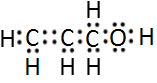
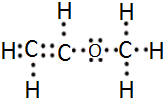
- Give the electron dot structure of the above two compounds.
Answer
- Molecules having same molecular formula but different structural formula are known as isomers.
- Two possible isomers of the compound with molecular formula $\text{C}_3\text{H}_6\text{O}$:
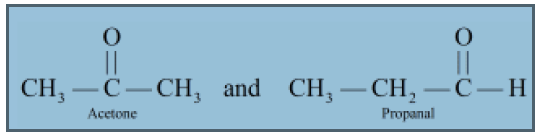
- Electron dot structure:
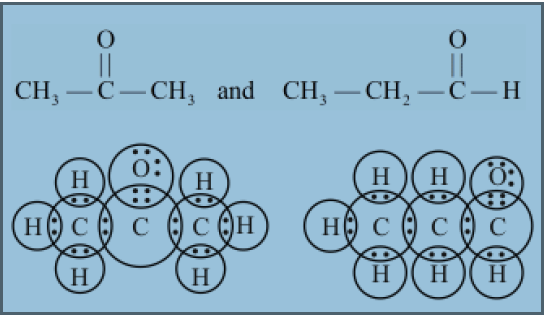
View full question & answer→Question 195 Marks
List in tabular for three physical and two chemical properties on the basis of which ethanol and ethanol acid can be differentiated.
AnswerDifference in Physical Properties of ethanol and ethanoic acid:
|
Ethanol
|
Ethanoic acid
|
|
It is liquid at room temperature.
|
It often freezen in winter.
|
|
Its melting point is 156K.
|
Its melting point is 290K.
|
|
Lts boiling point is 351K.
|
Its boiling point is 391K.
|
Difference in Chemical Properties of ethanol and ethanoic acid:
|
Ethanol
|
Ethanoic acid
|
|
On reaction with metallic sodium, ethanol releases hydrogen gas.
|
Ethanoic acid does not release hydrogen gas on reaction with metallic sodium.
|
|
Ethanol does not release carbon dioxide gas on reaction with sodium bicarbonate.
|
Carbon dioxide gas is released when ethanoic acid is reacted with sodium bicarbonate.
|
View full question & answer→Question 205 Marks
What is the difference between the chemical composition of soaps and detergents? State in brief the action of soaps in removing an oily spot from a shirt. Why are soaps not considered suitable for washing where water is hard?
AnswerThe Difference between the chemical composition of soaps and detergents are as follows:
- Soaps are sodium (Na) salts or Potassium (K) salts of some long chain carboxylic acids whereas detergents are ammonium or sulphurated salts or long chains of carboxylic acids (COOH).
- Soaps can't form lather with hard-water but detergents can form lather with hard water as well as soft water.
- Soaps are biodegradable and can be break into simpler substances but detergents are non-biodegradable and can be break into simpler substances.
Cleansing action of soaps: The oily spot present on shirt is organic in nature and insoluble in water. Therefore, it cannot be removed by only washing with water. When soap is dissolved in water, its hydrophobic ends attach themselves to the oily spot and remove it from the shirt. Then, the molecules of soap arrange themselves in the form of micelle and trap the dirt at the centre of the cluster. These micelles remain suspended in the water. Hence, the oily spots are easily rinsed away by water. The diagram details us of the cleansing action of soaps.
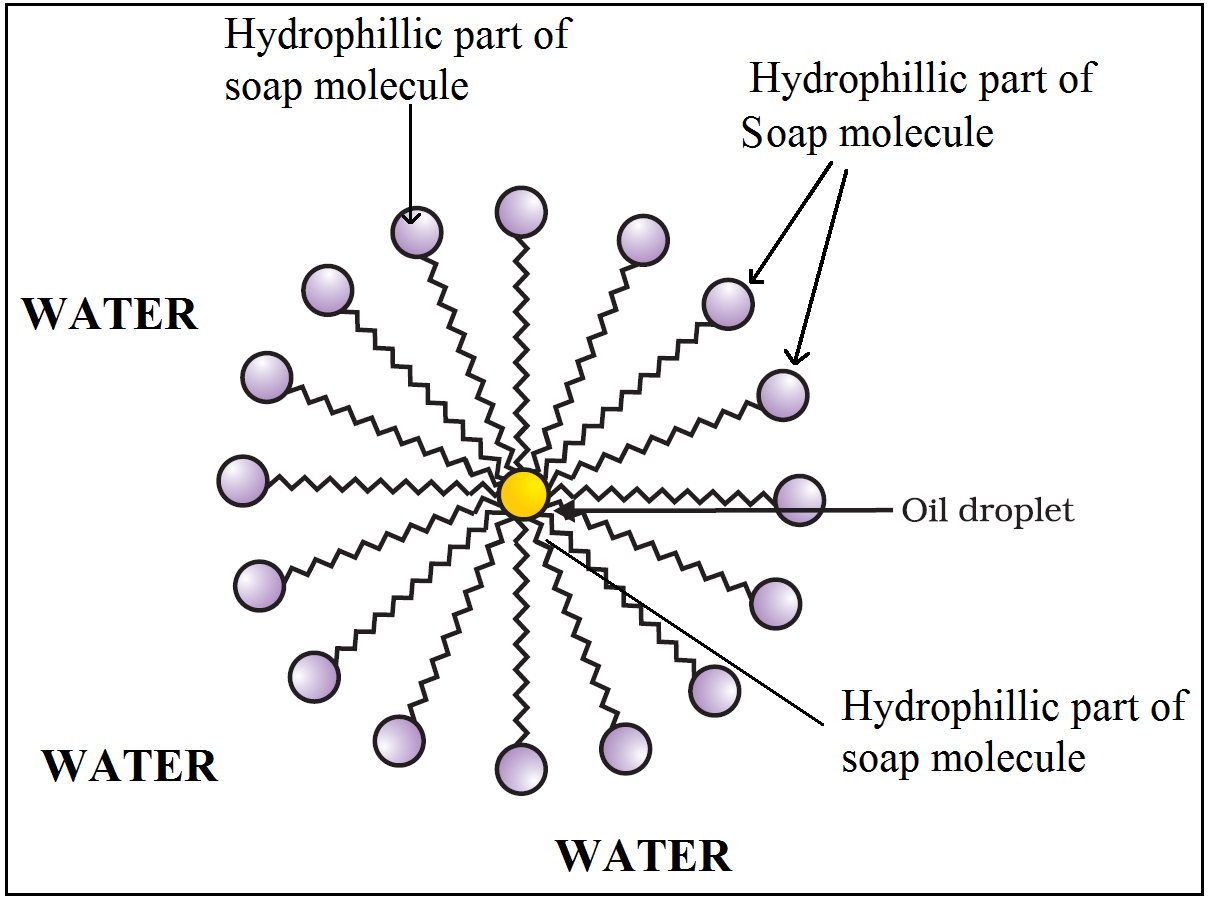
Soaps are not considered suitable when water is hard. Hard water contains salts of calcium and magnesium. A soap is a sodium or potassium salt of long chain fatty acids. When soap is added to hard water, calcium and magnesium ions present in water displace sodium or potassium ions from the soap molecules forming an insoluble substance called scum. The formation of scum results in wastage of an enormous quantity of soap.
View full question & answer→Question 215 Marks
- In tabular form, differentiate between ethanol and ethanol acid under the following heads:
- Physical state.
- Taste.
- $NaHCO_3$ test.
- Ester test.
- Write a chemical reaction to show dehydration of ethanol.
Answer
-
|
Property
|
Ethanol
|
Ethanoic Acid
|
|
Physical State
|
Ethanol is a colorless liquid with pleasant odor
|
Ethanoic acid is colorless, pungent smelling liquid
|
|
Taste
|
Ethanol is bitter to taste
|
Ethanoic acid is sour to taste
|
|
$NaHCO_3$ Taste
|
Ethanol does not react with sodium bicarbonate
|
When ethanoic acid reacts with sodium $NaHCO_3$ with the evolution of carbon dioxide gas.
|
|
Ester Test
|
Ethanol on reaction with ethanoic acid in the presence of acid forms ester.
|
Ethanoic acid on reaction with alcohols in the presence of conc. Sulphuric acid to form ester.
|
- Ethanol undergoes dehydration to form ethane.
$2\text{CH}_{3}\text{CH}_{2}\text{OH}\xrightarrow[\text{conc.} \text{H}_2 \text{SO}_{4}]{\Delta} 2\text{CH}_{2} = \text{CH}_{2} + \text{H}_{2}\text{O}$ View full question & answer→Question 225 Marks
- What is a soap? Why are soaps not suitable for washing clothes when the water is hard?
- Explain the action of soap in removing an oily spot from a piece of cloth.
Answer
- Soap is sodium or potassium salt of higher fatty acids such as oleic acid $\left( C _{17} H _{33} COOH \right)$, stearic acid $\left( C _{17} H _{35} COOH \right)$, palimitic acid $\left( C _{15} H _{31} COOH \right)$, etc. A soap is a sodium or potassium salt of long chain fatty acids
Soaps are not suitable for washing clothes when water is hard: Soaps, when used with hard water, does not lather or produce foam easily because of the formation of a curdy precipitate or scum. This scum is created when soaps react with the calcium and magnesium ions present in hard water.
- Cleansing action of soaps: The oily spot present on clothes is organic in nature and insoluble in water. Therefore, it cannot be removed by only washing with water. When soap is dissolved in water, its hydrophobic ends attach themselves to the oily spot and remove it from the cloth. Then, the molecules of soap arrange themselves in the form of micelle and trap the dirt at the centre of the cluster. These micelles remain suspended in the water. Hence, the oily spots are easily rinsed away by water.
View full question & answer→Question 235 Marks
- What is a homologous series of compounds? List any two characteristics of a homologous series.
-
- What would be observed on adding a 5% solution of alkaline potassium permanganate solution drop by drop to some warm ethanol taken in a test tube?
- Write the name of the compound formed during the chemical reaction.
- How would you distinguish experimentally between an alcohol and a carboxylic acid on the basis of a chemical property?
Answer
- A series of compounds in which the same functional group substitutes for hydrogen in a carbon chain is called a homologous series.
Characteristics of a homologous series:
- Th e molecular formulae of any two successive members of a homologous series differ by -$CH_2$.
- All the members of a homologous series show similar chemical properties.
- The members of a homologous series show a gradual change in their physical properties with increase in molecular mass.
- All members can be represented by the same general molecular formula.
-
- The pink colour of potassium permanganate disappears.
- Ethanoic acid/$CH_3COOH.$
- We can distinguish between an alcohol and a carboxylic acid on the basis of their reaction with carbonates and hydrogen carbonates. Acid reacts with carbonate and hydrogen carbonate to evolve $CO_2$ gas that turns lime water milky. Alcohols, on the other hand, do not react with carbonates and hydrogen carbonates.
View full question & answer→Question 245 Marks
- Why does carbon form compounds mainly by covalent bonding?
- List any two reasons for carbon forming a very large number of compounds.
- An organic acid ‘X’ is a liquid which often freezes during winter time in cold countries, has the molecular formula, $C _2 H _4 O _2$ On warming it with ethanol in the presence of a few drops of concentrated sulphuric acid, a compound ‘Y’ with a sweet smell is formed.
- Identify ‘X’ and ‘Y’.
- Write a chemical equation for the reaction involved.
Answer
- Carbon has 4 electrons in its valence shell. To attain stability, it should either gain 4 electrons or lose 4 electrons. It cannot lose 4 electrons as it involves a lot of energy. Also, it cannot gain 4 electrons because the nucleus cannot hold on to the four extra electrons added. Therefore, to complete the octet, it shares 4 electrons with other atoms. That is why, carbon forms compounds mainly by covalent bonding.
- Reasons for carbon forming a very large number of compounds:
- Catenation: The unique ability of carbon to form bonds with other atoms of carbon giving rise to long chains of different types of compounds.
- Isomerism: Ability of carbon to form compounds with same molecular formula but different structures.
- Tetravalency: Since carbon has a valency of 4, it is capable of bonding with four other atoms of carbon or atoms of elements like oxygen, hydrogen, nitrogen, sulphur, chlorine, etc.
- The bonds formed by carbon with other elements are very strong because of its small size which enables the nucleus to hold on to the shared pairs of electrons strongly.
-
- $\text{X}: \text{Ethanoic acid/}\text{CH}_{3}\text{COOH}$
$\text{Y}: \text{CH}_{3}\text{COOC}_{2}\text{H}_{5}/\text{Ethyl Acetate/Ethyl Ethanoate}$
- $\text{CH}_{3}\text{COOH} + \text{C}_{2}\text{H}_{5}\text{OH}\xrightarrow[]{\text{conc. H}_{2}\text{SO}_{4}}\text{CH}_{3}\text{COOC}_{2}\text{H}_{5} + \text{H}_{2}\text{O}$
View full question & answer→Question 255 Marks
What is methane? Draw its electron dot structure. Name the type of bonds formed in this compound. Why are such compounds:
- Poor conductors of electricity? and
- Have low melting and boiling points? What happens when this compound burns in oxygen?
Answer
Methane is a colourless, odourless and highly flammable gas which is the main component of natural gas. It is also called as marsh gas as it is produced when vegetation decomposes naturally in any swampy or marshlands.
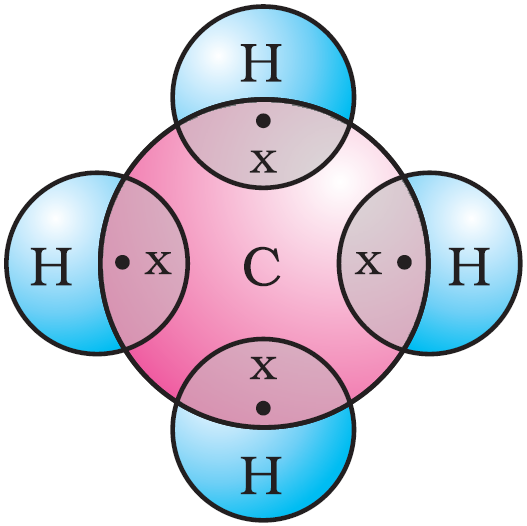
Electron Dot structure of methane is:
The type of bonds present in methane are all covalent bonds between four hydrogen atoms and the single carbon atom at the center of the molecule.
- Methane is a poor conductor of electricity because in methane all bonds are covalent bonds and therefore no free electrons are present in the molecule that can help in the conduction of electricity.
- Covalent compounds have low intermolecular forces of attraction between the molecules and thus show low melting and boiling points. Since, methane is also a covalent compound thus methane has very low melting and low boiling point.
When methane is burned in the presence of Oxygen it forms Carbon dioxide gas and water as a product of the reaction.
$\text{CH}_4\ +\ \text{O}_2\xrightarrow{ \ \ \ \ \ \ \ \ \ \ \ \ \ \\ \ \ }\text{CO}_2\ +\ \text{H}_2\text{O}\\^\text{Methane}\ \ ^\text{Water}\ \ \ \ \ ^\text{Carbon dioxide}\ \ \ ^\text{Water}$ View full question & answer→Question 265 Marks
- Write chemical equation for the following reactions:
- Calcium metal reacts with water.
- Cinnabar is heated in the presence of air.
- Manganese dioxide is heated with aluminium powder.
- What are alloys? List two properties of alloys.
Answer
-
- $\text{Ca}\ +\ 2\text{H}_2\text{O}\xrightarrow{\ \ \ \ \ \ }\text{Ca(OH)}_2+\text{H}_2$
- $2\text{H}\text{g}\text{S}\ +\ 3\text{O}_2\rightarrow2\text{H}\text{g}\text{O}\ +\ 2\text{SO}_2$
- $3\text{MnO}_2\ +\ 4\text{Al}\xrightarrow{\ \ \ \ \ \ }2\text{Al}_2\text{O}_3+3\text{Mn}$
- Alloys are homogeneous mixture of two or more metals or a metal and a non metal Properties:
Alloys are stronger/ harder/ have low melting point/ more resistant to corrosion/ some are magnetic in nature. View full question & answer→Question 275 Marks
Write the chemical formula and name of the compound which is the active ingredient of all alcoholic drinks. List its two uses. Write chemical equation and name of the product formed when this compound reacts with-
- Sodium metal.
- Hot concentrated sulphuric acid.
AnswerName of the compound which is the active ingredient of all alcoholic drinks is Ethanol, and its chemical formula is $CH _3 CH _2 OH$..Uses-
- Ethanol is used in medical wipes/ swabs and antibacterial hand sanitizers.
- Ethanol is also used in body lotions as preservatives and stabilizer of its ingredients.
Chemical reactions of ethanol-
- $\text{CH}_3\text{CH}_2\text{OH}\ +\ \text{Na}\xrightarrow{\ \ \ \ \ \ \ }\text{CH}_3\text{CH}_2\text{O}^-\text{Na}^++\text{H}_2\\^\text{Ethanol}\ \ \ \ \ \ \ \ \ \ \ \ \ \ \ \ \ ^\text{Sodium}\ \ \ \ \ \ \ \ \ ^\text{Soidum ethoxide}\ \ \ \ \ \ ^\text{Hydrogen ges}$
- $\text{CH}_3\text{CH}_2\text{OH}\ +\ \text{H}_2\text{So}_4(\text{conc.})\xrightarrow{\ \ \ \ \ \ \ }\text{C}_2\text{H}_4+\text{H}_2\text{O}\\^\text{Ethanol}\ \ \ \ \ \ \ \ \ \ \ \ \ \ \ \ \ ^\text{sulphuric acid}\ \ \ \ \ \ \ \ \ ^\text{ethene}\ \ \ \ \ \ ^\text{water}$
View full question & answer→Question 285 Marks
An organic compound $A$ having the molecular formula $C _3 H _8 O$ is a liquid at room temperature. The organic liquid $A$ reacts with sodium metal to evolve a gas which burns causing a little explosion. When the organic liquid A heated with concentrated sulphuric acid at $170^{\circ} C$, it forms a compound $B$ which decolourizes bromine water. The compound $B$ adds on one molecule of hydrogen in the presence of Ni as catalyst to forms compound C which gives substitution reactions with chlorine.
a. What is compound $A$ ?
b. What is compound $B$ ?
c. What type of reaction occurs when $A$ is converted into $B$ ?
d. What is compound C ?
e. What type of reaction takes place when B is converted into C ?
Answera. A is propanal, $CH _3- CH - CH OH$
b. B is propene, $CH CH = CH$
c. Dehydration reaction.
d. C is propane, $CH CH - CH$
e. Addition reaction.
View full question & answer→Question 295 Marks
What is a functional group? Give examples of four different functional groups.
AnswerFor the definition of functional group and example,
| Functional Group |
Family |
Representation |
| $-\text{OH}$ |
Alcohols |
$\text{R}-\text{O}-\text{H}$ |
| $\ \ \ \ \text{O}\\\ \ \ \ ||\\-\text{C}-\text{H}$ |
Aldehydes |
$\ \ \ \ \ \ \ \ \text{O}\\\ \ \ \ \ \ \ \ ||\\\text{R}-\text{C}-\text{H}$ |
| $\ \ \ \ \text{O}\\\ \ \ \ ||\\-\text{C}-$ |
Ketones |
$\ \ \ \ \ \ \ \ \text{O}\\\ \ \ \ \ \ \ \ ||\\\text{R}-\text{C}-\text{R}$ |
| $\ \ \ \ \text{O}\\\ \ \ \ ||\\-\text{C}-\text{OH}$ |
Carboxylic acids |
$\ \ \ \ \ \ \ \ \text{O}\\\ \ \ \ \ \ \ \ ||\\\text{R}-\text{C}-\text{OH}$ |
| $-\text{N}-\text{H}\\\ \ \ \ |\\\ \ \ \text{H}$ |
Amines |
$\text{R}-\text{NH}_2$ |
| $-\text{O}-$ |
Ethers |
$\text{R}-\text{O}-\text{R}$ |
| $-\text{X}\ (\text{halogen})$ |
Haloalkanes |
$\text{R}-\text{X}$ |
| $-\text{NO}_2$ |
Nitroalkanes |
$\text{R}-\text{NO}_2$ |
View full question & answer→Question 305 Marks
An organic compound $A$ with molecular form $C _4 H _8 O _2$ on alkaline hydrolysis gives two compound $B$ and C . C on acidification with dil. HCl gives D. Oxidation of B with $K _2 Cr _2 O _7 / H _2 SO _4$ also gives D. Identify $A , B , C$ and D and explain all the reactions involved.
AnswerA - Ethyl ethanoate $\text{CH}_3\text{COOCH}_2\text{CH}_3$ B - Ethanol $(\text{C}_2\text{H}_ 2\text{OH})$ C - Sodium ethanoate $(\text{CH}_3\text{COO}^-)$ D - Ethanoic acid. Esters upon alkaline hydrolysis gives back the carboxylic acid and the alcohol. The acid is initially obtained in its salt form. The reaction is called saponification.$\text{CH}_3\text{COOCH}_2\text{CH}_2 \xrightarrow{\text{NaOH}}\text{CH}_3\text{COONa}+\text{CH}_3\text{CH}_2\text{OH} \\ \ \ \ \ \ \ \ \ \ \ \ \ \ \ (\text{A}) \ \ \ \ \ \ \ \ \ \ \ \ \ \ \ \ \ \ \ \ \ \ \ \ \ \ \ \ \ \ \ \ \ \ \ \ \ \ (\text{C}) \ \ \ \ \ \ \ \ \ \ \ \ \ \ \ \ \ \ (\text{B})$
The salt (sodium ethanoate) is treated with dil HCl to obtain the carboxylic acid.$\text{CH}_3\text{COONa}+\text{HCl}\rightarrow\text{CH}_3\text{COOH}+\text{NaCl}\\ \ \ \ \ \ \ \ \ (\text{C}) \ \ \ \ \ \ \ \ \ \ \ \ \ \ \ \ \ \ \ \ \ \ \ \ \ \ \ \ \ \ \ \ (\text{D})$
Ethanol is oxidized to ethanoic acid in the presence of acidified potassium dichromate. Here, the acid used for acidification is $\text{H}_2\text{SO}_4.$$\text{CH}_3\text{CH}_2\text{OH}\xrightarrow{\text{Acidified}\text{K}_2\text{Cr}_2\text{O}_7+\text{Heat}}\text{CH}_2\text{COOH}\\ \ \ \ \ \ \ \ \ \ \ \ \ \ (\text{B}) \ \ \ \ \ \ \ \ \ \ \ \ \ \ \ \ \ \ \ \ \ \ \ \ \ \ \ \ \ \ \ \ \ \ \ \ \ \ \ \ \ \ \ (\text{D})$
View full question & answer→Question 315 Marks
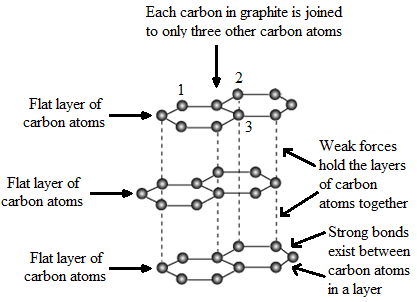
Describe the structure of graphite with the help of a labelled diagram.
AnswerThe structure of graphite is very different from that of diamond. A graphite crystal consists of layers of carbon atoms or sheets of carbon atoms. Each carbon atom in a graphite layer is joined to other three carbon atoms by strong covalent bonds to form flat hexagonal rings. The various layers of carbon atoms in graphite are held together by weak Van der Waals forces. Due to this sheet like structure, graphite is a comparatively soft substance.
View full question & answer→Question 325 Marks
You are given the following molecular formulae of some hydrocarbons:
$C_5 H_8: C_7 H_{14}: C_6 H_6 ; C_5 H_{10} ; C_7 H_{12} ; C_6 H_{12}$
a. Which formula represent cyclohexane as well as hexene?
b. Which formula represents benzene?
c. Which three formulae represent open chain unsaturated hydrocarbons having double bonds?
d. Which two formulae represent unsaturated hydrocarbons having triple bonds?
e. Which three formulae can represent cyclic hydrocarbons?
Answera. $C _6 H _{12}$ is the molecular formula which represents cyclohexane as well as hexene.
b. $C _6 H _6$ represents is the molecular formula of benzene.
c. $C _7 H _{14}, C _5 H _{10}, C _6 H _{12}$ are the molecular formulae for the open chain unsaturated hydrocarbons having double bonds.
d. $C _5 H _8$ and $C _7 H _{12}$ are the molecular formulae for the unsaturated hydrocarbons comprising triple bonds.
e. $C _7 H _{14}, C _5 H _{10}, C _6 H _{12}$ are the three molecular formulae which represent cyclic hydrocarbons.
View full question & answer→Question 335 Marks
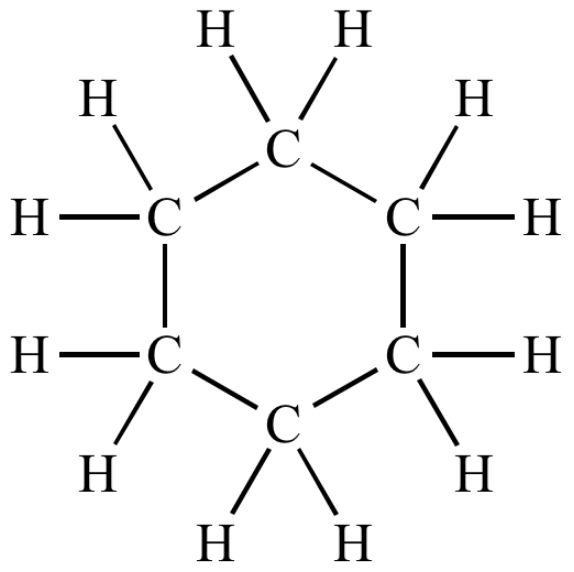
Two organic compounds $A$ and $B$ have the same molecular formula $C _6 H _{12}$. Write the names and structural formulae:
a. If A is a cyclic compound.
b. If $B$ is an open chain compound.
c. Which compound contains single bonds as well as a double bond?
d. Which compound contains only single bonds?
Answer
- If A is a cyclic compound, then $C _6 H _{12}$ is the molecular formula of the compound named cyclohexane.
- If B is an open chain compound, then $C _6 H _{12}$ is the molecular formula of the compound named hexene.
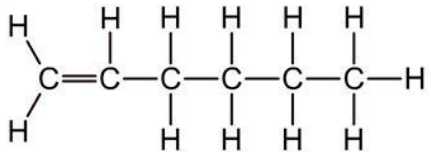
- Hexene (B) is an unsaturated hydrocarbon comprising both single-bonded and double-bonded carbon atoms.
- Cyclohexane is an alkane which contains only single-bonded carbon atoms.
View full question & answer→Question 345 Marks
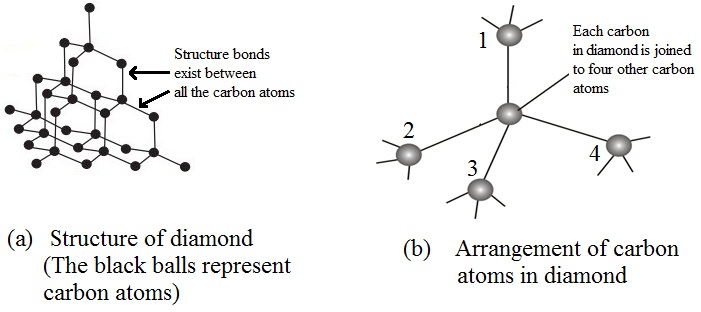
Describe the structure of diamond. Draw a simple diagram to show the arrangement of carbon atoms in diamond.
AnswerA diamond crystal is a giant molecule of carbon atoms. Each carbon atom in the diamond crystal is linked to four other carbon atoms by strong covalent bonds. The four surrounding carbon atoms are at the four vertices of a regular tetrahedron. This rigid structure of diamond makes it a very hard substance.
View full question & answer→Question 355 Marks
Name the reaction which is commonly used in the conversion of vegetable oils to fats. Explain the reaction involved in detail.
Answer
The reaction that is used to convert vegetable oil to fat is called as hydrogenation reaction. Vegetable oils contain unsaturated hydrocarbons which can exhibit addition reaction with hydrogen to form saturated hydrocarbons or fats. The reaction occurs in the presence of metal catalyst like finely divided nickel or palladium at 200°C and forms saturated vegetable fats.
The hydrogenation reaction is an industrial method for the manufacturing of vanaspati ghee from vegetable oil.
$\text{Vegetable oil}+\text{H}_2\xrightarrow{\ \ \text{Ni}, 473\text{K}\ \ }\text{Vanaspati ghee}$
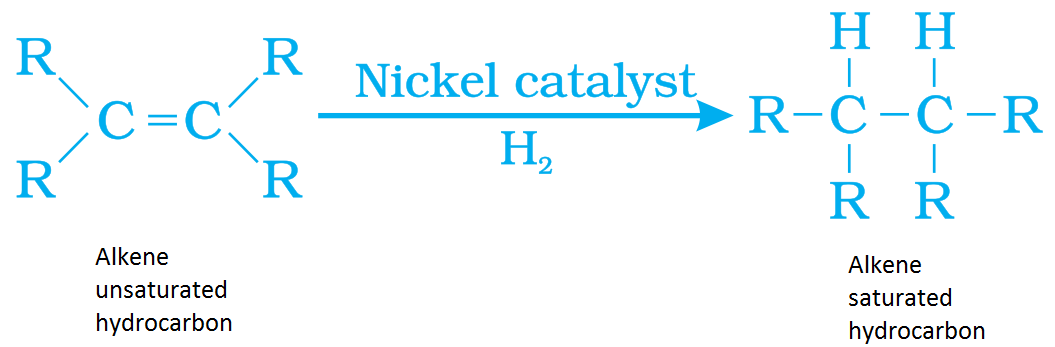
Here, R is any alkyl group which usually contains a large number of carbon atoms in vegetable oils. View full question & answer→Question 365 Marks
The solid element A exhibits the property of catenation. It is also present in the form of a gas B in the air which is utilised by plants in photosynthesis. An allotrope C of this element is used in glass cutters.
- What is element A?
- What is the gas B?
- Name the allotrope C.
- State another use of allotrope C (other than in glass cutters).
- Name another allotrope of element A which exists as spherical molecules.
- Name a yet another allotrope of element A which conduct electricity.
Answer
- Carbon is the element A which exhibits the property of catenation.
- Carbon dioxide is the gas B which is utilised by the plants for photosynthesis.
- Diamond is the allotrope C of carbon which is used in glass cutters.
- Diamond is used in making jewellery.
- Buckminsterfullerene is an allotrope of carbon which exists as spherical molecules.
- Graphite is another allotrope of carbon which conducts electricity.
View full question & answer→Question 375 Marks
A colourless organic liquid $X$ of molecular formula $C _2 H _4 O _2$ turns blue litmus to red. Another colourless organic liquid Y of molecular formula $C _3 H _6 O$ has no action on any litmus but it is used as a nail polish remover. A yet another colourless organic liquid Z of molecular formula $C _2 H _6 O$ has also no action on litmus but it is used in tincture of iodine.
a. Name the liquid X . To which homologous series does it belong? Give the name of another member of this homologous series.
b. Name the liquid Y . To which homologous series does it belong? Write the name of another member of this homologous series.
c. Can you name an organic compound having the same molecular formula as liquid $Y$ but which belongs to a different homologous series? What is this homologous series?
d. Name the liquid Z . To which homologous series does it belong? Write the name of another member of this homologous series.
Answer
- The liquid 'X' is ethanoic acid which turns the blue litmus red. It belongs to the homologous series of carboxylic acid. Methanoic acid is the other member of this homologous series.
- The liquid 'Y' is propanone which is colourless, and is widely used as a nail polish remover. It belongs to the homologous series of ketones. Butanone is the name of the other member of this homologous series.
- Propanal is an organic compound having the same molecular formula as of the liquid 'Y' (Propanone), but the former belongs to the homologous series of aldehydes.
- The liquid 'Z' is ethanol which has no action on the litmus, and is used in the tincture of iodine. It belongs to the homologous series of alcohols. Methanol is the other member of this homologous series.
View full question & answer→Question 385 Marks
Give the structural differences between saturated and unsaturated hydrocarbons with two examples, each.
AnswerSaturated hydrocarbons or alkanes contain either C—C or C—H bonds in their molecules. These are represented by the general formula $C _n H _{2 n+2}$ For example, For example,$\ \ \ \ \ \ \ \ \text{H}\ \ \ \ \ \text{H}\\\ \ \ \ \ \ \ \ \ |\ \ \ \ \ \ \ |\\\text{H}-\text{C}-\text{C}-\text{H}\\\ \ \ \ \ \ \ \ \ |\ \ \ \ \ \ \ |\\\ \ \ \ \ \ \ \ \text{H}\ \ \ \ \ \text{H}\\\ \ \ \ \ \ \ \ \text{Ethane}$ $\ \ \ \ \ \ \ \text{H}\ \ \ \ \ \text{H}\ \ \ \ \ \text{H}\\\ \ \ \ \ \ \ \ |\ \ \ \ \ \ \ |\ \ \ \ \ \ \ |\\\text{H}-\text{C}-\text{C}-\text{C}-\text{H}\\\ \ \ \ \ \ \ \ \ |\ \ \ \ \ \ |\ \ \ \ \ \ \ |\\\ \ \ \ \ \ \ \ \text{H}\ \ \ \ \text{H}\ \ \ \ \ \ \text{H}\\\ \ \ \ \ \ \ \ \ \ \text{Propane}$
Unsaturated hydrocarbons contain either atleast one >C = C< bond or triple —C ≡ C— bond in their molecules. These may be either alkenes or alkynes in nature. The general formula of alkenes is $C _n H _{2 n}$ while that of alkynes is $C _n H _{2 n-2}$ for example,
$\ \ \ \ \ \ \ \ \text{H}\ \ \ \ \ \text{H}\\\ \ \ \ \ \ \ \ \ |\ \ \ \ \ \ \ |\\\text{H}-\text{C}=\text{C}-\text{H}\\\ \ \ \ \text{Ethene}$ $\ \ \ \ \ \ \ \ \text{H}\\\ \ \ \ \ \ \ \ \ |\\\text{H}-\text{C}-\text{C}=\text{C}-\text{H}\\\ \ \ \ \ \ \ \ \ |\ \ \ \ \ \ \ |\ \ \ \ \ \ \ |\\\ \ \ \ \ \ \ \ \text{H}\ \ \ \ \ \text{H}\ \ \ \ \ \ \text{H}\\\ \ \ \ \ \ \ \ \text{Propene}$ $\text{H}-\text{C}\equiv\text{C}-\text{H}\\\ \ \ \ \ \ \text{Ethyne}$ $\ \ \ \ \ \ \ \ \text{H}\\\ \ \ \ \ \ \ \ \ |\\\text{H}-\text{C}-\text{C}\equiv\text{C}-\text{H}\\\ \ \ \ \ \ \ \ \ |\\\ \ \ \ \ \ \ \ \text{H}\\\ \ \ \ \text{Propyne}$
View full question & answer→Question 395 Marks
An organic compound having the molecular formula $C _3 H _6 O$ can exist in the form of two isomers $A$ and $B$ having different functional groups. The isomer $A$ is a liquid which is used as a solvent for nail polish. The isomer $B$ is also a liquid. An aqueous solution of one of the lower homologues of $B$ is used for preserving biological specimens in the laboratory.
- What is compound A?
- Write the electron-dot structure of A.
- What is compound B?
- Write the electron-dot structure of B.
- Name the lower homologue of compound B which is used in preserving biological specimens.
Answer
- The isomer A is propanone (acetone).
- The electron-dot structure of propanone is:
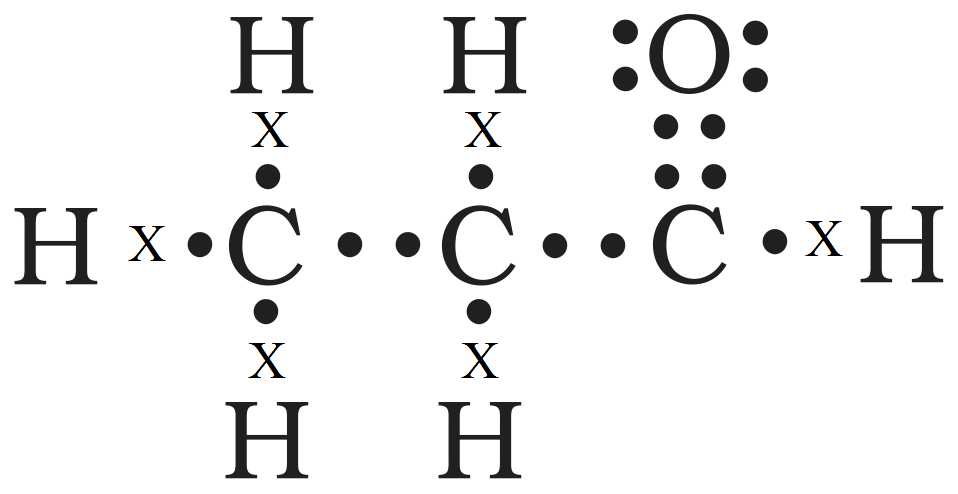
- The isomer B is propanal.
- The electron-dot structure of propanal is:
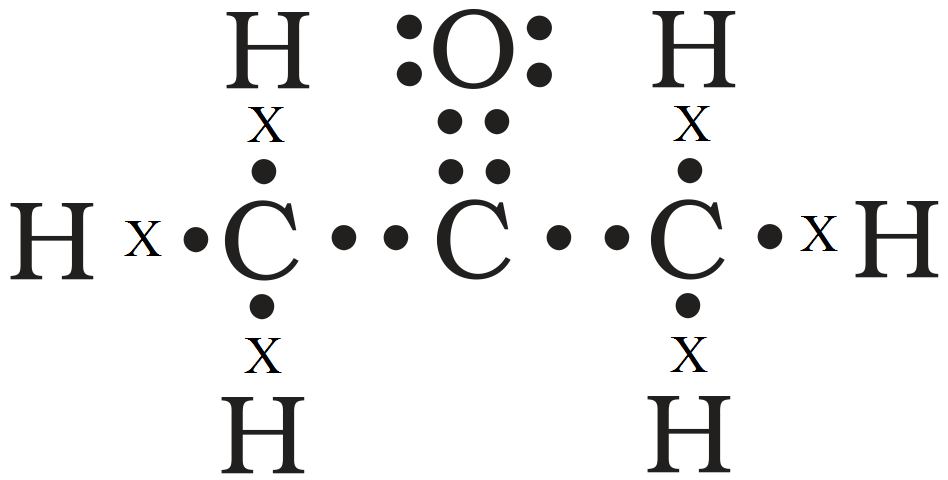
- Methanol or formaldehyde is the lower homologue of compound B, which is used to preserve biological specimens.
View full question & answer→Question 405 Marks
Consider the following organic compounds:
$CH _3 OH , C _2 H _5 OH , CH _3 COCH _3, CH _3 COOH , C _2 H _5 COOH , C _4 H _9 COOC _2 H _5, CH _4, C _2 H _6, CH _3 CHO , HCHO$
Out of these compounds:
a. Which compound is most likely to be sweet-smelling?
b. Which compound on treatment with conc. $H _2 SO _4$ at $170^{\circ} C$ forms an alkene?
c. Which compound on repeated chlorination forms chloroform?
d. Which compound is added to alcohol to denature it?
e. Which compound is a constituent of vinegar?
f. Which compound is used to sterilise wounds and syringes?
Answera. $C _4 H _9 COOC _2 H _5$ : Ester.
b. $C _2 H _5 OH$ : Alcohol forms ethane, $C _2 H$
c. $CH _4$ : Methane.
d. $CH _3 OH$ : Methanol.
e. $CH _3 COOH$ : Acetic acid.
f. $C _2 H _5 OH$ : Ethanol.
View full question & answer→Question 415 Marks
What are hydrocarbons? Give examples.
AnswerHydrocarbons are the organic compounds containing only carbon and hydrogen atoms as their constituents. These may be alkanes, alkenes and alkynes.
Alkane: $\ \ \ \ \ \ \ \ \text{H}\\\ \ \ \ \ \ \ \ \ |\\\text{H}-\text{C}-\text{H}\\\ \ \ \ \ \ \ \ \ |\\\ \ \ \ \ \ \ \ \text{H}\\\ \ \ \text{Methane}$ $\ \ \ \ \ \ \ \ \text{H}\ \ \ \ \ \text{H}\\\ \ \ \ \ \ \ \ \ |\ \ \ \ \ \ |\\\text{H}-\text{C}-\text{C}-\text{H}\\\ \ \ \ \ \ \ \ |\ \ \ \ \ \ \ |\\\ \ \ \ \ \ \ \text{H}\ \ \ \ \ \ \text{H}\\\ \ \ \ \ \ \ \text{Ethane}$ $\ \ \ \ \ \ \ \ \text{H}\ \ \ \ \ \text{H}\ \ \ \ \ \text{H}\\\ \ \ \ \ \ \ \ \ |\ \ \ \ \ \ |\ \ \ \ \ \ \ |\\\text{H}-\text{C}-\text{C}-\text{C}-\text{H}\\\ \ \ \ \ \ \ \ |\ \ \ \ \ \ \ |\ \ \ \ \ \ \ |\\\ \ \ \ \ \ \ \text{H}\ \ \ \ \ \ \text{H}\ \ \ \ \text{H}\\\ \ \ \ \ \ \ \ \ \ \text{Propane}$
Alkyl group: $\ \ \ \ \ \ \ \ \text{H}\\\ \ \ \ \ \ \ \ \ |\\\text{H}-\text{C}-\\\ \ \ \ \ \ \ \ \ |\\\ \ \ \ \ \ \ \ \text{H}\\ \text{Methyl group}$ $\ \ \ \ \ \ \ \ \text{H}\ \ \ \ \ \text{H}\\\ \ \ \ \ \ \ \ \ |\ \ \ \ \ \ |\\\text{H}-\text{C}-\text{C}-\\\ \ \ \ \ \ \ \ |\ \ \ \ \ \ \ |\\\ \ \ \ \ \ \ \text{H}\ \ \ \ \ \ \text{H}\\\ \ \ \text{Ethyl group}$ $\ \ \ \ \ \ \ \ \text{H}\ \ \ \ \ \text{H}\ \ \ \ \ \text{H}\\\ \ \ \ \ \ \ \ \ |\ \ \ \ \ \ |\ \ \ \ \ \ \ |\\\text{H}-\text{C}-\text{C}-\text{C}-\\\ \ \ \ \ \ \ \ |\ \ \ \ \ \ \ |\ \ \ \ \ \ \ |\\\ \ \ \ \ \ \ \text{H}\ \ \ \ \ \ \text{H}\ \ \ \ \text{H}\\\ \ \ \ \ \ \text{Propyl group}$
The structures of compounds belonging to a few families are:
$\ \ \ \ \ \ \ \ \text{H}\\\ \ \ \ \ \ \ \ \ |\\\text{H}-\text{C}-\text{Cl}\\\ \ \ \ \ \ \ \ \ |\\\ \ \ \ \ \ \ \ \text{H}$ $\ \ \ \ \ \ \ \ \text{H}\ \ \ \ \ \text{H}\\\ \ \ \ \ \ \ \ \ |\ \ \ \ \ \ |\\\text{H}-\text{C}-\text{C}-\text{OH}\\\ \ \ \ \ \ \ \ |\ \ \ \ \ \ \ |\\\ \ \ \ \ \ \ \text{H}\ \ \ \ \ \ \text{H}$ $\ \ \ \ \ \ \ \ \text{H}\ \ \ \ \ \text{H}\ \ \ \ \ \text{H}\\\ \ \ \ \ \ \ \ \ |\ \ \ \ \ \ |\ \ \ \ \ \ \ |\\\text{H}-\text{C}-\text{C}-\text{C}-\text{NH}_2\\\ \ \ \ \ \ \ \ |\ \ \ \ \ \ \ |\ \ \ \ \ \ \ |\\\ \ \ \ \ \ \ \text{H}\ \ \ \ \ \ \text{H}\ \ \ \ \text{H}$
View full question & answer→Question 425 Marks
Draw the structures for the following compounds.
- Ethanoic acid
- Bromopentane
- Butanone
- Hexanal.
Are structural isomers possible for bromopentane?
Answer
- $\text{CH}_3\text{COOH},$
$\ \ \ \ \ \ \ \ \text{H}\ \ \ \ \ \text{O}\ \\\ \ \ \ \ \ \ \ \ \mid\ \ \ \ \ \parallel\ \ \ \ \ \ \\\text{H}-\text{C}-\text{C}-\text{OH}\\\ \ \ \ \ \ \ \ \ \mid\ \ \ \ \ \ \ \ \ \ \ \ \ \\\ \ \ \ \ \ \ \ \text{H}\ \ \ \ \ \ \ \ \ \ \ \ $
- There are many structural isomers possible for bromopentane. Among them, the structures of three isomers are given.
$\text{CH}_3\text{CH}_2\text{CH}_2\text{CH}_2\text{CH}_2\text{Br},$
$\ \ \ \ \ \ \ \ \text{H}\ \ \ \ \text{H}\ \ \ \ \ \ \text{H}\ \ \ \ \ \text{H}\ \ \ \ \ \text{H}\\\ \ \ \ \ \ \ \ \ \mid\ \ \ \ \ \mid\ \ \ \ \ \mid\ \ \ \ \ \mid\ \ \ \ \ \mid\\\text{H}-\text{C}-\text{C}-\text{C}-\text{C}-\text{C}-\text{Br}\\\ \ \ \ \ \ \ \mid\ \ \ \ \ \mid\ \ \ \ \ \mid\ \ \ \ \ \mid\ \ \ \ \ \mid\\\ \ \ \ \ \ \ \text{H}\ \ \ \ \ \text{H}\ \ \ \ \ \ \text{H}\ \ \ \ \ \text{H}\ \ \ \ \text{H}$
$\ \ \ \ \ \ \ \ \text{H}\ \ \ \ \text{H}\ \ \ \ \ \ \text{H}\ \ \ \ \ \text{H}\ \ \ \ \ \text{H}\\\ \ \ \ \ \ \ \ \ \mid\ \ \ \ \ \mid\ \ \ \ \ \mid\ \ \ \ \ \mid\ \ \ \ \ \mid\\\text{H}-\text{C}-\text{C}-\text{C}-\text{C}-\text{C}-\text{H}\\\ \ \ \ \ \ \ \mid\ \ \ \ \ \mid\ \ \ \ \ \mid\ \ \ \ \ \mid\ \ \ \ \ \mid\\\ \ \ \ \ \ \ \text{H}\ \ \ \ \ \text{H}\ \ \ \ \ \ \text{H}\ \ \ \ \ \text{Br}\ \ \ \text{H}$
$\ \ \ \ \ \ \ \ \text{H}\ \ \ \ \text{H}\ \ \ \ \ \ \text{H}\ \ \ \ \ \text{H}\ \ \ \ \ \text{H}\\\ \ \ \ \ \ \ \ \ \mid\ \ \ \ \ \mid\ \ \ \ \ \mid\ \ \ \ \ \mid\ \ \ \ \ \mid\\\text{H}-\text{C}-\text{C}-\text{C}-\text{C}-\text{C}-\text{H}\\\ \ \ \ \ \ \ \mid\ \ \ \ \ \mid\ \ \ \ \ \mid\ \ \ \ \ \mid\ \ \ \ \ \mid\\\ \ \ \ \ \ \ \text{H}\ \ \ \ \ \text{H}\ \ \ \ \ \ \text{Br}\ \ \ \ \text{H}\ \ \ \ \ \text{H}$
- $\text{CH}_3\text{CH}_2\text{COCH}_3,$
$\ \ \ \ \ \ \ \ \text{H}\ \ \ \ \text{H}\ \ \ \ \ \text{O}\ \ \ \ \ \text{H}\\\ \ \ \ \ \ \ \ \ |\ \ \ \ \ \ |\ \ \ \ \ \ ||\ \ \ \ \ \ |\\\text{H}-\text{C}-\text{C}-\text{C}-\text{C}-\text{H}\\\ \ \ \ \ \ \ \ \ \mid\ \ \ \ \mid\ \ \ \ \ \ \ \ \ \ \ \ \ \mid\\\ \ \ \ \ \ \ \ \ \text{H}\ \ \ \ \ \text{H}\ \ \ \ \ \ \ \ \ \ \ \ \text{H}\ \ \ \ $
- $\text{CH}_3\text{CH}_2\text{CH}_2\text{CH}_2\text{CH}_2\text{CHO},$
$\ \ \ \ \ \ \ \ \text{H}\ \ \ \ \text{H}\ \ \ \ \ \ \text{H}\ \ \ \ \ \text{H}\ \ \ \ \ \text{H}\ \ \ \ \text{O}\\\ \ \ \ \ \ \ \ \ \mid\ \ \ \ \ \mid\ \ \ \ \ \mid\ \ \ \ \ \mid\ \ \ \ \ \mid\ \ \ \parallel\\\text{H}-\text{C}-\text{C}-\text{C}-\text{C}-\text{C}-\text{C}-\text{H}\\\ \ \ \ \ \ \ \mid\ \ \ \ \ \mid\ \ \ \ \ \mid\ \ \ \ \ \mid\ \ \ \ \ \mid\\\ \ \ \ \ \ \ \text{H}\ \ \ \ \ \text{H}\ \ \ \ \ \ \text{H}\ \ \ \ \ \text{H}\ \ \ \ \ \text{H}$ View full question & answer→Question 435 Marks
A four carbons atoms containing neutral organic compound X reacts with sodium metal to evolve a gas which burns with 'pop' sound. Another four carbon atoms containing carbon compound reacts with sodium hydrogen carbonate to evolve a gas which turns lime water milky. When compounds X and Y are heated together in the presence of a little of concentrated sulphuric acid, then a new compound Z is formed.
- What is compound X? Also write its formula.
- What is compound Y? Also write its formula.
- What is compound Z? Also write its formula.
- What type of smell is given by compound Z?
- What is the general name of compounds like Z?
- What is the general name of the reaction which which takes place between X and Y to form Z?
Answera. The compound $X$ is Butanol, and its formula is $C _4 H _9 OH$.
b. The compound $Y$ is butanoic acid, and its formula is $C _3 H _7 COOH$.
c. The compound $Z$ is butyl butanoate, and its formula is $C _3 H _7 COOC _4 H 9$.
d. The type of smell produced by the compound is a sweet, fruity fragrance.
e. Ester is the general name given to the compound formed by the reaction of X and Y .
f. Esterification is the general name of the reaction which takes place between Butanol and butanoic acid to produce butyl butanoate.
View full question & answer→Question 445 Marks
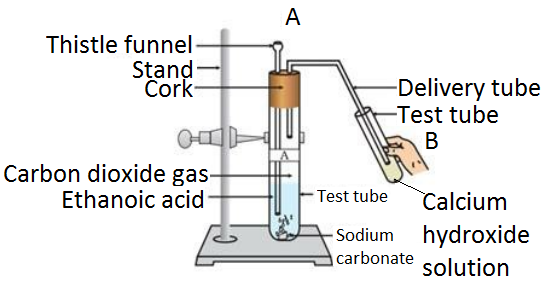
Look at Figure and answer the following questions:
- What change would you observe in the calcium hydroxide solution taken in tube B?
- Write the reaction involved in test tubes A and B respectively.
- If ethanol is given instead of ethanoic acid, would you expect the same change?
- How can a solution of lime water be prepared in the laboratory?
Answera. Calcium hydroxide solution in the test tube B becomes milky.
b. Reaction in test tube A:
$CH_3 COOH+NaHCO_3 \rightarrow CH_3 COONa+CO_2+H_2 O$
Reaction in test tube B:
$Ca(OH)_2+CO_2 \rightarrow CaCO_3+H_2 O$
c. Ethanol does not react with sodium hydrogen carbonate. Hence, same change cannot be observed.
d. For this, take distilled water in a beaker and mix calcium carbonate powder in it. After stirring thoroughly, wait till the mixture settles. Decant the clear liquid from the beaker. This liquid is lime water.
View full question & answer→Question 455 Marks
An organic compound A (molecular formula $C _2 H _4 O _2$ ) reacts with Na metal to form a compound B and evolves a gas which burns with a pop sound. Compound A on treatment with an alcohol C in the presence of a little of concentrated sulphuric acid forms a sweetsmelling compound D (molecular formula $C _3 H _6 O _2$ ). Compound D on treatment with NaOH solution gives back B and C . Identify $A , B , C$ and D .
Answera. A is ethanoic acid, $CH _3 COOH$
b. B is sodium ethanoate, $CH _3 COONa$
c. C is methanol, $CH _3 OH$
d. D is methyl ethanoate, $CH _3 COOCH _3$
View full question & answer→Question 465 Marks
A compound C (molecular formula, $C _2 H _4 O _2$ ) reacts with Na -metal to form a compound $R$ and evolves a gas which burns with a pop sound. Compound C on treatment with an alcohol A in presence of an acid forms a sweet smelling compound S (molecular formula, $C _3 H _6 O _2$ ). On addition of NaOH to C , it also gives R and water. S on treatment with NaOH solution gives back R and A .Identify $C , R , A , S$ and write down the reactions involved.
AnswerCompound C with molecular formula $C _2 H _4 O _2$ contains two oxygen atoms so it can be either ester or carboxylic acid. Since it reacts with sodium metal to form compound R and evolves a gas which burns with pop sound, therefore it should be a carboxylic acid which forms sodium alkanoate and hydrogen gas with sodium metal.
$2 CH_3 COOH+2 Na \longrightarrow 2 CH_3 COONa+H_2 \uparrow$
The gas which burns with pop sound is hydrogen gas.
Reaction of ethanoic acid with alcohol in the presence of an acid (Conc. $H _2 SO _4$ ) forms sweet smelling ester. So compound S that is formed due to reaction of ethanoic acid and methanol $(A)$ is methyl ethanoate with molecular formula $C _3 H _6 O _2$ and structural formula $CH _3 COOCH _3$.
$CH_3 COOH+CH_3 OH \xrightarrow{\text { Conc. } H_2 So_4} CH_3 COOCH_3+H_2 O$
Hence compound $C =$ Ethanoic acid $\left( CH _3 COOH \right), R =$ Sodium ethanoate $\left( CH _3 COONa \right), A =$ Methanol $\left( CH _3 OH \right)$ and $S =$ Methyl merhanoate $\left( CH _3 COOCH _3\right)$
View full question & answer→Question 475 Marks
Draw the possible isomers of the compound with molecular formula $C _3 H _6 O$ and also give their electron dot structures.
AnswerFive isomers possible for the molecular formula $C _3 H _6 O$ are listed below.
|
Sr. No.
|
Name of isomer
(Structural formula)
|
Electron dot structure
|
|
1.
|
Propanal
$\left(CH_3 CH_2 CHO\right)$
|
|
|
2.
|
Propanone
$\left(CH_3 COCH_3\right)$
|
|
|
3.
|
Prop-1-ene-1-ol
$\left(CH_2=CHCH_2-OH\right)$
|
|
|
4.
|
Prop-2-en-1-ol
$\left(CH_2=CHCH_2-OH\right)$
|
|
|
5.
|
Methoxyethene
$\left(CH_2=CH-OCH_3\right$
|
|
View full question & answer→Question 485 Marks
An organic compound A on heating with concentrated $H _2 SO _4$ forms a compound B which on addition of one mole of hydrogen in presence of Ni forms a compound C . One mole of compound C on combustion forms two moles of $CO _2$ and 3 moles of $H _2 O$. Identify the compounds $A , B$ and C and write the chemical equations of the reactions involved.
AnswerSince one mole of compound C on combustion forms two moles of $CO _2$ and three moles of $H _2 O$ the compound C is a hydrocarbon with formula $C _2 H _6$. It is ethane. The compound B which forms $C _2 H _6$ upon addition of hydrogen is ethene $\left( C _2 H _4\right)$. The organic compound A which forms ethene upon acidic dehydration is ethanol. The chemical equations for the reactions involved are::$\text{C}_2\text{H}_5\text{OH}\xrightarrow[\ \ \ \text{heat}\ \ \ ]{\ \text{H}_2\text{SO}_4\ }\text{CH}_2=\text{CH}_2\xrightarrow[\ \ \text{heat}\ \ \ ]{\ \ \text{H}_2\text{Ni}\ \ }\text{CH}_3-\text{CH}_3\\\text{Ethanol (A)}\ \ \ \ \ \ \ \ \ \text{Ethene (B)}\ \ \ \ \ \ \ \ \ \ \ \ \ \ \ \text{Ethane (C)}$
$\text{C}_2\text{H}_6+3\text{O}_2\xrightarrow{\ \ \ \ (\text{Combustion})\ \ \ }2\text{CO}_2+3\text{H}_2\text{O}\\\ \ (\text{C)}$
View full question & answer→Question 495 Marks
Give the reaction for the hydrogenation of unsaturated carbon compounds. Define the term catalyst and name the catalyst used in this reaction. Which oil should be chosen for cooking and why?
AnswerUnsaturated hydrocarbons are more reactive due to presence of double or triple bonds. They undergo addition reactions across the carbon-carbon double bonds to produce saturated hydrocarbons.
Addition of hydrogen across C - C double bonds is called hydrogenation. Unsaturated hydrocarbons add hydrogen in the presence of catalysts such as nickel/palladium to give saturated hydrocarbons.
For example:
$\text{CH}_3\text{CH}=\text{CH}_2+\text{H}_2\dashrightarrow\text{CH}_3\text{CH}_2\text{CH}_3$
Industrial application of addition reactions: Hydrogenation of vegetable oils.
Vegetable oils used for cooking are long unsaturated hydrocarbons which are healthy. Whereas animal fats such as vanaspati are saturated hydrocarbons and unhealthy for consumption. It can solidify and block the arteries of the heart.
View full question & answer→Question 505 Marks
Give a detailed explanation on the following.Properties of acetic acid.
AnswerAcetic acid is an organic acid which is the principal element of vinegar. It is also called glacial acetic acid, ethanoic acid or methane carboxylic acid.Physical properties:
- Ethanoic acid is vinegar smelling liquid. The lower carboxylic acids are liquids whereas higher ones are solids.
- Ethanoic acid is sour in taste. Other lower carboxylic acids are also sour in taste.
- Ethanoic acid has boiling point 391 K. Carboxylic acids have higher boiling points than corresponding alcohols, aldehydes and ketones.
- Acetic acid is soluble in water, i.e., it is miscible with water in all proportions. The lower carboxylic acids are soluble in water but solubility in water decreases with increase in molecular weight.
- Acetic acid freezes at 290 K. Thus, in cold weather crystallization of acetic acid may take place that is why pure acetic acid is called glacial acetic acid.
Chemical Properties:
- Ethanoic acid is weak acid but it turns blue litmus red.
- Reaction with Metale. Ethanoic acid reacts with metals like Na, K, Zn etc. to form metal ethanoates and hydrogen gas.
- Reaction with Carbonates. Ethanoic acid reacts with bicarbonates and carbonates and produces brisk effervescence due to formation of carbon dioxide, CO .
- Acetic acid reacts with alkalis and forms acetate salts, $\text{CH}_3\text{COOH}+\text{KOH}\rightarrow\text{CH}_3\text{COOK}+\text{H}_2\text{O}.$
- Acetic acid reacts with sodium bicarbonate to produce carbon dioxide.
$\text{CH}_3\text{COOH}+\text{NaHCO}_3\rightarrow\text{CH}_3\text{COONa}+\text{CO}_3(\text{g})+\text{H}_2\text{O}(\text{L})$ View full question & answer→