Questions · Page 2 of 2

2 Marks Questions

Question 512 Marks
How would you explain the following observations?
BeO is almost insoluble but $\mathrm{BeSO}_4$ is soluble in water
Answer
BeO is almost insoluble in water and $\mathrm{BeSO}_4$ is soluble in water. $\mathrm{Be}^{2+}$ is a small cation with a high polarizing power and $\mathrm{O}^{2-}$ is a small anion. The size compatibility of $\mathrm{Be}^{2+}$ and $\mathrm{O}^{2-}$ is high. Therefore, the lattice energy released during their formation is also very high. When BeO is dissolved in water, the hydration energy of its ions is not sufficient to overcome the high lattice energy. Therefore, BeO is insoluble in water. On the other hand, $\mathrm{SO}_4^{2-}$ ion is a large anion. Hence, $\mathrm{Be}^{2+}$ can easily polarize $\mathrm{SO}_4^{2-}$ ions, making $\mathrm{BeSO}_4$ unstable. Thus, the lattice energy of $\mathrm{BeSO}_4$ is not very high and so it is soluble in water.

View full question & answer
Question 522 Marks
Why is $\mathrm{PbCl}_4$ good oxidizing agent?
OR
Boron forms only covalent compounds.
Answer
$\mathrm{PbCl}_4$ is good oxidising agent because $\mathrm{Pb}^{2+}$ is more stable than $\mathrm{Pb}^{4+}$ due to inert pair effect, therefore, $\mathrm{Pb}^{4+}$ readily changes into $\mathrm{Pb}^{2+}$ by gaining two electrons.
View full question & answer
Question 532 Marks
Arrange the following in increasing order of Lewis acid character:
$\mathrm{BF}_3, \mathrm{BFI}_3, \mathrm{BBr}_3 \text { and } \mathrm{BI}_3$
Answer
$\mathrm{Bl}_3>\mathrm{BBr}_3>\mathrm{BCl}_3>\mathrm{BF}_3$
$\because$ Back bonding (donation of lone pair of halogen to vacant ' p ' orbital of B ) is most effective in $\mathrm{BF}_3$ due to $2 \mathrm{p}-2 \mathrm{p}$ overlapping and least effective in $\mathrm{Bl}_3$ due to $2 p-5$ p overlapping.
View full question & answer
Question 542 Marks
Between $\mathrm{AlF}_3$ and $\mathrm{AlCl}_3$, which one will have a higher melting point?
Answer
$\mathrm{AlF}_3$ is more ionic, therefore, has higher melting point as compared to $\mathrm{AlCl}_3$ because ' F ' is more electronegative than Cl . Higher the difference in electro-negativity more will be ionic character.
View full question & answer
Question 552 Marks
How is that silicon atoms can have a coordination number more than four but carbon atoms cannot?
Answer
Silicon has vacant d-orbitals, therefore, it can have coordination number more than four but carbon cannot have because it does not have d-orbitals. It can not expand its valency beyond four.
View full question & answer
Question 562 Marks
Like CO, why its analog of SiO is not stable?
Answer
CO is a resonance hybrid of the following two structures,

Thus, CO contains pπ-pπ multiple bonds. This is due to the reason that carbon has a strong tendency to form pπ-pπ multiple bonds due to its small size and high electronegativity. Silicon, on the other hand, because of its bigger size and lower electronegativity has no tendency to form pπ-pπ multiple bonds and hence, Si does not form SiO molecule analogous to CO molecule.
View full question & answer
Question 572 Marks
  1. What is drikold and for what purpose it is used?
  2. Why does lime water turn milky when $\text{CO}_2$ is passed through it?
Answer
  1. Solid carbon dioxide is known as dry ice. It is soft, white snow like substances and looks like ice. However, it does not wet a piece of cloth or paper because it sublimes without melting. Solid carbon dioxide is used as a refrigerant under the commercial name of drikold.
  2. When carbon dioxide is passed through lime water it turn milky due to the formation of $\text{CaCO}_3$.
But when carbon dioxide is passed continuously, the milkiness disappears due to the formation of soluble,$\text{Ca(HCO}_3)_2.$
$\text{Ca(OH})_32+\text{CO}_2\xrightarrow{\ \ \ \ \ \ \ }\text{CaCO}_3+\text{H}_2\text{O}\\\ \ \ \ \ \ \ \ \ \ \ \ \ \ \ \ \ \ \ \ \ \ \ \ \ \ \ \ \ \ \ \ \ \ \ \ \ \ \ \ \ \text{Milkiness}\\\xrightarrow{\frac{\text{CO}_2}{\text{H}_2\text{O}}}\text{Ca(HCO}_3)_2\\\ \ \ \ \ \ \ \ \ \text{Souble in water}$
View full question & answer
Question 582 Marks
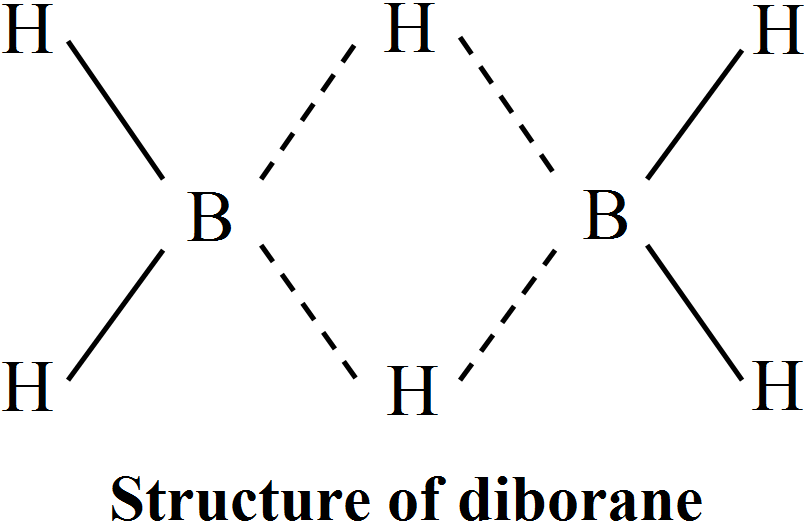
  1. How is diborane prepared in the laboratory? Draw its structure.
  2. Explain why $\mathrm{CO}_2$ is a gas whereas $\mathrm{SiO}_2$ is a solid.
Answer
  1. $2\text{NaBH}_4+\text{I}_2\xrightarrow{\ \ \ \ \ \ \ }\text{B}_2\text{H}_6+2\text{NaI}+\text{H}_2$
  1. $\mathrm{CO}_2$ exists as descrete molecules which are held together by weak van der Waals' forces of attraction whereas $\mathrm{SiO}_2$​​​​​​​ is three dimensional covalent solid.
View full question & answer
Question 592 Marks
Explain the following:
Boron does not exist as $B^{3+}$ ion.
Answer
Boron has three electrons in the valence shell. Because of its small size and high sum of the first three ionisation enthalpies $(\text{i.e.,}\triangle_\text{i}\text{H}_1+\triangle_\text{i}\text{H}_2+\triangle_\text{i}\text{H}_3),$ boron does not lose all its valence electrons to form $B^{3+}$ ions.
View full question & answer
Question 602 Marks
Starting from $\mathrm{SiCl}_4$ prepare the following in steps not exceeding the number given in parenthness (give reactions only).
i. Silicon.
ii. Linear silicon containing methyl groups only.
iii. $\mathrm{Na}_2 \mathrm{SiO}_3$.
Answer
  1. $3\text{SiCl}_4+4\text{Al}\xrightarrow{\ \ \ \ \ \ \ }4\text{AlCl}_3+3\text{Si}\\\ \ \ \ \ \ \ \ \ \ \ \ \ \ \ \ \text{Molten}$
  2. $\text{Si}+2\text{CH}_3\text{Cl}\xrightarrow[570\text{ K}]{\text{Cu powder}}(\text{CH}_3)_2\text{SiCl}_2$
View full question & answer
Question 612 Marks
Explain the nature of boric acid as a Lewis acid in water.
Answer
Boric acid is a weak monobasic acid and acts as a Lewis acid by accepting electrons from a hydroxyl ion.
$\text{B(OH)}_3+2\text{H}_2\text{O}\rightarrow[\text{B(OH)}_4]^-+\text{H}_3\text{O}^+$
View full question & answer
Question 622 Marks
$\mathrm{BCl}_3$ exists but $\mathrm{BH}_3$ does not. Explain.
Answer
In $\mathrm{BCl}_3, \mathrm{Cl}$ donates lone pair of electrons to vacant p-orbital of boron (back-bonding) making it more stable whereas in $\mathrm{BH}_3$ back-bonding is not possible, therefore, it exists as dimer. Secondly, in $\mathrm{BCl}_3$, chlorine being bigger in size cannot form bridged bonds like hydrogen in $\mathrm{B}_2 \mathrm{H}_6$.
View full question & answer
Question 632 Marks
Why does C differ from rest of elements?
Answer
Carbon has smallest size, highest ionisation enthalpy and high electronegativity and does not have d-orbitals, therefore, it differs from rest of the elements.
View full question & answer
Question 642 Marks
$\mathrm{AlCl}_3$ exist a as dimer while $\mathrm{BCl}_3$ exist as monomer, why?
Answer
'Al' has d-orbital which can accept a lone pair from ' Cl ' forming coordinate bond, $\mathrm{AlCl}_3$ exist as dimer.
In $\mathrm{BCl}_3$, 'Cl' donates a pair of electron to vacant p -orbital of ' B ' forming $\mathrm{p} \pi-\mathrm{p} \pi$ bond making it stable. It exist as $\mathrm{BCl}_3$
View full question & answer
Question 652 Marks
Arrange the following compounds in decreasing order of property indicated against each. Give reason for your answer: $\mathrm{BCl}_3, \mathrm{AlCl}_3, \mathrm{AgCl}_3, \mathrm{InCl}_3, \mathrm{TICl}_3$
(Stability of +3 oxidation state.)
Answer
$\mathrm{BCl}_3>\mathrm{AlCl}_3>\mathrm{GaCl}_3>\mathrm{InCl}_3>\mathrm{TICl}_3$ because of inert pair effect stability of +3 oxidation state decreases.
View full question & answer
Question 662 Marks
Carbon monoxide is readily absorbed by ammoniacal cuprous chloride solution but carbon dioxide is not. Explain.
Answer
Due to the presence of a lone pair of electrons on carbon in Co, it acts as a Lewis base (or ligand) and thus forms a soluble complex with ammoniacal cuprous chloride solution.
$\text{CaCl}+\text{NH}_3+:\text{CO}\xrightarrow{\\ \ \ \ \ \ }[\text{Cu(CONH}_3]^+\text{Cl}^-\\\ \ \ \ \ \ \ \ \ \ \ \ \ \ \ \ \ \ \ \ \ \ \ \ \ \ \ \ \ \ \ \ \ \ \ \ \ \ \ \ \ \ \ \text{Soluble complex}$
On the other hand, $\mathrm{CO}_2$ does not act as a Lewis base since it does not have a lone pair of electrons on the carbon atom and hence, does not dissolve in ammoniacal cuprous chloride solution.
View full question & answer
Question 672 Marks
Complete the following chemical reaction equations:
  1. $\text{I}_2+\text{HNO}_3\xrightarrow{\ \ \ \ \ \ \ \ \ }\\ \ \ \ \ \ \ \ \ \ ^\text{(conc.)}$
  2. $\text{HgCl}_2+\text{PH}_3\xrightarrow{\ \ \ \ \ \ \ \ \ \ }$
Answer
  1. $\text{I}_2+10\text{HNO}_3\xrightarrow{\ \ \ \ \ \ }2\text{HIO}_3+10\text{NO}_2+4\text{H}_2\text{O}\\ \ \ \ \ \ \ \ \ \ \ \ ^\text{(conc.)}$
  2. $3\text{HgCl}_2+2\text{PH}_3\xrightarrow{\ \ \ \ \ \ \ }\text{Hg}_3\text{P}_2+6\text{HCl}$
View full question & answer
Question 682 Marks
Give suitable reasons for the following:
i. $\left[\mathrm{SiF}_6\right]^{2-}$ is known whereas $\left[\mathrm{SiCl}_6\right]^{2-}$ not.
ii. Diamond is covalent, yet it has high melting point.
Answer
  1. It is because 'F' is smaller in size, more electronegative and stronger oxidising agent than chlorine.
  2. It is due to three dimensional compact structure, it has strong covalent bonds, which requires high amount of energy, therefore, high melting point.
View full question & answer
Question 692 Marks
  1. Complete the following chemical equations:
  1. $\text{Fe}_2\text{O}_3+3\text{CO}\xrightarrow{\Delta\ \ }$
  2. $\text{CaCO}_3+2\text{HCl}\xrightarrow{\ \ \ \ \ \ \ }$
  1. Write a brief account on the following:
  1. Diamond is covalent, yet it has high melting point.
  2. Atomic radius of gallium (135 pm) is less than that of aluminium (143 pm).
  3. Graphite is a good conductor of electricity but diamond is insulator.
Answer
  1.  
  1. $\text{Fe}_2\text{O}_3+3\text{CO}\xrightarrow{\Delta\ \ }2\text{Fe}+3\text{CO}_2$
  2. $\text{CaCO}_3+2\text{HCl}\xrightarrow{\ \ \ \ \ \ \ }\text{CaCl}_2+\text{H}_2\text{O}+\text{CO}_2$
  1.  
  1. It is due to strong $\text{C}-\text{C}$ bonding and compact structure.
  2. It is due to poor shielding effect of 3d electrons due to which effective nuclear charge increases in Ga, therefore, it is smaller than Al.
  3. It is due to the presence of free electrons in graphite but not in diamond.
View full question & answer
Question 702 Marks
Why do boron halides form addition compounds with ammonia and amines?
Answer
It is because they are electron deficient i.e. need a pair of electron to complete their octet. $\mathrm{NH}_3$ and $\mathrm{RNH}_2$ have lone pair of electron which can be donated to boron halides.
View full question & answer
Question 712 Marks
What type of glass is obtained when borax is added to sodium carbonate, silica and calcium carbonate?
Answer
Pyrex glass is obtained which is heat resistant. It can withstand high temperature. It is also called Borosil glass.
View full question & answer
Question 722 Marks
Why is $\mathrm{BF}_3$ planar molecule but $\mathrm{NH}_3$ is pyramidal?
Answer
In $\mathrm{BF}_3$ ' B ' is $\mathrm{sp}^2$ hybridised whereas in $\mathrm{NH}_3{ }^{\prime} \mathrm{N}^{\prime}$ is $\mathrm{sp}^3$ hybridised with one lone pair of electrons, therefore, it is pyramidal while $\mathrm{BF}_3$ is planar.
View full question & answer
Question 732 Marks
What happens when:
  1. Silicon dioxide is treated with excess of HF?
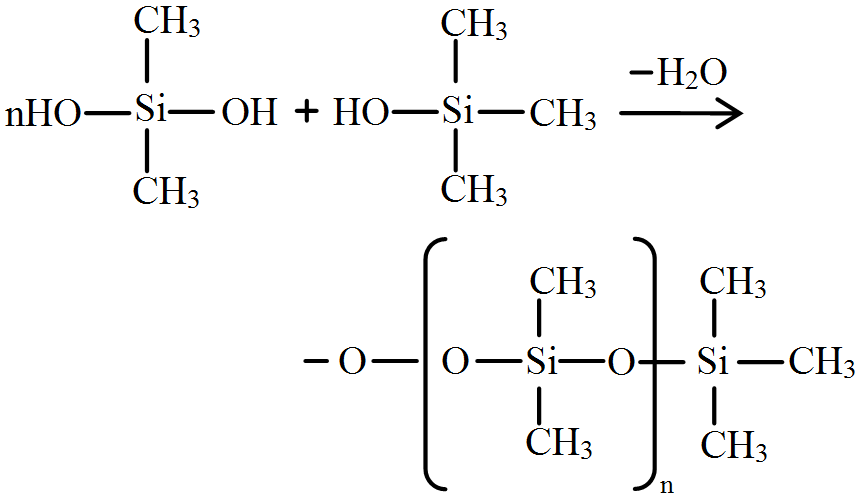
  2. $\mathrm{N}\left(\mathrm{CH}_3\right)_2 \mathrm{SI}(\mathrm{OH})_3$ is treated with $\left(\mathrm{CH}_3\right)_3 \mathrm{SiOH}$ ?
Answer
  1. Hydrofluorosilicic acid is obtained.
$\text{SiO}_2+4\text{HF}\xrightarrow{\ \ \ \ \ \ \ \ }\text{SiF}_4+2\text{H}_2\text{O}\\\ \ \ \ \ \ \ \ \ \ \ \ \ \ \ \ \ \ \ \ \ \ \ \ \ \ \ \ \ \ \ \ \big\downarrow^{_\text{2HF}}\\\ \ \ \ \ \ \ \ \ \ \ \ \ \ \ \ \ \ \ \ \ \ \ \ \ \ \ \ \ \ \ \text{H}_2\text{SiF}_6$
  1. Length of the silicone chain is controlled if $\left(\mathrm{CH}_3\right)_3 \mathrm{SiOH}$ is used.
View full question & answer
Question 742 Marks
Account for the following observations:
$\mathrm{AlCl}_3$ is a Lewis acid.
Answer
Electronic configuration of $\mathrm{Al} 2,8,3$. In $\mathrm{AlCl}_3$ it forms three bonds and hence outer shell has 6 electrons. Now Al needs two more electrons to complete its octet. By definition those which accepts electrons are called lewis acids. So $\mathrm{AlCl}_3$ is a Lewis acid.
View full question & answer
Question 752 Marks
Give one chemical reaction to show that:
  1. Tin (II) is a reducing agent whereas lead (II) is not.
  2. Tin (II) chloride is a reducing agent.
Answer
  1. Both tin and lead show two oxidation states of +2 and +4 due to inert pair effect. But the inert pair effect is more prominent in case of Pb than in Sn . In other words, +2 oxidation state of Sn is less stable than its +4 oxidation state. Therefore, Sn (II) acts as a reducing agent and gets converted into more stable Sn (IV) by losing two electrons. e.g. it reduces $Fe ^{3+}$ to $Fe ^{2+}$ ions.
$2\text{Fe}^{3+}+\text{Sn}^{2+}\xrightarrow{\ \ \ \ \ \ \ \ \ \ }2\text{Fe}^{2+}+\text{Sn}^{4+}$
In contrast, +2 oxidation state of Pb is more stable than its +4 oxidation state. In other words, Pb (II) does not lose electrons easily and hence does not act as a reducing agent.
  1. Being a reducing agent, tin (II) chloride reduces mercuric chloride $\left( HgCl _2\right)$ to mercurous chloride $\left( Hg _2 Cl _2\right)$ and ferric salts to ferrous salts.
$\text{SnCl}_2+2\text{HgCl}_ 2\xrightarrow{\ \ \ \ \ \ \ \ }\text{SnCl}_4+2\text{FeCl}_2$

$\text{SnCl}_2+2\text{FeCl}_3\xrightarrow{\ \ \ \ \ \ }\text{SnCl}_4+2\text{FeCl}_2$
View full question & answer
Question 762 Marks
  1. $\text{p}\pi-\text{d}\pi$ bonding is present in
  1. $\text{N(SiH}_3)_3$
  2. $\text{N(CH}_3)_3$
  3. $\text{N}_2\text{O}_4$
  4. $\text{NO}^-_3$
  1. Which of the following has ionic bonding?
$\text{PbCl}_2,\text{PbCl}_4,\text{CCl}_4,\text{SiCl}_4$
Answer
i. $\mathrm{N}(\mathrm{SiH})_3$ because ' Si ' has d -orbitals and accepts lone pair of electron from nitrogen forming $\mathrm{p} \pi-\pi \mathrm{p}$ bond.
ii. $\mathrm{PbCl}_2$ has ionic bonding because $\mathrm{Pb}^{2+}$ has less polarizing power.
View full question & answer
Question 772 Marks
Why is boric acid $\left(\mathrm{H}_2 \mathrm{BO}_3\right)$ monobasic acid?
Answer
It accepts a pair of electrons from $\mathrm{OH}^{-}$ion of $\mathrm{H}_2 \mathrm{O}$ therefore, it is monobasic acid. $\mathrm{B}(\mathrm{OH}) \_3+\mathrm{H}_2 \mathrm{O} \longrightarrow\left[\mathrm{B}(\mathrm{OH})_4\right]^{-}+\mathrm{H}^{+}$
View full question & answer
Question 782 Marks
Which one of the following elements exhibits +1 oxidation state as well?
AI, B, Ca, Ti, Be
Answer
TI shows +1 oxidation state due to inert pair effect i.e. $\mathrm{ns}^2$ electron does not take part in bond formation due to poor shielding effect of d and f -electrons is stronger attracted towards nucleus.
View full question & answer
2 Marks Questions - Page 2 - Chemistry STD 11 Science Questions - Vidyadip