Question 13 Marks
In Exercises $3.13$ and $3.14$, we have carefully distinguished between average speed and magnitude of average velocity. No such distinction is necessary when we consider instantaneous speed and magnitude of velocity. The instantaneous speed is always equal to the magnitude of instantaneous velocity. Why?
AnswerInstantaneous velocity is given by the first derivative of distance with respect to time i.e., $V_{in} = dx/dt$ Here, the time interval dt is so small that it is assumed that the particle does not change its direction of motion. As a result, both the total path length and magnitude of displacement become equal is this interval of time. Therefore, instantaneous speed is always equal to instantaneous velocity.
View full question & answer→Question 23 Marks
A jet airplane travelling at the speed of $500 km\ h^{–1}$ ejects its products of combustion at the speed of $1500km\ h^{–1}$ relative to the jet plane. What is the speed of the latter with respect to an observer on the ground?
AnswerSpeed of the jet airplane, $V_{j e t}=500 \mathrm{~km} / \mathrm{h}$ Relative speed of its products of combustion with respect to the plane, $V_{\text {smoke }}=-1500 \mathrm{~km} / \mathrm{h}$ Speed of its products of combustion with respect to the ground $=\mathrm{V}_{\text {smoke }}^{\prime}$ Relative speed of its products of combustion with respect to the airplane, $\mathrm{V}_{\text {smoke }}=\mathrm{V}_{\text {smoke }}^{\prime}-\mathrm{V}_{\text {jet }}-1500=\mathrm{V}_{\text {smoke }}^{\prime}-500 \mathrm{~V}_{\text {smoke }}^{\prime}=-$ $1000 \mathrm{~km} / \mathrm{h}$ The negative sign indicates that the direction of its products of combustion is opposite to the direction of motion of the jet airplane.
View full question & answer→Question 33 Marks
A player throws a ball upwards with an initial speed of $29.4 \mathrm{~m} \mathrm{~s}^{-1}$. To what height does the ball rise and after how long does the ball return to the player's hands? (Take $\mathrm{g}=9.8 \mathrm{~m}^{\mathrm{s}-2}$ and neglect air resistance).
AnswerInitial velocity of the ball, $u=29.4 \mathrm{~m} / \mathrm{s}$ Final velocity of the ball, $v=0$ (At maximum height, the velocity of the ball becomes zero) Acceleration, $a=-g=-9.8 \mathrm{~m} / \mathrm{s}^2$ From third equation of motion, height ( s ) can be calculated as: $\mathrm{v}^2-\mathrm{u}^2$ $=2 g s s=\left(v^2-u^2\right) / 2 g=\left((0)^2-(29.4)^2\right) / 2 \times(-9.8)=3 s$ Time of ascent $=$ Time of descent Hence, the total time taken by the ball to return to the player's hands $=3+3=6 \mathrm{~s}$.
View full question & answer→Question 43 Marks
The velocity-time graph of a particle in one-dimensional motion is shown in:
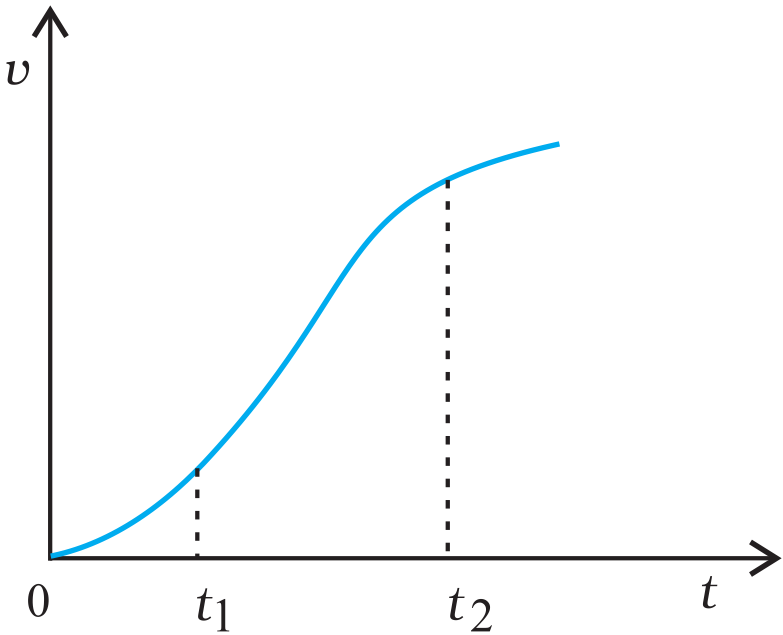
Which of the following formulae are correct for describing the motion of the particle over the time-interval $t_1$ to $t_2$:
a. $x\left(t_2\right)=x\left(t_1\right)+v\left(t_1\right)\left(t_2-t_1\right)+(1 / 2) a\left(t_2-t_1\right)^2$
b. $v\left(t_2\right)=v\left(t_1\right)+a\left(t_2-t_1\right)$
c. $v_{\text {average }}=\left(x\left(t_2\right)-x\left(t_1\right)\right) /\left(t_2-t_1\right)$
d. $\mathrm{a}_{\text {average }}=\left(\mathrm{v}\left(\mathrm{t}_2\right)-\mathrm{v}\left(\mathrm{t}_1\right)\right) /\left(\mathrm{t}_2-\mathrm{t}_1\right)$
e. $x\left(t_2\right)=x\left(t_1\right)+v_{\text {average }}\left(t_2-t_1\right)+(1 / 2) a_{\text {average }}\left(t_2-t_1\right)^2$
f. $x\left(t_2\right)-x\left(t_1\right)=$ area under the v-t curve bounded by the $t$-axis and the dotted line shown. AnswerThe correct formulae describing the motion of the particle are (c), (d) and, (f), The given graph has a non-uniform slope. Hence, the formulae given in (a), (b), and (e) cannot describe the motion of the particle. Only relations given in (c), (d), and (f) are correct equations of motion.
View full question & answer→Question 53 Marks
A man walks on a straight road from his home to a market $2.5$ km away with a speed of $5 km^{ h -1}$. Finding the market closed, he instantly turns and walks back home with a speed of $7.5 km h ^{-1}$. What is the Average speed of the man over the interval of time
i. $0$ to $30$ min ,
ii. $0$ to $50$ min ,
iii. $0$ to $40$ min ?
[Note: You will appreciate from this exercise why it is better to define average speed as total path length divided by time, and not as magnitude of average velocity. You would not like to tell the tired man on his return home that his average speed was zero!]
Answeri. 0 to 30 min ,
Average velocity $=$ Displacement/Time $=2.5 /(1 / 2)=5 km / h$
Average speed $=$ Distance $/$ Time $=2.5 /(1 / 2)=5 km / h$
ii. 0 to 50 min
Time $=50 min=50 / 60=5 / 6 h$
Net displacement $=0$
Total distance $=2.5+2.5=5 km$
Average velocity $=$ Displacement/Time $=0$
Average speed $=$ Distance $/$ Time $=5 /(5 / 6)=6 km / h$
iii. 0 to 40 min
Speed of the man $=7.5 km / h$
Distance travelled in first $30 min=2.5 km$
Distance travelled by the man (from market to home) in the next 10 min
$=7.5 \times 10 / 60=1.25 km$
Net displacement $=2.5-1.25=1.25 km$
Total distance travelled $=2.5+1.25=3.75 km$
Average velocity $=$ Displacement/Time $=1.25 /(40 / 60)=1.875 km / h$
Average speed $=$ Distance $/$ Time $=3.75 /(40 / 60)=5.625 km / h$
View full question & answer→Question 63 Marks
A police van moving on a highway with a speed of $30km h^{–1}$ fires a bullet at a thief’s car speeding away in the same direction with a speed of $192km h^{–1}$. If the muzzle speed of the bullet is $150m s^{–1}$, with what speed does the bullet hit the thief’s car? (Note: Obtain that speed which is relevant for damaging the thief’s car).
AnswerSpeed of the police van, $V p=30 \mathrm{~km} / \mathrm{h}=8.33 \mathrm{~m} / \mathrm{s}$ Muzzle speed of the bullet, $\mathrm{V}_{\mathrm{b}}=150 \mathrm{~m} / \mathrm{s}$ Speed of the thief's car, $\mathrm{V}_{\mathrm{t}}=192 \mathrm{~km} / \mathrm{h}=53.33 \mathrm{~m} / \mathrm{s}$ Since the bullet is fired from a moving van, its resultant speed can be obtained as: $=150$ $+8.33=158.33 \mathrm{~m} / \mathrm{s}$ Since both the vehicles are moving in the same direction, the velocity with which the bullet hits the thief's car can be obtained as: $\mathrm{V}_{\mathrm{bt}}=\mathrm{V}_{\mathrm{b}}-\mathrm{V}_{\mathrm{t}}=158.33-53.33=105 \mathrm{~m} / \mathrm{s}$
View full question & answer→Question 73 Marks
Explain clearly, with examples, the distinction between: magnitude of displacement (sometimes called distance) over an interval of time, and the total length of path covered by a particle over the same interval;
AnswerThe magnitude of displacement over an interval of time is the shortest distance (which is a straight line) between the initial and final positions of the particle. The total path length of a particle is the actual path length covered by the particle in a given interval of time. For example, suppose a particle moves from point A to point B and then, comes back to a point, C taking a total time t, as shown below. Then, the magnitude of displacement of the particle = AC.

Whereas, total path length = AB + BC It is also important to note that the magnitude of displacement can never be greater than the total path length. However, in some cases, both quantities are equal to each other.
View full question & answer→Question 83 Marks
A player throws a ball upwards with an initial speed of $29.4m s^{–1}$. Choose the $x = 0m$ and $t = 0s$ to be the location and time of the ball at its highest point, vertically downward direction to be the positive direction of x-axis, and give the signs of position, velocity and acceleration of the ball during its upward, and downward motion.
AnswerDuring upward motion, the sign of position is positive, sign of velocity is negative, and sign of acceleration is positive. During downward motion, the signs of position, velocity, and acceleration are all positive.
View full question & answer→Question 93 Marks
Suggest a suitable physical situation for of the following graphs.
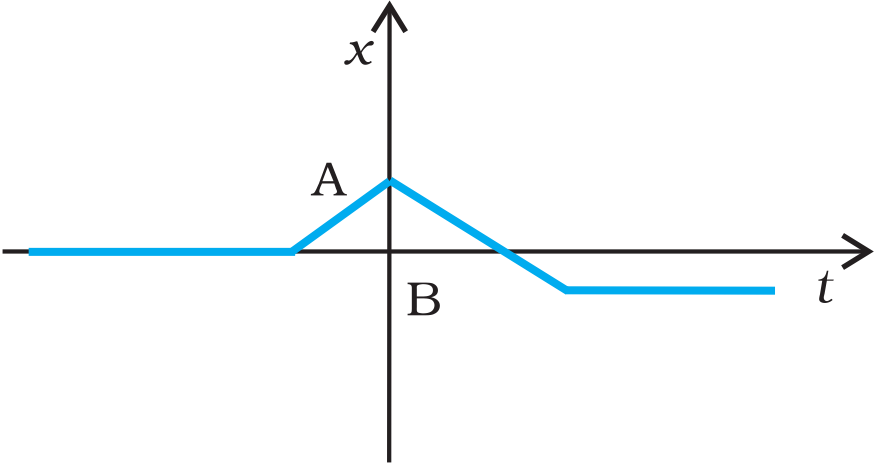
AnswerThe given x-t graph shows that initially a body was at rest. Then, its velocity increases with time and attains an instantaneous constant value. The velocity then reduces to zero with an increase in time. Then, its velocity increases with time in the opposite direction and acquires a constant value. A similar physical situation arises when a football (initially kept at rest) is kicked and gets rebound from a rigid wall so that its speed gets reduced. Then, it passes from the player who has kicked it and ultimately gets stopped after sometime.
View full question & answer→Question 103 Marks
Explain clearly, with examples, the distinction between: Magnitude of average velocity over an interval of time, and the average speed over the same interval. [Average speed of a particle over an interval of time is defined as the total path length divided by the time interval]. Show in both (a) and (b) that the second quantity is either greater than or equal to the first. When is the equality sign true? [For simplicity, consider one-dimensional motion only]
AnswerMagnitude of average velocity = Magnitude of displacement/Time interval For the given particle, Average velocity = AC/t Average speed = Total path length/Time interval = (AB + BC)/t Since (AB + BC) > AC, average speed is greater than the magnitude of average velocity. The two quantities will be equal if the particle continues to move along a straight line
View full question & answer→Question 113 Marks
A highway motorist travels at a constant velocity of $45 km / h ^{-1}$ in a $30 km / h ^{-1}$ zone. A motor-cyclist police officer has been watching from behind a bill board and at the same moment the speeding motorist passes the bill board, the police officer accelerates uniformly from rest to overtake her. If the acceleration of the police officer is $10 km / h ^{-2}$, how long does he take to reach the motorist?
AnswerLet the bill board be taken as the origin. Let t be the required time.
Let P represent the position where the police officer reaches the motorist.
For the motorist. (a case of uniform motion)
when $t=0, x(0)=0, v=45 km h ^{-1} x ( t )= x (0)+ vt$. or $x ( t )= vt$
$\Rightarrow 45 km h ^{-1} \times t =45 t km \ldots$ (i)
For the police officer. (a case of accelerated motion)
when $\text{t}=0,\text{x}(0),=\text{v}(0)=0,\text{a}=10\text{km/h}^2$
Now, $\text{x(t)}=\text{x}(0)+\text{v}(0)\text{t}+\frac{1}{2}\text{at}^2$
$\text{x(t)}=0+0+\frac{1}{2}\times10\times\text{t}^2$
$=5\text{t}^2\text{km}\ \dots(\text{ii})$ Comparing (i) and (ii),
we get $5t^2 = 45t t = 9$ hour.
View full question & answer→Question 123 Marks
In Exercises $3.13$ and $3.14$, we have carefully distinguished between average speed and magnitude of average velocity. No such distinction is necessary when we consider instantaneous speed and magnitude of velocity. The instantaneous speed is always equal to the magnitude of instantaneous velocity. Why?
AnswerInstantaneous velocity is given by the first derivative of distance with respect to time i.e., $V_{in} = dx/dt$ Here, the time interval dt is so small that it is assumed that the particle does not change its direction of motion. As a result, both the total path length and magnitude of displacement become equal is this interval of time. Therefore, instantaneous speed is always equal to instantaneous velocity.
View full question & answer→Question 133 Marks
The distance x travelled by a body in a straight line is directly proportional to $t^2$. Decide on the type of motion associated. If $\text{x}\propto\text{t}^3$ what change will you observe?
Answer$\text{x}\propto\text{t}^2\therefore \text{v}\propto\text{t}$ and $\text{a}\propto \text{t}^0$ So the motion is with uniform acceleration. If $\text{x}\propto \text{t}^3,$ then $\text{v}\propto \text{t}^2$ and $\text{a}\propto\text{t}.$ The motion becomes non-uniform acceleration.
View full question & answer→Question 143 Marks
Four persons K, L, M and N start from the vertices of a square of side 'a', simultaneously and move towards the neighbour in order always with the same speed of v. When and where do they meet?
AnswerAs K, L, M and N move towards the next person in order after a short time they will be at K', L', M' and N' respectively. The size to the square reduces. It indicates that they have come closer. After next short interval if they are at K", L", M" and N", the size of the square further reduces. Finally, they will follow a curvi-linear path and meet at 0, the centre of the square. 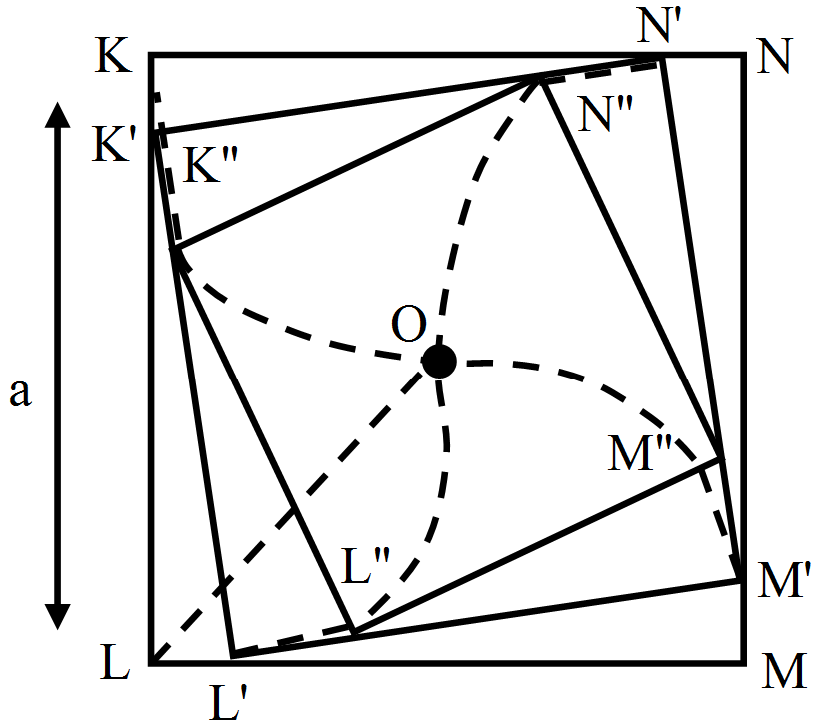 We know, the time taken $=\frac{\text{displacement}}{\text{Velocity in the direction of displacement}}$ $\therefore \text{t}=\frac{\text{LO}}{\text{v}\cos40^\circ}$ since v $\cos 45^\circ$ is the component of the velocity of L towards the destination. $\therefore \text{t}=\frac{\text{LO}}{\Big(\frac{\text{v}}{\sqrt{2}}\Big)}$ $=\frac{\frac{\text{a}}{\sqrt{2}}}{\frac{\text{v}}{\sqrt{2}}}=\frac{\text{a}}{\text{v}}$
 View full question & answer→Question 153 Marks
A jet airplane travelling at the speed of $500 km h^{–1}$ ejects its products of combustion at the speed of $1500km h^{–1}$ relative to the jet plane. What is the speed of the latter with respect to an observer on the ground?
AnswerSpeed of the jet airplane, $V_{j e t}=500 \mathrm{~km} / \mathrm{h}$ Relative speed of its products of combustion with respect to the plane, $V_{\text {smoke }}=-1500 \mathrm{~km} / \mathrm{h}$ Speed of its products of combustion with respect to the ground $=\mathrm{V}_{\text {smoke }}^{\prime}$ Relative speed of its products of combustion with respect to the airplane, $\mathrm{V}_{\text {smoke }}=\mathrm{V}_{\text {smoke }}^{\prime}-\mathrm{V}_{\text {jet }}-1500=\mathrm{V}_{\text {smoke }}^{\prime}-500 \mathrm{~V}_{\text {smoke }}^{\prime}=-$ $1000 \mathrm{~km} / \mathrm{h}$ The negative sign indicates that the direction of its products of combustion is opposite to the direction of motion of the jet airplane.
View full question & answer→Question 163 Marks
A car moving with a speed of $50km/ h^{-1}$ can be stopped by brakes after at least 6m. What will be the minimum stopping distance, if the same car is moving at a speed of $100km/ h^{-1}$?
AnswerApproach I:$\text{u}=50\text{km/ hr}, \text{s}=0.006\text{km}.$
$\text{v}^2-\text{u}^2=2\text{as}$
$0-(50)^2=2\times\text{a}\times0.006$
$\text{a}=-\frac{2500}{2\times0.006}\text{km/ hr}^2$
When speed of the car is 100km/hr then
$0-(100)^2=2\times\Big(\frac{-2500}{2\times0.006}\Big)\times\text{s}$
$\text{s}=0.024\text{km}=24\text{m}$
So, minimum stopping distance is 24m.
Approach II:
Stopping distance $=\text{s}=\frac{\text{u}^2}{2\text{a}}$
So, for "a" remaining the same, as u becomes 2u, s becomes 4s
i.e., 4 × 6 = 24m
View full question & answer→Question 173 Marks
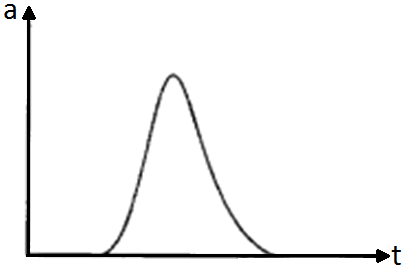
A uniformly moving cricket ball is turned back by hitting it with a bat for a very short time interval. Show the variation of its acceleration with time. (Take acceleration in the backward direction as positive).
AnswerImpulsive Force is generated by the bat: If we ignore the effect of gravity just by analyzing the motion of ball in horizontal direction only, then ball moving uniformly will return back with the same speed when a bat hits it. Acceleration of the ball is zero just before it strikes the bat. When the ball strikes the bat, it gets accelerated due to the applied impulsive force by the bat.
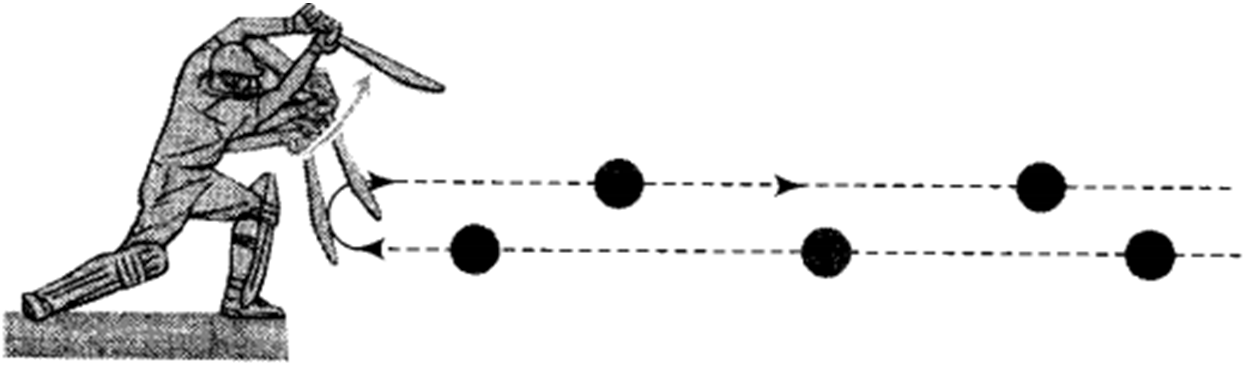
The variation of acceleration with time is shown in the graph.
View full question & answer→Question 183 Marks
If the initial velocity of a particle is u and collinear acceleration at any time t is $\text{a}\propto\text{t}.$ calculate the final velocity of the particle after time t.
AnswerAcceleration $\text{a}\propto \text{t}$ ⇒ a = Kt where K is a constant. $\therefore$ Equations of motion cannot be applied. $\therefore \frac{\text{dv}}{\text{dt}}=\text{Kt}$ $\Rightarrow\text{dv}=\text{Kt dt}$ Integrating, $\text{v}=\frac{\text{Kt}^2}{2}+\text{c}$ If v = 0 at t = 0 then, c = 0 $\therefore \text{v}=\frac{\text{Kt}^2}{2}$
View full question & answer→Question 193 Marks
Sketch velocity-time graph in following situations:
i. $\mathrm{v}_0>0 ; \mathrm{a}<0 \mid \mathrm{al} \rightarrow$ constant
ii. $v_0<0 ; a>0|a| \rightarrow$ is increasing uniformly.
a : acceleration, $\mathrm{v}_0$ : initial velocity
OR
- Displacement$-$time graph of any object is shown in the figure:
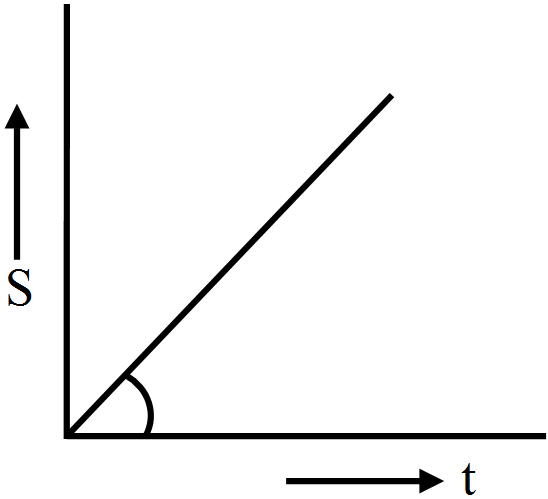
Draw the velocity$-$time graph for this motion.
- What does the area under acceleration$-$time graph represent?
Answer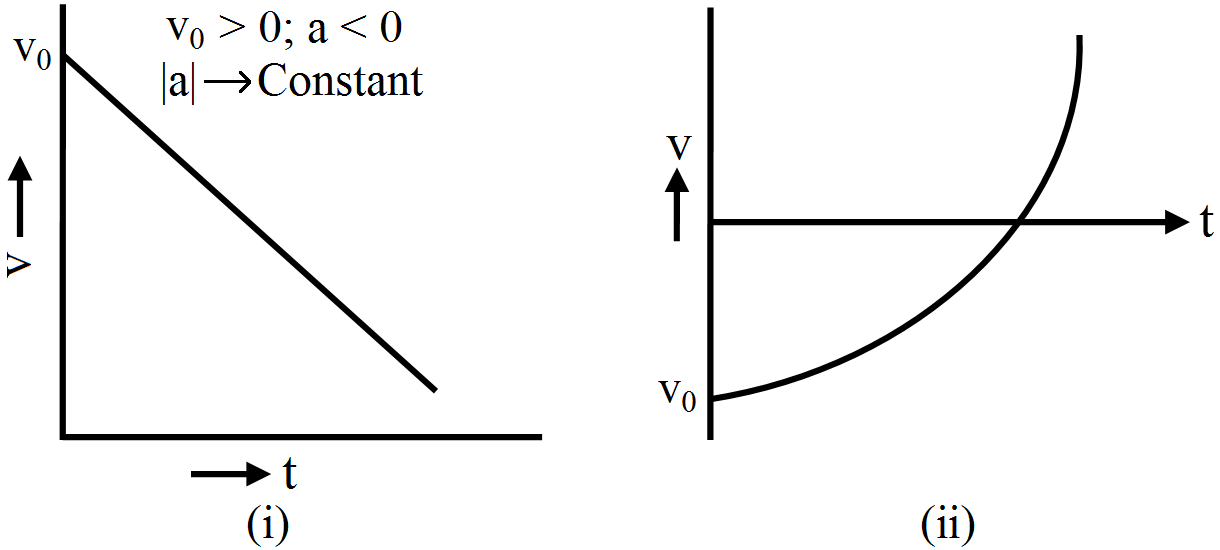
OR
-
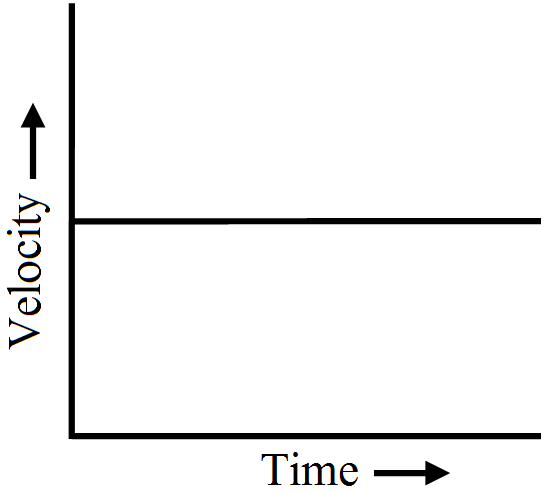
- Represents change in velocity.
View full question & answer→Question 203 Marks
How does the velocity-time graph for uniform motion give a geometrical way of calculating the displacement covered during a given time t?
AnswerConsider velocity-time graph for uniform motion along a straight path. The graph is a straight line parallel to the time axis as shown in following Fig.
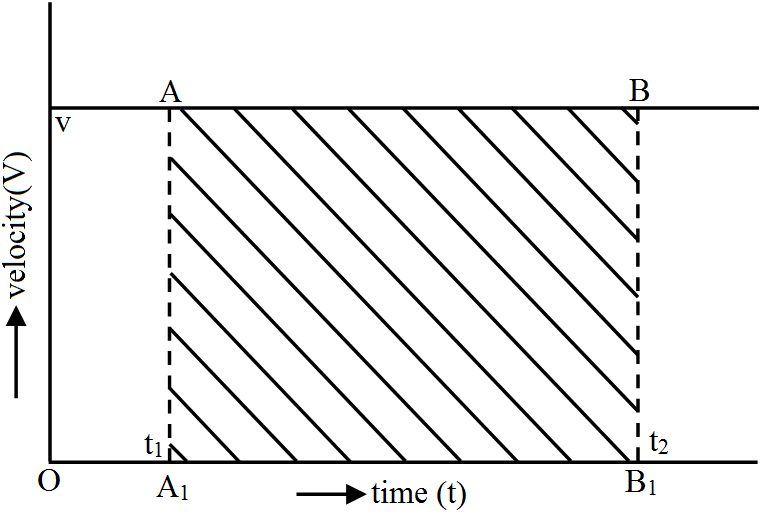
Let $A$ and $B$ be two points on velocity-time graph corresponding to the instants $t_1$ and $t_2$. As the motion is uniform, hence, $AA _1= BB _1= v$.
$\therefore \text { Area under } v \text { - } t \text { gaph between } t_1 \text { and } t_2$
$=\text { area } A B B_1 A_1=A A_1 \times A_1 B_1=v\left(t_2-t_1\right) \text { But velocitv is defined as } v$
$=\frac{\text { Displacement }}{\text { Time }}=\frac{x_2-x_1}{t_2-t_1}$
$\therefore v\left(t_2-t_1\right)=x_2-x_1$
$\therefore \text { area } A B B_1 A_1=\left(x_2-x_1\right)$
Hence, displacement of a particle in time intervel $\left(t_2-t_1\right)$ is numerically equal to the
area under velocity-time graph between the instants $t_1$ and $t_2$. View full question & answer→Question 213 Marks
The displacement-time graph of two bodies P and Q are represented by OA and BC respectively. What is the ratio of velocities of P and Q? $\angle \text{OBC}=60^\circ$ and $\angle \text{AOC}=30^\circ.$
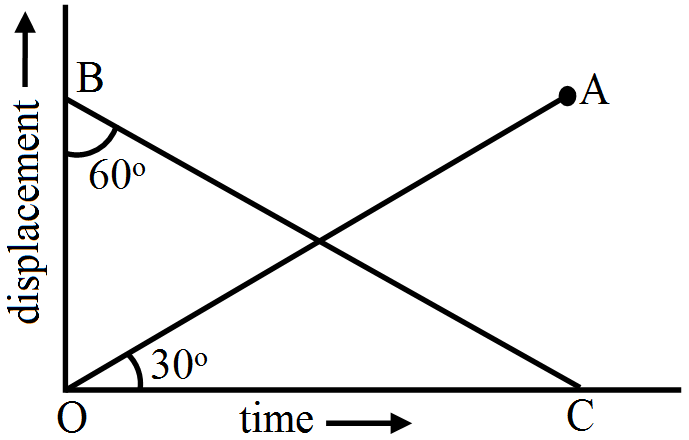
AnswerVelocity of P, $v_P =\tan30^\circ=\frac{1}{\sqrt{3}}$ Velocity of $Q, v_Q =-\tan 30^\circ=-\frac{1}{\sqrt{3}}$ RAtio of velocities of P and Q is 1 : -1
View full question & answer→Question 223 Marks
A train moves from one station to another in two hours time. Its speed during the motion is shown in the graph. Determine the maximum acceleration during the journey. Also calculate the distance covered during the time interval from $0.75h$ to $1\ hour$.
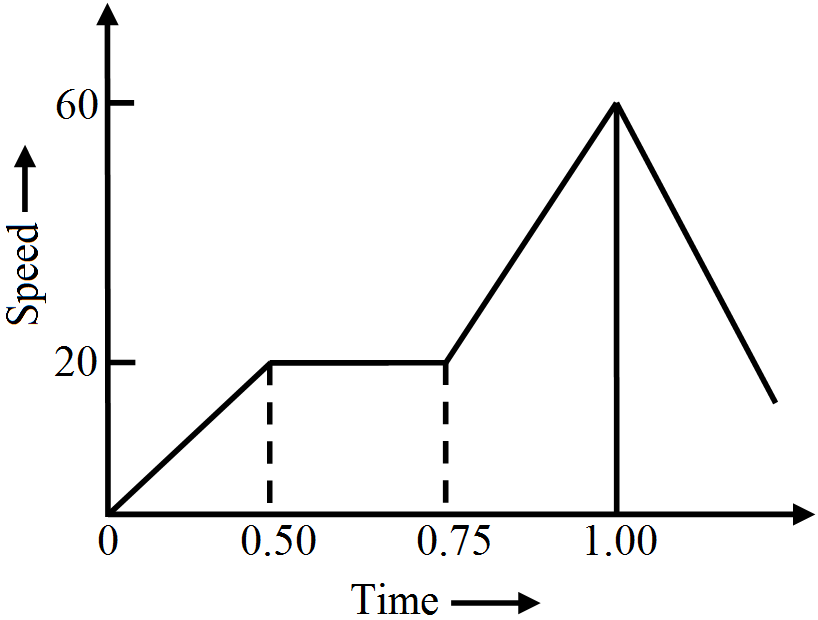
AnswerWe know that the slope of the velocity-time graph gives acceleration. Change in velocity in this interval ( 0.75 h to 1 hour) $=(60-20) \mathrm{km} / \mathrm{h}^{-1}=40 \mathrm{~km} / \mathrm{h}^{-1} $
$\therefore$ Acceleration in this interval $=\frac{40 \mathrm{~km} / \mathrm{h}^{-1}}{\frac{1}{4} \mathrm{~h}}=160 \mathrm{~km} / \mathrm{h}^{-2}$
Distance covered during the time interval from 0.75 h to $1 \mathrm{~h}=$ Area under the corresponding v - t graph $=\frac{1}{1}(20+60) 0.25=10 \mathrm{~km}$.
View full question & answer→Question 233 Marks
Give three important characteristics of displacement.
AnswerThree important characteristics of displacement are:
- Displacement is a vector quantity having both magnitude as well as direction.
- Displacement of a particle between two given positions is unique and is the shortest path through which particle may go from its initial to final position.
- Displacement is independent of the choice of origin to the co$-$ordinate system.
View full question & answer→Question 243 Marks
The minute hand of a wall clock is 10cm long. Find its displacement and the distance covered from 12:00 noon to 12:30 p.m.
AnswerLength of minute hand = radius of circle described by minute hand r = 10cm = 0.1m. 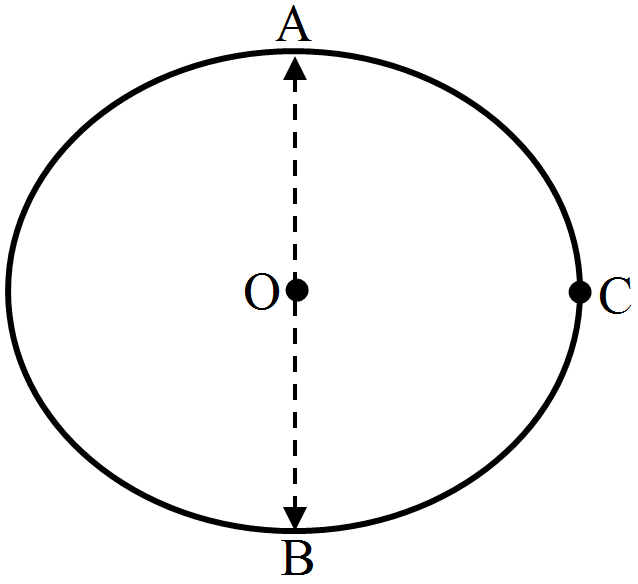 From 12:00 noon to 12:30 p.m., the tip of minute hand covers a net displacement equal to the diameter of circle. Hence, Displacement AOB = 2 × r = 2 × 0.1m = 0.2m During the same time total distance covered by tip of minute hand = semicircular path ACB $=\pi=3.14\times0.1=0.31\text{m}$
 View full question & answer→Question 253 Marks
A player throws a ball upwards with an initial speed of $29.4m s^{–1}$. To what height does the ball rise and after how long does the ball return to the player’s hands? (Take $g = 9.8m^{s–2}$ and neglect air resistance).
AnswerInitial velocity of the ball, $u=29.4 \mathrm{~m} / \mathrm{s}$ Final velocity of the ball, $v=0$ (At maximum height, the velocity of the ball becomes zero) Acceleration, $\mathrm{a}=-\mathrm{g}=-9.8 \mathrm{~m} / \mathrm{s}^2$ From third equation of motion, height ( s ) can be calculated as: $\mathrm{v}^2-\mathrm{u}^2$ $=2 \mathrm{gs} s=\left(\mathrm{v}^2-\mathrm{u}^2\right) / 2 \mathrm{~g}=\left((0)^2-(29.4)^2\right) / 2 \times(-9.8)=3 \mathrm{~s}$ Time of ascent $=$ Time of descent Hence, the total time taken by the ball to return to the player's hands $=3+3=6 \mathrm{~s}$.
View full question & answer→Question 263 Marks
Two balls of different masses are thrown vertically upwards with same initial speed. Which one will rise to the greater height? Which of the two will come back with greater speed to the point of projection?
AnswerSince they are thrown with same initial speed, and the equations of motion are independent of the masses, both of them will rise to the same height and will have same speed while coming back to the point of projection.
View full question & answer→Question 273 Marks
A monkey climbs up a slippery pole for 3 seconds and subsequently slips for 3 seconds. Its velocity at time t is given by v(t) = 2t(3 - t); 0 < t < 3 and v(t) = -(t - 3)(6 - t) for 3 < t < 6s in m/s. It repeats this cycle till it reaches the height of 20m. How many cycles (counting fractions) are required to reach the top?
AnswerGiven velocity $\text{v}(\text{t})=2\text{t}(3-\text{t})=6\text{t}-2\text{t}^2$ Distance covered in 0 to 3s = 9m Distance covered in 3 to 6s $=\int_3^6(18-9\text{t}+\text{t}^2)\text{dt}=\Big(18\text{t}-\frac{9\text{t}^2}{2}+\frac{\text{t}^3}{3}\Big)^6$ $=18\times6-\frac{9}{2}\times6^2+\frac{6^3}{3}-\Big(18\times3-\frac{9\times3^2}{2}+\frac{3^3}{3}\Big)$ $=108-9\times18+\frac{6^3}{3}-18\times3+\frac{9}{2}\times9-\frac{27}{3}$ $=-4.5\text{m}$ $\therefore$ Total distance travelled in one cycle $=\text{s}_1+\text{s}_2=9-4.5=4.5\text{m}$ Number of cycles to be covered in total distance $=\frac{20}{4.5}\approx4.44\approx5$
View full question & answer→Question 283 Marks
An electron travelling with a speed of $5 \times 10^3ms^{-1}$ passes through an electric field with an acceleration of $10^{12}ms^{-2}$. How long will it take for the electron to double its speed?
Answer$\text{v}(0)=5\times10^3\text{ms}^{-1},\text{a}=10^{12}\text{ms}^{-2}$
$\text{v(t)}=2\times\text{v}(0)=2\times5\times10^3\text{ms}^{-1},\text{t}=?$
Now, $\text{v(t)}=\text{v}(0)+\text{at}$ $\therefore 2\times5\times10^3=5\times10^3+10^{12}\times\text{t}$
$\Rightarrow 10^{12}\text{t}=5\times10^3$
$\Rightarrow\text{t}=\frac{5\times10^3}{10^{12}}$
$\text{t}=5\times10^{-9}\text{s}$
View full question & answer→Question 293 Marks
What is the position at any time, for a body starting from rest, with an acceleration $a = at^2$?
Answer$\text{a}=\alpha\text{t}^2$ is a variable acceleration.
$\therefore \text{dv}=\alpha\text{t}^2\text{dt}$ $|\text{v}|^\text{v}_0=\Big|\frac{\alpha\text{t}^3}{3}\Big|^\text{t}_0$
$\Rightarrow \text{v}=\frac{\alpha\text{t}^3}{3}$ Also $\text{v}=\frac{\text{dx}}{\text{dt}}$
$\therefore \text{dx}=\frac{\alpha\text{t}^3}{3}\text{dt}$
$|\text{x}|^{{\text{x}}_\text{f}}_{\text{x}_\text{i}}=\frac{\alpha\text{t}^4}{12}$
$\therefore \text{x}_\text{f}-\text{x}_\text{i}=\frac{\alpha\text{t}^4}{12}$
$\text{x}_\text{f}=\text{x}_\text{i}+\frac{\alpha\text{t}^4}{12}$ is the final position at time 't' seconds.
View full question & answer→Question 303 Marks
A body is moving with a uniform acceleration. Its velocity after 5 seconds is $25m/s$ and after $8$ seconds is $34m/s$. Calculate the distance it will cover in $10^{th}$ second.
AnswerSuppose v(0) and 'a' be the initial velocity and acceleration of the body respectively.Case I:
$\text{v(t)}=25\text{m/s}; \text{ t}=5\text{s}$
$\therefore \text{v(t)}=\text{v}(0)+\text{at}$ or $\text{v}(0)+5\text{a}=25$Case II:
$\text{v(t)}=34\text{m/s}; \text{ t}=8\text{s}$
$\therefore \text{v}(0)+8\text{a}=34$ Solving (i) and (ii), we get $a = 3ms^{-2}$
Also, $\text{S}_{\text{n}^{\text{th}}}=\text{v}(0)+\frac{\text{a}}{2}(2\text{n}-1)$ and $\text{v}(0)=10\text{ms}^{-1}$ $\text{S}_{\text{n}^\text{th}}=10+\frac{3}{2}(10\times2-1)$
$=10+\frac{57}{2}=38.5\text{m}$
View full question & answer→Question 313 Marks
Two cars $A$ and $B$ are running at velocities of $60\ km/ hr$ and $45\ km/ hr$ respectively. Calculate the relative velocity of car $A$ if :
- They are both travelling eastwards.
- Car $A$ is travelling eastwards and car $B$ is travelling westwards.
AnswerLet us take eastern direction as positive, then the western direction is negative.
$i. v_A=+60 \mathrm{~km} / \mathrm{hr} . \mathrm{V}_{\mathrm{B}}=+45 \mathrm{~km} / \mathrm{hr}$.
The relative velocity of the car $A\ w.r.t.$ car $B=v_A-v_B$
$\therefore v_{A B}=60-45=15 \mathrm{~km} / \mathrm{hr}$.
$\therefore \mathrm{v}_{\mathrm{AB}}$ is $\mathrm{km} / \mathrm{hr}$. estward.
$ii. \mathrm{v}_{\mathrm{A}}=+60 \mathrm{~km} / \mathrm{hr}$
$v_B=-45 \mathrm{~km} / \mathrm{hr}$
$v_{A B}=v_A-v_B$
$=60-(-45)$
$=105 \mathrm{~km} / \mathrm{hr}$ eastwards.
View full question & answer→Question 323 Marks
The velocity-time graph of a particle in one-dimensional motion is shown in:
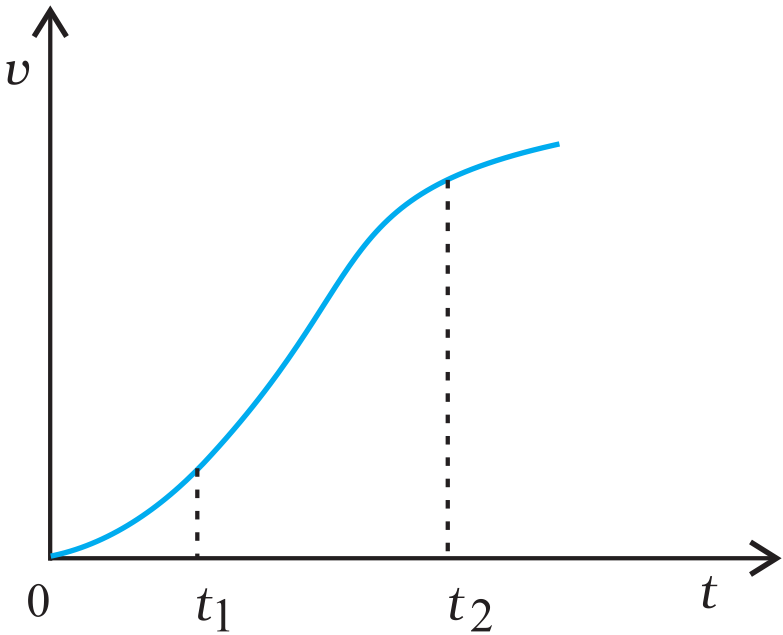
Which of the following formulae are correct for describing the motion of the particle over the time-interval $t_1$ to $t_2$:
a. $x\left(t_2\right)=x\left(t_1\right)+v\left(t_1\right)\left(t_2-t_1\right)+(1 / 2) a\left(t_2-t_1\right)^2$
b. $v\left(t_2\right)=v\left(t_1\right)+a\left(t_2-t_1\right)$
c. $v_{\text {average }}=\left(x\left(t_2\right)-x\left(t_1\right)\right) /\left(t_2-t_1\right)$
d. $a_{\text {average }}=\left(v\left(t_2\right)-v\left(t_1\right)\right) /\left(\mathrm{t}_2-\mathrm{t}_1\right)$
e. $x\left(t_2\right)=x\left(t_1\right)+v_{\text {average }}\left(t_2-t_1\right)+(1 / 2) a_{\text {average }}\left(t_2-t_1\right)^2$
f. $x\left(t_2\right)-x\left(t_1\right)=$ area under the $v$-t curve bounded by the $t$-axis and the dotted line shown. AnswerThe correct formulae describing the motion of the particle are (c), (d) and, (f), The given graph has a non-uniform slope. Hence, the formulae given in (a), (b), and (e) cannot describe the motion of the particle. Only relations given in (c), (d), and (f) are correct equations of motion.
View full question & answer→Question 333 Marks
A body starts accelerating uniformly with a from a velocity ‘u' and travels in a straight line. Prove that it covers a length of $\text{u}+\frac{\text{a}}{2}(2\text{t}-1)$ in the $t^{th}$ second of motion.
AnswerInitial velocity = u and acceleration = a. Length covered in t seconds $=\text{ut}+\frac{1}{2}\text{at}^2\ \dots\text{(i)}$ $=\text{u}(\text{t}-1)+\frac{1}{2}\text{a}(\text{t}-1)^2\ \dots{(\text{ii})}$
Subtracting (i) and (ii), we get Length covered in $t^{th}$ second $=\text{u}+\frac{\text{a}}{2}(2\text{t}-1).$
View full question & answer→Question 343 Marks
Identify the types of motion in following cases:
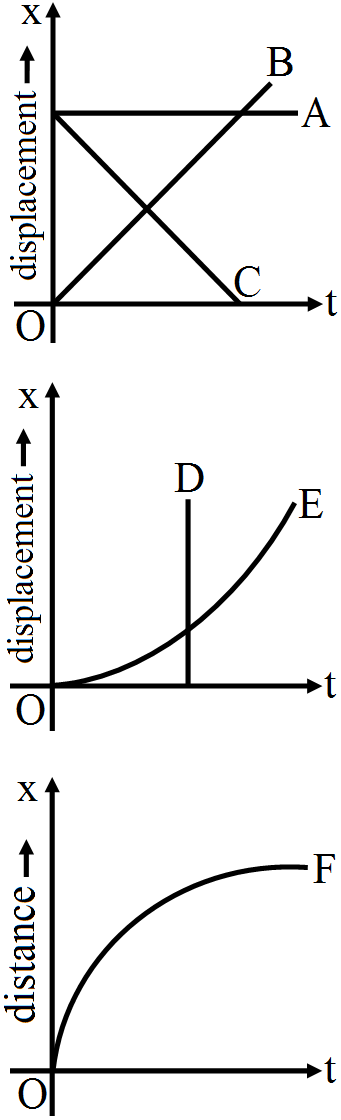
AnswerA - Body is at rest. B - Body has uniform motion-velocity is constant. C - Uniform motion but -ve velocity. D - Not a possible case, since x takes many values for same time. E - Accelerated motion, since slope (velocity) increases. F - Decelerated motion, since velocity decreases.
View full question & answer→Question 353 Marks
Give examples of a one-dimensional motion where: The particle moving along positive x-direction comes to rest periodically and moves forward.
AnswerThe equation which contains sine and cosine functions is periodic in nature. The particle will be moving along positive x-direction only if $\text{t}>\sin\text{t}$ We have displacement as a function of time, $(\text{x})=\text{t}-\sin\text{t}$ By differentiating this equation w.r.t. time we get velocity of the particle as a function of time. Velocity $\text{v}(\text{t})=\frac{\text{dx(t)}}{\text{dt}}=1-\cos\text{t}$ If we again differentiate this equation w.r.t. time we will get acceleration of the particle as a function of time. acceleration $\text{a}(\text{t})=\frac{\text{dv}}{\text{dt}}=\sin\text{t}$ When t = 0; x(t) = 0 When $\text{t}=\pi;\ \text{x}(\text{t})=\pi>0$ When $\text{t}=0;\ \text{x}(\text{t})=2\pi>0$
View full question & answer→Question 363 Marks
Find the displacement and distance travelled by a body in 10 seconds, using the v - t graph given below:
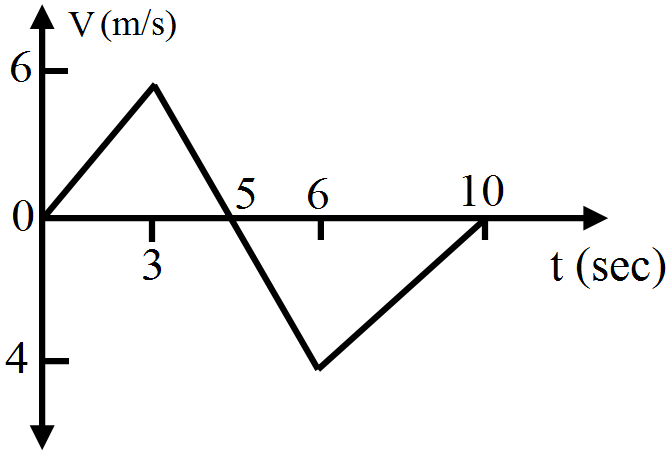
AnswerArea below v - t graph gives idea of distance travelled. +ve displacement $=\frac{1}{2}\times6\times5=15\text{m}$ -ve displacement $=\frac{1}{2}\times5\times4=10\text{m}$ Net displacement $=15-10=5\text{m}$ Distance travelled = 25m
View full question & answer→Question 373 Marks
Figure shows the $x$ coordinate of a particle as a function of time. Find the signs of $v_x$ and $a_x$ at $t = t_1, t = t_2$ and $t = t_3$.
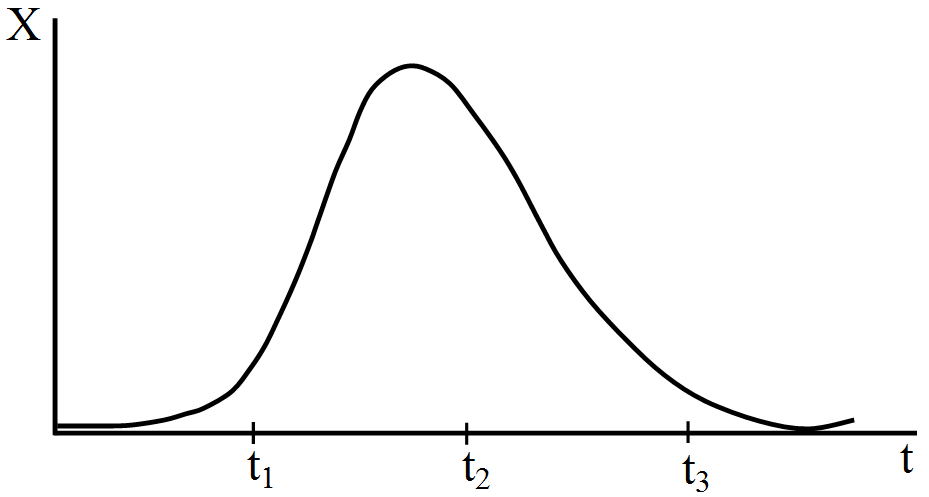
Answer
- As slope is positive velocity is positive.
As slope is increasing acceleration is positive.
- As slope is zero velocity is zero.
As slope is decreasing acceleration is negative.
- As slope is negative velocity is negative.
As slope is increasing acceleration is positive.
View full question & answer→Question 383 Marks
A man walks on a straight road from his home to a market 2.5 km away with a speed of $5 km^{ h -1}$. Finding the market closed, he instantly turns and walks back home with a speed of $7.5 km h ^{-1}$. What is the Average speed of the man over the interval of time
i. $0$ to $30$ min ,
ii. $0$ to $50$ min ,
iii. $0$ to $40$ min ?
[Note: You will appreciate from this exercise why it is better to define average speed as total path length divided by time, and not as magnitude of average velocity. You would not like to tell the tired man on his return home that his average speed was zero!]
Answer
i. 0 to 30 min ,
Average velocity $=$ Displacement/Time $=2.5 /(1 / 2)=5 km / h$
Average speed $=$ Distance $/$ Time $=2.5 /(1 / 2)=5 km / h$
ii. 0 to 50 min
Time $=50 min=50 / 60=5 / 6 h$
Net displacement $=0$
Total distance $=2.5+2.5=5 km$
Average velocity $=$ Displacement/Time $=0$
Average speed $=$ Distance $/$ Time $=5 /(5 / 6)=6 km / h$
iii. 0 to 40 min
Speed of the man $=7.5 km / h$
Distance travelled in first $30 min=2.5 km$
Distance travelled by the man (from market to home) in the next 10 min $=7.5 \times 10 / 60=1.25 km$
Net displacement $=2.5-1.25=1.25 km$
Total distance travelled $=2.5+1.25=3.75 km$
Average velocity $=$ Displacement $/$ Time $=1.25 /(40 / 60)=1.875 km / h$
Average speed $=$ Distance $/$ Time $=3.75 /(40 / 60)=5.625 km / h$
View full question & answer→Question 393 Marks
Two parallel rail tracks run north-south. Train A moves due north with a speed of $54km/ h^{-1}$ and train B moves due south with a speed of $90km/ h^{-1}$. What is the relative velocity of B with respect to A in $m s^{-1}$?
Answer$\mathrm{V}_{\mathrm{A}}=54 \mathrm{~km} / \mathrm{hr} \mathrm{V}_{\mathrm{B}}=90 \mathrm{~km} / \mathrm{hr}$ let due north direction be taken as + ve direction $\mathrm{V}_{\mathrm{BA}}=\mathrm{V}_{\mathrm{B}}-\mathrm{V}_{\mathrm{A}}=-90-54=-144 \mathrm{~km} /$ $\mathrm{hr}=-40 \mathrm{~m} / \mathrm{s}$ due to south.
View full question & answer→Question 403 Marks
State which of the following situations are possible and give an example for each of these?
- An object with a constant acceleration but with zero velocity.
- An object moving in a certain direction with acceleration in the perpendicular direction.
AnswerBoth the situations are possible:
- When an object is projected upwards, its velocity at the top-most point is zero even though the acceleration on it is $9.8m/s^2(g)$.
- When a stone tied to a string is whirled in a circular path, the acceleration acting on it is always at right angles i.e. perpendicular to the direction of motion of stone $($we will study about it in chapter ‘motion in a plane'$)$.
View full question & answer→Question 413 Marks
Two trains A and B of length 400m each are moving on two parallel tracks with a uniform speed of $72km/ h^{-1}$ in the same direction, with A ahead of B. The driver of B desires to overtake A and accelerates by $1ms^{-2}$. If, after 50s, the guard of B just brushes past driver of A, calculate the original distance between the two trains.
AnswerOriginally, both the trains have the same velocities. So, the relative velocity of B w.r.t. A is zero. Now, for train B, $\text{v}(0)=0,\text{a}=1\text{ms}^{-2}$
$\text{t}=50\text{s},\text{x(t)}-\text{x}(0)=?$
$\text{x(t)}=\text{v}(0)+\text{v}(0)\text{t}+\frac{1}{2}\text{at}^2$
$\text{x(t)}-\text{x}(0)=(0)\text{t}+\frac{1}{2}\text{at}^2$
$=0\times50+\frac{1}{2}\times1\times50\times50$ $=1250\text{m}$
View full question & answer→Question 423 Marks
A car travels first half of a length S with velocity $v_1$. The second half is covered with velocities $v_2$ and $v_3$ for equal time intervals. Find the average velocity of the motion.
AnswerAverage velocity, v $=\frac{\text{Total displacement}}{\text{Total time taken}}$ Time taken to cover first half of the length $=\frac{\text{S}}{2\text{v}_1}$
Let time taken to cover second half of the length = 2t Thus, $\text{v}=\frac{\text{S}}{\frac{\text{S}}{2\text{v}_1}+2\text{t}}$ Second is divided qually into two parts with equal time.
$\therefore \frac{\text{S}}{2}=\text{v}_2\text{t}+\text{v}_3\text{t}=(\text{v}_2+\text{v}_3)\text{t}$ $2\text{t}=\frac{\text{S}}{(\text{v}_2+\text{v}_3)}$
Now, $\text{v}=\frac{\text{S}}{\frac{\text{S}}{2\text{v}_1}+\frac{\text{S}}{(\text{v}_2+\text{v}_3)}}$ $\Rightarrow \text{v}=\frac{2\text{v}_1(\text{v}_2+\text{v}_3)}{(\text{v}_2+\text{v}_3+2\text{v}_1)}$
View full question & answer→Question 433 Marks
A particle moves in a straight line such that its displacement at any time is given by $s^2 = t^2 +1$. Find
- Velocity.
- Acceleration as a function of $s$.
Answer
- $\text{s}^2=\text{t}^2+1$
Differentiating with respect to time, we get
$2\text{s}\frac{\text{ds}}{\text{dt}}=2\text{t}$
$\text{sv}=\text{t}$ or $\text{v}=\frac{\text{t}}{\text{s}}$
- Differentiating again, with respect to time, we get
$\text{s}.\text{a}+\text{v}.\text{v}=1$
$\text{a}=\frac{1-\text{v}^2}{\text{s}}=\frac{1}{\text{s}}-\frac{\text{v}^2}{\text{s}}$
$=\frac{1}{\text{s}}-\frac{\text{t}^2}{\text{s}^3}$
$=\frac{\text{s}^2-\text{t}^2}{\text{s}^3}=\frac{1}{\text{s}^3}$
$\text{a}=\frac{1}{\text{s}^3}$ View full question & answer→Question 443 Marks
Differentiate between average and instantaneous velocity.
AnswerAverage velocity: Average velocity is the displacement divided by the time interval in which the displacement occurs. $\vec{\text{v}}_{\text{av}}=\frac{\Delta\vec{\text{x}}}{\Delta\text{t}}$ Instantaneous velocity: Instantaneous velocity is defined as the limit of the average velocity as the time interval $\Delta\text{t}$ becomes infinitesimally small. $\vec{\text{v}}=\lim\limits_{\Delta\text{t} \rightarrow 0}\frac{\Delta\vec{\text{x}}}{\Delta\text{t}}=\frac{\text{dx}}{\text{dt}}$
View full question & answer→Question 453 Marks
If in a case of motion, displacement is directly proportional to the square of the time elapsed, what do you think about its acceleration i.e. constant or variable? Explain. $OR$
An object is in uniform motion, along a straight line. What will be the position time graph for the motion of the object, when
i. $x_0=+v e, v=-v e(v) \rightarrow$ constant
ii. $\mathrm{x}_0=-\mathrm{ve}, \mathrm{v}=+\mathrm{ve}(\mathrm{v}) \rightarrow$ constant
AnswerIn case of motion, displacement $(x)$ is directly proportional to the square of the time elapsed $(t)$, i.e. $\text{x}\propto \text{t}^2$
$\Rightarrow \text{x}=\text{Ct}^2$ Velocity $\text{K}=\frac{\text{dx}}{\text{dt}}$
$=\text{C}\times2\text{t} ($On differentiating $w.r.t.)$ Acceleration $\text{A}=\frac{\text{dK}}{\text{dt}}=2\text{C}=$ Constant Thus acceleration remains constant when displacement is proportional to square of time period. $OR$
- $x_0 =$ positive, $v =$ negative $\rightarrow$ constant
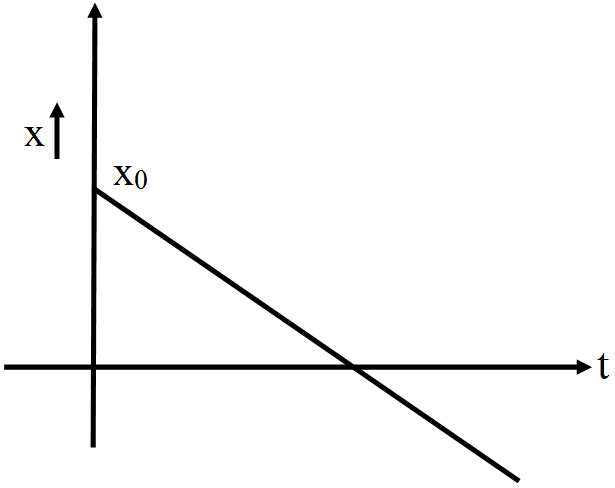
- $X_0 = -ve, v = +ve(v) \rightarrow$ constant
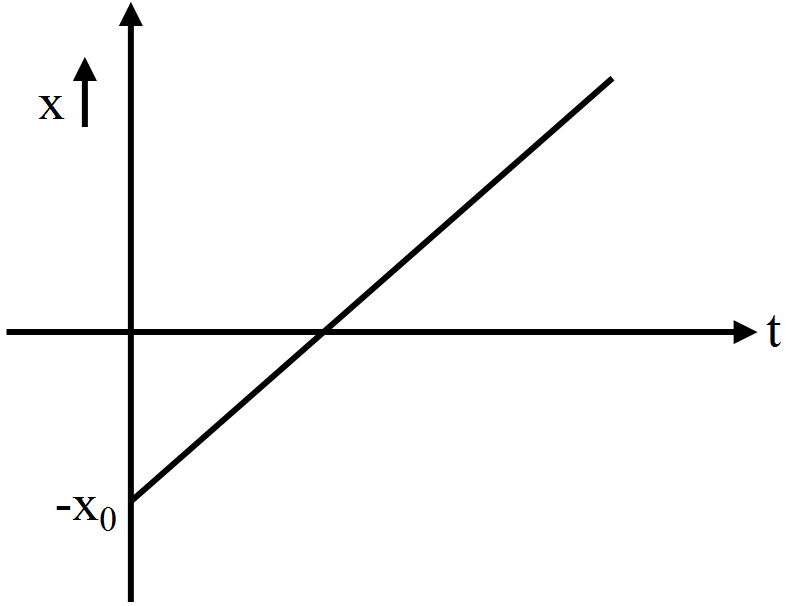
View full question & answer→Question 463 Marks
Establish the kinematic equation $v^2 - u^2 = 2as$ from velocity-time graph for a uniformly accelerated motion.
Answer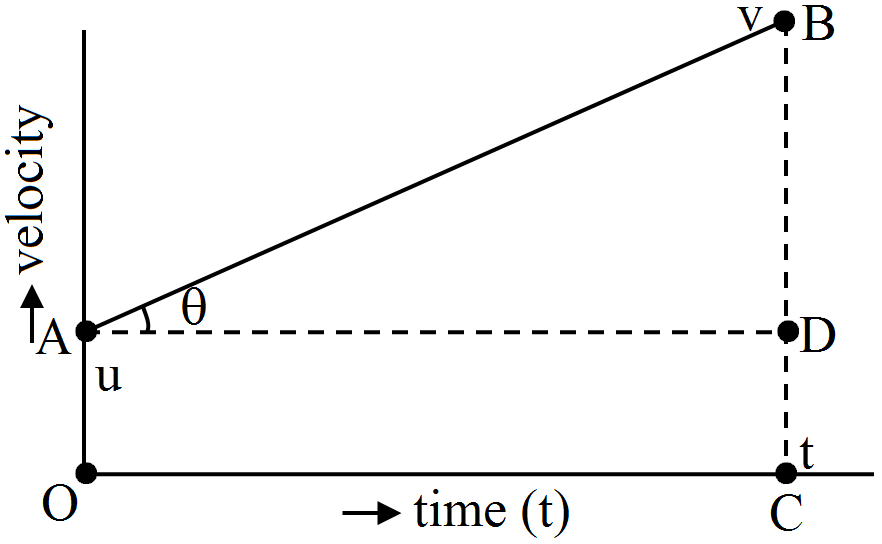
The velocity-time graph for uniformly accelerated motion has been shown in Fig. with initial velocity at t = 0 as u and final velocity at time t as v. Then area under the v-t graph gives the value of total displacement in the given time. Hence, displacement of moving particle in time t = area of trapezium $\Delta \text{ABC}$
$\text{s}=\frac{1}{2}(\text{OA}+\text{CB})\times\text{OC}$
$=\frac{1}{2}(\text{u}+\text{v})\times\text{t}$ However, from definition of acceleratiory we know that $\text{a}=\frac{\text{v}-\text{u}}{\text{t}}$ or $\text{t}=\frac{\text{v}-\text{u}}{\text{a}}$ Substituting this value of time t in equation (i), we get Displacemen $\text{s}=\frac{1}{2}(\text{u}+\text{v})\times\frac{\text{v}-\text{u}}{\text{a}}$
$\frac{(\text{v}^2-\text{u}^2)}{2\text{a}}$
$\Rightarrow 2\text{as}=\text{v}^2-\text{u}^2$
$\text{v}^2=\text{u}^2+2\text{as}$ View full question & answer→Question 473 Marks
A motor boat covers the distance between two spots on the river in time of 8hrs. and 12hrs. downstream and upstream respectively. What is the time required for the boat to cover this distance in still water?
AnswerTime taken in downstream, $8=\frac{\text{S}}{\text{v}_\text{r}+\text{v}_\text{b}}$ Time taken for upstream, $12=\frac{\text{S}}{\text{v}_\text{b}-\text{v}_\text{r}}$ We have, $\text{v}_\text{r}+\text{v}_\text{b}=\frac{\text{S}}{8},\text{v}_\text{b}-\text{v}_\text{r}=\frac{8}{12}$ Solving, $\text{v}_\text{b}=\frac{\text{S}}{2}\Big(\frac{1}{8}+\frac{1}{12}\Big)$ $=\frac{\text{S}}{2}\Big(\frac{20}{96}\Big)=\frac{10\text{S}}{96}$ $\text{v}_\text{r}=\frac{10\text{S}}{96}-\frac{\text{S}}{12}$ $=\frac{2\text{S}}{96}$ In still water, only the velocity of boat is to be considered. $\therefore$ Time taken in still water for covering length S is, $\text{t}=\frac{\text{S}}{\text{v}_\text{b}}=\frac{\text{S}\times96}{10\text{S}}$ $=9.6\text{hrs.}$
View full question & answer→Question 483 Marks
A 100m sprinter uniformly increases his speed from rest at the rate of $1ms^{-2}$ up to $\frac{3}{4}\text{th}$ of the total run and then covers the balance $\frac{1}{4}\text{th}$ run with uniform speed. How much time does he take to complete the race?
AnswerHere total distance covered s = 100m, u = 0 For first $\frac{3}{4}\text{th}$ of the run
i.e., $\text{s}_1=\frac{3}{4}\text{s}=\frac{3}{4}\times100\text{m}=75\text{m},$
$a = +1 ms^{-2}$. If time for this part of run be $t_1$,
then using the equation s $=\text{ut}+\frac{1}{2}\text{at}^2,$
we have $75=0+\frac{1}{2}\times1\times\text{t}^2_1$
$\text{t}^2_1=75\times2=150$
$\Rightarrow\text{t}_1=\sqrt{150}=12.25\text{s}$ and .
final velocity $v = u + at_1 = 0 + 1 \times 12.25 = 12.25ms^{-1}$.
For remaining run i.e., $s_2 = s - s_1 = 100 - 75 = 25m$,
uniform velocity $v = 12.25ms^{-1}$
$\therefore$ Time for this run $\text{t}_2=\frac{\text{s}_2}{\text{v}}=\frac{25}{12.25}=2.04\text{s}$
$\therefore $ Total time taken by the sprinter to complere the race $t = t_1 + t_2 = 12.25s + 2.04s = 14.29s$
View full question & answer→Question 493 Marks
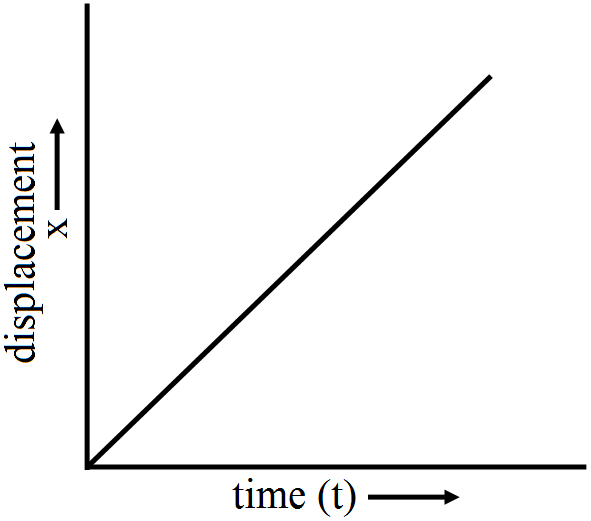
Velocity-time graph of a moving object is shown below. What is the acceleration of the object? Also draw displacement-time graph for the motion of the object.
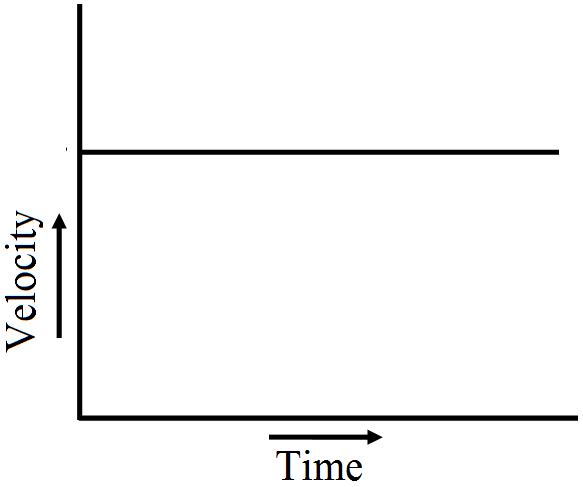
AnswerAcceleration = zero. x-t graph is as shown below.
View full question & answer→Question 503 Marks
A woman starts from her home at 8.00 a.m., walks with a speed of 5km/ hr on a straight road upto her office 5km away stays at the office upto 4 p.m., and returns home by an auto with a speed of 25km/ hr. Choose suitable scales, and plot the x-t graph of her motion.
AnswerThe time taken by the woman to reach office is one hour. The time taken by the woman to return home from office $\frac{5}{25}=12\text{ minutes.}$ 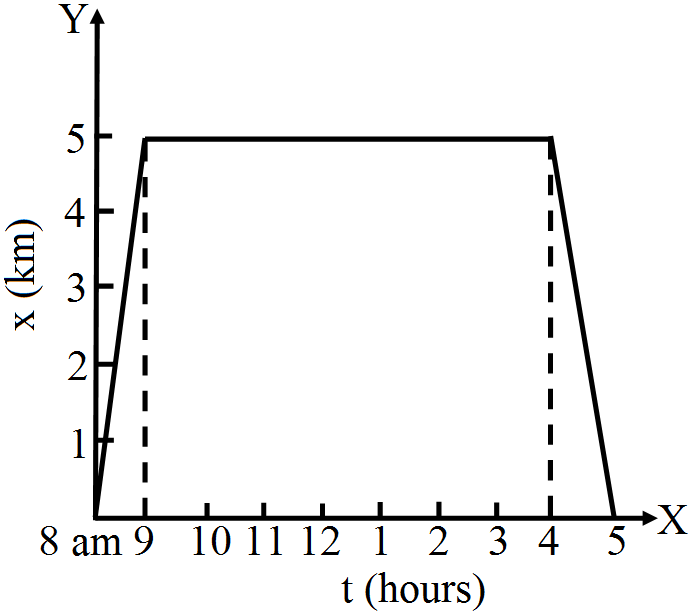
View full question & answer→