Question 13 Marks
A copper block of mass 2.5 kg is heated in a furnace to a temperature of $500^{\circ} \mathrm{C}$ and then placed on a large ice block. What is the maximum amount of ice that can melt? (Specific heat of copper $=0.39 \mathrm{Jg}^{-1} \mathrm{~K}^{-1}$; heat of fusion of water $=335 \mathrm{~J} \mathrm{~g}^{-1}$ ).
AnswerMass of the copper block, $\mathrm{m}=3 \mathrm{~kg}=3000 \mathrm{~g}$ Rise in the temperature of the copper block, $\Delta \theta=500^{\circ} \mathrm{C}$ Specific heat of copper, $\mathrm{C}=0.39 \mathrm{~J} \mathrm{~g}^{-1}{ }^{\circ} \mathrm{C}^{-1}$ The maximum heat the copper block can lose,
$\mathrm{Q}=\mathrm{mc} \Delta \theta=3000 \times 0.39 \times 500=5.85 \times 10^5 \mathrm{~J}$ Let, $\mathrm{m}_1$ be the total amount of ice melted by the hot block of copper. Heat gained by molten ice, $\mathrm{Q}=\mathrm{m}_1 \mathrm{~L} \therefore \mathrm{~m}_1=\frac{\mathrm{Q}}{\mathrm{L}}=\frac{585000}{335}=1746.26 \mathrm{~g}$
View full question & answer→Question 23 Marks
Explain why: An optical pyrometer (for measuring high temperatures) calibrated for an ideal black body radiation gives too low a value for the temperature of a red hot iron piece in the open, but gives a correct value for the temperature when the same piece is in the furnace.
AnswerAn optical pyrometer calibrated for an ideal black body radiation gives too low a value for temperature of a red hot iron piece kept in the open. Black body radiation equation is given by: $\text{E}=\sigma(\text{T}^4-\text{T}_0^4)$ Where, E = Energy radiation. T = Temperature of optical pyrometer. $T_0$ = Temperature of open space. $\sigma$ = Constant. Hence, an increase in the temperature of open space reduces the radiation energy. When the same piece of iron is placed in a furnace, the radiation energy, $\text{E}=\sigma\text{T}^4$
View full question & answer→Question 33 Marks
Explain why: A brass tumbler feels much colder than a wooden tray on a chilly day.
AnswerBrass is a good conductor of heat. When one touches a brass tumbler, heat is conducted from the body to the brass tumbler easily. Hence, the temperature of the body reduces to a lower value and one feels cooler. Wood is a poor conductor of heat. When one touches a wooden tray, very little heat is conducted from the body to the wooden tray. Hence, there is only a negligible drop in the temperature of the body and one does not feel cool. Thus, a brass tumbler feels colder than a wooden tray on a chilly day.
View full question & answer→Question 43 Marks
Name the three modes of transfer of heat from one object to other. Also, cite one example for each one of them.
AnswerThree modes of transfer of heat are:
- Conduction: In this mode, heat is transferred from one part of the body to another from particle to particle in the direction of fall of temperature without any actual movement of heated particle. e.g. when one end of the metal rod is heated it becomes hot till the other end gradually.
- Convection: In this mode, transfer of heat takes place by actual movement of heated particles of the medium. e.g. sea breeze, trade winds etc.
- Radiation: In this, heat is transferred from the source to the receiver without any actual movement of source or receiver and also without heating the intervening medium. e.g. heating of earth surface from sunlight.
View full question & answer→Question 53 Marks
A black body at 2000K emits maximum energy at a wavelength of $1.56\mu\text{m}.$ At what temperature will it emit maximum energy at a wavelength of $1.8\mu\text{m}\ ?$
AnswerHere, $\lambda_{\text{m}1}=1.56\mu\text{m},\text{T}=2000\text{K}$ $\lambda_{\text{m}2}=1.8\mu\text{m}, \text{T}_2=\ ?$ According to Wien's displacement law, $\lambda_\text{m}=\frac{\text{b}}{\text{T}}$ $\therefore\frac{\lambda_{\text{m}1}}{\lambda_{\text{m}1}}=\frac{\text{T}_2}{\text{T}_1}$ $\Rightarrow\frac{1.56}{1.8}=\frac{\text{T}_2}{2000}\Rightarrow\text{T}_2=\frac{1.56\times2000}{1.8}$ $\therefore\text{T}_2=1733.3\text{K}$
View full question & answer→Question 63 Marks
What is a black body? How was such a body designed by Fery?
AnswerA perfectly black body is that which absorbs completely the radiations of all wavelengths incident on it.As a perfectly black body neither reflects nor transmits any radiation, therefore the absorbance or absorbing power of a perfectly black body is unity.
We know that the colour of an opaque body is the colour (i.e., wavelength) of radiation reflected by it. As a blackbody reflects no wavelength, it appears black whatever be the colour of radiation incident on it.
When a perfectly black body is heated to a suitable high temperature, it emits radiations of all possible wavelengths. The radiations given out by a perfectly blackbody are called plain body radiations or full radiations or total radiations.
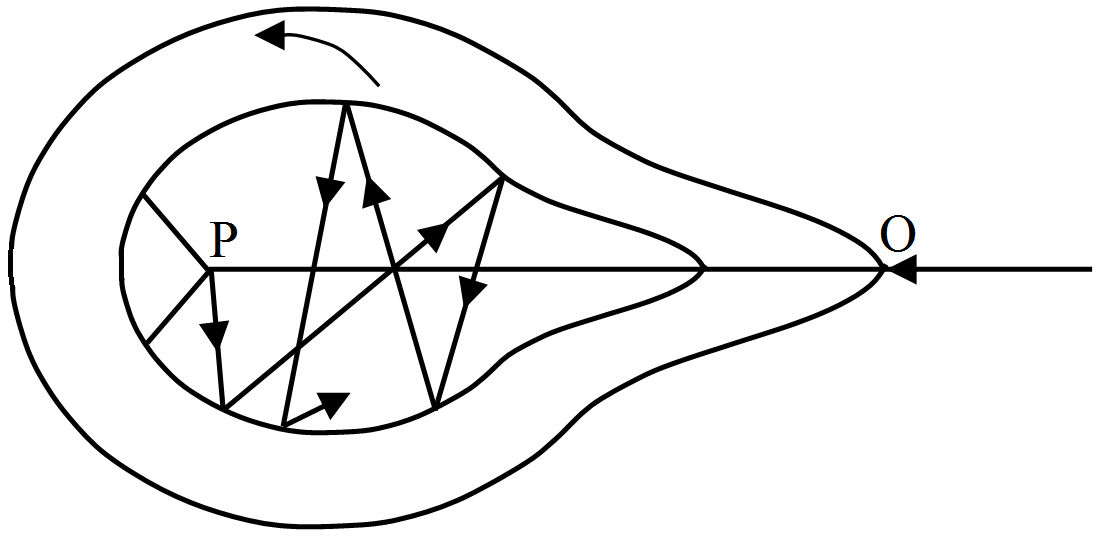
It consists of a hollow double walled metallic sphere having a narrow opening 0 on the side and a conical projection P inside just opposite to it. The inside of the sphere is coated with lamp black. Any radiation entering the sphere through the opening O suffers multiple reflections at its inner walls and about 97% of it is absorbed by lamp black at each reflection. Therefore, after a few reflections, almost entire radiation is absorbed. The projection helps in avoiding any direct reflection which even otherwise is hardly possible because of the small size of the opening O. When this body is placed in a bath at fixed temperature, the heat radiations come out of the hole. The opening thus acts as a black body radiator. It should be remembered that only the opening (and not the walls) acts as a black body radiator.
View full question & answer→Question 73 Marks
A copper block of mass $2.5kg$ is heated in a furnace to a temperature of $500°C$ and then placed on a large ice block. What is the maximum amount of ice that can melt? (Specific heat of copper = $0.39 J g^{–1} K^{–1\}$; heat of fusion of water = $335 J g^{–1}$ ).
AnswerMass of the copper block, m = 3kg = 3000g Rise in the temperature of the copper block, $\triangle\theta=500^\circ\text{C}$ Specific heat of copper, $\mathrm{C}=0.39 \mathrm{Jg}^{-1}{ }^{\circ} \mathrm{C}^{-1}$ The maximum heat the copper block can lose, $\text{Q}=\text{mc}\triangle\theta=3000\times0.39\times500=5.85\times10^5\text{J}$ Let, $m_1$ be the total amount of ice melted by the hot block of copper. Heat gained by molten ice, $Q = m_1L \therefore\text{m}_1=\frac{\text{Q}}{\text{L}}=\frac{585000}{335}=1746.26\text{g}$
View full question & answer→Question 83 Marks
When 0.2 kg of a body at $100^{\circ} \mathrm{C}$ is dropped into 0.5 kg of water at $10^{\circ} \mathrm{C}$, the resulting temperature is $16^{\circ} \mathrm{C}$. Find the specific heat of the body. Specific heat of water is $4.2 \times 10^3 \mathrm{~J} / \mathrm{kg} /{ }^{\circ} \mathrm{C}$.
AnswerFor the body, $\text{m}_1=0.2\text{kg};\Delta\text{T}_1$ $=100^\circ-16^\circ=84^\circ\text{C};$ $\text{s}_1=\ ?$ For water, $\text{m}_2=0.5\text{kg};\Delta\text{T}_2$ $=16^\circ-10^\circ=6^\circ\text{C};$ $\text{s}_2=4.2\times10^3\text{J}/\ \text{kg}/\ ^\circ\text{C}$ From law of conservation of energy; heat lost by body = heat gained by water i.e., $\text{m}_1\text{s}_1\Delta\text{T}_1=\text{m}_2\text{s}_2\Delta\text{T}_2$ or $\text{s}_1=\frac{\text{m}_2\text{s}_2\Delta\text{T}_2}{\text{m}_1\Delta\text{T}_1}=\frac{0.5\times(4.2\times10^3)\times6}{0.2\times84}$ $=0.75\times10^3\text{J}/\ \text{kg}/\ ^\circ\text{C}$
View full question & answer→Question 93 Marks
Explain why: An optical pyrometer (for measuring high temperatures) calibrated for an ideal black body radiation gives too low a value for the temperature of a red hot iron piece in the open, but gives a correct value for the temperature when the same piece is in the furnace.
AnswerAn optical pyrometer calibrated for an ideal black body radiation gives too low a value for temperature of a red hot iron piece kept in the open. Black body radiation equation is given by: $\text{E}=\sigma(\text{T}^4-\text{T}_0^4)$ Where, E = Energy radiation. T = Temperature of optical pyrometer. $T_0$ = Temperature of open space. $\sigma$ = Constant. Hence, an increase in the temperature of open space reduces the radiation energy. When the same piece of iron is placed in a furnace, the radiation energy, $\text{E}=\sigma\text{T}^4$
View full question & answer→Question 103 Marks
List the salient features of heat radiations.
AnswerHeat radiations :
- Can travel through vacuum.
- Travel with a velocity of $3 \times 10^9m/sec$.
- Travel in straight lines.
- Obey the laws of reflection.
- Does not heat the medium on its way.
- Reduce their intensity with square of the distance from source.
View full question & answer→Question 113 Marks
A steel wire of $2.0 \mathrm{~mm}^2$ cross-section is held straight (but under no tension) by attaching it firmly to two points a distance 1.50 m apart at $30^{\circ} \mathrm{C}$. If the temperature now decreases to $5^{\circ} \mathrm{C}$ and if the two points remain fixed, what will be the tension in the wire? Given that Young's modulus of steel $=2 \times 10^{11} \mathrm{Nm}^{-2}$ and coefficient of thermal expansion of steel $\mathrm{a}=1.1 \times 10^{-5{ }^{\circ} \mathrm{C}} \mathrm{C}$.
AnswerGiven, cross-section area, $\text{A}=2.0\text{mm}^2=2\times10^{-6}\text{m}^2,$ change in temperature, $\Delta\text{T}=30-5=25^\circ\text{C}$ Young's modulus of steel wire, $\text{Y}=2\times10^{11}\text{Nm}^{-2}$ ald coefficient of linear expansion of steel, $\alpha=1.1\times10^{-5}\ ^\circ\text{C}.$
$\therefore$ Tension developed in the rod, $\text{F}=\text{Y}\text{A}\alpha\Delta\text{T}$
$=2\times10^{11}\times2\times10^{-6}\times1.1\times10^{-5}\times25$
$\text{F}=110\text{N}$
View full question & answer→Question 123 Marks
What is the effect of pressure on melting point of a substance? What is the relegation. Give its one practical application.
AnswerThe melting point of those substances which expands on melting, increases with increase in pressure while the melting point of those substances which contact on melting, decreases with increase in pressure. The phenomenon ‘a' in which ice melts when pressure is increased and again freezes when pressure is removed is called relegation. It is due to the above fact that the skating is possible on snow.
View full question & answer→Question 133 Marks
A fat man is used to consuming about 3000k/ cal worth of food everyday. His food contains 50g of butter plus a plate of sweets everyday. besides items which provide him with other nutrients (proteins, vitamins, minerals, etc.) in addition to fats and carbohydrates. The calorific value of 10g of butter is 60k/ cal and that of a plate of sweets is of average 700k/ cal. What dietary strategy should he adopt to cut down his calories to about 2100k/ cal per day? Assume the man cannot resist eating the full plate of sweets once it is offered to him.
AnswerThe man intends to cut down = 3000 - 2100 = 900k/ cal. But avoiding sweets completely, he will cut down 700k/ cal. To cut down another 200k/ cal, he should cut down butter by, $\frac{10}{60}\times200\simeq33\text{g}$ per day. He should not cut down consumption of food, that provides him with vitamins and other vital nutrients.
View full question & answer→Question 143 Marks
Define emissive power and absorptive power. What is the significance of their ratio?
AnswerEmissive Power: The amount of energy radiated per second per unit area of a hot body is called emissive power (e). Absorptive Power: The amount of energy absorbed per second per unit area out of the energy incident normally is called absorptive power (a). The ratio of emissive to absorptive power of all bodies at the same temperature is a constant and is equal to the emissive power of a hot black body at the same temperature.
View full question & answer→Question 153 Marks
Two rods A and B are of equal length. Each rod has its ends at temperatures $T_1$ and $T_2$. What are the conditions that will ensure equal rates of flow of heat through the rods A and B?
Answer$\frac{\Delta\text{Q}_1}{\Delta\text{t}}= \frac{\Delta\text{Q}^2}{\Delta\text{t}}$As
$ \therefore \text{K}_1\text{A}_1\frac{\text{T}_2-\text{T}_1}{\Delta\text{x}_1}= \text{K}_2\text{A}_2 \frac{(\text{T}_2-\text{T}_1)}{\Delta\text{x}_2}$
As rods have equal lengle,
$\Delta \text{x}_1=\Delta\text{x}_2$
$\therefore \text{K}_1\text{A}_1 =\text{K}_2\text{A}_2 \text{ or }\frac{\text{A}_1}{\text{A}_2}=\frac{\text{K}_2}{\text{K}_2}$
i.e., ratio of cross sectional area of the two rods must be in the inverse ratio of their thermal conductivities.
View full question & answer→Question 163 Marks
Draw energy distribution curves for a black body at two different temperatures $T_1$ and $T_2$ where $(T_1 > T_2)$. Write any two conclusions that can be drawn from these curves.
Answer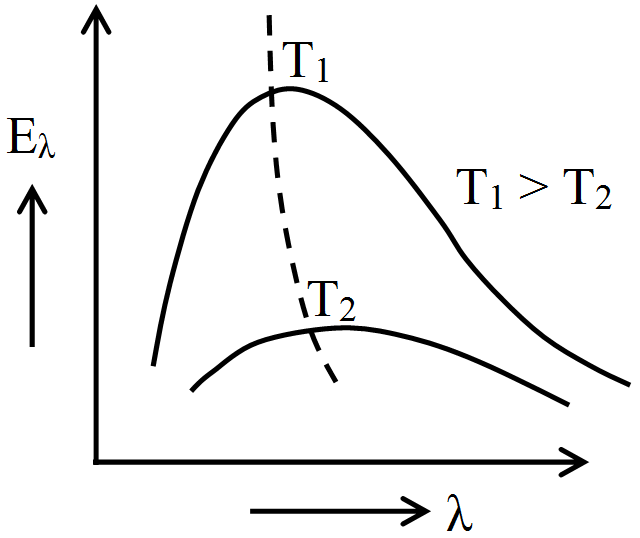
Conclusion:
- At a given temperature of a blackbody, the energy emitted is not distributed uniformly amongst all wavelengths.
- With the rise in temperature of black body, the total energy emitted increases rapidly for any given wavelength.
View full question & answer→Question 173 Marks
Find the difference in temperature across the surfaces of an iron plate 5 cm thick, through $100 \mathrm{sq} . \mathrm{m}$ of which heat flows at the rate of $9.6 \times 10^5 \mathrm{~J} / \mathrm{s}$. [Take $\mathrm{K}=96 \mathrm{Wm}^{-1} \mathrm{~K}^{-1}$]
Answer$$Given: $\Delta\text{x}= 5 \text { cm} $ $\text{A}= 100\text{ m}^2 $ $\frac{\Delta\theta}{\Delta\text{t}}=9.6\times10^6 \text{J/ sec.}$ $\text{K}=96 \text{ Wm}^{-1}\text{K}^{-1}$ We know that, $\Big|\frac{\Delta\text{Q}}{\Delta\text{t}}\Big| =\text{KA}\frac{\Delta\text{T}}{\Delta\text{x}}$ or ${\Delta\text{T}} = \Big|\frac{\Delta\text{Q}}{\Delta\text{t}}\Big|\frac{\Delta\text{x}}{\text{KA}}=5\text{K}$
View full question & answer→Question 183 Marks
A spherical black body with a radius of 12cm radiates 450W power at 500K. What would be the power of radiation if radius were to be halved and the temperature doubled.
AnswerAccording to Stefan's Law, Energy emitted per unit time i.e. power, $\text{H}=\text{A}\times\sigma\text{T}^4$ Here, $\text{H}_1=450\text{W},\text{T}=\text{T}$ and radius $\text{r}=\text{r}_1$ $\text{H}_2=\ ?\text{ T}=2\text{T}$ and $\text{r}=\frac{\text{r}_1}{2}$ $\therefore\text{H}_1=4\pi\text{r}^2_1\sigma\text{T}^4_1$ and $\text{H}_2=4\pi\Big(\frac{\text{r}_1}{2}\Big)^2\sigma(2\text{T}_1)^4$ Dividing eq. (i) by (ii) we get, $\frac{\text{H}_1}{\text{H}_2}=\frac{4\pi\text{r}^2_1.\sigma\text{T}^4_1}{4\pi\big(\frac{\text{r}_1}{2}\big).\sigma(2\text{T}_1)^4}$ $\Rightarrow\frac{450}{\text{H}_2}=\frac{\text{r}^2_1}{\text{r}^2_1}\times\frac{\text{T}^4_1}{16\text{T}^4_1}\Rightarrow\frac{450}{\text{H}_2}=\frac{1}{4}$ $\therefore\text{H}_2=450\times4=1800\text{W}$ Hence the required power = 1800W.
View full question & answer→Question 193 Marks
An ice box is built of wood $1.75cm$ thick, lined inside with cork $2cm$ thick. If the temperature of the inner surface of the cork is $0°C$ and that of the outer surface of the wood is $12°C$, what is the temperature of the interface? The thermal conductivity of wood is $0.0006$ and that of cork is $0.00012$ CGS units.
Answer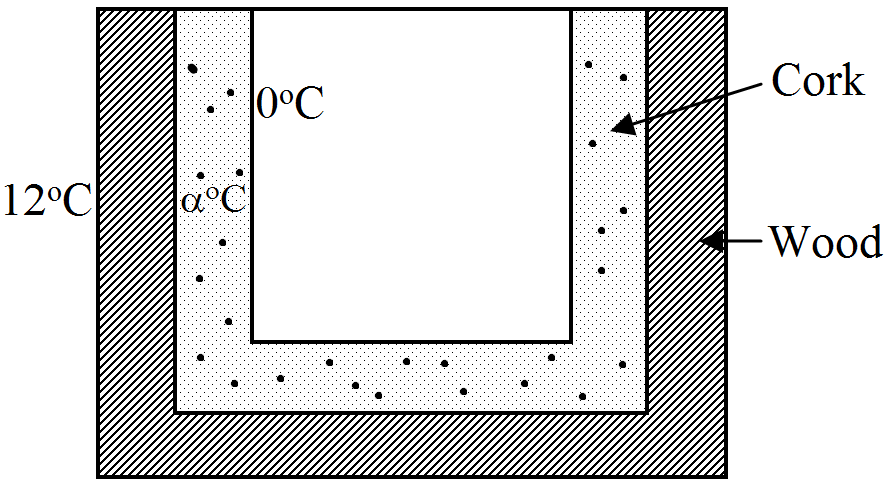
Let a be the temperature of the interface in the steady state. Since the same amount of heat must flow through wood and cork, we have, $\frac{\text{k}_1\text{A}(12-\alpha)}{\text{l}_1}=\frac{\text{k}_2\text{A}(\alpha-0)}{\text{l}_2}$ where $l_1$ and $l_2$ are the thicknesses of wood and cork respectively. Their respective conductivities are $k_1$ and $k_2$(Fig.). Substituting the values we get, $=\frac{6\times10^{-1}}{1.75}\times(12-\alpha)$ $=\frac{12\times10^{-5}}{2}\times\alpha$ or $12-\alpha=1.75\alpha\times10^{-1}$ or $\alpha=\frac{12}{1.175}=10.2^\circ\text{C}$ View full question & answer→Question 203 Marks
Explain the following:
- Hot tea cools rapidly when poured into the saucer from the cup.
- Temperature of a hot liquid falls rapidly in the beginning but slowly afterwards.
- A hot liquid cools faster if outer surface of the container is blackened.
Answer
- As surface area increases on pouring hot tea in saucer from the cup and the rate of loss of heat is directly proportional to surface area of the radiating surface, so the tea will cool faster in the saucer.
- Temperature of a hot liquid falls exponentially in accordance with Newton's law of cooling. In other words, rate of cooling is directly proportional to the temperature difference between hot liquid and the surroundings. It is due to this reason that a hot liquid cools rapidly in the beginning but slowly afterwards.
- When outer surface of container is blackened, the surface becomes good emitter of heat and so the hot liquid in it cools faster.
View full question & answer→Question 213 Marks
A certain substance has a mass of $50g/ mole$. When $300J$ of heat is added to $25g$ of sample of this material, its temperature rises from $25^\circ C$ to $45^\circ C$. Calculate:
- The thermal capacity,
- Specific heat capacity;
- Molar heat capacity of the sample.
Answer
- Total heat supplied to sample $\Delta\text{Q}=300\text{J}$ and rise in temperature,
$\Delta\text{T}=\text{T}_2-\text{T}_1=45-25=20^\circ\text{C}$
$\therefore$ Thermal capacity of substance $=\frac{\Delta\text{Q}}{\Delta\text{T}}=\frac{300\text{J}}{20^\circ\text{C}}=15\text{J}^\circ\text{C}^{-1}$
- As mass of sample $=25\text{g}=0.025\text{kg},$
$\therefore$ Specific heat capacity $\text{C}=\frac{1}{\text{m}}.\frac{\Delta\text{Q}}{\Delta\text{T}}=\frac{1}{0.025}\times15$
$=600\text{J}/\ \text{kg}^{-1}\ ^\circ\text{C}^{-1}.$
- As the substance has a mass of $50g/ mole$, hence number of moles in $25g$ sample,
$\mu=\frac{25}{50}=0.5\text{ mole}$
$\therefore$ Molar heat capacity $\text{C}=\frac{1}{\mu}\frac{\Delta\text{Q}}{\Delta\text{t}}$
$\Rightarrow\text{C}=\frac{1}{0.5}\times15\text{J}/\ \text{mol}^{-1}\ ^\circ\text{C}^{-1}$ or $\text{C}=30\text{J}/\ \text{mole}^{-1}\ ^\circ\text{C}^{-1}.$ View full question & answer→Question 223 Marks
Two rods of the same area of cross-section, but of lengths $l_1$ and $l_2$ and conductivities $K_1$ and $K_2$ are joined in series. Show that the combination is equivalent of a material of conductivity, $\text{K}=\frac{\text{l}_1+\text{l}_2}{\Big(\frac{\text{l}_1}{\text{K}_1}\Big)\Big(\frac{\text{l}_2}{\text{K}_2}\Big)}$
AnswerIt is given that conductivities $K_1$ and $K_2$, are in series, so rate of flow of heat energy is same. But the sum of the difference in temperature is the difference across their free ends.
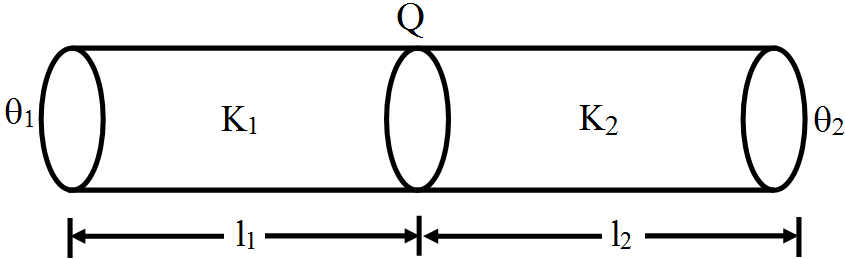
$\therefore(\theta_1-\theta)+(\theta-\theta_2)=(\theta_1-\theta_2)$
$=\frac{\theta}{\text{t}}.\frac{\text{l}_1}{\text{K}_1\text{A}}+\frac{\theta}{\text{t}}\frac{\text{l}_2}{\text{K}_2\text{A}}=\frac{\theta}{\text{t}}.\frac{(\text{l}_1+\text{l}_2)}{\text{K}_{\text{eq}}\text{A}}$
$\Rightarrow\frac{\text{l}_1}{\text{K}_1}++\frac{\text{l}_2}{\text{K}_2}=\frac{\text{l}_1+\text{l}_2}{\text{K}_{\text{eq}}}$
$\therefore\text{K}_{\text{eq}}=\frac{\text{l}_1+\text{l}_2}{\Big(\frac{\text{l}_1}{\text{K}_1}+\frac{\text{l}_2}{\text{K}_2}\Big)}$ View full question & answer→Question 233 Marks
On what factors the amount of heat flowing from hot face to the cold face depends? How?
AnswerIf $Q$ be the amount of heat flowing from hot to the cold face, then it is found to be:
- Directly proportional to the cross$-$sectional area $(A)$ of the face. i.e.,
i.e., $\text{Q}\propto\text{A}$
- Directly proportional to the temperature difference between the two faces i.e.,
i.e., $\text{Q}\propto\Delta\theta$
- Directly proportional to the time $t$ for which the heat flows.
i.e., $\text{Q}\propto\frac{1}{\Delta\text{x}}$
Combining factors $(1)$ to $(4)$, we get,
$\text{Q}\propto\frac{\text{A}\Delta\theta}{\Delta\text{x}}\text{t}$ or $\text{Q}=\text{KA}\frac{\Delta\theta}{\Delta\text{x}} \text{t}$
Where $K$ is the proportionality constant known as the coefficient of thermal conductivity. View full question & answer→Question 243 Marks
State Kirchhoff's law of black body radiations.
AnswerFor any given temperature and wavelength, the ratio of the emissive power to the absorptive power is the same for all substances and is equal to the emissive power of a perfectly black body at the same temperature.
View full question & answer→Question 253 Marks
$100 g$ of water is supercooled to $-10°C$. At this point, due to some disturbance mechanised or otherwise some of it suddenly freezes to ice. What will be the temperature of the resultant mixture and how much mass would freeze? $\left[\mathrm{Sw}=1 \mathrm{cal} / \mathrm{g} /{ }^{\circ} \mathrm{C}\right.$ and $\left.\mathrm{L}^{\mathrm{W}_{\text {Fusion }}}=80 \mathrm{cal} / \mathrm{g}\right]$
AnswerWater mass = 100g At -10^\circC ice and water mixture exists. Heat required (given out) by $10^\circ\text{Cice to }0^\circ\text{C ice}=\text{ms}\Delta\text{t}$
$=100\times1\times[0-(-10)]$
$\text{Q}=1000\text{cal}$ Let gm ice melted Q = ml $\text{m}=\frac{\text{Q}}{\text{L}}=\frac{1000}{80}=12.5\text{g}$ So, there is m = 12.5g water and ice in mixture. Hence temperature of mixture remains $0^\circ C$.
View full question & answer→Question 263 Marks
A metallic ball has a radius of $9.0 cm$ at $0^{\circ} \mathrm{C}$. Calculate the change in its volume when it is heated to $90^{\circ} \mathrm{C}$. Given that coefficient of linear expansion of metal of ball is $1.2 \times 10^{-5} \mathrm{~K}^{-1}$.
AnswerAs radius of ball, r = 9.0cm = 0.090m at $0^\circ C$, hence its, Volume, $\text{V}_0=\frac{4}{3}\pi\text{r}^3_0=\frac{4}{3}\times3.14\times(0.090)^3$
$=3.05\times10^{-3}\text{m}^3$ Again as, $\alpha=1.2\times10^{-5}\text{K}^{-1},$
$\therefore\gamma=3\alpha=3\times1.2\times10^{-5}$
$=3.6\times10^{-5}\text{K}^{-1}$ Moreover rise in temperature, $\Delta\text{T}=90^\circ\text{C}-0^\circ\text{C}=90^\circ\text{C}=90\text{K}$
$\therefore$ Increase in volume, $\Delta\text{V}=\text{V}\gamma\Delta\text{T}$
$=3.05\times10^{-3}\times3.6\times10^{-5}\times90$
$=9.88\times10^{-6}\text{m}^3$
$=9.88\text{cm}^3$
View full question & answer→Question 273 Marks
What is the temperature of the steel-copper junction in the steady state of the system shown in the figure. Length of steel rod = $15.0cm$, length of copper rod = $10.0cm$, temperature of the furnace = $300°C$, temperature of the other end = $0°C$. The area of cross-section of steel rod is twice that of copper rod. (Thermal conductivity of steel = $50.2Js^{-1}m^{-1}K^{-1}$ and of copper = $385Js^{-1}m^{-1}K^{-1}$).
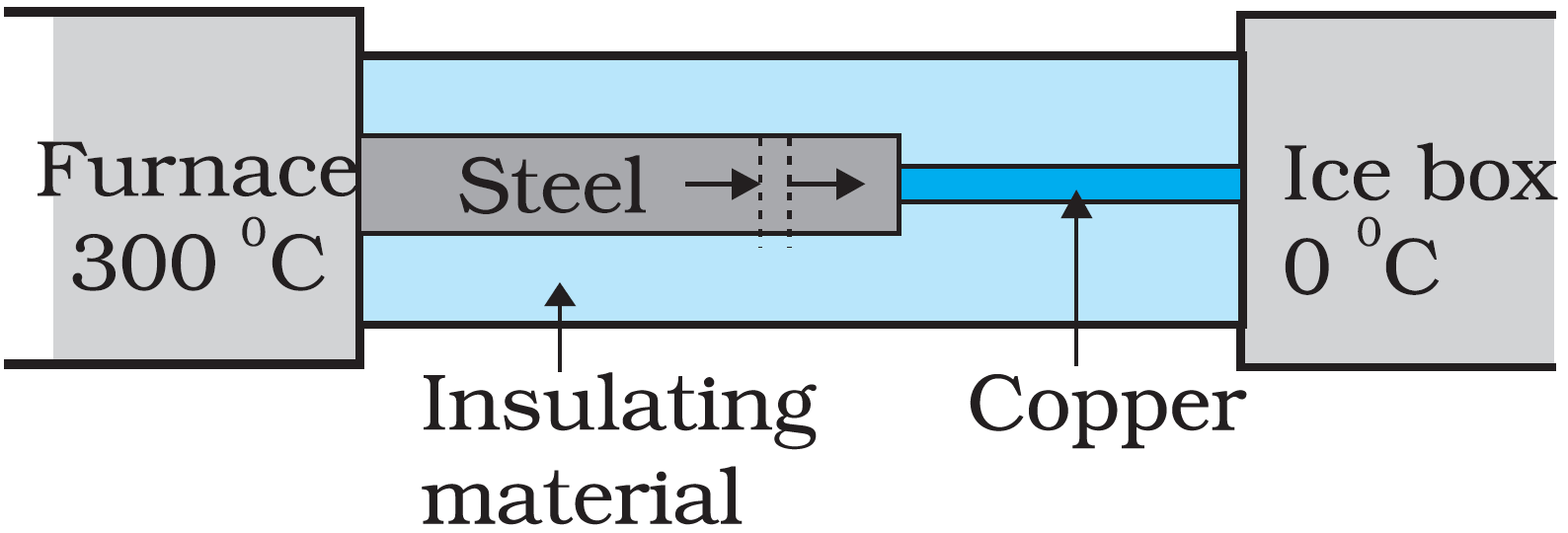
AnswerLet T be the temperature of steel-copper junction Length of steel rod $l_1 = 15 \times 10^{-2}m$ and length of copper rod $l_2 = 10 \times 10^{-2}m A_1$ = Area of cross-section of steel rod $A_2$_ = Cross-section area of copper rod Heat flowing per second in steel = Heat flowing per second in copper $\frac{\text{K}_1\text{A}_1(300-\text{T})}{\text{l}_1}=\frac{\text{K}_2\text{A}_2(\text{T}-0)}{\text{l}_2}$
$\Rightarrow\frac{50.2\times2\text{A}_2\times(300-\text{T})}{15\times10^{-2}}=\frac{385\times\text{A}_2(\text{T}-0)}{10\times10^{-2}}$
$\Rightarrow2(50.2)\times2\text{A}_2\times(300-\text{T})=3(385)\times\text{A}_2\text{T}$
$\Rightarrow200.8\text{A}_2(300-\text{T})=1155\text{A}_2\text{T}$
$\Rightarrow60240\text{A}_2-200.8\text{A}_2\text{T}=1155\text{A}_2\text{T}$
$\Rightarrow1355.8\text{A}_2\text{T}=60240\text{A}_2$
$\Rightarrow\text{T}=\frac{60240}{1355.8}=44.4^\circ\text{C}.$
View full question & answer→Question 283 Marks
Distinguish between conduction, convection and radiation.
Answer
|
S. No
|
Conduction
|
Convection
|
Radiation
|
|
1.
|
It is the transfer of heat by direct physical contact.
|
It is the transfer of heat by the motion of a fluid.
|
It is the transfer of heat by electromagnetic waves.
|
|
2.
|
It is due to temperature difference. Heat flows from high temperature region to low temperature region.
|
It is due to difference in density. Heat flows from low density region to high density region.
|
It occurs from all bodies at temperatures above 0K.
|
|
3.
|
It occurs in solids through molecular collisions, without actual flow of matter.
|
It occurs in fluids by actual flow of matter.
|
It can take place at large distances and does not heat the intervening medium.
|
|
4.
|
It is a slow process.
|
It is also a slow process.
|
It propagates at the speed of light.
|
|
5.
|
It does not obey the laws of reflection and refraction.
|
It does not obey the laws of reflection and refraction.
|
It obeys the laws of reflection and refraction.
|
View full question & answer→Question 293 Marks
Explain why: A brass tumbler feels much colder than a wooden tray on a chilly day.
AnswerBrass is a good conductor of heat. When one touches a brass tumbler, heat is conducted from the body to the brass tumbler easily. Hence, the temperature of the body reduces to a lower value and one feels cooler. Wood is a poor conductor of heat. When one touches a wooden tray, very little heat is conducted from the body to the wooden tray. Hence, there is only a negligible drop in the temperature of the body and one does not feel cool. Thus, a brass tumbler feels colder than a wooden tray on a chilly day.
View full question & answer→Question 303 Marks
Derive Newton's law of cooling from Stefan-Boltzman law.
AnswerFor a non-black body at temperature T surrounded by an enclosure $T_0$ (where $T > T_0$), we have $\text{E}=\text{e}\sigma(\text{T}^4-\text{T}^4_0)$ where e is a constant, and its value depends upon the physical nature of the emitting surface.
$\therefore\text{E}=\text{e}\sigma(\text{T}^2+\text{T}^2_0)(\text{T}^2-\text{T}_0^2)$ $=\text{e}\sigma(\text{T}^2+\text{T}^2_0)(\text{T}+\text{T}_0)(\text{T}-\text{T}_0)$
View full question & answer→Question 313 Marks
Two rods of the same area of cross-section, but of lengths l, and l, and conductivities K, and K, are joined in series. Show that the combination is equivalent of a material of conductivity $\text{K}=\frac{\text{l}_1+\text{l}_2}{\Big(\frac{\text{l}_1}{\text{K}_1}\Big)+\Big(\frac{\text{l}_2}{\text{l}_2}\Big)}$
AnswerSince they are in series, the rate of flow of heat energy is the same. But the sum of the difference in temperatures is the difference across their free ends. 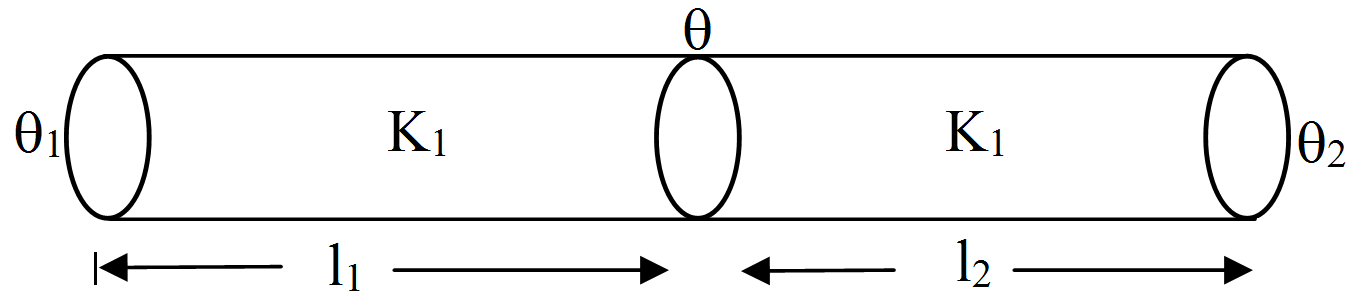 $\therefore (\theta-\theta)+(\theta-\theta)=(\theta_1-\theta_2)$
i.e.$\frac{\text{Q}}{\text{t}}.\frac{\text{l}_1}{\text{K}_1\text{A}}+\frac{\text{Q}}{\text{t}}.\frac{(\text{l}_1+\text{l}_2)}{\text{K}_\text{eq} \text{ A}}$$\Rightarrow \frac{\text{l}_1}{\text{K}_2}+\frac{\text{l}_2}{\text{K}_2}= \frac{\text{l}_1+\text{l}_2}{\text{K}_\text{eq}}\therefore\text{K}_\text{eq}= \frac{\text{l}_1+\text{l}_2}{\Big({\frac{\text{l}_1}{\text{K}_2}}+ \frac{\text{l}_2}{\text{K}_2}\Big)}$ View full question & answer→Question 323 Marks
Find out the increase in moment of inertia I of a uniform rod $($coefficient of linear expansion $\alpha)$ about its perpendicular bisector when its temperature is slightly increased by $\Delta\text{T}.$
AnswerI of rod its axis along perpendicular bisector $=\frac{1}{12}\text{ML}^2$ $\Delta\text{L}=\alpha\text{L}\Delta\text{T}$ $\text{I}'=\frac{1}{12}\text{M}(\text{L}+\Delta\text{L})^2$ $=\frac{1}{12}\text{M}(\text{L}^2+\Delta\text{L}^2+2\text{L}\Delta\text{L})$ Neglecting $\Delta\text{L}^2$ due to very small term. $\text{I}'=\frac{\text{M}}{12}(\text{L}^2+2\text{L}\Delta\text{L})$ $=\frac{\text{ML}^2}{12}+\frac{\text{ML}\Delta\text{L}}{6}\times\frac{2\text{L}}{2\text{L}}$ $\text{I}'=\frac{\text{ML}^2}{12}+\frac{\text{ML}^2}{12}\cdot\frac{2\Delta\text{L}}{\text{L}}$ $=\text{I}+\text{I}\cdot\frac{2\alpha\text{L}\Delta\text{T}}{\text{L}}$ $\text{I}'=\text{I}(1+2\alpha\Delta\text{T})$ So, new moment of inertia increased by $(2\text{I}\alpha\Delta\text{T}).$
View full question & answer→Question 333 Marks
A student records the initial length l, change in temperature $\Delta\text{T}$ and change in length $\Delta\text{l}$ of a rod as follows:
|
S.NO.
|
l(m)
|
$\Delta\text{T(C)}$
|
$\Delta\text{l}(\text{m})$
|
|
|
2
|
10
|
$4 \times 10^{-4}$
|
|
2.
|
1
|
10
|
$4 \times 10^{-4}$
|
|
3.
|
2
|
20
|
$2 \times 10^{-4}$
|
|
4.
|
3
|
10
|
$6 \times 10^{-4}$
|
If the first observation is correct, what can you say about observations 2, 3 and 4. AnswerIf the first observation is correct, hence from the $1^{st}$ observation we get the coefficient of linear expansion. $\alpha=\frac{\Delta\text{l}}{\text{l}\times\Delta\text{T}}=\frac{4\times10^{-4}}{2\times10}=2\times10^{-5}{^\circ{\text{C}}^{-1}}$ For $2^{nd}$ observation, $\Delta\text{l}=\alpha\text{l}\Delta\text{T}$
$=2\times10^{-5}\times1\times10$
$=2\times10^{-4}\text{m}\neq4\times10^{-4}\text{m}$ Which is incorrect, For $3^{rd}$ observation, $\Delta\text{l}=\alpha\text{l}\Delta\text{T}$
$=2\times10^{-5}\times2\times20$
$=8\times10^{-4}\text{m}\neq2\times10^{-4}\text{m}$ which is incorrect. For $4^{th}$ observation, $\Delta\text{l}=\alpha\text{l}\Delta\text{T}$
$=2\times10^{-5}\times3\times10=6\times10^{-4}\text{m}$ [i.e., observed value is correct]
View full question & answer→Question 343 Marks
Calculate the temperature which has same numeral value on celsius and Fahrenheit scale.
AnswerLet the required temperature is $x^0C = x^0F \frac{\text{C}}{100}=\frac{\text{F}-32}{180}$
$\Rightarrow\frac{\text{x}}{5}=\frac{\text{x}-32}{9}$
$\Rightarrow5\text{x}-160=9\text{x}$
$\Rightarrow-9\text{x}+5\text{x}=160$
$\Rightarrow-4\text{x}=160$
$\Rightarrow\text{x}=\frac{160}{-4}=-40^\circ$
$\therefore-40^\circ\text{F}=-40^\circ\text{C}$
View full question & answer→Question 353 Marks
A celsius and fahrenheit thermometer are put in an hot bath. The reading of fahrenheit thermometer is $\frac{3}{2}$ times the reading of celsius thermometer. What is the temperature of bath on celsius, fahrenheit and kelvin's scales.
AnswerLet if reading on celsius scale is $\theta.$ Reading on, $\text{T}_\text{F}=\frac{3}{2}\theta$ As $\frac{\theta}{100}=\frac{\text{T}_\text{F}-32}{180}$ $\frac{\theta}{5}=\frac{\frac{3}{2}\theta-32}{9}$ On solving, we get $\theta=-106.67^\circ\text{C}$ Temperature on kelvin's scale, $\text{T}_\text{K}=-106.67+273.15$ $=166.48\text{K}$
View full question & answer→Question 363 Marks
The coefficient of apparent expansion of a liquid when determined using two different vessels A and B are $\gamma_1$ and $\gamma_2$ respectively. If the coefficient of linear expansion of vessel A is α, find the coefficient of linear expansion of vessel B.
AnswerWe know that coefficient of real expansion of liquid $(\gamma_\text{r})=$ Coefficient of apparent expansion of the liquid $(\gamma_\text{a})\ +$ coefficient of volume expansion $(\gamma_\text{v}).$ i.e., $\gamma_\text{r}=\gamma_\text{a}+\gamma_\text{v}=\gamma_\text{a}+3\alpha$ Since the liquid is same in both the vessel, so value of $\gamma_\text{r}$ is same. For vessel A, $\gamma_\text{r}=\gamma_\text{1}+3\alpha_1=\gamma_1+3\alpha$ $[\because\alpha_1=\alpha$ given$]$ For vessel B, $\gamma_\text{r}=\gamma_2+3\alpha_2$ $\therefore\gamma_1+3\alpha=\gamma_2+3\alpha_2$ or $\alpha_2=\frac{\gamma_1-\gamma_2}{3}+\alpha.$
View full question & answer→Question 373 Marks
What is the temperature of the steel-copper junction in the steady state of the system shown in figure. The area of cross-section of steel rod is twice that of the copper rod, $\text{K}_\text{steel}= 50.2\text{ Js}^{-1} \text{m}^{-1}\text{K}^{-1}$
AnswerLet T be the temperature of steel -copper junction. Length $\text{l}_1=15 \times10^{-2}\text{m and}\text{ l}_2=10\times10^{-2}\text{m}$
Heat flowing per second in steel =Heat flowing per second in copper $\frac{50.2\times2\text{A}_2\times(300-\text{T})}{15\times10^{-2}}=\frac{385\times\text{A}_2\times(\text{T-0)}}{10\times10^2}$
Solve to get T $=44.4^\circ\text{C}.$
View full question & answer→Question 383 Marks
The ratio of thermal conductivities of two different metals is 5 : 3. In order to have the same thermal resistance in these metals of equal thickness, what should be the ratio of their lengths?
AnswerThermal resistance, $\text{R}_{\text{M}_1}=\frac{\text{l}_1}{\text{K}_1\text{A}_1}$ and $\text{R}_{\text{M}_2}=\frac{\text{l}_2}{\text{K}_2\text{A}_2}$ Since $\text{R}_{\text{M}_1}=\text{R}_{\text{M}_2}\Rightarrow\frac{\text{l}_1}{\text{K}_1\text{A}_1}=\frac{\text{l}_2}{\text{K}_2\text{A}_2}$ $\Rightarrow\frac{\text{l}_1}{\text{K}_1}=\frac{\text{l}_2}{\text{K}_2}$ $[\because$ They have equal thickness$]$ $\therefore\frac{\text{l}_1}{\text{l}_2}=\frac{\text{K}_1}{\text{K}_2}=\frac53$
View full question & answer→Question 393 Marks
Draw the energy$-$distribution graph of a black body. List some salient features.
Answer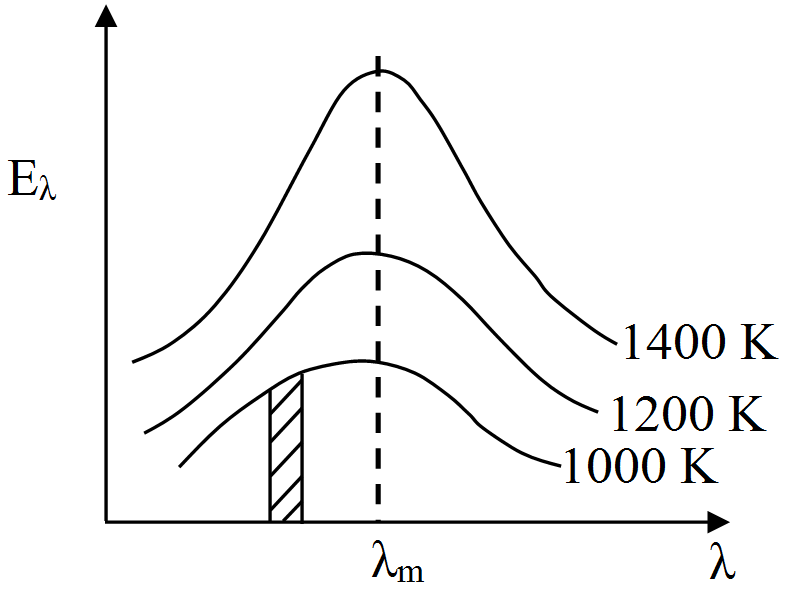
- At a given temperature with increase in wavelength, the energy radiated increases and then decreases.
- As the temperature increases, there is a shift in the wavelength towards lesser values corresponding to maximum intense wavelength, as given by $\lambda_\text{m}\text{T}=$ constant $(2.89 \times 10-^3m K)$.
- Area below the graph in a specified wavelength range is a measure of the radiant energy in that wavelength range.
View full question & answer→Question 403 Marks
Distinguish clearly between the three modes of heat transmission.
AnswerThree modes of heat transmission are conduction, convection and radiation. Their main points of distinction are as follows:
| S. No |
Conduction
|
Convection
|
Radiation
|
|
1.
|
There is no bodily motion of medium particles. Medium particles vibrate to and fro about their mean positions and pass on thermal energy to the neighbouring particles.
|
Heat is transferred from one part of system to another by the actual motion of the particles of the system.
|
Medium has no role as thermal radiation are transmitted without any material medium.
|
|
2.
|
No convection currents are formed.
|
Convection currents are formed.
|
Question of formation of convection currents does not arise.
|
|
3.
|
Conduction of heat takes place in solids and few liquids like mercury and molten metals.
|
Convection of heat takes place in fluids i.e., liquids as well as gases.
|
Radiant energy directly flows from heat source to the given body at a speed of $3 \times 10m^8/ s$ as electromagnetic waves.
|
View full question & answer→Question 413 Marks
State Wien's displacement law. Draw graph showing energy emitted versus wavelength for a blackbody at different temperature.
AnswerAccording to Wien's law, the product of the wavelength corresponding to maximum intense radiation and the absolute temperature is a constant,
i.e.
$\lambda_{\text{max}}⋅T = b$
where b is Wien's displacement constant, approximately equal to $2.898 \times 10^{−3} m⋅K$
View full question & answer→Question 423 Marks
What is a black body ? Draw the curves showing the energy distribution among black body radiations at different temperature. Hence, define Wein's displacement law. Give one application of Wein's displacement law.
AnswerBlack body: A perfectly black body is that which absorbs completely the radiations of all wavelengths incident on As a perfectly black body neither reflects nor transmits any radiation, therefore the absorbtance or absorbing power of a perfectly black body is unity. We know that the colour of an opaque body is the colour $($i.e., wavelength$)$ of radiation reflected by it. As a black body reflects no wavelength, it appears black whatever be the colour of radiation incident on it. When a perfectly black body is heated to a suitable high temperature, it emits radiations of all possible wavelengths. The radiations given out by a perfectly black body are called plain body radiations or full radiations or total radiations. A perfectly black body cannot be realised in practice. Fery designed a perfectly
black body which is most commonly used.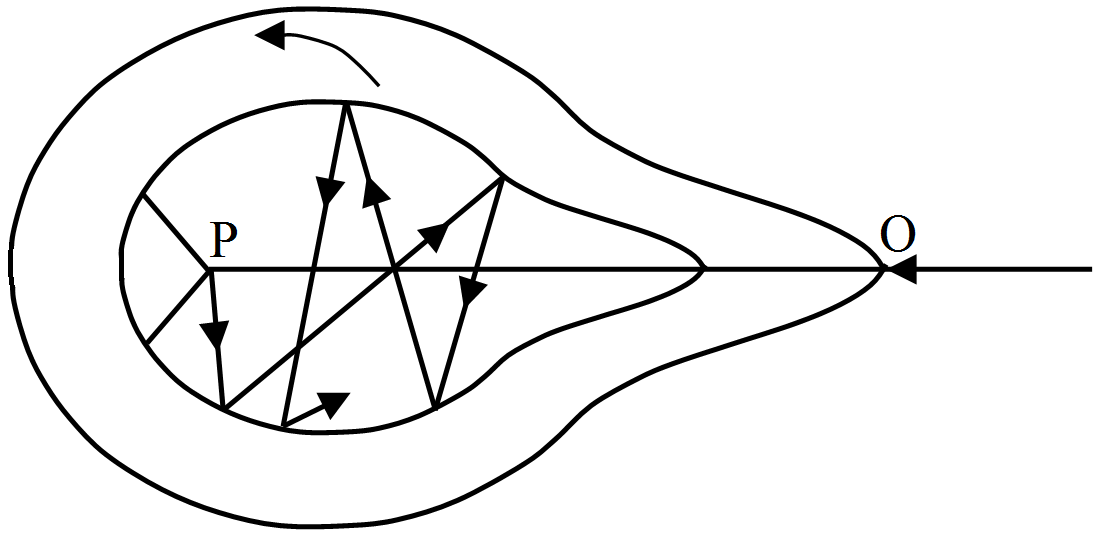 It consists of a hollow double walled metallic sphere having a narrow opening $0$ on the side and a conical projection $P$ inside just opposite to it. The inside of the sphere is coated with lamp black. Any radiation entering the sphere through the opening $O$ suffers multiple reflections at its inner walls and about $97\%$ of it is absorbed by lamp black at each reflection. Therefore, after a few reflections, almost entire radiation is absorbed. The projection helps in avoiding any direct reflection which even otherwise is hardly possible because of the small size of the opening $O$. When this body is placed in a bath at fixed temperature, the heat radiations come out of the hole. The opening thus acts as a black body radiator. It should be remembered that only the opening $($and not the walls$)$ acts as a black body radiator. Energy distribution in black body.
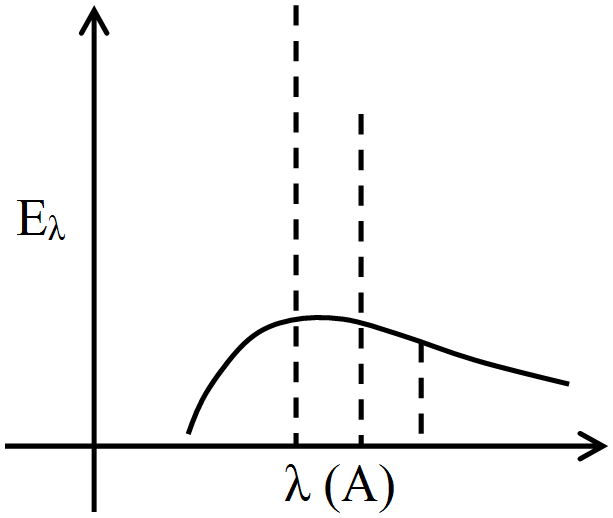
- At a given temperature with increase in wavelength, the energy radiated increases and then decreases.
- As the temperature increases, there is a shift in the wavelength towards lesser values corresponding to maximum intense wavelength, as given by.
$\lambda_\text{m}\text{T}= \text{constant}(2.89\times10^{-3}\text{mk})$
- Area below the graph in a specified wavelength range is a measure of the radiant energy in that wavelength range.
- Wein's law and its application. According to Wien's law, the product of the wavelength corresponding to maximum intense radiation and the absolute temperature is a constant, i.e., $T = \lambda\text{m}\text{T} = $constant.
- To find the temperature of stars, one can use Wien's law. If the wavelength of maximum intense component is known, temperature can be found from. $\lambda_\text{m}\text{T}=\text{b}=(2.89 \ 10^{-3}\text{mk})$.
View full question & answer→Question 433 Marks
What are the basic requirements of a cooking utensil in respect of specific heat, thermal conductivity and coefficient of expansion?
AnswerA cooking utensil should be of suitable material which possesses small value of specific heat (S), large value of thermal conductivity (K) and low coefficient of expansion $(\alpha).$
View full question & answer→Question 443 Marks
Two bodies A and B have thermal emissivity of 0.01 and 0.81 respectively. The outer surface area as of both the bodies are same. The two emit the same total radiated power. The wavelength $\lambda_\text{B}$ corresponding to the maximum intensity in radiations from B, is shifted from the wavelength $\lambda_\text{A}$ a corresponding to the maximum intensity in radiations from A by $1\mu\text{m}.$ If the temperature of body A is 5802K, find the temperature of body B and the wavelength ago $\lambda_\text{B}.$
AnswerHere, $\varepsilon_\text{A}=0.01$ and $\varepsilon_\text{B}=0.81$ $\Big(\frac{\text{dQ}}{\text{dt}}\Big)_\text{A}=\Big(\frac{\text{dQ}}{\text{dt}}\Big)_\text{B}$ $\therefore\varepsilon_\text{A}\sigma_\text{A}\text{T}^\text{4}_\text{A}=\varepsilon_\text{B}\sigma_\text{A}\text{T}^4_\text{B}\Rightarrow\frac{\varepsilon_\text{A}}{\varepsilon_\text{B}}=\frac{\text{T}^4_\text{B}}{\text{T}^4_\text{A}}$ But $\lambda\text{T}=$ Contant, $\therefore\lambda_\text{A}\text{T}_\text{A}=\lambda_\text{B}\text{T}_\text{B}$ $\therefore\frac{\varepsilon_\text{A}}{\varepsilon_\text{B}}=\frac{\lambda^4_\text{A}}{\lambda^4_\text{B}}=\frac{0.1}{0.81}=\Big(\frac{1}{3}\Big)^4$ $\therefore\frac{\lambda_\text{A}}{\lambda_\text{B}}=\frac{1}{3}$ $\Rightarrow\lambda_\text{B}=3\lambda_\text{A}...(1)$ But $\lambda_\text{B}-\lambda_\text{A}=10^{-6}...(2)$ $\therefore3\lambda_\text{A}-\lambda_\text{A}=10^{-6}$ $\therefore\lambda_\text{A}=0.5\times10^{-6}\text{m}$ and $\lambda_\text{B}=3\times0.5\times10^{-6}$ $=1.5\times10^{-6}\text{m}$
View full question & answer→Question 453 Marks
How should one kg of water at 5°C be so divided that one part of it when converted into ice at 0°C, would by this change of state provide a quantity of heat that would be sufficient to vaporize the other part?
AnswerInitially 1000g of water is at 5°C. Let m gram of it be cooled to ice at 0°C. Heat released fue to this Heat released due to this = (m × 1 × 5) + (m × 80) = 5m + 80m = 85m/ cal. The heat required by (1000 - m)g of water at 5ºC to become steam at 100ºC = [(1000 - m)(100 - 5) + (1000 - m)540]cal, = (1000 - m)(95 + 540)cal = (1000 - m)(635)cal, Now, 85m = (1000 - m)(635) or 720m = 635 × 1000 $\Rightarrow\text{m}=\frac{635\times1000}{720}=881.9\text{g}$
View full question & answer→Question 463 Marks
What is meant by monochromatic emittance, emissive power, emissivity and monochromatic absorbtance.
Answer1. Monochromatic emittance or spectral emissive power of a body corresponding to particular wave length at a particular temperature is defined as the amount of radiant energy emitted per unit time per unit surface area of the body within unit wavelength interval around a i.e., between $\Big(\lambda-\frac{1}{2}\Big)$ and $\Big( \lambda+\frac{1}{2}\Big).$ It is represented by $\text{e}_\lambda.$
If we consider a small wavelength interval d around $\lambda$ i.e., between $\Big(\frac{\lambda-\text{d}\lambda}{2}\Big)$ and $\Big(\frac{\lambda+\text{d}\lambda}{2}\Big),$
then the amount of energy radiated per unit time per unit area of the body in the wave length interval d will be given by $\text{e}_\lambda\text{d}_\lambda.$
2. The total emittance or emissive power of a body at a certain temperature is defined as the total amount of thermal energy emitted per unit time per unit area of the body for all possible wavelengths. It is represented by e.
As the wavelengths of radiation emitted range from 0 to $\infty,$ obviously,
View full question & answer→Question 473 Marks
A copper plate has an area of $250 \ cm^2$ at $0^\circ C$. Calculate the area of this plate at $60^\circ C$. Given coefficient of linear expansion of copper is $1.7 × 10^{-5 \ \circ} C^{-1}$.
AnswerHere,
$A_0 = 250 cm^2$
$\beta=2 \alpha =2 \times 1.7 \times 10^{-5}$
$=3.4 \times 10^{-5}\ ^\circ C^{-1}$
$\Delta\text{T} = (602 - 0)=60^\circ C.$
Using $A_\theta = A_0(1 + \beta\ \Delta T),$
we have $A_{80^\circ C}=250( 1 + 3.4^{-5} \times 60)$
$ = 250(1+00204) = 250.51 \ cm^2$
$\therefore$, Area of copper plate at $60^\circ C =250.51 \ cm^2.$
View full question & answer→Question 483 Marks
Define Coefficient of Thermal Conductivity and derive its SI unit. Calculate the rate of loss of heat through a glass window of area $1000 cm^2$ and thickness $0.4 cm$ when temperature inside is $37^\circ C$ and outside is $-5^\circ C$. Coefficient of thermal conductivity of glass is $2.2 \times 10^{-3}cal \ s^{-1}\ cm^{-1}\ K^{-1}$.
AnswerThermal conductivity is defined as heat energy transferred in unit time from unit area having a difference in temperature of unity over unit length.
It is expressed in $Js^{-1}m^{-1} \ {}^{\circ}C^{-1}$ or $Wm^{-1}K^{-1}$.
It is given by $K= \Big(\frac{Q}{t}\Big). \frac{dl}{Ad\theta}$
and is expressed in SI system as $\frac{\text{joule}}{\sec} \frac{\text{metre}}{\text{metre}^2K} $
ie., $Js^{-1}m^{-1}K^{-1}$ or ${Wm}^{-1}K^{-1}$
$A= 1000 cm^{-2}= 10^{-1}m^{-1}K^{-1}$
$l=0.4 \times 10^{-2}m,$
$d\theta =37 -(-5)=42^\circ C $
$K= 2.2 \times 10^{-3} \times 4.2 \times10^{1}\ Js^{-1}\ m^{-1}\ K^{-1}$
$\frac{Q}{t}= K \frac{Ad\theta}{l}$
$= \frac{2.2 \times 10^{-3} \times 4.2 \times 10^2 \times 10^{-1} \times 42}{0.4 \times 10^{-2}}$
$= 970.2J\sec$
View full question & answer→Question 493 Marks
Calculate the heat required to convert $3kg$ of ice at $-12^\circ C$ kept in a calorimeter to steam at $100^\circ C$ at atmospheric pressure.
Given specific heat capacity of ice $= 2100 \ J \ kg^{-1} \ K^{-1}$,
specific heat capacity of water $= 4186 \ J \ kg^{-1}\ K^{-1}$,
latent heat of fusion of ice $= 3.35 \times 10^5 \ J \ kg^{-1}$
and latent heat of steam $= 2.256 \times 10^6 \ J \ kg^{-1}$. (No heat is absorbed by the calorimeter).
Answer$m = 3kg, S_{\text{ice}} = 2100J/ kg/ k.$
Heat required to convert ice at $-12^\circ C$ to $0^\circ C$.
$Q_1= m \ S_\text{ice}\ \Delta T_1$
$=3\times2100\times[0-(-12)]$
$=75600J$
Heat required to melt ice at $0^\circ C$ to water at $0^\circ C$.
$Q_2 = m\ L_{\text{ice}} = 3 \times 3.35 \times 10^5$
$= 10.05 × 10^5$
$= 1005000 J$
Heat required to convert water at $0^\circ C$ to water at $100^\circ C$.
$Q_3 = m \ S_w\ \Delta T_2$
$=3\times4186\times(100-0)$
$=1,255,800 J$
Heat required to conevert water at $100^\circ C$ to steam at $100^\circ C$.
$Q_4 = m\ L_{\text{steam}}$
$=3 \times 2.256 \times 10^6$
$= 6768000 J$
Total heat spent
$Q = Q_1 + Q_2 + Q_3 + Q_4$
$ = 9,104,400J = 9.1 \times 10^6 J.$
View full question & answer→Question 503 Marks
The spectrum of a black body at two temperatures $27 {}^\circ C$ and $327 {}^\circ C$ is shown in the figure. Let $A_1$ and $A_2$ be the respective areas under the two curves. Estimate the ratio $\frac{A_2}{A_1}.$
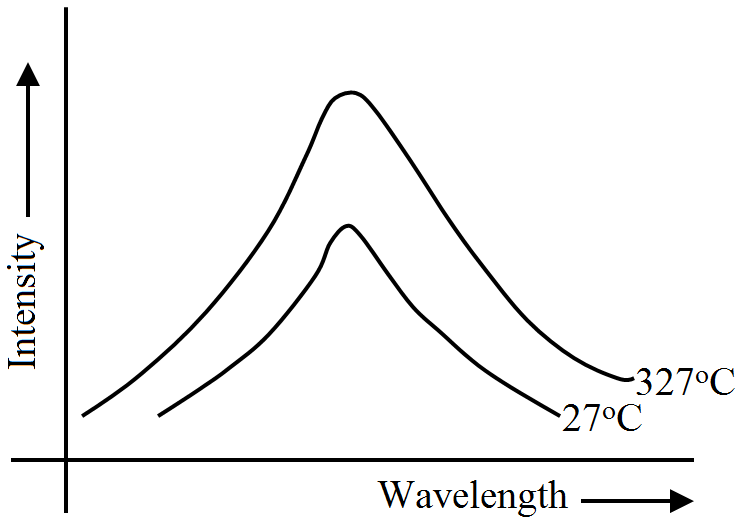
AnswerAccording to Stefan's Law, Area $=\frac{1}{T^4}$
$\therefore\frac{A_1}{A_2}=\frac{T_2^4}{T^4_1}$
$\Rightarrow\frac{A_2}{A_1}=\frac{T^4_1}{T^4_2}$
$\frac{A_2}{A_1}=\Big(\frac{327+273}{27+273}\Big)^4$
$\Rightarrow\frac{A_2}{A_1}=\Big(\frac{600}{300}\Big)^4$
$\Rightarrow\frac{A_2}{A_1}=(2)^4$
$\therefore\frac{A_2}{A_1}=\frac{16}{1}$
$\therefore$ Ratio is $16 : 1$.
View full question & answer→