Question 512 Marks
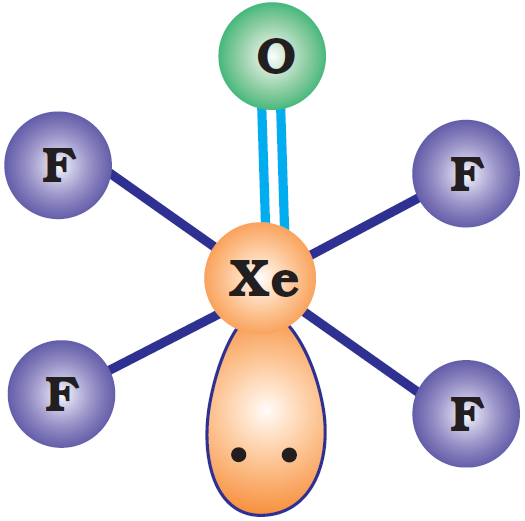
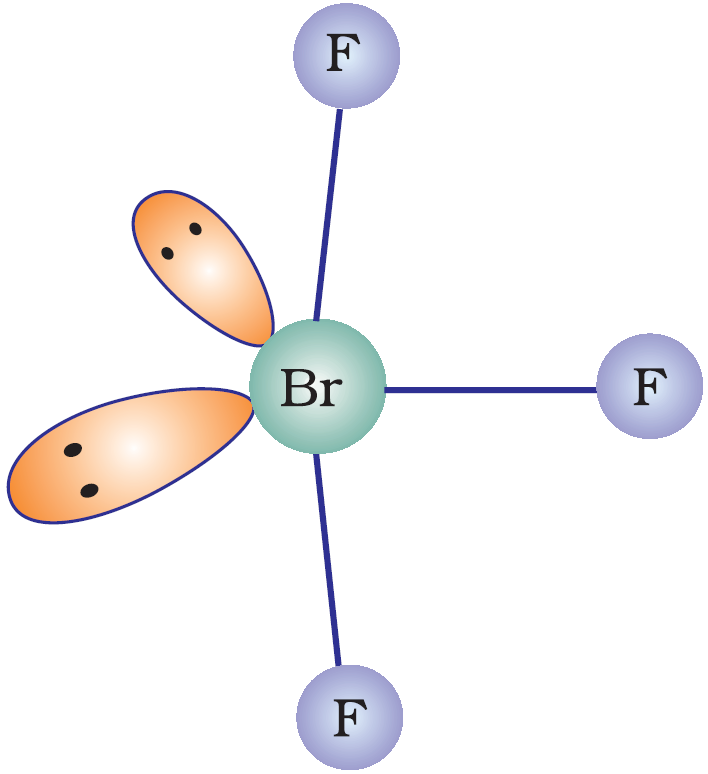
Draw the shape of the following molecules:
- $XeOF_4.$
- $BrF_3.$
View full question & answer→Question 522 Marks
Arrange the following in order of property indicated for each set:
- $H_2O,\ H_2S,\ H_2Se,\ H_2Te$ -Increasing acidic character.
- $HF,\ HCl,\ HBr,\ HI $-Decreasing bond enthalpy.
Answer
- The increasing order of acidic character is $H_2O < H_2S < H_2Se < H_2Te < h < h$
- The decreasing order of bond enthalpy is $HF > HCl > HBr > HI$
View full question & answer→Question 532 Marks
Write balanced chemical equations for the following processes:
- $XeF_2$ undergoes hydrolysis.
- $MnO_2$ is heated with conc. $HCl.$
Answer
- $2\text{XeF}_2(\text{s})\ +\ 2\text{H}_2\text{O}(\text{l})\xrightarrow{\ \ \ \ \ \ \ \ \ \ }2\text{Xe(g)}\ +\ 4\text{HF(aq)}\ +\ \text{O}_2(\text{g})$
- $4\text{HCl}\ +\ \text{MnO}_2\xrightarrow{\ \ \ \ \ \ \ \ \ \ }\text{Cl}_2+\text{MnCl}_2\ +\ 2\text{H}_2\text{O}$
View full question & answer→Question 542 Marks
Give reason for the following:
Noble gases form compounds with fluorine and oxygen only.
AnswerFluorine and oxygen are the most electronegative elements and hence are very reactive. So, they form compounds with noble gases, particularly xenon.
View full question & answer→Question 552 Marks
Out of $H_2O$ and $H_2S,$ which one has higher bond angle and why?
AnswerBond angle of $H_2O$ is larger, because oxygen is more electronegative than sulphur therefore bond pair electron of $O–H$ bond will be closer to oxygen and there will be more bond-pair bond -pair repulsion between bond pairs of two $O–H$ bonds.
View full question & answer→Question 562 Marks
Account for the following:
$PF_5$ is known but $NF_5$ is not known.
AnswerP has vacant 3d-orbitals in its valence shell while N does not have. As a result, P can form additional bonds to give $PF_5$ while N cannot extend its covalency beyond three and hence it forms only $NF_3$ but not $NF_5.$
View full question & answer→Question 572 Marks
Give reason for the following:
$NCl_3$ gets readily hydrolysed while $NF_3$ does not.
AnswerIn $NCl_3,$ Cl has vacant d-orbitals to accept the lone pair of electrons donated by O-atom of $H_2O$ molecule but in $NF_3,\ F$ does not have d-orbitals.
$NCl_3 + 3H_2O → NH_3 + 3HOCl$
$NF_3 + H_2O →$ No reaction
View full question & answer→MCQ 582 Marks
Note: In the following questions a statement of assertion followed by a statement of reason is given. Choose the correct answer out of the following choices.
Assertion: $N_2$ is less reactive than $P_4.$
Reason: Nitrogen has more electron gain enthalpy than phosphorus.
- A
Both assertion and reason are correct statements, and reason is the correct explanation of the assertion.
- B
Both assertion and reason are correct statements, but reason is not the correct explanation of the assertion.
- ✓
Assertion is correct, but reason is wrong statement.
- D
Assertion is wrong but reason is correct statement.
AnswerCorrect option: C. Assertion is correct, but reason is wrong statement.
$N_2$ is less reactive than $P_4$ molecule this is so, because nitrogen has very high bond dissociation enthalpy because of triple bond between two nitrogen atom which is not the case with phosphorus.
View full question & answer→Question 592 Marks
Account for the following:
Both $NO$ and $ClO_2$ are odd electron species but $NO$ dimerises while $ClO_2$ does not.
AnswerIn $NO,$ the odd electron on $N$ is attracted by only one $O-$atom but in $ClO_2,$ the odd electron on $Cl$ is attracted by two $O-$atoms. Thus, the odd electron on $N$ in $NO$ is localised while the odd electron on $Cl$ in $ClO_2$ is delocalised. Consequently, $NO$ has a tendency to dimerise but $ClO_2$ does not.
View full question & answer→Question 602 Marks
Sea is the greatest source of some halogens. Comment.
AnswerSea water contains chlorides, bromides, and iodides of $Na,\ K,\ Mg,$ and $Ca$.
However, it primarily contains $NaCl.$ The deposits of dried up sea beds contain sodium chloride and carnallite, $KCl.MgCl_2.6H_2O.$
Marine life also contains iodine in their systems.
For example, sea weeds contain upto $0.5%$ iodine as sodium iodide. Thus, sea is the greatest source of halogens.
View full question & answer→Question 612 Marks
Account for the following:
Bismuth is a strong oxidising agent in the pentavalent state.
AnswerAs the inert pair effect is very prominent in Bi, its $+5$ oxidation state is less stable than its $+3$ oxidation state. In other words, bismuth in the pentavalent state can easily accept two electrons and thus gets reduced to trivalent bismuth.
$Bi^{5+} + 2e^- → Bi^{3+}$
Thus, it acts as a strong oxidising agent.
View full question & answer→Question 622 Marks
Answer the following question:
Why is $\text{K}_{\text{a}_2}<<\text{K}_{\text{a}_1}$ for $\text{H}_2\text{SO}_4$ in water?
Answer$\text{K}_{\text{a}_2}<<\text{K}_{\text{a}_1},$ because $\text{HSO}_{4}-$ ion has much less tendency to donate a proton to $H_2O$ as compared to $H_2SO_4.$
View full question & answer→Question 632 Marks
Give reason for the following:
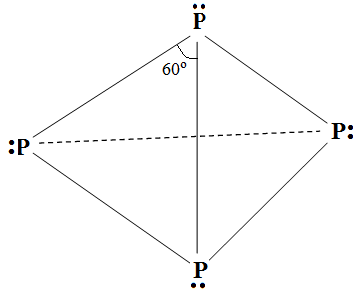
Elemental nitrogen exists as a diatomic molecule whereas elemental phosphorus is a tetraatomic molecule.
AnswerNitrogen because of its small size and high electronegativity forms $\text{p}\pi-\text{p}\pi$ multiple bonds. Thus, it exists as a diatomic molecule having a triple bond between the two $N-$atoms. Phosphorus due to its larger size and lower electronegativity usually does not form $\text{p}\pi-\text{p}\pi$ multiple bonds with itself. Instead it prefers to form $P-P$ single bonds and hence it exists as tetrahedral $P_4$ molecules.
View full question & answer→Question 642 Marks
Why is helium used in diving apparatus?
AnswerAir contains a large amount of nitrogen and the solubility of gases in liquids increases with increase in pressure. When sea divers dive deep into the sea, large amount of nitrogen dissolves in their blood. When they come back to the surface, solubility of nitrogen decreases and it separates from the blood and forms small air bubbles. This leads to a dangerous medical condition called bends. Therefore, air in oxygen cylinders used for diving is diluted with helium gas. This is done as He is sparingly less soluble in blood.
View full question & answer→Question 652 Marks
Why do noble gases have comparatively large atomic sizes?
AnswerNoble gas are stable so they cannot form molecules In case noble gas from molecule the force of attraction that acting is vander waal force.
On other hand, other element form covalent bond and it is well known that vander waal radii is larger than covalent radii. Thus noble gases have comparatively large atomic sizes.
View full question & answer→Question 662 Marks
How is the presence of $SO_2$ detected?
Answer$SO_2$ is a colourless and pungent smelling gas. It can be detected with the help of potassium permanganate solution. When $SO_2$ is passed through an acidified potassium permanganate solution, it decolonizes the solution as it reduces. $\text{MnO}^-_4 \ \text{ions to} \text{Mn}^{2+} \ \text{ions}$$5\text{SO}_2+2\text{MnO}_4^-+2\text{H}_2\text{O}\rightarrow5\text{SO}^{2-}_4+4\text{H}^++2\text{Mn}^{2+}$
View full question & answer→Question 672 Marks
Account for the following:
Sulphur exhibits greater tendency for catenation than selenium.
AnswerAs we move from S to Se, the atomic size increases and hence the strength of E-E bond decreases. Thus, S-S bond is much stronger than Se-Se bond. Consequently, S shows greater tendency for catenation than selenium.
View full question & answer→Question 682 Marks
Give the resonating structures of $NO_2$ and $N_2O_5.$
View full question & answer→Question 692 Marks
Assign a reason for the following:
Sulphur hexafluoride is used as a gaseous electrical insulator.
Answer$SF_6$ is a colourless, odourless and non-toxic gas at room temperature. It is thermally stable and chemically inert. Because of its inertness and high tendency to suppress internal discharges, it is used as a gaseous electrical insulator in high voltage generators and switch gears.
View full question & answer→Question 702 Marks
Give two examples to show the anomalous behaviour of fluorine.
Answer
- Oxidation state: Fluorine shows oxidation state of – 1 only. It does not show any positive oxidation state. Other halogens show oxidation states such as +1, +3, +5, +7 also.
- Extra-ordinary reactivity: Fluorine is extraordinary most reactive element. This is due to F—F bond energy is very low as compared to that of other halogen molecules.
View full question & answer→Question 712 Marks
Phosphorus forms a number of oxoacids. Out of these oxoacids phosphinic acid has strong reducing property. Write its structure and also write a reaction showing its reducing behaviour.
AnswerPhosphinic acid is hypophosphorus acid $(H_3PO_2)$ which acts as a reducing agent due to possession of P – H bonds.
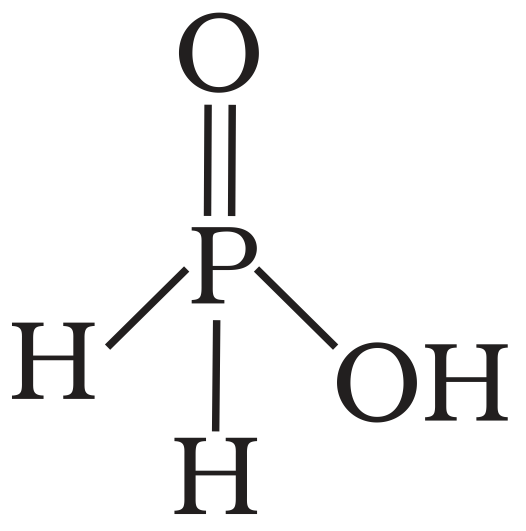
Its reducing properties are:
$4\text{AgNO}_3+\text{H}_3\text{PO}_2+2\text{H}_2\text{O}\xrightarrow{\ \ \ \ \ \ \ \ \ \ }4\text{Ag}+\text{H}_3\text{PO}_4+4\text{HNO}_3$
$2\text{HgCl}_2+\text{H}_3\text{PO}_2+2\text{H}_2\text{O}\xrightarrow{\ \ \ \ \ \ \ \ \ \ }2\text{Hg}+\text{H}_3\text{PO}_4+4\text{HCl}$
$\text{H}_3\text{PO}_2+2\text{H}_2\text{O}+2\text{Cl}_2\xrightarrow{\ \ \ \ \ \ \ \ \ \ }\text{H}_3\text{PO}_4+4\text{HCl}$ View full question & answer→Question 722 Marks
Give reason for the following:
ICl is more reactive than $I_2.$
AnswerICl is more reactive than $I_2$ because I-Cl bond is weaker than I-I bond. Consequently, ICl breaks easily to form halogen atoms which readily bring about the reactions.
View full question & answer→MCQ 732 Marks
Note: In the following questions a statement of assertion followed by a statement of reason is given. Choose the correct answer out of the following choices.
Assertion: $HI$ cannot be prepared by the reaction of $KI$ with concentrated $\ce{H_2SO_4}$
Reason: $HI$ has lowest $H-X$ bond strength among halogen acids.
- A
Both assertion and reason are correct statements, and reason is the correct explanation of the assertion.
- ✓
Both assertion and reason are correct statements, but reason is not the correct explanation of the assertion.
- C
Assertion is correct, but reason is wrong statement.
- D
Assertion is wrong but reason is correct statement.
AnswerCorrect option: B. Both assertion and reason are correct statements, but reason is not the correct explanation of the assertion.
$HI$ cannot be prepared by the reaction of $KI$ with concentrated $\ce{H_2SO_4}$ because HI formed is converted to $I_2.$
View full question & answer→Question 742 Marks
Mention three areas in which $H_2SO_4$ plays an important role.
Answer
-
It is used in the manufacture of fertilizers such as $(NH_4)^2$ $SO_4 $, calcium superphosphate.
-
It is used as an electrolyte in storage batteries.
-
It is used in petroleum refining, detergent industry and in the manufacture of paints, pigments and dyes.
View full question & answer→MCQ 752 Marks
Note: In the following questions a statement of assertion followed by a statement of reason is given. Choose the correct answer out of the following choices.
Assertion: $SF_6$ cannot be hydrolysed but $SF_4$ can be.
Reason: Six $F$ atoms in $SF_6$ prevent the attack of $H_2O$ on sulphur atom of $SF_6.$
- ✓
Both assertion and reason are correct statements, and reason is the correct explanation of the assertion.
- B
Both assertion and reason are correct statements, but reason is not the correct explanation of the assertion.
- C
Assertion is correct, but reason is wrong statement.
- D
Assertion is wrong but reason is correct statement.
AnswerCorrect option: A. Both assertion and reason are correct statements, and reason is the correct explanation of the assertion.
$SF_6$ is sterically protected due to presence of six $F$ atoms around $S$ which prevents the attack of $H_2O$ on $SF_6.$
View full question & answer→Question 762 Marks
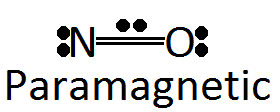
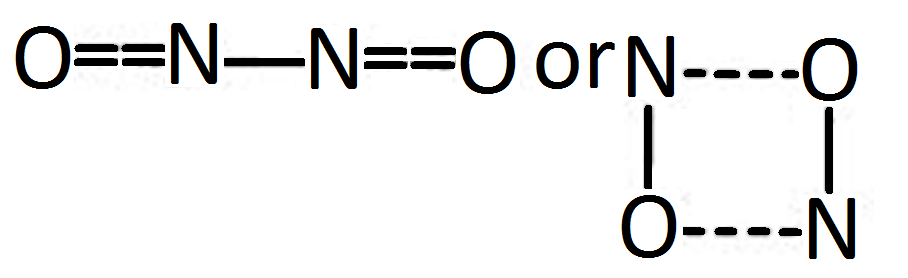
Why is nitric oxide paramagnetic in gaseous state but the solid obtained on cooling it is diamagnetic?
Answer
Nitric oxide (NO) in the gaseous state is monomer having one unpaired electron as it is paramagnetic in nature.
However, in solid state it forms a dimer, $N_2O_2$ which is diamagnetic in nature.
View full question & answer→Question 772 Marks
Answer the following question: Complete the following chemical equations.
- $\text{NH}_4\text{Cl(aq)}+\text{NaNO}_2\text{(aq)}\rightarrow$
- $\text{P}_4+3\text{NaOH}+3\text{H}_2\text{O}\rightarrow$
Answer
- $\text{NH}_4\text{Cl(aq)}+\text{NaNO}_2\text{(aq)}\rightarrow\text{N}_2\text{(g)}+2\text{H}_2\text{O(l)}+\text{NaCl(aq)}$
- $\text{P}_4+3\text{NaOH}+3\text{H}_2\text{O}\ \ \xrightarrow{\ \ \ \ \ }\ \ \ \ \text{PH}_3\ \ +\ \ 3\text{NaH}_2\text{PO}_2\\ \ \ \ \ \ \ \ \ \ \ \ \ \ \ \ \ \ \ \ \ \ \ \ \ \ \ \ \ \ \ \ \ \ \ \ \ \ \ \ \ \ \ \ \ \ \ \ \ \ ^\text{Phosphine}$
View full question & answer→Question 782 Marks
Assign appropriate reasons for the following statement:
Perchloric acid is a stronger acid than sulphuric acid.
AnswerThe oxidation state of Cl in perchloric acid is +7 while that of S in sulphuric acid is +6. Greater the oxidation state of central atom, more readily the O-H bond breaks and hence stronger is the acid.
View full question & answer→Question 792 Marks
Explain the following:
$SF_6$ is inert towards hydrolysis.
AnswerIn $SF_6,$ S atom is sterically protected by six F atoms and does not allow water molecules to attack the S atom. Further, F does not have d-orbitals to accept the electrons donated by $H_2O$ molecules. Due to these reasons, $SF_6$ is kinetically an inert substance.
View full question & answer→Question 802 Marks
Give reason for the following:
Among the hydrides of Group $16$, water shows unusual physical properties.
AnswerBecause of high electronegativity of $O,$ the $O-H$ in $H_2O$ forms strong intermolecular H-bonds. Thus, water exists as an associated molecule while other hydrides of Group 16 do not form H-bonds and hence exist as discrete molecules. Hence, water shows unusual physical properties, i.e., high boiling point, high thermal stability and weaker acidic character as compared to other hydrides of Group $16.$
View full question & answer→Question 812 Marks
Answer the following question:
Write balanced chemical equations for the following:
- Complete hydrolysis of $XeF_6.$
- Disproportionation reaction of orthophosphorus acid.
Answer
- $\text{XeF}_6+3\text{H}_2\text{O}\rightarrow\text{XeO}_3+6\text{HF}$
- $4\text{H}_3\text{PO}_3\xrightarrow{\ \ \triangle\ \ }3\text{H}_3\text{PO}_45+\text{PH}_3$
View full question & answer→Question 822 Marks
The HNH angle value is higher than HPH, HAsH and HSbH angles. Why? [Hint: Can be explained on the basis of $sp_3$ hybridisation in NH3 and only s–p bonding between hydrogen and other elements of the group].
View full question & answer→Question 832 Marks
Account for the following observation:
Among the halogens, $F_2$ is the strongest oxidising agent.
AnswerThis is due to the:
- Low enthalpy of dissociation of $F-F$ bond.
- High hydration enthalpy of $F^-.$
View full question & answer→Question 842 Marks
Write main differences between the properties of white phosphorus and red phosphorus.
Answer
| White phosphorus |
Red phosphorus |
|
It is a soft and waxy solid.
It possesses a garlic smell
|
It is a hard and crystalline solid, without any smell.
|
|
It is poisonous.
|
It is non-poisonous.
|
|
It is insoluble in water but soluble in carbon
disulphide.
|
It is insoluble in both water and carbon disulphide.
|
|
It undergoes spontaneous
combustion in air.
|
It is relatively less reactive.
|
|
In both solid and vapour
states, it exists as a $P_4$
molecule.
|
It exists as a chain of tetrahedral $P_4$ units. 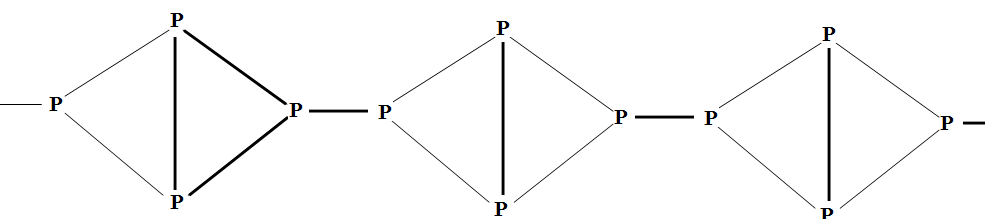 |
View full question & answer→Question 852 Marks
Which aerosols deplete ozone?
AnswerFreons or chlorofluorocarbons (CFCs) are aerosols that accelerate the depletion of ozone. In the presence of ultraviolet radiations, molecules of CFCs break down to form chlorine-free radicals that combine with ozone to form oxygen.
View full question & answer→Question 862 Marks
Answer the following question:
Why is HF acid stored in wax coated glass bottles?
AnswerHF does not attack wax but reacts with glass. It dissolves $SiO_2$ present in glass forming hydrofluorosilicic acid.
$SiO_2 + 6HF → H_2SiF_6 + 2H_2O$
View full question & answer→Question 872 Marks
Why is $K_{a2} << K_{a1}$ for $H_2SO_4$ in water?
Answer$\text{H}_2\text{SO}_{4(\text{aq})}+\text{H}_2\text{O}_{(\text{I})}\rightarrow\text{H}_3\text{O}^+_{(\text{aq})}+\text{HSO}_{4(\text{aq})}^-; \ \text{K}_{\text{a}_1}>10$$\text{H}\text{SO}_{4(\text{aq})}+\text{H}_2\text{O}_{(\text{I})}\rightarrow\text{H}_3\text{O}^+_{(\text{aq})}+\text{SO}_{4(\text{aq})}^-; \ \text{K}_{\text{a}_2}=1.2\times10^{-2}$
It can be noticed that $\text{K}_{\text{a}_1}>>\text{K}_{\text{a}_2}$ This is because a neutral $H_2SO_4$ has a much higher tendency to lose a proton than the negatively charged . Thus, the former is a much stronger acid than the latter.
View full question & answer→Question 882 Marks
Account for the following:
Chlorine water has both oxidising and bleaching properties.
AnswerChlorine water produces nascent oxygen which is responsible for bleaching action and oxidation.
$Cl_2 + H_2O → 2HCl + [O]$
View full question & answer→Question 892 Marks
Sulphur dioxide is passed into aqueous solution of $Fe\ (III)$ salt?
Answer$SO_2$ acts as a reducing agent and hence reduces an aqueous solutuin of $Fe\ (III)$ salt to $Fe\ (II)$ salt.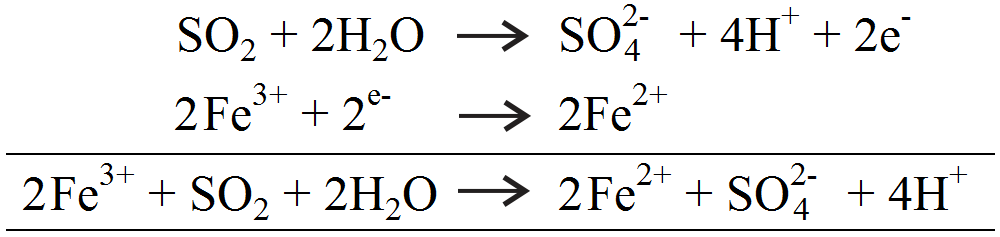
View full question & answer→Question 902 Marks
How can you prepare $Cl_2$ from $HCl$ and $HCl$ from $Cl_2?$ Write reactions only.
Answer$\text{MnO}_2+4\text{HCl}\rightarrow\text{MnCl}_2+\text{Cl}_2+2\text{H}_2\text{O}\\\text{Oxidising}\\\text{agent}$We can also used $KMnO_4, K_2Cr_2O_7,$ etc., in place of $MnO_2.$
$\text{H}_2+\text{Cl}_2\xrightarrow[]{\text{Diffiused sunlight}}2\text{HCl}$
View full question & answer→Question 912 Marks
Draw the structure of the following: $HOClO_2$
View full question & answer→Question 922 Marks
Draw the structure of the following: $XeO_3$
View full question & answer→Question 932 Marks
Assign appropriate reasons for the following statement:
Metal fluorides are more ionic in nature than metal chlorides.
AnswerAccording to Fajan’s rule, a bigger anion is more easily polarised than a smaller anion. As a result, same metal cation can polarise a bigger $Cl^-$ ion more easily than the smaller $F^-$ ion. In other words, for the same metal, the metal fluoride is more ionic than metal chloride. So, in general, we can easily say that metal fluorides are more ionic than metal chlorides.
View full question & answer→Question 942 Marks
Mention the conditions required to maximise the yield of ammonia.
AnswerAmmonia is prepared using the Haber’s process. The yield of ammonia can be maximized under the following conditions:
- High pressure $(200\ atm).$
- A temperature of $700\ K.$
- Use of a catalyst such as iron oxide mixed with small amounts of $K_2O$ and $Al_2O_3.$
View full question & answer→Question 952 Marks
Explain the following:
$PCl_5$ is ionic in nature in the solid state.
AnswerThis is because in solid state $PCl_5$ exists as $[PCl_4]^+\ [PCl_6]^-$ in which cation is tetrahedral and the anion is octahedral. On melting, these ions become free to move and hence it conducts electricity.
View full question & answer→Question 962 Marks
Give reason for the following:
Neon is generally used for warning signals.
AnswerNeon lights are visible from long distances even in fog and mist and hence neon is generally used for warning signals.
View full question & answer→Question 972 Marks
Nitrogen exists as diatomic molecule and phosphorus as $P_4$. Why?
AnswerNitrogen owing to its small size has a tendency to form $\text{p}\pi-\text{p}\pi$ multiple bonds with itself.
Nitrogen thus forms a very stable diatomic molecule,$N_2$ On moving down a group, the tendency to form $\text{p}\pi-\text{p}\pi$ bonds decreases (because of the large size of heavier elements).
Therefore, phosphorus (like other heavier metals) exists in the $P_4$ state.
View full question & answer→Question 982 Marks
Explain why ozone is thermodynamically less stable than oxygen.
AnswerOzone is thermodynamically unstable with respect to oxygen since its decomposition into oxygen results in the liberation of heat ($\Delta\text{H}$ is negative) and an increase in entropy ($\Delta\text{S}$ is positive). These two effects reinforce each other, resulting in large negative Gibbs energy change ($\Delta\text{G}$) for its conversion into oxygen.
View full question & answer→Question 992 Marks
How is ammonia manufactured industrially?
AnswerAmmonia is manufactured industrially by Haber's process.$\text{N}_2(\text{g})+3\text{H}_2(\text{g})\rightleftharpoons2\text{NH}_3(\text{g}) \ \Delta_\text{f}\text{H}^\circ=-46.1\text{KJ mol}^{-1}$
A mixture of dry nitrogen and hydrogen gases in the ratio of $1:3$ by volume is compressed to about $200$ to $300$ atm and passed over iron catalyst at a temperature of about $723$ k to $773$ k. The iron catalyst is mixed with aluminiumoxide $(Al_2O_3)$ and potassium oxide $(K_2O)$ which act as promoters. Ammonia being formed is continuously removed by liquefying it. The optimum conditions for the production of ammonia are a pressure of about $200$ atm, a temperature of $\sim 700$ k and use of a catalyst such as iron oxide with small amounts of $K_2O$ and $Al_2,\ O_3$ to increase the rate of attainment of equilibrium.
View full question & answer→Question 1002 Marks
How are $XeO_3$ and $XeOF_4$ prepared?
AnswerPreparation of $XeO_3$: It is prepared by the hydrolysis of $XeF_4$ and $XeF_6$ under controlled pH of medium.$6\text{XeF}_4+12\text{H}_2\text{O}\rightarrow4\text{Xe}^-+2\text{XeO}_3+24\text{HF}+3\text{O}_2$
$\text{XeF}_4+3\text{H}_2\text{O}\rightarrow\text{XeO}_3+6\text{HF}$
Preparation of $XeOF_4$ Partial hydrolysis of $XeF_6$ gives $XeOF_4.\text{XeF}_6+\text{H}_2\text{O}\rightarrow\text{XeO}_4+2\text{HF}$
View full question & answer→