Question 15 Marks
A monoenergetic (18 keV) electron beam initially in the horizontal direction is subjected to a horizontal magnetic field of 0.04 G normal to the initial direction. Estimate the up or down deflection of the beam over a distance of 30 cm $(m_e = 9.11 \times 10^{–19} C).$
[Note: Data in this exercise are so chosen that the answer will give you an idea of the effect of earth’s magnetic field on the motion of the electron beam from the electron gun to the screen in a TV set.]
[Note: Data in this exercise are so chosen that the answer will give you an idea of the effect of earth’s magnetic field on the motion of the electron beam from the electron gun to the screen in a TV set.]
Answer
View full question & answer→Energy of an electron beam, $E = 18 keV = 18 \times 10^3 eV$
Charge on an electron, $e = 1.6 \times 10^{−19}C$
$E = 18 \times 10^3 \times 1.6 \times 10^{−19} J$
Magnetic field, $B = 0.04 G$
Mass of an electron, $m_e = 9.1 \times 10^{−31} kg$
Distance up to which the electron beam travels, $d = 30 cm = 0.3 m$
We can write the kinetic energy of the electron beam as:
$\text{E}=\frac{1}{2}\text{mv}^2$
$\text{v}=\sqrt{\frac{2\text{E}}{\text{m}}}$
$\text{v}=\sqrt{\frac{2\times18\times10^3\times1.6\times10^{-19}}{9.1\times10^{-31}}}=0.795\times10^{8}\text{m}/\text{s}$
The electron beam deflects along a circular path of radius, r.
The force due to the magnetic field balances the centripetal force of the path.
$\text{B}_e\text{V}=\frac{\text{mv}^2}{\text{r}}$
$\therefore\ \text{r}=\frac{\text{mv}}{\text{Be}}$
$=\frac{9.1\times10^{-31}\times0.795\times10^8}{0.4\times10^{-4}\times1.6\times10^{-19}}=11.3\text{ m}$
Let the up and down deflection of the electron beam be $\text{x}=\text{r}(1-\cos\theta)$
Where, $\theta$ = Angle of declination.
$\sin\theta=\frac{\text{d}}{\text{r}}$
$=\frac{0.3}{11.3}$
$\theta=\sin^{-1}\frac{0.3}{11.3}=1.521^\circ$
And $\text{x}=11.3(1-\cos1.521^\circ)$
$=0.0039\text{ m}=3.9\text{ mm}$
Therefore, the up and down deflection of the beam is 3.9 mm.
Charge on an electron, $e = 1.6 \times 10^{−19}C$
$E = 18 \times 10^3 \times 1.6 \times 10^{−19} J$
Magnetic field, $B = 0.04 G$
Mass of an electron, $m_e = 9.1 \times 10^{−31} kg$
Distance up to which the electron beam travels, $d = 30 cm = 0.3 m$
We can write the kinetic energy of the electron beam as:
$\text{E}=\frac{1}{2}\text{mv}^2$
$\text{v}=\sqrt{\frac{2\text{E}}{\text{m}}}$
$\text{v}=\sqrt{\frac{2\times18\times10^3\times1.6\times10^{-19}}{9.1\times10^{-31}}}=0.795\times10^{8}\text{m}/\text{s}$
The electron beam deflects along a circular path of radius, r.
The force due to the magnetic field balances the centripetal force of the path.
$\text{B}_e\text{V}=\frac{\text{mv}^2}{\text{r}}$
$\therefore\ \text{r}=\frac{\text{mv}}{\text{Be}}$
$=\frac{9.1\times10^{-31}\times0.795\times10^8}{0.4\times10^{-4}\times1.6\times10^{-19}}=11.3\text{ m}$
Let the up and down deflection of the electron beam be $\text{x}=\text{r}(1-\cos\theta)$
Where, $\theta$ = Angle of declination.
$\sin\theta=\frac{\text{d}}{\text{r}}$
$=\frac{0.3}{11.3}$
$\theta=\sin^{-1}\frac{0.3}{11.3}=1.521^\circ$
And $\text{x}=11.3(1-\cos1.521^\circ)$
$=0.0039\text{ m}=3.9\text{ mm}$
Therefore, the up and down deflection of the beam is 3.9 mm.
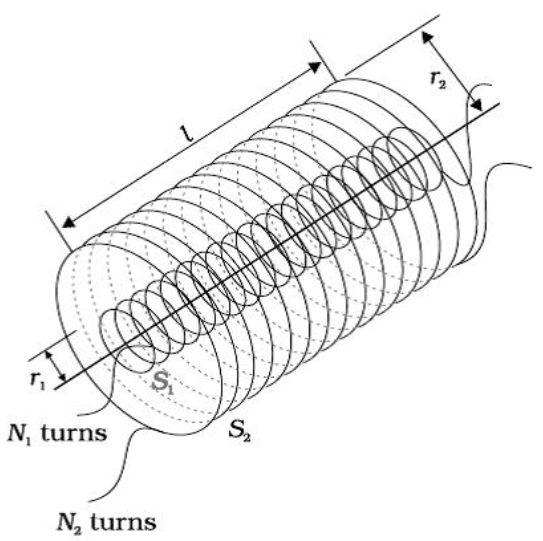
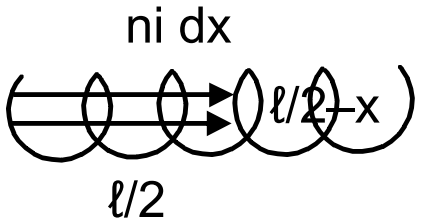 Current at ‘0’ due to the circular loop $=\text{dB}=\frac{\mu_0}{4\pi}\times\frac{\text{a}^2\text{in}\ \text{dx}}{\Big[\text{a}^29+\Big(\frac{1}{2}-\text{x}\Big)^2\Big]^\frac{3}{2}}$