Question 12 Marks
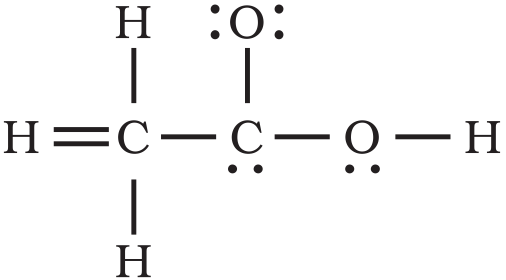
The skeletal structure of CH3COOH as shown below is correct, but some of the bonds are shown incorrectly.Write the correct Lewis structure for acetic acid.
Answer
In the given figure, hydrogen has valency of two, which is not possible and also octet of oxygen is not complete. So, the correct structure is:
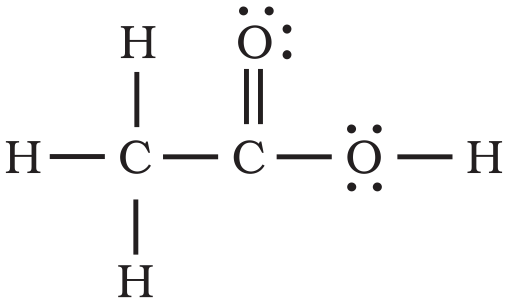
View full question & answer→Question 22 Marks
Write Lewis symbols for the following atoms and ions: $H$ and $H^{-}$
Answer$H$ and $H^{-}$
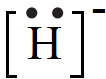
The number of valence electrons in hydrogen is $1$:
The Lewis dot symbol of hydrogen ($H$) is:

The uninegative charge infers that there will be one electron more in addition to the one valence electron. Hence, the Lewis dot symbol is.
View full question & answer→Question 32 Marks
Write Lewis symbols for the following atoms and ions: $S$ and $S^{2-}$.
Answer$S$ and $S^{2-}$
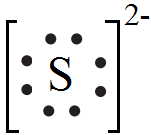
The number of valence electrons in sulphur is $6$.
The Lewis dot symbol of sulphur ($S$) is:

The Lewis dot symbol of sulphur ($S$) is
View full question & answer→Question 42 Marks
$\mathrm{H}_3 \mathrm{PO}_3$ can be represented by structures 1 and 2 shown below. Can these two structures be taken as the canonical forms of the resonance hybrid representing $\mathrm{H}_3 \mathrm{PO}_3$? If not, give reasons for the same.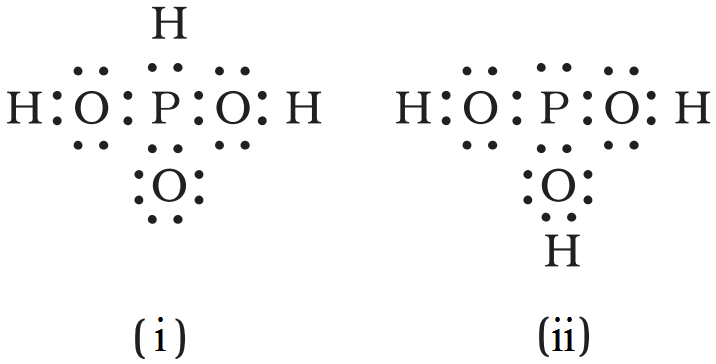
AnswerThese two cannot be called as canonical forms as relative position of hydrogen is changed. In resonance, canonical forms should differ only in the position of electrons and not in the position of atoms.
View full question & answer→Question 52 Marks
Write Lewis symbols for the following atoms and ions: Al and $\text{Al}^{3+}$
AnswerAl and $\text{Al}^{3+}$
The number of valence electrons in aluminium is 3.
The Lewis dot symbol of aluminium (Al) is:

The tripositive charge on a species infers that it has donated its three electrons. Hence, the Lewis dot symbol is. $[\text{Al}]^{3+}$ View full question & answer→Question 62 Marks
How do you express the bond strength in terms of bond order?
AnswerThe extent of bonding which occurs between two atoms while forming a molecule is represented by bond strength. As the bond strength increases the bond becomes stronger and the bond order increases.
View full question & answer→Question 72 Marks
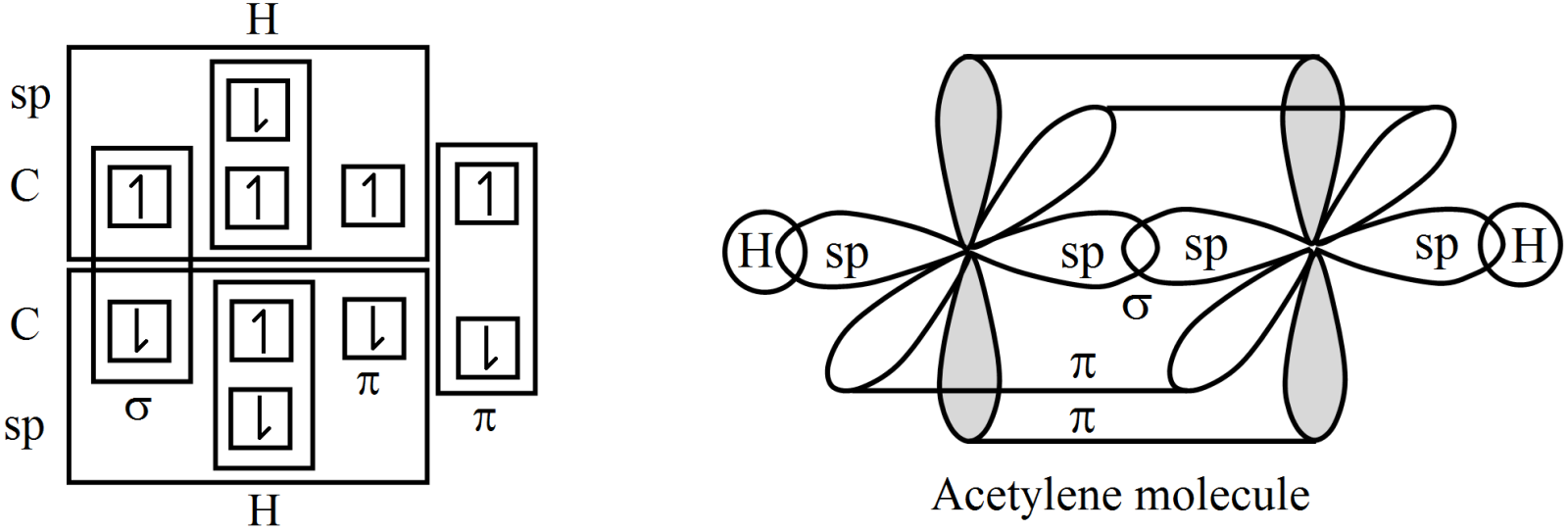
Define hybridisation. Explain the structure of $\mathrm{C}_2 \mathrm{H}_2$ with orbital diagram.
Answer
Hybridisation is process of intermixing of atomic orbitals of slightly different energies which give rise to hybridised orbitals having exactly equal energy, identical shape and more stability.
In $\text{H}-\text{C}\equiv\text{C}-\text{H}$ each 'C' is 'sp' hybridised, therefore, it has linear shape.
View full question & answer→Question 82 Marks
All the $\mathrm{C}-\mathrm{O}$ bonds in carbonate ion $\left(\mathrm{CO}^{2-}{ }_3\right)$ are equal in length. Explain.
Answer
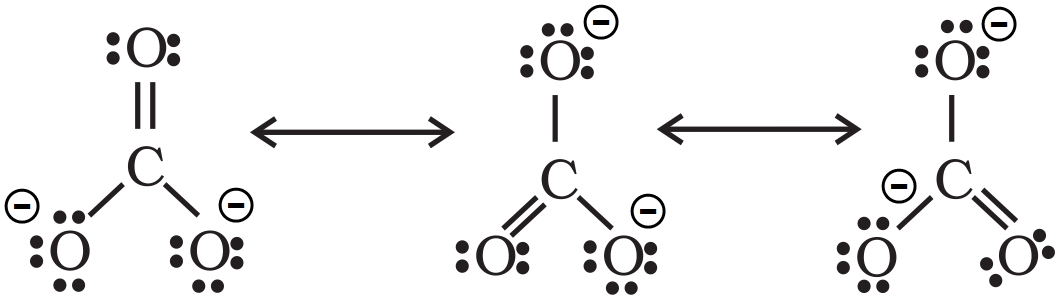
Carbonate ion is represented by resonating structures as given below:
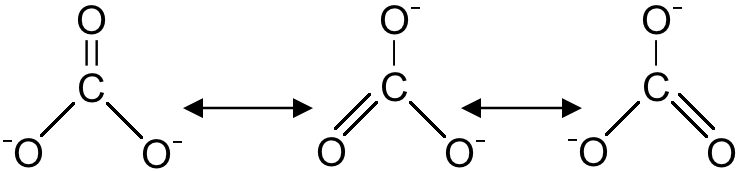
Actual structure will be the mixture of all resonating structures, also called resonance hybrid structure.
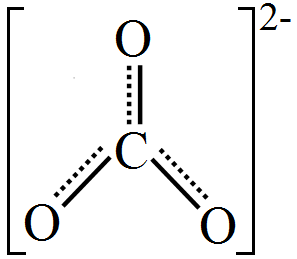
View full question & answer→Question 92 Marks
Which of the species have similar shape and why?
$\text{NO}^-_2, \text{NO}^+_2, \text{CO}_2, \text{O}_3$
Answer$\text{NO}^-_2$ and $\mathrm{CO}_2$ are sp hybridised, therefore, they have linear shape.
$\text{O}=\stackrel{{\ \ \ +}}{\hbox{N}}=\text{O},\ \text{O}=\text{C}=\text{O}\\\ \ \ \ \ \ \text{Linear}\ \ \ \ \ \ \ \ \ \text{Linear}$
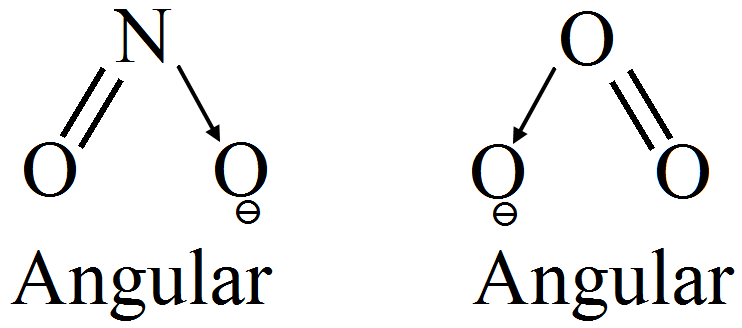
$\text{NO}^-_2$ and $\mathrm{O}_3$ are $\mathrm{sp}^2$ hybridised. Both have lone pair of electrons but in former case it is not donated but in later case it is donated. Thus, their shape is angular.
View full question & answer→Question 102 Marks
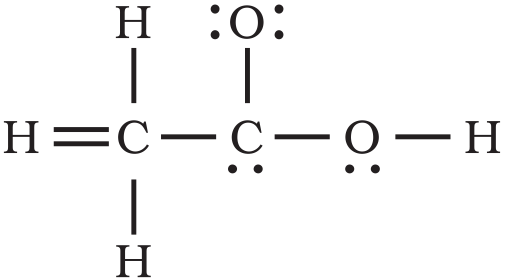
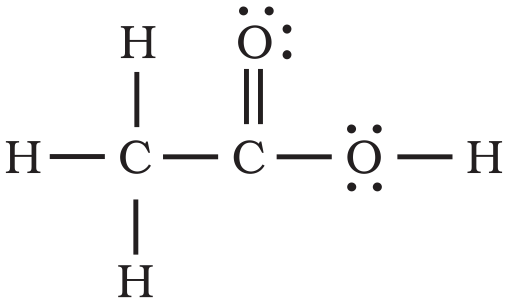
The skeletal structure of CH3COOH as shown below is correct, but some of the bonds are shown incorrectly.Write the correct Lewis structure for acetic acid.
Answer
In the given figure, hydrogen has valency of two, which is not possible and also octet of oxygen is not complete. So, the correct structure is:
View full question & answer→Question 112 Marks
- CO is isoelectronic with which of the following compounds:
$\text{NO}^+,\text{N}_2,\text{SnCl}_2,\text{NO}^-_2$
- Which of the following species have the same shape?
$\text{CO}_2\text{CCl}_4,\text{O}_3,\text{NO}^-_2$Answeri. CO is isoelectronic with (i) $\mathrm{NO}^{+}$and (ii) $\mathrm{N}_2$.
ii. $\mathrm{O}_3$ and $\mathrm{NO}_2^{-}$, have same shape, i.e. bent molecule or angular molecule.
View full question & answer→Question 122 Marks
$\mathrm{AIF}_3$ is a high melting solid whereas $\mathrm{SiF}_4$ is a gas. Explain.
Answer$\mathrm{AIF}_3$ is an ionic compound and there is strong force of attraction between $\mathrm{Al}^{3+}$ and $\mathrm{F}^{-}$ions. Whereas $\mathrm{SiF}_4$ is a covalent compound formed by sharing of electrons.
View full question & answer→Question 132 Marks
Give electron dot structure for carbon suboxide, $\mathrm{C}_3 \mathrm{O}_2$. Write its structural formula.
Answer$\text{O}=\text{C}=\text{C}=\text{C}=\text{O}$
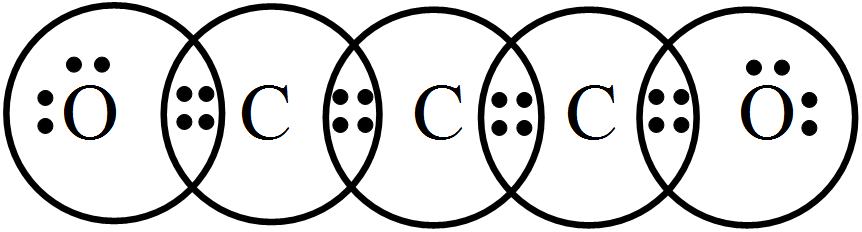
Carbon is tetravalent and oxygen is divalent. View full question & answer→Question 142 Marks
$\text{N}_2$ molecule has a greater bond dissociation energy than $\text{N}^+_2$ ion whereas $\text{O}_2$ molecule has a lower bond dissociation energy than $\text{O}^+_2$ ion. Explain in terms of molecular orbital theory.
Answer$\text{N}_2(14):(\sigma\text{ls})^2(\sigma*\text{ls})^2(\sigma2\text{S})^2(\sigma*\text{2s})^2(\pi2\text{p}_\text{x}^2=\pi2\text{p}^2_\text{x})(\sigma2\text{p}_\text{z})^2;$
$\text{B.O.}=\frac12(10-4)=3$
$\text{N}^+_2(13):(\sigma\text{ls})^2(\sigma*\text{ls})^2(\sigma2\text{s})^2(\pi2\text{p}_\text{x}^2=\pi2\text{p}_\text{x}^2)(\sigma2\text{p}_\text{z})^1$
$\text{B.O.}=\frac{1}{2}(9-4)=\frac52$
Since $\text{N}_2$ has higher bond order than $\text{N}_2^+,$ therefore $\text{N}_2$ has higher bond dissociation energy than $\text{N}^+_2.$
$\text{O}_2(16):(\sigma\text{ls})^2(\sigma*\text{ls})^2(\sigma2\text{s})^2(\sigma*2\text{s})^2(\sigma2\text{p}_\text{z})^2(\pi2\text{p}_\text{x}=\pi2\text{p}_\text{y}^2)(\pi*2\text{p}_\text{x}^1=\pi*2\text{p}_\text{y}^1)$
$\text{B.O.}=\frac12(10-6)=\frac42=2$
$\text{O}^+_2(15):(\sigma\text{ls})^2(\sigma*\text{ls})^2(\sigma2\text{s})^2(\sigma*\text{2s})^2(\sigma2\text{p}_\text{z})^2{(\pi2\text{p}_\text{x}^2=\pi\text{p}^2_\text{y}}(\pi*2\text{p}^1_\text{x})$
$\text{B.O.}=\frac{1}{2}(10-5)=\frac52$
$\text{O}^+_2$ has higher bond order than $\text{O}_2$, therefore, it has high bond dissociation energy than $\text{O}_2$.
View full question & answer→Question 152 Marks
Explain the shape of $I^{-3}$ ion.
AnswerThe central l-atom has the outer shell electronic configuration in the ground state as $\text{5s}^2\ \text{5p}_\text{x}^2\ 5\text{p}^2_\text{y}\ \text{5p}^1_\text{z}\ 5\text{d}^0.$ It undergoes $s p^3$ d hybridisation. Out of the five $s p^3$ d hybrid orbitals, one is half-filled, one is empty and the remaining three are fully-filled. The half-filled orbital forms covalent bond with iodine atom.
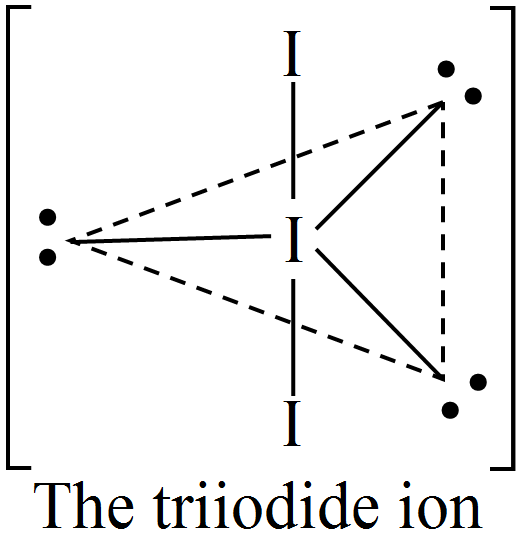
The empty orbital accepts electron pair from $I^-$ ion to form a coordinate bond. The remaining three fully-filled orbitals occupy equatorial positions. Thus, the geometry of three lone pairs and two bond pairs is trigonal bipyramidal and the shape of $\text{I}^-_3$ is linear as shown in the figure. View full question & answer→Question 162 Marks
- Which of the following are isostructural species. Give their structures.
$\text{NO}^+_2,\text{BCl}_3,\text{CO}_2,\text{BeCl}_2$
- Which has most electronegativity of carbon? Why?
$\text{CH}_3-\text{CH}_3,\text{CH}=\text{CH}_2,\text{HC}\equiv\text{CH}$Answeri. $\mathrm{NO}_2^{+}, \mathrm{CO}_2, \mathrm{BeCl}_2$ also isostructural as these are linear.
$\mathrm{BCl}_3$ has trigonal planar structure.
ii.
a. has most electronegative ' C ' because it is sp hybridised ( $50 \%$ ' s ' character) than $\mathrm{sp}^2$ hybridised ' C ' in $\mathrm{CH}_2=\mathrm{CH}_2$, sp ${ }^2$ (33\% 's' character) and sp ${ }^3$ ( $25 \%$ s-character) in $\mathrm{CH}_3-\mathrm{CH}_3$.
Greater the s-character, more electronegativity.
$\therefore$ 's' orbital is closer to nucleus.
View full question & answer→Question 172 Marks
Out of H and $\mathrm{H}_2$, the latter has higher first ionisation energy while out of 0 and $\mathrm{O}_2$, the former has higher first ionisation energy. Explain why?
AnswerIn $\mathrm{H}_2$, first electron has to be removed from $\sigma\left(1\right.$ s) which has lower energy (more stable) than H -atom. In $\mathrm{O}_2$, first electron has to be removed from $\pi\left(2 \mathrm{p}_{\mathbf{x}}\right)$ or $\pi\left(\mathrm{p}_{\mathbf{y}}\right)$ orbital which has higher energy than 2 p -orbital of O -atom.
View full question & answer→Question 182 Marks
- Explain the structure of $\text{CO}^{2-}_3$ ion in terms of resonance.
- Which out of $\mathrm{NH}_3$ and $\mathrm{NF}_3$ has higher dipole moment and why?
Answer
- In the resonance structure of $\text{CO}^{2-}_3$ ion, two $\text{C}-\text{O}$ bonds are represented by single bonds with negative charge on oxygen and one of the $\text{C}-\text{O}$ bond is a double bond. All $\text{C}-\text{O}$ bonds in $\text{CO}^{2-}_3$ are equivalent and hence $\text{CO}^{2-}_3$ is represented as the resonance hybrid of the canonical forms I, II and III below:
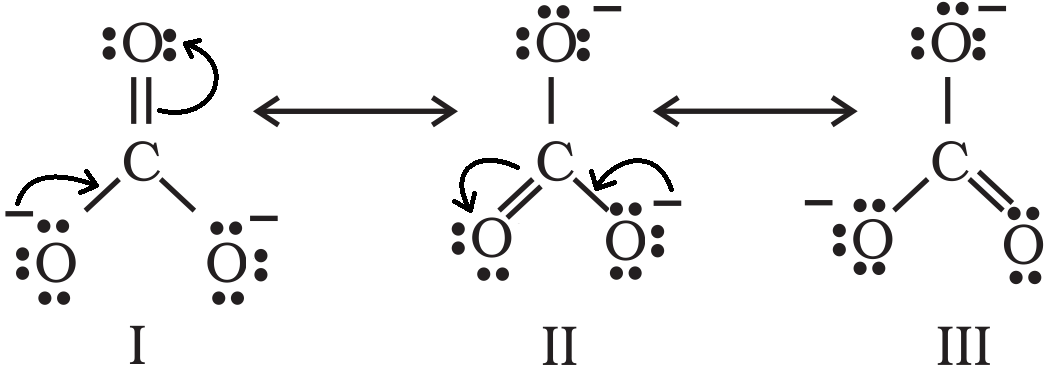
- Dipole moment of $\mathrm{NH}_3$ is higher than that of $\mathrm{NF}_3$. This is because in $\mathrm{NH}_3$, the orbital dipole due to lone pair on N is in the same direction as the dipole of $\text{N}-\text{H}$ bond. On the other hand in $\mathrm{NF}_3$ direction of orbital dipole and bond dipole is opposite because of F being more electronegative than N.
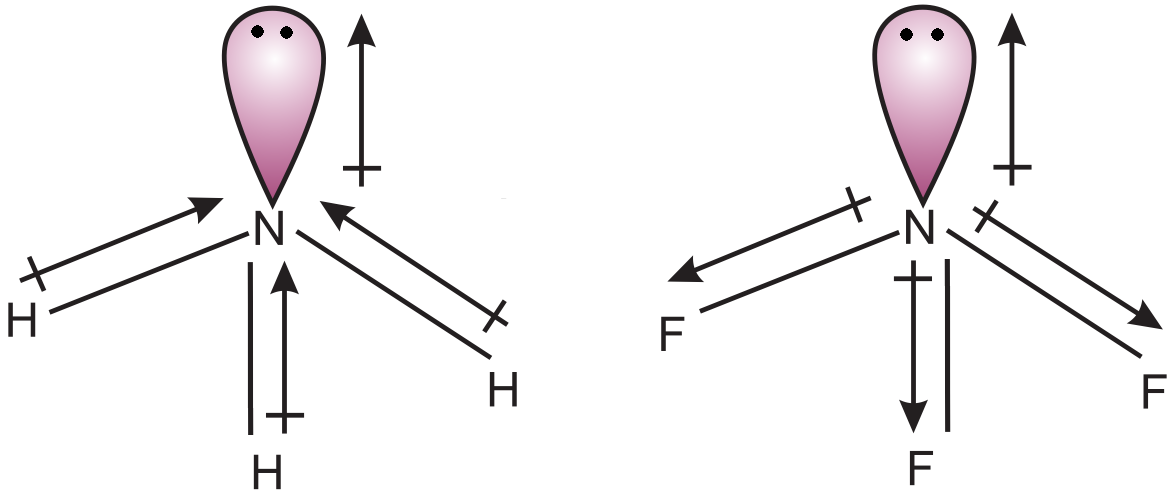
View full question & answer→Question 192 Marks
Explain the shapes of the following on the basis of VSEPR theory:
- $\text{BeCl}_2$
- $\text{PH}_4^+$
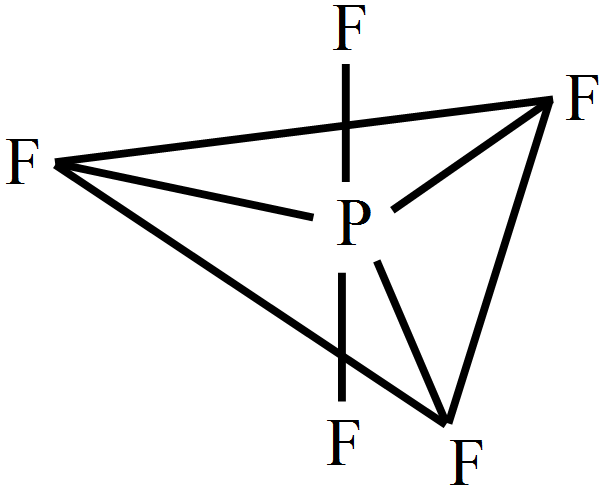
- $\text{PF}_5$
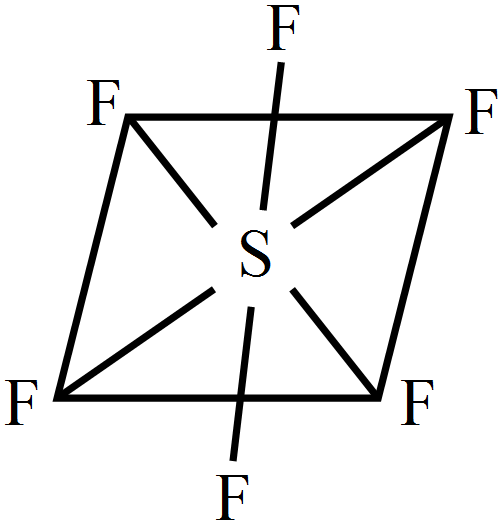
- $\text{SF}_6$
Answer
- $\text{BeCl}_2$ has 2 bond pairs of electrons, therefore, it has linear shape.
$\text{Cl}-\text{Be}-\text{Cl}$
- $\text{PH}^+_4$ has 4 bond pairs of electrons, it is tetrahedral.
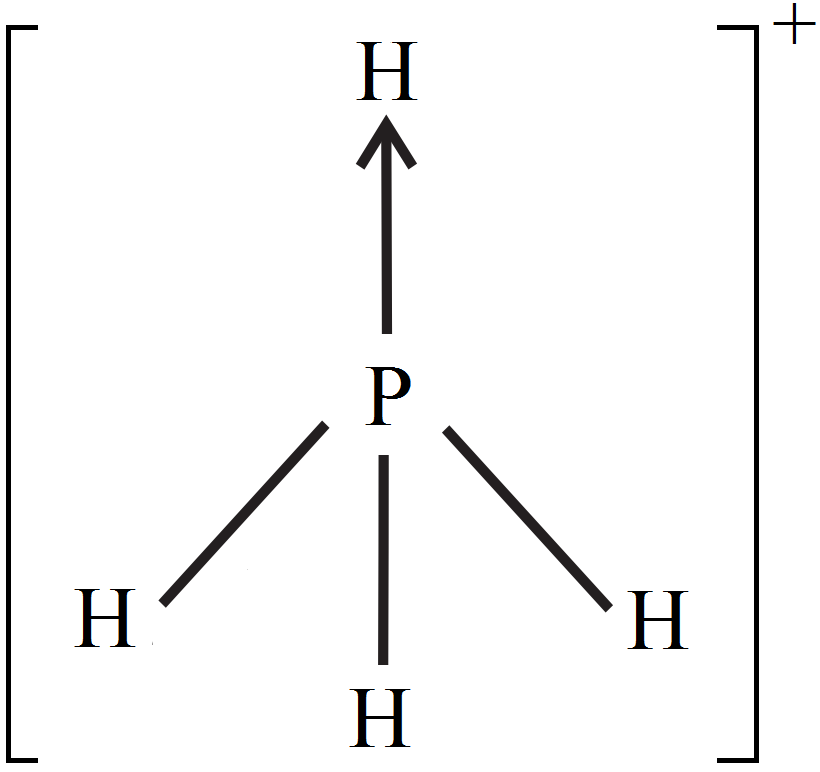
- $\text{PF}_5$ has 5 bond pairs of electrons, it is trigonal bipyamidal.
- $\text{SF}_6$ has 6 bond pairs of electrons, therefore, it has octahedral shape.
View full question & answer→Question 202 Marks
Aluminium forms the ion $\mathrm{Al}^{3+}$, but not $\mathrm{Al}^{4+}$ why?
AnswerAluminium ( $[\mathrm{Ne}]^{3 \mathrm{~s}^2} 3 \mathrm{p}^{\prime}$ can achien the electronic configuration of the nearest noble gas ( Ne ) by losing only three electrons. : $\mathrm{Al}^{3+}=1 \mathrm{~s}^2 2 \mathrm{~s}^2 2 \mathrm{p}^6$. Aluminium with not form the $\mathrm{Al}^{4+}$ ion because an extremely high amount of energy would be required to remove an electron from the stable noble gas configuration.
View full question & answer→Question 212 Marks
What is state of hybridization of the carbon atoms in $\text{CH}_3-\text{HC}=\text{CH}_2?$
Answer$\ 3\ \ \ \ \ \ \ \ \ \ \ \ \ 2 \ \ \ \ \ \ \ \ \ 1\\ \text{CH}_3-\text{HC}=\text{CH}_2\\\text{sp}^3\ \ \ \ \ \ \ \ \text{sp}^2 \ \ \ \ \ \ \ \text{sp}^2$ because $\ 3\\\text{C}$ is attched to single bonds only $\text{sp}^3$, $\ 2\\\text{C}$ and $\ 1\\\text{C}$ are attached double bond $\therefore$ $\text{sp}^2$ hybridised.
View full question & answer→Question 222 Marks
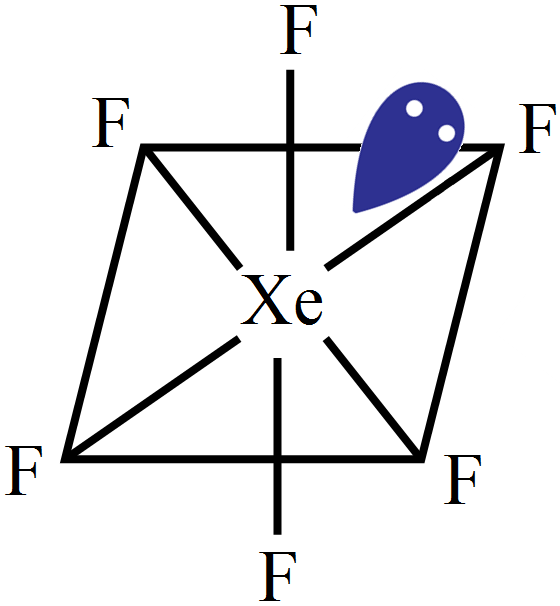
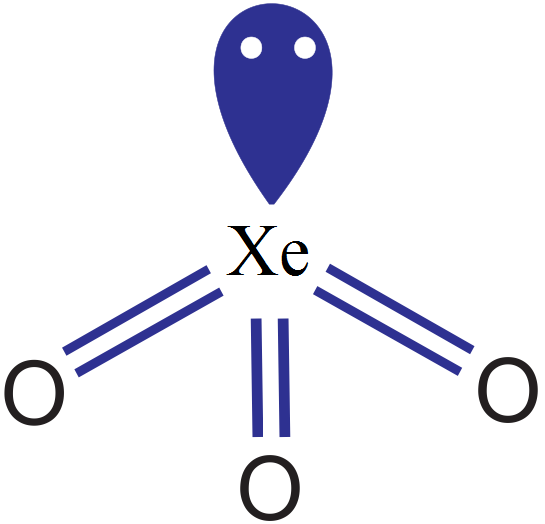
Draw the shape of:
- $\text{XeOF}_5$
- $\text{XeO}_3$
View full question & answer→Question 232 Marks
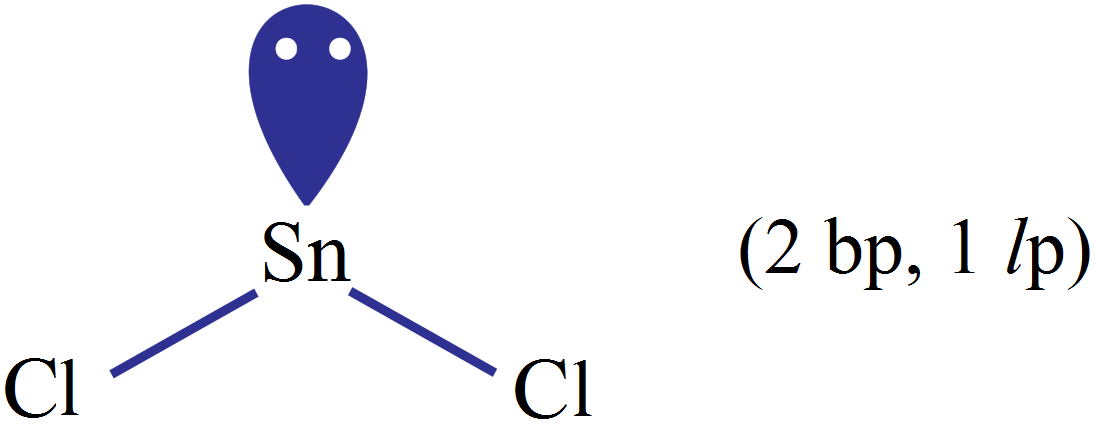
Why is $\mathrm{BeCl}_2$ linear whereas $\mathrm{SnCl}_2$ angular molecule?
Answer$\mathrm{BeCl}_2$ is linear due to sp hybridisation and 2 boned pair (bp) of electrons and no lone pair (lp). In $\mathrm{SnCl}_2$, there is sp hybridisation with a lone pair of electron, it is bent molecule.
View full question & answer→Question 242 Marks
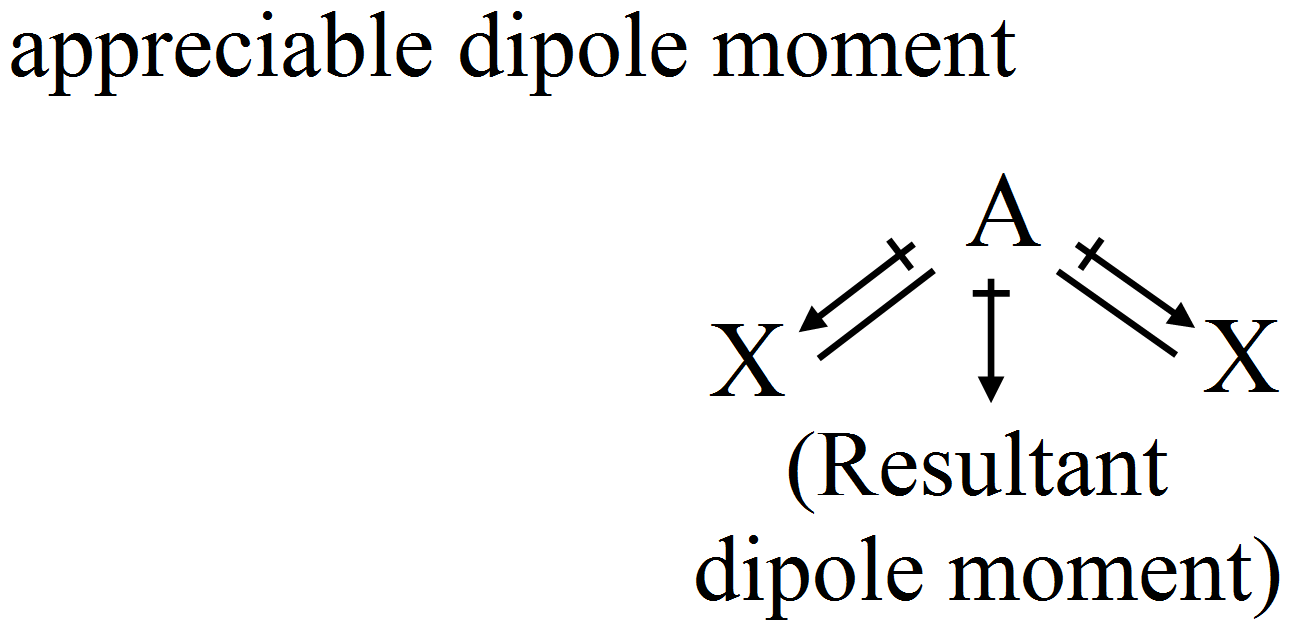
Which of the following structures contributes least towards resonance hybrid?

Answer
- Contributes least because like charges reside on adjacent atoms and there is +ve charge on more electronegative oxygen atom making it least stable.
View full question & answer→Question 252 Marks
- Describe the hybridisation in case of $\mathrm{PCl}_5$.
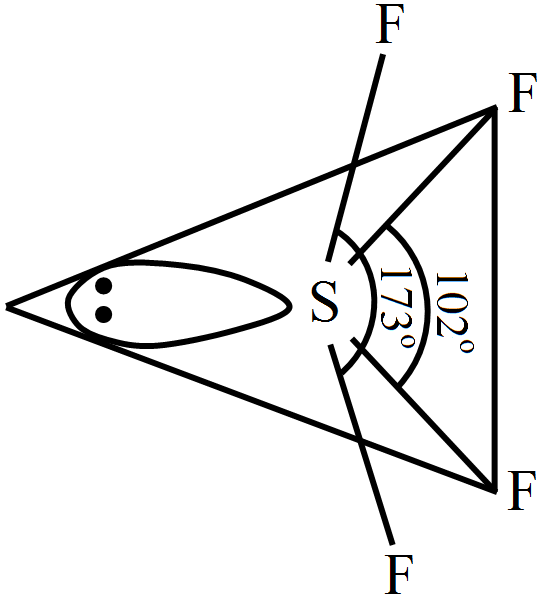
- Deduce the shape of $\mathrm{SF}_4$ molecule on the basis of VSEPR theory.
Answer
- Electronic configuration of $P(15): 1 s^2 2 s^2 2 p^6 3 s^2 3 p^3$
$P(15)$ in ecited state $1 s^2 2 s^2 2 p^6 3 s^1 3 p x^1 3 p y^1 3 p^1 3 d^1$
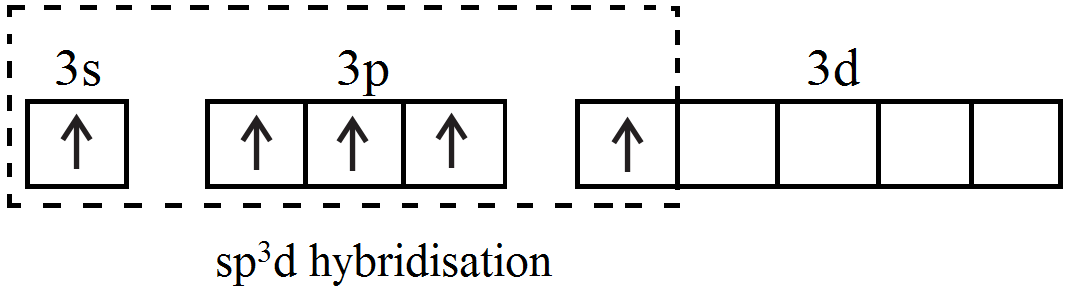
It has $\mathrm{sp}^3 \mathrm{~d}$ hybridisation
- In $\mathrm{SF}_4$, there are four bonded pair of electrons and one lone pair of electrons. It has sea-saw shape so as to have minimum repulsion, lone pair is on equitorial position.
View full question & answer→Question 262 Marks
Give shapes of:
- $\text{NH}^+_4,$
- $\text{CO}^{2-}_3,$
- $\text{BeF}^-_3,$
- $\text{SO}^{2-}_4$
Answer
- $\text{NH}^+_4,$ is tetrahedral,
- $\text{CO}^{2-}_3,$ is trigonal planar,
- $\text{BeF}^-_3,$ is trigonal planar,
- $\text{SO}^{2-}_4$ is tetrahedral.
View full question & answer→Question 272 Marks
On the basis of VSEPR theory, predict the shapes of the following molecules and ions:
- $\text{PH}_3$
- $\text{NH}_3$
- $\text{NH}^-_2$
- $\text{H}_3\text{O}^+$
Answer
- $\mathrm{PH}_3$ has 3 bond pairs, one lone pair, it has pyramidal shape.
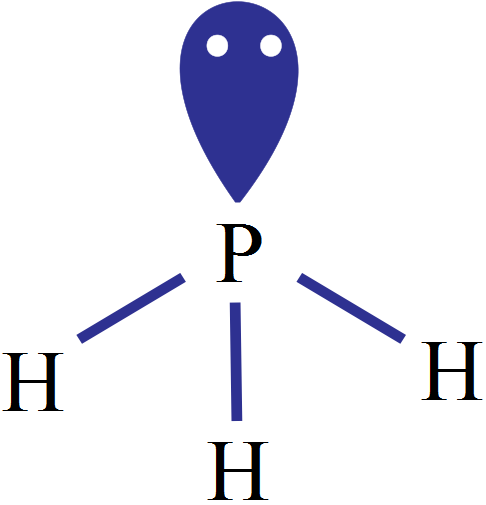
- $\mathrm{NH}_3$ has 3 bond pairs and one lone pair, it has pyramidal shape.
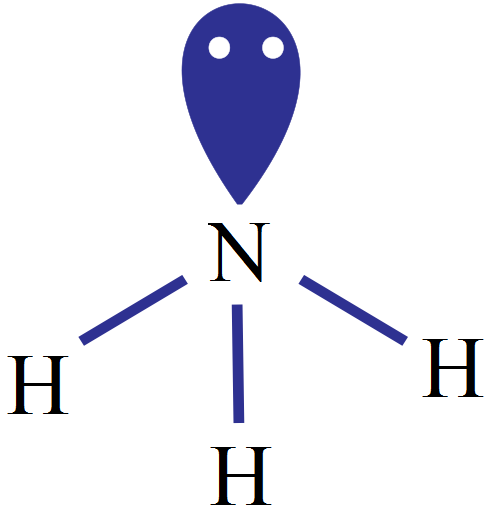
- $\text{NH}^-_2$ has 2 bond pairs and 2 lone pairs, therefore, it has V-shape or bent molecule.
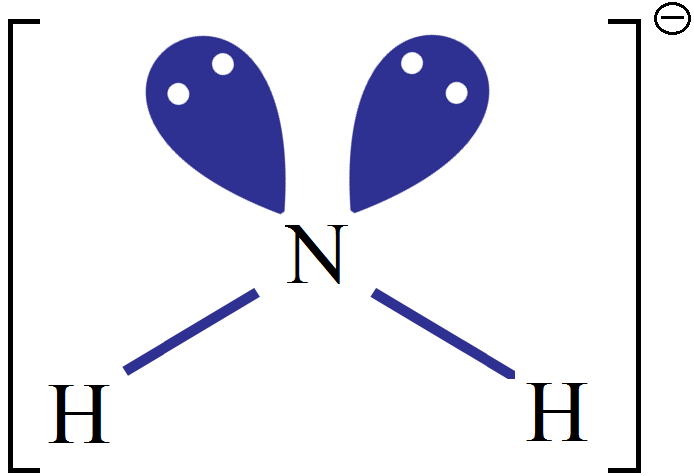
- $\text{H}_3\text{O}^+$ has 3 bond pairs and one lone pair, therefore, it is pyramidal.
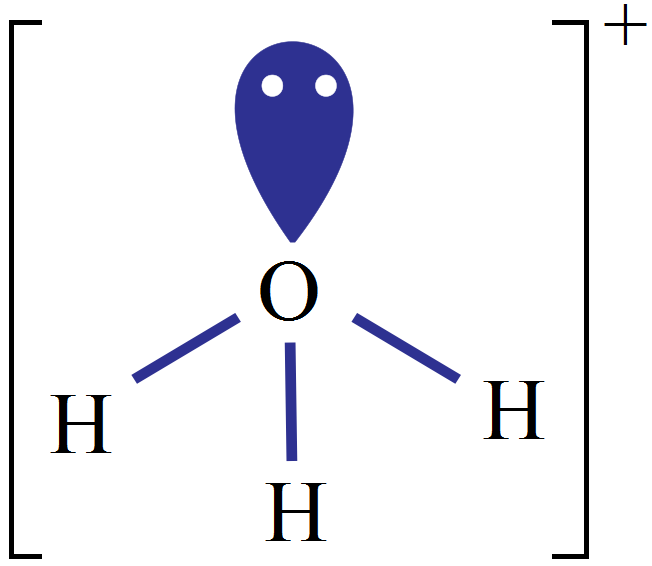
View full question & answer→Question 282 Marks
In the following ionisation processes, how will the bond orders in $\mathrm{N}_2$ and $\mathrm{O}_2$ be influenced?
- $\text{N}_2\xrightarrow{\ \ \ \ \ \ \ }\text{N}_2^++\text{e}^-$
- $\text{O}_2\xrightarrow{\ \ \ \ \ \ \ \ }\text{O}_2^++\text{e}^2$
Answeri. $\mathrm{N}_2^{+}$has less bond order than $\mathrm{N}_2$, i.e. bond order decreases in ionisation process of $\mathrm{N}_2 . \mathrm{N}_2$ has bond order 3, $\mathrm{N}_2^{+}$has bond order 2.5 because electron is removed from bonding molecular orbital (BMO).
ii. $\mathrm{O}_2^{+}$has higher bond order than $\mathrm{O}_2$, i.e. bond order increases in ionisation process in $\mathrm{O}_2 \cdot \mathrm{O}_2^{+}$has bond order $\frac{5}{2} . \mathrm{O}_2$ has 2 because $\mathrm{O}_2$ loses one electron from antibonding MO,
$\therefore$ bond order increases.
View full question & answer→Question 292 Marks
Which hybrid orbitals are used by underlined carbon in the following molecules?
- $\text{CH}_3-\underline{\text{C}}\text{HO}$
- $\text{CH}_3-\text{CH}=\underline{\text{C}}\text{H}_2$
Answeri. $\text {sp}^2$
ii. $\text {sp}^2$
View full question & answer→Question 302 Marks
Why does type of overlap given in the following figure not result in the bond formation?
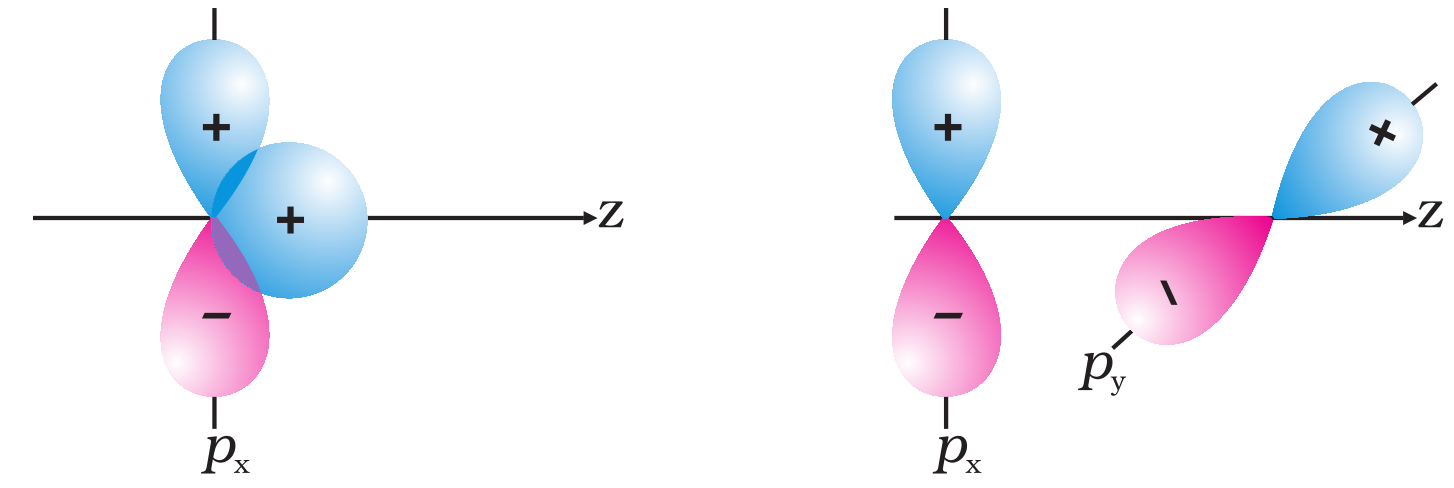
AnswerIn first figure, the + overlap is equal to + overlap and therefore, these cancel out and net overlap is zero.
In second figure, no overlap is possible because the two orbitals are perpendicular to each other.
View full question & answer→Question 312 Marks
Explain why HF is less viscous than $\mathrm{H}_2 \mathrm{O}$.
AnswerThere is greater intermolecular hydrogen bonding in $\mathrm{H}_2 \mathrm{O}$ than that in HF as each $\mathrm{H}_2 \mathrm{O}$ molecule forms four H -bonds with other water molecules, whereas HF forms only two H -bonds with other HF molecules. Greater the intermolecular H-bonding, greater is the viscosity. Hence, HF is less viscous than $\mathrm{H}_2 \mathrm{O}$.
View full question & answer→Question 322 Marks
Compare the relative stability of the following species on the basis of molecular orbital theory and indicate their magnetic properties:
$\text{O}^+_2,\text{O}^-_2.$
AnswerMolecular orbital configuration of $\text{O}_2$ is:
$(\sigma\text{ls})^2(\sigma*\text{ls})^2(\sigma2\text{s})^2(\sigma*2\text{s})^2(\sigma2\text{P}_\text{z})^2(\pi2\text{p}_\text{x}=\pi2\text{p}^2_\text{y})$
$(\pi*2\text{p}^1_\text{x})=\pi*2\text{p}^\text{1}_\text{y})$
Hence molecular orbital, configuration of $\text{O}^+_2$ is
$(\sigma\text{ls})^2(\sigma*\text{ls})^2(\sigma2\text{s})^2(\sigma2\text{s})^2(\sigma2\text{p}_2)^2(\pi2\text{p}_\text{x})^2(\pi2\text{p}_\text{x}^2=\pi2\text{p}^2_\text{y})$
$(\pi*2\text{p}^1_\text{x})$
Bond order of $\text{O}^+_2=\frac{10-5}{2}=\frac52=2.5$
It is paramagnetic.
Molecular orbital configuration of $\text{O}^-_2$ is
$(\sigma\text{ls})^2(\sigma*\text{ls})^2(\sigma2\text{s})^2(\sigma*2\text{s})^2(\sigma2\text{p}_\text{z})^2(\pi\text{p}_\text{x}^2=\pi2\text{p}^2_\text{y})$
$(\pi*2\text{p}^2_\text{x}=\pi*2\text{p}^\text{1}_\text{y})$
Bond order of $\text{O}^-_2=\frac{10-7}{2}=\frac32=1.5$
It is paramagnetic.
Since, the bond order of $\text{O}^+_2$ is greatest than $\text{O}^-_2$ therefore, $\text{O}^+_2$ is more stable than $\text{O}^-_2$
View full question & answer→Question 332 Marks
Arrange the following in decreasing order of ionic characters of the bond and give reason:
NaF, NaBr, NaCl, Nal
AnswerNaF > NaCl > NaBr > Nal
Greater the difference in electronegativity, more will be ionic character.
View full question & answer→Question 342 Marks
Give correct reason for the following:
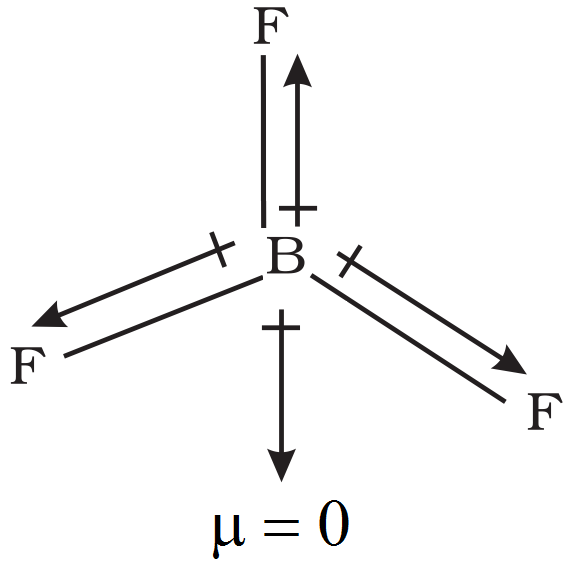
- $\text{BF}_3$ has a zero dipole moment although the $\text{B}-\text{F}$ bonds are polar.
- All carbon to oxygen bonds in $\text{CO}^{2-}_3$ are equivalent.
Answer
- It is due to planar structure, individual dipoles get canceled.
- It is due to resonance, all $\text{C}-\text{O}$ bonds are equivalent.
View full question & answer→Question 352 Marks
Arrange the following in order of decreasing bond angles.
- $\text{CH}_4, \text{NH}_3, \text{H}_2\text{O}, \text{BF}_3, \text{C}_2\text{H}_2$
- $\text{NH}_3, \text{NH}^‑_2, \text{NH}^+_4$
Answer
- $\text{C}_2\text{H}_2(180^\circ) > \text{CH}_4 (109^\circ28') > \text{BF}_3 (120^\circ) >\text{NH}_3(107^\circ) > \text{H}_2\text{O} > (104.5^\circ)$
- $\text{NH}^+_4> \text{NH}_3 > \text{NH}^-_2$
This is because all of them involve $\mathrm{sp}^3$ hybridisation. The number of lone pair of electrons present on N -atom are 0,1 and 2 respectively. Greater the number of lone pairs, greater is the repulsion and lesser is the bond angle. View full question & answer→Question 362 Marks
- How many sigma and pi bonds are there in the following molecule.
$\text{CH}_2=\text{CH}-\text{CH}_2-\text{C}\equiv\text{CH}$
- Which type of hybrid orbitals are used by the second carbon atom in the following molecule.
$\text{CH}\equiv\text{C}-\text{CH}_2-\text{CH}=\text{CH}_2$Answer
- $\ \ \ \ \ \ \ \ {\text{H}\ \ \ \ \ \ \text{H}\ \ \ \ \text{H}}\\\ \ \ \ \ \ \ \ \ |\ \ \ \ \ \ \ \ |\ \ \ \ \ \ |\\ \text{H}-\text{C}=\text{C}-\text{C}-\text{C}\equiv\text{C}-\text{H}\\\ \ \ \ \ \ \ \ \ \ \ \ \ \ \ \ \ \ \ \ \ \ \ \ \ |\\\ \ \ \ \ \ \ \ \ \ \ \ \ \ \ \ \ \ \ \ \ \ \ \ \text{H}$ $10\sigma $ and $3\ \pi-$ bonds.
(Trople bond has $1\sigma$ and $2\pi$)
- $\ 5\ \ \ \ \ \ \ \ \ 4\ \ \ \ \ \ 3\ \ \ \ \ \ \ \ \ \ 2\ \ \ \ \ \ \ \ \ 1\\\text{CH}\equiv\text{C}-\text{CH}_2-\text{CH}=\text{CH}_2$
($\because$ Double bond is preferred over triple bond if they are equidistant) in second carbon. View full question & answer→Question 372 Marks
Give reason for the following.
- Ionic compounds are soluble in water whereas covalent compounds are mostly insoluble in water.
- Ionic compounds have higher melting points than the covalent compounds.
Answer
- Being polar in nature ionic compounds are soluble in water but covalent compounds are generally non-polar so they are insoluble in water (like dissolves like).
- Because of the presence of strong electrostatic forces of attraction melting points of ionic compounds are higher than that of covalent compounds.
View full question & answer→Question 382 Marks
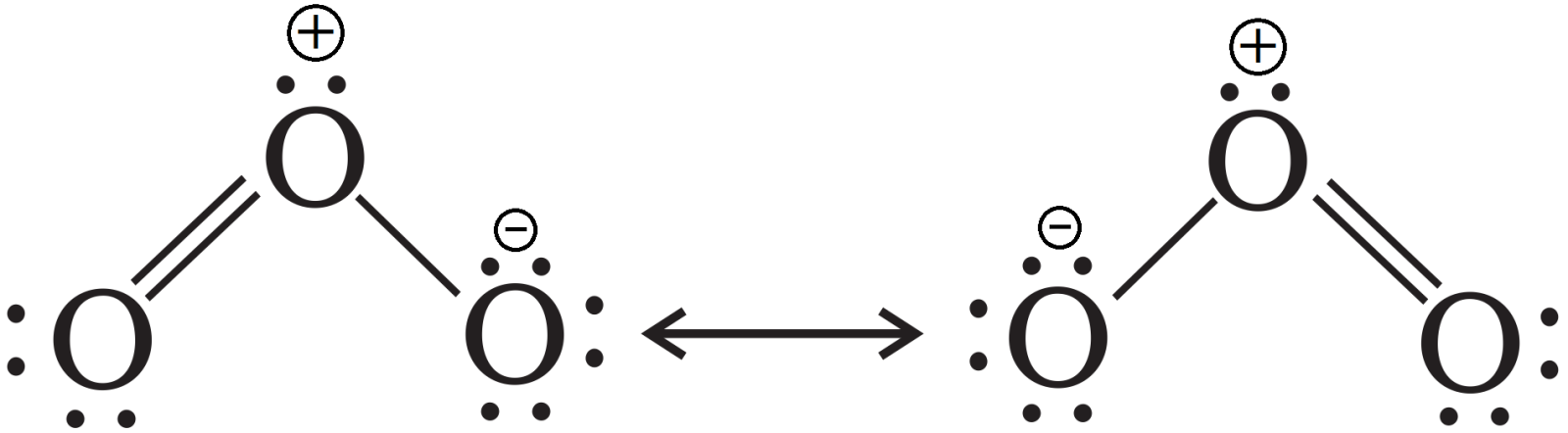
Write resonating structures of $\text{O}_3$.
AnswerResonating Structures of Ozone:
View full question & answer→Question 392 Marks
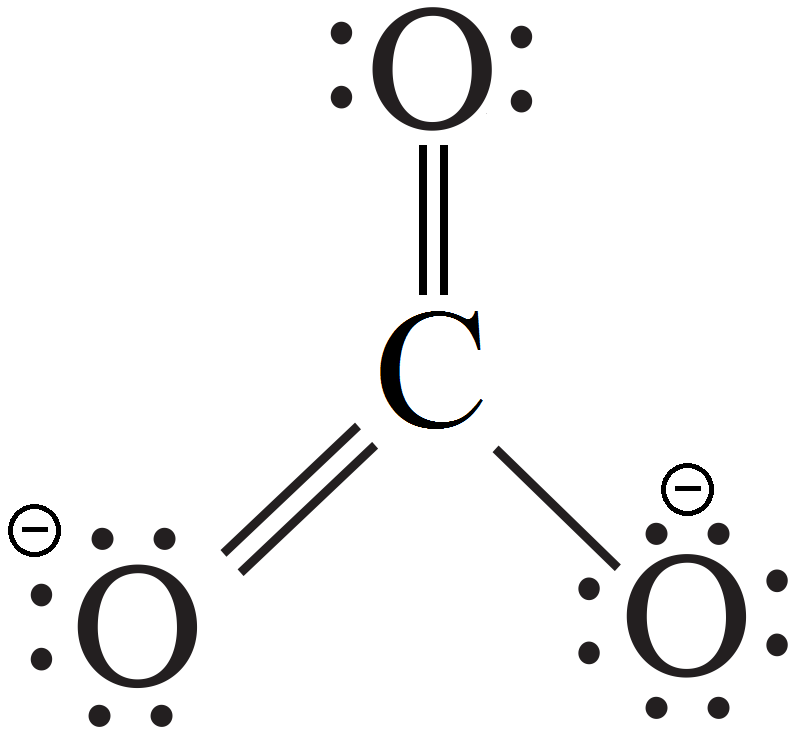
What is the state of hybridisation of carbon in $\text{CO}^{2-}_3$ ion?
Answer$\text{sp}^2$ because 'C' is linked with one double bond and two single bonds.
View full question & answer→Question 402 Marks
What is hybrid state of central atom in the following?
$\text{NO}^-_3,\text{BF}_4^-,\text{PF}_5,\text{IF}_5$ and $\text{CO}_2$
AnswerN in $\mathrm{NO}_3^{-}$is $\mathrm{sp}^2$ hybridised, B in $\mathrm{BF}_4^{-}$is $\mathrm{sp}^3$ hybridised, Pin $\mathrm{PF}_5$ is $\mathrm{sp}^3 \mathrm{~d}$ hybridised, I in $\mathrm{IF}_5$ is $\mathrm{sp}^3 \mathrm{~d}^2$ hybridised, C in $\mathrm{CO}_2$ is sp hybridised.
View full question & answer→Question 412 Marks
Which of the following has highest lattice energy and why?
CsF, CSCl, CsBr, Csl
AnswerCsF has highest lattice energy because 'F' is smallest in size and is more electronegative, therefore, it has maximum ionic character and maximum force of attraction, hence highest lattice energy, more energy will be required to break crystal lattice into ions.
View full question & answer→Question 422 Marks
In $\text{NO}^-_3$ ion, the number of bond pairs and lone pairs of electron on nitrogen atom are:
Answer

To solve this question, we must know the structure of $\text{NO}^-_3$ ion i.e.
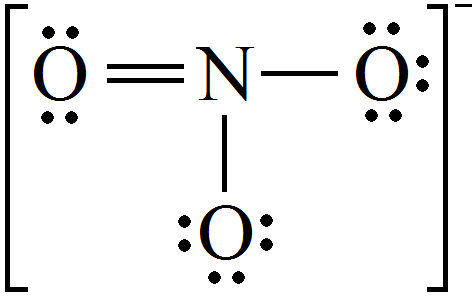
In N-atom, number of valence electrons = 5
Due to the presence of one negative charge, number of valence electrons = 5 + 1 = 6 one O-atom forms two bond (=bond) and two O-atom shared with two electrons of N-atom.
Thus, 3 O-atoms shared with 8 electrons of N-atom.
$\therefore$ Number of bond pairs (or shared pairs) = 4
Number of lone pairs = 0 View full question & answer→Question 432 Marks
Why is dipole moment of HF (1.98D) higher than that of HCl (1.03D)?
AnswerHF is more polar as compared to HCl because 'F' is more electronegative than HCl. Greater the difference in electronegativity, more will be polarity, higher will be the dipole moment.
View full question & answer→Question 442 Marks
Which of the following has larger bond angle in each pair?
i. $\mathrm{CO}_2, \mathrm{BF}_3$
ii. $\mathrm{NH}_3, \mathrm{CH}_4$
iii. $\mathrm{H}_2 \mathrm{O}, \mathrm{H}_2 \mathrm{~S}$
iv. $\mathrm{SiF}_4, \mathrm{C}_2 \mathrm{H}_2$
Answeri. $\mathrm{CO}_2$
ii. $\mathrm{CH}_4$
iii. $\mathrm{H}_2 \mathrm{O}$
iv. $\mathrm{C}_2 \mathrm{H}_2$
View full question & answer→Question 452 Marks
Compare the $\text{H}-\text{N}-\text{H}$ bond angle in the following molecules and ions:
$\text{NH}_3,\text{NH}_4^+,\text{NH}^-_2$
Answer$\mathrm{NH}_4^{+}>\mathrm{NH}_3>\mathrm{NH}_2^{-}$
$\because \mathrm{NH}_4^{+}$has $109.5^{\circ}, \mathrm{NH}_3$ has $107^{\circ}$ due to one lone pair.
$\mathrm{NH}_2^{\ominus}$ has $104.5^{\circ}$ due to repulsion between 2 lone pair of electrons.
View full question & answer→Question 462 Marks
Compare the dipole moment of the compounds in each of the following sets:
i. $\mathrm{CHCl}_3, \mathrm{CCl}_4$
ii. $\mathrm{CF}_4, \mathrm{SF}_4$
iii. $\mathrm{BF}_3, \mathrm{BCl}_3$
iv. $\mathrm{CO}_2, \mathrm{SO}_2$
Answeri. $\mathrm{CHCl}_3$ has higher dipole moment than $\mathrm{CCl}_4 \cdot(\mu=0)$
ii. $\mathrm{SF}_4$ has higher dipole moment than $\mathrm{CF}_4 \cdot(\mu=0)$
iii. $\mathrm{BF}_3$ and $\mathrm{BCl}_3$ have zero dipole moment.
iv. $\mathrm{SO}_2$ has higher dipole moment than $\mathrm{CO}_2 \cdot(\mu=0)$
View full question & answer→Question 472 Marks
What is the total number of sigma and pi bond in the following molecules?
- $\text{C}_2\text{H}_3\text{Cl}$
- $\text{C}_4\text{H}_4\text{Cl}_2$
- $\ \ \ \ \ \ \ \ \ \ \ \ \ {\text{H}\ \ \ \ \text{H}}\\\ \ \ \ \ \ \ \ \ \ \ \ \ |\ \ \ \ \ \ \ |\\ \text{H}_3\text{C}-\text{C}=\text{C}-\text{C}\equiv\text{C}-\text{H}$
Answer
- Is $\ \ \ \ \ \ \ \ {\text{H}\ \ \ \ \text{H}}\\\ \ \ \ \ \ \ \ \ |\ \ \ \ \ \ |\\\text{H}-\text{C}=\text{C}-\text{Cl}$ (5 $\sigma-$bond, one $\pi-$bonds)
-
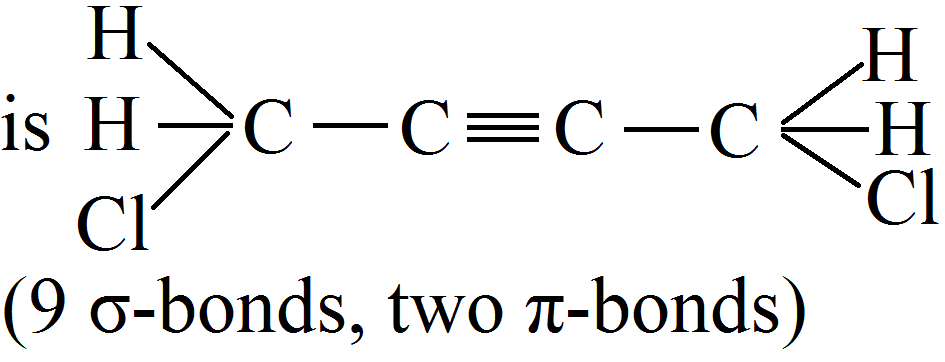
- Is $\ \ \ \ \ \ \ \ {\text{H}\ \ \ \ \text{H}\ \ \ \ \ \text{H}}\\\ \ \ \ \ \ \ \ \ |\ \ \ \ \ \ |\ \ \ \ \ \ \ |\\ \text{C}-\text{C}-\text{C}=\text{C}-\text{C}\equiv\text{C}-\text{H}\\\ \ \ \ \ \ \ \ \ |\\\ \ \ \ \ \ \ \ \text{H}$ (10 $\sigma-$bonds, $3\pi-$bonds)
View full question & answer→Question 482 Marks
Explain why carbon has a valency of four and not two and why are the four C-H bonds in methane identical.
Answer
The ground state electronic configuration of carbon is $\text{1s}^2,\ 2\text{s}^2,\ \text{2p}^2.$ But carbon forms bond with other atoms is excited state. The electronic configuration in excited state $1\text{s}^2,\ \text{2s}^1,\ 2\text{p}_\text{x}^1\ \text{2p}_\text{y}^1,\ \text{2p}_\text{z}^1.$
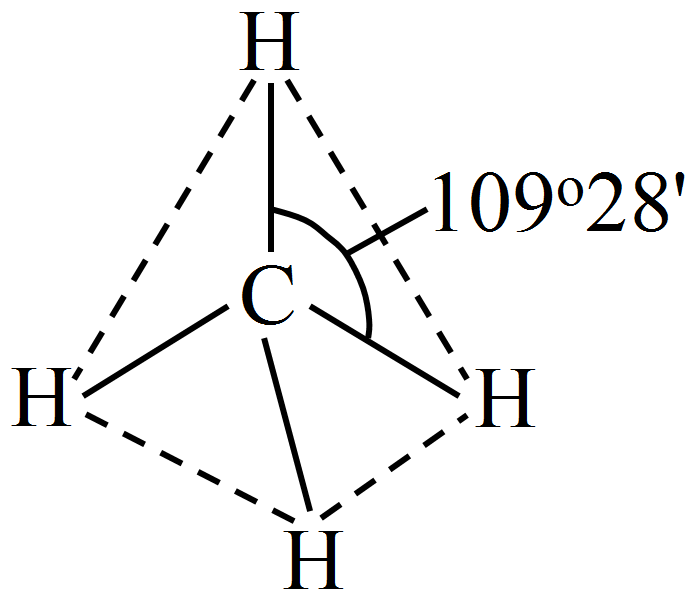
The one s-orbital and three p-orbitals of the valence shell intermix to form four $\mathrm{sp}^3$ hybrid obitals of equivalent energies and shape. These hybrid orbitals are arranged tetrahedrally at an angle of $109^{\circ} 28^{\prime}$ to each other. The four $\mathrm{sp}^3$ hybrid orbitals overlap with the half-filled is orbitals of four H atoms to form $\mathrm{CH}_4$ as shown below.
View full question & answer→Question 492 Marks
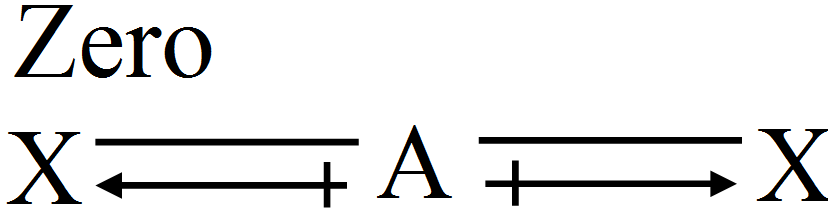
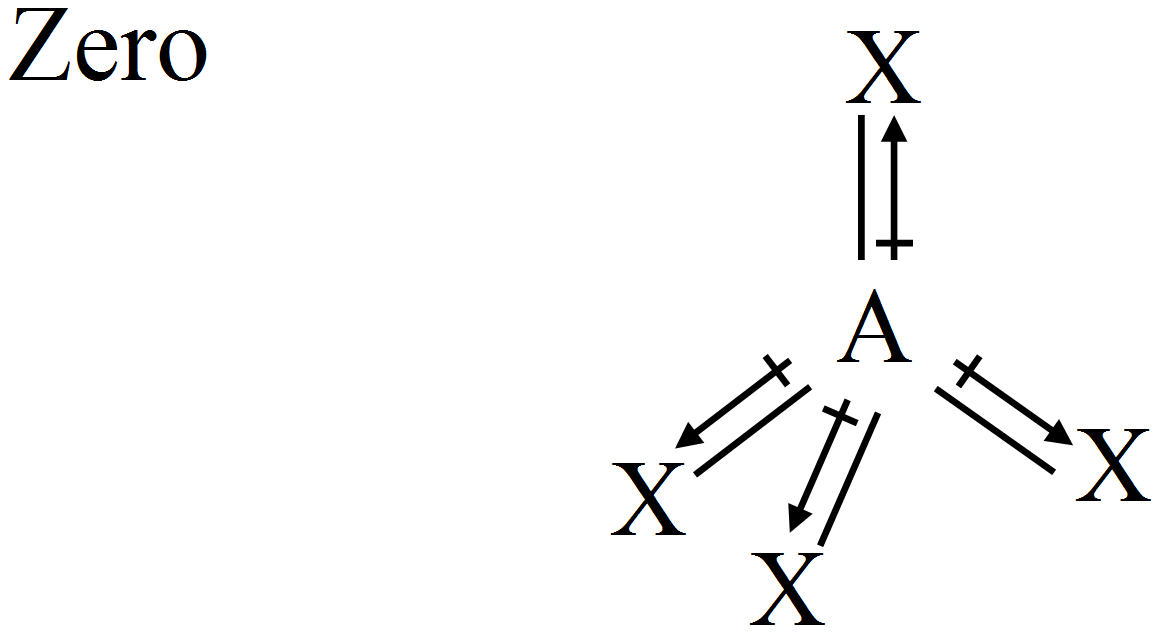
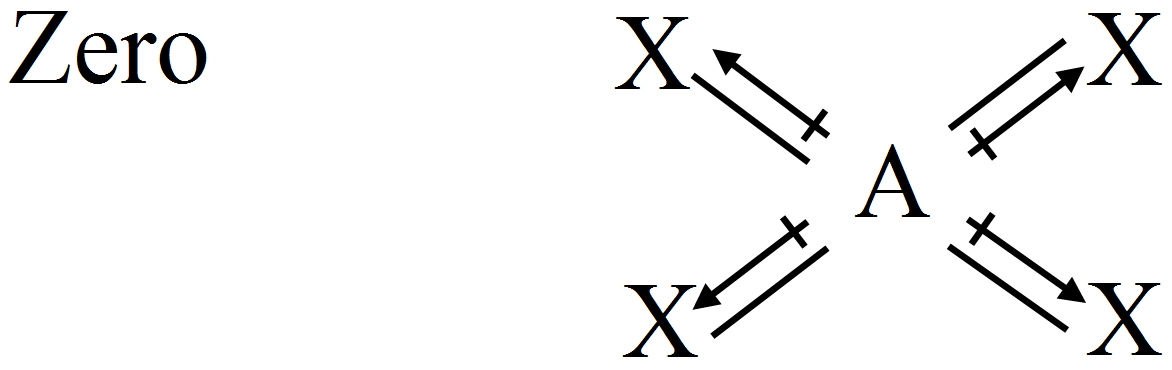
Predict the dipole moment of:
- A molecule of the type $\mathrm{AX}_2$ having a linear geometry.
- A molecule of the type $\mathrm{AX}_4$ having tetrahedral geometry.
- A molecule of the type $\mathrm{AX}_2$ having angular geometry.
- A molecule of the type $\mathrm{AX}_4$ having square planar geometry.
View full question & answer→Question 502 Marks
What is the total number of electrons in $\text{NO}^-_ 3?$
AnswerNO, has 7 + 24 + 1 = 32 electrons
$\because$ 'N' has atomic number 7, therefore 7 electrons, O has 8 electrons, 30 atoms will have 24 electrons. $\text{NO}^-_3$ ions is formed by gaining one electron.
View full question & answer→Question 512 Marks
Write molecular orbital configuration of $\mathrm{O}_2$. Predict its magnetic behaviour and calculate its bond order.
Answer$\mathrm{O}_2(16)$,
Molecular orbital configuration:
$(\sigma\text{ls})^2(\sigma*\text{ls})^2(\sigma2\text{s})^2(\sigma*2\text{s})^2(\sigma2\text{P}_\text{z})^2(\pi2\text{p}_\text{x}^2=\pi2\text{p}_\text{y}^2)$
$(\pi*2\text{p}_\text{x}^1=\pi*2\text{p}^1_\text{y})$
It is paramagnetic in nature due to presence of two unpaired electrons.
$\text{B.O.}=\frac12(\text{N}_\text{b}-\text{N}_\text{a})=\frac12(10-6)=\frac42=2$
View full question & answer→Question 522 Marks
$\mathrm{H}_3 \mathrm{~PO}_3$ can be represented by structures 1 and 2 shown below. Can these two structures be taken as the canonical forms of the resonance hybrid representing $\mathrm{H}_3 \mathrm{~PO}_3$? If not, give reasons for the same.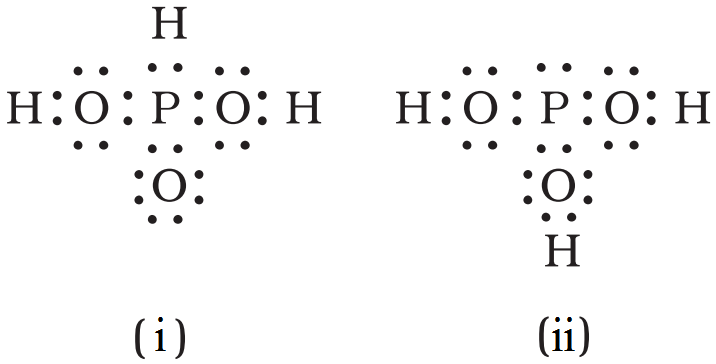
AnswerThese two cannot be called as canonical forms as relative position of hydrogen is changed. In resonance, canonical forms should differ only in the position of electrons and not in the position of atoms.
View full question & answer→Question 532 Marks
What is the hybrid state of each carbon in the following molecules?
- $\text{CH}_2=\text{C}=\text{CH}_2$
- $\text{CH}_3\text{CH}=\text{CH}_2$
- $\text{CH}_3\text{CHO}$
- $\text{CH}_3\text{CH}_2\text{OH}$
- $\text{CH}_3\text{COOH}$
Answer
- $\stackrel{\text{sp}^3}{\text{CH}_2}=\stackrel{\text{sp}}{\text{C}}=\stackrel{\text{sp}^3}{\text{CH}_2}$
- $\stackrel{{\text{sp}^3\ \ \ \ }}{\hbox{CH}_3}-\stackrel{{\text{sp}^2\ \ \ \ }}{\hbox{CH}}=\stackrel{{\text{sp}^3}\ \ \ \ }{\hbox{CH}_2}$
- $\stackrel{{\text{sp}^3}}{\hbox{CH}}-\stackrel{{\text{sp}^2\ \ \ \ \ \ \ }}{\hbox{CHO}}$
- $\stackrel{\text{sp}^3\ \ \ }{\hbox{CH}_3}-\stackrel{{\text{sp}^3\ \ \ \ }}{\hbox{CH}_3}-\text{OH}$
- $\stackrel{{\text{sp}^3}\ \ \ }{\hbox{CH}_3}-\stackrel{\text{sp}^3\ \ \ \ \ \ \ \ \ }{\hbox{COOH}}$
View full question & answer→Question 542 Marks
Draw molecular orbital energy level diagram for $\text{N}^+_2.$ Calculate its bond order and explain its magnetic characteristics.
Answer
$\text{N}^+_2(13):\sigma\text{ls}^2,\sigma\text{*ls}^2,\sigma2\text{s}^2,\sigma*2\text{s}^2,\pi2\text{p}^2_\text{x}=\pi2\text{p}^2_\text{y},\sigma2\text{p}^1_\text{z}$
$\text{B.O.}=\frac12(9-4)=\frac52=2.5$
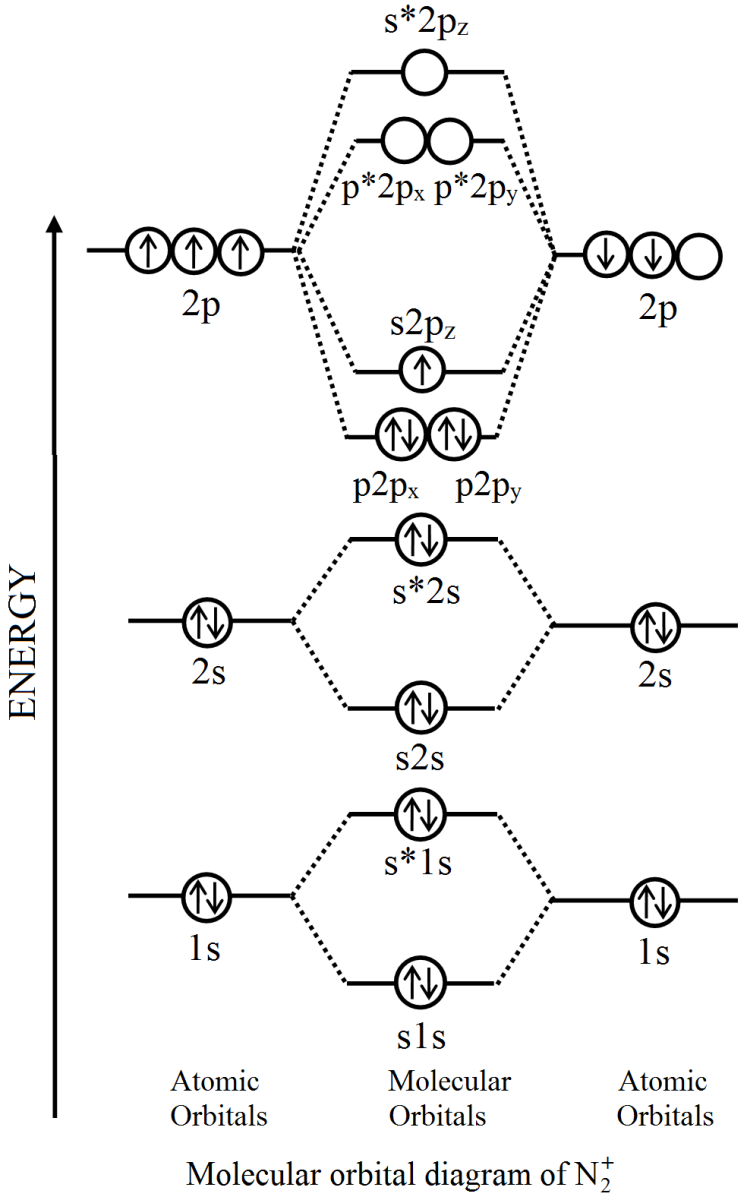
It is paramagnetic due to presence of one unpaired electron. View full question & answer→Question 552 Marks
Which is more polar: $\mathrm{CO}_2$ or $\mathrm{N}_2 \mathrm{O}$? Give reason.
Answer$\mathrm{N}_2 \mathrm{O}$ is more polar than $\mathrm{CO}_2$. This is because $\mathrm{CO}_2$ is linear and symmetrical. Its net dipole moment is zero,
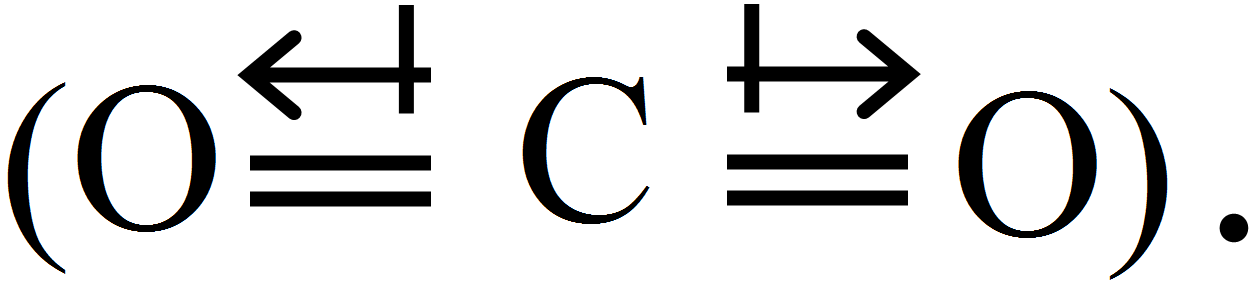
$\mathrm{N}_2 \mathrm{O}$ on the other hand, is linear but unsymmetrical. It is considered as a resonance hybrid of the following two structures.

It has a net dipole moment of 0.116D. View full question & answer→Question 562 Marks
What is the effect of following process on the bond order in $\mathrm{N}_2$ and $\mathrm{O}_2$?
- $\text{N}_2\xrightarrow{\ \ \ \ \ }\text{N}^+_2+\text{e}^-$
- $\text{O}_2\xrightarrow{\ \ \ }\text{O}^+_2+\text{e}^-$
AnswerAccording to molecular orbital theory, electronic configurations and bond order of $\text{N}_2,\text{N}^+_2,\text{O}_2$ and $\text{O}^+_2$ species are as follows.
$\text{N}_2(14\text{e}^-)=\sigma\text{ls}^2,\ \stackrel{{*}\ \ \ \ \ \ \ \ }{\sigma\text{ls}^2},\sigma2\text{s}^2,\ \stackrel{*\ \ \ \ \ \ \ \ }{\sigma\hbox{2s}^2}\ (\pi2\text{p}_\text{x}^2\approx\pi2\text{p}^2_\text{y}),\sigma2\text{p}^2_\text{z}$
Bon order $=\frac12[\text{N}_\text{b}-\text{N}_\text{a}]=\frac12(10-4)=3$
$\text{N}^+_2(13\text{e}^-)=\sigma\text{ls}^2,\ \stackrel{*\ \ \ \ \ \ \ }{\sigma\hbox{ls}^2},\ \sigma2\text{s}^2,\ \stackrel{*\ \ \ \ \ \ \ \ }{\sigma\text{2s}^2},\ (\pi2\hbox{p}_\text{x}^2\approx\pi2\text{p}_\text{y}^2)\sigma2\text{p}^1_\text{z}$
Bond order $=\frac12[\text{N}_\text{b}-\text{N}_\text{a}]=\frac12(9-4)=25$
$\text{O}_2(16\text{e}^-)=\sigma\text{1s}^2\stackrel{*\ \ \ \ \ \ \ \ }{\sigma\text{ls}^2},\ \sigma2\text{s}^2,\ \stackrel{*\ \ \ \ \ \ }{\sigma2\text{s}^2},\ \sigma2\text{p}_\text{z}^2,\\\text{(}\pi2\text{p}_\text{x} \approx\pi2\text{p}_\text{y}^2),(\stackrel{*\ \ \ \ \ \ \ \ \ \ }{\pi\hbox{2p}_\text{x}}\ \approx\ \stackrel{*\ \ \ \ \ \ \ \ \ }{\pi\hbox{2p}^1_\text{y}})$
Bond order $=\frac12[\text{N}_\text{b}-\text{N}_\text{a}]=\frac12(10-6)=2$
$\text{O}^+_2(15\text{e}^-)=\sigma\text{ls}^2,\ \stackrel{*\ \ \ \ \ \ }{\sigma\hbox{ls}^2},\ \sigma2\text{s}^2,\ \stackrel{*\ \ \ \ \ \ }{\sigma2\text{s}^2},\ \sigma2\text{p}^2_\text{z},\\ (\pi2\text{p}^2_\text{x}\approx\pi2\text{p}_\text{y}^2),\ (\stackrel{*\ \ \ \ \ \ \ \ }{\pi2\text{p}^2_\text{y}}\ \approx\ \stackrel{*\ \ \ \ \ \ \ \ \ }{\pi2\text{p}_\text{y}})$
Bond order $=\frac12[\text{N}_\text{b}-\text{N}_\text{a}]=\frac12(10-5)=25$
$\text{N}_2\ \ \ \ \xrightarrow{\ \ \ \ \ \ \ \ \ \ }\ \ \ \ \ \ \ \ \text{N}^+_2+\text{e}^-\\\ \text{BO}=3\ \ \ \ \ \ \ \ \ \ \ \ \text{BO}=2.5$
Thus, bond orer decreases.
View full question & answer→Question 572 Marks
Calculate the number of sigma and $\pi-$electrons in 0.1mole of vinyl cyanide
$(\text{CH}_2=\text{CH}-\text{C}\equiv\text{N}).$
Answer$\text{CH}_2=\text{CH}-\text{C}\equiv\text{N},$ there are 6 sigma bond and $3\pi$ bonds.
1 mole of vinyl cynide contains 18 (both $\sigma$ and $\pi$ ) $\times 6.022 \times 10^{23}$ electrons.
0.1 mole of vinyl cynide contains
$18 \times 6.022 \times 10^{23} \times 0.1=108.384 \times 0.1 \times 10^{23}$
$=108.384 \times 10^{24} \text { electons }$
View full question & answer→Question 582 Marks
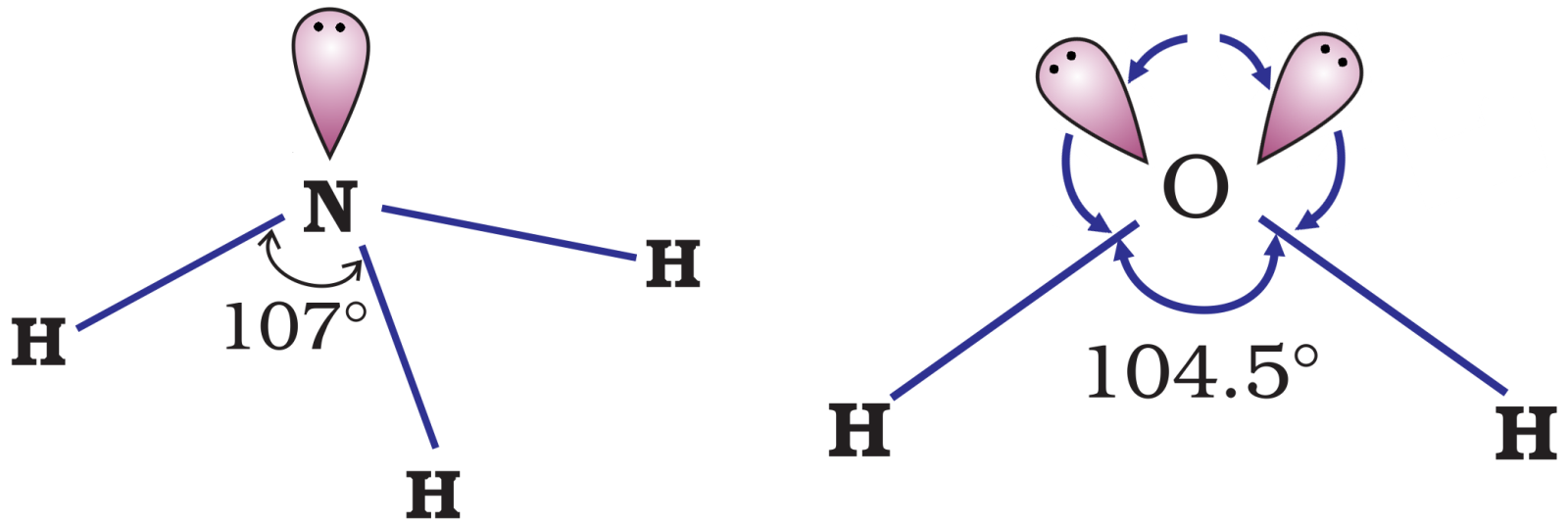
Bond angle in $\mathrm{NH}_3$ is more than in $\mathrm{H}_2 \mathrm{O}$. Justify.
AnswerBoth $\mathrm{NH}_3$ and $\mathrm{H}_2 \mathrm{O}$ are $\mathrm{sp}^3$ hybridised but there is only one lone pair present on N in $\mathrm{NH}_3$ and two lone pairs on O of $\mathrm{H}_2 \mathrm{O}$. Since lone pair-lone pair repulsion is greater than lone pair-bond pair and bond pair-bond pair repulsions, two lone pairs on oxygen push the bond pairs more closer than one lone pair on nitrogen. This leads to smaller bond angle in $\mathrm{H}_2 \mathrm{O}$ than in $\mathrm{NH}_3$.
View full question & answer→Question 592 Marks
- Which of the following have identical bond order?
$\text{CN}^-,\text{NO}^-,\text{O}^-_2,\text{O}^{2-}_2$
- Which of the following attain the linear structure?
$\text{BeCl}_2,\text{NCO}^+,\text{NO}_2,\text{CS}_2$Answeri. $\mathrm{CN}^{-}$and $\mathrm{NO}^{+}$have identical bond order as these have same number of electrons.
ii. $\mathrm{BeCl}_2$ and $\mathrm{CS}_2$ have linear structure.
View full question & answer→Question 602 Marks
i. KHF , exists but $\mathrm{KHCl}_2, \mathrm{KHBr}_2$ do not, why?
ii. Out $\mathrm{HF}, \mathrm{H}_2 \mathrm{O}, \mathrm{HCl}, \mathrm{CCl}_4$ which is not liquid and why?
Answeri. $\mathrm{KF}$ - $\mathrm{HF}, \mathrm{KF}$ can form H -bonds with HF whereas KCl cannot form H -bond with HCl and KBr cannot form H -bond with HBr .
ii. HCl is not liquid because it is not associated with inter molecular H -bonding $\mathrm{H}_2 \mathrm{O}$ and HF are liquids due to inter molecular H -bonding.
$\mathrm{CCl}_4$ is non-polar covalent compound with high molecular weight, therefore, liquid.
View full question & answer→Question 612 Marks
Account for the following:
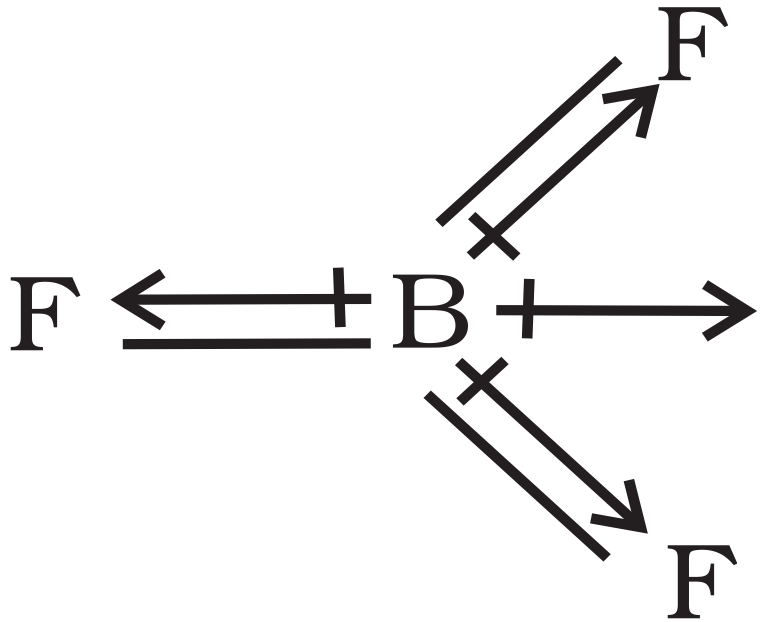
- BF, molecule has a zero dipole moment although $\text{B}-\text{F}$ bonds are polar.
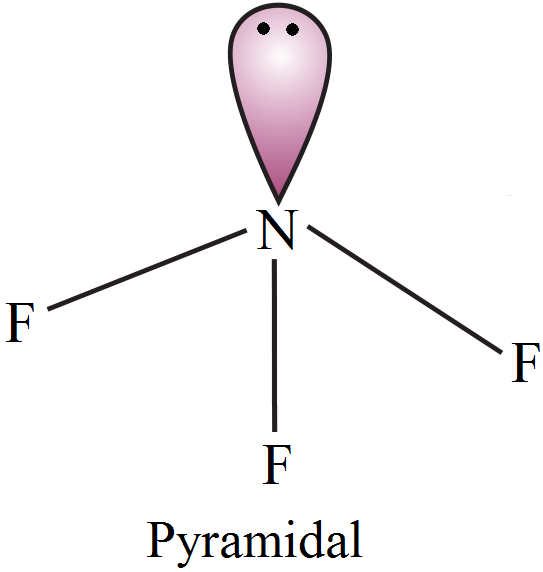
- The structure of $\mathrm{NH}_3$ molecule is pyramidal.
Answer
- Although $\text{B}-\text{F}$ bonds are polar but net dipole moment of $\mathrm{BF}_3$ molecule is zero because of the symmetry of the molecule, individual dipole moments cancel out as shown below.
- $\mathrm{NH}_3$ is pyramidal due to the presence of lone pair of electrons on nitrogen and 3 bonded pair of electrons.
View full question & answer→Question 622 Marks
Among the molecules, $\mathrm{NO}^{+}, \mathrm{N}_2, \mathrm{SnCl}_2$ and $\mathrm{NO}_2^{-}$, identify the species which is isoelectronic with CO .
Answer

Isoeleclronic species are those species have same number of electrons but different nuclear charge.
Electrons present in $\mathrm{CO}=6+8=14$
Then, $\ln \mathrm{NO}^{+}=7+8-1=14$
In $\mathrm{N}_2=7+7=14$
In $\mathrm{SnCl}_2=$ (very high) $50+17 \times 2=50+34=84$
In $\mathrm{NO}_2^{-}=7+16+1=24$ View full question & answer→Question 632 Marks
Predict the shapes of the following molecules on the basis of hybridization.
$\mathrm{BCl}_3, \mathrm{CH}_4, \mathrm{CO}_2, \mathrm{NH}_3$
Answer$\mathrm{BCl}_3 \mathrm{~sp}^2$ hybridisation.
Triangular Planar $\mathrm{CH}_4 \mathrm{~sp}^3$ hybridisation.
Tetrahedral $\mathrm{CO}_2$ sp-hybridisation.
Linear $\mathrm{NH}_3 \mathrm{~sp}^3$ hybridisation OR Pyramidal.
View full question & answer→Question 642 Marks
Why are dipole moments of $\text{CO}_2,\text{BF}_3,\text{CCl}_4,\text{PF}_5,\text{SF}_6$ are zero?
AnswerThey have symmetrical shape, individual bond moments or dipoles get cancelled, therefore, net dipole moment is zero.
View full question & answer→Question 652 Marks
$\mathrm{CO}_2$ and $\mathrm{SO}_2$ both are triatomic molecules but there is a big difference in their dipole moment, why?
Answer

Is linear and bond moments are equal and opposite, therefore, net dipole moment is zero, dipoles get cancelled.
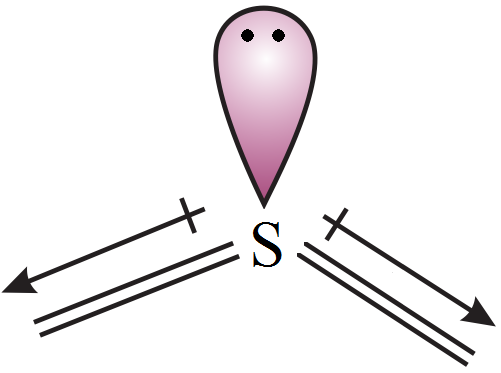
$\mathrm{SO}_2$ is bent molecule, it has net dipole moment because dipole do not get cancelled. View full question & answer→Question 662 Marks
Using valençe bond theory, draw the molecular structures of $\mathrm{OSF}_4$ and $\mathrm{XeF}_4$ indicating the location of lone pairs (s) of electrons and hybridisation of central atoms.
View full question & answer→Question 672 Marks
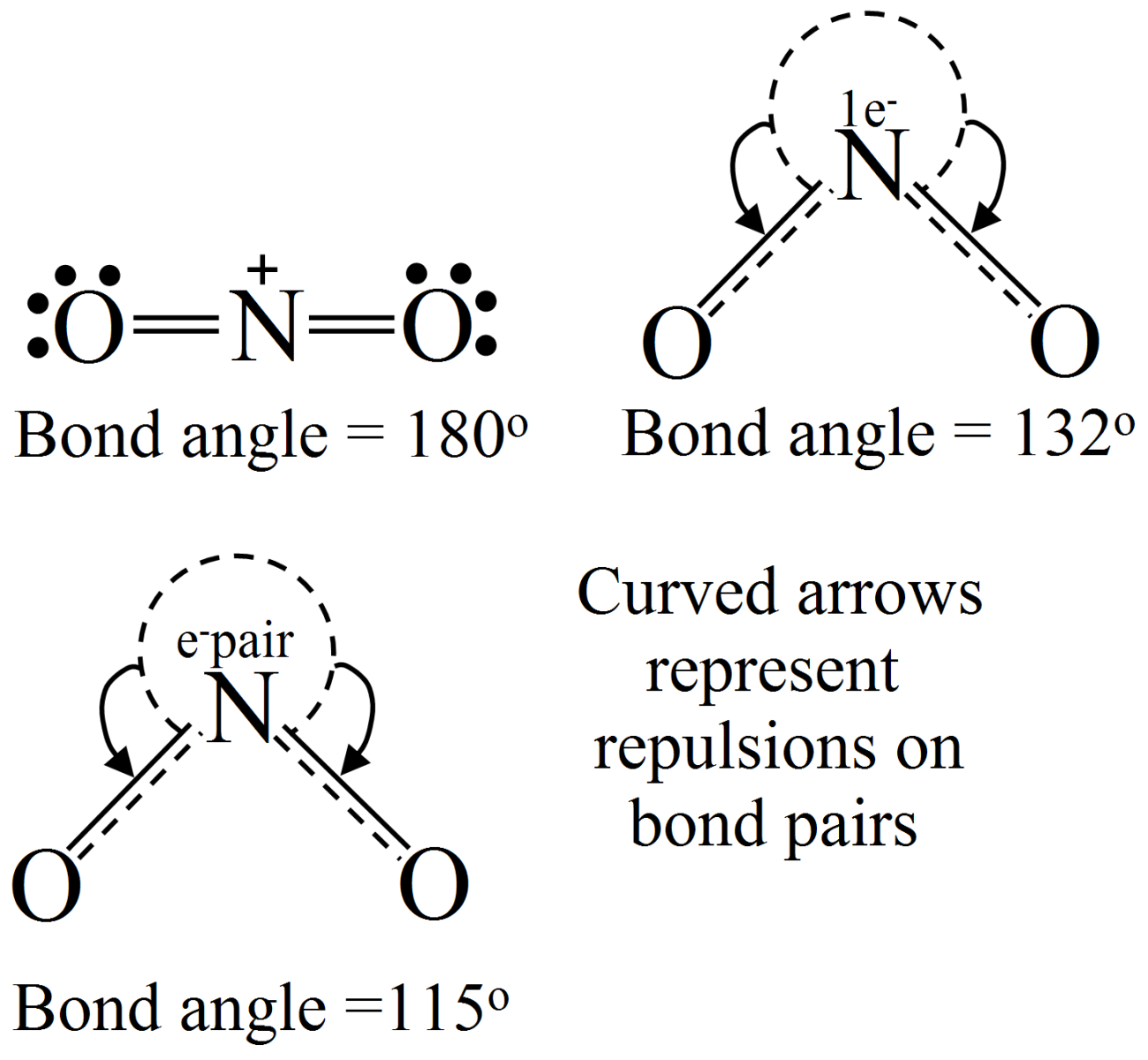
Arrange the following in order of decreasing bond angle, giving reason $\mathrm{NO}_2, \mathrm{NO}^{+}{ }_2, \mathrm{NO}_2^{-}$.
Answer$\text{NO}^+_2 > \text{NO}_2 > \text{NO}^-_2.$ This is because $\text{NO}^-_2$ has no lone pair of electrons (i.e. has only bond pairs on two sides) and hence it is linear.
$\mathrm{NO}_2$ has one unshared electron while $\text{NO}^-_2$ has one unshared electron pair.
There are greater repulsion on $\text{N}-\text{O}$ bonds in case of $\text{NO}^-_2$ than in case of $\mathrm{NO}_2$.
View full question & answer→Question 682 Marks
The $\text{H}-\text{S}-\text{H}$ bond angle in $\mathrm{H}_2 \mathrm{S}$ is 92.2° whereas the $\text{H}-\text{O}-\text{H}$ bond angle in $\mathrm{H}_2 \mathrm{O}$ is 104.5°, why?
AnswerIn $\mathrm{H}_2 \mathrm{S}$, there is less polarity as compared to $\mathrm{H}_2 \mathrm{O}$ because sulphur is bigger in size and less electronegative, therefore, bond pair bond pair electrons repulsion is less in $\mathrm{H}_2 \mathrm{S}$ than in $\mathrm{H}_2 \mathrm{O}$ hence bond angle is less.
View full question & answer→Question 692 Marks
Why does formic acid exist as dimer? What is its one consequence?
Answer
Formic acid exists as dimer because of hydrogen bonding.
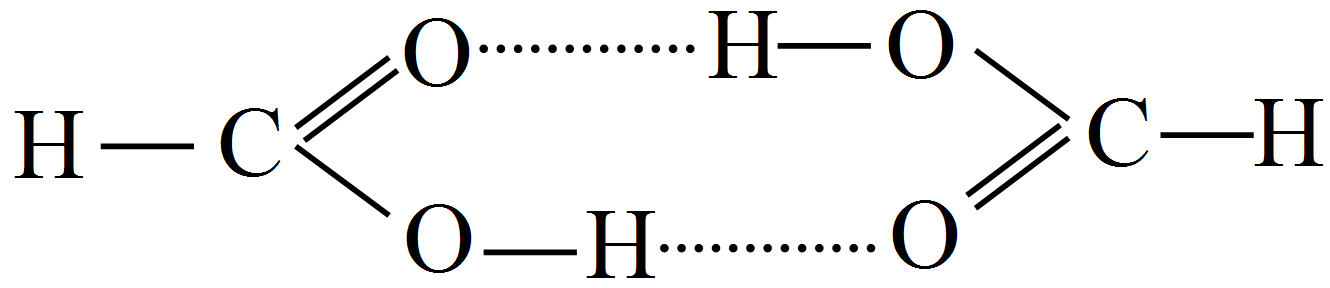
Because of hydrogen bonding, it pretends larger size as well as molecular mass.
View full question & answer→Question 702 Marks
Give reasons for the following:
$\text{H}^+_2$ and $\text{H}^-_2$ ions have same bond order but $\text{H}^+_2$ ions are more stable than $\text{H}^-_2.$
AnswerIt is because electron present in anti-bonding orbital in $\mathrm{H}_2$ destabilize the molecular ion slightly more than bonding electron stabilizes due to higher energy.
View full question & answer→Question 712 Marks
All the $\text{C}-\text{O}$ bonds in carbonate ion $\Big(\text{CO}^{2-}_3\Big)$ are equal in length. Explain.
Answer

To explain the reason of equal in length of $\text{C}-\text{O}$ bonds, it should keep in mind about the resonance. As a result of resonance, the bond length in a molecule become equal. Carbonate ion $\Big(\text{CO}^{2-}_3\Big)=3$ bond pair + 1 lone pair.
⇒ Trigonal planar

Due to resonance all $\text{C}-\text{O}$ bond length are equal. View full question & answer→