MCQ 11 Mark
The mass number of a nucleus is :
- A
Always less than its atomic number.
- B
Always more than its atomic number.
- ✓
Sometimes equal to its atomic number.
- D
Sometimes equal and sometimes more than its atomic number.
AnswerCorrect option: C. Sometimes equal to its atomic number.
View full question & answer→MCQ 21 Mark
Number of angular nodes for $4d$ orbital is $ .........$
View full question & answer→MCQ 31 Mark
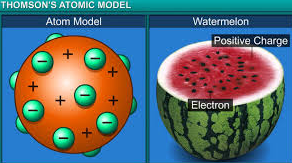
Who was the first scientist to propose a model for the structure of an atom?
AnswerJ.J. Thomson was the first one to propose a model for the structure of an atom
View full question & answer→MCQ 41 Mark
The value of $'h\ ' = 6.63 \times 10^{-34}$ Js. The speed of light is $3 \times 10^{17}nm/ s^{-1}$. Which value is closer to the wavelength in nanometer of a quantum of light with frequency $6 \times 10^{15} s^{-1}$.
Answer$\text{v}=\frac{\text{c}}{\lambda}$
$\Rightarrow\frac{\text{c}}{\text{v}}=\frac{3\times10^{17}\text{m/ ms}^{-1}}{6\times10^{15}\text{n/ ms}^{-1}}=50\text{ nm}.$
View full question & answer→MCQ 51 Mark
Total number of orbitals associated with third shell will be $ .........$
AnswerNo of orbitals in $3^{rd}$ shell $\ce{(n = 3) = n^2 = 3^2 = 9.}$
View full question & answer→MCQ 61 Mark
The radius of second Bohr's orbits for hydrogen atoms is :
$\text{h}=6.6262\times10^{-34}\text{Js},\text{m}_\text{e}$
$=9.109\times10^{-31}\text{kg},\text{e}_{\text{change}}$
$=1.6021\times10^{19\text{C}}$
- A
$1.65\mathring{\text{A}}$
- B
$4.76\mathring{\text{A}}$
- C
$0.529\mathring{\text{A}}$
- ✓
$2.12\mathring{\text{A}}$
AnswerCorrect option: D. $2.12\mathring{\text{A}}$
$\text{r}_\text{n}=\frac{\text{n}^2\text{h}^2}{4\pi^2\text{me}^2\text{Z}}$
We get, $\text{r}_\text{n}=\frac{0.529\mathring{\text{A}}\times2^2}{\text{z}}=\frac{0.529\mathring{\text{A}}\times2^2}{4}$
$=2.12\mathring{\text{A}}$
View full question & answer→MCQ 71 Mark
The mass number is same as $ ..........$
AnswerThe mass number should also not be confused with the relative atomic mass $($also called atomic weight$)$ of an element, which is the ratio of the average atomic mass of the different isotopes of that element $($weighted by abundance$)$ to the unified atomic mass unit.
View full question & answer→MCQ 81 Mark
Protons and neutrons are also called $ ..........$
AnswerProtons and neutrons are also called nucleons.
View full question & answer→MCQ 91 Mark
Thomson proposed the model of an atom similar to :
AnswerThomson proposed the model of an atom be similar to that of a Christmas pudding. The electrons in a sphere of positive charge were like currants $($dry fruits$)$ in a spherical Christmas pudding.
View full question & answer→MCQ 101 Mark
The number of radial nodes for $3p$ orbital is $ ..........$
AnswerFor a hydrogen atom wave function, there are $\ce{n - l - 1}$ radial nodes and $(n - 1)$ total nodes.
Number of radial nodes for $3p$ orbital $= \ce{n - l - 1}$
$= 3 - 1 - 1 = 1$
View full question & answer→MCQ 111 Mark
Thomson showed that the stream of particles in cathode ray tube is made up of small particles which are a component of the atom and is :
AnswerThomson discovered electrons using the cathode ray tube. It has been previously seen that if a electric current is passed through a vacuum tube, a glowing stream is formed. Thomson found that the mysterious glowing stream would bend toward a positively charged electric plate. He concluded that the stream is negatively charged. He also concluded based on his experiments that the negative stream has negatively charged particles that he called corpuscles $($later renamed electrons$).$
View full question & answer→MCQ 121 Mark
The radius of which of the following orbit is same as that of first orbit of hydrogen atom?
- A
$\ce{He^+(n = 2)}$
- B
$\ce{L^{2+}(n = 2)}$
- C
$\ce{Li^{2+}(n = 3)}$
- ✓
$\ce{Be^{3+}(n = 2)}$
AnswerCorrect option: D. $\ce{Be^{3+}(n = 2)}$
$\text{r}_\text{n}=\frac{0.529\mathring{\text{A}}\times\text{n}^2}{\text{z}}=\frac{0.529\times1^2}{1}$
$=0.529\mathring{\text{A}}$ for $H-$ atom
$\text{Be}^{3+}=\frac{0.529\mathring{\text{A}}\times2^2}{\text{z}}=\frac{0.529\mathring{\text{A}}\times2^2}{4}$
$=0.529\mathring{\text{A}}$
View full question & answer→MCQ 131 Mark
What tool was Thomson using when he discovered the electron?
MCQ 141 Mark
Atomic number of an atom is equal to the $ .........$
- A
- B
- ✓
Both $a$ and $b$.
- D
Sum of proton and electron.
AnswerCorrect option: C. Both $a$ and $b$.
Atomic number $(Z)$ is the number of protons in an atom. It is also equal to the number of electrons in the atom.
Atomic number $=$ number of protons
Example : the atomic number of an element is $12,$ then, its atom contains $12$ protons and $12$ electrons.
View full question & answer→MCQ 151 Mark
On bombarding a beam of a $-$ particles on the atom of the gold sheet, a few particles get deflected whereas most of them go straight and remains undeflected. This is due to :
- ✓
The nucleus occupy much smaller volume as compared to the volume of atom.
- B
The force of repulsion on fast moving a $-$ particles is very small.
- C
The neutrons in the nucleus do not have any effect on a $-$ particles.
- D
The force of attraction on a $-$ particles by the oppositely charged electron is not sufficient.
AnswerCorrect option: A. The nucleus occupy much smaller volume as compared to the volume of atom.
On bombarding a beam of a $-$ particles on the atom of the gold sheet, a few particles get deflected whereas most of them go straight and remains undeflected because the nucleus occupy much smaller volume as compared to the volume of atom.
View full question & answer→MCQ 161 Mark
Electronic configuration of five elements $\ce{I, II, III, IV, V}$ is mentioned below. In the above configuration element $\ce{I, II, III, IV}$ and $\ce{V}$ represent as :
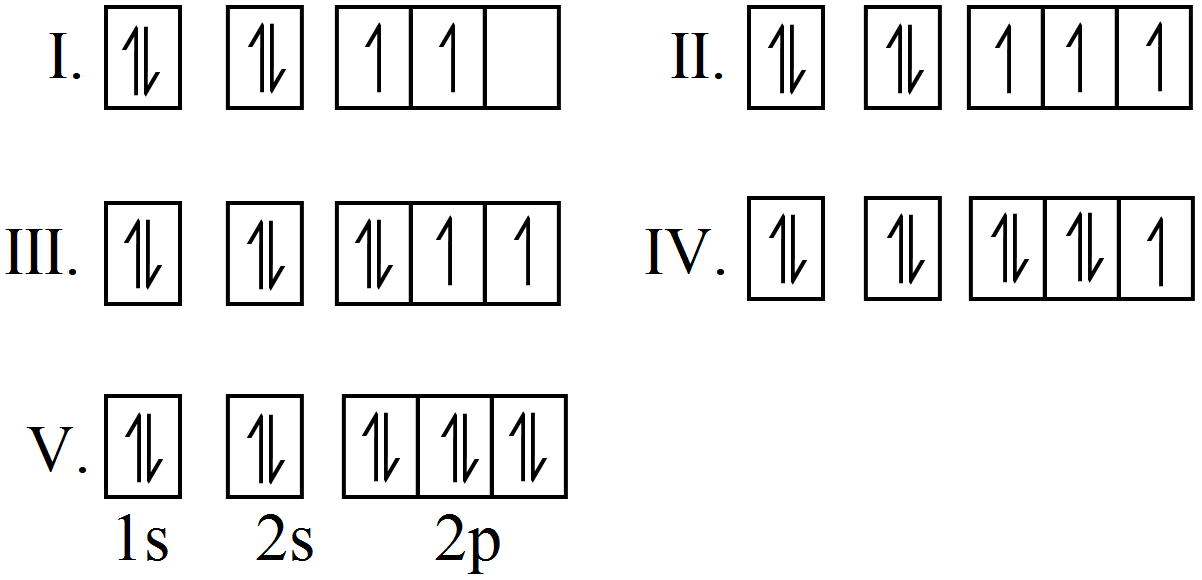
- ✓
$\ce{C, N, O, F, Ne}$
- B
$\ce{Ne, F, O, N, C}$
- C
$\ce{C, O, N, Ne, F}$
- D
$\ce{O, C, F, Ne, V}$
AnswerCorrect option: A. $\ce{C, N, O, F, Ne}$
View full question & answer→MCQ 171 Mark
How will you find out the maximum number of electrons in the main energy level?
AnswerCorrect option: D. $2n^2$
The maximum number of electrons in an energy level is given by $2(n^2).$
View full question & answer→MCQ 181 Mark
The probability density plots of $1s$ and $2s$ orbitals are given in figure.
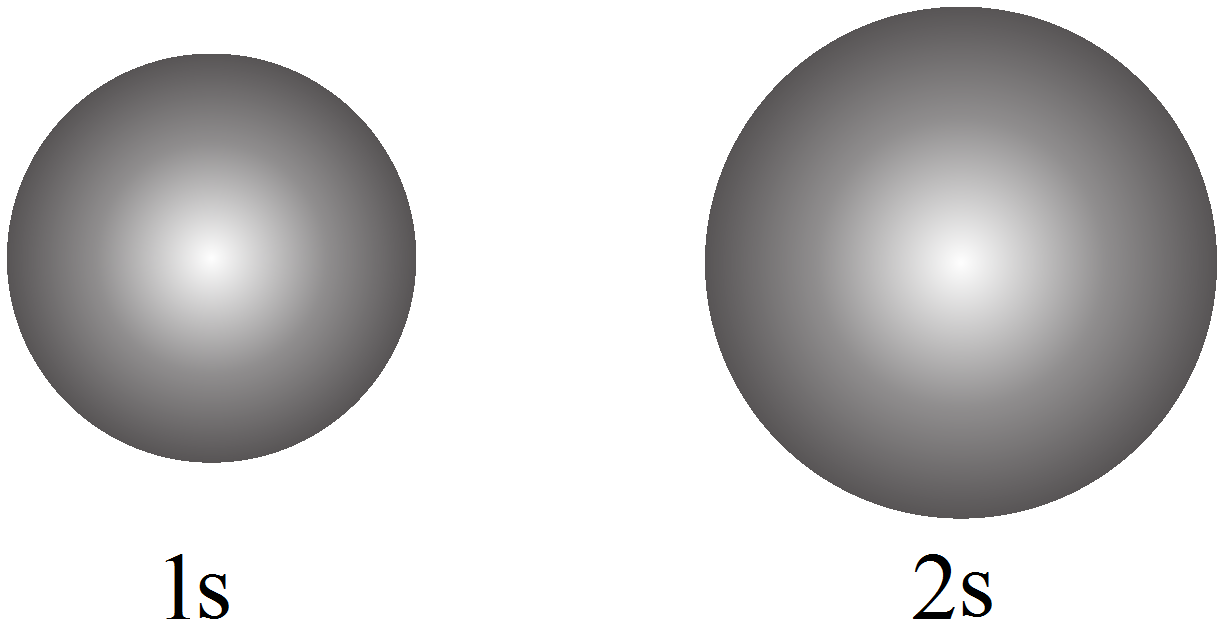
The density of dots in a region represents the probability density of finding electrons in the region.
On the basis of above diagram which of the following statements is incorrect? AnswerCorrect option: D. The probability density of electrons for $2s$ orbital decreases uniformly as distance from the nucleus increases.
The probability density of electrons in $2s$ orbital first increases then decreases and after that it begins to increases again as distance increases from nucleus.
View full question & answer→MCQ 191 Mark
Thomson's atomic model concluded that $ ......... $ is the constituent particle of all kinds of atoms.
AnswerThomson experiments with cathode $-$ ray tubes showed that all atoms contain tiny negatively charged subatomic particles or electrons.
View full question & answer→MCQ 201 Mark
The correct set of four quantum numbers for the valence electrons of rubidium atom $(Z = 37)$ is :
- ✓
$5,0,0+\frac{1}{2}$
- B
$5,1,0+\frac{1}{2}$
- C
$5,1,1+\frac{1}{2}$
- D
$5,0,1+\frac{1}{2}$
AnswerCorrect option: A. $5,0,0+\frac{1}{2}$
Given, atomic number of $Rb, Z = 37$ stress
Thus, its electronic configuration is $[Kr]^5 \ s^1$.
Since, the last electron or valence electron enter in $5\ s$ subshell.
So, the quantum numbers are $n = 5, l = 0, ($for $s-$ orbital$)$
$\text{m}=0(\because\text{m}=+\text{l}\ \text{to }-\text{l}),$
$\text{s}=+\frac{1}{2}$ or $-\frac{1}{2}.$
View full question & answer→MCQ 211 Mark
Which of the following is responsible to rule out the existence of definite paths or trajectories of electrons?
- A
Pauli's exclusion principle.
- ✓
Heisenberg's uncertainty principle.
- C
Hund's rule of maximum multiplicity.
- D
AnswerCorrect option: B. Heisenberg's uncertainty principle.
Werner Heisenberg, a German physicist in $1927,$ stated uncertainty principle which states that it is impossible to determine simultaneously, the exact position and exact momentum of an electron.
Mathematically, $\Delta\text{x}\times\Delta\text{p}\geq\frac{\text{h}}{4\pi}$
The important implications of the Heisenberg uncertainty principle is that it rules out existence of definite paths or trajectories of electrons and other similar particles.
View full question & answer→MCQ 221 Mark
In atom, an electron is moving with a speed of $600m/ s$ with an accuracy of $0.005\%$. Certainty with which the position of the electron can be located is : $\left(\mathrm{h}=6.6 \times 10^{-34} \mathrm{~kg} / \mathrm{m}^2 \mathrm{~s}^{-1}\right.,$ mass of electron, em $= 6.6 \times 10^{-31}kg)$
- A
$1.52 \times 10^{-4}m$
- B
$5.10 \times 10^{-3}m$
- ✓
$1.92 \times 10^{-3}m$
- D
$3.84 \times 10^{-3}m$
AnswerCorrect option: C. $1.92 \times 10^{-3}m$
By Heisenberg's uncertainty principle,
$\Delta\text{x}.\text{m}\Delta\text{v}=\frac{\text{h}}{4\pi}$
$\Delta\text{v}=0.005\%$ or $600\text{ms}=\frac{600\times0.005}{100}=0.03$
$\Delta\text{x}\times9.1\times10^{-31}\times0.03=\frac{6.6\times10^{-34}}{4\times3.14}$
Hence, $\Delta\text{x}=\frac{6.6\times10^{-34}}{4\times3.14\times0.03\times9.1\times10^{-31}}$
$=1.92\times10^{-3}\text{m}$
View full question & answer→MCQ 231 Mark
A ray of white light is spread out into a series of coloured bands of visible light are called :
MCQ 241 Mark
What is the atomic number of Krypton?
AnswerThe atomic number is the number of protons in an atom of an element. An atom of Krypton has $36$ protons in its nucleus.
View full question & answer→MCQ 251 Mark
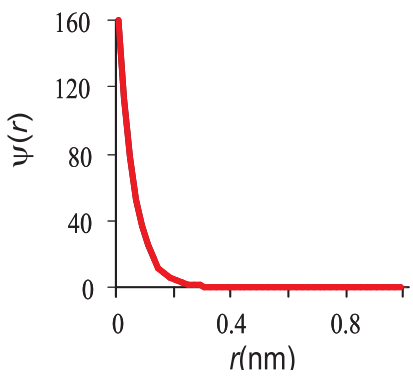
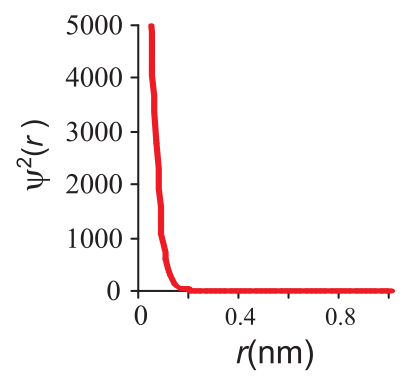
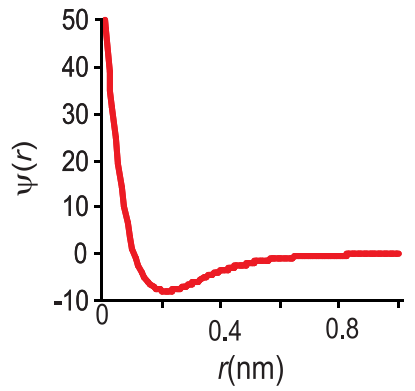
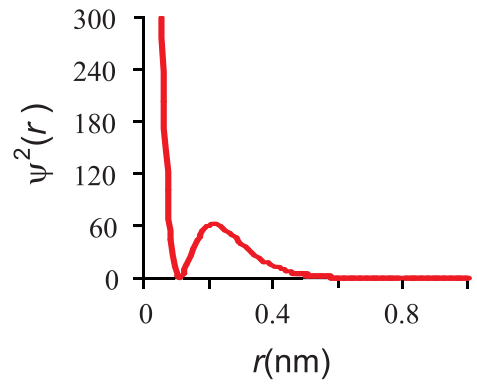
The plot of orbital wave function $\psi(\text{r})$ as a function of distance $r$ of the electron from the nucleus for $2\ s$ orbital is :
AnswerPlots of $(a)$ and $(c)$ are the variation of orbital wave function $\psi(\text{r})$ with $r(nm)$ while $(b)$ and $(d)$ are the variation of probability density $\psi^2(\text{r})$ as a function of distance $(r)$ of the electron from the nucleus for $1s$ and $2s$ orbital.
For $1s$ orbital the probability density is maximum at the nucleus and it decreased sharply as we move away from it. For $2s$ orbital the probability density first decreases sharply to zero and then starts increasing. After reaching maxima it decreases again and approaches zero as the value of $r$ increases further.
View full question & answer→MCQ 261 Mark
The pair of ions having same electronic configuration is $ .........$
- A
$\mathrm{Cr}^{3+}, \mathrm{Fe}^{3+}$
- ✓
$\mathrm{Fe}^{3+}, \mathrm{Mn}^{2+}+$
- C
$\mathrm{Fe}^{3+}, \mathrm{CO}^{3+}$
- D
$\mathrm{Sc}^{3+}, \mathrm{Cr}^{3+}$
AnswerCorrect option: B. $\mathrm{Fe}^{3+}, \mathrm{Mn}^{2+}+$
$ { }_{26} \mathrm{Fe}=[\mathrm{Ae}] 3 \mathrm{d}^6, 4 \mathrm{s}^2{ }_{26} \mathrm{Fe}^{3+}=[\mathrm{Ar}] 3 \mathrm{d}^5 $
$ { }_{25} \mathrm{Mn}=[\mathrm{Ar}] 3 \mathrm{d}^5, 4 \mathrm{s}^2{ }_{25} \mathrm{Mn}^{2+}=[\mathrm{Ar}] 3 \mathrm{d}_5$
View full question & answer→MCQ 271 Mark
Mass number is also called as $ .........$
AnswerThe mass number $(A),$ also called atomic mass number or nucleon number, is the total number of protons and neutrons $($together known as nucleons$)$ in an atomic nucleus. It determines the atomic mass of atoms.
View full question & answer→MCQ 281 Mark
Atomic number of elements represent :
- ✓
Number of protons in the nucleus.
- B
Number of neutrons in the nucleus.
- C
Number of protons an neutrons in the nucleus.
- D
The valency of an element.
AnswerCorrect option: A. Number of protons in the nucleus.
Atomic number is the number of protons in nucleus of an atom.
View full question & answer→MCQ 291 Mark
Identify the pairs which are not of isotopes?
- A
$^{13}_6\text{X},\ ^{13}_6\text{Y}.$
- B
$^{35}_{17}\text{X},\ ^{37}_{17}\text{Y}.$
- ✓
$^{14}_6\text{X},\ ^{14}_7\text{Y}.$
- D
$^{8}_5\text{X},\ ^{8}_5\text{Y}.$
AnswerCorrect option: C. $^{14}_6\text{X},\ ^{14}_7\text{Y}.$
Isotopes have the same atomic number but different mass number.
$\therefore\ \Big(\ ^{14}_{6}\text{X},\ ^{14}_{7}\text{Y}\Big)$ and $\Big(\ ^8_4\text{X},\ ^8_5\text{Y}\Big)$ are not isotopes.
View full question & answer→MCQ 301 Mark
By knowing the number of protons in a neutral atom, one can determine :
- ✓
The identity of the element.
- B
The number of neutrons in the atom.
- C
The number of common isotopes of the element.
- D
AnswerCorrect option: A. The identity of the element.
In a neutral atom, the number of protons is always the atomic number of the element and uniquely identifies the element. and in this, the number of positive protons and negative electrons is always equal.
View full question & answer→MCQ 311 Mark
Thomson's atomic model concluded that $ ........ $ is the constituent particle of all kinds of atoms.
AnswerThomson experiments with cathode $-$ ray tubes showed that all atoms contain tiny negatively charged subatomic particles or electrons.
View full question & answer→MCQ 321 Mark
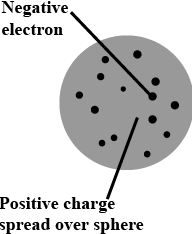
The first model of an atom was given by $ ..........$
AnswerSir J.J Thomson gave the first model of atom.
He by means of cathode $-$ ray experiment discovered the existence of negatively charged particles in an atom which led to the discovery of electrons.
He gave the plum $-$ pudding model of an atom in which electrons are embedded in atom $-$ like currants.
Positive electrons are distributed all over the atom.
View full question & answer→MCQ 331 Mark
Which of the following is responsible to rule out the existence of definite paths or trajectories of electrons?
- A
Pauli’s exclusion principle.
- ✓
Heisenberg’s uncertainty principle.
- C
Hund’s rule of maximum multiplicity.
- D
AnswerCorrect option: B. Heisenberg’s uncertainty principle.
According to Heisenberg’s uncertainty principle, the position and velocity of an electron cannot be determined simultaneously with accuracy which rules out the existence of fixed paths.
View full question & answer→MCQ 341 Mark
If $\ce{E_A, E_B}$ and $\ce{E_C}$ represent kinetic energies of an electron, alpha particle and proton respectively and each moving with same de $-$ Broglie wavelength, then choose the correct increasing representation,
AnswerCorrect option: D. $\ce{E_A < E_C < E_B}$
View full question & answer→MCQ 351 Mark
Who is regarded as father of modern chemistry ?
AnswerAntoine Lavoisier $(1743-1794)$. He was a French chemist who made important contributions to the science. He is considered the father of modern chemistry. He recognized and named oxygen and isolated the major components of air. Antoine-Laurent de Lavoisier is known as "the father of modern chemistry."
View full question & answer→MCQ 361 Mark
Which of the following is the energy of a possible excited state of hydrogen?
- A
$+\ \ce{13.6eV}$
- B
$-\ \ce{6.8eV}$
- ✓
$-\ \ce{3.4eV}$
- D
$+\ \ce{6.8eV}$
AnswerCorrect option: C. $-\ \ce{3.4eV}$
View full question & answer→MCQ 371 Mark
The electronic configuration of element with atomic no. $14$ is :
- A
$(2, 6, 6)$
- B
$(4, 6, 4)$
- C
$(2, 4, 8)$
- ✓
$(2, 8, 4)$
AnswerCorrect option: D. $(2, 8, 4)$
Electronic configuration of element with atomic number with $14$ is $2, 8, 4$
View full question & answer→MCQ 381 Mark
The number of neutrons in the dispositive zinc ion is : $($mass number of $Zn = 65)$
View full question & answer→MCQ 391 Mark
Pauli exclusion principle states that :
- A
No two electrons in an atom can have the same set of four quantum numbers.
- B
Only two electrons may exist in the same orbital and these electrons must have opposite spin.
- ✓
Both $(a)$ and $(b)$.
- D
AnswerCorrect option: C. Both $(a)$ and $(b)$.
View full question & answer→MCQ 401 Mark
The number of radial nodes for $3p$ orbital is $ ..........$
AnswerNumber of radial nodes $= n - 1 - 1$
For $3p$ orbital, $n = 3 - 1 - 1 = 1$
Number of radial nodes $= 3 - 1 - 1 = 1.$
View full question & answer→MCQ 411 Mark
Which of the following properties of atom could be explained correctly by Thomson model of atom?
- ✓
Overall neutrality of atom.
- B
Spectra of hydrogen atom.
- C
Position of electrons, protons and neutrons in atom.
- D
AnswerCorrect option: A. Overall neutrality of atom.
View full question & answer→MCQ 421 Mark
Which of the following statement is not correct about the characteristics of cathode rays?
- A
They start from the cathode and move towards the anode.
- B
They travel in straight line in the absence of an external electrical or magnetic field.
- C
Characteristics of cathode rays do not depend upon the material of electrodes in cathode ray tube.
- ✓
Characteristics of cathode rays depend upon the nature of gas present in the cathode ray tube.
AnswerCorrect option: D. Characteristics of cathode rays depend upon the nature of gas present in the cathode ray tube.
Characteristics of cathode rays depend upon the nature of gas present in the cathode ray tube. Because Characteristics of cathode rays does not depend upon the nature of gas present in the cathode ray tube.
View full question & answer→MCQ 431 Mark
The principal quantum number increases, the difference of energy between consecutive energy levels :
- ✓
- B
- C
- D
Ometimes increases and sometimes decreases.
AnswerDifference in energy is given as; $\triangle\text{E}=\frac{\text{Z}^2\text{R}}{\text{n}^2}$
Therefore, as principal quantum number $(n)$ increases the energy of transition decreases.
View full question & answer→MCQ 441 Mark
In the line spectrum of hydrogen, the lines described by the formula $\overline{\text{v}}=109.677\Big(\frac{1}{2^2}-\frac{1}{\text{n}^2}\Big)\text{cm}^{-1}$ where, $n =$ integer, $\text{n}\geq3.$
Constitutes :
View full question & answer→MCQ 451 Mark
Magnetic moment $\ce{2.83BM}$ is given by which of the following ions? $[$Atomic number $\ce{Ti = 22, Cr = 24, Mn = 25, Ni = 28].}$
- A
$\ce{Ti}^{3+}$
- ✓
$\ce{Ni}^{2+}$
- C
$\ce{Cr}^{2+}$
- D
$\ce{Mn}^{2+}$
AnswerCorrect option: B. $\ce{Ni}^{2+}$
$4s^03d^8$ has $3$ unpaired electon,
$\mu=\sqrt{\text{n}(\text{n}+2)}=\sqrt{3\times5}=\sqrt{15}$
$=3.83\text{BM}.$
View full question & answer→MCQ 461 Mark
Which of the following options does not represent ground state electronic configuration of an atom?
- A
$\ce{1 s^2 2 s^2 2 p^6 3 s^2 3 p^6 3 d^8 4 s^2} $
- B
$\ce{1 s^2 2 p^6 3 s^2 3 p^6 3 d^9 4 s^2 }$
- C
$\ce{ 1 s^2 2 s^2 2 p^6 3 s^2 3 p^6 3 d^{10} 4 s^1} $
- ✓
$\ce{1 s^2 2 s^2 2 p^6 3 s^2 3 p^6 3 d^5 4 s^1}$
AnswerCorrect option: D. $\ce{1 s^2 2 s^2 2 p^6 3 s^2 3 p^6 3 d^5 4 s^1}$
Correct configuration should be $\ce{1 s^2 2 s^2 2 p^6 3 s^2 3 p^6 3 d^{10} 4 s^1}$ for the copper which has atomic number $\ce{29(29Cu)}$. Due to extra stability of full filled orbital of $d-$ subshell, the last electron enter into $d-$ orbital instead of $s-$ orbital.
View full question & answer→MCQ 471 Mark
Atomic mass number is same as $ .........$
AnswerThe mass number $(A),$ also called atomic mass number or nucleon number, is the total number of protons and neutrons $($together known as nucleons$)$ in an atomic nucleus. This is not the same as the atomic number $(Z)$ which denotes the number of protons in a nucleus, and thus uniquely identifies an element.
View full question & answer→MCQ 481 Mark
Aufbau principle does not give the correct arrangement of filling up of the atomic orbitals in :
- A
$\ce{Cu}$ and $\ce{Zn}$
- B
$\ce{Co}$ and $\ce{Zn}$
- C
$\ce{Mn}$ and $\ce{Cr}$
- ✓
$\ce{Cu}$ and $\ce{Cr}$
AnswerCorrect option: D. $\ce{Cu}$ and $\ce{Cr}$
Aufbau principle does not give the correct arrangement of filling up of atomic orbitals in copper and chromium because half $-$ filled and completely filled electronic configuration of $\ce{Cr}$ and $\ce{Cu}$ have lower energy and therefore, more stable.
$\ce{Cr(Z = 24) = 1 s^2, 2 s^2 2 p^6, 3 s^2 3 p^6 3 d^5, 4 s^1}$
$\ce{Cu(Z = 29) = $1 s^2, 1 s^2 2 p^6, 3 s^2 3 p^6 3 d^{10}, 4 s^1}$
View full question & answer→MCQ 491 Mark
While revolving in discrete orbits, the electrons do not radiate energy. These orbits or shells are called $ .........$
AnswerWhile revolving in discrete orbits, the electrons do not radiate energy.
These orbits or shells are called energy levels.
View full question & answer→MCQ 501 Mark
How many lines does a spectrum contain in an electronic transition from $n = 1$ to $n = 5$ in hydrogen atom?
AnswerThe no. of spectral lines produced in a spectrum $=\frac{(\text{n}_2-\text{n}_1)(\text{n}_2-\text{n}_1+1)}{2}$
Given that $\ce{n_2 = 5}$ and $\ce{n_1= 1}$ ; the no. of spectral lines $=\frac{4\times5}{2}$
$= 10.$
View full question & answer→MCQ 511 Mark
How many electrons can fit in the orbital for which : $n = 3$ and $l = 1\ ?$
View full question & answer→MCQ 521 Mark
The difference between the mass number and the atomic number gives the $ .........$
View full question & answer→MCQ 531 Mark
Atomic number is denoted by $ ..........$
AnswerAtomic number is denoted by $Z.$
View full question & answer→MCQ 541 Mark
The maximum number of electrons that can be filled into all the orbitals corresponding to the azimuthal quantum number $l = 3,$ is :
AnswerFor $l = 3,$ possible values of $m = 2l + 1 = 7$. For each m, there can be $2$ electrons filled.
Maximum number of electrons, thus $= 2 \times 7 = 14.$
View full question & answer→MCQ 551 Mark
The electronic configuration of an element is $\ce{1s^22s^22p^3}$. The number of unpaired electron in this atom are :
View full question & answer→MCQ 561 Mark
The phenomenon of splitting of spectral lines under the influence of the electric field is called :
MCQ 571 Mark
Element having atomic number $33$ belongs to this group?
- A
$\ce{III}$
- B
$\ce{IV}$
- ✓
$\ce{V}$
- D
$\ce{VI}$
AnswerCorrect option: C. $\ce{V}$
Electronic configuration of element with atomic number $33$ is $\ce{1 s^2 2 s^2 2 p^6 3 s^2 3 p^6 4 s^2 3 d^{10} 4 p^3}$.
So, it is a $p\ -$ block element with $3$ electrons in $p$ orbital, therefore it lies in $5\ A$ group or $15$ group.
View full question & answer→MCQ 581 Mark
Bohr proposed his atomic model based on :
AnswerBohr proposed his atomic model based on planck's quantum theory.
View full question & answer→MCQ 591 Mark
Energy of the electron in Bohr's orbit is equal to ?
- A
- B
- ✓
Sum of potential and kinetic energy.
- D
difference of kinetic and potential energy.
AnswerCorrect option: C. Sum of potential and kinetic energy.
Energy of electron in Bohr orbit is equal to sum of kinetic and potential energy.
$\triangle \ce{E = KE + PE}$
Because of orbital energy is $PE$ and electron revolving energy is kinetic energy.
View full question & answer→MCQ 601 Mark
Determine the number of electron in the isotope of $'H\ ' ($mass no. $2).$
AnswerThe isotope has atomic number $1$ and thus no. of protons is equal to no. of electrons $= 1.$
View full question & answer→MCQ 611 Mark
The atomic number of an element is $32$ and mass number $55$. Calculate the number of neutrons?
AnswerAtomic number or number of protons $= 32$
Mass number $= 55$
Mass number $(A) \ =$ Number of protons $+$ Number of neutrons
$55 = 32\ +$ Number of neutrons
Number of neutrons $= 55 − 32$
Number of neutrons $= 23$
View full question & answer→MCQ 621 Mark
Pairing of electrons in the orbitals belonging to the same subshell $(p, d$ or $f)$ does not take place until each orbital belonging to that subshell is singly occupied. This is called :
- ✓
Hund's rule of maximum multiplicity.
- B
Pauli's exclusion principle.
- C
- D
AnswerCorrect option: A. Hund's rule of maximum multiplicity.
Pairing of electrons in the orbitals belonging to the same subshell $(p, d$ or$f)$ does not take place until each orbital belonging to that subshell has got one electron each, i.e. it is singly occupied. This is called Hund's rule of maximum multiplicity.
View full question & answer→MCQ 631 Mark
A neutral atom has $13$ electrons and $14$ neutrons. Its mass number is $ ..........$
View full question & answer→MCQ 641 Mark
- A
The spectrum of hydrogen atom only.
- ✓
The spectrum of any atom or ion having one electron only.
- C
The spectrum of hydrogen molecule.
- D
AnswerCorrect option: B. The spectrum of any atom or ion having one electron only.
Bohr's model successfully explained the spectrum of an atom or ion having one electron only.
View full question & answer→MCQ 651 Mark
According to modern atomic theory atoms of argon and calcium have same atomic weight, these are known as :
AnswerAtoms having same atomic weights are known as isobars.
View full question & answer→MCQ 661 Mark
When an electron do transition from $n = 4$ to $n = 2,$ the emitted line of spectrum will be :
- A
First line of Lyman series.
- ✓
Second line of Balmer series.
- C
First line of Paschen series.
- D
Second line of Paschen series.
AnswerCorrect option: B. Second line of Balmer series.
Balmer series corresponds to visible region.
Now for, $n = 4, n = 2$ we get
$4 − 2 = 2$
View full question & answer→MCQ 671 Mark
Mass number is $ ........$
- ✓
The sum of the total number of protons and neutrons present in the nucleus of an atom.
- B
The electrons present in the outermost shell of an atom.
- C
An atom of each element having a definite combining capacity.
- D
The total number of protons present in the nucleus of an atom.
AnswerCorrect option: A. The sum of the total number of protons and neutrons present in the nucleus of an atom.
The mass number is defined as the sum of the total number of protons and neutrons present in the nucleus of an atom.
View full question & answer→MCQ 681 Mark
Two atoms are said to be isobars if :
- A
They have same atomic number but different mass number.
- B
They have same number of electrons but different number of neutrons.
- C
They have same number of neutrons but different number of electrons.
- ✓
Sum of the number of protons and neutrons is same but the number of protons is different.
AnswerCorrect option: D. Sum of the number of protons and neutrons is same but the number of protons is different.
Isobars have different atomic number, i.e., number of protons but same mass number, i.e., sum of number of protons and neutrons.
View full question & answer→MCQ 691 Mark
Which of the following is wrong statement?
- A
The uncertainty principle is $\Delta\text{x}.\Delta\geq\frac{\text{h}}{4\pi}.$
- B
Half filled and fully filled orbitals have greater stability due to greater exchange energy, greater symmetry and more balanced arrangement.
- ✓
The energy of $2s$ orbital is less than the energy of $2p-$ orbitals in case of hydrogen like atoms.
- D
de Broglie wavelength, $\lambda=\frac{\text{h}}{2\pi}.$
AnswerCorrect option: C. The energy of $2s$ orbital is less than the energy of $2p-$ orbitals in case of hydrogen like atoms.
View full question & answer→MCQ 701 Mark
Chlorine exists in two isotopic forms, $\text{Cl}-37$ and $\ce{Cl}-35$ but its atomic mass is $35.5$. This indicates the ratio of $\ce{Cl}-37$ and $\ce{Cl}-35$ is approximately :
- A
$1 : 2.$
- B
$1 : 1.$
- ✓
$1 : 3.$
- D
$3 : 1.$
AnswerCorrect option: C. $1 : 3.$
$^{37}_{17}\text{C}:\ ^{35}_{17}\text{Cl}$
$1\ \ \ \ :\ \ 3$ Ratio Average atomic mass $=\frac{(1\times37)+(3\times35)}{1+3}=\frac{142}{4}=35.5$
View full question & answer→MCQ 711 Mark
Atomic number of platinum is?
AnswerAtomic number of Platinum is $78.$
View full question & answer→MCQ 721 Mark
The de Broglie wavelengths associated with a ball of mass $1\ kg$ having kinetic energy $0.5J$ is :
- ✓
$6.626 \times 10^{-34} \mathrm{~m}$
- B
$13.20 \times 10^{-34} \mathrm{~m}$
- C
$10.38 \times 10^{-21} \mathrm{~m}$
- D
$6.626 \times 10^{-34} \mathrm{~A}$
AnswerCorrect option: A. $6.626 \times 10^{-34} \mathrm{~m}$
$\lambda=\frac{\text{h}}{\text{mv}}$ and $\ce{K.E}. =\frac{1}{2}\text{mv}^2$
$\text{v}^2=\frac{2\text{KE}}{\text{m}}$
$\Rightarrow\text{v}=\sqrt{\frac{\text{KE}\times2}{\text{m}}}$
$\lambda=\frac{\text{h}}{\text{m}\sqrt{\frac{2\text{KE}}{\text{m}}}}$
$=\frac{\text{h}}{\sqrt{2\text{KE}\times\text{m}}}=\frac{6.626\times10^{-34}}{\sqrt{2\times0.5\times1}}$
$=6.626\times10^{-34}\text{m}$
View full question & answer→MCQ 731 Mark
For an element $\ce{(Z = 25)},$ how many electrons are present in the $"N\ "$ shell in its ground state?
Answer$25$ is atomic number of Manganese.
Electronic Configuration : $[\mathrm{Ar}] 4 \mathrm{~s}^2 3 \mathrm{~d}^5$
View full question & answer→MCQ 741 Mark
he atomic number is identical to the amount of $ ........ $ in the atom nucleus.
AnswerThe element number is identical to the amount of protons in the atom nucleus. The amount of neutrons of an element varies, two atoms with the same amount of protons and neutrons are of the same isotope.
View full question & answer→MCQ 751 Mark
Bohrs atomic model assumes :
- A
The nucleus is of infinite mass and is at rest
- B
Electron in a quantized orbit will not radiate energy
- C
Mass of the electron remains constant
- ✓
AnswerBohr's Assumption:
$(i)$ Electron in atoms orbit the nucleus.
$(ii)$ Electron in a quantized orbit will not radiate energy.
$(iii)$ Electrons can only gain and lose energy by jumping from one allowed orbit to other.
He also assumed one of the postulates of Rutherford's atomic model, that is, the mass of the nucleus is very large compared to that of the electrons and hence assumed to be infinite.
View full question & answer→MCQ 761 Mark
The energy of a hydrogen atom in the ground state is $\ce{13.6 eV}$. The energy of $\ce{He} +$ ion in the first excited state will be :
- ✓
$-\ce{13.6 eV}$
- B
$-\ce{27.2 eV}$
- C
$-\ce{54.4 eV}$
- D
$-\ce{6.8 eV}$
AnswerCorrect option: A. $-\ce{13.6 eV}$
$\text{E}_\text{n}=-13.6\Big(\frac{\text{Z}^2}{\text{n}^2}\Big)=(-13.6)\Big(\frac{4}{4}\Big)=-13.6\text{ eV}$
View full question & answer→MCQ 771 Mark
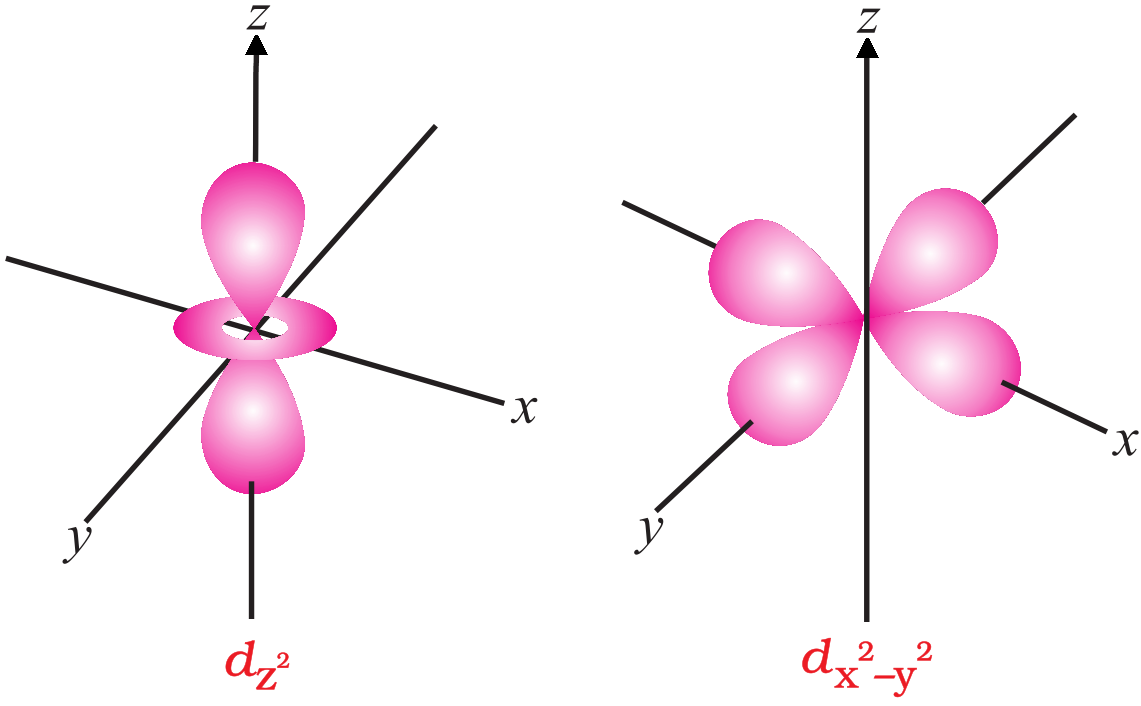
Which of the following pairs of $d-$ orbitals have electron density along the axis?
- A
$\text{d}_{\text{z}^2}\text{d}_{\text{xz}}$
- B
$\text{d}_{\text{xz}},\text{d}_\text{yz}$
- ✓
$\text{d}_{\text{z}^2},\text{d}_{\text{x}^2\text{y}^2}$
- D
$\text{d}_{\text{zy}},\text{d}_{\text{x}^2\text{y}^2}$
AnswerCorrect option: C. $\text{d}_{\text{z}^2},\text{d}_{\text{x}^2\text{y}^2}$
They have electron density along the axis.
View full question & answer→MCQ 781 Mark
A neutral atom has $12$ electrons and $13$ neutrons. Its mass number is :
Answerass $=$ number of electrons/ protones $+$ number of neutrons
$= 12 + 13 = 25$
View full question & answer→MCQ 791 Mark
Which of the following energy state is filled by an electron after the completion of 4p orbital?
MCQ 801 Mark
In the lowest energy level of hydrogen atom, electron has an angular momentum equal to :
- A
$\frac{\pi}{\text{h}}$
- B
$\frac{\text{h}}{\pi}$
- ✓
$\frac{\text{h}}{2\pi}$
- D
$\frac{2\pi}{\text{h}}$
AnswerCorrect option: C. $\frac{\text{h}}{2\pi}$
The angular momentum $L = \ce{m_evr}$ is on integer multiple of $\frac{\text{h}}{2\pi}$
$\text{mvr}=\frac{\text{nh}}{2\pi}$
For $, n = 1$
$\text{mvr}=\frac{\text{h}}{2\pi}$
View full question & answer→MCQ 811 Mark
Orbital angular momentum depends on $ ..........$
- ✓
$l$
- B
$n$ and $l$
- C
$n$ and $m$
- D
$\ce{m}$ and $\ce{s}$
View full question & answer→MCQ 821 Mark
Relative molecular mass of water is $ .........$
AnswerRelative molecular mass for water $\ce{(H_2O)}$
$= 2\ \times $ relative atomic number for hydrogen $+\ 1\ \times $ relative atomic number for oxygen
$= 2 \times 1 + 1 \times 16$
$= 18$
View full question & answer→MCQ 831 Mark
The atomic weight of an atom is because of :
- A
- B
- ✓
- D
Electrons, neutrons and protons.
AnswerAtomic weight depends upon mass number, which is equal to sum of, number of protons and neutrons.
View full question & answer→MCQ 841 Mark
Which of the following conclusions could not be derived from Rutherford’s $\alpha-$ particle scattering experiement?
AnswerCorrect option: C. Electrons move in a circular path of fixed energy called orbits.
The concept of circular paths of fixed energy was proposed by Bohr and not derived from Rutherford’s scattering experiment.
View full question & answer→MCQ 851 Mark
What is maximum number of orbitals that can be identified with the following quantum number?
AnswerOut of $3{\text{p}_\text{x}},3\text{}\text{p}_\text{y},3\text{p}_\text{z}$ only one of them $3\text{p}_\text{z}$ will have $\ce{m_I = 0,}$ others will have $+\ 1$ and $-\ 1.$
View full question & answer→MCQ 861 Mark
After the completion of $\text{np6}$ electronic configuration, the next orbital will be filled by :
- A
$\ce{(n + 1)d}$
- ✓
$\ce{(n + 1)s}$
- C
$\ce{(n + 1)f}$
- D
AnswerCorrect option: B. $\ce{(n + 1)s}$
View full question & answer→MCQ 871 Mark
How much energy would be required by an electron while moving from ground state to $3^{rd}$ excited state in $\ce{He}^+$ ion :
- A
$\ce{40.8ev}$
- B
$\ce{0.2ev}$
- ✓
$\ce{51ev}$
- D
$\ce{35ev}$
AnswerCorrect option: C. $\ce{51ev}$
View full question & answer→MCQ 881 Mark
According to Bohr hypothesis, discrete quantity is :
MCQ 891 Mark
The series of lines appearing in $\ce{UV}$ region of electromagnetic spectrum of hydrogen is called :
View full question & answer→MCQ 901 Mark
The electrons are filled in various sub levels according to the order of their energies, is known as :
AnswerThe order of filling of orbitals from lower energy to higher energy is explained by the Aufbau's principle and the $\ce{n + l}$ rule.
View full question & answer→MCQ 911 Mark
Atomic number of element $ ........ $ is $19.$
- A
$\ce{Mg}$
- ✓
$\ce{K}$
- C
$\ce{Ar}$
- D
$\ce{Ca}$
AnswerCorrect option: B. $\ce{K}$
Atomic number of potassium $\ce{(K)}$ is $19.$
Atomic numbers of $\ce{Mg, Ar}$ and $\ce{Ca}$ are $12, 18$ and $20$ respectively.
View full question & answer→MCQ 921 Mark
The first model of an atom is given by :
MCQ 931 Mark
The electronic transition from $n = 2$ to $n = 1$ will produce the shortest wavelength in $($where, $n =$ principal quantum number$).$
- A
$\ce{He}^+$
- B
$\ce{H}$
- C
$\ce{H}^+$
- ✓
$\ce{Li}2^+$
AnswerCorrect option: D. $\ce{Li}2^+$
The electronic transition from $n = 2$ to $n = 1$ will produce the shortest wavelength in $\ce{Li}2^+$.
The exact value can be calculated via Rydberg formula,
$\Big(\because\text{Z}\propto\frac{1}{\lambda}\Big)$
View full question & answer→MCQ 941 Mark
Atomic number of calcium is?
AnswerThe number o protons found in the nucleus of an aumbtom of a given element is called atomic ner. Elements are placed in periodic table according to their atomic numer.
View full question & answer→MCQ 951 Mark
Which of the following has the same number of protons?
AnswerIsotopes are elements having the same atomic number but different mass numbers. e.g : $_1 \ce{{H}^1,_1{H}^2,_1{H}}^3$ are isotopes of hydrogen.
View full question & answer→MCQ 961 Mark
The best evidence that electrons are arranged in definite orbits or energy levels is based on the observation that :
- ✓
Atomic spectra consist of discrete lines and not continuous bands.
- B
Electrons in the beta ray have high kinetic energy.
- C
The penetrating power of cathode ray electrons depends upon the voltage used to produce them.
- D
Electrons revolve around the nucleus.
AnswerCorrect option: A. Atomic spectra consist of discrete lines and not continuous bands.
The best evidence that electrons are arranged in definite orbits or energy levels is based on the observation that the spectral lines of hydrogen atom consist of discrete lines and not continuous bands.
View full question & answer→MCQ 971 Mark
Impossible orbital among the following is :
AnswerIf the value of principle quantum number is $3$.
So the maximum possible value of Azimuthal quantum number is $(3 - 1) = 2$ which describes the $d$ subshell.
But for $f$ subshell, the value of $l$ must be $3$.
So, $3f$ orbital is not possible at all.
View full question & answer→MCQ 981 Mark
According to the electromagnetic theory of Maxwell, which one is correct?
AnswerCorrect option: A. Charged particles when accelerated should emit electromagnetic radiation.
View full question & answer→MCQ 991 Mark
The pair of ions having same electronic configuration is $ ..........$
- A
$\mathrm{Cr}^{3+}, \mathrm{Fe}^{3+}$
- ✓
$\mathrm{Fe}^{3+}, \mathrm{Mn}^{2+}$
- C
$\mathrm{Fe}^{3+}, \mathrm{Co}^{3+}$
- D
$\mathrm{Sc}^{3+}, \mathrm{Cr}^{3+}$.
AnswerCorrect option: B. $\mathrm{Fe}^{3+}, \mathrm{Mn}^{2+}$
$ \mathrm{Cr}^{3+}(Z=24)=[\mathrm{Ar}] 3 \mathrm{~d}^3 $
$ \mathrm{Fe}^{3+}(\mathrm{Z}=26)=[\mathrm{Ar}] 3 \mathrm{d}^5 $
$ \mathrm{Mn}^{2+}(\mathrm{Z}=25)=[\mathrm{Ar}] 3 \mathrm{d}^5$
$ \mathrm{Co}^{3+}(\mathrm{Z}=27)=[\mathrm{Ar}] 3 \mathrm{d}^6 $
$ \mathrm{Sc}^{3+}(\mathrm{Z}=21)=[\mathrm{Ar}] 3 \mathrm{d}^0$
$\ce{Fe^{3+}}$ and $\ce{Mn^{2+}}$ will have the same number of electrons,
i.e., $23$ and, hence, have the same electronic configuration.
View full question & answer→MCQ 1001 Mark
Which of these have the same chemical properties, but their physical properties may be different?
MCQ 1011 Mark
Elements which have fully filled valence shell electrons belong to :
MCQ 1021 Mark
Which of the following properties of atom could be explained correctly by Thomson Model of atom?
- ✓
Overall neutrality of atom.
- B
Spectra of hydrogen atom.
- C
Position of electrons, protons and neutrons in atom.
- D
AnswerCorrect option: A. Overall neutrality of atom.
According to Thomson model of atom, the mass of the atom is assumed to be uniformly distributed over the atom. This model was able to explain the overall neutrality of the atom.
View full question & answer→MCQ 1031 Mark
The atomic numbers of elements $X, Y$ and $Z$ are $19, 21$ and $25$ respectively. The number of electrons present in the $M-$ shell of these elements follow the order :
- A
$\ce{Z > X > Y}$
- B
$\ce{X > Y > Z}$
- ✓
$\ce{Z > Y > X}$
- D
$\ce{Y > Z > X}$
AnswerCorrect option: C. $\ce{Z > Y > X}$
View full question & answer→MCQ 1041 Mark
For an element $, A = 34$ and $N = 19,$ What is the atomic number of the element?
AnswerA is the mass number and $N$ is the number of neutrons.
$A = Z + N$
$Z = A − N$
$Z = 34 − 19$
$Z = 15$
View full question & answer→MCQ 1051 Mark
The spectrum of radiation emitted by a substance after absorbing energy is called :
MCQ 1061 Mark
When electron jumps from $N$ shell to $L$ shell, the energy is :
AnswerThe energy is released when an electron jumps from $N$ shell to $L$ shell as $N$ shell have higher energy than $L$ shell, so, it emits a photon when it transits from $N$ to $L$ shell.
View full question & answer→MCQ 1071 Mark
The ratio of energy to frequency of a radiation emitted by an electron is equal to :
AnswerThe ratio of energy to frequency of a radiation emitted by an electron is equal to Planck's constant.
View full question & answer→MCQ 1081 Mark
The only series of lines appear in the visible region of the electromagnetic spectrum of hydrogen is :
MCQ 1091 Mark
What idea states that lower energy level orbitals will be filled with electrons before higher energy level orbitals?
- A
Pauli's exclusion principle.
- B
- ✓
- D
AnswerAufbau's rule/ principle states that the sub shell and orbitals of lower energy must be filled first before higher energy levels. The energy is proportional to $(n + l)$ value.
View full question & answer→MCQ 1101 Mark
Which of the following properties are similar for isotopes?
- A
- ✓
- C
Both physical and chemical properties.
- D
Neither physical nor chemical properties.
View full question & answer→MCQ 1111 Mark
Major development $(s)$ responsible for the formulation of Bohr's model of atom were :
- A
Dual character of the electromagnetic radiation.
- B
Experimental results regarding atomic spectra which can be explained only by assuming quantized electronic energy levels in atoms.
- ✓
Both $(a)$ and $(b).$
- D
AnswerCorrect option: C. Both $(a)$ and $(b).$
View full question & answer→MCQ 1121 Mark
Identify the correct order of increase in the energy of the orbitals for hydrogen atom :
- ✓
$1s < 28 = 2p < 3s = 3p = 3d < 4s = 4 p = 4d = 4f$
- B
$1s > 2s = 2p > 3s = 3p = 3d > 4s = 4p = 4d = 4f$
- C
$1s = 2s = 3s = 4s > 2p = 3 p = 4p > 3d = 4d > 4f$
- D
$1s = 2s = 3s = 4s < 2p = 3p = 4p < 3d = 4d < 4f$
AnswerCorrect option: A. $1s < 28 = 2p < 3s = 3p = 3d < 4s = 4 p = 4d = 4f$
View full question & answer→MCQ 1131 Mark
What is the nucleon number of an atom?
- A
- B
- ✓
The total number of protons and neutrons.
- D
The total number of protons and electrons.
AnswerCorrect option: C. The total number of protons and neutrons.
The nucleon number or mass number of an atom, is the total number of protons and neutrons in an atomic nucleus.
View full question & answer→MCQ 1141 Mark
Total number of orbitals associated with third shell will be $ ..........$
AnswerTotal number of orbitals associated with $n^{th}$ shell
$= n^2$
Total number of orbitals associated with third shell
$= (3)^2 = 9$
View full question & answer→MCQ 1151 Mark
Atomic number of Bismuth is :
AnswerThe number of protons found in the nucleus of an atom of a given element is called atomic number. Elements are placed in periodic table according to their atomic number. Atomic number increases from left to right and top to bottom of periodic table. Higher the atomic number, heavier is the atom.
View full question & answer→MCQ 1161 Mark
The first line in the Balmer series in the $H$ atom will have the frequency :
- A
$3.29 \times 10^{25} \mathrm{~s}^{-1}$
- ✓
$4.57 \times 10^{24} \mathrm{~s}^{-1}$
- C
$8.22 \times 10^{25} \mathrm{~s}^{-1}$
- D
$8.02 \times 10^{14} \mathrm{~s}^{-1}$
AnswerCorrect option: B. $4.57 \times 10^{24} \mathrm{~s}^{-1}$
Frequency of first line in Balmer series can be calculated as,
$\text{v}=3.29 \times10^{15}\bigg[\frac{1}{\text{n}^2_2}-\frac{1}{\text{n}^2_2}\bigg]\text{s}^{-1}$
Here, $\text{n}_1=2$
$\Rightarrow\text{n}_2=3$
$=3.29\times10^{15}\times\frac{5}{36}$
$=4.57\times10^{14}\text{s}^{-1}.$
View full question & answer→MCQ 1171 Mark
The probability density plots of $1s$ and $2s$ orbitals are given in Fig :
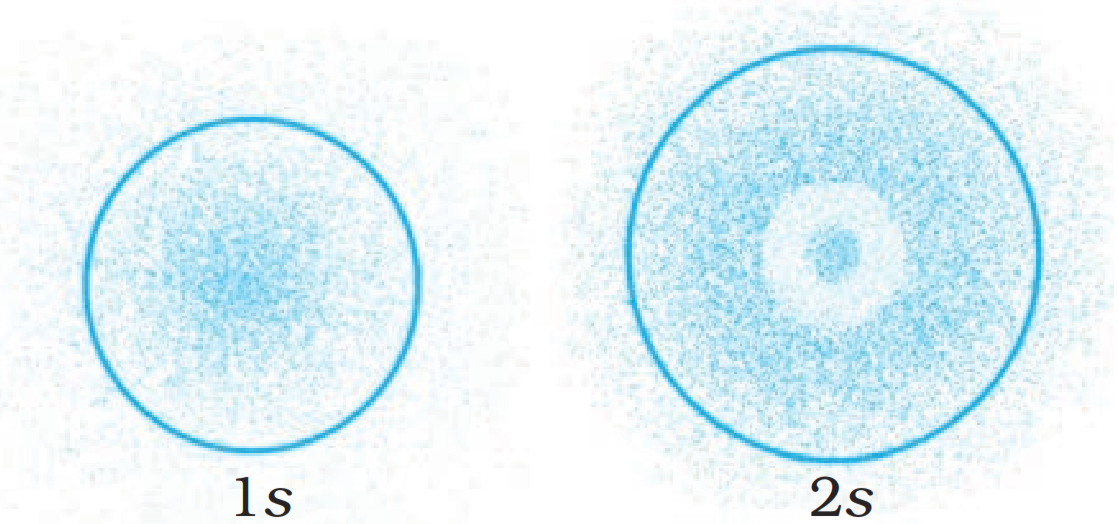
The density of dots in a region represents the probability density of finding electrons in the region.
On the basis of above diagram which of the following statements is incorrect?
AnswerCorrect option: D. The probability density of electrons for $2s$ orbital decreases uniformly as distance from the nucleus increases.
The probability density of electrons for $2s$ orbital first increases then decreases and after that it begins to increase again.
View full question & answer→MCQ 1181 Mark
The atomic number at which filling of a $g-$ zorbital is likely to begin is :
AnswerThe above question can be answered on the basis of reasoning from analogy. We note that two periods have to pass before $d-$ orbitals begin to fill. This is also true of the spot where $f-$ orbitals commence filling. The second row where $f-$ orbitals fill happens to be row $\#\ 7 \ ($the one starting with $Fr)$. The first element where $5f-$ orbitals enter in is actinium $(\ce{Ac , Z = 89})$. Adding $32$ to this would give element $121$ termed as Unbiunium, the first Super $-$ Actinide.
View full question & answer→MCQ 1191 Mark
According to Aufbau principle, the electron has a tendency to occupy that sub $-$ shell which has :
AnswerThe Aufbau principle states that in the ground state of an atom or ion, electrons fill atomic orbitals of the lowest available energy levels before occupying higher levels $($e.g., $1s$ before $2s)$. In this way, the electrons of an atom or ion form the most stable electron configuration possible.
View full question & answer→MCQ 1201 Mark
Atomic number is given by the number of $ ........ $ of an atom.
AnswerIt is the number of protons of an atom, which determines its atomic number.
View full question & answer→MCQ 1211 Mark
Which of the following options does not represent ground state electronic configuration of an atom
- A
$ \ce{1 s^2 2 s^2 2 p^6 3 s^2 3 p^6 3 d^8 4 s^2} $
- ✓
$ \ce{1 s^2 2 s^2 2 p^6 3 s^2 3 p^6 3 d^9 4 s^2} $
- C
$ \ce{1 s^2 2 s^2 2 p^6 3 s^2 3 p^6 3 d^{10} 4 s^1} $
- D
$\ce{1 s^2 2 s^2 2 p^6 3 s^2 3 p^6 3 d^5 4 s^1} $
AnswerCorrect option: B. $ \ce{1 s^2 2 s^2 2 p^6 3 s^2 3 p^6 3 d^9 4 s^2} $
Correct electronic configuration of the two subshells $(3d$ and $4s)$ should be $\ce{3d^{10} 4s^1}$.
In certain elements such as $\ce{Cu}$ or $\ce{Cr},$ where the two subshells $(4s$ and $3d)$ differ slightly in.
View full question & answer→MCQ 1221 Mark
$f$ Aufbau rule is violated, then $\ce{Ca}^{20}$ will be in :
- A
$S-$ block
- B
$P-$ block
- ✓
$D-$ block
- D
$F-$ block
AnswerCorrect option: C. $D-$ block
According to the Aufbau principle, electron enters into the lowest energy level $($orbital$),$ before entering into a higher energy level. Hence, according to this principle, the electronic configuration of $\ce{Ca}^{20}$ is $\ce{1 s^2 2 s^2 2 p^6 3 s^2 3 p^6 4 s^2}$, as differentiating electron enters into the $s-$orbital, $\ce{Ca}$ belongs to $s-$ block.
If we don't follow the Aufbau rule, the electronic configuration of $\ce{Ca}^{20}$ would be $\ce{1 s^2 2 s^2 2 p^6 3 s^2 3 p^6 3 d^2}$.
View full question & answer→MCQ 1231 Mark
Bohr modified the $ .......... $ by adding that the electrons move in orbits of fixed size and energy.
AnswerBohr modified the Rutherford model by adding that the electrons move in orbits of fixed size and energy. Electrons revolve around the nucleus in concentric circular orbits at fixed distance from the nucleus. These are stationary orbits and the energy of electrons in these orbits is constant.
View full question & answer→MCQ 1241 Mark
Atomic number of nitrogen is $7$. The number of protons in Nitrogen atom is equal to $ ..........$
AnswerSince, atomic number $=$ Number of protons $=$ Number of electrons
Therefore, number of electrons in nitrogen $= 7$
Number of protons in nitrogen $= 7$
View full question & answer→MCQ 1251 Mark
Define the atomic mass unit.
- ✓
Mass unit equal to exactly one $-$ twelfth the mass of a carbon $-12$ atom.
- B
Mass unit equal to exactly the mass of a carbon $-12$ atom.
- C
Mass unit equal to exactly one $-$ twelfth the mass of a hydrogen atom.
- D
AnswerCorrect option: A. Mass unit equal to exactly one $-$ twelfth the mass of a carbon $-12$ atom.
Atomic mass unit is a mass unit equal to exactly one $-$ twelfth the mass of a carbon $-12$ atom.
View full question & answer→MCQ 1261 Mark
Which of the following quantities can only be a whole number?
AnswerAtomic number of an element $=$ number of protons $=$ number of electrons and is always a whole number.
View full question & answer→MCQ 1271 Mark
The main defect of Bohr's atom model is :
- A
Mixing of classical and quantum theories.
- B
Exclusion of nuclear motion.
- C
Failed to explain the fine structure of spectral lines.
- ✓
Failed to explain larger atoms.
AnswerCorrect option: D. Failed to explain larger atoms.
Bohr's model can only clearly explain hydrogen or hydrogen $-$ like atoms, it fails when applied to larger and heavier atoms like iron, gold, mercury, etc.
View full question & answer→MCQ 1281 Mark
What is the name for the number of protons in an atom?
AnswerAtomic number is the number of protons in the nucleus of an atom, which is characteristic of a chemical element and determines its place in the periodic table.
View full question & answer→MCQ 1291 Mark
The correct mathematical expression of Heisenberg's uncertainty principle is :
- A
$\frac{\Delta\text{x}}{\Delta\text{v}_\text{x}}>\frac{\text{h}}{4\pi\text{m}}$
- B
$\Delta\text{x}\times\Delta\text{v}_\text{x}>\frac{\text{h}}{4\pi\text{m}}$
- C
$\Delta_\text{x}\times\Delta\text{v}_\text{x}=\frac{\text{h}}{4\pi\text{m}}$
- ✓
$\Delta\text{x}\times\Delta\text{v}_\text{x}\geq\frac{\text{h}}{4\pi\text{m}}$
AnswerCorrect option: D. $\Delta\text{x}\times\Delta\text{v}_\text{x}\geq\frac{\text{h}}{4\pi\text{m}}$
View full question & answer→MCQ 1301 Mark
Orbital angular momentum depends on $ ............$
- ✓
$\ce{l}.$
- B
$\ce{n}$ and $\ce{l.}$
- C
$\ce{n}$ and $\ce{m}$.
- D
$\ce{m}$ and $\ce{s}.$
AnswerCorrect option: A. $\ce{l}.$
Orbital angular momentum $=\sqrt{\frac{(\text{l}+1){\text{h}}}{2\pi}}$.
Hence, it depends only on $\ce{'l\ '}.$
View full question & answer→MCQ 1311 Mark
In the Schrodinger equation, $\widehat{\text{H}}.$
- A
A mathematical operator called Hamiltonian operator.
- B
Introduced by Schrodinger from the expression for the total energy of the system.
- ✓
Both $(a)$ and $(b)$.
- D
AnswerCorrect option: C. Both $(a)$ and $(b)$.
In Schrodinger equation, $\widehat{\text{H}}$ is a mathematical operator called Hamiltonian. It was introduced by Schrödinger from the expression for the total energy of the system.
View full question & answer→MCQ 1321 Mark
For the electrons of oxygen atom, which of the following statements is correct?
- A
$\ce{Z_{eff}}$ for an electron in a $2\ s$ orbital is the same as $\ce{Z_{eff}}$ for an electron in a $2p$ orbital.
- B
An electron in the $2\ s$ orbital has the same energy as an electron in the $2p$ orbital.
- C
$\ce{Z_{eff}}$ for an electron in $1\ s$ orbital is the same as $\ce{Z_{eff}}$ for an electron in a $2\ s$ orbital.
- ✓
The two electrons present in the $2\ s$ orbital have spin quantum numbers $\ce{m_s}$ but of opposite sign.
AnswerCorrect option: D. The two electrons present in the $2\ s$ orbital have spin quantum numbers $\ce{m_s}$ but of opposite sign.
The two electrons present in the $2\ s$ orbital have spin quantum numbers ms but of opposite sign. It is correct due to Pauli's exclusion principle, “An orbital can have maximum two electrons with opposite spin".
View full question & answer→MCQ 1331 Mark
In which of the following pairs, the ions are iso $-$ electronic?
- ✓
$ \mathrm{Na}^{+}, \mathrm{Mg}^{2+}$
- B
$ \mathrm{Al}^{3+}, \mathrm{O}^{-} $
- C
$ \mathrm{Na}^{+}, \mathrm{O}^{3-} $
- D
$ \mathrm{N}^{3-}, \mathrm{Cl}^{-} $
AnswerCorrect option: A. $ \mathrm{Na}^{+}, \mathrm{Mg}^{2+}$
Atoms or ions having same number of electrons is known as isoelectronic species.
View full question & answer→MCQ 1341 Mark
The mass number of $X$ is $23$ which contains $15$ electrons. What is the atomic mass of $X\ ?$
- A
$38$ amu.
- ✓
$23$ amu.
- C
$8$ amu.
- D
AnswerCorrect option: B. $23$ amu.
Mass no. $=$ no. of protons $ +$ no. of neutrons
Atomic mass $=$ Mass number $= 23$
View full question & answer→MCQ 1351 Mark
Probability of finding an electron at a point within an atom is :
- A
Equal to the $|\psi|^2$ at that point.
- ✓
Proportional to the $|\psi|^2$ at that point.
- C
Inversely proportional to the $|\psi|^2$ at that point.
- D
AnswerCorrect option: B. Proportional to the $|\psi|^2$ at that point.
View full question & answer→MCQ 1361 Mark
When electron jumps from $N$ shell to $L$ shell, the energy is :
AnswerThe energy is released when an electron jumps from $N$ shell to $L$ shell as $N$ shell have higher energy than $L$ shell, so, it emits a photon when it transits from $N$ to $L$ shell.
View full question & answer→MCQ 1371 Mark
Which of the following statements about the electron is incorrect?
- A
It is a negatively charged particle.
- ✓
The mass of electron is equal to the mass of neutron.
- C
It is a basic constituent of all atoms.
- D
It is a constituent of cathode rays.
AnswerCorrect option: B. The mass of electron is equal to the mass of neutron.
The mass of electron is very small as compared to the mass of the neutron.
Mass of electron $= 9.1 \times 10^{-31} \ kg$ Mass of neutron $= 1.674 \times 10^{-27}kg.$
View full question & answer→MCQ 1381 Mark
An electron is moving in Bohr's fourth orbit. Its de $-$ Broglie wavelength is $2$. Calculate the circumference of the fourth orbit.
- A
$2\lambda$
- ✓
$4\lambda$
- C
$\frac{4}{\lambda}$
- D
$\frac{2}{\lambda}$
AnswerCorrect option: B. $4\lambda$
According to Bohr's concept,
$\therefore\text{mvr}=\frac{\text{nh}}{2\pi}\Big(\because\lambda=\frac{\text{h}}{\text{mv}}\Big)$ and $\text{n}=4$
$\therefore$ Circumference $=2\pi\text{r}=4.\frac{\text{h}}{\text{mv}}=4\lambda$
View full question & answer→MCQ 1391 Mark
The relation between atomic number $(Z)$ and atomic mass $(A)$ for light elements is given by :
- A
$A = Z$
- ✓
$A = 2Z$
- C
$2A = Z$
- D
$A = 4Z$
AnswerCorrect option: B. $A = 2Z$
Atomic number $(Z)$ is total no of proton present in nucleus and atomic mass $(A)$ is total no of proton and neutron present in nucleus.
For light atoms till atomic number $20,$ generally atomic mass is twice the atomic number.
$A = 2Z$ as $n = p$
View full question & answer→MCQ 1401 Mark
he electrons revolve around the nucleus only in certain fixed paths called :
AnswerThe electrons revolve around the nucleus only in certain fixed paths called orbits.
They are $\ce{K, L, M, N,}$ etc. Each orbit consists of a fixed number of electrons.
The electrons are distributed in the orbits according to the formula $\ce{2n^2}$.
View full question & answer→MCQ 1411 Mark
Which of the following statement is not correct regarding Bohr's model of hydrogen atom?
- A
Energy of the electrons in the orbit is quantized.
- B
The electron in the orbit nearest to the nucleus has the lowest energy.
- C
Electrons revolve in different orbits around the nucleus.
- ✓
The position and velocity of the electrons in the orbit cannot be determined simultaneously.
AnswerCorrect option: D. The position and velocity of the electrons in the orbit cannot be determined simultaneously.
‘The position and velocity of the electrons in the orbit cannot be determined simultaneously'. This statement is not correct for Bohr's model of hydrogen atom. It is infact given by Heisenberg in his uncertainty principle.
View full question & answer→MCQ 1421 Mark
Two electrons occupying the same orbital are distinguished by :
- A
Principle quantum Number.
- B
- C
Azimuthal quantum number.
- ✓
AnswerAccording to the Pauli exclusion principle no two electrons can have the same set of all four quantum numbers simultaneously. Two electrons present in the same orbital can be distinguished by their spin quantum number. If one of them has $\text{a}+\frac{1}{2}$ value then other must have the $\frac{-1}{2}$value.
View full question & answer→MCQ 1431 Mark
The ration of de Broglie wavelengths of a deuterium atom to that of $a-$ particles, when the velocity of the former is $5$ times greater than of latter is :
Answer$\text{m}_\alpha=2\text{m}_\text{d}$
$\frac{\lambda_\text{D}}{\lambda_\alpha}=\frac{\frac{\text{h}}{\text{m}_\text{D}\text{v}_\text{D}}}{\frac{\text{h}}{\text{m}_\alpha\text{v}_\alpha}}=\frac{\text{m}_\alpha\text{v}_\alpha}{\text{m}_\text{D}\text{v}_\text{D}}=\frac{2}{5}=0.4$
$\because\frac{\text{m}_\alpha}{\text{m}_\alpha}=2$ and $\frac{\text{v}_\text{D}}{\text{V}_\alpha}=5$
View full question & answer→MCQ 1441 Mark
If travelling at same speeds, which of the following matter waves have the shortest wavelength?
AnswerCorrect option: B. Alpha particle $\ce{(He}^{2+})$
$\lambda=\frac{\text{h}}{\text{mv}}=\frac{\text{h}}{\text{p}}$
Higher the mass, shortest is the wavelength. Since alpha particles have the highest mass, they have shortest wavelength.
View full question & answer→MCQ 1451 Mark
The valence electrons of magnesium is different in $...........$ quantum number.
AnswerThe configuration of magnesium is $\ce{1 s^2 2 s^2 2 p^6 3 s^2}$.
The outermost electron is in $s$ orbital and is paired.
Therefore, for the two electrons in $3\ s$ orbital, only $s,$ spin quantum number is different.
View full question & answer→MCQ 1461 Mark
Atoms of two elements $P$ and $Q$ have $5$ electrons in $2^{nd}$ shell and $3^{rd}$ shell respectively. What will be the atomic numbers of these elements?
- A
$4 : 15$
- B
$5 : 15$
- C
$7 : 13$
- ✓
$7 : 15$
AnswerCorrect option: D. $7 : 15$
$P$ has $5$ electrons in the second shell $(n = 2),$ thus the electronic configuration is : $2, 5 $ and atomic no. $= 7$
$Q$ has $5$ electrons in the third shell $(n = 3),$ thus the electronic configuration is : $2, 8, 5$ and atomic no. $= 15.$
View full question & answer→MCQ 1471 Mark
Number of angular nodes for $4d$ orbital is $ ...........$
AnswerNumber of radial nodes in any orbital $= (n - l - 1)$
$= (4 - 2 - 1) = 1$
Total number of nodes $= ( n - 1 )$
$= (4 - 1) = 3$
So angular node $=$ total node $-$ radial node
$= (3 - 1) = 2.$
View full question & answer→MCQ 1481 Mark
After completion of $'np\ ’$ level, the electron enters into which level according to $\ce{(n + p)}$ rule?
- A
$\ce{(n − 1)d}$
- ✓
$\ce{(n + 1)s}$
- C
$\ce{nd}$
- D
$\ce{(n + 1)p}$
AnswerCorrect option: B. $\ce{(n + 1)s}$
Energy of nd level would be higher than $\ce{(n + 1)s}.$
$\ce{nd = n + 2, (n + 1)s = n + 1}.$
So, electron will enter into lower energy level.
i.e, $\ce{(n + 1)s}$
Let us take an example of $'4p\ '$ orbital.
As per Moeller diagram, the orbital that will be filled after $'4p\ '$ orbital is $'5s\ '.$
View full question & answer→MCQ 1491 Mark
Who suggested the distribution of electrons into different orbits of an atom?
AnswerThe arrangement and distribution of electrons in different orbits were given by Bohr and Bury. The arrangement of electrons in different shells and sub $-$ shells is known as the electronic configuration of a particular element.
View full question & answer→MCQ 1501 Mark
Atomic mass unit is abbreviated as $ ..........$
AnswerAtomic mass unit is abbreviated as amu.
View full question & answer→MCQ 1511 Mark
An atom of an element has two electrons in the $M$ shell. Identify its atomic number.
AnswerFor $M$ shell value of $\ce{n = 3}$.
Thus the electronic configuration is : $2, 8, 2$ and atomic number is $12.$
View full question & answer→MCQ 1521 Mark
For the electrons of oxygen atom, which of the following statements is correct?
- A
$\ce{Z_{eff}}$ for an electron in a $2s$ orbital is the same as $\ce{Z_{eff}}$ for an electron in a $2p$ orbital.
- B
An electron in the $2\ s$ orbital has the same energy as an electron in the $2p$ orbital.
- C
$\ce{Z_{eff}}$ for an electron in $1\ s$ orbital is the same as $\ce{Z_{eff}}$ for an electron in a $2\ s$ orbital.
- ✓
The two electrons present in the $2\ s$ orbital have spin quantum numbers $\ce{m_s}$ but of opposite sign.
AnswerCorrect option: D. The two electrons present in the $2\ s$ orbital have spin quantum numbers $\ce{m_s}$ but of opposite sign.
- Electrons in $2\ s$ and $2p$ orbitals have different screening effect. Hence, their $\ce{Z_{eff}}$ is different. $\ce{Z_{eff}}$ of $2\ s$ orbital $ > \ce{Z_{eff}}$ of $2p$ orbital.
Therefore, it is not correct.
- Energy of $2\ s$ orbital $ < $ energy of $2p$ orbital.
Hence, it is not correct.
- $\ce{Z_{eff}}$ of $1\ s$ orbital $\neq \ce {Z_{eff}}$ of $2s$ orbital
Hence, it is incorrect.
- For the two electrons of $2s$ orbital, the value of $\ce{m_s}$ is $+\frac{1}{2}$ and $-\frac{1}{2}.$
Hence, it is correct. View full question & answer→MCQ 1531 Mark
The life span of atomic hydrogen is :
AnswerThe life span of hydrogen is approximately $0.3 \sec.$
View full question & answer→MCQ 1541 Mark
Calculate the wavelength $($in nanometer$)$ associated with a proton moving at $1.0 \times 10^3ms{-1}\ ($Mass of proton $= 1.67 \times 10^{-27}kg$ and $h = 6.63 \times 10^{-34}Js)$
- A
$0.032nm$
- ✓
$0.40nm$
- C
$2.5nm$
- D
$14.0nm$
AnswerCorrect option: B. $0.40nm$
$\lambda=\frac{\text{h}}{\text{mv}}=\frac{6.63\times10^{-34}}{1.67\times10^{-27}\times1\times10^3}$
$=3.97\times10^{-10}\text{m}\sim0.40\text{nm}$
View full question & answer→MCQ 1551 Mark
Isotopes have same $ ......... $ but different $ ........$
- ✓
Atomic number, mass number.
- B
Mass number, atomic number.
- C
Number of neutrons, atomic number.
- D
AnswerCorrect option: A. Atomic number, mass number.
Isotopes of an element have same atomic number and different mass numbers.
View full question & answer→MCQ 1561 Mark
Mosley's name is most closely associated with the discovery of :
MCQ 1571 Mark
The atomic number of an element is determined by :
- A
The number of electrons in one atom.
- B
The number of neutrons in one atom.
- C
The valency of the element.
- ✓
The number of protons in one atom.
AnswerCorrect option: D. The number of protons in one atom.
Atomic number is the number of protons in the nucleus of an atom and also the total positive charge in the atomic nucleus.
View full question & answer→MCQ 1581 Mark
The ionisation enthalpy of hydrogen atom is $\ce{1.312 \times 10^6J mol^{-1}}$. The energy required to excite the electron in the atoms from $n = 1$ to $\ce{n_2 = 2}$ is :
- A
$ 6.56 \times 10^5 \mathrm{~J} \mathrm{~mol}^{-1} $
- ✓
$9.84 \times 10^5 \mathrm{~J} \mathrm{~mol}^{-1} $
- C
$ 7.56 \times 10^5 \mathrm{~J} \mathrm{~mol}^{-1} $
- D
$ 8.51 \times 10^5 \mathrm{~J} \mathrm{~mol}^{-1}$
AnswerCorrect option: B. $9.84 \times 10^5 \mathrm{~J} \mathrm{~mol}^{-1} $
$\Delta\text{E}-\text{E}_2-\text{E}_1$
$=\Big(\frac{-1.312\times10^6}{2^2}\Big)-\Big(\frac{-1.312\times10^6}{1}\Big)$
$=9.84\times10^5\text{J mol}^{-1}$
View full question & answer→MCQ 1591 Mark
The first use of quantum theory to explain the structure of atom was made by :
AnswerIt was in $1913$ that Neils Bohr put forth the stability of the atom and with the help of Planck's quantum theory explain the reason for spectral lines. Bohr first made use of quantum theory to explain the structure of atoms and proposed that the energy of electrons in an atom is quantized.
View full question & answer→MCQ 1601 Mark
The band spectrum is caused by :
- ✓
- B
- C
Any substance in solid state.
- D
Any substance in liquid state.
AnswerThe band spectrum is caused by molecules. The energy levels of molecules are so close to each other that they combine to form a band. The valence band and conduction band are two types of bands. Electron transition between these two bands forms band spectrum.
For example a spectrum of air. The bright bands are due to molecular oxygen $\ce{(O_2)},$ molecular nitrogen $\ce{(N_2)},$ and other molecules.
View full question & answer→MCQ 1611 Mark
Which of the following statements is/ are correct regarding Rutherford scattering experiment?
- A
Most of the $A-$ particles passed through the gold foil remain undeflected.
- B
A small fraction of the $Q-$ particles was deflected by small angles.
- C
A very few $a-$ particles $(\sim1$ in $20000)$ bounced back, i.e. were deflected by nearly $180^\circ .$
- ✓
View full question & answer→MCQ 1621 Mark
The Bohr model of atoms :
- A
Uses Einstein's photo electric equation.
- B
Predicts continuous emission spectra for atoms.
- C
Predicts the same emission spectra for all types of atoms.
- ✓
Assumes that the angular momentum of electrons is quantized.
AnswerCorrect option: D. Assumes that the angular momentum of electrons is quantized.
Bohr model of an atom states that only those orbits are allowed where angular momentum of electron are integral multiple of $nh/2\pi$ . These orbits have quantized energy and angular momentum associated with electron.The model can be applied to hydrogen or hydrogen-like atoms to explain their line emission spectrum.
View full question & answer→MCQ 1631 Mark
For an atom of a given element, the number of electrons equals to :
AnswerCorrect option: B. The atomic number of the element.
For an atom of a given element, the number of electrons are equal to the number of protons which is equal to atomic number of the element.
View full question & answer→MCQ 1641 Mark
Isotopes have same $ ........ $ but different $ .........$
- ✓
Atomic number, mass number.
- B
Mass number, atomic number.
- C
Number of neutrons, atomic number.
- D
AnswerCorrect option: A. Atomic number, mass number.
Isotopes of an element have same atomic number and different mass numbers.
View full question & answer→MCQ 1651 Mark
For the electrons of oxygen atom, which of the following statements is correct?
- A
$\ce{Z_{eff}}$ for an electron in a $2\ s$ orbital is the same as $\ce{Z_{eff}}$ for an electron in a $2p$ orbital.
- B
An electron in the $2\ s$ orbital has the same energy as an electron in the $2p$ orbital.
- C
$\ce{Z_{eff}}$ for an electron in $1\ s$ orbital is the same as $\ce{Z_{eff}}$ for an electron in a $2\ s$ orbital $\text{LED}.$
- ✓
The two electrons present in the $2\ s$ orbital have spin quantum numbers $m,$ but of opposite sign.
AnswerCorrect option: D. The two electrons present in the $2\ s$ orbital have spin quantum numbers $m,$ but of opposite sign.
- Electrons in $2s$ and $2p$ orbitals have different screen effect. Hence, their $\ce{Z_{eff}}$ are different. $\ce{Z_{eff}}$ of $2s$ orbital $ > \ce{Z_{eff}}$ of $2p$ orbital,
Therefore, it is not correct.
- Energy of $2s$ orbital $ < $ energy of $2p$ orbital.
Hence, it is not correct.
- $\ce{Z_{eff}}$ of $1\ s$ orbital $\not=\text{Z}_{\text{eff}}$ of $2\ s$ orbital,
Hence, it is incorrect.
- For the two electrons of $2\ s$ orbital, the value of $\ce{m_s}$ is $+\frac{1}{2}$ and $-\frac{1}{2}.$
Hence, it is correct. View full question & answer→MCQ 1661 Mark
Determine the element if its ground state has $13$ electrons in its "$M-$ shell".
AnswerThe $M$ shell is the third energy level; the first $(K)$ shell can contain only $2$ electrons. The second $(L)$ shell can contain up to $8$ electrons, for a total of $10$. The third $(M)$ shell can contain up to $18$ electrons, but when it gets to $10,$ the fourth or $N$ shell starts to fill up, since its first two electrons have lower energy than the next energy level in the M shell, so we have $18$ electrons in the $K, L,$ and $M$ shells and the next two go into the $N$ shell $($for element $20,$ or calcium$)$. So calcium has $10$ electrons in the $M$ shell and two in the $N$ shell; then the next electrons go into the $M$ shell $($the $3d$ orbitals) so when we get to a total of $25$ electrons, we have $10$ in the $K$ and $L$ shells, two in the $N$ shell, and $13$ in the $M$ shell. If it is a neutral atom, the element has atomic number $25,$ that is, manganese.
View full question & answer→MCQ 1671 Mark
Number of electrons surroundings $\ce{Kr}$ in $\ce{KrF_2}$ is :
View full question & answer→MCQ 1681 Mark
The angular moment of electron in $d-$ orbital is equal to : $($Where $\not\text{h}=\frac{\text{h}}{2\pi})$
AnswerCorrect option: C. $\sqrt{6\not}\text{h}$
$\text{m},\text{vr}=\text{l}\sqrt{(\text{l}+1)}\frac{\text{h}}{2\pi}=\sqrt{2\times3}\frac{\text{h}}{2\pi}$
$=\sqrt{6}\frac{\text{h}}{2\pi}=\sqrt{6}\not\text{h}$
View full question & answer→