Question 13 Marks
Given a + b + c + d = 0, which of the following statements are correct: a, b, c, and d must each be a null vector.
AnswerIncorrect.Explanation:
In order to make vectors a + b + c + d = 0, it is not necessary to have all the four given vectors to be null vectors. There are many other combinations which can give the sum zero.
View full question & answer→Question 23 Marks
Three girls skating on a circular ice ground of radius 200m start from a point P on the edge of the ground and reach a point Q diametrically opposite to P following different paths as shown in Fig. What is the magnitude of the displacement vector for each? For which girl is this equal to the actual length of path skate?
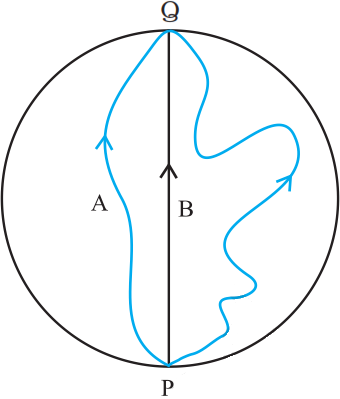
AnswerDisplacement is given by the minimum distance between the initial and final positions of a particle. In the given case, all the girls start from point P and reach point Q. The magnitudes of their displacements will be equal to the diameter of the ground. Radius of the ground = 200m Diameter of the ground = 2 × 200 = 400m Hence, the magnitude of the displacement for each girl is 400m. This is equal to the actual length of the path skated by girl B.
View full question & answer→Question 33 Marks
Pick out the two scalar quantities in the following list: force, angular momentum, work, current, linear momentum, electric field, average velocity, magnetic moment, relative velocity.
AnswerBoth Work and current are scalar quantities.Work done is given by the dot product of force and displacement.
W = (F.S)
Since the dot product of two quantities is always a scalar, therefore work is a scalar physical quantity.
Current is described only by its magnitude. Its direction is not taken into account. Hence, it is a scalar quantity.
View full question & answer→Question 43 Marks
Given a + b + c + d = 0, which of the following statements are correct: The magnitude of (a + c) equals the magnitude of ( b + d).
AnswerCorrect.Explanation:
a + b + c + d = 0 a + c = – (b + d) Taking modulus on both the sides, we get, |a + c| = |–(b + d)| = |b + d| Hence, the magnitude of (a + c) is the same as the magnitude of (b + d).
View full question & answer→Question 53 Marks
Shows that the projection angle $\theta_0$ for a projectile launched from the origin is given by, $\theta_0=\tan^{-1}\Big(\frac{4\text{h}_\text{m}}{\text{R}}\Big)$ where the symbols have their usual meaning.
AnswerMaximum vertical height, $\text{h}_\text{m}=\frac{\text{u}_0^2\sin^2\theta}{2\text{g}}\ ...(\text{i})$ Horizontal range, $\text{R}=\frac{\text{u}_0^2\sin^22\theta}{\text{g}}\ ...(\text{ii})$ $\frac{\text{h}_\text{m}}{\text{R}}=\frac{\sin^2\theta}{2\sin^22\theta}$ $=\frac{\sin\theta\times\sin\theta}{2\times\sin\theta\cos\theta}$ $=\frac{\sin\theta}{4\cos\theta}=\frac{\tan\theta}{4}$ $\tan\theta=\frac{4\text{h}_\text{m}}{\text{R}}$ $\theta=\tan^{-1}\frac{4\text{h}_\text{m}}{\text{R}}$
View full question & answer→Question 63 Marks
Given a + b + c + d = 0, which of the following statements are correct: The magnitude of a can never be greater than the sum of the magnitudes of b, c, and d.
AnswerCorrect.Explanation:
a + b + c + d = 0 a = -(b + c + d) Taking modulus both sides, we get, |a| = |b + c + d| |a| ≤ |a| + |b| + |c| .....(i) Equation (i) shows that the magnitude of a is equal to or less than the sum of the magnitudes of b, c, and d. Hence, the magnitude of vector a can never be greater than the sum of the magnitudes of b, c, and d.
View full question & answer→Question 73 Marks
A stone tied to the end of a string 80cm long is whirled in a horizontal circle with a constant speed. If the stone makes 14 revolutions in 25s, what is the magnitude and direction of acceleration of the stone?
AnswerLength of the string, l = 80cm = 0.8m Number of revolutions = 14 Time taken = 25s Frequency, v $=\frac{\text{= Number of revolutions}}{\text{Time taken}}$ $=\frac{14}{25}\text{hz}$ Angular frequency, $\omega=2\pi\text{v}$ $=2\times\frac{22}{7}\times\frac{14}{25}=\frac{88}{25}\text{ rad s}^{-1}$ Centripetal acceleration, $\text{a}_\text{c}=\omega^2\text{r}$ $=\Big(\frac{88}{25}\Big)^2\times0.8$ $=9.91\text{ms}^{-2}$ The direction of centripetal acceleration is always directed along the string, toward the centre, at all points.
View full question & answer→Question 83 Marks
Can you associate vectors with $(a)$ the length of a wire bent into a loop, $(b)$ a plane area, $(c)$ a sphere? Explain
Answer
- No, one cannot associate a vector with the length of a wire bent into a loop.
- Yes, one can associate an area vector with a plane area. The direction of this vector is normal, inward or outward to the plane area.
- No, one cannot associate a vector with the volume of a sphere. However, an area vector can be associated with the area of a sphere.
View full question & answer→Question 93 Marks
Rain is falling vertically with a speed of $30m s^{-1}$. A woman rides a bicycle with a speed of $10ms^{-1}$ in the north to south direction. What is the direction in which she should hold her umbrella?
AnswerThe described situation is shown in the given figure.
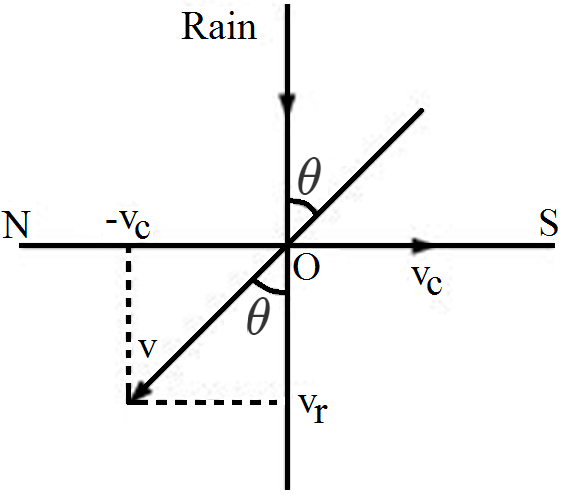
Here, $v_c$ = Velocity of the cyclist $v_r$ = Velocity of falling rain
In order to protect herself from the rain, the woman must hold her umbrella in the direction of the relative velocity (v) of the rain with respect to the woman. $v = v_r + (-v_c) = 30 + (-10)$ = 20m/s $\tan\theta=\frac{\text{v}_\text{c}}{\text{v}_\text{r}}=\frac{10}{30}$ $\theta=\tan^{-1}\big(\frac{1}{3}\big)$
$=\tan^{-1}(0.333)\approx10^\circ$
Hence, the woman must hold the umbrella toward the south, at an angle of nearly 18° with the vertical. View full question & answer→Question 103 Marks
A man can swim with a speed of $4.0km/h$ in still water. How long does he take to cross a river $1.0km$ wide if the river flows steadily at $3.0km/h$ and he makes his strokes normal to the river current? How far down the river does he go when he reaches the other bank?
AnswerSpeed of the man, $v_m = 4 km/h$ Width of the river = 1km $\text{Time taken to cross the river}=\frac{\text{Width of the river}}{\text{Speed of the river}}$
$=\frac{1}{4}\text{h}=1\times\frac{60}{4}=15\text{min}$ Speed of the river, $v_r = 3km/h$ Distance covered with flow of the river = $v_r × t =3\times\frac{1}{4}=\frac{3}{4}\text{km}$
$=3\times\frac{1000}{4}$ = 750m.
View full question & answer→Question 113 Marks
Show that the horizontal range of a projectile is same for angles of projection $(45+\alpha)^\circ$ and $(45-\alpha)^\circ.$
AnswerFor angle of projection $(45+\alpha)^\circ,$ the horizontal range is $\text{R}_1=\frac{\text{u}^2}{\text{g}}\sin2(45+\alpha)^\circ$ $=\frac{\text{u}^2}{\text{g}}\sin(90+2\alpha)^\circ=\frac{\text{u}^2}{\text{g}}\cos2\alpha\dots(\text{i})$ and for an angle of projection
$(45-\alpha)^\circ,$ the horizontal range is $\text{R}_1=\frac{\text{u}^2}{\text{g}}\sin2(45-\alpha)^\circ$
$=\frac{\text{u}^2}{\text{g}}\sin(90-2\alpha)^\circ=\frac{\text{u}^2}{\text{g}}\cos2\alpha\dots(\text{ii})$ By comparing eqn. (i) and (ii), we find $R_1= R_2$
View full question & answer→Question 123 Marks
A ball is thrown from a roof top at an angle of $45^\circ$ above the horizontal. It hits the ground a few seconds later. At what point during its motion, does the ball have. Explain?
- greatest speed.
- smallest speed.
- greatest acceleration?
Answer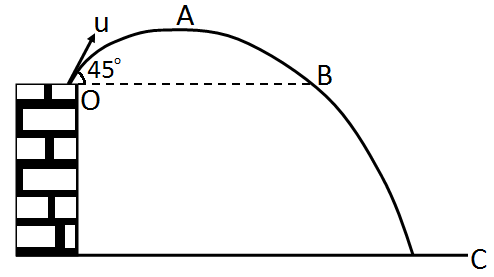
In this problem total mechanical energy of the ball is conserved. As the ball is projected from point $O$, and covering the path $\text{OABC.}$
At point $A$ it has both kinetic and potential energy.
But at point $C$ it have only kinetic energy, $($keeping the ground as reference where $PE$ is zero.$)$
- At point $B$, it will gain the same speed $u$ and after that speed increases and will be maximum just before reaching $C.$
- During upward journey from $O$ to $A$ speed decreases and smallest speed attained by it is at the highest point, i.e., at point $A$.
- Acceleration is always constant throughout the journey and is vertically downward equal to $g$.
View full question & answer→Question 133 Marks
A fighter jet makes a loop of $1000m$ with a speed of $250m s^{-1}$. Compare its centripetal acceleration with the acceleration due to gravity.
AnswerHere $r = 1000m v = 250m s^{-1}$ Centripetal acceleration is given by $\text{a}=\frac{\text{v}^2}{\text{r}}=\frac{250\times250}{1000}=62.5\text{m s}^{-2}$ Acceleration due to gravity, $g = 9.8m s^{-2}$
$\therefore\ \frac{\text{Centripetal acceleration}}{\text{Acceleration due to gravity}}=\frac{62.5}{9.8}=6.4$
View full question & answer→Question 143 Marks
Can any of the rectangular components of a given vector have magnitude greater than the vector itself? Explain.
AnswerNo; The rectangular components of a vector $\vec{\text{A}}$ has values $\text{A}\cos\theta$ and $\text{A}\sin\theta.$ Since the values of $\cos\theta$ and $\sin\theta$ can never be greater than one, hence the value of any rectangular components of a vector can never be greater than the given vector.
View full question & answer→Question 153 Marks
The acceleration associated with a mass 'm' moving in a circular path is to be found. It is given that the velocity at any instant is v = krt, where k is a constant. Classify the motion and find acceleration.
AnswerGiven, v = krt Since velocity changes with time, the motion in circular path involves tangential acceleration. So it is a non-uniform circular motion. $\text{a}_\text{r}=\frac{\text{v}^2}{\text{r}}=\text{k}^2\text{rt}^2$ or $\text{a}_\text{k}=\frac{\text{dv}}{\text{dt}}=\text{kr}$ Net acceleration $=\text{a}_\text{n}=\sqrt{\text{a}^2_\text{r}+\text{a}^2_\text{t}}$ $=\sqrt{(\text{k}^2\text{rt}^2)^2+(\text{kr}^2)}=\text{kr}\sqrt{1+\text{k}^2\text{t}^4}.$
View full question & answer→Question 163 Marks
The sum of the magnitude of two forces acting at a point is 18N and the magnitude of their resultant is 12N. If the resultant is at 90° with the force of smaller magnitude, what are the magnitude of forces?
AnswerLet A and B be the two forces acting at a point and $\theta$ be the angle between them. Then $\text{A}+\text{B}=18\dots(\text{i})$And $\text{A}^2+\text{B}^2+2\text{AB}\cos\theta=12^2=144\dots(\text{ii})$
If A is the smaller force, then as per question $\tan90^\circ=\frac{\text{B}\sin\theta}{\text{A}+\text{B}\cos\theta}$ $\infty=\frac{\text{B}\sin\theta}{\text{A}+\text{B}\cos\theta}$ $\text{A}+\text{B}\cos\theta=0$ $\cos\theta=-\frac{\text{A}}{\text{B}}$ From (ii), $\text{A}^2+\text{B}^2+2\text{AB}\Big(-\frac{\text{A}}{\text{B}}\Big)=144$ $\text{B}^2-\text{A}^2=144$ $(\text{B}-\text{A})(\text{B}+\text{A})=144$ $(\text{B}-\text{A})=\frac{144}{(\text{B}+\text{A})}=\frac{144}{18}=8\dots(\text{iii})$ Solving (i) and (ii) A = 5N and B = 13N
View full question & answer→Question 173 Marks
Given a + b + c + d = 0, which of the following statements are correct: a, b, c, and d must each be a null vector.
AnswerIncorrect.Explanation:
In order to make vectors a + b + c + d = 0, it is not necessary to have all the four given vectors to be null vectors. There are many other combinations which can give the sum zero.
View full question & answer→Question 183 Marks
Show that the vector addition is associative.OR
Show that $(\vec{\text{A}}+\vec{\text{B}})+\vec{\text{C}}=\vec{\text{A}}+(\vec{\text{B}}+\vec{\text{C}}).$
Answer
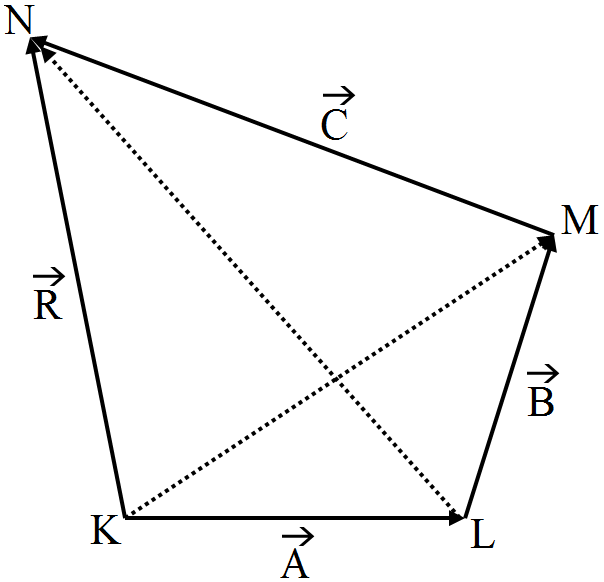 To show that vector addition is associative, we consider addition of three vectors $\vec{\text{A}},\vec{\text{B}}$ and $\vec{\text{C}}$ in two different manners. Let us first add $\vec{\text{A}}$ and $\vec{\text{B}}$ to obtain a vector $\overrightarrow{\text{KM}}$ and then add $\vec{\text{C}}$ to it so as to get the resultant vector $\overrightarrow{\text{KN}}.$ It means that
$(\vec{\text{A}}+\vec{\text{B}})+\vec{\text{C}}=\overrightarrow{\text{KN}}=\vec{\text{R}}\dots(\text{i})$
Again we add $\vec{\text{B}}$ and $\vec{\text{C}}$ to obtain a vector $\overrightarrow{\text{LN}}.$ Now to vector $\vec{\text{A}}$ add $\overrightarrow{\text{LN}}$ so as to get a resultant $\overrightarrow{\text{KN}}=\vec{\text{R}}$ as shown in Fig. It means that,
$(\vec{\text{A}})+(\vec{\text{B}}+\vec{\text{C}})=\overrightarrow{\text{KL}}+\overrightarrow{\text{LN}}=\overrightarrow{\text{KN}}=\vec{\text{R}}\dots(\text{ii})$
From (i) and (ii), it is clear that,
$(\vec{\text{A}}+\vec{\text{B}})+\vec{\text{C}}=\vec{\text{A}}+(\vec{\text{B}}+\vec{\text{C}})$
That is the vector addition is associative. View full question & answer→Question 193 Marks
Two balls of different masses $m_1$ and $m_2 (m_1 > m_2)$ are thrown vertically upwards with the same initial speed $v_0$ simultaneously.
- Which one of the two balls, will rise to the greater height?
- Which of the two balls, will come back with greater speed to the point of projection?
- Which of the two balls, will come back first to the point of projection?
AnswerTwo balls of different masses $m_1$ and $m_2 (m_1 > m_2)$ are thrown vertically upward with the same initial speed $vo$ simultaneously.
- Both balls will rise to the same height.
$\because\ \text{v}^2-\text{v}_0^2=-2\text{gh},$ here at highest point, $v = 0$
$\therefore\ \text{h}=\frac{\text{v}_0^2}{2\text{g}}$
- Both balls will come back with the same speed $vo$ to the point of projection.
- Both balls will come back at the same time to the point of projection.
$\because\ \text{t}=2\frac{\text{v}_0}{\text{g}}$ View full question & answer→Question 203 Marks
A body is projected in horizontal direction with a uniform velocity from top of tower. Show that the path is parabola.
AnswerLet the body be projected horizontally with a velocity u, from the top of a tower of height h. Time taken to reach the ground, $\text{t}=\sqrt{\frac{2\text{h}}{\text{g}}}.$ Since the initial vertical velocity is zero and there is no acceleration in the horizontal.Thus, x = ut
$\text{x}=\text{u}\sqrt{\frac{2\text{h}}{\text{g}}}$i.e., $\text{h}=\text{x}^2.\frac{\text{g}}{2\text{u}^2}$
As $\text{h}\propto\text{x}^2,$ the path is a parabola.
View full question & answer→Question 213 Marks
Define a uniform circular motion. For uniform circular motion, prove that: Linear velocity $\text{v}=\text{r}\omega.$
AnswerIf the speed of the particle in circular path remains constant, the motion is uniform circular motion. We know, the arc length x covered with an angular displacement $\theta$ is $\text{x}=\text{r}\theta.$ Differentiating, $\frac{\text{dx}}{\text{dt}}=\text{r}\frac{\text{d}\theta}{\text{dt}}$ $\because$ r is constant, $\therefore\ \text{v}=\text{r}\omega.$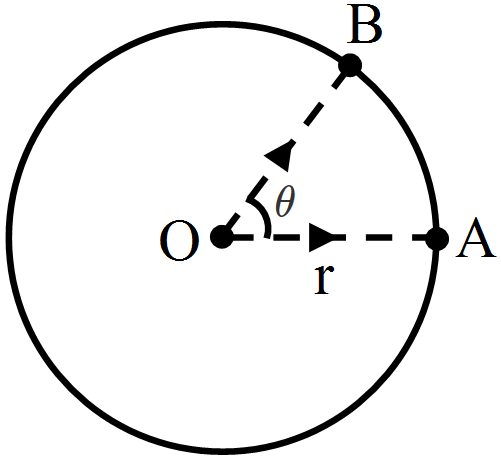
View full question & answer→Question 223 Marks
A mass is projected horizontally with a velocity u from a tower. Find the horizontal length it will cover from the foot of the tower?
AnswerIf h is the height of the tower, the time taken to reach the ground is $\text{t}=\sqrt{\frac{2\text{h}}{\text{g}}}.$ Since the horizontal velocity u is same everywhere, the distance covered is $\text{ut}=\text{u}\sqrt{\frac{2\text{h}}{\text{g}}}.$
View full question & answer→Question 233 Marks
- What can be the maximum and minimum values of $(\vec{\text{A}}+\vec{\text{B}})$ and $(\vec{\text{A}}-\vec{\text{B}})?$
- If two vectors of equal magnitude added to each other gives magnitude of one of them. What is the angle between them?
AnswerMinimum value $=(\vec{\text{A}}-\vec{\text{B}})$ Maximum value $=(\vec{\text{A}}+\vec{\text{B}})$
Let vector is $A$, then It is given that two vectors of equal magnitude added to each other gives magnitude of one of them, i.e. $\sqrt{\text{A}^2+\text{A}^2+2\text{A}.\text{A}\cos\theta}=\text{A}$ Squaring on both sides, we get $\text{A}^2(1+2\cos\theta)=\text{A}^2$
$\Rightarrow\ \cos\theta=\frac{-1}{2}$
$\Rightarrow\ \theta=120^\circ$
View full question & answer→Question 243 Marks
Three girls skating on a circular ice ground of radius 200m start from a point P on the edge of the ground and reach a point Q diametrically opposite to P following different paths as shown in Fig. What is the magnitude of the displacement vector for each? For which girl is this equal to the actual length of path skate?
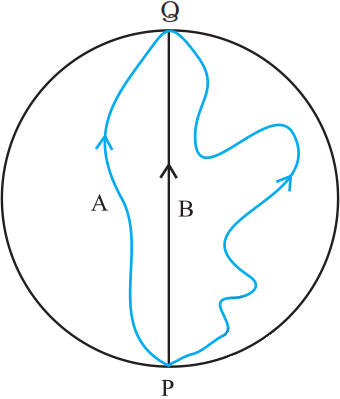
AnswerDisplacement is given by the minimum distance between the initial and final positions of a particle. In the given case, all the girls start from point P and reach point Q. The magnitudes of their displacements will be equal to the diameter of the ground. Radius of the ground = 200m Diameter of the ground = 2 × 200 = 400m Hence, the magnitude of the displacement for each girl is 400m. This is equal to the actual length of the path skated by girl B.
View full question & answer→Question 253 Marks
Show that there are two values of time for a projectile when it is at same height. Also show that the sum of these two times is equal to the time of flight.OR
Prove the following relations by calculus method:
- $\text{s}=\text{ut}+\frac{1}{2}\text{at}^2$
- $\text{v}^2-\text{u}^2=2\text{as}$
AnswerFor projectile motion equation for y-coordinates $\text{y}=\text{u}\sin(\theta)\text{t}-\frac{1}{2}\text{gt}^2$ Solving this for t (using quadratic formula) $\text{t}=\frac{\text{u}\sin\theta\pm\sqrt{\text{u}^2\sin^2\theta-2\text{gy}}}{\text{g}}$ Without loss of generalityl, let $\text{t}_1=\frac{\text{u}\sin\theta}{\text{g}}+\frac{\sqrt{\text{u}^2\sin^2\theta-2\text{gy}}}{\text{g}}$ $\text{t}_2=\frac{\text{u}\sin\theta}{\text{g}}-\frac{\sqrt{\text{u}^2\sin^2\theta-2\text{gy}}}{\text{g}}$ for $\text{t}_1+\text{t}_2=\frac{2\text{u}\sin\theta}{\text{g}}$ which is equation of time of flight.OR
- Consider an object moving in a straight line with uniform acceleration 'a', let at any instant of time 't', dx be the displacement of the objects.
$\therefore$ instantaneous velocity, $\text{v}=\frac{\text{dx}}{\text{dt}}$ or dx = vdt.
dx = (u + at)dt $(\because$ v = u + at)
let $x_0$ and x be the displacements of the obhect at time 'zero' and 't'.
$\int\limits^{\text{x}}_{\text{x}_0}\text{dx}=\int\limits^{\text{t}}_0(\text{u}+\text{at})\text{dt}$
$=\text{u}\int\limits^{\text{t}}_0\text{dt}+\text{a}\int\limits^{\text{t}}_0\text{t dt}$
$(\text{x})^{\text{x}}_{\text{x}_0}=\text{u}(\text{t})^\text{t}_0+\text{a}\Big(\frac{\text{t}^2}{2}\Big)^\text{t}_0$
$\text{x}-\text{x}_0=\text{ut}+\frac{1}{2}\text{at}^2$
If $x = x_0 = s$ (distance) covered by the object.
$\text{s}=\text{ut}+\frac{1}{2}\text{at}^2$
- Consider a particle moving in a straight line with initial velocity 'v' and acceleration 'a'.
Then, $\text{a}=\frac{\text{dv}}{\text{dt}}=\frac{\text{dv}}{\text{dx}}\times\frac{\text{dx}}{\text{dt}}=\frac{\text{dv}}{\text{dx}}\times\text{v}$
$\text{a dx}=\text{v dv}$
Integrating,
$\int\limits^{\text{x}}_{\text{x}_0}\text{a dx}=\int\limits^{\text{V}}_\text{u}\text{v dv}$
$\Rightarrow\ \text{a}|\text{x}|^{\text{x}}_{\text{x}_0}=\Big[\frac{\text{v}^2}{2}\Big]^\text{V}_\text{u}$
$\text{a}(\text{x}-\text{x}_0)=\frac{\text{v}^2}{2}-\frac{\text{u}^2}{2}$
$\text{v}^2-\text{u}^2=2\text{a}(\text{x}-\text{x}_0)$
$\text{v}^2-\text{u}^2=2\text{a}\text{s.}$ View full question & answer→Question 263 Marks
Which is greater; the angular velocity of the hour hand of a watch or angular velocity of earth around its own axis?
AnswerTime period for hour hand of watch, $T_h = 12h$ and for earth, $T_e = 24h$ Now, Angular velocity, $\omega=\frac{2\pi}{\text{T}}$
$\therefore\ \frac{\omega_\text{h}}{\omega_\text{e}}=\frac{\text{T}_\text{e}}{\text{T}_\text{h}}=\frac{24}{12}=2$ $\text{or }\omega_\text{h}=2\omega_\text{e}.$
View full question & answer→Question 273 Marks
Pick out the two scalar quantities in the following list: force, angular momentum, work, current, linear momentum, electric field, average velocity, magnetic moment, relative velocity.
AnswerBoth Work and current are scalar quantities.Work done is given by the dot product of force and displacement.
W = (F.S)
Since the dot product of two quantities is always a scalar, therefore work is a scalar physical quantity.
Current is described only by its magnitude. Its direction is not taken into account. Hence, it is a scalar quantity.
View full question & answer→Question 283 Marks
A projectile is projected with velocity $u$ making an angle $\theta$ with horizontal direction, find:
- Time of flight.
- Horizontal range.
Answer
- At maximum height $v =0$
$\therefore\ 0=\text{u}\sin\theta-\text{gt};$
or $\text{t}=\frac{\text{u}\sin\theta}{\text{g}}$
But time of flight,
$\text{T}=\text{2t}=\frac{2\text{u}\sin\theta}{\text{g}}$
- When the body returns to the same horizontal level $y = 0$
$\therefore 0=\text{x}\tan\theta-\frac{\text{gx}^2}{2\text{u}^2\cos^2\theta} [$From $(i)]$
or $\text{x}\tan\theta=\frac{\text{gx}^2}{2\text{u}^2\cos^2\theta}$
or $\text{x}=\frac{2\text{u}^2\sin\theta\cos\theta}{\text{g}}=\frac{\text{u}^2\sin2\theta}{\text{g}}$
But coordinates of $M$ are $(R, 0).$
Putting $x = R$, we have $\text{R}=\frac{\text{u}^2\sin2\theta}{\text{g}}$ View full question & answer→Question 293 Marks
Define the terms resultant or equivalent of two forces. Two forces $F_1$ and $F_2$ acting at an angle $\theta$ on a body simultaneously have a resultant F. Show that $\theta=\cos^{-1}\Big[\frac{(\text{F}_1^2+\text{F}_2^2+2\text{F}_1\text{F}_2\cos\theta)}{2\text{F}_1\text{F}_2}\Big]$
AnswerThe resultant vector of two or more vectors is defined as that single vector which produces the same effect as is produced by individual vectors together. If $F_1$ and $F_2$ are the two forces the magnitude of the resultant F is given by,
$\text{F}=\sqrt{\text{F}_1^2+\text{F}_2^2+2\text{F}_1\text{F}_2\cos\theta}$ The angle $\theta$ between them is, $\theta=\cos^{-1}\Big(\frac{\text{F}^2-\text{F}_1^2-\text{F}_2^2}{2\text{F}_1\text{F}_2}\Big)$
View full question & answer→Question 303 Marks
A ball is thrown from a point with a speed $v_0$ at an angle of projection $\theta.$ From the same point and at the same instant, a person starts running with a constant speed $\frac{\text{v}_0}{2}$ to catch the ball. Will the person be able to catch the ball? If yes, what should be the angle of projection?
AnswerYes. The person will be able to catch the ball if the horizontal component of the velocity of the ball is equal to the speed of the person.
$\therefore\ \text{u}_0\cos\theta=\frac{\text{v}_0}{2}$
$\Rightarrow\ \cos\theta=\frac{1}{2}\Rightarrow\ \theta=60^\circ.$
View full question & answer→Question 313 Marks
If the position vectors of P and Q be respectively $(\hat{\text{i}}+3\hat{\text{j}}-7\hat{\text{k}})$ and $(5\hat{\text{i}}-2\hat{\text{j}}+4\hat{\text{k}}),$ find $\overrightarrow{\text{PQ}}.$
Answer
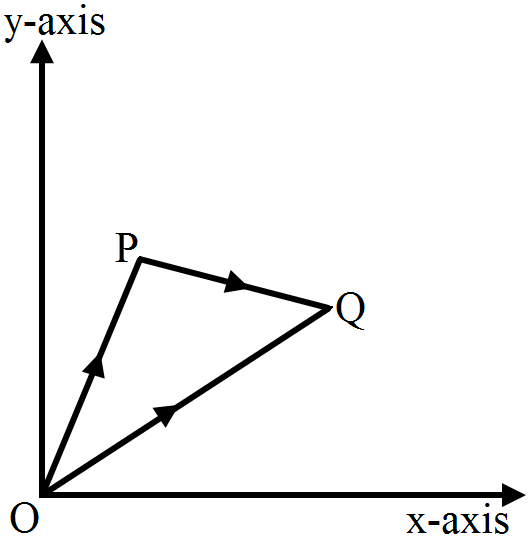 Let O be the origin
Given $\overrightarrow{\text{OP}}=\hat{\text{i}}+3\hat{\text{j}}-7\hat{\text{k}}$
$\overrightarrow{\text{OQ}}=5\hat{\text{i}}-2\hat{\text{j}}+4\hat{\text{k}}$
By triangle law of vector addition,
$\overrightarrow{\text{OP}}+\overrightarrow{\text{PQ}}=\overrightarrow{\text{OQ}}$
$\overrightarrow{\text{PQ}}=\overrightarrow{\text{OQ}}-\overrightarrow{\text{OP}}$
$=(5\hat{\text{i}}-2\hat{\text{j}}+4\hat{\text{k}})-(\hat{\text{i}}+3\hat{\text{j}}-7\hat{\text{k}})$
$=(4\hat{\text{i}}-5\hat{\text{j}}+11\hat{\text{k}})$ View full question & answer→Question 323 Marks
If the time of flight of a projectile projected with a velocity u at an angle $\theta$ is $\frac{2\text{u}\sin\theta}{\text{g}},$ find the condition for maximum range and its value?
AnswerTime of flight $=\frac{2\text{u}\sin\theta}{\text{g}}$ Horizontal velocity $=\text{u}\cos\theta$ Range $=\text{u}\cos\theta\times\frac{2\text{u}\sin\theta}{\text{g}}$ $=\frac{2\text{u}^2\sin\theta\cos\theta}{\text{g}}=\frac{\text{u}^2\sin2\theta}{\text{g}}$ Range is maximum when, $\sin2\theta=1,$ i.e., $\theta=45^\circ$ Maximum range $=\frac{\text{u}^2}{\text{g}}.$
View full question & answer→Question 333 Marks
Show that there are two values of time for same height during the course of flight of a projectile and the sum of these times is equal to the total time of flight.
Answer
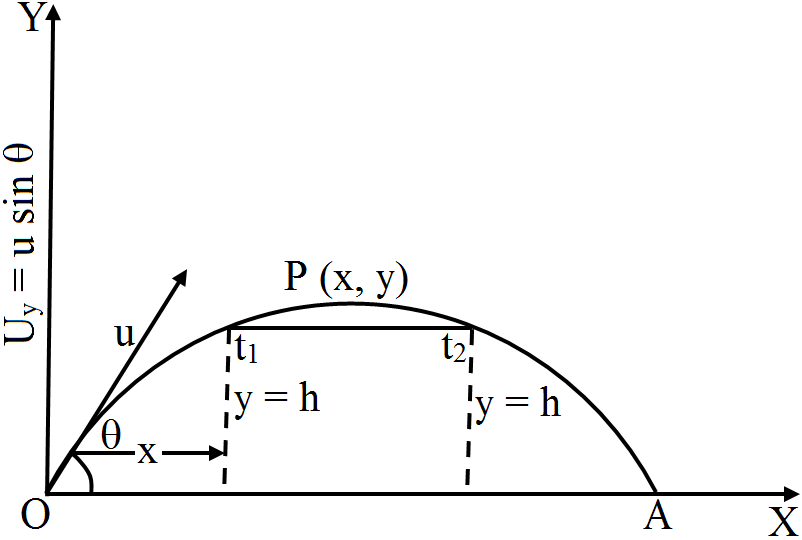
We know, the vertical distance travelled by a projectile in time t is given by,
$\text{y}=\text{u}\sin\theta\times\text{t}-\frac{1}{2}\text{gt}^2$
If h be the height of point p, then for y = h,
we have, $\text{h}=\text{u}\sin\theta\times\text{t}-\frac{1}{2}\text{gt}^2$
or $\frac{1}{2}\text{gt}^2-\text{u}\sin\theta\times\text{t}+\text{h}=0$
or $\text{t}^2-\frac{2\text{u}\sin\theta}{\text{g}}.\text{t}+\frac{2\text{h}}{\text{g}}=0$
This equation is quadratic in t and has two roots $t_1$ and $t_2$. Thus there are two values of time for which the height of the projectile is same during flight of projectile.
$\text{t}=\frac{\frac{2\text{u}\sin\theta}{\text{g}}\pm\sqrt{\Big(\frac{2\text{u}\sin\theta}{\text{g}}\Big)^2-\frac{8\text{h}}{\text{g}}}}{2}$
$\text{t}=\frac{\text{u}\sin\theta}{\text{g}}\pm\sqrt{\frac{\text{u}^2\sin^2\theta}{\text{g}^2}-\frac{2\text{h}}{\text{g}}}$
$\therefore\ \text{t}_1=\frac{\text{u}\sin\theta}{\text{g}}+\sqrt{\frac{\text{u}^2\sin^2\theta}{\text{g}^2}-\frac{2\text{h}}{\text{g}}}$
and $\text{t}_2=\frac{\text{u}\sin\theta}{\text{g}}-\sqrt{\frac{\text{u}^2\sin^2\theta}{\text{g}^2}-\frac{2\text{h}}{\text{g}}}$
Now $\text{t}_1+\text{t}_2=\frac{2\text{u}\sin\theta}{\text{g}}$ (time during the course of flight).
Thus, the sum of times for the same height is equal to the total time of flight. View full question & answer→Question 343 Marks
The equation of trajectory of an oblique projectile is, $\text{y}=\sqrt{3}\text{x}-\frac{\text{gx}^2}{2}$ What is the initial velocity and the angle of projection of the projectile?
AnswerComparing the given equation with the standard equation of the trajectory of an oblique projectile, $\text{y}=\text{x}\tan\theta-\frac{\text{gx}^2}{2\text{v}^2\cos^2\theta}$ We get $\tan\theta=\sqrt{3}\Rightarrow\ \theta=60^\circ$ Also, $\text{v}^2\cos\theta=1$ $\Rightarrow\ \text{v}^2=\frac{1}{\cos^2\theta}$ or $\text{v}^2=\frac{1}{\cos^260^\circ}=4$ $\text{v}=2\text{m s}^{-1}$
View full question & answer→Question 353 Marks
Given a + b + c + d = 0, which of the following statements are correct: The magnitude of (a + c) equals the magnitude of ( b + d).
AnswerCorrect.Explanation:
a + b + c + d = 0 a + c = – (b + d) Taking modulus on both the sides, we get, |a + c| = |–(b + d)| = |b + d| Hence, the magnitude of (a + c) is the same as the magnitude of (b + d).
View full question & answer→Question 363 Marks
What is the change in momentum between the initial and final points of the projectile path, if the range is maximum?
AnswerRange is maximum. Therefore, the angle of projection is 45°. Since, the initial velocity, horizontally remains same throughout, there is no change in momentum in the horizontal. The vertical velocity of $\text{u}\sin45^\circ$ will be equal in magnitude but opposite in direction at these points.$\therefore$ Change in momentum $=2\text{mu}\sin45^{\circ}=\frac{2\text{mu}}{\sqrt{2}}=\sqrt{2}\text{mu}$
View full question & answer→Question 373 Marks
Define centripetal acceleration. Give two examples.
AnswerAcceleration needed for a particle to undergo uniform circular motion is called 'centripetal acceleration'. It is directed along the radius of circular path towards its centre.Two common examples are:
- An electron revolving around the nucleus of an atom in a uniform circular motion experiences a centripetal acceleration on account of Coulombian electrostatic force on electron due to nucleus.
- A satellite revolving around the earth in a circular orbit experiences a centripetal acceleration on account of gravitational force due to the earth.
View full question & answer→Question 383 Marks
A body is projected with velocity $u$ at an angle $\theta_0$ upward from horizontal. Deduce the expression for :
- Horizontal range.
- Maximum height attained.
AnswerConsider a body is projected with velocity $u$ at an angle $\theta_0.$ The horizontal and vertical components initially with velocity are $\text{u}\cos\theta_0$ and $\text{u}\sin\theta_0$ respectively.
- Horizontal range: It is the horizontal distance covered by the body between its point of projection and the point of hitting the ground, when both points are on same horizontal plane. It is denoted by $R$.
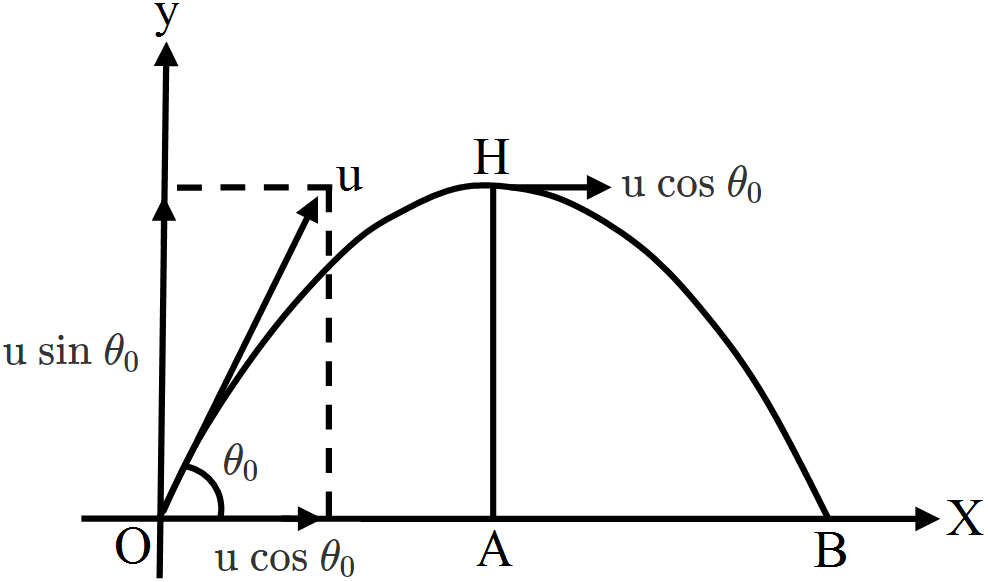
$\therefore\ \text{R}=\text{u}\cos\theta_0\times$ Total time of flight $(T)$
$=\text{u}\cos\theta_0\times\frac{2\text{u}\sin\theta_0}{\text{g}}$
$=\frac{\text{u}^2}{\text{g}}2\sin\theta_0\cos\theta_0$
$=\frac{\text{u}^2}{\text{g}}\sin2\theta_0$
$\text{R}=\frac{\text{u}^2\sin2\theta_0}{\text{g}}$
- Maximum height : Maximum height ($h_{max}$) is the maximum vertical height attained by the body above the point of projection during its flight.
Here, $AH$ is referred as the maximum height attained against gravity. At highest point vertical component of velocity become zero.
Using, $v^2 = u^2 + 2as$, we have
$0=\text{u}^2\sin^2\theta_0-2\text{gh}_\text{max}$
$\Rightarrow\ \text{h}_\text{max}=\frac{\text{u}^2\sin^2\theta_0}{2\text{g}}$ View full question & answer→Question 393 Marks
There are two displacement vectors, one of magnitude $3m$ and other of magnitude $4m$. How should the two vectors be added so that the magnitude of resultant vector be $(i)\ 7m \ (ii)\ 1m$ and $(iii)\ 5m$?
Answer
- $\theta=0,$ in same direction $($or$)$ parallel.
- $\theta=180^\circ,$ in same line but opposite or anti parallel.
- $\theta=90^\circ,$ in perpendicular direction.
View full question & answer→Question 403 Marks
Establish a relation between linear velocity and angular velocity in a uniform circular motion and explain the direction of linear velocity.
AnswerWe know that $\text{S}=\text{r}\theta$ if a body covers an arc of length s in a radius r, turning its radial line by $\theta.$ Differentiating both sides with respect to time, we have $\frac{\text{ds}}{\text{dt}}=\text{r}\frac{\text{d}\theta}{\text{dt}}$ i.e., $\text{v}=\text{r}\omega.$ Linear velocity = radius × angular velocity. At each point the body moves along the tangent. The presence of centripetal force $mv^2/ r$ makes it to pass in the circular path. Thus the direction of velocity is always along the tangent at any point in the circular path.
View full question & answer→Question 413 Marks
State parallelogram law of vector addition. Show that resultant of two vectors A and B inclined at an angle $\theta$ is $\text{R}=\sqrt{\text{A}^2+\text{B}^2+2\text{AB}\cos\theta}.$
AnswerParallelogram law of vector addition: If two vectors $\vec{\text{A}}$ and $\vec{\text{B}}$ represent two adjacent sides of a parallelogram, the sum of the vectors is represented by the diagonal of the parallelogram.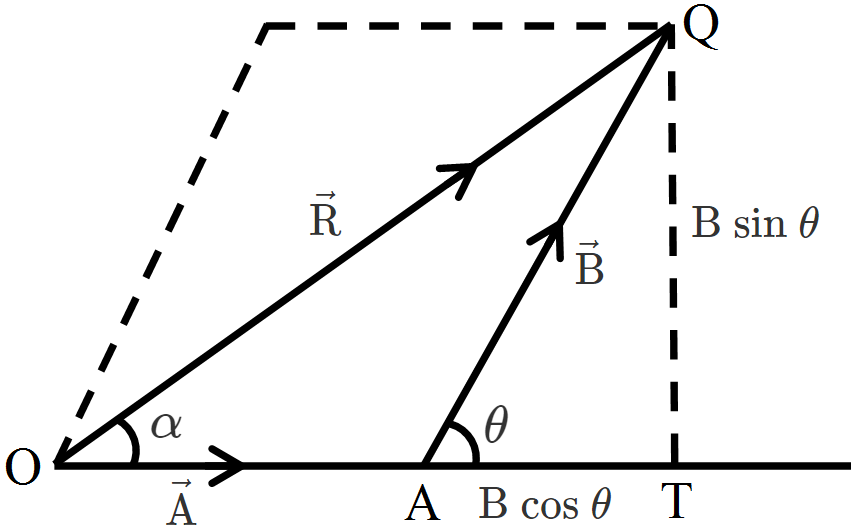
Let $\vec{\text{A}}$ and $\vec{\text{B}}$ be two vectors at an angle 8 between them. According to the law of parallelogram of vectors, the diagonal of the parallelogram indicates the sum of the other two sides/ vectors $\vec{\text{A}}$ and $\vec{\text{B}}.$ $|\vec{\text{OQ}}|=|\vec{\text{A}}+\vec{\text{B}}|=\sqrt{(\text{OT})^2+(\text{TQ})^2}$ $|\vec{\text{R}}|=\sqrt{(\text{A}+\text{B}\cos\theta)^2+(\text{B}\sin\theta)^2}$ $\text{R}=\sqrt{\text{A}^2+\text{B}^2+2\text{AB}\cos\theta}$ The resultant R is at an angle $\alpha$ to $\vec{\text{A}}$ given by, $\alpha=\tan^{-1}\Big(\frac{\text{B}\sin\theta}{\text{A}+\text{B}\cos\theta}\Big)$ View full question & answer→Question 423 Marks
A bullet fired at an angle of 30° with the horizontal hits the ground 3km away. By adjusting its angle of projection, can one hope to hit a target 5km away? Assume the muzzle speed to be fixed, and neglect air resistance. (Take $g = 10ms^{-2}$)
AnswerHorizontal range R = 3000m If u and $\theta$ denote the velocity of the bullet, and the angle made by the bullet with the horizontal, we have $\text{R}=\frac{\text{u}^2\sin2\theta}{\text{g}}$ or $3000=\frac{\text{u}^2\sin60}{10}$ or $\text{u}^2=\frac{3000\times10\times2}{\sqrt{3}}=34641\text{ms}^{-1}$ Solving, we get $\text{u}=186.12\text{ms}^{-1}$ for maximum range, $\theta=45^\circ$
$\sin2\theta=\sin90^\circ=1$ $\text{R}_\text{max}=\frac{\text{u}^2}{\text{g}}=\frac{34641}{10}=3464.1\text{m}$
$=3.46\text{ km}$ Thus, for the fixed muzzle speed, the maximum range of bullet is 3.46km. Therefore, it cannot hit a target 5km away.
View full question & answer→Question 433 Marks
Briefly discuss subtraction of vectors.
Answer
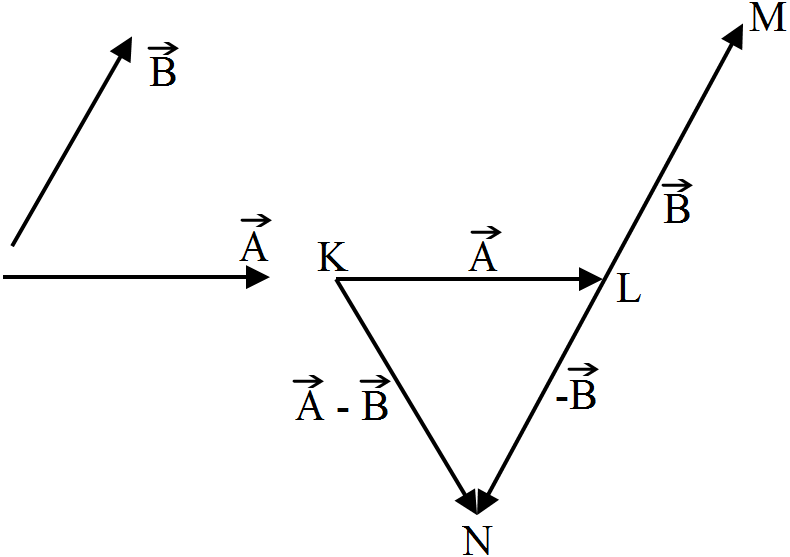 Subtraction of vectors is a special case of vector addition. Subtraction of $\vec{\text{B}}$ from $\vec{\text{A}}$ may be considered as addition of $(-\vec{\text{B}})$ i.e., negative of $\vec{\text{B}}$ to vector $\vec{\text{A}}.$
$\therefore\ \vec{\text{A}}-\vec{\text{B}}=\vec{\text{A}}+(-\vec{\text{B}})$
Therefore, we first draw $\vec{\text{A}}$ and $\vec{\text{B}}.$ Now draw a vector having same magnitude as of $\vec{\text{B}}$ but in opposite direction. It is $(-\vec{\text{B}}).$ Sum of $\vec{\text{A}}$ and $(-\vec{\text{B}})\text{s}$ gives the requisite result.
In Fig., $\vec{\text{A}}-\vec{\text{B}}=\vec{\text{A}}+(-\vec{\text{B}})=\overrightarrow{\text{KL}}+(-\overrightarrow{\text{LM}})$
$=\overrightarrow{\text{KL}}+\overrightarrow{\text{LN}}=\overrightarrow{\text{KN}}.$ View full question & answer→Question 443 Marks
Determine a unit vector which is perpendicular to both $\vec{\text{A}}=2\hat{\text{i}}+\hat{\text{j}}+\hat{\text{k}}$ and $\vec{\text{B}}=\hat{\text{i}}-\hat{\text{j}}+2\hat{\text{k}}.$
AnswerUnit vector perpendicular to both, $\vec{\text{A}}=2\hat{\text{i}}+\hat{\text{j}}+\hat{\text{k}}$ and $\hat{\text{i}}-\hat{\text{j}}+2\hat{\text{k}}$ is given by $\hat{\text{n}}=\frac{\vec{\text{A}}\times\vec{\text{B}}}{|\vec{\text{A}}\times\vec{\text{B}|}}$ $=\vec{\text{A}}\times\vec{\text{B}}=\begin{vmatrix}\hat{\text{i}} & \hat{\text{j}} &\hat{\text{k}}\\2 & 1&1\\1&-1&2 \end{vmatrix}$ $=\hat{\text{i}}[2-(-1)]-\hat{\text{j}}(4-1)+\hat{\text{k}}(-2-1)$ $=3\hat{\text{i}}-3\hat{\text{j}}-3\hat{\text{k}}$ Unit vector is $\hat{\text{n}}=\frac{3\hat{\text{i}}-3\hat{\text{j}}-3\hat{\text{k}}}{\sqrt{9+9+9}}=\frac{3\hat{\text{i}}-3\hat{\text{j}}-3\hat{\text{k}}}{\sqrt{27}}$
View full question & answer→Question 453 Marks
A particle is projected in air at some angle to the horizontal, moves along parabola as shown in Fig., where x and y indicate horizontal and vertical directions, respectively. Show in the diagram, direction of velocity and acceleration at points A, B and C.
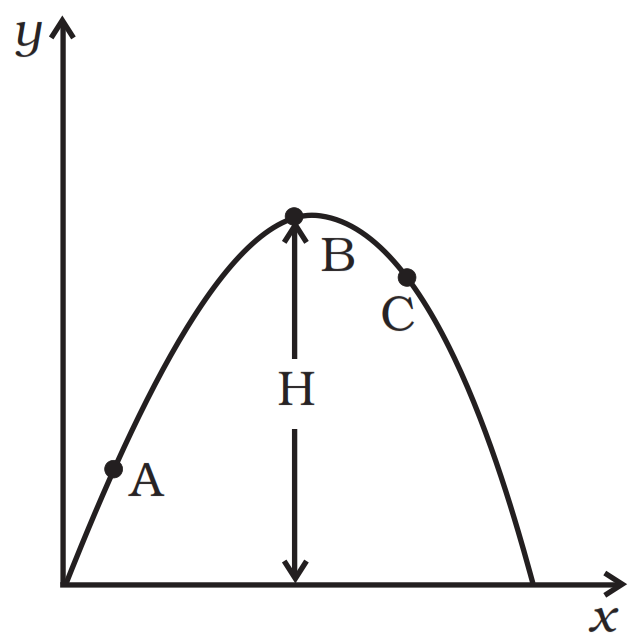
AnswerThe motion of projectile is always parabolic or its part. Its velocity at any point of its path is always tangentially toward the direction of motion so velocities at points A, B and C are tangentially shown,
The point B is at its maximum height of trajectory. So the vertical component of B $V_y = 0$ and horizontal component is $\text{u}\cos\theta.$
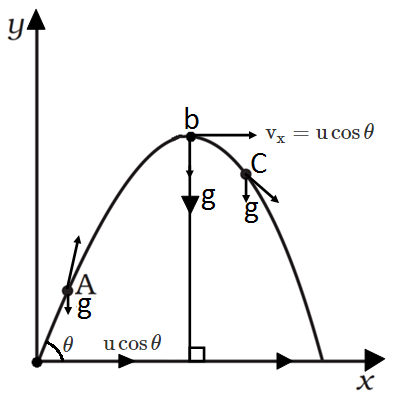
As the direction of acceleration is always in the direction of the force acting on it. The gravitational force is acting on the body hence the direction of acceleration is always vertically downward equal to acceleration to gravity (g). View full question & answer→Question 463 Marks
Show that range of projection of a projectile for two angles of a projection $\alpha$ and $\beta$ is same where $\alpha+\beta=90^\circ.$
AnswerRange of a projectile $=\frac{\text{u}^2\sin2\theta}{\text{g}}$ for an angle $\theta$ of projection. For an angle $(90^\circ-\theta),$ Range $=\frac{\text{u}^2\sin[2(90^\circ-\theta)]}{\text{g}}$ $=\frac{\text{u}^2\sin(180^\circ-2\theta)}{\text{g}}=\frac{\text{u}^2\sin2\theta}{\text{g}}$ $\therefore$ For two angles, $\alpha$ and $\beta$ such that $\alpha+\beta=\frac{\pi}{2}$ the range will be same.
View full question & answer→Question 473 Marks
If R be the horizontal range for inclination $\theta$ and h be the maximum height reached by the projectile, show that maximum range is given by $\frac{\text{R}^2}{8\text{h}}+2\text{h.}$
AnswerHorizontal range of the projectile is, $\text{R}=\frac{\text{u}^2\sin2\theta}{\text{g}}$ Maximum height attained by the projectile is,$\text{h}=\frac{\text{u}^2\sin^2\theta}{2\text{g}}$
$\therefore\ \frac{\text{R}^2}{8\text{h}}+2\text{h}$
$=\frac{\text{u}^2(\sin2\theta)^2}{\text{g}^2}\times\frac{2\text{g}}{8\text{u}^2\sin^2\theta}+\frac{2\text{u}^2\sin^2\theta}{2\text{g}}$
$=\frac{\text{u}^2(2\sin\theta\cos\theta)^2}{4\text{g}\sin^2\theta}+\frac{\text{u}^2\sin^2\theta}{\text{g}}$
$=\frac{\text{u}^2\cos^2\theta}{\text{g}}+\frac{\text{u}^2\sin^2\theta}{\text{g}}$
$=\frac{\text{u}^2}{\text{g}}(\cos^2\theta+\sin^2\theta)=\frac{\text{u}^2}{\text{g}}=\text{R}_\text{max}$
View full question & answer→Question 483 Marks
The position of a particle is given by: $\vec{\text{r}}=3.0\text{t}\hat{\text{i}}-2.0\text{t}^2\hat{\text{j}}+4\hat{\text{k}}\text{ m}$ where $t$ is in seconds, $r$ is in metres and the coefficients have the proper units.
- Find the velocity $v$ and acceleration $a.$
- What is the magnitude of velocity of the particle at $t = 2s$?
Answer$\vec{\text{r}}=3.0\text{t}\hat{\text{i}}-2.0\text{t}^2\hat{\text{j}}+4\hat{\text{k}}\text{ m}$
- $\vec{\text{v}}=$ velocity $=\frac{\text{d}\vec{\text{r}}}{\text{dt}}=3.0\hat{\text{i}}-4.0\text{t }\hat{\text{j }}\text{m/s}$
$\vec{\text{a}}=$ acceleration $=\frac{\text{d}\vec{\text{v}}}{\text{dt}}=-4.0\hat{\text{ j }}\text{m/s}^2$
- Magnitude of velocity at $t = 2s$
$\vec{\text{v}}=3.0\hat{\text{i}}-8.0\hat{\text{j}}$
$|\vec{\text{v}}|=\sqrt{(3)^2+(-8)^2}$
$=\sqrt{9+64}=\sqrt{73}\text{ m/s}$ View full question & answer→Question 493 Marks
Two particles located at a point begin to move with velocities $4m s^{-1}$ and $1m s^{-1}$ horizontally in opposite directions. Determine the time when their velocity vectors become perpendicular. Assume that the motion takes place in a uniform gravitational field of strength g.
AnswerVelocity of first particle at time $\text{t}=4\hat{\text{i}}-\text{gt}\hat{\text{j}}$ Velocity of second particle at time $\text{t}=-\hat{\text{i}}-\text{gt}\hat{\text{j}}$Since the dot product of two perpendicular vectors is zero therefore
$(4\hat{\text{i}}-\text{gt}\hat{\text{j}}).(-\hat{\text{i}}-\text{gt}\hat{\text{j}})\text{s}=0$ $\Rightarrow\ -4+\text{g}^2\text{t}^2=0$ $\text{or }\text{ g}^2\text{t}^2=4\ \text{ or }\text{ gt}=2$$\Rightarrow\ \text{t}=\frac{2}{\text{g}}$
View full question & answer→Question 503 Marks
State triangle law of vector addition. Gives analytical treatment to find the magnitude and direction of a resultant vector by using this law.
AnswerIf two vectors $\vec{\text{A}}$ and $\vec{\text{B}},$ represent two adjacent sides of a triangle, then the resultant vector $\vec{\text{R}}$ is represented by the third side of the triangle.
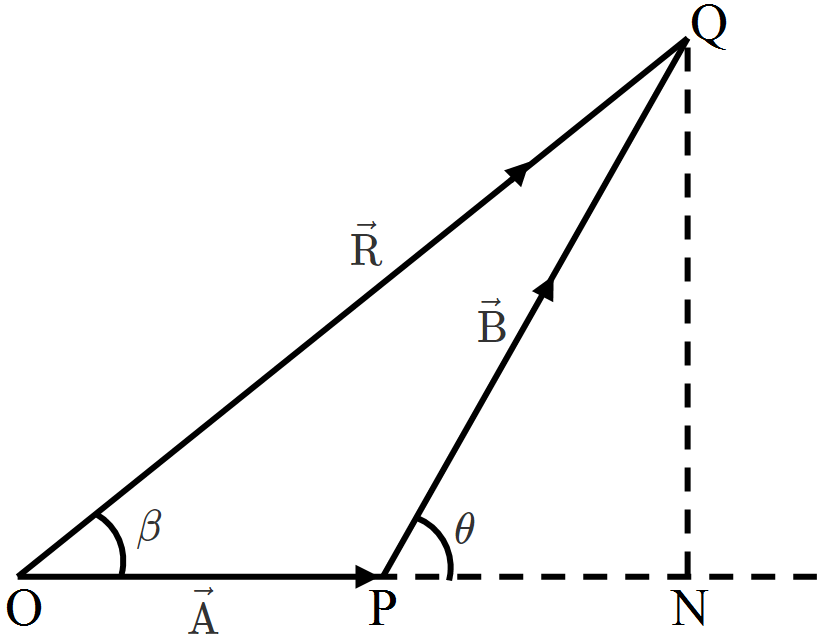
Let the two vectors $\vec{\text{A}}$ and $\vec{\text{B}}$ inclined at an angle $\theta$ is acting on a particle at the same time. Let they are represented in magnitude and direction by two sides $\vec{\text{OP}}$ and $\vec{\text{PQ}}$ of triangle OPQ, taken in same order, then, the resultant vector $\vec{\text{R}}$ is represented by the third side $\vec{\text{OQ}}$ of triangle, taken in opposite order.In $\triangle\text{QNP},\ \frac{\text{PN}}{\text{PQ}}=\cos\theta$
$\Rightarrow\ \text{PN}=\text{PQ}\cos\theta=\text{B}\cos\theta\dots(\text{i})$
$\text{QN}=\text{PQ}\sin\theta=\text{B}\sin\theta\dots(\text{ii})$
In right angled triangle ONQ, we have
$OQ^2 = ON^2 + NQ2$
$\Rightarrow OQ^2 = (OP + PN)^2 + NQ^2$
$\Rightarrow\ \text{R}^2=(\text{A}+\text{B}\cos\theta)^2+(\text{B}\sin\theta)^2$
[From (i) and (ii)] $\text{R}^2=\text{A}^2+2\text{AB}\cos\theta+\text{B}^2(\cos^2\theta+\sin^2\theta)$ $\text{R}=\sqrt{\text{A}^2+\text{B}^2+2\text{AB}\cos\theta}$Direction of $\vec{\text{R}}:$ Let the resultant $\vec{\text{R}}$ make an angle $\beta$ with the direction of $\vec{\text{A}}.$ Then from right angle triangle QNO,
$\tan\beta=\frac{\text{QN}}{\text{ON}}$ $=\frac{\text{QN}}{\text{OP}+\text{PN}}=\frac{\text{B}\sin\theta}{\text{A}+\text{B}\cos\theta}$ This proves the law of conservation of linear momentum. View full question & answer→