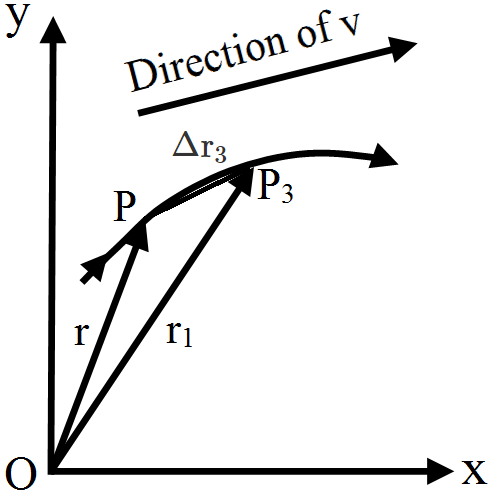
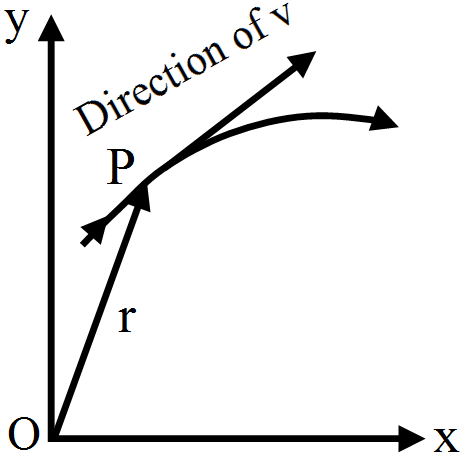
MCQ 11 Mark
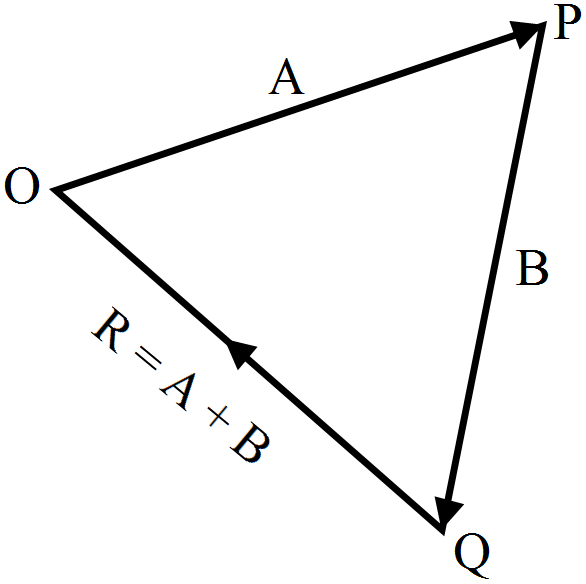
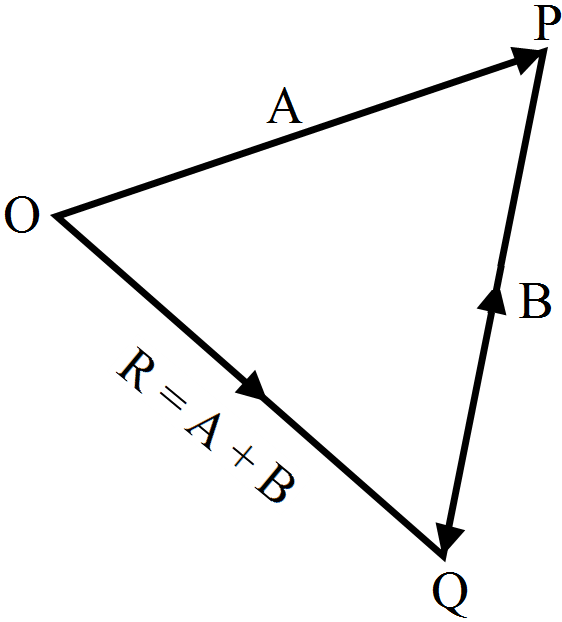
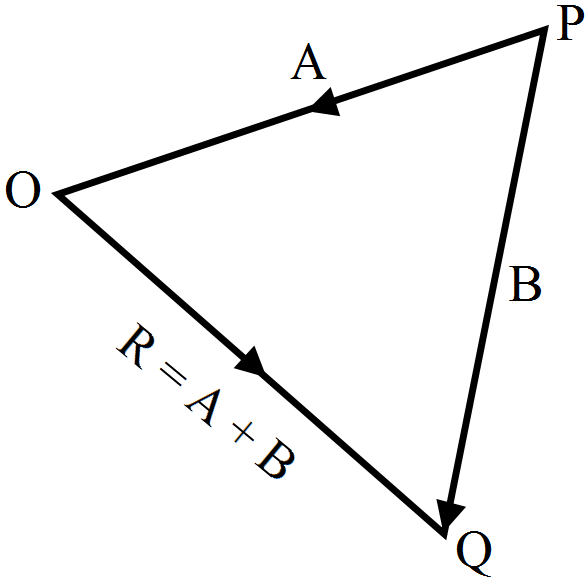
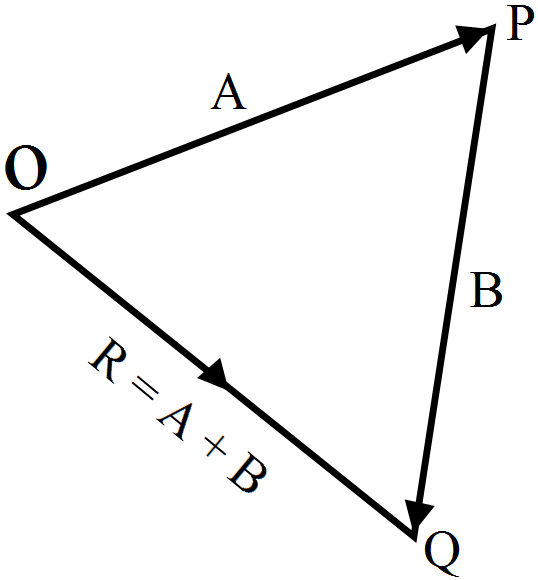
$A$ and $B$ are two inclined vectors. $R$ is their sum. Choose the correct figure for the given description.
View full question & answer→MCQ 21 Mark
The length of seconds hand of a watch is $1\ cm.$ The change in velocity of its tip in $15$ seconds in $cm/ s$ is:
AnswerCorrect option: D. $\frac{2\pi}{(30\sqrt{2})}$
The angle described at the centre by the length of second hand of a watch in $15$ second
$=90^\circ=\frac{\pi}{2}$ radians Figure.
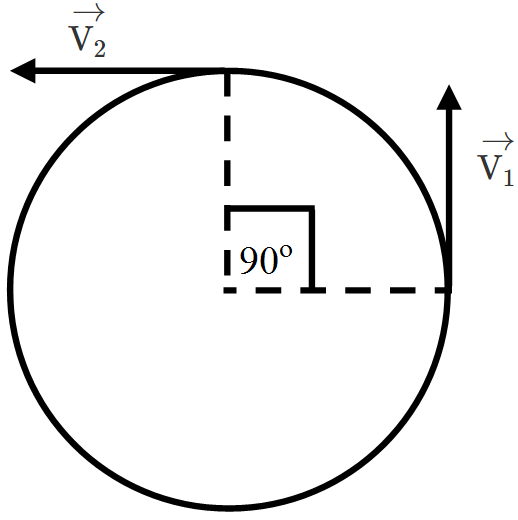
Linear speed $\text{v}=\text{r}\omega$
$=\frac{\text{r}\theta}{\text{t}}$
$=\frac{1\times\big(\frac{\pi}{2}\big)}{15}$
$=\frac{\pi}{30}\text{cm s}^{-1}$
Magnitude of change in velocity in $15 \sec;$
$|\Delta\vec{\text{v}}|=|\vec{\text{v}}_2-\vec{\text{v}}_1|$
$=\sqrt{\text{v}^2_2-\text{v}_1^2}$
$=\sqrt{\text{v}^2+\text{v}^2}$
$=\sqrt{2}\text{v}$
$=\sqrt{2}\frac{\pi}{30}$
$=\frac{2\pi}{30\sqrt{2}}$ View full question & answer→MCQ 31 Mark
What is the position vector of a point mass moving on a circular path of radius of $10m$ with angular frequency of $2 \text{rads}^{-1}$ after $\frac{\pi}{8}\text{s}?$ Initially the point was on $Y-$axis.
- A
$5.(\hat{\text{i}}+\hat{\text{j}})$
- ✓
$5\sqrt{2}(\hat{\text{i}}+\hat{\text{j}})$
- C
$\hat{\text{i}}+\hat{\text{j}}$
- D
$\frac{1}{\sqrt{2}}(\hat{\text{i}}+\hat{\text{j}})$
AnswerCorrect option: B. $5\sqrt{2}(\hat{\text{i}}+\hat{\text{j}})$
View full question & answer→MCQ 41 Mark
Figure shows the orientation of two vectors $u$ and $v$ in the $XY$ plane.
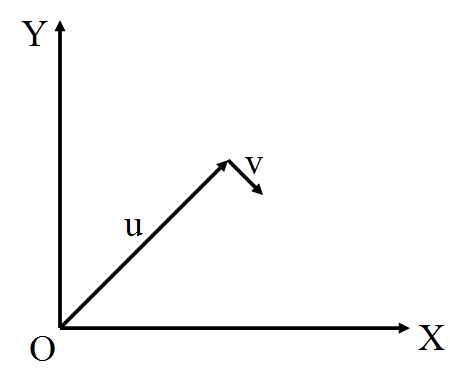
If $\text{u}=\text{a}\hat{\text{i}}+\text{b}\hat{\text{j}}$ and $\text{v}=\text{p}\hat{\text{i}}+\text{q}\hat{\text{j}}$ which of the following is correct? - A
$a$ and $p$ are positive while $b$ and $q$ are negative.
- ✓
$a, p$ and $b$ are positive while $q$ is negative.
- C
$a, q$ and $b$ are positive while $p$ is negative.
- D
$a, b, p$ and $q$ are all positive.
AnswerCorrect option: B. $a, p$ and $b$ are positive while $q$ is negative.
Main concept used: Sign of $a, b, p$ and $q$ are the sign of their resolving components in the $XY$ direction.
Explanation: Components along $X$ and $Y$ axis of the vector $\vec{\text{u}}$ are both $+X$ and $Y$ direction,
so $a, b$ are positive.
Now if we resolve $\vec{\text{v}}$ its $X$ component is in $+ve\ X$ direction but $Y$ component will be in $-ve\ Y$ direction.
Hence, $a, b$ and $p$ are positive but $q$ is negative. Verifies option $(b).$
View full question & answer→MCQ 51 Mark
For a particle performing uniform circular motion, choose the correct statement$(s)$ from the following:
Answer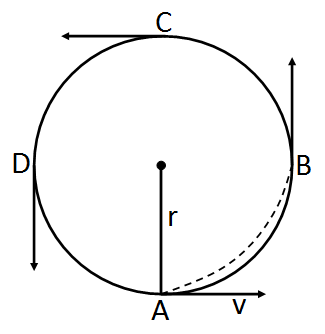
While a particle is in uniform circular motion. Then the following statements are true.
- Speed will be always constant throughout.
- Velocity will be always tangential in the direction of motion at a particular point.
- The centripetal acceleration $a = v^2/r$ and its direction will always towards centre of the circular trajectory.
- Angular momentum $(mvr)$ is constant in magnitude and direction. And its direction is perpendicular to the plane containing $r$ and $v.$
Important point: In uniform circular motion, magnitude of linear velocity and centripetal acceleration is constant but direction changes continuously. View full question & answer→MCQ 61 Mark
A particle starts from origin at $t = 0$ with a velocity $5.0\hat{\text{i}}\text{ ms}^{-1}$ and moves in $XY-$plane under action of force which produces a constant acceleration of $(3.0\hat{\text{i}}+2.0\hat{\text{j}})\text{ ms}^{-2}.$ What is the $y-$coordinate of the particle at the instant when its $x-$coordinate is $84m?$
View full question & answer→MCQ 71 Mark
In a two dimensional motion, instantaneous speed $v_0$ is a positive constant. Then which of the following are necessarily true?
- A
The average velocity is not zero at any time.
- B
Average acceleration must always vanish.
- C
Displacements in equal time intervals are equal.
- ✓
Equal path lengths are traversed in equal intervals.
AnswerCorrect option: D. Equal path lengths are traversed in equal intervals.
Speed $($Instantaneous Speed$):$ The magnitude of the velocity at any instant of time is known as Instantaneous Speed or simply speed at that instant of time. It is denoted by $v.$
Quantitatively: Speed $=$ distance/ time
Mathematically, it is the time rate at which distance is being travelled by the particle.
- Speed is a scalar quantity. It can never be negative $($as shown by speedometer of our vehicle$).$
- Instantaneous speed is the speed of a particle at a particular instant of time.
Hence, Total distance travelled $=$ Path length $= ($speed$) \times $ time taken
Important point: We should be very carefull with the fact that speed is related with total distance covered not with displacement. View full question & answer→MCQ 81 Mark
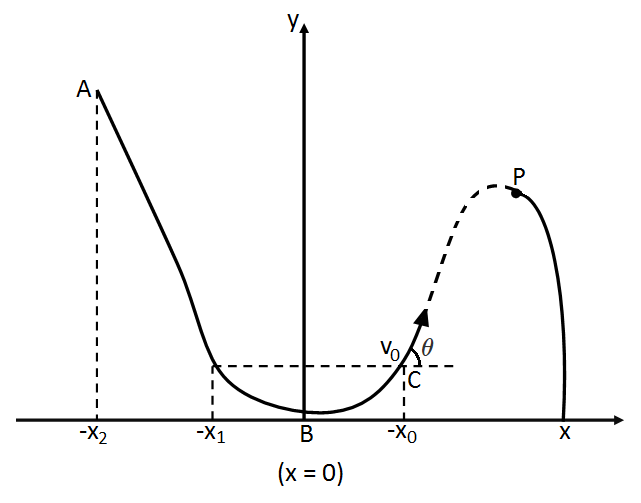
A particle slides down a frictionless parabolic $(y = x^2)$ track $(A – B – C)$ starting from rest at point $A.$ Point $B$ is at the vertex of parabola and point $C$ is at a height less than that of point $A$. After $C,$ the particle moves freely in air as a projectile. If the particle reaches highest point at $P,$ then
- A
$KE$ at $P = KE$ at $B.$
- B
height at $P =$ height at $A$.
- ✓
total energy at $P =$ total energy at $A.$
- D
time of travel from $A$ to $B =$ time of travel from $B$ to $P.$
AnswerCorrect option: C. total energy at $P =$ total energy at $A.$
In such type of problems, we have to observe the nature of track that if there is a friction or not, as friction is not present in this track, total energy of the particle will remain constant throughout the journey.
According to the problem, the path traversed by the particle on a frictionless track is parabolic, is given by the equation $y = x^2,$
thus total energy $\text{(KE + PE)}$ will be same throughout the journey.
Hence, total energy at $A =$ total energy at $P$
At $B$ the particle is having only $\text{KE}$ but at $P$ some $\text{KE}$ is converted to $\text{PE.}$
So, $\ce{(KE)_B > (KE)_P}$
Total energy at $\text{A = PE =}$ Total energy at $\text{B = KE =}$ Total energy at $\text{P = PE + KE}$
The potential energy at $A$ is converted to $\text{KE}$ and $\text{PE}$ at $P,$
hence $\text{(PE)P < (PE)A}$
Hence, $($Height$)P < ($Height$)A$
As, Height of $P <$ Height of $A$
Hence, path length $AB >$ path length $BP$
Hence, time of travel from $A$ to $B \neq$ Time of travel from $B$ to $P.$
View full question & answer→MCQ 91 Mark
A man standing on a road has to hold his umbrella at $30^\circ$ with the vertical to keep the rain away. He throws the umbrella and starts running at $10\ kmh^{-1}.$ He finds that raindrops are hitting his head vertically. The actual speed of raindrops is:
AnswerCorrect option: A. $20\text{kmh}^{-1}$
When the man is at rest with respect to the ground, the rain comes to him at an angle $30^\circ$ with the vertical. This is the direction of the velocity of raindrops with respect to the ground.
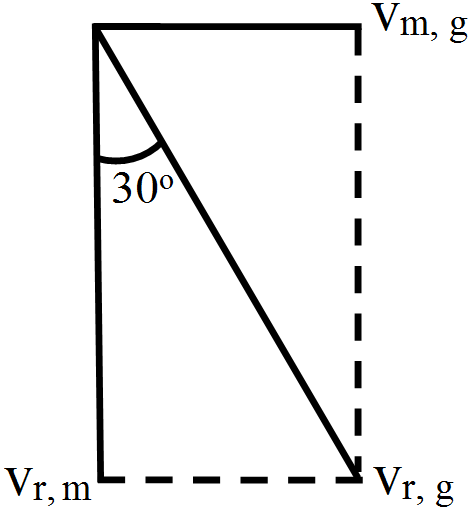
Here, $V_{r,g} =$ Velocity of the rain with respect to the ground
$V_{m,g} =$ Velocity of the man with respect to the ground
and $V_{r,m} =$ Velocity of the rain with respect to the man.
Here, $V_{m,g} = 10\ kmh^{-1}$
$\text{V}_{\text{r, g}}=\frac{10}{\sin30^\circ}=20\text{kmh}^{-1}$ View full question & answer→MCQ 101 Mark
The angle between $\vec{\text{A}}=\hat{\text{i}}+\hat{\text{j}}$ and $\vec{\text{B}}=\hat{\text{i}}-\hat{\text{j}}$ is
- A
$45^\circ$
- ✓
$90^\circ$
- C
$–45^\circ$
- D
$180^\circ$
AnswerCorrect option: B. $90^\circ$
Given $\vec{\text{A}}=\hat{\text{i}}+\hat{\text{j}}$
$\vec{\text{B}}=\hat{\text{i}}-\hat{\text{j}}$
$\vec{\text{A}}.\vec{\text{B}}=|\text{A}||\text{B}|\cos\theta$
$\cos\theta=\frac{\vec{\text{A}}.\vec{\text{B}}}{|\text{A}||\text{B}|}$
$=\frac{(\hat{\text{i}}+\hat{\text{j}}).(\hat{\text{i}}-\hat{\text{j}})}{\sqrt{1^2+1^2}\times\sqrt{1^2+(-1)^2}}=\frac{1-1}{2}=0$
$\Rightarrow\cos\theta=\cos90$
$\therefore\theta=90^\circ.$
Hence, verifies the option $(b).$
View full question & answer→MCQ 111 Mark
Two cars of masses $m,$ and $my$ are moving in circles of radii $r_1$ and $r_2$, respectively. Their speeds are such that they make complete circles in the same time $t.$ The ratio of their centripetal accelerations is:
- A
$m_1r_1 : m_2r_2$
- B
$m_1 : m_2$
- ✓
$r_1 : r_2$
- D
$1 : 1$
AnswerCorrect option: C. $r_1 : r_2$
As, centripetal acceleration is given as, $\text{a}_\text{c}=\frac{\text{v}^2}{\text{r}}$
For the first body of mass $m_1$, $\text{a}_{\text{c}_1}=\frac{\text{v}_1^2}{\text{r}_1}$
For the second body of mass $m_2$, $\text{a}_{\text{c}_2}=\frac{\text{v}_2^2}{\text{r}_2}$
Also time to complete one revolution by both body is same.
Hence, $\frac{2\pi\text{r}_1}{\text{v}_1}=\frac{2\pi\text{r}_2}{\text{v}_2}$
$\Rightarrow\ \frac{\text{v}_1}{\text{v}_2}=\frac{\text{r}_1}{\text{r}_2}\dots(\text{i})$
i.e., $\text{a}_{\text{c}_1}:\text{a}_{\text{c}_2}=\frac{\text{v}_1^2}{\text{r}_1}\times\frac{\text{r}_2}{\text{v}^2_2} [$from eq. $(i)]$
$=\frac{\text{r}_1^2}{\text{r}_2^2}\times\frac{\text{r}_2}{\text{r}_1}=\frac{\text{r}_1}{\text{r}_2}=\text{r}_1:\text{r}_2$
View full question & answer→MCQ 121 Mark
A plane is inclined at an angle of $30^\circ$ with horizontal. The magnitude of component of a vector $\vec{\text{A}}=-10\hat{\text{k}}$ perpendicular to this plane is $($here $z-$direction is vertically upwards$):$
- A
$5\sqrt{2}$
- ✓
$5\sqrt{3}$
- C
$5$
- D
$2.5$
AnswerCorrect option: B. $5\sqrt{3}$
View full question & answer→MCQ 131 Mark
In a two dimensional motion, instantaneous speed $v_0$ is a positive constant. Then which of the following are necessarily true?
- A
The acceleration of the particle is zero.
- B
The acceleration of the particle is bounded.
- ✓
The acceleration of the particle is necessarily in the plane of motion.
- D
The particle must be undergoing a uniform circular motion.
AnswerCorrect option: C. The acceleration of the particle is necessarily in the plane of motion.
This motion is two dimensional and given that instantaneous speed $v_0$ is positive constant. Acceleration is defined as the rate of change of velocity $($instantaneous speed$)$, hence it will also be in the plane of motion.
View full question & answer→MCQ 141 Mark
A projectile is hurled into air from a point on the horizontal ground at an angle with the vertical. If the air exerts a constant resistive force,
- A
The path of projectile will be parabolic path.
- B
The time of ascent will be equal to time of decent.
- C
The total energy of the projectile is not conserved.
- ✓
View full question & answer→MCQ 151 Mark
A cart moves with a constant speed along a horizontal circular path. From the cart, a particle is thrown up vertically with respect to the cart, the particle will,
- A
Land outside the circular path.
- B
Land somewhere on the circular path.
- C
- ✓
$A$ and $C$
AnswerCorrect option: D. $A$ and $C$
View full question & answer→MCQ 161 Mark
Two cars $A$ and $B$ move along a concentric circular path of radius $r_A$ and $r_B$ with velocities $v_A$ and $v_B$ maintaining constant distance, then $\frac{\text{v}_\text{A}}{\text{v}_\text{B}}$ is equal to:
- A
$\frac{\text{r}_\text{B}}{\text{r}_\text{A}}$
- ✓
$\frac{\text{r}_\text{A}}{\text{r}_\text{B}}$
- C
$\frac{\text{r}_\text{A}^2}{\text{r}_\text{B}^2}$
- D
$\frac{\text{r}_\text{B}^2}{\text{r}_\text{A}^2}$
AnswerCorrect option: B. $\frac{\text{r}_\text{A}}{\text{r}_\text{B}}$
View full question & answer→MCQ 171 Mark
If $\vec{\text{a}}_1$ and $\vec{\text{a}}_2$ are two non collinear unit vectors and $|\vec{\text{a}}_1+\vec{\text{a}}_2|=\sqrt{3},$ then the value of $(\vec{\text{a}}_1-\vec{\text{a}}_2).(2\vec{\text{a}}_1+\vec{\text{a}}_2)$ is:
- A
$2$
- B
$\frac{3}{2}$
- ✓
$\frac{1}{2}$
- D
$1$
AnswerCorrect option: C. $\frac{1}{2}$
View full question & answer→MCQ 181 Mark
The component of a vector $r$ along $X-$axis will have maximum value if
- A
$r$ is along positive $Y-$axis.
- ✓
$r$ is along positive $X-$axis.
- C
$r$ makes an angle of $45^\circ $ with the $X-$axis.
- D
$r$ is along negative $Y-$axis.
AnswerCorrect option: B. $r$ is along positive $X-$axis.
Consider a vector $\vec{\text{R}}$ in $X-Y$ plane as shown in figure. If we draw orthogonal vectors $\vec{\text{R}}_{\text{x}}$ and $\vec{\text{R}}_{\text{y}}$ along $x$ and $y$ axes respectively, by law of vector addition, $\vec{\text{R}}=\vec{\text{R}}_{\text{x}}+\vec{\text{R}}_{\text{y}}$
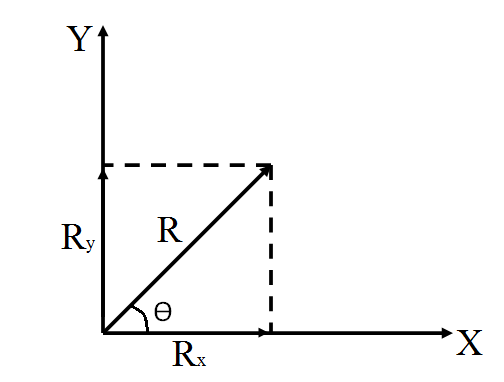
The magnitude of component of $r$ along $X-$axis
$\text{r}_\text{x}=|\text{r}|\cos\theta$
$(\text{r}_\text{x})_{\text{maximum}}=|\text{r}|(\cos\theta)_{\text{maximum}}$
$\text{r}_\text{x}=|\text{r}|\cos\theta$
$=|\text{r}|\cos0^\circ=|\text{r}|$ $(\because\cos\theta$ is maximum if $\theta=0^\circ)$
As $\theta=0^\circ,$
$r$ is along positive $x-$axis. View full question & answer→MCQ 191 Mark
The $x-$component of the resultant of several vectors:
AnswerCorrect option: A. Is equal to the sum of the $x-$components of the vectors.
The $x-$component of the resultant vector can never be greater than the sum of the magnitude of the vectors.
View full question & answer→MCQ 201 Mark
During projectile motion the quantities that remain unchanged are:
- A
Force and vertical velocity.
- ✓
Acceleration and horizontal velocity.
- C
Kinetic energy and acceleration.
- D
Acceleration and momentum.
AnswerCorrect option: B. Acceleration and horizontal velocity.
View full question & answer→MCQ 211 Mark
A particle moves on a given line with a constant speed $v.$ At a certain time it is at a point $P$ on its straight line path. $O$ is fixed point. The value of $(\overrightarrow{\text{OP}}\times\vec{\text{v}})$ is $($where $y$ is perpendicular distance from $0$ to given line$)$
- ✓
$-\text{y v}\hat{\text{k}}$
- B
$-2\text{y v}\hat{\text{k}}$
- C
$-3\text{y v}\hat{\text{k}}$
- D
AnswerCorrect option: A. $-\text{y v}\hat{\text{k}}$
View full question & answer→MCQ 221 Mark
A body is thrown with a velocity of $10\ ms^{-1}$ at an angle of $60^\circ$ with the horizontal. Its velocity at the highest point is:
- A
- ✓
$5\ ms^{-1}$
- C
$10\ ms^{-1}$
- D
$8.66\ ms^{-1}$
AnswerCorrect option: B. $5\ ms^{-1}$
At the highest point of the angular projection, the velocity of projectile has only horizontal component velocity $=\text{u}\cos\theta$
$=10\cos60^\circ$
$=5\text{ms}^{-1}.$
View full question & answer→MCQ 231 Mark
Given, $\ce{|A + B| = P, |A - B| = Q.}$ The value of $\ce{P^2 + Q^2}$ is:
- ✓
$\ce{2(A^2 + B^2)}$
- B
$\ce{A^2 - B^2}$
- C
$\ce{A^2 + B^2}$
- D
$\ce{2(A^2 - B^2)}$
AnswerCorrect option: A. $\ce{2(A^2 + B^2)}$
View full question & answer→MCQ 241 Mark
Choose the correct option regarding the given figure.
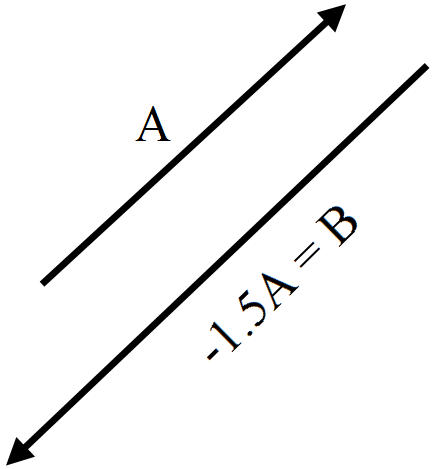
AnswerCorrect option: D. $|\text{B}|\neq|\text{A}|$
View full question & answer→MCQ 251 Mark
Two projectiles $A$ and $B$ thrown with speeds in the ratio $1:\sqrt{2}$ acquired the same height. If $A$ is thrown at an angle of $45^\circ$ with the horizontal, then angle of projection of $B$ will be:
- A
$0^\circ$
- B
$60^\circ$
- ✓
$30^\circ$
- D
$45^\circ$
AnswerCorrect option: C. $30^\circ$
View full question & answer→MCQ 261 Mark
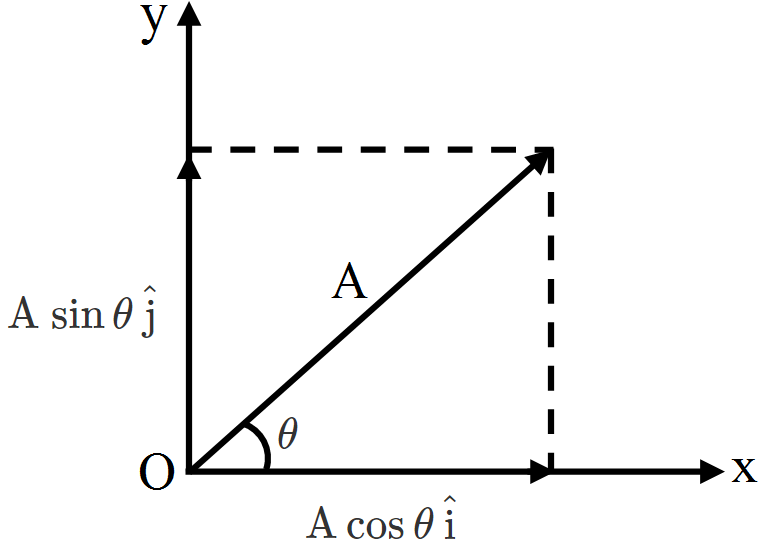
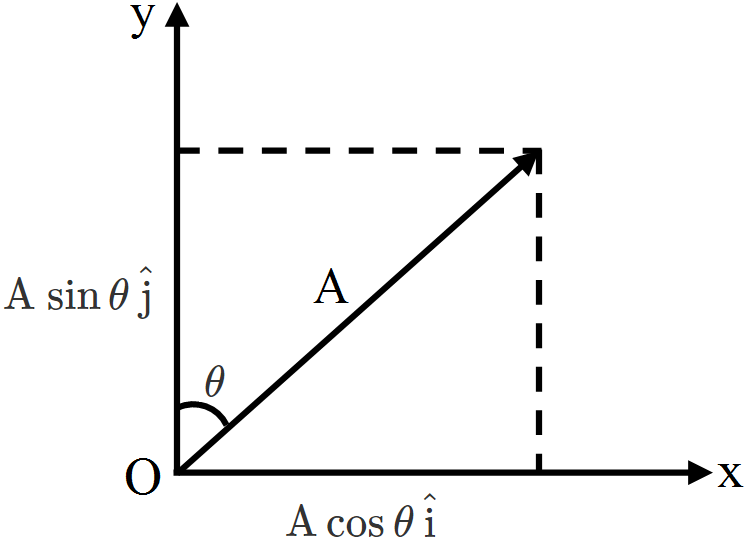
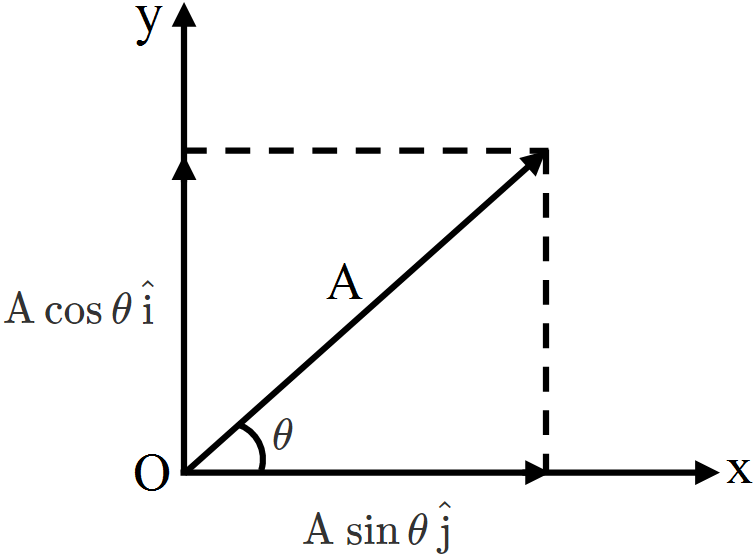
. The quantities $A_x$ and $A_y$ are called $x$ and $y-$components of the vector $A.$ Note that $A_x$ is itself not a vector, but $\text{A}_\text{x}\hat{\text{i}}$ is a vector, and so is $\text{A}_\text{y}\hat{\text{j}}.$ Using simple trigonometry, we can express $A_x$ and $A_y$ in terms of the magnitude of $A$ and the angle it makes with the $x-$axis $\text{A}_\text{x}=\text{A}\cos\theta$ $\text{A}_\text{y}=\text{A}\sin\theta$ Choose the correct figure on the basis of given description.
View full question & answer→MCQ 271 Mark
A boy aims a gun at a target from a point, at a horizontal distance of $100m.$ If the gun can impart a horizontal velocity of $500\ ms^{-1}$ to the bullet, the height above the target where he must aim his gun, in order to hit it is $($Take $g = 10\ ms^{-2})$
- ✓
$20\ cm$
- B
$10\ cm$
- C
$50\ cm$
- D
$100\ cm$
AnswerCorrect option: A. $20\ cm$
View full question & answer→MCQ 281 Mark
A body is projected horizontally with a velocity of $4\ ms^{-1}$. The velocity of the body after $0.7s$ is nearly $($take $g = 10\ ms^{-2}$)
- A
$10\ ms^{-1}$
- ✓
$8\ ms^{-1}$
- C
$19.2\ ms^{-1}$
- D
$11\ ms^{-1}$
AnswerCorrect option: B. $8\ ms^{-1}$
View full question & answer→MCQ 291 Mark
If a person can throw a stone to maximum height of $h$ metre vertically, then the maximum distance through which it can be thrown horizontally by the same person is:
- A
$\frac{\text{h}}{2}$
- B
$h$
- ✓
$2h$
- D
$3h$
View full question & answer→MCQ 301 Mark
Five equal forces of $10N$ each are applied at one point and are all lying in one plane. If the angles between them are equal, the resultant of these forces will be:
- ✓
- B
$10N$
- C
$20N$
- D
$10\sqrt{2}\text{N}$
AnswerThe five forces inclined equally acting on the particle can be represented by the five sides of a pentagon taken in the same order. Hence, their resultant is zero.
View full question & answer→MCQ 311 Mark
Three particles $A, B$ and $C $projected from the same point with the same initial speeds making angle $30^\circ , 45^\circ$ and $60^\circ ,$ respectively with the horizontally. Which of the following statements is correct?
- A
$A, B$ and $C$ have unequal ranges.
- ✓
Ranges of $A$ and $C$ are less than that of $B.$
- C
Ranges of $A$ and $C$ are equal and greater than that of $B.$
- D
$A, B$ and $C$ have equal ranges.
AnswerCorrect option: B. Ranges of $A$ and $C$ are less than that of $B.$
When a body is projected at an angle with the horizontal with initial velocity $u,$ then the horizontal range $R$ of projectile is $\text{R}=\frac{\text{u}^2\sin2\theta}{\text{g}}.$
Clearly, for maximum horizontal range $\sin2\theta=1$ or $2\theta=90^\circ$ or $\theta=45^\circ.$
Hence, in order to achieve maximum range, the body should be projected at $45^\circ .$
In this case $\text{R}_\text{max}=\frac{\text{u}^2}{\text{g}}$
Hence, ranges of $A$ and $C$ are less than that of $B.$
View full question & answer→MCQ 321 Mark
A girl riding a bicycle with a speed of $5\ ms^{-1}$ towards North direction sees raindrops falling vertically downwards. On increasing the speed to $15\ ms$ rain appears to fall making an angle of $45^\circ$ of the vertical. Find the magnitude of velocity of rain.
AnswerCorrect option: B. $5\sqrt{5}\text{ ms}^{-1}$
View full question & answer→MCQ 331 Mark
$|\lambda\text{A}|=\lambda|\text{A}|,\ \text{if}$
- ✓
$\lambda>0$
- B
$\lambda<0$
- C
$\lambda=0$
- D
$\lambda\neq0$
AnswerCorrect option: A. $\lambda>0$
View full question & answer→MCQ 341 Mark
The displacement of a particle moving on a circular path of radius $r$ when it makes $60^\circ$ at the centre is:
- A
$2r$
- ✓
$r$
- C
$\sqrt{2}\text{r}$
- D
View full question & answer→MCQ 351 Mark
The ceiling of a hall is $30m$ high. A ball is thrown with $60\ ms^{-1}$ at an angle $\theta,$ so that maximum horizontal distance may be covered. The angle of projection is given by,
- A
$\sin\theta=\frac{1}{\sqrt{8}}$
- ✓
$\sin\theta=\frac{1}{\sqrt{6}}$
- C
$\sin\theta=\frac{1}{\sqrt{3}}$
- D
AnswerCorrect option: B. $\sin\theta=\frac{1}{\sqrt{6}}$
Given $u = 60\ ms^{-1}$
$\therefore$ maximum height, $\text{H}=\frac{\text{u}^2\sin^2\theta}{2\text{g}}$
$\Rightarrow\ 30=\frac{(60)^2\sin^2\theta}{2\text{g}}$
$\Rightarrow\ \sin^2\theta=\frac{30\times2\text{g}}{60\times60}=\frac{10}{60}$
$\Rightarrow\ \sin\theta=\frac{1}{\sqrt{6}}$
View full question & answer→MCQ 361 Mark
It is found that $|\text{A}+\text{B}|=|\text{A}|.$ This necessarily implies,
AnswerCorrect option: A. $\text{B}=0$
$|\vec{\text{A}}+\vec{\text{B}}|=|\vec{\text{A}}|$
Applying dot product,
$|\vec{\text{A}}+\vec{\text{B}}|.|\vec{\text{A}}+\vec{\text{B}}|=|\vec{\text{A}}|.|\vec{\text{A}}|$
$\Rightarrow\ |\vec{\text{A}}|^2+2\vec{\text{A}}.\vec{\text{B}}+|\vec{\text{B}}|^2=|\text{A}|^2$
$\Rightarrow\ |\vec{\text{B}}|^2=-2\vec{\text{A}}.\vec{\text{B}}$
$\Rightarrow\ |\vec{\text{B}}|=0$
Therefore, option $(a)$ is correct.
View full question & answer→MCQ 371 Mark
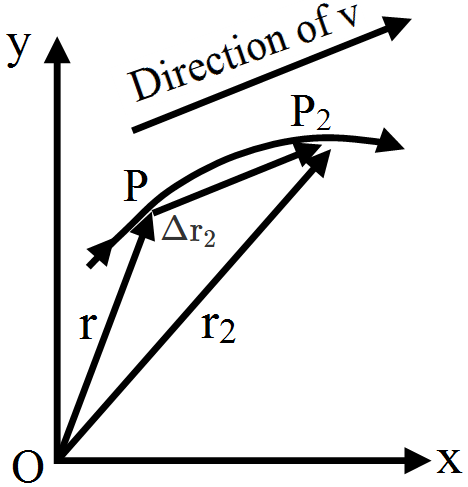
The direction of instantaneous velocity is show by:
MCQ 381 Mark
Two particles are projected in air with speed $v_o$ at angles $\theta_1$ and $\theta_2 ($both acute$)$ to the horizontal, respectively. If the height reached by the first particle is greater than that of the second, then tick the right choices
- ✓
angle of projection: $q_1 > q_2$
- B
time of flight: $T_1 > T_2$
- C
$A$ and $C$
- D
total energy: $U_1 > U_2$
AnswerCorrect option: A. angle of projection: $q_1 > q_2$
- According to the problem,
$\Rightarrow\ \text{H}_1>\text{H}_2$
$\Rightarrow\ \frac{\text{v}^2_0\sin^2\theta_1}{2\text{g}}>\frac{\text{v}^2_0\sin^2\theta_2}{2\text{g}}$
$\Rightarrow\ \sin^2\theta_1>\sin^2\theta_2$
$\Rightarrow\ \sin^2\theta_1-\sin^2\theta_2>0$
$\Rightarrow\ (\sin\theta_1-\sin\theta_2)(\sin\theta_1+\sin\theta_2)>0$
Thus, either $\sin\theta_1+\sin\theta_2>0$
$\Rightarrow\ \sin\theta_1-\sin\theta_2>0$
$\Rightarrow\ \sin\theta_1>\sin\theta_2\text{ or }\theta_1>\theta_2$
Hence option $(a)$ is correct.
- Time of flight, $\text{T}=\frac{2\text{u}\sin\theta}{\text{g}}=\frac{2\text{v}_0\sin\theta}{\text{g}}$
Thus, $\text{T}_1=\frac{2\text{v}_0\sin\theta_1}{\text{g}}$ and $\text{T}_2=\frac{2\text{v}_0\sin\theta_2}{\text{g}}$
$($Here, $T_1 =$ Time of flight of first particle and $T_2 =$ Time of flight of second particle$).$
As, $\sin\theta_1>\sin\theta_2$
Thus, $\text{T}_1>\text{T}_2$
Hence option $(b)$ is correct.
- We know that Range, $\text{R}=\frac{\text{u}^2\sin2\theta}{\text{g}}=\frac{\text{v}^2_0\sin2\theta}{\text{g}}$
Range of first particle $=\text{R}_1=\frac{\text{u}^2_0\sin2\theta_1}{\text{g}}$
Range of second particle $=\text{R}_2=\frac{\text{u}^2_0\sin2\theta_2}{\text{g}}$
Given, $\sin\theta_1>\sin\theta_2$
$\Rightarrow\ \sin2\theta_1>\sin2\theta_2$
$\Rightarrow\ \frac{\text{R}_1}{\text{R}_2}=\frac{\sin2\theta_1}{\sin2\theta_2}>1$
$\Rightarrow\ \text{R}_1>\text{R}_2$
But if $\theta_1+\theta_2=90^\circ,$ then $\text{R}_1=\text{R}_2$
Hence option $(c)$ is incorrect.
Important points about time of flight: For complementary angles of projection $\theta$ and $90^\circ-\theta.$
- Ratio of time of flight $=\frac{\text{T}_1}{\text{T}_2}=\frac{2\text{u}\sin\frac{\theta}{\text{g}}}{2\text{u}\sin\frac{(90^\circ-\theta)}{\text{g}}}=\tan\theta$
$\Rightarrow\ \frac{\text{T}_1}{\text{T}_2}=\tan\theta$
- Multiplication of time of flight $=\text{T}_1\text{T}_2=\frac{2\text{u}\sin\theta}{\text{g}}\frac{2\text{u}\cos\theta}{\text{g}}$
$\Rightarrow\ \text{T}_1\text{T}_2=\frac{2\text{R}}{\text{g}}$ View full question & answer→MCQ 391 Mark
Following are four differrent relations about displacement, velocity and acceleration for the motion of a particle in general. Choose the incorrect one $(s):$
- A
$\text{v}_\text{av}=\frac{1}2\big[\text{v}(\text{t}_1)+\text{v}(\text{t}_2)\big]$
- B
$\text{v}_\text{av}=\frac{r(\text{t}_2)-\text{r}(\text{t}_1)}{\text{t}_2-\text{t}_1}$
- C
$\text{r}=\frac{1}2(\text{v}(\text{t}_2)-\text{v}(\text{t}_1))(\text{t}_2-\text{t}_1)$
- ✓
$A$ and $C$
AnswerCorrect option: D. $A$ and $C$
When an object covers a displacement $\Delta\text{r}$ in time $\Delta\text{t},$ its average velocity is given by $\vec{\text{v}}_\text{avg}=\frac{\overrightarrow{\Delta\text{r}}}{\Delta\text{t}}=\frac{\text{r}_2-\text{r}_1}{\text{t}_2-\text{t}_1}$
where $r_1$ and $r_2$ are position vectors corresponding to time $t_1$ and $t_2$.
If the velocity of an object changes from $v_1$ to $v_2$ in time $\Delta\text{t},$ average acceleration is given by
$\text{a}_\text{av}=\frac{\Delta\text{v}}{\Delta\text{t}}=\frac{\text{v}_2-\text{v}_1}{\text{t}_2-\text{t}_1}$
But, when acceleration is non$-$uniform,
$\text{v}_\text{av}\neq\frac{\text{v}_1+\text{v}_2}{2}$
Option $(D)$ is similar to the relation $\vec{\text{r}}=\frac{1}2\text{at}^2$ which is not correct if initial velocity is given.
View full question & answer→MCQ 401 Mark
Choose the correct option/s.
- A
To represent two$-$dimensional motion we need vectors.
- B
To represent one$-$dimensional motion we use positive and negative signs.
- C
To represent $3-$dimensional motion we need vectors.
- ✓
All $(a), (b)$ and $(c).$
AnswerCorrect option: D. All $(a), (b)$ and $(c).$
View full question & answer→MCQ 411 Mark
The sum of magnitudes of two forces acting at a point is $18$ units and the magnitude oftheir resultant is $12$ units. The resultant is at $90^\circ$ with the force of the smaller magnitude. The magnitude of the individual forces is:
- A
$5, 12$
- ✓
$5, 13$
- C
$6, 14$
- D
AnswerCorrect option: B. $5, 13$
View full question & answer→MCQ 421 Mark
Three vectors $\vec{\text{A}},\ \vec{\text{B}}$ and $\vec{\text{C}}$ add up to zero. Find which is false.
- A
$(\vec{\text{A}}\times\vec{\text{B}})\times\vec{\text{C}}$ is not zero unless $\vec{\text{B}},\ \vec{\text{C}}$ are parallel.
- B
$(\vec{\text{A}}\times\vec{\text{B}}).\vec{\text{C}}$ is not zero unless $\vec{\text{B}},\ \vec{\text{C}}$ are parallel.
- C
If $A, B, C$ define a plane, $(\vec{\text{A}}\times\vec{\text{B}})\times\vec{\text{C}}$ is in that plane.
- ✓
$A$ and $C$
AnswerCorrect option: D. $A$ and $C$
$\vec{\text{A}}+\vec{\text{B}}+\vec{\text{C}}=0$
So $\vec{\text{A}},\ \vec{\text{B}}$ and $\vec{\text{C}}$ are in a plane and can be represented bt the three sides of a triangle taken in order.
- $\vec{\text{B}}\times(\vec{\text{A}}+\vec{\text{B}}+\vec{\text{C}})=\vec{\text{B}}\times0=0$
$\vec{\text{B}}\times\vec{\text{A}}+\vec{\text{B}}\times\vec{\text{B}}+\vec{\text{B}}\times\vec{\text{C}}=0$
$\vec{\text{B}}\times\vec{\text{A}}+0+\vec{\text{B}}\times\vec{\text{C}}=0$
$\vec{\text{B}}\times\vec{\text{A}}=-\vec{\text{B}}\times\vec{\text{C}}$
$\vec{\text{A}}\times\vec{\text{B}}=\vec{\text{B}}\times\vec{\text{C}}\ \dots(\text{i})$
Or $(\vec{\text{A}}\times\vec{\text{B}})\times\vec{\text{C}}=(\vec{\text{B}}\times\vec{\text{C}})\times\vec{\text{C}}$
$\therefore$ It cannot be zero
$\vec{\text{B}}\times\vec{\text{C}}$ will be zero if $\vec{\text{B}}\times\vec{\text{C}}$ are parallel or antiparallel.
i.e, $(\vec{\text{A}}\times\vec{\text{B}})\times\vec{\text{C}}=[\text{BC}\sin0^\circ]\times\vec{\text{C}}$
$(\vec{\text{A}}\times\vec{\text{B}})\times\vec{\text{C}}=0$ only if $\vec{\text{B}}||\vec{\text{C}}$
Hence option $(a)$ is verified.
- $(\vec{\text{A}}\times\vec{\text{B}})=\vec{\text{B}}\times\vec{\text{C}} [$from $(i)]$
$(\vec{\text{A}}\times\vec{\text{B}}).\vec{\text{C}}=(\vec{\text{B}}\times\vec{\text{C}}).\vec{\text{C}}$
if $\vec{\text{B}}||\vec{\text{C}}$
$\vec{\text{B}}\times\vec{\text{C}}=\text{BC}\sin0^\circ=0$
$\therefore\ (\vec{\text{A}}\times\vec{\text{B}}).\vec{\text{C}}=0$ IF $\vec{\text{B}}||\vec{\text{C}}$
So option $(b)$ is not verified.
- $(\vec{\text{A}}\times\vec{\text{B}})=\vec{\text{X}}$
The direction of $x$ is perpendicular to both planes containing $A$ and $B.$
$(\vec{\text{A}}\times\vec{\text{B}})\times\vec{\text{C}}=\vec{\text{X}}\times\vec{\text{C}}=\vec{\text{Y}}$
The direction of $\vec{\text{Y}}$ is perpendicular to the plane of $\vec{\text{X}}$ and $\vec{\text{C}}$ which again become in the plane of $\vec{\text{A}},\ \vec{\text{B}},\ \vec{\text{C}}$ but perpendicular to the plane of $\vec{\text{X}}$ and $\vec{\text{C}}.$
Hence option $(c)$ is also verified.
- $|\text{A}|^2+|\text{B}|^2=|\text{C}|^2$ given
It shows that angle between $\vec{\text{A}}$ and $\vec{\text{B}}$ is $90^\circ$
$=|\text{A}||\text{B}||\text{C}|\cos\theta\neq|\text{A}||\text{B}||\text{C}|$
$(\vec{\text{A}}\times\vec{\text{B}}).\vec{\text{C}}=|\text{A}||\text{B}||\text{C}|\cos\theta$
Does not verified option $(d).$ View full question & answer→MCQ 431 Mark
The speed of a projectile at the maximum height is $\frac{1}{2}$ its initial speed. Find the ratio of range of projectile to the maximum height attained.
- A
$4\sqrt{3}$
- ✓
$\frac{4}{\sqrt{3}}$
- C
$\frac{\sqrt{3}}{4}$
- D
$6$
AnswerCorrect option: B. $\frac{4}{\sqrt{3}}$
View full question & answer→MCQ 441 Mark
A vector is of magnitude $10\sqrt{3}$ units and making equal angles with the positive direction of $x, y$ and $z$ axis is:
- ✓
$10(\hat{\text{i}}+\hat{\text{j}}+\hat{\text{k}})$
- B
$10(\hat{\text{i}}+2\hat{\text{j}}+3\hat{\text{k}})$
- C
$10(-\hat{\text{i}}-\hat{\text{j}}-\hat{\text{k}})$
- D
$10(\hat{\text{i}}-\hat{\text{j}}+\hat{\text{k}})$
AnswerCorrect option: A. $10(\hat{\text{i}}+\hat{\text{j}}+\hat{\text{k}})$
View full question & answer→MCQ 451 Mark
If $A$ is a vector with magnitude $|A|,$ then the unit vector â in the direction of vector $A$ is:
AnswerCorrect option: D. $\frac{\text{A}}{|\text{A}|}$
View full question & answer→MCQ 461 Mark
From the top of a tower of height $40m,$ a ball is projected upwards with a speed of $20\ m/ s$ at an angle of elevation of $30^\circ .$ The ratio of the total time taken by the ball to hit the ground to its time of flight time taken to come back to the same elevation is $($Take $g = 10\ m/ s^2)$
- ✓
$2 : 1$
- B
$3 : 1$
- C
$3 : 2$
- D
$1.5 : 1$
AnswerCorrect option: A. $2 : 1$
View full question & answer→MCQ 471 Mark
Which one of the following statements is true?
- A
A scalar quantity is the one that is conserved in a process.
- B
A scalar quantity is the one that can never take negative values.
- C
A scalar quantity is the one that does not vary from one point to another in space.
- ✓
A scalar quantity has the same value for observers with different orientations of the axes.
AnswerCorrect option: D. A scalar quantity has the same value for observers with different orientations of the axes.
A scalar quantity does not depend on direction so it does not change for different orientation of axes.
So this verifies the option $(d).$
View full question & answer→MCQ 481 Mark
The horizontal range of a projectile fired at an angle of $15^\circ$ is $50m.$ If it is fired with the same speed at an angle of $45^\circ$ , its range will be
- A
$60m$
- B
$71m$
- ✓
$100m$
- D
$141m$
AnswerCorrect option: C. $100m$
projectile is fired at $\theta=15^\circ,\ \text{R} = 50\text{m}$
$\text{R}=\frac{\text{u}^2\sin2\theta}{\text{g}}$
$50=\frac{\text{u}^2\sin2\times15^\circ}{\text{g}}\Rightarrow\text{u}^2=50\text{g}\times2$
$\text{u}^2=100\text{g}$
Now $\theta = 45^\circ,\ \text{u}^2=100\text{g}$
$\therefore\ \text{R}=\frac{\text{u}^2\sin2\theta}{\text{g}}=\frac{100\text{g}\times\sin2\times45^\circ}{\text{g}}$
$\Rightarrow\ \text{R}=100\text{m}$
So, this verifies option $(c).$
View full question & answer→MCQ 491 Mark
Consider the quantities, pressure, power, energy, impulse, gravitational potential, electrical charge, temperature, area. Out of these, the only vector quantities are
- A
Impulse, pressure and area.
- ✓
- C
Area and gravitational potential.
- D
AnswerWe know that impulse $J = F. \Delta\text{t}=\Delta\text{p},$
where $F$ is force, At is time duration and $Ap$ is change in momentum.
As $\Delta\text{p}$ is a vector quantity,
hence impulse is also a vector quantity.
Sometimes area can also be treated as vector direction of area vector is perpendicular to its plane.
View full question & answer→MCQ 501 Mark
The relation between the vectors $A$ and $-2A$ is that,
- A
Both have same magnitude.
- B
Both have same direction.
- ✓
They have opposite directions.
- D
AnswerCorrect option: C. They have opposite directions.
Multiplying a vector $A$ by a negative number $\lambda$ gives a vector $\lambda\text{A},$ whose directions opposite to the direction of $A$ and it's magnitude is $-\lambda$ times $|A|.$
View full question & answer→MCQ 511 Mark
Angle that the vector $\vec{\text{A}}=2\hat{\text{i}}+2\hat{\text{j}}$ makes with $y-$axis is:
- A
$\tan^{-1}\Big(\frac{3}{2}\Big)$
- ✓
$\tan^{-1}\Big(\frac{2}{3}\Big)$
- C
$\sin^{-1}\Big(\frac{2}{3}\Big)$
- D
$\cos^{-1}\Big(\frac{3}{2}\Big)$
AnswerCorrect option: B. $\tan^{-1}\Big(\frac{2}{3}\Big)$
As $\vec{\text{A}}=2\hat{\text{i}}+2\hat{\text{j}},$
therefore $A_x = 2$ and $A_y = 3.$ If $\theta$ is the angle which $\vec{\text{A}}$ encloses with $y-$axis, then.
$\tan\theta=\frac{\text{A}_\text{x}}{\text{A}_\text{y}}=\frac{2}{3}$ or $\theta=\tan^{-1}\Big(\frac{2}{3}\Big)$
View full question & answer→MCQ 521 Mark
If a unit vector is represented by $0.5\hat{\text{i}}+0.8\hat{\text{j}}+\text{c}\hat{\text{k}},$ then the value of $'c\ '$ is:
- A
$1$
- ✓
$\sqrt{0.11}$
- C
$\sqrt{0.01}$
- D
$\sqrt{0.39}$
AnswerCorrect option: B. $\sqrt{0.11}$
Here,$(0.5)^2 + (0.8)^2 + (c)^2 = 1$
or $\text{c}=\sqrt{0.11}$
View full question & answer→MCQ 531 Mark
A person moves $30m$ North, then $20m$ East then $30\sqrt{2}$ South$-$West. His displacement from the original position is:
- A
$14m$ South$-$West.
- B
$28m$ South.
- ✓
$10m$ West.
- D
$15m$ East.
AnswerCorrect option: C. $10m$ West.
Resolving displacement $30\sqrt{2}\text{ m}$ south$-$west in two rectangular components:
we have $30\sqrt{2}\cos45^\circ=30\sqrt{2}\times\frac{1}{\sqrt{2}}=30\text{m}$ towards south
and $30\sqrt{2}\times\sin45^\circ=30\times\sqrt{2}\times\frac{1}{\sqrt{2}}=30\text{m}$ towards west.
The resultant of $30m$ north will neutralise the displacement of $30m$ south.
Hence, the effective displacement is the resultant of $30m$ west and $20m$ east $= 10m$ west.
View full question & answer→MCQ 541 Mark
The simple sum of two forces acting at a point is $16N$ and their sum is $8N$ and its direction is perpendicular to the smaller force, then the forces are:
- ✓
$6N$ and $10N$
- B
$8N$ and $8N$
- C
$4N$ and $12N$
- D
$2N$ and $14N$
AnswerCorrect option: A. $6N$ and $10N$
Here $A + B = 16 ...(i)$
$\sqrt{\text{A}^2+\text{B}^2+2\text{AB}\cos\theta}=8\dots(\text{ii})$
and $\tan90^\circ=\frac{\text{B}\sin\theta}{\text{A}+\text{B}\cos\theta}$
or $\text{A}+\text{B}\cos\theta=\frac{\text{B}\sin\theta}{\tan90^\circ}=0$
or $\text{B}\cos\theta=-\text{A}$ or $\cos\theta=\frac{-\text{A}}{\text{B}}$
From $(ii), \text{A}^2+\text{B}^2+2\text{AB}\Big(\frac{-\text{A}}{\text{B}}\Big)=64$
or $B^2 - A^2 = 64$
Solving $(i)$ and $(iii),$ we get
$A = 6N$ and $B = 10N.$
View full question & answer→MCQ 551 Mark
For two vectors $A$ and $B, |\text{A} + \text{B}| = |\text{A} - \text{B}|$ is always true when
AnswerCorrect option: D. $B$ and $C$
According to the problem, $|\vec{\text{A}}+\vec{\text{B}}|=|\vec{\text{A}}-\vec{\text{B}}|$
$\Rightarrow\ \sqrt{|\vec{\text{A}}|^2+|\vec{\text{B}}|^2+2|\vec{\text{A}}||\vec{\text{B}}|\cos\theta}\\=\sqrt{|\vec{\text{A}}|^2+|\vec{\text{B}}|^2-2|\vec{\text{A}}||\vec{\text{B}}|\cos\theta}$
$\Rightarrow\ |\vec{\text{A}}|^2+|\vec{\text{B}}|^2+2|\vec{\text{A}}||\vec{\text{B}}|\cos\theta\\=|\vec{\text{A}}|^2+|\vec{\text{B}}|^2-2|\vec{\text{A}}||\vec{\text{B}}|\cos\theta$
$\Rightarrow\ 4|\vec{\text{A}}||\vec{\text{B}}|\cos\theta=0$
$\Rightarrow\ |\vec{\text{A}}||\vec{\text{B}}|\cos\theta=0$
$|\vec{\text{A}}|=0$ or $|\vec{\text{B}}|=0$ or $\cos\theta=0$
i.e. $\theta=90^\circ$
When $\theta=90^\circ,$ we can say that $\vec{\text{A}}\bot\vec{\text{B}}.$
Hence options $(B)$ and $(C)$ are correct.
View full question & answer→MCQ 561 Mark
A constant force is acting perpendicular to the velocity of a particle. For this situation which one is correct?
- A
- ✓
Acceleration is constant.
- C
Momentum will be constant.
- D
Particle will follow elliptical path.
AnswerCorrect option: B. Acceleration is constant.
When a constant force will be acting perpendicular to the velocity, the body will describe a circular path and its acceleration $($called centripetal acceleration$)$ will be constant.
View full question & answer→MCQ 571 Mark
If the resultant of three forces $\vec{\text{F}}_1=\text{p}\hat{\text{i}}+3\hat{\text{j}}-\hat{\text{k}},\ \vec{\text{F}}_2=-5\hat{\text{i}}+2\hat{\text{k}},$ and $\vec{\text{F}}_3=6\hat{\text{i}}-\hat{\text{k}}$ acting on a particle has a magnitude equal to $5$ units, then the value of $p$ is:
View full question & answer→