Question 11 Mark
Total number of space isomers of the formula of the above complex is:
AnswerLoss of water on treatment with sulfuric acid indicates presence of water molecule in the ionization sphere.
Yellow precipitate of $Agl$ on treatment with silver nitrate indicates presence of the iodide ion in the ionization sphere.
Thus the complex is $\ce{[Co(en)_2Cl_2](H_2O)I}.$
Two geometrical isomers cis and trans are possible.
Cis isomer is optically active and exists in $d$ and $l$ forms.
Trans isomer is optically inactive.
Thus total three steroisomers are possible.
View full question & answer→Question 21 Mark
Select the correct $\text{IUPAC}$ name for $\ce{[FeF_4(OH_2)_2]^−}.$
AnswerIn $\ce{[FeF_4(OH_2)_2]^−}$ the oxidation state of iron is $+3$ so correct $\text{IUPAC}$ name is diaquatetrafluoroferrate$(III)$ ion.
View full question & answer→Question 31 Mark
The ionizable valency of $\ce{Ni}$ in $\ce{Ni(CO)_4}$ is $.......$
AnswerIonizable valency is the one which is associated with the net charge on complex sphere and since in this case it is zero so it has no ionizable valency.
View full question & answer→Question 41 Mark
The correct order of ligands for writing the formula of complex compounds is _________.
Answer
- Neutral, anionic, cationic
Explanation:
The formula of a coordination complex is written in a different order than its name. The chemical symbol of the metal center is written first.
The ligands are written next, with neutral ligands coming before anionic ligands. If there is more than one anion or neutral ligand, they are written in alphabetical order according to the first letter in their chemical formula.
View full question & answer→Question 51 Mark
The co$-$ordination number of a metal in co$-$ordination compound is$:$
AnswerThe secondary valency is equal to the coordination number the secondary valency are non ionizable valencies.
These are satisfied by neutral molecules or negative ions.
For example in $\ce{[Ni(CO)_{4}]}$ the coordination number of $Ni$ metal is four and its secondary valency is also four.
View full question & answer→Question 61 Mark
$\text{IUPAC}$ name of $\ce{[Pt(NH_3)_2 Cl(NO_2)]}$ is$:$
AnswerIn this case both the central atom as well as ligands are present in the coordination sphere.
The legands are named first in alphabetical order before the name of central atom or ion.
Names of the anionic ligands end with suffix $'-o\ '.$
The name of the central metal atom is written at the end along with its oxidation state in Roman numeral.
which is $(II)$ for the central metal atom "platinum".
Note the "chlorido" is preferred term$/$ name over chloro for chloride ion as a ligand as per modern trend.
View full question & answer→Question 71 Mark
An ion $M^{2+},$ forms the complexes $\ce{[M(H_{2}O)_6]^{2+}, [M(en)_3]^{2+}}$ and $\ce{[MBr_6]^{4−}}.$ The colour of the complexes will be $..........$ respectively.
AnswerCrystal Field Stabilization Energy $\text{(CFSE)}$ is proportional to the frequency of the absorbed light.
The emitted colors are red, green and blue.
The corresponding absorbed colors are green, red and orange.
So the first complex will be blue, second is red and third is green.
View full question & answer→Question 81 Mark
$\ce{IUPAC}$ name for the complex $\ce{[Cu(NH_3)_4]SO_4}$ is$:$
AnswerSince $4$ amino groups are present, it will be called as tetrammine.
Since copper$(II)$ is the central metal, it will be tetrammine copper$(II).$
Note that we can determine the oxidation number of copper by charge balance.
Now finally since sulphate is the counter ion, it's full name will be tetrammine copper$(II)$ sulphate.
View full question & answer→Question 91 Mark
The molecular interactions responsible for hydrogen bonding in HF:
Answer
- Dipole dipole
Explanation:
A hydrogen bond is formed by a dipole-dipole force between an electronegative atom (the hydrogen acceptor) and a hydrogen atom that attaches covalently with another electronegative atom (the hydrogen donor) of the same molecule or of a different molecule.
Only nitrogen, oxygen, and fluorine atoms can interact with hydrogen to form hydrogen bonds. Hence the molecular interactions responsible for hydrogen bonding in HF are dipole-dipole interaction.
View full question & answer→Question 101 Mark
Due to the presence of ambidentate ligands coordination compounds show isomerism. Palladium complexes of the type $\ce{[Pd(C_6H_5)_{2 }(SCN)_2]}$ and $\ce{[Pd(C_6H_5)_{2 }(NCS)_2]}$ are
AnswerLinkage isomerism arises in a coordination compound containing ambidentate ligand. A simple example is provided by complexes containing the thiocyanate ligand, $\ce{NCS-},$ which may bind through the nitrogen to give $\ce{M-NCS}$ or through sulphur to give $\ce{M-SCN}.$
View full question & answer→Question 111 Mark
Indicate the incorrect statement$:$
Answer$2_{px} \& \ 2_{py}$ orbitals of Carbon cannot be hybridized to yield $2$ more stable orbitals.
This is because hybridization takes place between orbitals of different atoms thus the statement of option $B$ is incorrect.
View full question & answer→Question 121 Mark
Atomic number of $\ce{Mn, Fe, Co}$ and $\ce{Ni}$ are $25, 26, 27$ and $28$ respectively. Which of the following outer orbital octahedral complexes have same number of unpaired electrons?
AnswerOuter orbital complex or high spin complex Orbitals of $Co^{3+}$ ion:

Again, fluoride ion is a weak field ligand. It cannot cause the pairing of the $3d$ electrons.
As a result, the $Co^{3+}$ ion will undergo $sp^3d^2$ hybridization $sp^3d^2.$ Hybridized orbitals of $Co^{3+}$ ion are:
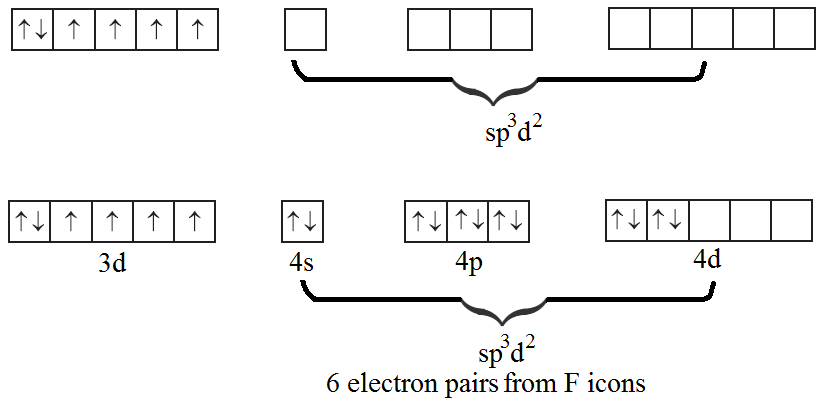
Similarly, $\ce{[MnCl_6]^{3-}}$ is also outer orbital complex or high spin complex.
Magnetic propertyparamagnetic due to presence of unpaired electrons in it.
$($The number. of unpaired electrons $= 4)$ View full question & answer→Question 131 Mark
Iron carbonyl, $\ce{Fe(CO)_{5}}$ is $.........$
AnswerIron carbonyl, $\ce{Fe(CO)_5}$ is mononuclear. In $\ce{Fe(CO)_5},$ one $Fe$ atom is surrounded by $5 \ CO$ ligands.
Mononuclear complexes are those complexes in which one metal atom/ion is surrounded by ligands.
View full question & answer→Question 141 Mark
Complex species that exhibits isomerism is:
AnswerNone of the given complexes can exhibit either geometrical or optical isomerism. But the complex $\ce{[Co(NO_2)(NH_3)_5]^{2+}}$ shows linkage isomerism as it contains nitro group which is ambidentate ligand and can be attached through either $N$ atom or $O$ atom.
View full question & answer→Question 151 Mark
Transition metals are coloured due to the following electronic transition:
Answer
- d - d
Explanation:
Transition metals are coloured due to the d-d electronic transition.It's a transition where an electron jumps from one d orbital to another. Normally these are degenerate (the d orbitals have the same energy), but under some conditions, such as the presense of ligands, the degeneracy can be removed so that there is a specific energy (and therefore wavelength) associated with these transitions.
These sorts of transitions sometimes have energies located in the visible band, and it's one reason transition metal ions (and complex ions in particular) tend to be highly colored.
View full question & answer→Question 161 Mark
The $\text{CFSE}$ for octahedral $\ce{[CoCl_6]^{4-} is 18,000\ cm^{-1}}$. The $\text{CFSE
}$ for tetrahedral $\ce{[CoCl_4]^{2-}}$ will be:
Answer$\text{CFSE}$ for tetrahedral complex is $\Delta_\text{t}=\Big(\frac{4}{9}\Big)\Delta_0$
$\Delta_\text{t}=\frac{4}{9}\times18,000=8,000\text{ cm}^{-1}$
View full question & answer→Question 171 Mark
A hybrid orbital formed from s-and p-orbital can contribute to:
Answer
- a $\sigma$ bond only
Explanation:
A hybrid orbital formed from s-and p-orbital can contribute to a $\sigma$ bond only.
This is because sideways or lateral overlap with s orbital is not possible. View full question & answer→Question 181 Mark
Which kind of isomerism is exhibited by octahedral $\ce{[Co(NH_3)_4Br_2]Cl}$?
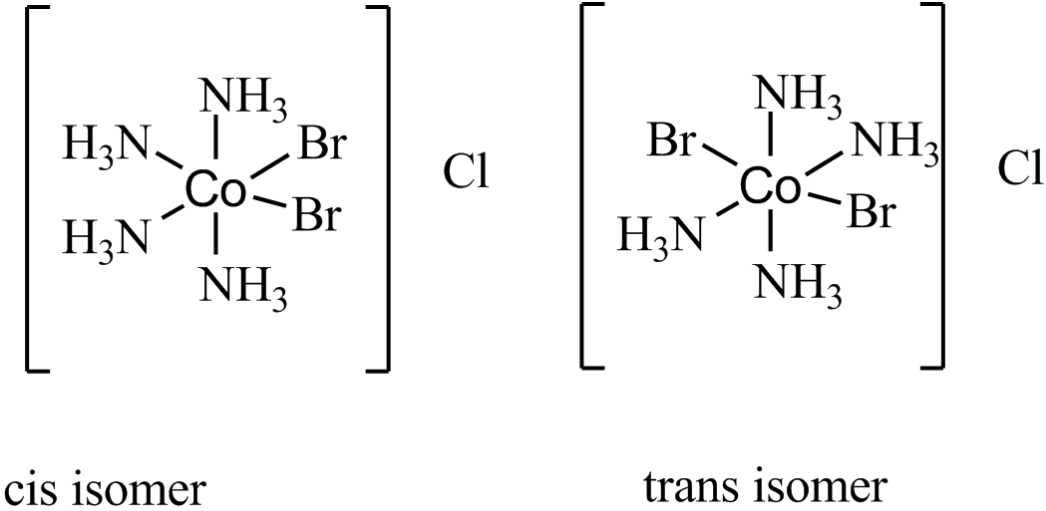
AnswerThe octahedral complex $\ce{[Co(NH_3)_{4}Br_2]Cl}$ exhibits geometrical as well as ionization isomerism.
The geometrical isomers are cis and trans isomers.
The ionization isomers are $\ce{[Co(NH_3)_4Br_2]Cl} $ and $\ce{[Co(NH_3)_4Cl]Br_{2}}.$
View full question & answer→Question 191 Mark
Which of the following shows maximum number of isomers?
Answer$\ce{[Cr(SCN)_{2}(NH_3)_4]^+}$ shows maximum number of isomers.
It shows geometrical $($cis trans$)$ isomerism as well as linkage isomerism.
$\ce{SCN^−} $ is ambidentate ligand and can coordinate through either $S$ or $N$ atom.
View full question & answer→Question 201 Mark
The correct $\text{IUPAC}$ name of $\ce{Mn_3(CO)_{12} }$ is:
AnswerThe correct $\text{IUPAC}$ name of $\ce{Mn_3(CO)_{12}}$ is dodecacarbonyltrimanganese $(0)$.
The central metal atom is a cobalt atom in zero oxidation state.
The oxidation state is written in parenthesis.
Three such Mn atoms are present. Hence, the prefix tri is used. $12$ carbonyl groups are present.
Hence, the prefix dodeca is used.
View full question & answer→Question 211 Mark
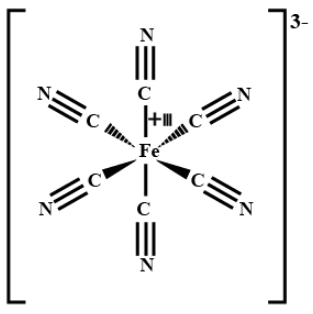
AnswerTurnbull's blue is $\ce{Fe_3[Fe(CN)_6]_{2}}.$
The structure is as follows:
View full question & answer→Question 221 Mark
$\ce{Ti^{3+}(aq)}$ is violet while $\ce{Ti^{4+}(aq)}$ is colourless because $−$
Answer$\ce{Ti^{+3}: d^1}$ configuration have one unpaired $d -$ electron so it is colourful but
$\ce{Ti^{+4}: d^0}$ configuration have zero unpaired $d -$ electron so it is colourless.
View full question & answer→Question 231 Mark
The primary valence of the metal ion is satisfied by:
Answer
- Negative ions
Explanation:
The primary or principal valency; this is the ionisable valency.
A metal always gives electron and becomes positively charged that can be neutralized by bonding with negative ion only. In a coordination compound, the number of negative ions needed to satisfy the charge on the central metal ion is it's primary valency.
View full question & answer→Question 241 Mark
$\ce{[Pt(NH_3)_4][CuCl_{4}]}$ and $\ce{[Cu(NH_3)_4][PtCl_4]}$ are known as:
AnswerDifferent complex ions have the same molecular formula.
Ligands are interchanged between the complex cation and complex anion.
These type of complexes are called coordination isomers.
In $\ce{[Pt(NH_{3})_4][CuCl_{4}]},$ ammonia ligands are attached to $Pt$ metal and chloride ligands are attached to $Cu$ metal.
In $\ce{[Cu(NH_3)_{4}][PtCl_4]},$ ammonia ligands are attached to $Cu$ metal and chloride ligands are attached to $Pt$ metal.
View full question & answer→Question 251 Mark
Which of the following compounds is most stable?
Answer
- LiF
Explanation:
Lithium is an alkali metal and it is electro-positive in nature.
The order of electronegativity of halides present in these compounds are as follow:
F > Cl > Br > I
Hence, lithium fluoride (LiF) is the most stable compound because of the small size of Li.
As we go down the group in the periodic table the size of the element increases so, the Li−X bond becomes weak.
As Li and F are of comparable size that is why LiF is the most stable.
Also, LiF has the highest lattice enthalpy.
View full question & answer→Question 261 Mark
Which is a coordination compund?
AnswerOnly 'Potassium ferrocyanide' $($i.e. $\ce{[Fe(CN)_5])}$ shows properties of coordination compound.
When it gets dissolve they do not form simple ion like $\ce{Fe^{+2} or CN^−},$ but instead their complex ions remain intact.
whereas carnallite $($i.e. $\ce{KMgCl_3 )}$,
Gypsum $($i.e. $\ce{CaSO_4)}$ and Ferrous ammonium sulphate $($i.e. $\ce{(NH_4)_{2}Fe(SO_{4})_{2})}$ they dissovle and give simple ions.
View full question & answer→Question 271 Mark
What is the oxidation number of gold in the complex $\ce{[AuCl_{4}]^{1−}}$?
AnswerOxidation state of chlorine $Cl$ is $−1.$
Let the oxidation number of gold $Au$ be $x$.
$\therefore x + 4 \times (−1) = −1$
$\Rightarrow x = +3$
Thus oxidation number of gold is $+3$.
View full question & answer→Question 281 Mark
The $\text{IUPAC}$ name of $\ce{[PtCl(NH_2CH_3)(NH_3)_2]Cl}$ is:
AnswerThe $\text{IUPAC}$ name of $\ce{[PtCl(NH_2CH_3)(NH_3)_2]Cl}$ is diamminechloro $($methylamine$)$ platinum $(II)$ chloride.
The ligands present are ammine, chloro and methyl amine.
The ligands are named according to the alphabetical order.
The prefix di indicates two.
The oxidation state of platinum is $+2$.
The oxidation state is written in roman numerals inside parenthesis.
View full question & answer→Question 291 Mark
The colour of blood is red due to the presence of:
Answer
- Haemoglobin
Explanation:
Since haemoglobin is red pigment present in blood which is red due to intra ligand charge transfer along porphyrin ring leads to red colouration.
View full question & answer→Question 301 Mark
The hybridisation involved in $\ce{[Co(C_{2}O_4)_{3}]^{3−}}$ is?
Answer$\ce{[Co(C_2O_4)_3]^{3−}= CO^{3+ }= [Ar]3d^{6 }}$
$\ce{C_2O^{2−}=}$ Strong field ligand.
$= \ce{d^2sp^3}$ Hybridisation.
$=$ Octahedral.
$\ce{(C_2O_{4})^{−2}}=$ Bidentate Ligand
View full question & answer→Question 311 Mark
True structure is predicted by:
Answer
- Hybrid orbital formation
Explanation:
Hybrid formation was introduced to explain molecular structure when the other theories failed to correctly predict them.
View full question & answer→Question 321 Mark
Which of the following does not show optical isomerism?
AnswerThe compound $\ce{[Co(NH_3)_3Cl_3]}$ does not show optical isomerism.
This is a coordination compound where coordination number is $6$ and geometry octahedral symmetrical.
Compounds with an octahedral geometry having bidentate ligands show optical isomerism.
The given compound does not contain any bidentate ligands, also it has symmetrical geometry,
thus, it does not show optical isomerism.
View full question & answer→Question 331 Mark
Identify the type of isomerism shown by $\ce{[Co(NH_{3})_4Cl_2]^+}$:
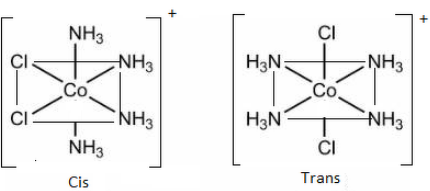
Answer$\ce{[Co(NH_{3})_4Cl_2]^+}$ will show cis, trans geometrical isomerism.
View full question & answer→Question 341 Mark
Which of the following species is not expected to be a ligand?
AnswerLigand must have atleast a lone pair of electrons to form $M-L ($metal$-$ligand bond$).$ In the above case $NH_4^+$ does not possess any lone pair of electrons, hence it is not expected to be a ligand.
View full question & answer→Question 351 Mark
In calcium fluoride, having the fluorite structure, the coordination numbers for calcium ion $\ce{(Ca^{2+})}$ and fluoride ion $(F^−)$ are:
AnswerCalcium fluoride crystallizes in a Face $-$ Centered Cubic unit cell $\ce{(FCC)}$ having an edge length of $5.463$ Angstroms.
The cell is displayed here with calcium cations $($in blue$)$ defining $\ce{FCC}$ lattice sites, and fluoride anions $($in green$)$ occupying all tetrahedral sites.
Fluoride anions have $4$ neighbors of opposite charge arranged at vertices of an tetrahedron.
Calcium cations have $\text{EIGHT}$ neighbors of opposite charge arrange at corners that outline a smaller cube.
So the $Ca: F$ coordination ratio is $8 : 4$ or $2 : 1$.
In $\ce{4CaF_2}$ the the co ordination number of $\ce{Ca^{+2}}$ is $\ce{8 F^−}$ is $4$.
View full question & answer→Question 361 Mark
If a transition-metal compound absorbs violet-indigo radiation in the visible region. Its color would be:
Answer
- Yellow.
Explanation:
From color wheel, it can be seen that if a transition-metal compound absorbs violet-indigo radiation in the visible region. Its color would be yellow.
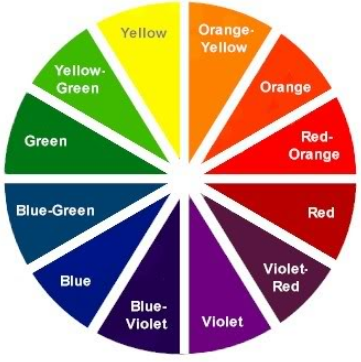
View full question & answer→Question 371 Mark
Co $-$ ordination compounds have great importance in biological systems. In this context which of the
following statements is incorrect?
AnswerChlorophyll is the green pigment in plants that helps in photosynthesis.
The metal inside the ring structure of chlorophyll is magnesium $\ce{(Mg^{2+})}$.
The four nitrogen atoms in the ring structure of chlorophyll are bonded to the magnesium ion.
View full question & answer→Question 381 Mark
The correct increasing order of trans $-$ effect of the following species is:
AnswerTrans effect can be defined as the effect of a ligand towards substitution on other ligand which is trans to it.
$($weak$)\ F^− < HO^− < H_2O < NH_3 < py < Cl^− < Br^− < I^− < SCN^− < NO_2^{ }< SC(NH_3)_{2}$$ < Ph− < SO_3 < PR_3 < AsR_3 < SR_2 < H_3C^− < H^− < NO < CO < NC^− < C_2H_{4 }\ ($strong$)$.
Trans effect is nothing but those ligands which are trans directing.
That means, which prefer a trans structure. Mostly in Square planar complexes.
View full question & answer→Question 391 Mark
Which of the following complexes is used to be as an anticancer agent?
Answercis$-\ce[{PtCl_2NH_3)_2}]$ known as cis platin is used as an anticancer agent.
View full question & answer→Question 401 Mark
Linear combination of two hybridzed orbitals, belonging to two atoms and each having one electron leads to:
Answer
- Sigma - bond
Explanation:
Linear combination of two hybridized orbitals, belonging to two atoms and each having one electron leads to formation of sigma bond.
View full question & answer→Question 411 Mark
Which of the following statement is correct?
Answer
- Number of hybrid orbitals formed should be same as the number of atomic orbitals involved in hybridization.
Explanation:
Number of hybrid orbitals formed is equal to number of atomic orbitals involved in hybridisation. $\pi$ bonds will be formed always by pure orbitals (p or d orbitals). Hybrid orbitals arrange around the centre of atom gymmetrically depending on number of bond pairs and lone pairs. View full question & answer→Question 421 Mark
What is the correct name of $IF_7$?
AnswerIodine heptafluoride, also known as iodine$(VII)$ fluoride or iodine fluoride, is an interhalogen compound with the chemical formula $IF_7.$ It has an unusual pentagonal bipyramidal structure.
View full question & answer→Question 431 Mark
Which of the following complexes formed by $Cu^{2+}$ ions is most stable?
AnswerThe stability of complexes is represented by the magnitude of its "Stability constant $(K)".$ A higher value of stability constant of certain complex denotes its greater stability. Mathematically, the same hols good for $\log K$ values. Among the given $\log K$ values of different complexes, it is noted that the $\log K$ value for complex at $(ii)$ is maximum $(ie = 27.3).$ Hence it is most stable.
View full question & answer→Question 441 Mark
TEL is a compound used as:
Answer
- Antiknocking
Explanation:
Anti knocking compounds are the chemicals which reduce knocking for improving the quality of gasoline. example:- Tetraethyl lead (TEL).
View full question & answer→Question 451 Mark
Example for a coordination compound is $........$
AnswerCarnallite: $\ce{KCl.MgCl_2.6H_{2}O}$
Alum: $\ce{K_2SO_4Al_2(SO_3)24H_2O}$
Ferrous ammonium sulphate: $\ce{(NH_4)2Fe(SO_4)26H_2O}.$
All are double salts.
Only $\ce{[Co(NH_{3})_6].Cl_3}$ is complex compound.
View full question & answer→Question 461 Mark
Amongst the following, the most stable complex is$:$
AnswerIn each of the given complex, $Fe$ is in $+3$ oxidation state.
As $\ce{C_2O_4^{2-}}$ is didentate chelating ligand, it forms chelate rings.
hence $(c)$ out of complexes given above is the most stable complex.
View full question & answer→Question 471 Mark
The formula of the complex, tris$- ($ethylenediamine$)$ cobalt $(iii)$ sulphate is$:$
Answer$\ce{[Co(en)_3]_2(SO_4)_3}$
Oxidation of $en = 0 \ SO_{4 }= −2$ then we get $CO = +3$ as given.
And tris is used as two numbers are present at that same spot.
where $2$ is called $"di"$ and $3$ is called "tris".
View full question & answer→Question 481 Mark
Developed photography film is due to:
Answer
- Ag
Explanation:
The developed photography film is due to Ag.
The treatment of the exposed photgraphic film with reducing agent is called developing of the film.
A developer is usually an alkaline solution of hydroquinone or alkaline solution of pyrogallol.
The pairs activated by light are reduced to deposit more of black silver.
View full question & answer→Question 491 Mark
The value of $X$ in $\ce{Fe(CO)_2(NO)x},$ is$:$
AnswerThe coordination sphere of a coordination compound or complex consists of the central metal atom$/$ion plus its attached ligands.
The coordination sphere is usually enclosed in brackets when written in a formula.
The coordination number is the number of donor atoms bonded to the central metal atom$/$ion.
Most metal complexes or compounds except for alloys.
Specific examples include hemoglobin and $Ru_{3}(CO)_{12}.$
So the total electron should be $18$
valence electron of iron is $= 8$
$CO$ gives $= 2e^−, NO$ gives $3e^−$
$18 = 8 + (2 \times 2) + (3 \times x)$
$18 - 8 - 4 = 3x$
$x = 2$
View full question & answer→Question 501 Mark
The number of isomers exhibited by $\ce{[Cr(NH_3)_3Cl_3]}$ is:
AnswerThe complex $\ce{[Cr(NH_3)_3Cl_3]}$ is of the type $\ce{Ma_3b_3,}$ has two isomers cis and trans or facial and meridional.
View full question & answer→Question 511 Mark
The formula for lithium iodotris $($trifluorophosphine$)$ nickelate$(0)$ is$:$
AnswerTrifluorophosphine is $PF_{3}.$
The formula should be $\ce{Li[Ni(PF_3)_3I]}.$
View full question & answer→Question 521 Mark
Which of the following complexes show linkage isomerism?
Answer$NO_2$ and $\ce{SCN}$ are ambidentate ligands.
hence, show linkage isomerism.
View full question & answer→Question 531 Mark
Which of the following complexes are heteroleptic?
AnswerComplexes in which a metal is bound to more than one kind of donor groups are known as heteroleptic. This condition is satisfied by complexes mentioned at $(ii)\ \& \ (iv)$ where the donor groups are $\ce{NH_3 Cl_2}.$ Therefore, complexes at $(ii) (iv)$ are heteroleptic.
View full question & answer→Question 541 Mark
Transition elements form complexes readily because:
Answer
- All the above
Explanation:
Transition elements form complexes readily because
Due to lower size and higher charge, they have high charge density.
They have vacant d orbital in which a ligand can donate its electron and form complex.
View full question & answer→Question 551 Mark
The stability of ferric ion is due to:
Answer$Fe^{3+} = 1s^22s^22p^63s^23p^63d^5$
$d$ orbital is half filled.So ferric ion is stable.
View full question & answer→Question 561 Mark
The primary and secondary valency of a central metal ion in $\ce{[Co(NH_{3})_{4}CO_3]Cl}$ complex is $.........$ and $.........$ respectively.
AnswerThe charge on cobalt ion is $+3$ which balances $−2$ charge on carbonate ion and $−1$ charge on chloride ion.
Hence, the primary valency of cobalt ion is $3.$
Cobalt ion is surrounded by four monodentate and one bidentate ligand $(4$ ammonia and on carbonate$)$ in the coordination sphere.
Hence, its coordination number $($secondary valency$)$ is $6.$
View full question & answer→Question 571 Mark
Calculate the octahedral crystal field splitting energy in $\ce{KJ/mol}$ for $\ce{[Fe(CN)_6]^{4−}},$ if the wavelength of the most intensely absorbed light is $305\ nm.$
View full question & answer→Question 581 Mark
Answer
- Combination and redistribution of atomic orbitals.
Explanation:
Hybridization is the concept of mixing atomic orbitals to form new hybrid orbitals.
Atomic orbitals with similar energy combine to give degenerated hybrid orbitals.
The number of combining atomic orbitals is equal to the hybridised orbitals.
They involve redistribution of electrons of combined atomic orbital to hybrid orbitals.
View full question & answer→Question 591 Mark
Mg is an important component of which biomolecule occurring extensively in living world?
Answer
- Chlorophyll
Explanation:
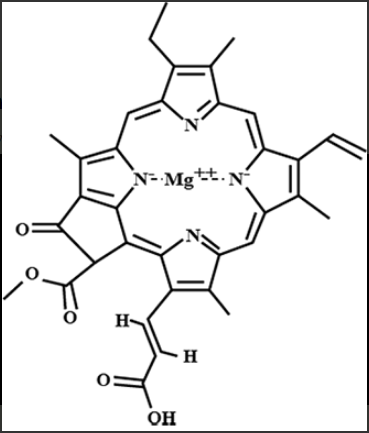
View full question & answer→Question 601 Mark
Barium ions, $CN^{− }$ and $Co^{2+}$ form an ionic complex. If that complex is supposed to be $75\%$ ionised in water with vant Hoff factor $'i\ '$ equal to four, then the coordination number of $Co^{2+}$ in the complex can be.
AnswerComplex formed is $\ce{Bq_2[CO(CN)_6]}$ in which oxidation of $CO$ is $(2+)$ and $CN$ of $CO$ is six.
View full question & answer→Question 611 Mark
Which of the following complex has five unpaired electrons?
Answer$Mn^{2+}$ has $d^5$ configuration, since $H_2O$ is weak ligand field, so it does not causes pairing of electrons and hence it has $5$ unpaired electrons.
View full question & answer→Question 621 Mark
Which of the following options are correct for $\ce{[Fe(CN)_6]^{3-}}$ complex?
Answer$\ce{[Fe(CN)_6]^{3-}}$
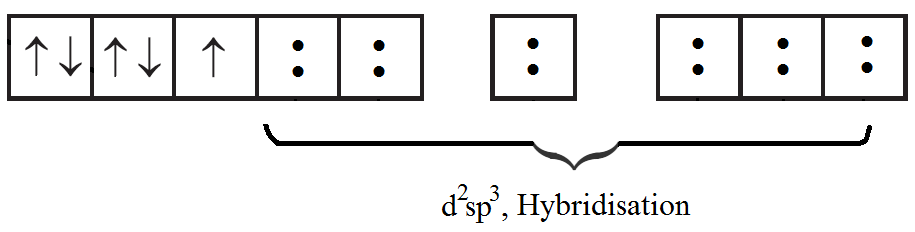
Magnetic nature$-$paramagnetic. View full question & answer→Question 631 Mark
Which of the following pairs of complexes whose aqueous solutions gives pale yellow and white precipitates respectively with $0.1\ce{M AgNO_{3}}$?
AnswerThe complex having $Br$ and $Cl$ out of coordination sphere only gives $\ce{AgBr}($pale yellow $)$ and $\ce{AgCl }($white $\ce{ppt)}.$
respectively upon reaction with $\ce{AgNO_3}.$
View full question & answer→Question 641 Mark
What kind of isomerism exists between $\ce{[Cr(H_2O)_6]Cl_3 (violet)}$ and $\ce{[Cr(H_2O)_5Cl]Cl_2⋅H_2O} ($ greyish$-$green$)$?
AnswerThe given compounds havfe different number of water molecules inside and outside the coordinate sphere.
View full question & answer→Question 651 Mark
Which can exist both as diastereoisomer and enantiomer?
AnswerIt exists as lis trans which is diastereomer and its cis form is optically active and exits as enantiomer also, where as only exists as enantiomers.
View full question & answer→Question 661 Mark
$1$ mole of amino cobalt chloride on treating with an excess of $AgNO_3$ solution gives $2$ moles of $\text{AgCl}$ precipitate. The number of $Cl^−$ ions which satisfies both primary and secondary valency of cobalt in the complex is:
Answer$1$ mole of amino cobalt chloride gives $2$ moles of $\text{AgCl}$ so number of $Cl^−$ ions which satisfies both primary and secondary valency of cobalt in the complex is $1.$
View full question & answer→Question 671 Mark
The formula of prussian blue is $:$
AnswerFerric ferrocyanide $/$ Potassium ferrocyanide $/$ Sodium ferrocyanide is prussian blue.
$\ce{Fe4[Fe(CN)6]3}$
View full question & answer→Question 681 Mark
Indicate the types of isomerism exhibited by the following complexes and draw the structures for these isomers$:$
AnswerExhibits cis trans.
Exhibits optical Isomerism.
Exhibits linkage Isomerism $\ce{(NO_2,−ONO)}$
Cis$-$Trans Isomerism.
View full question & answer→Question 691 Mark
Which of the following inert gas has the smallest ionization energy?
Answer
- Xe
Explanation:
Ionization energy decreases from top to bottom of each column because the outer shell electrons become farther removed from the nucleus.
View full question & answer→Question 701 Mark
The correct $\text{IUPAC}$ name of $\ce{[Pt(NH_3)_2Cl_2]}$ is:
AnswerThe complex compound is $\ce{[Pt(NH_3)_2Cl_2]. NH_3}$ is a neutral ligand and named as amine. $Cl$ is anion ligand and named as chloride. $Di$ or tri is prefixed to represent the number.
So the name of the compound is$-$ Diamminedichloridoplatinum $(II).(II)$ represent the oxidation state of platinum.
View full question & answer→Question 711 Mark
Among the following coordination compounds, the one giving a white precipitate with $\ce{BaCl_{2}}$ solution is:
AnswerAmong the following coordination compounds, the one giving a white precipitate with $\ce{BaCl_2}$ solution is $\ce{[Cr(H_{2}O)_5Br]SO_4.}$
It dissociates in aqueous solution to give sulphate ions. Sulphate ions react with barium chloride to form a white precipitate of barium sulphate.
View full question & answer→Question 721 Mark
The primary and secondary valency of $Co$ in the octahedral complex $\ce{CoCl_3.5NH_3}$ are $..........$
AnswerThe primary valency of $Co$ is $3$ and the secondary valency of $Co$ is $6.$
The primary valency represents the number of ions in the ionization sphere and the secondary valency represents the number of ligands.
In this example, one chlorine atom serves dual role.
View full question & answer→Question 731 Mark
Number of $Cl^−$ ions satisifying both primary and secondary valency are in $\ce{CoCl_3.5NH_3.}$
AnswerThere is one $Cl^−$ ion which satisfies both primary and secondary valency in $\ce{CoCl_3.5NH_3}.$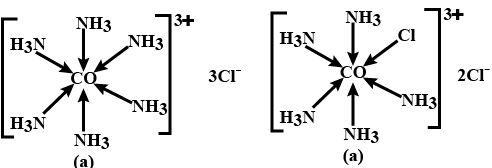
View full question & answer→Question 741 Mark
The number of isomers for the compound with the molecular formula $\ce{C2BrClFI}$ is $:$
AnswerTotal $6$ isomers are possible.
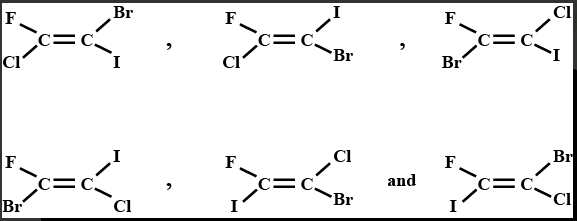
View full question & answer→Question 751 Mark
Identify the optically active compounds from the following$:$
Answer$(a, c) [Co(en)3]^{3+}$ and cis $[Co(en)_2Cl_2]^{2+}$ are optically active compounds because their mirror images are non$-$superimposable isomer.
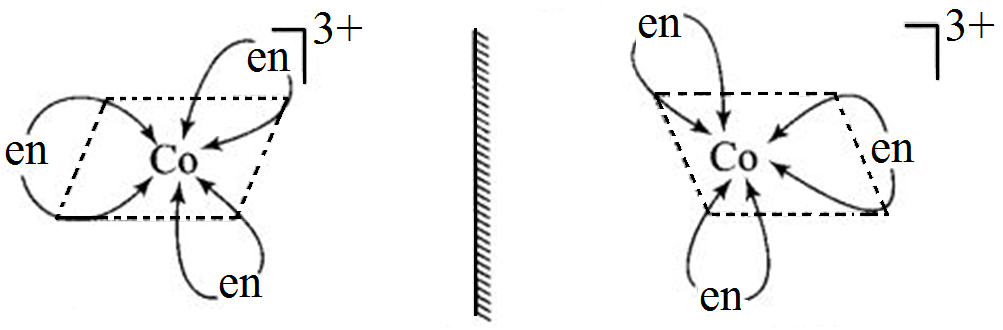
Non$-$supermposable isomers of $[Co(en)_3]^{3+}$
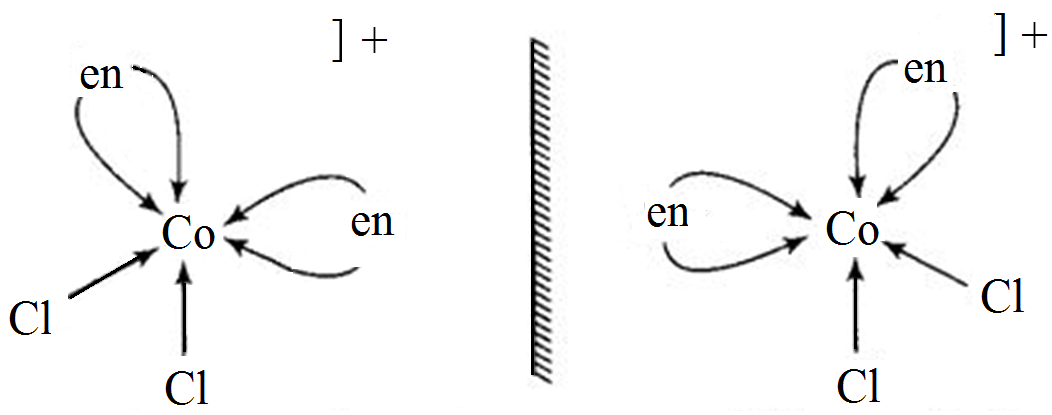
Non$-$superimosable isomers of $[Co(en)_2Cl_2]^+$
Hence, $(a)$ and $(c)$ are correct choices. View full question & answer→Question 761 Mark
The two compounds pentaamminesulphatocobalt $(III)$ bromide and pentaamminesulphatocobalt $(III)$ chloride represent:
AnswerPentaamminesulphatocobalt $(III)$ bromide is $\ce{[Co(SO_4)(NH_3)_4]Br}$ and pentaamminesulphatocobalt $(III)$ chloride is $\ce{[Co(SO_4)(NH_3)_5]Cl}.$The two compounds pentaamminesulphatocobalt $(III)$ bromide and pentaamminesulphatocobalt $(III)$ chloride represent no isomerism.
View full question & answer→Question 771 Mark
Coordination compounds have great importance in biological systems. In this context which of the following statements is incorrect?
Answer
- Chlorophylls are green pigments in plants and contain calcium.
Explanation:
Chlorophylls are green pigments in plants and contain magnesium.
They are useful during photosynthesis to store energy in the form of glucose from carbon dioxide and water in presence of sunlight.
View full question & answer→Question 781 Mark
When $\ce{KCN}$ is added to $\ce{CuSO_{4}}$ solution, there is formation of the stable water soluble complex. This complex is:
AnswerWhen $\ce{KCN}$ is added to $\ce{CuSO_4}$ solution, the following reaction occurs. $\ce{4KCN+CuSO_{4 }\rightarrow K_3[Cu(CN)_{4}].}$
View full question & answer→Question 791 Mark
Which of the following statements is not correct?
Answer
- Hybridization is the mixing of atomic orbitals of large energy difference.
Explanation:
Hybridisation is the concept of mixing atomic orbitals into new hybrid orbitals (with different energies, shapes, etc., than the component atomic orbitals) suitable for the pairing of electrons to form chemical bonds.
View full question & answer→Question 801 Mark
Number of stereoisomer's possible for coordination complex $\ce{Na[Cr(en)Cl2Br2}]$ is $:$
AnswerThere are four stereoisomers are possible for the given coordination compound.
View full question & answer→Question 811 Mark
The colour of a complex compound is due to:
Answer
- Promotion of 3d-electrons of the central atom/ion to d-orbitals.
Explanation:
The colour of a complex compound is due to promotion of 3d-electrons of the central atom/ion to d-orbitals..
The colour of the complex compound is due to d−d electronic transition.The d-orbitals of a free transition metal atom or ion are degenerate (all have the same energy.)
When transition metals form coordination complexes, the d-orbitals of the metal interact with the electron cloud of the ligands in such a manner that the d-orbitals become non-degenerate (not all having the same energy).
View full question & answer→Question 821 Mark
When mole of $\ce{CoCl_3.6NH_3}$ is treated with excess of $AgNO_3$ solution. The number of moles of $\text{AgCl}$ precipitated is:
AnswerOne mole of $\ce{CoCl_3.6NH_3}$ gives $3$ moles of $Cl$ ion so when mole of $\ce{CoCl_3.6NH_3}$ is treated with excess of $AgNO_{3}$ solution, it gives $3$ moles of $\ce{AgCl.CoCl_3.6NH_3(aq) + excess AgNO_3(aq) \rightarrow 3AgCl + Co(NO_3)_3.6NH_3(aq).}$
View full question & answer→Question 831 Mark
During the splitting of degenerate d-orbitals under the influence of ligand the average d-orbital energy:
Answer
- Remains same
Explanation:
When examining a single transition metal ion, the five d-orbitals have the same energy. When ligands approach the metal ion, some experience more opposition from the d-orbital electrons than others based on the geometric structure of the molecule.
Since ligands approach from different directions, not all d-orbitals interact directly. These interactions, however, create a splitting due to the electrostatic environment.The average energy of the five d orbitals remains the same.
View full question & answer→Question 841 Mark
Find the ratio of geometrical isomers in $\ce{[M(AA)_{2}b_2]}$ and optical isomers of $\ce{[M(AA)_3]}.$
AnswerThe complex $\ce{[M(AA)_2b_2]}$ has $2$ geometrical isomers cis and trans isomers.
The complex $\ce{[M(AA)_3]}$ has two optical isomers $d$ and $l$ forms.
$\frac{2}{2} = 1$
Thus, the ratio of geometrical isomers in $\ce{[M(AA)_2b_2]}$ and optical isomers of $\ce{[M(AA)_{3}]}$ is $1.$
View full question & answer→Question 851 Mark
By which of the following, poisoning of lead in the body can be removed?
Answer
- EDTA
Explanation:
EDTA is a hexadentate ligand and forms the water-soluble stable chelate complex with metals such as lead. Hence, it can be used to remove lead from the body.
In this way, EDTA helps in removing poisoning of lead from the body.
View full question & answer→Question 861 Mark
Secondary valencies correspond to ____________ of the metal atom and are satisfied by ligands.
Answer
- Coordination number
Explanation:
Secondary valency corresponds to the coordination number of central metal atom or ion. This may be satisfied by either negative ions or neutral molecules called ligands.
Ligands satisfying the secondary valencies are always shown in square brackets, i.e. they form the coordination sphere of the metal atom.
View full question & answer→Question 871 Mark
Square planar complex of the type MAXBL (where A, B, X and L are unidentate ligands) shows following set of isomers.
Answer
- Two cis and one trans
Explanation:
Square planar complex of the type MAXBL (where A, B, X, and L are unidentate ligands) shows two cis and one trans isomer as shown in the image.

View full question & answer→Question 881 Mark
Amongst the following ions which one has the highest magnetic moment value?
Answer
- $[Fe(H_2O)_6]^{2+}$
- No. of unpaired electrons in $[Cr(H_2O)_6]^{3+}= 3$
$\text{Then, µ}=\sqrt{\text{n}(\text{n}+2)}$
$=\sqrt{\text{3}(\text{3}+2)}$
$=\sqrt{15}$
$=\text{~}4\text{BM}$
- No. of unpaired electrons in $[Fe(H_2O)_6]^{2+}= 4$
$\text{Then, µ}=\sqrt{4(4+2)}$
$=\sqrt{24}$
$=\text{~}5\text{BM}$
- No. of unpaired electrons in $[Zn(H_2O)_6]^{2+}= 0$
Hence, $[Fe(H_2O)_6]^{2+}$ has the highest magnetic moment value. View full question & answer→Question 891 Mark
The following ion shows colour not due to d-d transistion.
Answer
- All
Explanation:
All are coloured not due to d-d transition but due to charge transfer theory. They are coloured, though there are no unpaired electrons, because of "CHARGE TRANSFER SPECTRUM" (ie).
Colour is associated with the electrons being promoted from one energy level to another, and absorbing or emitting the energy difference between the two levels.
Thus transfer of an electron from M to L or viceverse results in charge transfer which gives rise to a spectra called charge transfer spectra.
View full question & answer→Question 901 Mark
Which of the following sets of examples and geometry of the compounds is not correct?
Answer$\ce{[Fe(NH_3)_{6]}^{2+ }= Fe^{2+ }= [Ar]3d^{6 }=}$ Octahedral.Hybridisation is $=sp^3d^2.$
$\ce{[CuCl_{4}]^{2+ }= Cu^{2+ }= [Cu]3d^{9 }=} $Tetrahedral.
Hybridisation $= sp^3$
These two do not have trigonal bipyramidal geometry.
View full question & answer→Question 911 Mark
$2.33g$ of compound $X($empirical formula $\ce{CoH_{12}N_4Cl_3)}$ upon treatment with excess $\ce{AgNO_{3}}$ solution produces $1.435g$ of a white precipitate. The primary and secondary valences of cobalt in compound $X,$ respectively, are.
$[$Given : Atomic mass: $\ce{Co = 59, Cl = 35.5, Ag = 108]}.$
AnswerSince $0.01$ mole of $X$ produces $0.01$ mole of $\ce{AgCl}.$
hence one $Cl^−$ is out of coordination sphere or complex is $\ce{[CO(NH_3)_4Cl_2]Cl}$ And Hence $CO(3+),$ has $6$ coordination number.
View full question & answer→Question 921 Mark
Which of the following is first formed inert gas compound?
AnswerThe ionisation energy of $Xe $is lower than that of $Kr.$ Hence upon reaction with $\ce{[PtF_6], Xe[PtF_6]}$ should get formed first.
View full question & answer→Question 931 Mark
Which of the following complexes are homoleptic?
AnswerIn complexes $\ce{[Co(NH_3)_6]^{3+}}$ and $\ce{[Ni(CN)_4]^{2-}},$ both $Co$ and $Ni$ are attached to one kind of ligands only hence, they are homoleptic.
View full question & answer→Question 941 Mark
When $1$ mol $\ce{CrCl_3⋅6H_2O}$ is treated with excess of $AgNO_3, 3$mol of $\text{AgCl}$ are obtained. The formula of the complex is:
AnswerOne mol of $\text{AgCl}$ is precipitated by one mole of $Cl^-$ ion, therefore three moles of $\text{AgCl}$ would get precipitared by three moles of chloride ions, $Cl^-$ and, in this case $3Cl^-$ are present in ionization sphere $($i.e. outside the coordination sphere$)$ in complex at $(iv),$ therefore when $1$mol of it is treated with excess of this complex $3$mols of $\text{AgCl}$ is precipitated. This satisfies the formula of the complex at $(iv).$
View full question & answer→Question 951 Mark
Which of the following has the highest molar conductivity?
AnswerThe dissociation of is as follows;
$\ce{[Co(NH_{3})_6]Cl_3} \rightleftharpoons \ce{[Co(NH_3)_{6}]^{3+ } + 3Cl^−}$
The number of ions produced here is .
So the molar conductivity is the highest.
View full question & answer→Question 961 Mark
The colour of the coordination compounds depends on the crystal field splitting. What will be the correct order of absorption of wavelength of light in the visible region, for the complexes, $\ce{[Co(NH_3)_6]^{3+}, [Co(CN)_6]^{3–}, [Co(H_2O)_6]^{3+}}$
AnswerIn strong field ligand, there is more energy separation than weak field ligand it means that as the strength of ligand increases crystal field splitting energy increases.
$\Delta\text{E}=\frac{\text{hc}}{\lambda}\ \text{or}\ \Delta\frac{\text{E}\alpha1}{\lambda}$
As $\Delta\text{E}$ increases, wavelength of light absorbed decreases.
Further, the colour of coordination compounds depends on nature and the magnitude of crystal field splitting of the ligand bonded with central atom. A stronger ligand has higher splitting power than a weak ligand .Amongst the given ligands in Co$-$complexes the order of splitting power is:
$\ce{H_2O < NH_3 < CN^-};$ Since $\ce{CN^-}$ has higher splitting power it would absorb more.
Hence the correct order of absorption of wavelength of light is represented by option $(iii).$
View full question & answer→Question 971 Mark
When $0.01$ mole of a cobalt complex is treated with excess silver nitrate solution, $4.305 g$ silver chloride is precipitated. The formula of the complex is:
Answer$4.305g\ AgCl = \frac{4.305}{143.5}\ mol = 0.03\ mol$.
As $0.01\ mole$ of the complex gives $0.03\ mole$ of $AgCI,$ this shows that there are three ionisable $Cl.$
View full question & answer→Question 981 Mark
In which one of the following the central atom is $sp^3$ hydridised?
View full question & answer→Question 991 Mark
The oxidation number of cobalt in $\ce{K[Co(CO)_4]}$ is$:$
AnswerWe know that $CO$ is a neutral ligand and $K$ carries a charge of $+1.$
Therefore, the complex can be written as $\ce{K^+[Co(CO)_4]^- }.$
Therefore, the oxidation number $-$ of $Co$ in the given complex is $-1.$
Hence, option $(iii)$ is correct.
View full question & answer→Question 1001 Mark
Which of following is the incorrect match?
Answer
- Chlorophyll - Chromium
Explanation:
Chlorophyll contains magnesium ion, encased in a large ring structure known as chlorine, derived from pyrrole.
View full question & answer→Question 1011 Mark
Which compound is formed when excess of $\ce{KCN}$ is added to an aqueous solution of copper sulphate?
AnswerWhen excess of $\ce{KCN}$ is added to an aqueous solution of $\ce{CuSO_4}$ then$-$
Initially, cupric cyanide is formed, $\ce{Cu(CN)_2}.$
$\ce{CuSO_4 + 2KCN \rightarrow K_2CO_4 + Cu(CN)_{2}}$
Cupric Cyanide will decompose to produce cuprous cyanide,$\ce{Cu_2(CN)_2}.$
$\ce{2Cu(CN)_{2 }\rightarrow 2Cu_2(CN)_{2 }+ 2(CN)}$
Cuprous cyanide reacts with an excess of $\ce{KCN}$ to form a complex, $\ce{K_3[Cu(CN)_{4}]},$
which is a stable complex. $\ce{CuCN + 3Ka \rightarrow K_3[Cu(CN)_{4}]}.$
View full question & answer→Question 1021 Mark
Which one of the following molecular geometries $($i.e. shapes$)$ is not possible for the $sp^3d^2$ hybridization?
View full question & answer→Question 1031 Mark
The brown complex obtained in the detection of nitrate radical is formulated as $ \ce{[Fe(H_2O)_5NO]SO_4}.$ What is the oxidation number of $Fe$ in this complex?
AnswerThe brown colour complex obtained in the detection of nitrate radical is formulated as $\ce{[Fe(H_2O)_5NO]SO_4}.$ In this complex, oxidation state of iron is $+1.$ The univalent character of iron in the complex is justified by the presence of a coordinated $NO^+$ group.
View full question & answer→Question 1041 Mark
According to Werner’s theory of valency, transition metals possess:
Answer
- Two types of valencies
Explanation:
According to Werner’s theory of valence, transition metals has two valencies are primary valencies and secondary valency.
The primary valency relates to the oxidation state and the secondary valency relates to the coordination number or it is the number of ligands attached to metal ions.
View full question & answer→Question 1051 Mark
The isomerism exhibited by following compounds $\ce{[Co(NH_3)_6][Cr(CN)6]}$ and $\ce{[Cr(NH_3)_6][Co(CN)_6]}$ is$:$
AnswerCoordination isomerism occurs in those complexes in which the total ratio of ligand to metal remains the same but the ligands attached to the specific metal ion varies.
View full question & answer→Question 1061 Mark
The complex used as an anticancer agent is:
AnswerCisplatin, or cis$-$diamminedichloroplatinum$(II)[2] \text{(CDDP)}$ is a chemotherapy drug. It was the first member of a class of platinum$-$containing anti-cancer drugs, which now also includes carboplatin and oxaliplatin. These platinum complexes react in vivo, binding to and causing crosslinking of $\text{DNA},$ which ultimately triggers apoptosis $($programmed cell death$).$
View full question & answer→Question 1071 Mark
The coordination of Pt in the complex ion $\ce{[Pt(en)_2Cl_2]^{2+}}$ is:
AnswerThe coordination of Pt in the complex ion $\ce{[Pt(en)_2Cl_{2}]^{2+}}$ is $6.$
en $($ethylene diamine$)$ is bidentate ligand.
So, $2$ en ligands and $2Cl^−$ ligands corresponds to six donor atoms.
View full question & answer→Question 1081 Mark
The stabilisation of coordination compounds due to chelation is called the chelate effect. Which of the following is the most stable complex species?
AnswerChelation $($formation of cycle by linkage between metal ion and ligand$)$ stabilizes the coordination compound. The ligand which chelates the metal ion are known as chelating ligand.
Here, only $[\ce{Fe(C2O4)3}]^{3-}$ is a coordination compound which contains oxalate ion as a chelating ligand. Hence, it stabilizes coordination compound by chelating $\ce{Fe}^{3+}$ ion.
View full question & answer→Question 1091 Mark
The compounds $\ce{[Co(SO_{4})(NH_3)_{5}]Br}$ and $\ce{[Co(SO_4)(NH_3)_5]Cl}$ represents:
AnswerThe compounds $\ce{[Co(SO_4)(NH_{3})_5]Br}$ and $\ce{[Co(SO_4)(NH_3)_{5}]Cl}$ represent no isomerism as they have different molecular formulae.
View full question & answer→Question 1101 Mark
The correct labeling of different terms used in coordination compounds is:
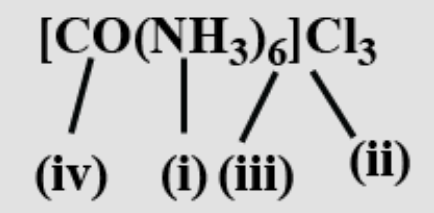
AnswerAmmonia is a ligand. It donates lone pair of electrons to Cobalt $($central metal atom$)$ and forms co$-$ordinate bond. Co$-$ordination number is $6$ as $6$ ammonia ligand coordinate to central metal.$(ii)$ represents ionisation sphere, $\ce{[Co(NH_3)_6]}$ has $+3$ charge.
View full question & answer→Question 1111 Mark
Chrome green is $..........$
AnswerChrome green is $\ce{PbCrO4 + Fe^{III}[Fe^{II}(CN)_6]^−}$
It is a composite pigment consisting of a combination of chrome yellow and prussian blue.
View full question & answer→Question 1121 Mark
Which element is not present in chlorophyll?
Answer
- Calcium
Explanation:
In chlorophyll the central ion is magnesium, and the large organic molecule is a porphyrin. The porphyrin contains four nitrogen atoms that form bonds to magnesium in a square planar arrangement. There are several forms of chlorophyll.
So, an element not present in chlorophyll is calcium.
View full question & answer→Question 1131 Mark
A chelating agent has two or more than two donor atoms to bind to a single metal ion. Which of the following is not a chelating agent?
AnswerThiosulphato or $\ce{S2O3}^–$ is not a chelating agent since it is a monodentate ligand.
View full question & answer→Question 1141 Mark
Transition metal compounds are usually colored. This is due to the electronic transition:
Answer
- Within the d-orbitals.
Explanation:
Coloured compound of transition elements is assosiated with partially filled (n-1)d orbitals. the transition metal ions containing unpaired d-electrons undergoes electronic transition from one d-orbital to another.
During this d-d transition process the electrons absorb certain energy from the radiation and emit the remainder of energy as colored light. the color of ion is complementary of the color absorbed by it.
Hence, colored ion is formed due to d-d transition which falls in visible region for all transition elements.
View full question & answer→Question 1151 Mark
Atomic number of $\text{Mn, Fe}$ and $Co$ are $25, 26$ and $27$ respectively. Which of the following inner orbital octahedral complex ions are diamagnetic?
AnswerMolecular orbital electronic configuration of $Co^{3+}$ in $\ce{[Co(NH_3)_6]^{3+}}$ is
,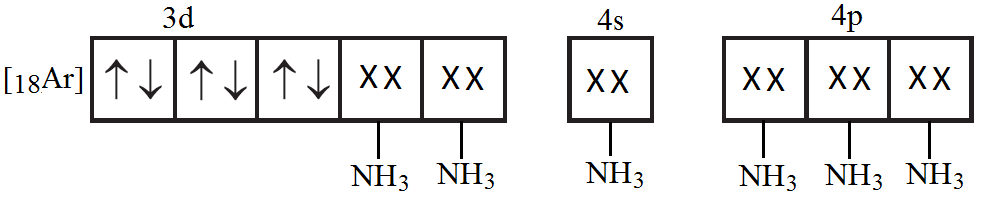
Number of unpaired electron $= 0$
Magnetic property = Diamagnetic
- Molecular orbital electronic configuration of $Mn^{3+}$ in $\ce{[Mn(CN)_6]^{3-}}$

Number of unpaired electron $= 2$
Magnetic property $=$ Paramagnetic
- Molecular orbital electronic configuration of $Fe^{2+}$ in $\ce{[Fe(CN_6]^{4-}}$ is
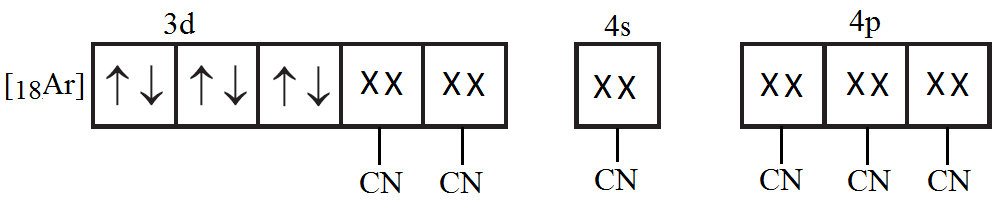
Number of unpaired electron $= 0$
Magnetic property $=$ Diamagnetic
- Molecular orbital electronic configuration of $Fe^{3+}$ in $\ce{[Fe(CN)_6]^{3-}}$
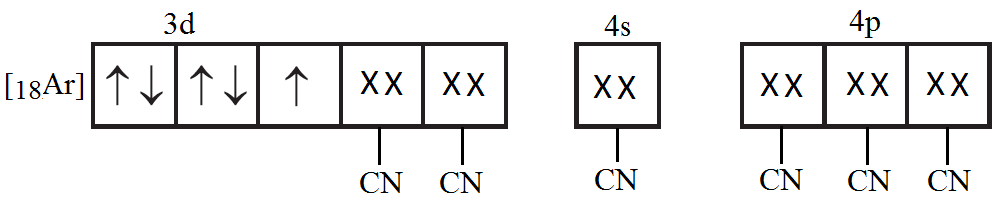
Number of unpaired electron $= 1$
Magnetic property $=$ Paramagnetic View full question & answer→Question 1161 Mark
Copper sulphate dissolves in ammonia due to the formation of$:$
AnswerCopper sulphate dissolves in ammonia due to the formation of $\ce{[Cu(NH_3)_4]SO_4}.$
$\ce{CuSO_4 + 4NH_3 \rightarrow [Cu(NH_3)_{4}]SO_4}$
$\ce{[Cu(NH_3)_{4}]SO_{4 }}$ contains complex cation $\ce{[Cu(NH_3)_4]^{2+}}.$
View full question & answer→Question 1171 Mark
Which of the following statements is true about hybridisation?
AnswerIn hybridization, the number of hybrid orbitals is equal to the number of atomic orbitals that are hybridized.
Let's take an example: $CH_{4}$
Carbon electronic configuration is $2S^22P^{2 }$ in ground state, in excited state one electron of $s$ orbital move into $p$ orbital and thus we get $4$ unpaired electrons in atomic orbital which will take part in bonding,
The hybridisation of carbon in $CH_4^{ }$ is $sp^3 ,$ means $4$ hybrid orbitals. $($one $s$ orbital and three $p$ orbitals$).$
View full question & answer→Question 1181 Mark
Which of the following compounds would exhibit co$-$ordination isomerism?
AnswerCo$-$ordination isomerism is a form of structural isomerism in which the composition of the complexion varies.
In a coordination isomer, the total ratio ligand to metal remains the same, but the ligand attached to specific metal ion change.
In $B$ option ratio of metal to the ligand is the same and they can exchange their ligands $\ce{(NH_{3},CN)}.$
View full question & answer→Question 1191 Mark
Indicate the complex ion which shows geometrical isomerism:
Question 1201 Mark
Which of the following complexes exists in facial and meridional forms?
Answer$\ce{[Co(NH)_3(NO_2)_3]}$
View full question & answer→Question 1211 Mark
$\ce{IUPAC}$ name of $\ce{Na_3[Co(ONO)_{6}]}$ is$:$
AnswerThe above complex $\ce{Na_3[Co(ONO)_6]}$ has two ions: $Na+$ and a complex ion which is negatively charged $\ce{[Co(ONO)_6]^{3−}}$
According to the rules, name of the positive ion comes first $($i.e., sodium$),$ do not mention the number of sodium as it is not present in a square bracket.
After naming the positive ion, next will be the negative ion,
Now in this example, the negative ion is a complex compound, which contain's 'metal' and 'ligand'.
While naming a complex, name of ligand comes first, also mention the number of ligand by using prefix $($di, tri, tetra. etc..$)$ and if a bidentate ligand is present then mention the atom which is attached to central metal $($i.e., hexanitrito $−O−)$ followed by name of metal with the ending 'ate' $($i.e., cobaltate, always use the word 'ate' if the complex is negatively charge$)$ and than oxidation number of metal.
To show the oxidation state, we use Roman numerals inside parenthesis.
View full question & answer→Question 1221 Mark
Consider the coordination compound$, \ce{K{2}[Cu(CN)4}]$. A coordinate covalent bond exists between:
AnswerThe coordinate covalent bond exists between the central metal and ligand. In $\ce{K2[Cu(CN)4}]$ ex the coordinate bond exists between $\ce{Cu^{2+}}$ and $\ce{CN}^−$.
View full question & answer→Question 1231 Mark
The neutral complex, diamine dibromo dichloro platinum $(IV)$ is best represented as$:$
AnswerIn a complex compound, the neutral ligand is written first followed by an anionic ligand. But if there are more than one anionic ligand then their name is written in alphabetical order thus bromo is written first then chloro.
View full question & answer→Question 1241 Mark
Co-ordination compounds are mostly formed by:
Answer
- d-block elements
Explanation:
Since 'd' block elements have higher oxidation states and variable oxidation states and their tendency to form co-ordinate bonds due to presence of unpaired electrons, they form co-ordination complexes.
View full question & answer→Question 1251 Mark
Which of the following will give $Fe^{3+}$ ions in the solution?
Answer$\ce{[Fe(CN)_6]^{3−}}$ and $\ce{[Fe(CN)_6]^{4−}}$ are complex ions.They retain their identity in the solution.
Hence, they will not give $Fe^{3+}$ ions in the solution.
$\ce{NH_4(SO_4)_2.FeSO_4.6H_2O}$ is a double salt.
In the solution, it breaks into individual ions, but it will give $Fe^{2+}$ ions in the solution.
Similarly, $\ce{Fe_2(SO_4)_{3}}$ also breaks into individual ions.
Hence, they will give $Fe^{3+}$ ions in the solution.
View full question & answer→Question 1261 Mark
True structure is predicted by:
Answer
- Hybrid orbital
Explanation:
Hybridisation helps to explain molecular shape, since the angles between bonds are (approximately) equal to the angles between hybrid orbitals.
View full question & answer→Question 1271 Mark
The properties of a compound are:
Answer
- Different from the properties of its constituents
Explanation:
A compound is a substance formed when two or more chemical elements are chemically bonded together. The elements in any compound are always present in fixed ratios.
Example: Pure methane is a compound made from two elements - carbon and hydrogen. The ration of hydrogen to carbon in methane is always 4:1. The properties of a compound are different from the properties of its constituents.
View full question & answer→Question 1281 Mark
Hexa ammine nickel $(II)$ hexa nitro cobaltate $(III)$ can be written as:
Answer$[\ce{Ni(NH3)6]3[CO(NO2)6]2 ≡ 3[Ni(NH3)6]^{2+}∣2[CO(NO2)6]^{3−}}$
Since $\ce{3Ni(2+})$ balance with $\ce{2Co(3+})$
View full question & answer→Question 1291 Mark
$\ce{CuSO_{4}}$ when reacts with $\ce{KCN}$ forms $\ce{CuCN}$ which is insoluble in water. It is soluble in excess of $\ce{KCN},$ due to formation of the following complex:
AnswerHere, $\ce{CuCN}$ is insoluble in water. This means $Cu$ in $\ce{CuCN}$ is in $+1$ state.
Because $Cu$ is unstable in water only when it is in $+1$ state.
Co$-$ordination sphere exactly contains $\ce{4CN^−}$ ions.
So, its structure would be $\ce{[Cu(CN)_4]^x}$
Calculating $x, Cu$ is $+1$ state
$1 + 4(−1) = x$
$1 − 4 = x$
$x = −3$
So, $\ce{[Cu(CN)4]^{−3}}$
It combines with $3K^+$ ions to form $\ce{K_3[Cu(CN)_{4}]}.$
View full question & answer→Question 1301 Mark
The chemical formula of iron $(III)$ hexacyanoferrate $(II)$ is :
AnswerWe proceed from left to right, iron $(III)$ means $\ce{Fe}^{3+},$ hexacyano means $\ce{6CN}^−$ ions are present and ferrate $(II)$ means $\ce{Fe}^{2+}$ is the central metal atom.
So, the complex ion is $\ce{[Fe(CN)6}]^{4−}$ and the counter ion is $\ce{Fe^{3+}}$.
So, after balancing the charge, the formula becomes $\ce{Fe4[Fe(CN)6}]3$.
View full question & answer→Question 1311 Mark
Pair of compounds which is planar:
Answer$\ce{[Ni(CN)_{4}]^{−4}, [Rh(CO)_2(PPh_3)_2]^+}$
View full question & answer→Question 1321 Mark
Which one of the following platinum complexes is used in cancer chemotherapy?
AnswerCis$-\ce{[PtCl_2(NH_3)_2]}$ known as cis$-$platin.
Cisplatin is a chemotherapy medication used to treat several cancers.
These include testicular cancer, ovarian cancer, cervical cancer, breast cancer, bladder cancer, head and neck cancer, oesophagal cancer, lung cancer, mesothelioma, brain tumours and neuroblastoma.
It is given by injection into a vein.
View full question & answer→Question 1331 Mark
What is the electronic configuration of elements of $III^{rd}$ group :
Answer$1s^2, 2s^22p^6, 3s^23p^1$
As it is $p$ block element therefore the group is $12 + 1 = 13\ (III\ A$ group$)$.
View full question & answer→Question 1341 Mark
How many ions are produced from the complex $\ce{Co(NH_3)_6Cl_2}$ in solution?
AnswerThe given complex can be written as $\ce{Co(NH_3)_6 Cl_2}.$
Thus, $\ce{[Co(NH_3)_6]^+}$ along with two $Cl-$ ions are produced.
View full question & answer→Question 1351 Mark
Which of the following order is correct for the $IR$ vibrational frequency of $CO$?
AnswerThe $IR$ vibrational frequency depends on the strength of $CO$ bond, More is the bond strength more will be the $IR$ vibrational frequency.
Since, $CO$ is a pi acceptor ligand and accepts electron in antibonding pi orbital.
More electrons in antibonding orbital implies less bond strength of $CO.$
In the given complexes the oxidation state of metals is $\ce{Fe(2-), Co(1-), Ni(0)}.$
Therefore more electrons on metal implies more will be the pi backbonding more stronger will be the Metal$-C$ bond weaker will be the $C-O$ bond hence, the $IR$ vibrational frequency order will be $\ce{[Fe(CO)_{4}]^{2− }< [Co(CO)_{4}]^{− }< [Ni(CO)_{4}]}.$
View full question & answer→Question 1361 Mark
According to Werner's theory of coordination compounds$:$
AnswerPrimary valency is ionisable according to Werner's theory of coordination compounds.
According to Werner's coordination theory, there are two kinds of valency, primary and secondary.
The primary valency of a central metal ion is satisfied with anions.
For example, in $\ce{[Cu(NH_3)_4]SO_4}$ primary valency is $2$ and secondary valency is $4.$
Secondary valence refers to coordination number.
Since copper is coordinated to $4$ ammonia ligands, secondary valence is $4.$
Primary valence is satisfied by anions.
Since sulphate ion has $-2$ charge, primary valence is $2.$
View full question & answer→Question 1371 Mark
In octahedral complexes for which of the following configuration of central metal atom magnitude of crystal field stabilization energy $\text{(CFSE)}$ is maximum in presence of ligand $CN^−$?
AnswerIn the presence of strong field ligand the maximum energy occurs when all elements are in $t_{2g}$ level.
So, $d^6$ has all the electrons in $t_{2g}$ level.
View full question & answer→Question 1381 Mark
Hypo is used in photography because it is:
AnswerHypo forms the complex $\ce{[Ag(S2O3)2}]^{3−}$ from insoluble $Ag$.
$[\ce{Ag(S{2}O{3})2}]^{3−}$ is formed by treatment of $\ce{Na2S2O3.5H2O}$ with $\ce{AgBr}$.
Therefore, Hypo is used in photography because it is a strong Complexing agent.
View full question & answer→Question 1391 Mark
An aqueous pink solution of cobalt $(II)$ chloride changes to deep blue on addition of excess of $\text{HCl}.$ This is because $..........$
AnswerThe aqueous pink solution is due to equilibrium between Cobalt species $\ce{[Co(H_2O)_6]^{2+}}$ and $\ce{[CoCl_4]^{2-}}.$ In $\ce{[Co(H_2O)_6]^{2+}}$ there is an octahedral geometry of the complex and the $d-$ orbital electron suffers a transition from $t_{2g}$ to $e_g$ energy level thereby absorbing wavelengths of visible region to produce a complimentary colour as pink.When excess of $\text{HCl}$ solution is added to this solution the equilibrium between the two cobalt species is disturbed $($as per LeChatelier's principle$)$ thereby yielding a relatively higher concentration of the species $\ce{[CoCl_4]^{2-}}$ which produces a tetrahedral field where in none of the $d-$orbitals point exactly towards the ligands and therefore the splitting energy will be less than in octahedral field. This results in absorbing wavelength of light favourable to exhibit a deep blue colour. Thus, statements at $(ii)$ and $(iii)$ are correct.
View full question & answer→Question 1401 Mark
Type of isomerism exhibited by $\ce{[Cr(NCS)(NH_3)_5][ZnCl_{4}]}$ is$:$
Answer$\ce{As -NCS}$ and $-\ce{SCN}$ are isomer, both acts as ligand here, so linkage isomer due to this.
Also in this $\ce{Cl}$ and $\ce{NCS}$ can change coordinate sphere so coordination ismerism due to this.
View full question & answer→Question 1411 Mark
$\ce{Al_4C_3}$ on hydrolysis yields$:$
AnswerThe hydrolysis reaction of $\ce{Al_4C_{3}}$
$\ce{Al_{4}C_3 + 12H_2O \rightarrow 4Al(OH)_3 + 3CH_{4}}$
So, $\ce{Al_4C_3}$ on hydrolysis gives methane.
View full question & answer→Question 1421 Mark
$\ce{CuSO_4⋅5H_2O}$ is blue is colour while $\ce{CuSO_4}$ is colourless due to$:$
AnswerIn $\ce{CuSO_4⋅5H_{2}O},$ water acts as ligand and causes crystal filed splitting.
This makes $d - d$ transitions possible.
On the other hand, in $\ce{CuSO_4},$ due to absence of ligand crystal filed splitting is not possible.
Hence no colour is observed.
View full question & answer→Question 1431 Mark
The total number of possible isomers of the compound $[\ce{Cu^{II}(NH3)4][Pt^{II}Cl4]}$ are:
Answer$[\ce{Cu^{II}(NH3)4][Pt^{II}Cl4]}$ will show $4$ isomers $(2$ coordinate isomers and $2$ geometrical isomer of coordinate isomer$)$.
View full question & answer→Question 1441 Mark
Which of the following alkaline earth metal sulphates has hydration enthalpy higher than the lattice enthalpy?
Answer$\ce{MgSO_{4}}$
View full question & answer→Question 1451 Mark
In the presence of strong eletrical field, the following set of orbitals are not degenerate:
AnswerDue to their different axis orientation; in presence of strong electrical field$, 3d_{xy}$ and $3d_{z^2}$ orbitals are not degenerated.
View full question & answer→Question 1461 Mark
The $\text{IUPAC}$ name of $[\ce{Ni(CO)4}]$ is :
AnswerThe $\text{IUPAC}$ name of $\ce{Ni(CO)4}$ is Tetracarbonyl nickel $(0)$ since the oxidation state of carbonyl ligand is $0,$ so $Ni$ will also be $0$ and four ligand are bonded to central metal atom.
View full question & answer→Question 1471 Mark
Silver halides are used in photography because they are-
Answer
- Photosensitive
Explanation:
Silver halides are used in photography because they are photosensitive as they react with light to form the image, silver halides being reduced to silver.
They are also soluble in hyposolution.
View full question & answer→Question 1481 Mark
The correct representation of $\ce{CuSO_{4}⋅5H_2O}$ is:
AnswerFor,$\ce{CuSO_4.5H_2O}$ in this $4H_2O$ are bonded by co$-$ordinate bond and $1H_{2}O$ by covalent bonding.
Therefore, Its formula of the compound is $\ce{[Cu(H_2O)_4]SO_4⋅H_2O}.$
View full question & answer→Question 1491 Mark
The two compounds $[\ce{Co(SO4)(NH3)5]Br}$ and $[\ce{Co(SO4)(NH3)5]Cl}$ represent.
AnswerEven formula of compounds is not same so no isomerism.
View full question & answer→Question 1501 Mark
A violet colour compound is formed in detection of $S$ in a compound:
Answer$\ce{Na2S + Na2[Fe(CN)5NO] \rightarrow Na4[Fe(CN)5NOS}]\ ($Violet Color Compond$)$.
View full question & answer→Question 1511 Mark
The solubilities of carbonates decrease down the magnesium group due to decrease in:
Answer
- Hydration energies of carbon.
View full question & answer→Question 1521 Mark
Which of the following metal ion is present in Ziegler$-$Natta catalyst?
AnswerZiegler$-$Natta catalyst is triethylaluminium $\ce{Al(C_2H_{5)3}}$ along with $\ce{TiCl_4}.$

View full question & answer→Question 1531 Mark
The correct order regarding the electronegativity of hybrid orbitals of carbon is:
Answer$\ce{sp > sp^{2 } > sp^3}$
$s$ orbitals hold electrons more tightly to nucleus than $p$ orbitals. That is the s orbitals are effectively more electronegative.
In $sp^2$ carbon, the character of each orbital has $33\%$ of $s$ character and $25\%\ s$ character in $sp^3$ carbon, whereas in $sp, s$ character has $50\%$ and therefore the electronegativity order goes this way.
$\ce{sp > sp^{2 } > sp^3}$
View full question & answer→Question 1541 Mark
Four one–litre flasks are separately filled with the gases hydrogen, helium, oxygen and ozone at the same room temperature and pressure. The ratio of total number of atoms of these gases present in the different flasks would be:
Answer$1$ mole $H_{2 }$ molecule contains $\rightarrow 2$ moles of $H$ atoms.
$1$ mole $He$ molecule contains $\rightarrow 1$ mole of $He$ atoms.
$1$ mole $O_2$ molecule contains $\rightarrow 2$ moles of $O$ atoms.
$1$ mole $O_{3}$ molecule contains $\rightarrow 3$ moles of $O$ atoms.
Since, number of moles of atoms is directly proportional to the number of atoms, ratio of number of atoms is $2:1:2:3.$
View full question & answer→Question 1551 Mark
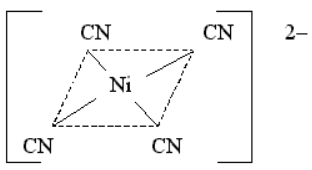
The geometry of $\ce{[Ni(CN)_4]^{2−}}$ is:
AnswerThe geometry of $\ce{[Ni(CN)_{4}]^{2−}}$ is square planar as shown in the image.
View full question & answer→Question 1561 Mark
Select the correct $\ce{IUPAC}$ name for $\ce{[Co(NH_3)_{6}]^{2+}}.$
AnswerIn $\ce{[CO(NH_{3})_6]^{2+}}$ the oxidation state of $\ce{CO}$ is $2.$
So the correct $\text{IUPAC}$ name is hexaamminecobalt$\ce{(II)}$ ion.
View full question & answer→Question 1571 Mark
In $\ce{TeCl4},$ the central atom tellurium involves:
AnswerNumber of hybrid orbitals $=\frac{1}{2}\ ($no. of electrons in valence shell of atom $+$ no. of monovalent atoms $-$ charge no cation $+$ charge on the anion.
Number of hybride orbitals $=\frac{1}{2}(6+4+0+0) = 5$
Hence$, \ce{TeCl4}$ shows $sp^3d$ hybridisation.
View full question & answer→Question 1581 Mark
The concept hybridisation of orbits of an atom was introduced by ______.
Answer
- Linus Pauling
Explanation:
The concept of hybridisation of orbits of an atom was introduced by Linus Pauling.
Hybridisation is the concept of mixing atomic orbitals into new hybrid orbitals.
View full question & answer→Question 1591 Mark
An excess of $AgNO_3$ is added to $100\ ml$ of a $0.1M$ solution of dichlorotetraaquachromium $(III)$ chloride. The number of mol of $\text{AgCl}$ precipitate would be:
AnswerDichlorotetra aquachromium $(III)$ cholride is $\ce{[Cr(H_2O)_4Cl_2]Cl},$
so one mole of it will give one mole of $Cl^−$ ion so $100\ ml$ of$ 0.1M$ will give $0.01$ mole of $Cl^−$ ion and $0.01$ mole of $\text{AgCl}$ formed.
View full question & answer→Question 1601 Mark
Which of the following will give maximum number of isomer?
Answer$[Co(NO_2)_2(NH_3)_4]^+$ shows the following isomerism:
Linkage isomerism through oxygen $[−ONO]$ and nitrogen $[−NO_2].$
Geometrical isomerism: $2$ cis isomers and $1$ trans isomer.
$[Ni(en)(NH_3)_4^{]2+}$ and $[Fe(C_2O_4)(en)_{2}]^{2−}$ will show optical isomerism. But total isomers are $4$. But it has $5$ isomerism.
View full question & answer→Question 1611 Mark
What is the angle between any two bonds in methane molecule?
Answer
- 109°28′
Explanation:
The angle between any two bonds to the central carbon atom in the methane molecule is 109°28′. The molecule of methane has a tetrahedral geometry.

View full question & answer→Question 1621 Mark
Which of the following biomolecules contain non-transition metal ion?
Answer
- Chlorophyll
Explanation:
Chlorophyll contains a non-transition metal ion. Chlorophyll is magnesium porphyrin complex. It is a green pigment present in plant leaves and is used in photosynthesis.
View full question & answer→Question 1631 Mark
The compounds $[\ce{Co(SO4)(NH3)5]Br}$ and $[\ce{Co(SO4)(NH3)5]Cl}$ represent:
AnswerIsomers means having same molecular formula but different structural formula but in the above question the molecular formula is different.
Hence they are not isomers.
View full question & answer→Question 1641 Mark
Total number of stereoisomers of $\ce{[Co(acac)_2BrCl]^-}$ are.
AnswerTotal number of stereo isomers of $\ce{[Co(acac)_2BrCl]^−}$ are $3$ i.e. cis, trans, optical.
View full question & answer→MCQ 1651 Mark
Which of these is a ambidentate ligand -
AnswerCorrect option: C. $SCN ^{-}$
View full question & answer→MCQ 1661 Mark
What will be the no of halide ions in the complex $\left[ Pt ( NH )_3 Cl _2 Br \right] Cl -$
View full question & answer→