Questions

Case study (4 Marks)

Take a timed test

12 questions · self-marked practice — reveal the answer and mark yourself.

Question 14 Marks
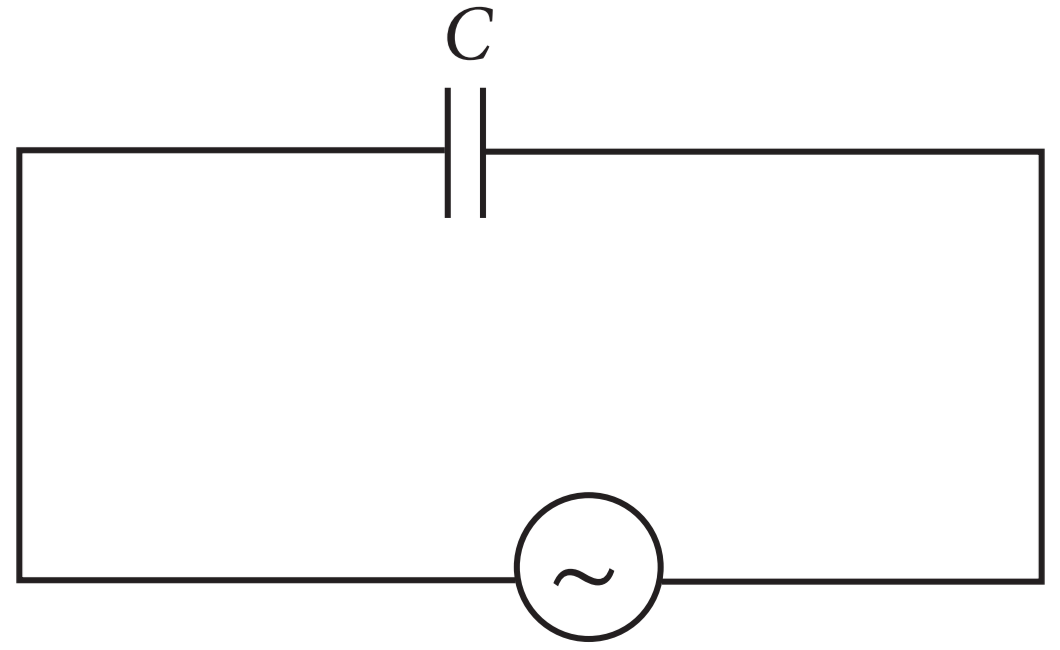
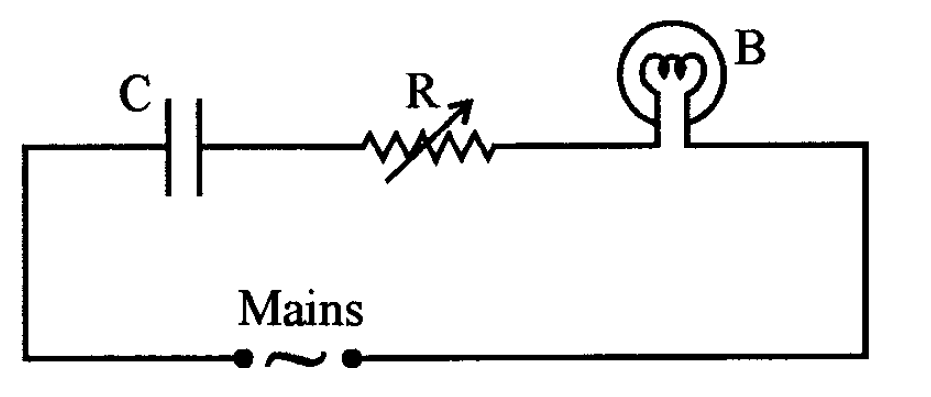
A capacitor'C', a variable resistor 'R' and a bulb 'B' are connected in series to the ac mains in circuit as shown. The bulb glows with some brightness. How will the glow of the bulb change if (i) a dielectric slab is introduced between the plates of the capacitor, keeping resistance R to be the same; (ii) the resistance R is increased keeping the same capacitance?
Answer
  1. Reactance of the capacitor will decrease, resulting in increase of the current in the circuit. Therefore the bulb will glow brighter.
  2. Increased resistance will decrease the current in the circuit, which will decrease glow of the bulb.
View full question & answer
Question 24 Marks
The household supply of electricity is at 220V (rms value) and 50Hz. Find the peak voltage and the least possible time in which the voltage can change from the rms value to zero.
Answer
$\text{E}_\text{rms}=220\text{V}$
$\text{Frequency}=50\text{Hz}$
  1. $\text{E}_\text{rms}=\frac{\text{E}_0}{\sqrt{2}}$
$\Rightarrow\ \text{E}_0=\text{E}_\text{rms}\sqrt{2}$

$=\sqrt{2}\times220=1.414\times220$

$=311.08\text{V}=311\text{V}$
  1. Time taken for the current to reach the peak value = Time taken to reach the 0 value from r.m.s.
$\text{I}=\frac{\text{I}_0}{\sqrt{2}}$

$\Rightarrow\ \frac{\text{I}_0}{\sqrt{2}}=\text{I}_0\sin\omega\text{t}$

$\Rightarrow\ \omega\text{t}=\frac{\pi}{4}$

$\Rightarrow\ \text{t}=\frac{\pi}{4\omega}=\frac{\pi}{4\times22\pi\text{f}}$

$=\frac{\pi}{8\pi50}=\frac{1}{400}=2.5\text{ms}$
View full question & answer
Question 34 Marks
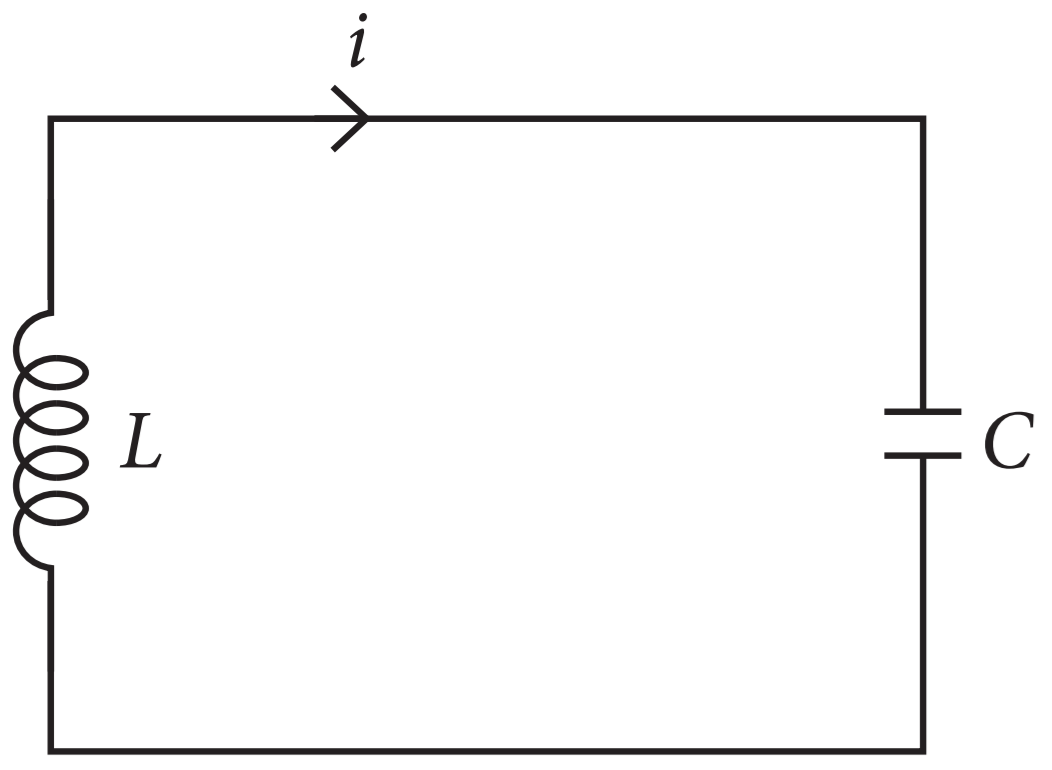
An LC circuit also called a resonant circuit, tank circuit or tuned circuit is an electric circuit consisting of an inductor represented by the letter Land a capacitor, represented by the letter C connected together. An LC circuit is an idealized model since it assumes there is no dissipation of energy due to resistance. An LC circuit contains a 20mH inductor and a $50\mu\text{F}$ capacitor with an initial charge of 10mC. The resistance of the circuit is negligible. Let the instant the circuit is closed bet = 0.
  1. The total energy stored initially is:
  1. 5J
  2. 3J
  3. 10J
  4. 1J
  1. The natural frequency of the circuit is:
  1. 159.24Hz
  2. 200.12Hz
  3. 110.25Hz
  4. 95Hz
  1. At what time is the energy stored completely electrical?
  1. $0, 5\text{T}, 9\text{T}$
  2. $0,\text{T}, 2\text{T}, 3\text{T}$
  3. $\frac{\text{T}}{2},\frac{\text{5T}}{2},\frac{\text{9T}}{2}$
  4. $0,\frac{\text{T}}{2},{\text{T}},\frac{\text{3T}}{2}$
  1. At what time is the energy stored completely magnetic?
  1. $\frac{\text{T}}{2},\frac{\text{3T}}{2},\frac{\text{T}}{4}$
  2. $\frac{\text{T}}{3},\frac{\text{T}}{9},\frac{\text{T}}{12}$
  3. $0, 2\text{T}, 3\text{T}$
  4. $\frac{\text{T}}{4},\frac{\text{3T}}{4},\frac{\text{5T}}{4}$
  1. The value of $X_L$ is:
  1. $20\Omega$
  2. $40\Omega$
  3. $60\Omega$
  4. $50\Omega$
Answer
  1. (d) 1J
Explanation:
Energy, $\text{E}=\frac{1}{2}\frac{\text{Q}^2}{\text{C}}=\frac{(10\times10^{-3})^2}{2\times50\times10^{-6}}=1\text{J}$
  1. (a) 159.24Hz
Explanation:
Frequency, $\upsilon=\frac{1}{2\pi\sqrt{\text{LC}}}$
$\upsilon=\frac{1}{2\pi\sqrt{20\times10^{-3}\times50\times10^{-6}}}$
$=\frac{10^3}{2\pi}=159.24\text{Hz}$
  1. (d) $0,\frac{\text{T}}{2},{\text{T}},\frac{\text{3T}}{2}$
Explanation:
Total time period, $\text{T}=\frac{1}{\upsilon}=\frac{1}{159.24}=6.20\text{ms}$
Total charge on capacitor at time t, $\text{Q}'=\text{Q}\cos\frac{2\pi}{\text{T}}\text{t}$
For energy stored is electrical, we can write Q' = ± Q.
Hence, energy stored in the capacitor is completely electrical at, $\text{t}=0,\frac{\text{T}}{2},\text{t},\frac{3\text{T}}{2},\ ......$
  1. (d) $\frac{\text{T}}{4},\frac{\text{3T}}{4},\frac{\text{5T}}{4}$
Explanation:
Magnetic energy is maximum when electrical energy is equal to zero.
Hence, $\text{t}=\frac{\text{T}}{4},\frac{\text{3T}}{4},\frac{\text{5T}}{4},\ ....$
  1. (a) $20\Omega$
Explanation:
$\text{X}_\text{L}=\omega_\text{L}=2\pi\upsilon\text{L}$
$2 × 3.14 × 159.24 × 20 × 10^{-3}$
$\Rightarrow\text{X}_\text{L}=20\Omega$
View full question & answer
Question 44 Marks
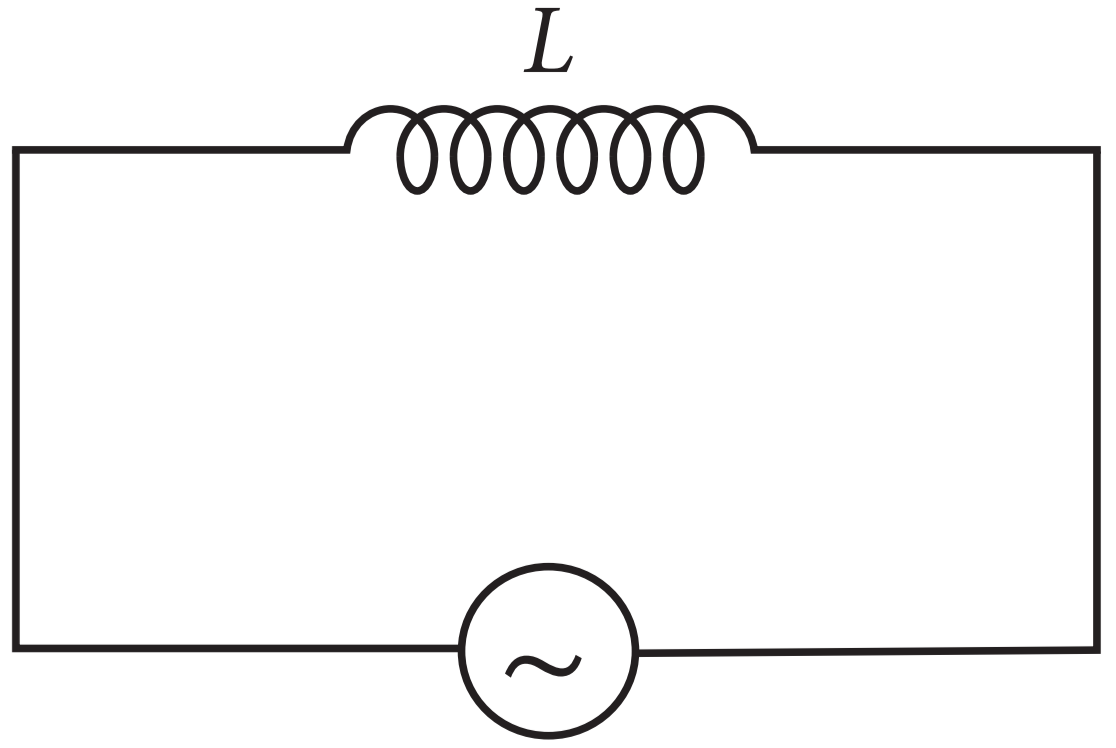
Let a source of alternating e.m.f. $\text{E} = \text{E}_\circ\sin\omega\text{t}$ be connected to a circuit containing a pure inductance L. If I is the value of instantaneous current in the circuit, then $\text{I}=\text{I}_\circ\sin\Big(\omega\text{t}-\frac{\pi}{2}\Big).$ The inductive reactance limits the current in a purely inductive circuit and is given by $\text{X}_\text{L}= \text{W}_\text{L}.$
  1. A 100 hertz a.c. is flowing in a 14mH coil. The reactance is:
  1. $15\Omega$
  2. $7.7\Omega$
  3. $8.8\Omega$
  4. $10\Omega$
  1. In a pure inductive circuit, resistance to the flow of current is offered by:
  1. Resistor
  2. Inductor
  3. Capacitor
  4. Resistor and inductor
  1. In a inductive circuit, by what value of phase angle does alternating current lags behind e.m.f.?
  1. 45º
  2. 90º
  3. 120º
  4. 75º
  1. How much inductance should be connected to 200V, 50Hz a.c. supply so that a maximum current of 0.9A flows through it?
  1. 5H
  2. 1H
  3. 10H
  4. 4.5H
  1. The maximum value of current when inductance of 2H is connected to 150V, 50Hz supply is:
  1. 0.337A
  2. 0.721A
  3. 1.521A
  4. 2.522A
Answer
  1. (c) $8.8\Omega$
Explanation:

Inductive reactance,

$\text{X}_\text{L}= \text{W}_\text{L}=2\pi\mu\text{L}$

$=2\pi\times100\times14\times10^{-3}$

$\text{X}_\text{L}=8.8\Omega$
  1. (b) Inductor
  2. (b) 90º
Explanation:

In an inductor vol tag: leads the current by $\frac{\pi}{2}$ or current lags the voltage by $\frac{\pi}{2}.$
  1. (b) 1H
Explanation:

The current in the inductor coil is given by,

$\text{I}_0=\frac{\text{E}_0}{\text{X}_\text{L}}=\frac{\sqrt{2}\text{E}_\text{V}}{2\pi\mu\text{L}}$

$\text{L}=\frac{\sqrt{2}\text{E}_\text{V}}{2\pi\mu\text{I}_0}=\frac{1.414\times200}{2\times3.14\times50\times0.9}=1\text{H}$
  1. (a) 0.337A
Explanation:

Inductive reactance,

$\text{X}_\text{L}= \text{W}_\text{L}=2\pi\mu\text{L}$

$=2\pi\times3.14\times50\times2=628\Omega$

$\text{I}_0=\frac{\text{E}_0}{\text{X}_\text{L}}$

$\Rightarrow\text{I}_0=\frac{\sqrt{2}\times\text{E}_\text{V}}{\text{X}_\text{L}}=\frac{\sqrt{2}\times150}{628}=0.337\text{A}$
View full question & answer
Question 54 Marks
Step-down transformers are used to decrease or step-down voltages. These are used when voltages need to be lowered for use in homes and factories. A small town with a demand of 800kW of electric power at 220V is situated 15km away from an electric plant generating power at 440V. The resistance of the two wire line carrying power is 0.5Q per km. The town gets power from the line through a 4000 - 220V step-down transformer at a sub-station in the town.
  1. The value of total resistance of the wires is:
  1. $25\Omega$
  2. $30\Omega$
  3. $35\Omega$
  4. $15\Omega$
  1. The line power loss in the form of heat is:
  1. 550kW
  2. 650kW
  3. 600kW
  4. 700kW
  1. How much power must the plant supply, assuming there is negligible power loss due to leakage?
  1. 600kW
  2. 1600kW
  3. 500W
  4. 1400kW
  1. The voltage drop in the power line is:
  1. 1700V
  2. 3000V
  3. 2000V
  4. 2800V
  1. The total value of voltage transmitted from the plant is:
  1. 500V
  2. 4000V
  3. 3000V
  4. 7000V
Answer
  1. (d) $15\Omega$
Explanation:
Resistance of the two wire lines carrying power $=0.5\frac{\Omega}{\text{Km}}$
Total resistance $=(15+15)0.5=15\Omega$
  1. (c) 600kW
Explanation:
Line power loss $= I^2R$
RMS current in the coil,
$\text{I}=\frac{\text{P}}{\text{V}_1}=\frac{800\times10^3}{4000}=200\text{A}$
$\therefore$ Power loss $= (200)^2 \times 15 = 600kW$
  1. (d) 1400kW
Explanation:
Assuming that the power loss is negligible due to the leakage of the current.
The total power supplied by the plant,
= 800kW + 600kW = 1400kW
  1. (b) 3000V
Explanation:
Voltage drop in the power line = IR
= 200 × 15 = 3000V
  1. (d) 7000V
Explanation:
Total voltage transmitted from the plant,
= 3000V + 4000V = 7000V
View full question & answer
Question 64 Marks
The power averaged over one full cycle of a.c. is known as average power. It is also known as true power.
$\text{P}_\text{av}=\text{V}_\text{rms}\text{I}_\text{rms}\cos\phi=\frac{\text{V}_0\text{I}_0}{2}\cos\phi$
Root mean square or simply rms watts refer to continuous power.
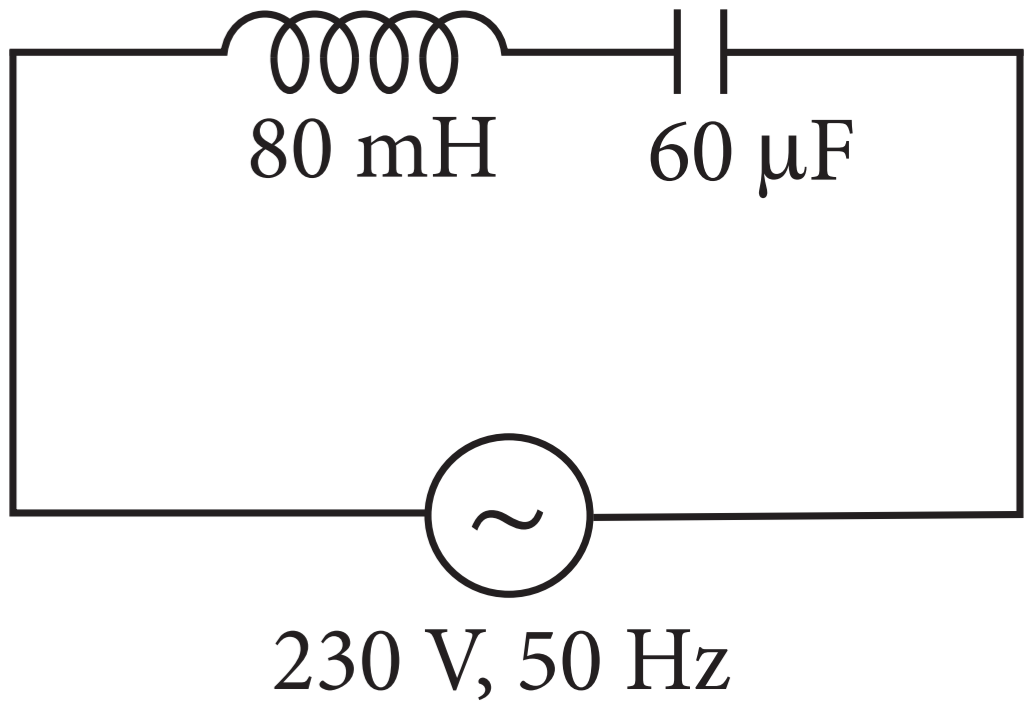
A circuit containing a 80mH inductor and a $60\mu\text{F}$ capacitor in series is connected to a 230V, 50Hz supply. The resistance of the circuit is negligible.
  1. The value of current amplitude is:
  1. 15A
  2. 11.63A
  3. 17.65A
  4. 6.33A
  1. Find rms value.
  1. 6A
  2. 5.25A
  3. 8.23A
  4. 7.52A
  1. The average power transferred to inductor is:
  1. Zero
  2. 7W
  3. 2.5W
  4. 5W
  1. The average power transferred to the capacitor is:
  1. 5W
  2. Zero
  3. 11W
  4. 15W
  1. What is the total average power absorbed by the circuit?
  1. Zero
  2. 10W
  3. 2.5W
  4. 15W
Answer
  1. (b) 11.63A
  1. Explanation:
    Average power consumed by the capacitor is zero because of phase difference of $\frac{\pi}{2}$ between voltage and current through capacitor.
  2. (a) Zero
  3. Explanation:
    Average power consumed by the inductor is zero because of phase difference of $\frac{\pi}{2}$ between voltage and current through inductor.
  4. (b) Zero
  5. Explanation:
    rms value of current,
    $\text{I}=\frac{\text{I}_0}{\sqrt{2}}=-\frac{-11.63}{\sqrt{2}}=-8.23\text{A}$
    Negative sign appears as $\text{W}_\text{L}<\frac{1}{\text{W}_\text{C}}.$
  6. (a) Zero
  7. Explanation:
    Inductance, $L = 80mH = 80 \times 10^{-3}H$
    Capacitance, $\text{C}=60\mu\text{F}=60\times10^{-6}\text{F},\ \text{V}=230\text{V}$
    Frequency, $\upsilon=50\text{Hz}$
    $\omega=2\pi\upsilon=100\pi\ \text{red}\ \text{s}^{-1}$
    Peak voltage, $\text{V}_0=\text{V}\sqrt{2}=230\sqrt{2}\text{V}$
    Maximum current is given by, $\text{I}_0=\frac{\text{V}_0}{\Big(\omega\text{L}-\frac{1}{\omega\text{C}}\Big)}$
    $\text{I}_0=\frac{230\sqrt{2}}{\Big(100\pi\times80\times10^{-3}-\frac{1}{100\pi\times60\times10^{-6}}\Big)}$
    $\text{I}_0=\frac{230\sqrt{2}}{\Big(8\pi-\frac{1000}{6\pi}\Big)}=-11.63\text{A}$
    Amplitude of maximum current, $I_0= 11.63A$
  8. (c) 8.23A
View full question & answer
Question 74 Marks
In an a.c. circuit, values of voltage and current change every instant. Therefore, power of an a.c. circuit at any instant is the product of instantaneous voltage (E) and instantaneous current (I). The average power supplied to a pure resistance R over a complete cycle of a.c. is $\text{P} = \text{E}_\text{V}\text{I}_\text{V}.$ When circuit is inductive, average power per cycle is $\text{E}_\text{V}\text{I}_\text{V}\cos\phi.$

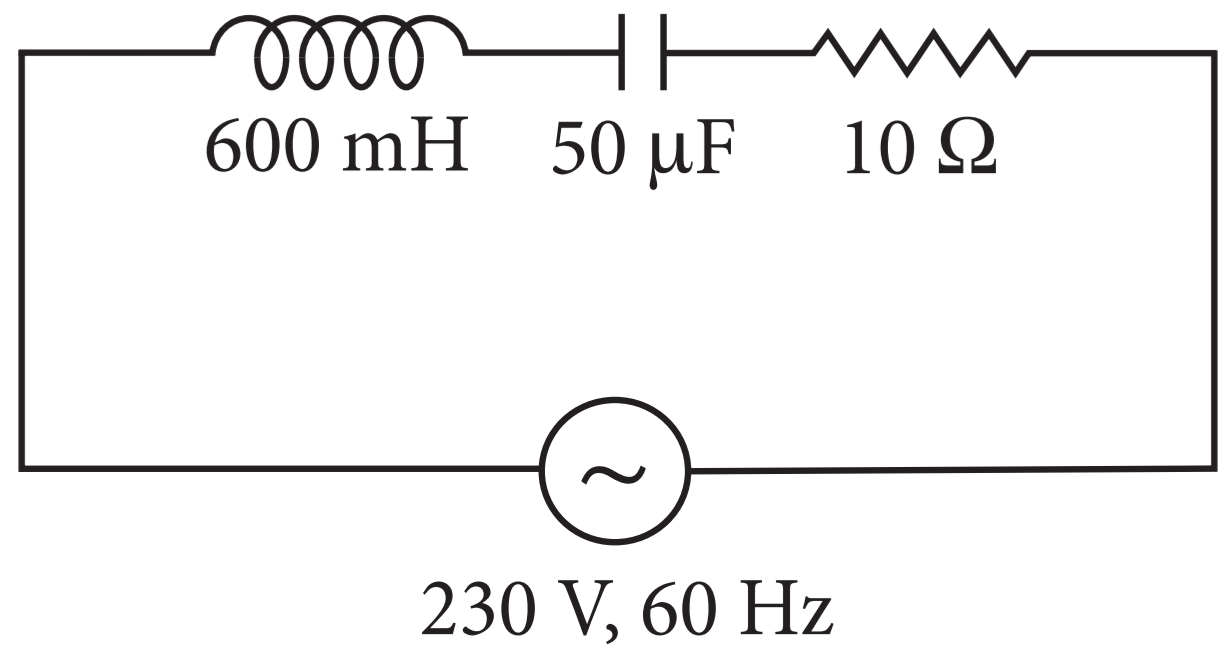
In an a.c. circuit, 600mH inductor and a $15\Omega$ capacitor are connected in series with $10\Omega$ resistance. The a.c. supply to the circuit is 230V, 60Hz.
  1. The average power transferred per cycle to resistance is:
  1. 10.42W
  2. 15.25W
  3. 17.42W
  4. 13.45W
  1. The average power transferred per cycle to capacitor is:
  1. Zero
  2. 10.42W
  3. 17.42W
  4. 15W
  1. The average power transferred per cycle to inductor is:
  1. 25W
  2. 17.42W
  3. 16.52W
  4. Zero
  1. The total power transferred per cycle by all the three circuit elements is:
  1. 17.42W
  2. 10.45W
  3. 12.45W
  4. Zero
  1. The electrical energy spend in running the circuit for one hour is:
  1. $7.5 \times 10^5$ Joule
  2. $10 \times 10^3 $ Joule
  3. $9.4 \times 10^3$ Joule
  4. $6.2 \times 10^4$ Joule
Answer
  1. (c) 17.42W
Explanation:
Average power transferred per cycle to resistance is $\text{P}_\text{V} = \text{I}^2_\text{V}\text{R}$
As, $\text{X}_\text{L}=\omega_\text{L}=2\pi\upsilon\text{L}=2\times\frac{22}{7}\times60\times0.6=226.28\Omega$
$\text{X}_\text{C}=\frac{1}{\omega\text{C}}=\frac{1}{2\pi\upsilon\text{C}}$
$=\frac{1}{2\times\frac{22}{7}\times60\times50\times10^{-6}}=53.03\Omega$
$\text{Z}=\sqrt{\text{R}^2+(\text{X}_\text{L}-\text{X}_\text{C})^2}$
$=\sqrt{\text{10}^2+(\text{226.28}_-\text{53.03})^2}=173.53\Omega$
$\text{I}_\text{V}=\frac{\text{E}_\text{V}}{\text{R}}=\frac{230}{173.53}=1.32\text{A}$
$\text{P}_\text{V} = \text{I}^2_\text{V}\text{R}=(1.32)^2\times10=17.42\text{W}$
  1. (a) Zero
Explanation:
$\text{P}_\text{V}=\text{E}_\text{V}\text{I}_\text{V}\cos\phi.$
In a capacitor, phase difference, $\phi=90^\circ$
$\therefore​​​​\text{P}_\text{L}=\text{E}_\text{V}\text{I}_\text{V}\cos90^\circ=\text{Zero}$
  1. (d) Zero
Explanation:
$\text{P}_\text{L}=\text{E}_\text{V}\text{I}_\text{V}\cos\phi.$
In an inductor, phase difference, $\phi=90^\circ$
$\therefore​​​​\text{P}_\text{L}=\text{E}_\text{V}\text{I}_\text{V}\cos90^\circ=\text{Zero}$
  1. (a) 17.42W
Explanation:
Total power absorbed per cycle
$P = P_R+ P_C+ P_L= 17.42 + 0 + 0 = 17.42W$
  1. (d) $6.2 \times 10^4$ Joule
Explanation:
Energy spent = power × time
$= 17.42 \times 60 \times 60$
$= 6.2 \times 10^4$ Joule
View full question & answer
Question 84 Marks
Let a source of alternating e.m.f. $\text{E} = \text{E}_\circ\sin\omega\text{t}$ be connected to a capacitor of capacitance C. If 'I' is the instantaneous value of current in the circuit at instant t, then $\text{I}=\frac{\text{E}_0}{\frac{1}{\omega\text{C}}}\sin\Big(\omega\text{t}+\frac{\pi}{2}\Big).$ The capacitive reactance limits the amplitude of current in a purely capacitive circuit and it is given by $\text{X}_\text{C}=\frac{1}{\omega\text{C}}.$
  1. What is the unit of capacitive reactance?
  1. Farad
  2. Ampere
  3. Ohm
  4. $Ohm^{-1}$
  1. The capacitive reactance of a $5\mu\text{F}$ capacitor for a frequency of $10^6Hz$ is:
  1. $0.032\Omega$
  2. $2.52\Omega$
  3. $1.25\Omega$
  4. $4.51\Omega$
  1. In a capacitive circuit, resistance to the flow of current is offered by:
  1. Resistor
  2. Capacitor
  3. Inducto
  4. Frequency
  1. In a capacitive circuit, by what value of phase angle does alternating current leads the e.m.f?
  1. $45^\circ$
  2. $90^\circ$
  3. $75^\circ$
  4. $60^\circ$
  1. One microfarad capacitor is joined to a 200V, 50Hz alternator. The rrns current through capacitor is:
  1. $6.28 \times 10^{-2}A$
  2. $7.5 \times 10^{-4}A$
  3. $10.52 \times 10^{-2}A$
  4. $15.25 \times 10^{-2}A$
Answer
  1. (c) Ohm
Solution:
Ohm is the unit of capacitive reactance.
  1. (a) $0.032\Omega$
Solution:
Capacitive reactance, $\text{X}_\text{C}=\frac{1}{\omega\text{C}}=\frac{1}{2\pi\mu\text{C}}$
$=\frac{1}{2\pi\times10^6\times5\times10^{-6}}$
$=0.032\Omega$
  1. (b) Capacitor
Solution:
In capacitive circuit, resistance to the flow of current is offered by the capacitor.
  1. (b) $90^\circ$
  2. (a) $6.28 \times 10^{-2}A$
Solution:
Current, $\text{l}_\text{v}=\frac{\text{E}_\text{V}}{\text{X}_\text{C}}=\frac{1}{\frac{1}{2\pi\mu\text{C}}}=(2\pi\mu\text{C})\text{E}_\text{V}$
$\text{I}_\text{v}=2\times3.14\times50\times10^{-6}\times200$
$=6.28 × 10^{-2}\text{A}$
View full question & answer
Question 94 Marks
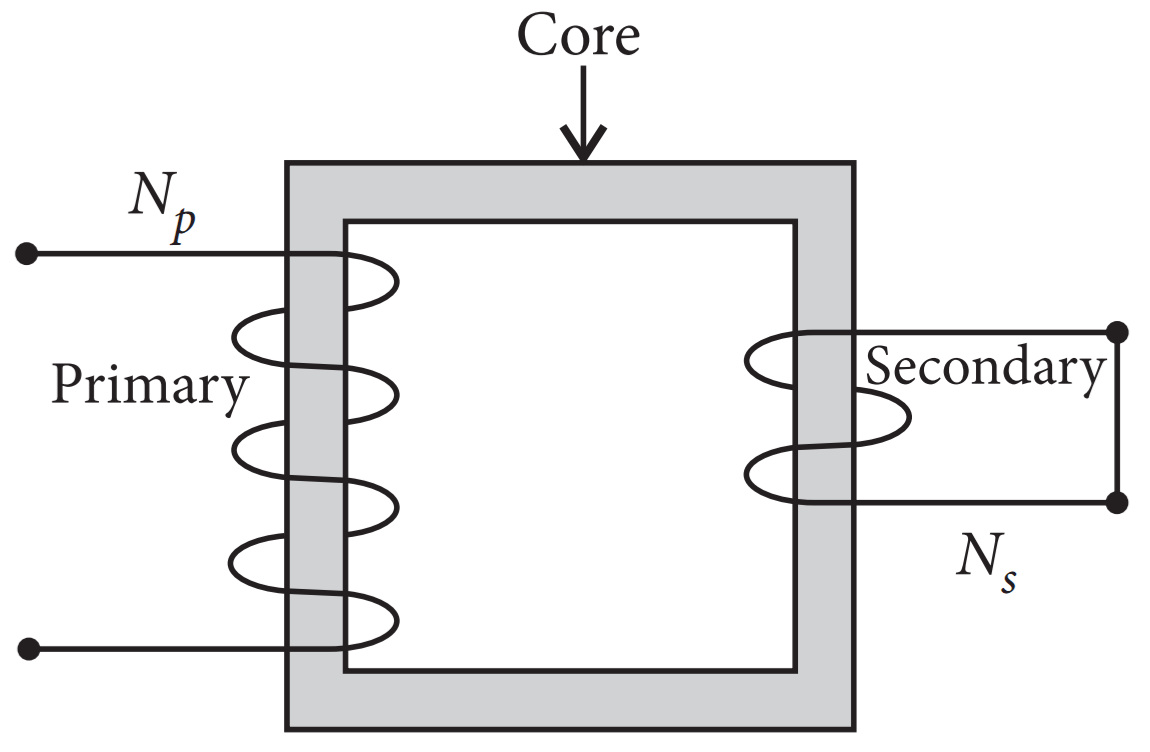
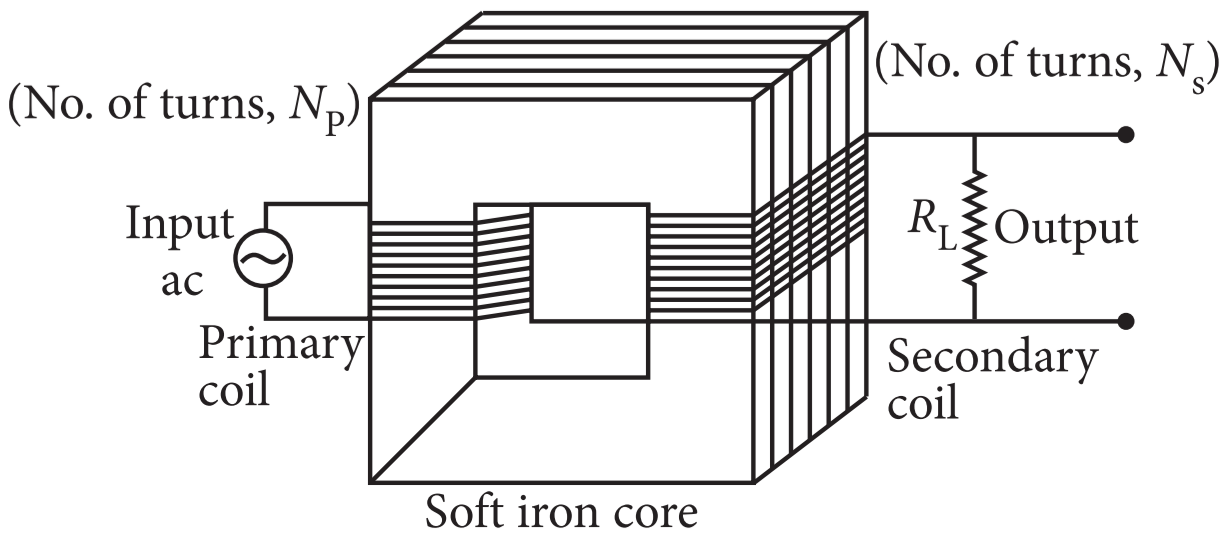
A transformer is essentially an a.c. device. It cannot work on d.c. It changes altemating voltages or currents. It does not affect the frequency of a.c. It is based on the phenomenon of mutual induction. A transformer essentially consists of two coils of insulated copper wire having different number of tums and wound on the same soft iron core.
The number of turns in the primary and secondary coils of an ideal transfonner are 2000 and 50 respectively. The primary coil is connected to a main supply of 120V and secondary coil is connected to a bulb of resistance $0.6\Omega.$
  1. The value of voltage across the secondary coil is:
  1. 5V
  2. 2V
  3. 3V
  4. 10V
  1. The value of current in the bulb is:
  1. 7A
  2. 15A
  3. 3A
  4. 5A
  1. The value of current in primary coil is:
  1. 0.125A
  2. 2.52A
  3. 1.51A
  4. 3.52A
  1. Power in primary coil is:
  1. 20W
  2. 5W
  3. 10W
  4. 15W
  1. Power in secondary coil is:
  1. 15W
  2. 20W
  3. 7W
  4. 8W
Answer
  1. (c) 3V
Explanation:
As, $\frac{\text{E}_\text{s}}{\text{E}_\text{p}}=\frac{\text{n}_\text{s}}{\text{n}_\text{p}}$
$\Rightarrow\text{E}_\text{s}=\text{E}_\text{p}\times\frac{\text{n}_\text{p}}{\text{n}_\text{p}}$
$=\frac{120\times50}{2000}=3\text{V}$
  1. (d) 5A
Explanation:
$\text{I}_0=\frac{\text{E}_\text{S}}{\text{R}}\Rightarrow\text{I}_0=\frac{3}{0.6}=5\text{A}$
  1. (a) 0.125A
Explanation:
As, $\frac{\text{I}_\text{P}}{\text{I}_\text{S}}=\frac{\text{E}_\text{S}}{\text{E}_\text{P}}$
$\Rightarrow\text{I}_\text{p}=\frac{\text{E}_\text{S}}{\text{E}_\text{P}}\times\text{I}_\text{S}=\frac{3}{120}\times5=0.125\text{A}$
  1. (d) 15W
Explanation:
Power in primary, $P_P= E_P \times I_P= 120 \times 0.125$
= 15W
  1. (a) 15W
Explanation:
Power in secondary coil, $P_S = E_S \times I_S = 3 \times 5$
= 15W
View full question & answer
Question 104 Marks
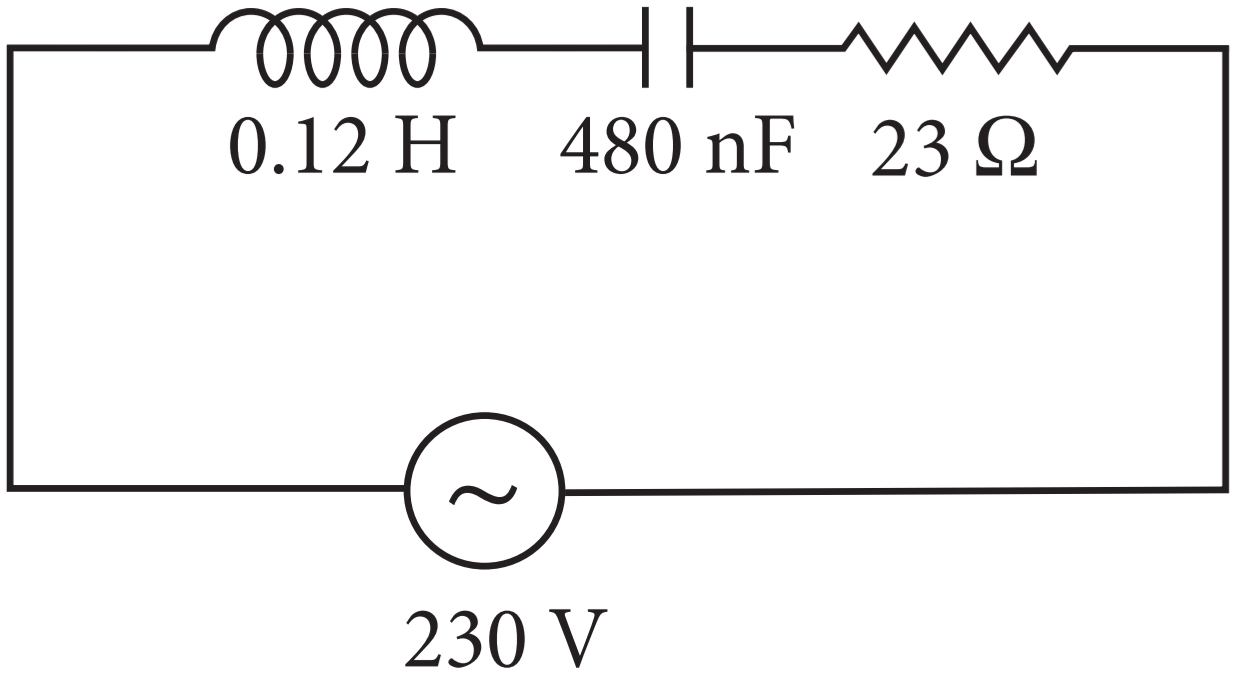
When the frequency of ac supply is such that the inductive reactance and capacitive reactance become equal, the impedance of the series LCR circuit is equal to the ohmic resistance in the circuit. Such a series LCR circuit is known as resonant series LCR circuit and the frequency of the ac supply is known as resonant frequency. Resonance phenomenon is exhibited by a circuit only if both Land Care present in the circuit. We cannot have resonance in a RL or RC circuit.
A series LCR circuit with L = 0.12H, C = 480nF, $\text{R} = 23\Omega$ is connected to a 230V variable frequency supply.
  1. Find the value of source frequency for which current amplitude is maximum.
  1. 222.32Hz
  2. 550.52Hz
  3. 663.48Hz
  4. 770Hz
  1. The value of maximum current is:
  1. 14.14A
  2. 22.52A
  3. 50.25A
  4. 47.41A
  1. The value of maximum power is:
  1. 2200W
  2. 2299.3W
  3. 5500W
  4. 4700W
  1. What is the Q-factor of the given circuit?
  1. 25
  2. 42.21
  3. 35.42
  4. 21.74
  1. At resonance which of the following physical quantity is maximum?
  1. Impedance
  2. Current
  3. Both (a) and (b)
  4. Neither (a) nor (b)
Answer
  1. (c) $663.48Hz$
Explanation:
Here, $L = 0.12H, e = 480nF = 480 \times 10^{-9}F$
$\text{R} = 23\Omega,$ V = 230V
$\text{V}_0=\sqrt{2}\times230=325.22\text{V}$
$\text{I}_0=\frac{\text{V}_0}{\sqrt{\text{R}^2+\Big(\omega\text{L}-\frac{1}{\omega\text{C}}\Big)^2}}$
At resonance, $\omega\text{L}-\frac{1}{\omega\text{C}}=0$
$\omega=\frac{1}{\sqrt{\text{LC}}}=\frac{1}{\sqrt{0.12\times480\times10^9}}=4166.67\ \text{rad}\ \text{s}^{-1}$
$\upsilon_\text{R}=\frac{4166.67}{2\times3.14}=663.48\text{H}_\text{z}$
  1. (a) $14.14A$
Explanation:
Current, $\text{I}_0=\frac{\text{V}_0}{\text{R}}=\frac{325.22}{23}=14.14\text{A}$
  1. (b)$ 2299.3W$
Explanation:
Maximum power, $\text{P}_\text{max}=\frac{1}{2}(\text{I}_0)^2\text{R}$
$=\frac{1}{2}\times(14.14)^2\times23=2299.3\text{W}$
  1. (d) $21.74$
Explanation:
Quality factor, $\text{Q}=\frac{\text{X}_\text{R}}{\text{R}}=\frac{\omega_\text{r}\text{L}}{\text{R}}$
$=\frac{4166.67\times0.12}{23}=21.74$
  1. (b) Current
View full question & answer
Question 114 Marks
A transformer is an electrical device which is used for changing the a.c. voltages. It is based on the phenomenon of mutual induction i.e. whenever the amount of magnetic flux linked with a coil changes, an e.m.f. is induced in the neighbouring coil. For an ideal transformer, the resistances of the primary and secondary windings are negligible.

It can be shown that $\frac{\text{E}_\text{S}}{\text{E}_\text{P}}=\frac{\text{I}_\text{P}}{\text{I}_\text{S}}=\frac{\text{n}_\text{S}}{\text{n}_\text{P}}=\text{K}$
where the symbols have their standard meanings.
For a step up transformer, $\text{n}_\text{S} > \text{n}_\text{P}; \text{E}_\text{S} > \text{E}_\text{P}; \text{k} > \text{I}; \therefore \text{I}_\text{S} < \text{I}_\text{P}$
For a step down transformer, $\text{n}_\text{S} > \text{n}_\text{P}; \text{E}_\text{S} > \text{E}_\text{P}; \text{k} > \text{I};$
The above relations are on the assumptions that efficiency of transfonner is 100%.
lnfact, efficiency $\eta=\frac{\text{output power}}{\text{intput power }}=\frac{\text{E}_\text{S}\text{I}_\text{S}}{\text{E}_\text{P}\text{I}_\text{P}}$
  1. Which of the following quantity remains constant in an ideal transformer?
  1. Current.
  2. Voltage.
  3. Power.
  4. All of these.
  1. Transformer is used to.
  1. Convert ac to de voltage.
  2. Convert de to ac voltage.
  3. Obtain desired de power.
  4. Obtain desired ac voltage and current.
  1. The number of tums in primary coil of a transformer is 20 and the number of turns in a secondary is 10. If the voltage across the primary is ac 220V, what is the voltage across the secondary?
  1. ac 100V
  2. ac 120V
  3. ac 110V
  4. ac 220V
  1. In a transformer the number of primary turns is four times that of the secondary turns. Its primary is connected to an a.c. source of voltage V. Then,
  1. Current through its secondary is about four times that of the current through its primary.
  2. Voltage across its secondary is about four times that of the voltage across its primary.
  3. Voltage across its secondary is about two times that of the voltage across its primary.
  4. voltage across its secondary is about $\frac{1}{2\sqrt{2}}$ times that of the voltage across its primary.
  1. A transformer is used to light 100W-110V lamp from 220V mains. If the main current is 0.5A, the efficiency of the transformer is:
  1. 95%
  2. 99%
  3. 90%
  4. 96%
Answer
  1. (c) Power
Explanation:
In an ideal transformer, there is no power loss. The efficiency of an ideal transformer is $\eta=1$ (i.e 100%) i.e. input power = output power.
  1. (d) Obtain desired ac voltage and current.
Explanation:
Transformer is used to obtain desired ac voltage and current.
  1. (c) ac 110V
Explanation:
For a transformer, $\frac{\text{V}_\text{S}}{\text{V}_\text{p}}=\frac{\text{n}_\text{S}}{\text{n}_\text{p}}$
Where N denotes number of turns and V = voltage.
$\therefore{\text{V}_\text{S}}={\text{ac}\ 110}{\text{V}}$
  1. (a) Current through its secondary is about four times that of the current through its primary.
Explanation:
In a transformer the primary and secondary currents are related by,
$\text{I}_\text{S}=\Big(\frac{\text{N}_\text{S}}{\text{N}_\text{P}}\Big)\text{I}_\text{P}$
And the Voltage are related by,
$\text{V}_\text{S}=\Big(\frac{\text{N}_\text{P}}{\text{N}_\text{S}}\Big)\text{V}_\text{P}$
where subscripts p and s refer to the primary and secondary of the transformer.
Here, $\text{V}_\text{P}=\text{V},\frac{\text{N}_\text{P}}{\text{N}_\text{S}}=4\ \therefore\text{I}_\text{P}=4\text{I}_\text{P}$
and, $\text{V}_\text{S}=\Big(\frac{1}{4}\Big)\text{V}=\frac{\text{V}}{4}$
  1. (c) 90%
Explanation:
The efficiency of the transformer is:
$\eta=\frac{\text{output power}(\text{p}_\text{out})}{\text{intput power}(\text{p}_\text{in})}\times100$
Here, $\mathrm{P_{out}= 100W, P_{in}= (220V)(0.5A) = 110W}$
$\therefore\eta=\frac{100\text{W}}{110\text{W}}\times100=90\%$
View full question & answer
Question 124 Marks
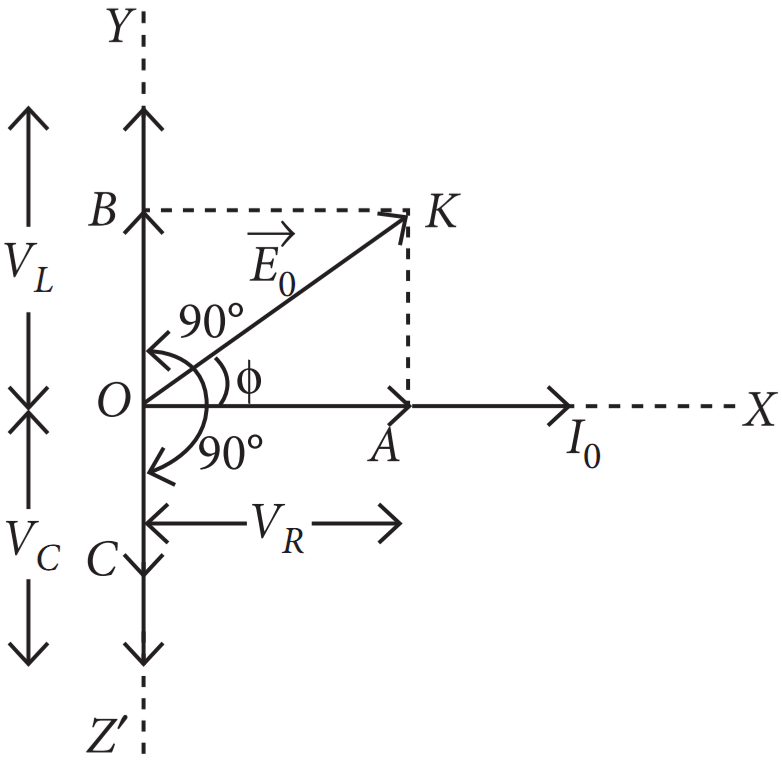
When a pure resistance R, pure inductor L and an ideal capacitor of capacitance C is connected in series to a source of alternating e.m.f., then current at any instant through the three elements has the same amplitude and is represented as $\text{I} = \text{I}_0\sin\omega\text{t}.$ However, voltage across each element has a different phase relationship with the current as shown in graph. The effective resistance of RLC circuit is called impedance (Z) of the circuit and the voltage leads the current by a phase angle $\phi.$

A resistor of $12\Omega,$ a capacitor ofreactance $14\Omega,$ and a pure inductor of inductance 0.1H are joined in series and placed across 200V, 50Hz a.c. supply.
  1. The value of inductive reactance is:
  1. $15\Omega$
  2. $31.4\Omega$
  3. $20\Omega$
  4. $30\Omega$
  1. The value of impedance is:
  1. $20\Omega$
  2. $15\Omega$
  3. $30\Omega$
  4. $21.13\Omega$
  1. What is the value of current in the circuit?
  1. $5A$
  2. $15A$
  3. $10A$
  4. $9.46A$
  1. What is the value of the phase angle between current and voltage?
  1. $53º9'$
  2. $63º9'$
  3. $55º4'$
  4. $50º$
  1. From graph, which one is true from following?
  1. $V_L \geq V_C$
  2. $V_L < V_C$
  3. $V_L < V_C$
  4. $V_L < V_C$
Answer
  1. (b) $31.4\Omega$
Explanation:
Given, $\text{R}=12\Omega,\ \text{X}_C=14\Omega,\ \text{L}=0.1\text{H}$
$\text{X}_L=\omega_\text{L}=2\pi\upsilon\text{L}$
$= 2\times3.14\times50\times0.1$
$=31.4\Omega$
  1. (d) $21.13\Omega$
Explanation:
Impedance, $\text{Z}=\sqrt{\text{R}^2+(\text{X}_\text{L}-\text{X}_\text{C})^2}$
$=\sqrt{\text{12}^2+(\text{31.4}-\text{14})^2}$
$=21.13\Omega$
  1. (d) 9.46A
Explanation:
$\text{l}_\text{v}=\frac{\text{E}_\text{v}}{\text{Z}}=\frac{200\text{V}}{21.13}$
$= 9.46\text{A}$
  1. (c) $55º4'$
Explanation:
$\tan\phi=\frac{\text{X}_\text{L}-\text{X}_\text{C}}{\text{R}}$
$=\frac{3.14-14}{12}=1.45$
$\phi\tan^{-1}(1.45)=55^\circ4'$
  1. (c) $V_L < V_C$
View full question & answer