Three capacitors of capacitances $6\mu\text{F}$ each are available. The minimum and maximum capacitances, which may be obtained are:
Answer
$2\mu\text{F},\ 18\mu\text{F}$
Explanation:
The minimum capacitance can be obtained by connecting all capacitors in series. It can be calculated as follows:
$\frac{1}{\text{C}}=\frac{1}{6}+\frac{1}{6}+\frac{1}{6}=\frac{1}{2}$
$\Rightarrow\text{C}=2\mu\text{F}$
The maximum capacitance can be obtained by connecting all capacitors in parallel. It can be calculated as follows:
$\text{C}=6+6+6=18\mu\text{F}$
what is the potential difference between two points, if 2J of work must be done to move a 4 mC charge from one point to another is:
Answer
500 V
Explanation:
The total work done = energy transferred.
So, we might see the equation energy = voltage x charge, E = V × Q, written as,
work = voltage x charge, W = V × Q.
In this case, the charge is 4 mC, that is, 0.004 C and work done is 2J.
Which of the following is an example of a molecule whose centre of mass of positive and negative charges does not coincide each other?
Answer
$NH_3$ is a molecule in which the centre of mass of positive and negative charges does not collide with each other and is called a polar molecule. They have a permanent dipole moment. They have unsymmetrical shapes.
Work done to bring a unit positive charge from infinity to a point in an electric field is known as _______?
Answer
Electric potential.
Explanation:
Electric potential is defined as the amount of work done to bring a unit positive charge from an infinite distance to a particular point of an electric field. The total energy of that point charge means the sum of kinetic energy and potential energy which is not the same as the potential energy if the particle is in motion.
What type of surface is the surface of a conductor?
Answer
Equipotential
Explanation:
Electric field at any point is equal to the negative of the potential gradient. But inside a conductor, the electric field is zero. Hence, the electric potential is constant throughout the volume of a conductor and has the same value on its surface. Thus the surface of a conductor is equipotential.
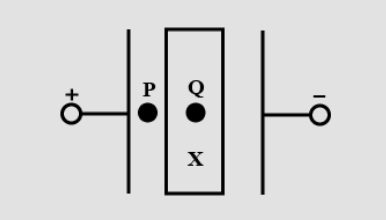
A slab $X$ is placed between the two parallel isolated charged plates as shown in the figure. If $E_p$ and $E_q$ denotes the intensity of electric field at$ P$ and $Q,$ then:
Answer
There is no effect of the metal on the external electric field $($ thus $A$ is incorrect$)$ while the dielectric reduces the net electric field outside. The dielectric produces an electric field inside it due to the induced charges which is opposite to the external field. Thus $EQ$ is reduced and $B$ and $C$ are also incorrect.$($Note that $E_P$ is not the external field$).$ Now as the electric field inside the conductor is zero, the field $E_{p}$ is zero if $X$ is a metallic.
What is the nature of equipotential surfaces in case of a positive point charge?
Answer
Spherical
Explanation:
We know that electric field lines cross the equipotential surfaces perpendicularly. Electric field lines are generated radially from a positive point charge. Therefore, for holding both the conditions, the equipotential surfaces must be spherical.
Explanation:
Every condenser is made with two plates. The charge on one plate is +Q and other is −Q.
Thus total charge of condenser is Qt = +Q - Q = 0
A charge q is at the center of the circle ABCDE. Which among the following is true if the charge is taken from A to B, C, D, and E?
Answer
Work done along all the paths are zero.
Explanation:
As the charge q is situated at the center of the circle ABCDE, therefore the circle is an equipotential surface. That means all the points on the circle i.e. A, B, C, D, and E have the same potential. Therefore, work done to bring the charge from A to any point on the circle is zero always.
What is the amount of work done to bring a charge of $4 \times 10^{-3}C$ charge from infinity to a point whose electric potential is $2 \times 10^2V?$
Answer
Work done $=$ potential \times charge by definition. We know that the potential of a point is the amount of work done to bring a unit charge from infinity to a certain point. Therefore, work done $W = q \times V = 4 \times 10^{-3 }\times 200J = 0.8J.$ The work done is positive in this case.
What is the electric potential at the perpendicular bisector of an electric dipole?
Answer
Zero
Explanation:
Any point on the perpendicular bisector is equidistant from both the charges of the dipole. Therefore, the electric potential at that point is equal and opposite due to the two different charges. Therefore, the total electric potential at that point is zero.
If a charged body is moved in an electric field against the Coulomb force, then ________?
Answer
Work is done on the body by an external agent.
Explanation:
To move a body against some force, work is to be done on the body. In this case, an external force is to be applied on the body to move it i.e. an external work is to be done. As we are moving the body against the Coulomb’s force, hence no work is done on the body by the electric field.
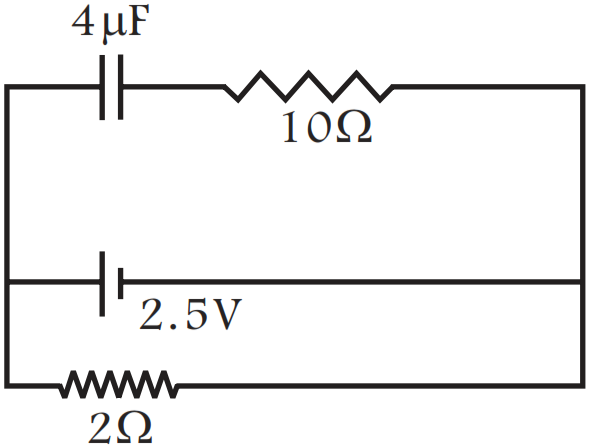
A capacitor of 4μ F is connected as shown in the circuit (Fig.). The internal resistance of the battery is 0.5Ω. The amount of charge on the capacitor plates will be:
Answer
8μ C.
The capacitor offers infinite resistance in a DC circuit. Here, no current will flow through the capacitor and 10Ω resistance after the capacitor is full charged.
The potential difference across 10Ω resistance will be zero. It will act like a plain wire.
Current flowing through 2Ω resistance is given by
$\text{I}=\frac{\text{V}}{(\text{R}+\text{r})}=\frac{2.5}{(2+0.5)}=1\text{A}$
Potential difference across 2Ω resistance V = IR= 1 × 2 = 2V
Here, capacitor is connected in parallel with 2 Ω resistance, so it will also have 2V potential difference across it.
The charge on capacitor, q = CV = (2 mF) × 2V = 8 mC.
A parallel plate condenser is connected to a battery of emf 4 volt. If a plate of dielectric constant 8 is inserted into it, the potential difference on the condenser will be:
Answer
4V
Explanation:
Total charged is conserved in the condenser. Here the potential difference on the condenser is equal to the emf of battery. When dielectric is inserted between the plates the charge will maintain the constant potential in the capacitor. Thus, the potential difference on the condenser is 4V
When a dielectric slab is introduced between the two plates of condenser then its capacity ___________.
Answer
Increases
Explanation:
As the dielectric slab is introduced there is some charge distribution in the slab and because of this the electric field between the two plates is decreased, due to which the capacitor can hold more charge. Thus, the capacity to hold charge of the capacitor is increased.
Equipotential lines are always perpendicular to the electric field.
Explanation:
There is no potential gradient along any direction parallel to the surface, and no electric field is parallel with the surface, This means electric field are always at right angle to the equipotential surface.
Point A is at a lower electrical potential than point B. An electron between them on the line joining them will:
Answer
Move towards B
Explanation:
Given that point A is at lower electric potential than point B. The electron between them on line joining will move.
We have to find where this electron moves.
Since we know that electric currents move from a higher potential or a lower potential. Also, electrons move in the direction opposite to electric current. So the electron on the line joining two points A and B will move from lower to higher potential i.e, it will move towards B.
How is the electric field at the surface of a charged conductor related to the surface charge density?
Answer
Proportional to each other.
Explanation:
The electric field at the surface of a charged conductor is proportional to the surface charge density. The electric field is zero inside the conductor and just outside, it is normal to the surface. The contribution to the total flux comes only from its outer cross-section.
The work done to move a charge along an equipotential from $A$ to $B:$
Answer
Must be defined as $-\int\limits_\text{A}^\text{B}\text{E}.\text{dl}$.
Is zero.
Work done in moving a charge particle from point $A$ to point $B$ is given by $W_{AB} = q(V_B - V_A)$ and the line integral of electrical field from point $A$ to $B$ gives potential difference i.e., $\text{V}_\text{B}-\text{V}_\text{A}=-\int\limits_\text{A}^\text{B}\text{E}.\text{dl}$
Now, work done to move a charge aling an equipotential from $A$ to $B$ is zero when potentials at point $A$ and $B$ are some.
The work done in moving a unit positive test charge over a closed path in an electric field is _____________.
Answer
Zero
Explanation:
We say electrostatic forces are conservative in nature since the work done in moving a unit positive test charge over a closed path in an electric field is zero.
If a conductor has a potential V ≠ 0 and there are no charges anywhere else outside, then:
Answer
There must be charges on the surface or inside itself.
There cannot be any charge in the body of the conducor.
The potential of a body is due to charge of the body and due to the charge of surrounding. If there are no charges anywhere else outside, then the potential of the body will be due to its own charge. If there is a cavity inside a conducting body, then charge can be placed inside the body. Hence there must be charges on its surface or inside itself.
Hence option (a) is correct. The charge resides on the outer surface of a closed charged conductor. Hence there cannot be any charge in the body of the conductor.
Hence option (b) is correct.
The capacity of a parallel plate air condenser is 2 μF. If a dielectric of dielectric constant 4 is introduced between the plates, its new capacity is:
Answer
8 μF
Explanation:
We know $\text{C}=\frac{\epsilon_0\text{A}}{\text{d}}$
When dielectric is added:
$\text{C'}=\frac{\text{K}\epsilon_0\text{A}}{\text{d}}=4\times2\mu\text{F}=8\mu\text{F}$
Explanation:
An electric potential (also called the electric field potential or the electrostatic potential) is the amount of electric potential energy that a unitary point electric charge would have if located at any point of space, and is equal to the work done by an electric field in carrying a unit positive charge from infinity to that point.
This value can be calculated in either a static (time-invariant) or a dynamic (varying with time) electric field at a specific time in units of joules per coulomb, or volts (V). The electric potential at infinity is assumed to be zero.
A long, hollow conducting cylinder is kept coaxially inside another long, hollow conducting cylinder of larger radius. Both the cylinders are initially electrically Neutral.
Answer
A potential difference appears between the two cylinders when a charge density is given to the inner cylinder.
The anode of a thermionic diode is connected to the negative terminal of a battery and the cathode to its positive terminal:
Answer
No appreciable current will pass through the diode.
Explanation:
If the anode is given a negative potential relative to the cathode, the electrons are pushed back to the cathode. Hence, no current will flow through the diode.
The separation between the plates of a charged parallel-plate capacitor is increased. Which of the following quantities will change?
Answer
Potential difference across the capacitor.
Energy of the capacitor.
Explanation:
Because the charge always remains conserved in an isolated system, it will remain the same.
Now,
$\text{V}=\frac{\text{Qd}}{\epsilon_0\text{A}}$
Here, Q, A and d are the charge, area and distance between the plates, respectively.
Thus, as d increases, V increases.
Energy is given by:
$\text{E}=\frac{\text{qV}}{2}$
So, it will also increase.
Energy density u, that is, energy stored per unit volume in the electric field is given by:
$\text{u}=\frac{1}{2}\epsilon_0\text{E}^2$
So, u will remain constant with increase in distance between the plates.